2019
年度 博士学位論文Value Cocreation in International Sports Tourism:
A Qualitative Study of a Regional Revitalizing Marathon Event in Japan
立教大学大学院観光学研究科博士後期課程 陳慶光
2019
年度 博士学位論文Value Cocreation in International Sports Tourism:
A Qualitative Study of a Regional Revitalizing Marathon Event in Japan
指導教授 佐藤大祐
立教大学大学院観光学研究科博士後期課程 陳慶光
ii
iii
ABSTRACT
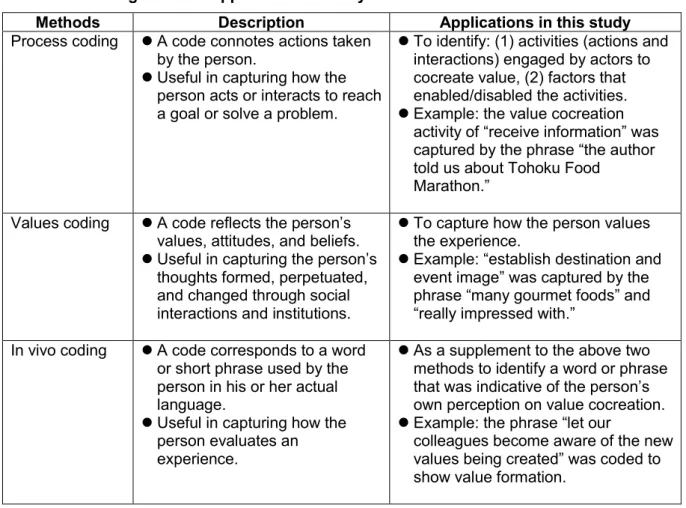
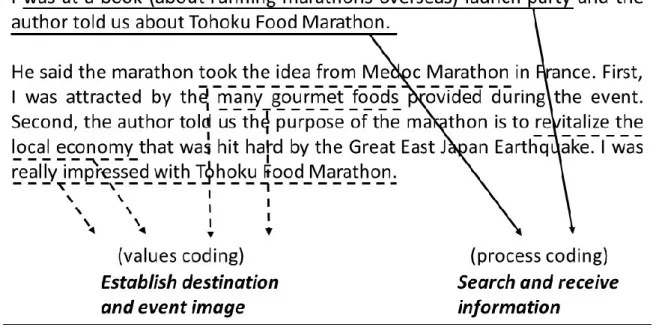
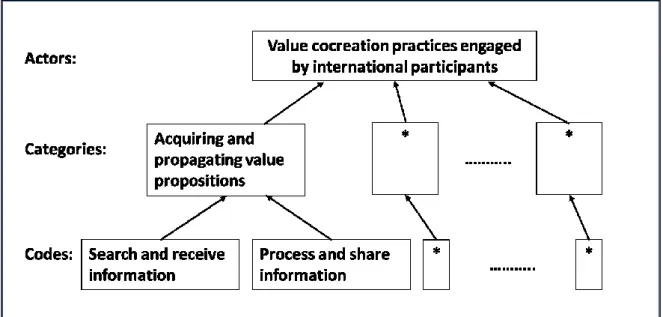
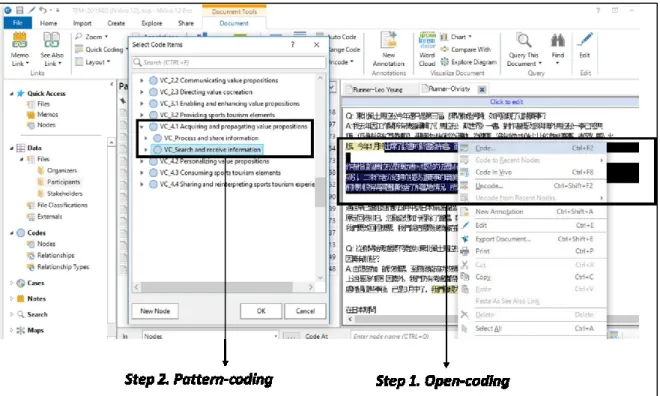
Drawing on the concept of value cocreation, this study identified and categorized value cocreation practices engaged by different groups of actors (event organizers, event stakeholders, international participants) in an international sports tourism context. Qualitative data were gathered during a period of 18 months covering two consecutive editions (2016 and 2017) of Tohoku Food Marathon & Festival, an annual two-day event that has a substantial regional revitalization focus and a high ratio of international participants compared with marathons of similar scope and scale in Japan. Data collection included several rounds of interviews and onsite surveys, which involved participant observations both as a marathon runner and as a supporting member of the event organizers. Data analysis proceeded with a three-step coding process done by using NVivo 12.
Value cocreation practices are categorized as follows:
⚫ Event organizers: (1) developing value propositions; (2) communicating value propositions; (3) directing value cocreation.
⚫ Event stakeholders: (1) enabling and enhancing value propositions; (2) providing sports tourism elements.
⚫ International participants: (1) acquiring and propagating value propositions; (2) personalizing value propositions; (3) consuming sports tourism elements; (4) sharing and reinterpreting sports tourism experience.
The temporal variations in the actors’ roles and behaviors prompted a further discussion to present value cocreation in a three-phase value cocreation process model, during which value was assigned a temporal dimension in the form of value-in-expectation, value-in-experience, and value-in-retrospect. This study contributes to the sports tourism literature in identifying actor-specific value cocreation practices by extending the C2C (customer-to-customer) interactions to include the interactions between international participants and event stakeholders. Moreover, rather than adopting the traditional host-guest dichotomy, the research introduced event stakeholders as an independent category of actors in value cocreation to explain their specific roles in directly interacting with participants through service offerings of sports tourism elements. The results are expected to help sports tourism planners in implementing a platform that motivates actors to become more engaged in value cocreation.
One of the limitations of this research is that domestic (Japanese) participants were not
included as one of the main actors. Nevertheless, results of this study are expected to provide
a basis for multiple case studies to present a more complete analysis of value cocreation in
sports tourism or event tourism in general.
iv
ACKNOWLEDGEMENTS
Doing a Ph.D. has been a long journey. It has not always been smooth, but it has always been fascinating and inspiring.
The journey actually started well before I enrolled at Rikkyo University. Along the way there were dots being connected, connections being broken, and linkages being reconnected.
Sometimes I feel lost, but luckily the journey has never been alone.
First, I would like to thank my supervisors Prof. Sato and Prof. Du for supporting me through the Ph.D. research process and for leaving me the freedom to pursue my ideas while providing useful comments and guidance. I would also like to express my gratitude toward Prof. Sato for allowing me the space and flexibility to complete this thesis alongside many other responsibilities.
I am very much indebted to the late Prof. Frank Go for inspiring me in several aspects of doing research. In addition, I need to thank Prof. Masutani and Prof. Senju for providing valuable guidance in qualitative research methods. Similar words of thanks need to be addressed toward Atsuko Hanyu, Amber Lee, and Erik van 't Klooster for their valued input and feedback. I also thank all the faculty members at the Graduate School of Tourism and of course the program director Prof. Ono. Also the management and staff members require mention as they have been instrumental to building an amicable academic environment.
Similar expressions of appreciation need to be directed toward my fellow Ph.D. students.
My survey in Tohoku has brought me in contact with many interesting people. I really appreciate all the interviewees for their time and information they provided.
Lastly, I need to thank my parents. Every wonderful experience and achievement over the years would not happen without your love and support.
July 2019, Tokyo
v
CONTENTS
1. Introduction ... 1
1.1 Research background ... 1
1.2 Literature review ... 4
1.2.1 Sports tourism and its international aspects ... 4
1.2.2 Value and value cocreation... 10
1.2.3 Applications of qualitative research methods ... 18
1.3 Research objectives ... 21
1.4 Research methods ... 23
1.4.1 Research setting ... 23
1.4.2 Data collection ... 32
1.4.3 Data analysis ... 38
2. Value Cocreation from the Perspective of Event Organizers ... 45
2.1 Developing value propositions ... 45
2.1.1 Incorporate destination resources ... 46
2.1.2 Incorporate social issues ... 50
2.1.3 Incorporate international elements ... 55
2.2 Communicating value propositions... 59
2.2.1 Communicate face-to-face ... 59
2.2.2 Communicate through marketing channels ... 61
2.3 Directing value cocreation ... 67
2.3.1 Facilitate service encounters ... 67
2.3.2 Incentivize active participation ... 72
2.4 Facilitators and barriers ... 75
2.4.1 Personal and organizational resources ... 75
2.4.2 Social contexts ... 78
3. Value Cocreation from the Perspective of Event Stakeholders ... 83
3.1 Enabling and enhancing value propositions ... 83
3.1.1 Provide complementary expertise ... 84
3.1.2 Invest additional resources ... 87
3.2 Providing sports tourism elements ... 92
3.2.1 Collaborate across organizational boundaries ... 92
3.2.2 Engage in intercultural communications ... 95
3.2.3 Interpret the experience ... 100
3.3 Facilitators and barriers ... 104
vi
3.3.1 Personal and organizational objectives ... 104
3.3.2 Social contexts ... 105
4. Value Cocreation from the Perspective of International Participants ... 111
4.1 Acquiring and propagating value propositions ... 111
4.1.1 Search and receive information ... 112
4.1.2 Process and share information ... 115
4.2 Personalizing value propositions ... 119
4.2.1 Participate in side events and activities ... 119
4.2.2 Combine marathon running with traveling ... 120
4.2.3 Engage in activities related to sports and running ... 123
4.2.4 Train and prepare mentally and physically ... 124
4.3 Consuming sports tourism elements ... 129
4.3.1 Engage in intercultural communications ... 129
4.3.2 Interpret the experience ... 136
4.4 Sharing and reinterpreting sports tourism experience ... 140
4.4.1 Share across time and space ... 140
4.4.2 Reinterpret through sharing and recollecting ... 142
4.5 Facilitators and barriers ... 145
4.5.1 Personal objectives ... 145
4.5.2 Social contexts ... 146
4.5.3 Destination image ... 147
5. The Mechanism of Value Cocreation ... 155
5.1 Value cocreation: a holistic view across actor roles ... 155
5.1.1 Event organizers and event stakeholders ... 155
5.1.2 Event organizers and international participants... 156
5.1.3 Event stakeholders and international participants ... 159
5.2 Value cocreation: a three-phase process ... 160
5.2.1 Cocreate value-in-expectation ... 161
5.2.2 Cocreate value-in-experience ... 162
5.2.3 Cocreate value-in-retrospect ... 163
6. Conclusion ... 165
6.1 Toward a sustainable value cocreation cycle ... 165
6.2 Implications and contributions ... 167
6.3 Limitations and future research directions ... 168
References ... 169
Appendix ... 174
vii
LIST OF TABLES
Table 1-1 Classification of value concept ... 14
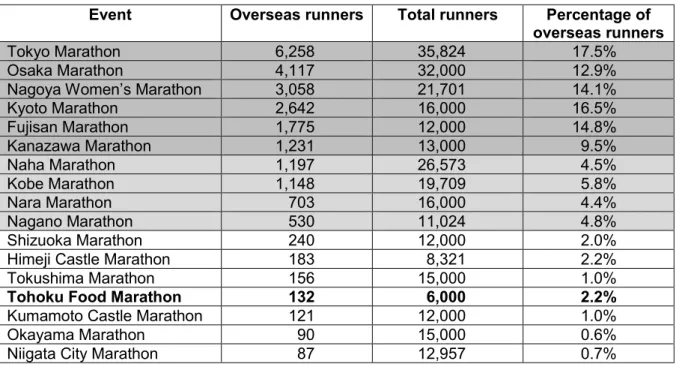
Table 1-2 The number of overseas runners for major marathons in Japan (2017) ... 25
Table 1-3 Number of participants in Tohoku Food Marathon (2014–2017) ... 28
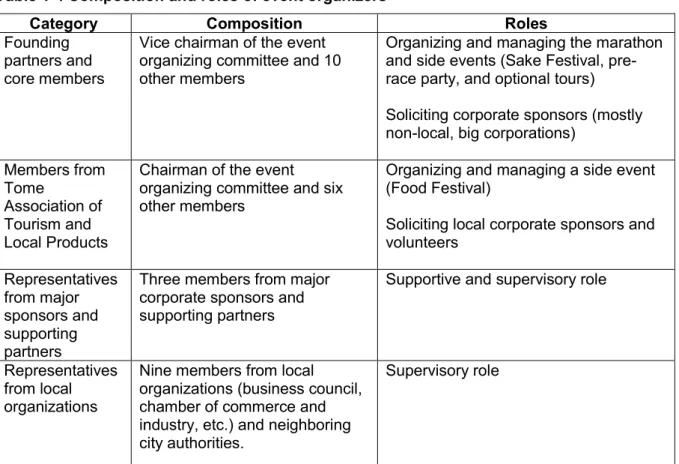
Table 1-4 Composition and roles of event organizers ... 29
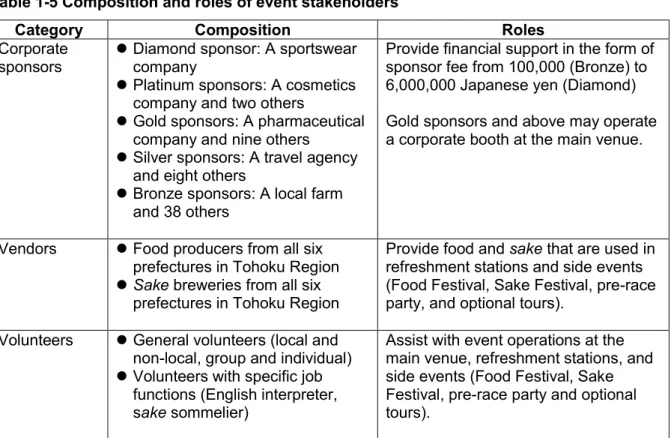
Table 1-5 Composition and roles of event stakeholders ... 31
Table 1-6 Place of residence composition of international participants (2016–2017) .... 32
Table 1-7 Summary of data collection procedures ... 33
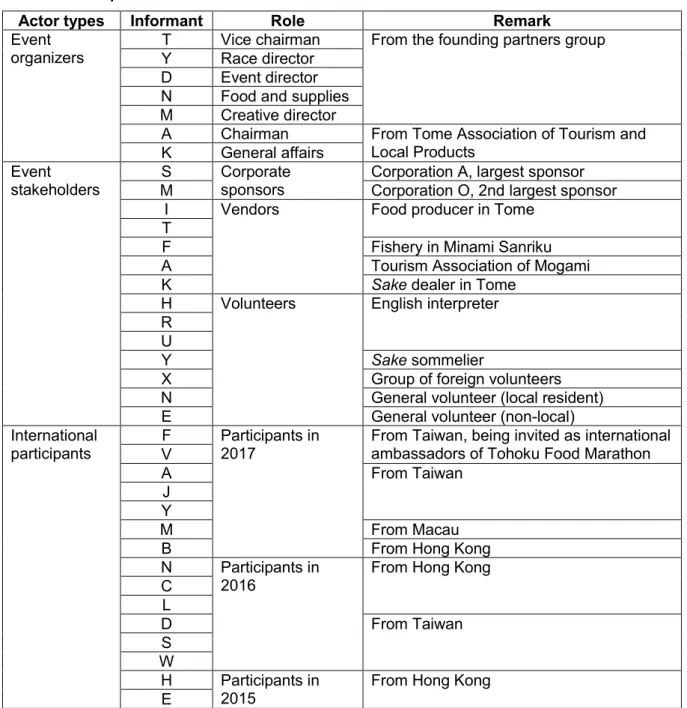
Table 1-8 Composition of the main informants ... 37
Table 1-9 Data volume by actor type and language composition ... 38
Table 1-10 Coding methods applied in data analysis ... 39
Table 2-1 Specialty foods and drinks served at refreshment stations and finish ... 48
Table 2-2 Awards received by Tohoku Food Marathon (2015–2017) ... 77
Table 2-3 Value cocreation practices engaged by event organizers ... 81
Table 3-1 Value cocreation practices engaged by event stakeholders ... 108
Table 4-1 International participants’ travel itineraries ... 121
Table 4-2 Experience sharing by international participants ... 141
Table 4-3 Value cocreation practices engaged by international participants ... 151
viii
LIST OF FIGURES
Figure 1-1 Example of open-coding ... 40
Figure 1-2 Example of pattern-coding ... 41
Figure 1-3 Example of the coding process in NVivo 12 ... 42
Figure 2-1 Value cocreation from the perspective of event organizers ... 82
Figure 3-1 Value cocreation from the perspective of event stakeholders ... 109
Figure 4-1 Course map showing the foods served at refreshment stations ... 125
Figure 4-2 Value cocreation from the perspective of international participants ... 153
Figure 5-1 Information delivery among international participants ... 157
Figure 5-2 Three-phase value cocreation process model ... 160
Figure 6-1 A sustainable value cocreation cycle... 166
ix
LIST OF PHOTOS
Photo 1-1 Runners participating in Tohoku Food Marathon ... 26
Photo 1-2 The Food Festival of Tohoku Food Marathon ... 27
Photo 1-3 The Sake Festival of Tohoku Food Marathon ... 27
Photo 1-4 Participant observation as a marathon runner ... 35
Photo 1-5 Participant observation as a supporting member of the event organizers .... 36
Photo 2-1 The English website of Tohoku Food Marathon ... 57
Photo 2-2 An example of email newsletter sent to international participants ... 62
Photo 2-3 An example of earned media publicity ... 64
Photo 2-4 Promotion booth of Tohoku Food Marathon at Medoc Marathon ... 65
Photo 2-5 International ambassadors from Taiwan ... 66
Photo 2-6 Reception for international participants ... 68
Photo 2-7 A bilingual signboard ... 68
Photo 2-8 A bilingual interpreter volunteering at the Minami Sanriku tour ... 69
Photo 2-9 International participants posing for the costume competition ... 73
Photo 2-10 Souvenirs brought by participants ... 74
Photo 3-1 Brochure and leaflet of the Tohoku Food Marathon tour package ... 85
Photo 3-2 Promotion booth of Tohoku Food Marathon at Taipei Marathon Expo ... 86
Photo 3-3 Intercultural communications enabled by staging side activities ... 97
Photo 3-4 Intercultural communications facilitated by food served in side events ... 101
Photo 4-1 An international participant wearing special costumes ... 127
Photo 4-2 An international participant joining in side events and activities ... 130
x
Photo 4-3 An international participant giving high-fives to the cheering crowds ... 134
Photo 4-4 An international participant taking photos of the cheering crowds ... 135
Photo 4-5 An international participant taking photos of other runners ... 135
Photo 4-6 Water used for brewing sake ... 137
Photo 4-7 Memory recollecting: Tome-grown rice sold in Hong Kong ... 143
Photo 4-8 Memory recollecting: Tome-breed pork sold in Hong Kong ... 143
1
1. Introduction
1.1 Research background
Sports tourism plays an increasingly important role in providing a strategic toolkit for places to develop, convey, and sustain their place brand equity. Among various types of sports tourism activities, traveling to participate in sports events has attracted significant attention from practitioners and academia (Getz & Page, 2016). Sports events are believed to contribute toward place marketing (Chalip, Green, & Hill, 2003), urban development (Carlsen & Taylor, 2003; Clark & Huxley, 2009) and city re-imaging (Smith, 2005). In particular, mega sports events such as the Olympics and FIFA World Cups have received the most attention with respect to their economic impacts and country re-imaging effects (Kasimati, 2003; Chung &
Woo, 2011).
While mega sports events consist of a small number of elite athletes and large number of spectators, non-elite sports events such as city marathons in contrast have a participatory character. Rather than focusing on competitive results, non-elite sports events focus on participation and social engagement with the overarching aim of social inclusion. Coleman and Ramchandani (2010) investigated the economic impacts of non-elite sports events in Western countries and argued that city marathons can generate economic impacts similar to elite sports events, while putting less burden on public finance. In addition to the economic and city branding benefits, city marathons also contribute to a healthier population through long-term sports participation (Long, 2004; Lechner, 2009). Moreover, the active participation of volunteers and local residents in the staging of a marathon manifests that when positioned on a decentralizing continuum such an event is important to them. In particular, the involvement of citizens young and old signals their pride of the event and such bonding may give affordance to bridging the generation gap (Coleman & Ramchandani, 2010), and by extension fostering social cohesion.
Starting with the New York City Marathon in 1970, a marathon has evolved from elite
competition to mass participation as well as a form of active sports tourism that has
international appeal. In Japan, while there were many mass participation marathons catering
to health-conscious civic runners in secondary cities and suburbs, marathons held on main
roads and areas in major cities such as Tokyo, Osaka, and Fukuoka were reserved exclusively
for elite runners (Havens, 2015). This dichotomy has been converging since 2007, when the
hugely successful Tokyo Marathon was launched and became the category forerunner in
2
Japan. The number of annual applicants for Tokyo Marathon rose from 95,044 in 2007 to more than 300,000 in the 2010s, while the total number of runners was capped at around 36,000 (Tokyo Marathon, 2018). Despite its relatively short history, the Tokyo Marathon has joined Boston, London, Berlin, Chicago, and New York City as one of the six most renowned marathons in the world (Abbott World Marathon Majors, 2019).
Observing the huge success of Tokyo Marathon, major cities in Japan such as Osaka, Kyoto, and Kobe among others, have started hosting their own city marathons, not only to promote sports participation and destination image, but also to attract sports tourists and revitalize the local economy. However, while many cities may desire to achieve those aims, they find themselves surrounded by an increasingly competitive environment and therefore face daunting challenges should they decide to enter the arena.
The first challenge is heightened competition with existing city marathons. Despite the growing demand from runners to participate in marathons, the time-frame and slot to host a marathon is constrained by both time and climate. Since most marathons take place on weekends in seasons with suitable weather conditions, city marathons are inevitably facing competition from both established and new events. The second challenge regards the macroeconomic environment. In a time of economic uncertainty and budget constraints across public and private sectors, the impending resource scarcity and decrease in investments from both public and private sector are forcing city authorities and marathon organizers to intensify their search for dependable resources, where inputs from relevant stakeholders might be intelligently pooled under a sound governance structure, in accordance with a sustainable business approach. The third challenge concerns the aging and declining population in Japan.
Though cities have been trying to counter this demographic trend by attracting non-resident populations to participate in their city marathons, it would be a zero-sum game for Japanese society as a whole if their focus is limited to a domestic scope. This implies that city authorities and marathon organizers would have to shift their perspective from competing with each other to expanding the participant base to overseas runners.
Despite all these challenges, some city authorities and marathon organizers actually see a
silver lining in the crowded sports tourism market. Traveling from overseas to Japan to run
marathons is an emerging sports tourism phenomenon and many destinations across Japan
have been aiming to capitalize on this opportunity by promoting their city marathons as an
important element of tourism destination competitiveness. As the number of marathons
continues to grow, heightened competition forces event organizers to expand their participant
base internationally and provide unique value for their participants. Different motives and
3
behavior patterns between domestic and international participants, along with the multiplicity of actors involved in a marathon, call for the need to investigate international sports tourism with a holistic approach that acknowledges the different perspectives held and different roles played by different categories of actors.
Accordingly, this research responds to the growing demand for understanding international
sports tourism in the marathon event context by applying the marketing concept of value
cocreation (Prahalad & Ramaswamy, 2004) to investigate how relevant actors cocreate value
in an international sports tourism setting. The study aims to explore in depth the phenomenon
of value cocreation by investigating the interactions between event organizers, event
stakeholders, and international participants involved in a mass participation marathon that has
a substantial regional revitalization focus and a high ratio of international participants
compared with marathons of similar scope and scale. The results are expected to provide a
blueprint for city authorities, sports event organizers, and tourism stakeholders to put forward
a value cocreation space that allows all involved actors to benefit from participating in it.
4
1.2 Literature review
This section presents a systematic review of the concepts and current state of research on sports tourism and value cocreation, with a specific attention given to studies on international sports tourism. In addition, applications of qualitative research methods are reviewed to provide a basis for developing research design and data analysis procedures for the current study.
1.2.1 Sports tourism and its international aspects
The history of people traveling for sports can be traced back at least to the ancient Olympic Games in 776 BC; however, academic study on the phenomenon of sports tourism has started only in very recent years (Hinch, Higham, & Sant, 2014). Before the 1990s, sports tourism research tended to treat the sports component as sport-based activities or events that occur within a broader context of tourism. Insights in the relationships between sports and tourism were mainly provided through related fields such as hallmark events, health and fitness, and outdoor recreation. Though these studies contributed to our understanding of sports tourism, research in the 1990s remained isolated and did not focus on the interdependent relationship between sports and tourism (Hinch & Higham, 2001).
As the body of literature started to accumulate, the publication of the Journal of Sport Tourism
1in 1993 marked a first step toward the establishment of sports tourism as an academic research field. As with other emerging academic disciplines, the study of sports tourism started with discussions on its conceptualization and typology. In their article proposing a research framework for sports tourism, Hinch and Higham (2001) discussed how sports tourism was defined by researchers from related fields. Though the various definitions differ in wording and focus, they often included activity (sport-based activity), spatial (travel away from the usual environment), and temporal (temporary, leisure time, or during holidays) dimensions that collectively define sports tourism. A typical definition of sports tourism reads:
“All forms of active and passive involvement in sporting activity, participated in casually or in an organized way for noncommercial or business/commercial reasons, that necessitate travel
1