Accountability Voting
journal or
publication title
Journal of policy studies
number
57
page range
111-132
year
2018-09-30
1 Introduction
Retrospective voting has been examined mainly through the models of economic voting; that is, deter-mining whether, when, and how voters are influenced by socio- and individual-economic status (see, Lewis-Beck & Paldam 2000, Markus 1988, Nannestad & Paldam 1994, Kinder & Kiewiet 1979, 1981). To
assess economic fluctuations, voters must possess a certain level of knowledge and competence(see, Lau & Redlawsk 1997, Lupia 1998)1. Voters are assumed
to own cues to understand economic conditions, such as business cycles, economic growth, employment, inflation, and social welfare, which are thought to influence on sanctions (e.g. Ferejohn 1986, Barro 1973, Kramer 1971) or selections of an incumbent
1 As the representatives of negative assertions, for example, see Delli Carpini & Keeter (1996), Converse (1964) are in the context of limited ratio-nality and pitfully low knowledge, Achen & Bartels (2004) is based on voter’s randomized response for events, and Huber et al. (2012) points out the serious bias for the recent performance rather than the passed.
Nuanced Voters in Japan
Estimating Transition between Economic
and Accountability Voting
大 村 華 子
Hanako Ohmura
Recent retrospective voting studies have focused not only on the retrospective economic voting (economic voting), but also on the retrospective accountability voting (accountability voting). Retrospective voting based on voter’s evaluations of economic conditions is con-sidered economic voting, whereas accountability voting is where voters consider the consis-tency between promises the government makes and what it actually implements. Voters are assumed to waver between economic and accountability voting; this balance informs time-series transitions in relative weight given to each in voting behavior. Referring to such vot-ers as nuanced votvot-ers, this research uses the case of Japan’s electoral politics and attempts to determine historical change in retrospective voting patterns. In this study, electoral accountability is set as the deviation of the realized (observed) value from the promised value by the government. Two types of analysis are then conducted: the impulse-response functions between economic/accountability voting and the cabinet approval rate by the Bayesian structural vector autoregressive (B-SVAR) model, and time-series contributions of economic/accountability components for approval ratings by historical decompositions (HDC). Assuming that the weight of economic/accountability voting changed after 1993-94 electoral institutional reform in Japan, a transition in the behavior of nuanced voters was clearly apparent in public works spendings in the private goods sphere. Moreover, accord-ing to theoretical expectations, accountability votaccord-ing in regard to government expenditures and GDP predominated both preand post-reform, and neither nuanced change between eco-nomic and accountability voting nor critical change after reform were observed.
Key Words : Retrospective Voting, Electoral Accountability, Political Representation, Bayesian Structural Equation Modeling, Historical Decomposition
government (e.g. Ashworth & Bueno de Mesquita 2008, Fearon 1999)2. Hence, as Healy & Malhotra
(2009, 387) stated that “ [t]he study of retrospective voting has mainly focused on economic conditions”, economic voting has been placed at the core of performance voting .
A recent study, however, has examined the situa-tion in which voters simply responded to the present economic status or to a gap/congruence between the promises an incumbent makes and what she actually implements. Under the newly accepted assumption of voter responsiveness, which voters are deemed to have the capacity to make judgments the national economy and make decisions based on them (e.g. Ansolabehere et al. 2014, Woon 2012, Lau et al. 2014, Lewis-Beck et al. 2013), recent empirical research on retrospective voting seems to have shifted in its perspectives about what determines a voter’s retro-spection as a broader sense. Is the economy still the main domain of retrospective voting? Which affects a voter’s decision more: the state of the economy per se or the consistency between policy commitments and economic status? Further, how does retrospec-tive behavior incentivize politicians to realize better policy outcome and comply with policy commit-ments? While the effects of economic itself have previously been sought, the notion of accountability voting is now highlighted to answer these ques-tions (see, Ashworth 2012, Healy & Malhotra 2013, Hellwig 2012, Woon 2012).
Such interests naturally lead to the next ques-tion: does economic voting or accountability voting predominate? As a substantial understanding of real voters implies, voters cannot be starkly divided into two dimensions–either voting simply for the
economy or for accountability. A certain voter who deeply cares about business conditions may simply consider the presence of a macro economic boom itself, while those who work in the financial world may try to scrutinize the gap between the govern-ment’s economic perspective and real economic values such as gross domestic products (GDP), infla-tion, unemployment rate, industrial production index, and so on. If we are to analyze a population whose concerns about actual economic status, incumbent policy promises, and their consistency/inconsistency are diverse and not mutually exclusive, the nuanced transitions of voters in time-series should be an appropriate and fruitful subject for analysis.
This study focuses upon those who not only consider the economic climate, but also who closely examine the government’s economic performance in terms of kept/unkept promises (Manin et al. 1999, Powell 2000). It defines such retrospection as accountability voting3. Further, voters whose voting
behavior wavers between retrospective economic voting (economic voting) and retrospective account-ability voting (accountaccount-ability voting) will be referred to as nuanced voters. As mentioned in Healy & Malhotra (2009, 301), scholarship on political behavior “is providing a more nuanced, realistic, and complete picture of how retrospective voting actually takes place,”–i.e., it is trying to outline retrospective behavior in an inclusive, multi-faceted way. Along these lines, this research takes illustrating nuanced voters as its study object, incorporating both aspects of economic voting and accountability voting.
To grasp the above, the need for two types of empirical analyses is suggested. First, a time-series transition of the nuanced voters should be captured4. 2 For more detailed classification of theories and empirics of the selection-sanction model, see for example, Ashworth (2012, 184-186). Further,
dis-cussions combining retrospective and prospective voting exists (e.g. Fearon 1999). In this research, assuming that both are not starkly divided, the retrospection is solely and mainly dealt with.
3 The term, accountability voting, may seem to be inappropriate, since retrospective economic voting per se embraces accountability elements. Yet, when electoral accountability should be narrowly defined as the consistency between policy promise and implementation (Manin et al. 1999), eco-nomic voting is not necessarily linked to electoral accountability. That is, even if ecoeco-nomic voting functions, it does not immediately mean voters hold government accountable for her performance. In this sense, accountability should not be understood simply intrinsic in economic retrospec-tive voting, but its effect in retrospection should be externally and separately estimated. To prove accountability aspect in retrospection, voters’ evaluations on electoral accountability based on government’s promise and performance should be separately analyzed. Thus, in this research, accountability voting is almost separately set from economic voting.
4 Against macro-level approach, in order to cope with ecological fallacy, “[i]ndividual-level election survey investigations (microstudies) are invaluable” (Lewis-Beck & Stegmaier 2013, 368). Pursuit of the nuanced voters between economic/accountability voting and their transition, the micro-study is useful. However, firstly, the illustration of time-series nuanced change can be further well illustrated by the aggregated data. Secondly, about the Japan’s case adopted in this research, the individual data is collected since 1960’s though, questionnaires about economic conditions in surveys are not constant through each period, and one for political accountability is so confined to a few recent surveys. Thus, this research will be conducted with the aggregated data based on the cabinet approval rates.
In a concrete sense, the degree to which electoral accountability versus simple economic voting prevails in retrospective voting changes over time:, thus, comparing the extent to which accountability versus the economy can explain the variance of change in public support must be examined. Second, whether transitions in relative dominance of account-ability versus the economy experience dramatic switches from one status to another should be under-stood. With a change in the electoral institution, for example, it can be theoretically deduced that struc-tural shifts in voters’ evaluations of the real economy and their emphases on electoral accountability may occur (see, Anderson 2000).
For exploring the transition between economy and accountability in one shot, and further, the temporal transition of the nuanced gradation itself, the quasi-experimental setting offered by Japan’s 1993-94 electoral institutional reform can be expected to yield meaningful implications. That is, the author tries to explore whether the electoral institutional reform that was envisioned to change the party government’s accountability also led to a shift in voter retrospec-tion. The structural change of electoral institutional reform is expected to bring about change in electoral accountability led by the ruling party. In Japan, a new electoral system was sought to remedy the series of political scandals and corruption that had resulted from the money-oriented politics during the Middle Member District (MMD) system until the early 1990s. With a sizable political realignment, the longtime rule of the dominant Liberal Democratic Party (LDP) ended in 1993, and the new coalition government passed electoral institutional reform. This reform was founded on the motivation to move away from pork-barrel-based politics towards policy-based politics.
The newly instituted Single Member District and Proportional Representation (SMD/PR) system prompted voters to focus on policy aspects, and was adopted in 1993 and first implemented in the 1995 election for the House of Representatives. Under the electoral institution of the SMD, there has been a strong tendency for politicians to focus little on
specific policy areas (special interest/private goods), and rather to orient their concerns towards a broader policy sphere (including general interest/public goods) (Cox 2008, Cox & McCubbins 2001, Cox 1997)5. This change by politicians toward general
interest meant that Japanese legislators began to distribute their attention more evenly across broad policy areas such as diplomacy, defense, finance, cabinet and public administration, tax, environment and so on, which had tended to be disregarded during the MMD period (Fujimura 2012, Saito 2010, Hirano 2006, Tatebayashi 2004). Given this change in policy emphasis by legislators, it has been theoretically and empirically argued that the legislators/parties/govern-ment in Japan have become more policy-oriented and have tried to assimilate policy promises into policy implementation6. This change is thought to have
motivated the shift in voting retrospection from the economybased to the accountability-based. It leads us to the question: have graded, critical and policy-dimensional changes between economic and account-ability retrospective voting manifested in Japan?
Focusing on Japanese politics, I will conduct an empirical study using two types of analysis to seek meaningful implications for nuanced retrospective voting. In the next section, a review of relevant litera-ture is introduced. Drawing mainly from the selec-tion-sanction models (Fearon 1999, Ashworth 2005, Ashworth & Mesquita 2006), voters are assumed to face a complicated situation in which sophisticated knowledge is required for accountability retrospec-tion, but have an incentive to cut the cost to assess what constitutes a good government. Voter inertia readily promotes the possibility of economy-based retrospection, by which a ruling party offering economic strength would be continually reelected. Such economic voting could be changed, however, by the way legislators are chosen.
The theoretical argument is then reviewed in the context of data from Japan: a shift in economic/ accountability voting is expected, which can be an appropriate case with which to analyze the nuanced, critical and policydimensional transitions between
5 Japan is not limited to the SMD system, but the PR system also exists. However, depending on the ratio of the margin of loss in a single mem-ber district, losers can still win a seat through PR (“best-loser” rule). Thus, candidates in the SMD/PR system are strongly incentivized to fight against rivalries (Pekkanen et al. 2006). In this situation, the Japanese electoral system is characterized more by SMD properties than by PR ones, compared with Germany, for example.
6 As this background, institutional reform intended to alter voting patters from personal vote to party vote (Estévez-Abe 2008, Cox 1997, Carey & Shugart 1995). Aside from the fact that this change actually occurred or not, party label indeed come to be strengthened as discussed in later.
economic/accountability voting. In the third section, research design of variable settings and a strategy for estimations are introduced. In the fourth section, empirical studies are conducted with estimations of the impulse-response function computed by a Bayesian structural vector autoregressive (B-SVAR) model and historical decomposition (HDC). In the last section, discussions and conclusions that linken the estimation results into the context of Japan will be reviewed. Specifically, in regard to the analysis of public works spending as an index of the private goods sphere, the nuanced transition between economic and accountability voting is confirmed. Before the 1993-94 electoral reform, economic voting predominated over accountability voting, whereas after reform, election accountability became accen-tuated. On the other hand, in regard to government expenditure and GDP, which has been considered to represent the public goods sphere, accountability voting has prevailed through all periods.
2 Why Should the Nuanced Voter be
Emphasized: The Case of Japan
2.1 What economic and accountability voting
bring about
In the literature, many theoretical and empirical studies have attempted to connect retrospective voting and electoral accountability in a narrow sense. It has been strongly postulated that economic voting is in some sense a variety of democratic account-ability, because citizens sanction or reward a govern-ment through economic performance (Anderson 2007, Ferejohn 1986). However, recent studies have tried to extract the essence of accountability and its direct influence on retrospective voting (Ashworth 2012, Healy & Malhotra 2013, Woon 2012, Hellwig 2012). Relevant studies have tackled accountability with ingenious research designs, and include: studies that regarded accountability as a kind of evalua-tion of government sincerity/ honesty with regard to promises to emphasize public or private goods and then analyzed its influence on retrospective behavior (Healy & Malhotra 2009, Chen 2013); an analysis of the effect of school board transparency on electoral outcomes (Berry & Howell 2007); and an exami-nation of the relationship between the severity of judges’ sentences and their election results (Gordon
et al. 2007), and an analysis of the influence of policy adjustment to voters’ policy positions on electoral performance (Hellwig 2012) .
Considering the literature trying to directly assess the effect of electoral accountability on retro-spective voting, what is notable is the assumption that citizens have the competence to evaluate not merely socioeconomic conditions, but the origins of them– i.e., electoral promises for social economic policy. Regarding retrospective behavior, a long-running dialogue has been held over voters’ rationality and responsiveness (see, Lewis-Beck et al. 2013, Anderson 2007). Although recent studies assume enough citizen competence to understand the state of economy either in a sociotropic or pocketbook way, disputes persist over the extent to which voters can connect policy outcomes with party policy promises, policy formulations, and government competence (Lewis-Beck et al. 2013, Duch & Stevenson 2013).
In order to understand voters’ information-processing, the selection and sanction models specifi-cally offer an important implication (Fearon 1999, Ashworth 2005, Ashworth & Mesquita 2006): voters reckon the performance of a government’s economic stewardship after an election, based on a certain level of policy information to assess the consistency between what government previously appealed and what it presently implements. To judge this consis-tency, voters need a more sophisticated rationality than simply considering the economic climate and their personal economic status per se (Alt et al. 2014, Woon 2012, Healy & Malhotra 2013). Here, even using the heuristic to understand the complex macro financial economics or individual economic status, voters must treat information not only based on their intuitive knowledge of economic status, but on their scrutiny of government’s sincerity. Thus, at least the selection-sanction model seems to imply that some voters hold considerably higher knowledge and understanding (Alt et al. 2014, Ansolabehere et al. 2014, Woon 2012).
From the selection-sanction theory, contrast-ingly, another critical implication can be drawn: rational voters are incentivized to reselect or punish an incumbent to diminish costs for scrutiny of policy information (e.g. Huber et al. 2012, Besley 2007). Given voters desire enhancement of welfare in general, if they believe a single ruling party/govern-ment to continuously supply it, they will regularly
re-elect a good government that benefits them. Under these conditions, voters are presumed to overlook economic performance vis a vis previous elec-toral promises and economic voting with constant welfare benefits is predicted to take precedence over accountability voting with heavy considerations on policy promises . Moreover, in such a situation, voters are assumed to pay their attentions on the targeted private goods rather than public ones (see, Cox & McCubbins 2001). Voters entertaining the targeted private goods are expected to continually select economically-good government (see, Stokes 1999, 2005, Scheiner 2008). In other words, repeated reelection of economically-good government inversely implies that the chance for a opposition party whose capabilities are unknown to be selected is diminished during that time (Scheiner 2006). As long-time rule and watereddown opposition parties continue, economic voting is predicted to be held to gradually predominate over accountability voting.
A certain structural change, however, guides nuanced voters away from economic-centered voting toward accountability-centered voting, causing change in the ruling party, government. When insti-tutional changes foster voters’ attention on policy per se, citizens are motivated to check the congru-ence among electoral policy promises before an election, policy formulation after the election, and policy outcomes. In sum, a certain type of electoral institutional change aiming to transform electoral accountability can foster retrospective voting as a manifestation of policy responsiveness, not merely of government economic performance7.
To this end, the most influential alteration is thought to be the electoral institutional change from a system in which multiple candidates are selected from one district into a small member-district (SMD) system (Bonoli 2001, Anderson 2000, Cox 2008)8.
Under an SMD system, at each district level, voters can readily reselect (replace) a good incumbent (a bad incumbent) with whom they judge to be competent. On a national level, voters can readily evaluate ruling party performance because there are fewer options in an SMD (Taagepera & Shugart 1993), in which the
value of a party label is relatively stronger and a two-party system is fostered. This change is presumed to lead a shift in voter attention on party policy, since policy package is embedded into a partisanship that focuses on few options. As the change of legislators/ candidates, they must cover the broader policy area. Also, as each district is limited to one or two potent candidate, policy coverage must be expanded and this transition should create an emphasis on policy and an increase in policy information for voters. Thus, SMD should promote to function electoral accountability, and with this electoral system, accountability voting should be promoted.
In sum, whilst retrospective voting under an electoral institution allowing multiple winners is predicted to lean toward economic voting, an insti-tution that allows for only one winner promotes accountability voting. Gradual wavering between economic and accountability voting should emerge through time. However, in order to analyze the transitions of nuanced voters’ priorities which are theoretically and empirically expected, what kinds of cases and methods should be employed?
2.2 What the case of Japan reveals: Electoral
institutions as the context
Retrospective voting closely links to how the govern-ment to be selected. Which party voters retrospec-tively select is inextricably associated with which party is chosen as the ruling party or punished to go into the opposition. The case of Japan, in which the long-time rule by the LDP had lasted, but in turn, power shift has been seen with some frequency, implies that the pattern of voters’ retrospection is likely to have changed. How can this change be examined vis a vis the axis of economic/account-ability voting? And what implications does the Japa-nese nuanced voters to retrospective voting studies in general?
Japanese politics have been long understood along the axes of special interests vs. general interests, or private goods vs. public goods (e.g. Ramseyer & Rosenbluth 1997, Pekkanen et al. 2006) 9. During 7 Research dealing with the direct link among retrospective voting, electoral institution and political knowledge seems to have been limited. The seminal exceptions are such as Duch & Stevenson (2008) and Powell & Whitten (1993), but in them, the path in which electoral institution deter-mines the degree of policy information, and finally influences retrospection, has not been studied yet.
8 As the literature claiming the limitation of political institutions, see Hobolt et al. (2013).
the 38 years of Liberal Democratic Party dominance under the so-called 1955 System, the MMD system continued to bring electoral incentives that delivered pork to voters seeking targeted interests (e.g. McCubbins & Rosenbluth 1995). A political candidate can win with less votes, since multi-candidates from one party and one electoral district can be elected under the MMD system. This situation meant that Japanese legislators specialized in specific policy interests that would readily yield pork in such areas as construction, agriculture, transportation, commerce and trade, budget, and posts 10. In this
sense, the 1955 system and the MMD era can be rephrased as the political era of special interests and private goods. The MMD system kept politicians incentivized to deliver pork, inescapably encouraging money politics and thus evoking the necessity for institutional change.
Recognizing the need for reform, the four political reform-related bills [Seiji Kaikaku Yon Hou] were passed in 1993 and came into effect in 1994. Under the newly adopted SMD/PR system, the most char-acteristic change was that electoral incentives for politicians shifted to cover a broader policy area. Under the SMD system in which only one candidate can be elected, each candidate is also expected to include in their platform previously unpopular policy areas of public goods. Recalling the tenet of Healy & Malhotra (2009, 389), when a government is rich in accountability, it should stress policies related to the formation of public goods rather than targeted private goods. Weighed against this classification, electoral accountability was considered to shift after the electoral reform in Japanese politics through the change from stressing private goods to including public ones. As politicians/ruling parties/government accentuate policy (promise), voters are naturally led to obtain more policy information. Founded on these
logics, in the case of Japan, how was this change brought about? Further, how does it relate to retro-spective voting?11
The policy area for private goods and special interests such as construction, transportation, commerce, industry, etc. is closely related to the business climate (Kohno & Nishizawa 1990, as in the Japanese context, see,). As the political business cycle theory suggests, the government’s legitimacy is threatened if there is a downturn in the economy (see, Iversen & Soskice 2006). Thus, the govern-ment, which is acutely aware that voters observe and take into account economic conditions in electoral decisions, tries to create an economic boom before an election. The government ensures an increase in public works projects to reduce unemployment, sacrificing inflation to an extent. In the context of Japan, public works have been thought of as a func-tional equivalent of social welfare, which is the core of targeted private goods (Estévez-Abe 2008). Public construction generates employment not only in the construction industry, but also in transportation companies that haul building materials, mid-sized producers of building materials, and so on. Coupled with electoral incentives toward influence peddling, this kind of special interest/private goods politics seemed to pressure voters toward retrospective economic voting through attention on the economic climate under the MMD system led by the LDP12.
Consequently, from the perspective of voters, the motivations for economic voting are ascendant under the MMD system. The implication is that the LDP’s long-time rule fostered voter reluctance to select a challenger whose governance capabilities are unknown (Scheiner 2006). The scrutiny required of policy responsiveness–i.e., electoral accountability– is relatively costly, with high burden placed on voters compared with simply judging the economy.
10 As a brief review, see Scheiner (2008, 163-164). The detailed explanations are in Estévez-Abe (2008), Fujimura (2012), Fujimura (2013), Hirano (2006), McCubbins & Rosenbluth (1995), Ramseyer & Rosenbluth (1997), Saito (2010), Tatebayashi (2004). As the related perspective, special interest lobbyists [Zoku-giin] reigned supreme in LDP politics through strong ties with bureaucrats of the relevant ministries, fostered in policy deliberation committees and individual committees. Although specialinterest lobbyists naturally survived after reform, the incentives to be as-signed to a particular committee for distributive politics is likely to gradually decline.
11 In Japan, studies on legislative politics, which focuses on the distribution politics between public and private goods are abundant, as reviewed in this section. Against this, it is a bit limited the research as to how voters perceive and evaluate distribution of goods, how the electoral institution-al change influences on voters’ perceptions and behaviors, and how voters’ evinstitution-aluations on electorinstitution-al accountability has changed. Although mainly aiming to draw the general implication of retrospective voting, this research also pursues to explain the effect of electoral institutional change on Japanese electorate.
12 As another topic, we must consider not only whether voters observe and can rationally judge government competence, but whether they can be conscious about how the government controls business cycles. In this paper, these questions will not be directly dealt with; however, voter capac-ity to act based on higher-level policy information should be carefully analyzed in future work.
Under the MMD system with its many profits and limited policy information, those who were intensely concerned with matters of personal profit and gain did not take the opportunity to carefully check the government’s policy responsiveness13.
After electoral reform, however, Japanese retro-spective voting supposedly inclined more toward accountability voting. As mentioned previously, legis-lators began to move toward a broader policy area and devote more attention to policy-based behavior rather than special-interest-based (Fujimura 2012, 2013, Hirano 2006, Scheiner 2008). Although previ-ously not well-confirmed in literature without a few exception, legislators’ emphasis on policy is thought to influence the Japanese electorate’s attitudes and behaviors. Before reform, the division of limited resources was of highest interest, not the policy itself. After reform, with the presumed increase in voter-policy interest, the electorate is assumed to care more about how well policy promises match policy outcomes14. Providing a collateral evidence, Nyblade
(2011) proposes the notion of hyper-accountability (see also, Roberts 2008). Japanese voters are recently apt to demand more electoral accountability in both qualitative (requiring more sincerity) and quantita-tive (requiring more frequency) terms. This change is thought to indicate that power shifts occur frequently. The direct evidence of rising accountability voting is limited, but as the hyper-accountability argument suggests, accountability voting is likely to predomi-nate following the institutional change to the SMD-dominated system.
In the context of Japanese electoral politics, hence, the relative dominance of economic versus accountability voting should be observable. And electoral institutional change likely to transform the relative weight of Japanese nuanced voters’ reflec-tions. The predicted change can be put simply as: before electoral institutional reform, economic voting was dominant, while after reform,
account-ability voting was.
Further, depending on whether the policy sphere is public or private, the proportion of both economic and accountability ought to differ. As recent studies have shown, if the government is suffi-ciently accountable, it weighs heavily on policies related to the public sphere (Healy &Malhotra 2009). According to Healy & Malhotra (2009), when the government is good (sincere) enough to supply public goods, electoral accountability is emphasized15. From
this understanding, the implication can be deduced that the spending respective to public goods sphere can foster accountability voting rather than economic voting. Against this expectation, in the private policy sphere, voters look to targeted goods and value benefits that immediately surround them. Thus, in the case of rising profits and voters’ attentions on the direct interests in the private goods sphere, we can predict a prevalence of economic voting. Again, nuanced voters wavering between economic and accountability voting should show different trends in the context of private versus public spheres.
Along these lines, the Japan’s case is expected to offer the nuanced, critical and policy-dimensional changes in voters’ retrospection between economic/ accountability voting. In order to examine two main tasks: (i) the graded change, (ii) before and after the electoral reform, and (iii) private versus public goods contrast: the research design including measurement of electoral accountability and methods for estima-tions will be explained in the next section.
3 Research Design
3.1 Measuring Accountability
In empirical analyses, how government approval ratings respond to the real economy and account-ability will be estimated. Time-series approval ratings data is required to perform longitudinal
13 As a further emphatic argument, the relationship between Japanese voters and government was typified by perverse accountability, in which vot-ers were paradoxically held accountable to the ruling party in order to receive more resources (see, Saito 2010).
14 Although it is not directly related to the retrospective voting, the unity within each party and the power of party leaders are thought to be strength-ened after reform (e.g., Cox et al. 1999).Leaders in the ruling party have still held stronger power in the allocation of posts, interests, and cam-paign resources than before the change. Although legislators began to care more about broader policy areas, including general interests, the policy deliberation committees relating to special interests have been popular (Fujimura 2012). In order to be assigned to such committees, the degree to which the backbenchers obey party leadership increases and party discipline has been gradually enhanced. With this change, in appealing to party leadership, legislators try to be well versed in many policy areas.
15 In Healy & Malhotra (2009), private goods are set as the procurements for natural disasters, while public goods are defined as preparedness for them.
analyses. Monthly data of the cabinet’s approval rating is collected by the Jiji-Press (JP: Jiji Tsuushin-sha), and is widely employed as the most reliable and longest-running dataset of the topic. Thus, the following analysis will basically adopt JP’s approval data. According to explain later in this section, data consists of periods from the second quarter (April-June) of 1981 to the second quarter of 2013, and the full numbers of samples are 133.
Since, in this research, accountability is defined based on responsiveness (Manin et al. 1999, 40-46), economic gain does not always mean strengthened government support, because both economic and accountability voting aspects factor into support levels. In Besley (2007, Chap. 3), for example, accountability is set as the growth of economic performance such as (state) income growth and tax increases in the context of a U.S. gubernatorial election16. Such a measurement has the power of
simplicity because it can directly capture an incum-bent’s ability to bring about economic growth or decline. This type of definition, however, seems to have two problems. Firstly, variables representing the growth of economic performance cannot distinguish pure economic effects ones from accountability component reflected in economic condition; however, the setting presumes economic growth and decline entirely reflect an economic cause. The consequence of accountability is resultingly measured as the economic outcome. If at all, economic outcomes referring to pure economic status and ones including accountability aspects must not be mixtured, and separately operationaized. Secondly, this measure-ment does not incorporate the core of accountability: that is, what a ruling party or government promises. For any measurement of accountability, the most important aspect is to substantially reflect a govern-ment’s promise or prospects.
Along this sense, whether a government carries out a better policy with words or without words should be separated in the measurement of account-ability. Taxonomically, a given electoral situation can be divided into four patterns according to the “talk the talk vs. don’t talk the talk” and “walk the walk and don’t walk the walk” axes (as in Table 1). When
the government sets a higher numerical goal, it must be punished if it fails and rewarded if it succeeds. Meanwhile, when a government opts for subdued language or does not make any proposals, its respon-siveness should be differently assessed. From the perspective of the distinction between economic and accountability voting, “don’t talk the talk” is synony-mous with economic voting: voters select an incum-bent based only on economic performance, not on future promises. The incumbent is thus reinforced to “don’t talk the talk” through repeated past elections, as she knows that “don’t talk the talk” brings the better (or least worst) outcome. When the incumbent declines to firmly commit to a concrete numerical goal and the economy spontaneously improves, she is expected to garner public support with the boom, a similar positive evaluation to “talk the talk”. In “talk the talk but don’t walk the walk”, politicians can lose points with voters by speaking ambiguously or without making firmly commitments (Alesina & Cukierman 1987). Politicians can avoid the worst case if they meet “don’t talk the talk and don’t want the walk”, under which they are responsible only for their own mismanagement in actual economic condi-tions, not for economic policies that they have prom-ised.
In order to compare overarching patterns for this analysis, one of the desirable method is to divide all samples (periods) into these four types and compare the extent to which economic conditions influence fluctuations of the government’s approval. Based on whether a government mentions a concrete numerical economic goal, cases can be also classi-fied by the level of success. If economic conditions affect approval rates in the case of “talk the talk”
16 Besley (2007, 122-123) accountability is defined as the congruence/deviation between governors’ and voters’ ideology. The higher the degree of congruence is, the better the electoral performance is realized. While the definition of accountability in Besley (2007) is based on the consistency between citizen and government, the definition herein focuses the one between policy promises and policy implementation. Difference in the un-derstanding of responsiveness is reflected to the variation of operationalization.
Table 1: Patterns of Economic Voting and Accountability Voting
talk the talk (accountability-oriented)
don’t talk the talk (economy-oriented) walk the walk
(good economy) best result good result don’t walk
the walk (bad
with respect to “don’t talk the talk”17, it implies that
economic voting is far more influential than account-ability voting in retrospective voting. In contrast, if the influence of economic status is diminished in the case of “talk the talk,” an electorate is likely to be influenced not just by the economy but by what the government has said.
However, despite the significance of a quasi-experimental setting with the abovementioned case comparison, such a deterministic classification of cases–whether or not an incumbent makes a concrete promise–is not suitable for the sequential transition of a gradated picture in retrospective voting. In addi-tion, whether, what, and how an incumbent commits to an economic policy is also hard to identify. Using for example manifesto data to identify a party’s policy promises does not guarantee that a concrete numerical goal is set. While it is not impossible to extract qualitative data from the wording of mani-festos, it is difficult to assume that the tone in every election year is the same, and even more difficult to interpolate the data for non-election years. In fact, according to the theory that an incumbent party may intentionally retain ambiguous wording or a lack of commitment to promise key economic policy, economic policy promises, which are necessary to measure deviation from actual achievements, may not be even observable. In sum, if we rely on mani-festo data sorted by election year, due to the unal-terable and non-annual characteristics of electoral manifestos, the only available valid methodology is a deterministic case comparison between whether an incumbent states a concrete promise or not.
Gauging the nuanced transition of the nuanced voters, a sequential measurement that captures the movement of an electorate’s emphasis on economy versus accountability, would be ideal. To operation-alize the aspect of electoral accountability as the gap between what an incumbent says and what she might do, the author focuses on the annually reported values from the economic prospects and the basic
stance (EPBS) [Keizai Mitoshi to Keizai Seisaku ni taisuru Kihonteki Taido] for economic and fiscal management published by the Cabinet Office of the Government of Japan 18. The EPBS is
annu-ally approved in a Cabinet meeting. In the EPBS, prospects of the increase and decrease of economic indexes are stated. These indexes include GDP, government expenditures (including the ment’s final consumption expenditures and govern-ment fixed-capital formation), contribution ratio of domestic demand, national income, unemployment rate, industrial production index, consumer price index, and the balance of payments. Characterized more as forecasts than as promises, the economic prospects are approved by the government with the government’s basic stance for economic and fiscal policy that reflects its engagements. According to the two-edged properties of the EPBS, we can gauge the government’s will for the economic front from the numerical targets that appear in the indexes.
Consistent with the definition of electoral accountability in this paper, the degree of account-ability to be measured is the deviation from what the government says and what government realizes. Thus, the accountability is simply set as:
The degree of accountability
=[economic indicator: realized values]-[economic indicator: prospected values in the EPBS].
If the degree of accountability is positive (suffi-ciently large), it means accountability is met (suffi(suffi-ciently met). In contrast, if its value is negative (consider-ably small), it implies that accountability is not met (insufficient). In this paper, the economic indicators used are percentage changes from previous periods of GDP19, government expenditure as a whole20, and
public investment (which is almost equal to govern-ment fixed-capital formation)21. Spending on public
works has been considered the functional equiva-lent of social welfare in Japan’s welfare politics
17 For example, the option for an estimation is through analysis with interaction terms between whether a government has made a promise and how successfully it is implemented.
18 Available at http://www5.cao.go.jp/keizai1/mitoshi/mitoshi.html. Data before 1990, the raw document of EPBS can be accessed at National Ar-chives of Japan. In EPBS, the actual measured percentage (of the first and second preceding years) and the prospected percentage of key economic indicators are reported. Reports include items of GDP, government expenditure, publicsector fixed-capital formation, imports and exports, contri-bution ratio of domestic demand and foreign demand, national income, employment/unemployment, industrial production index, consumer price index.
19 Data is originally from “national economic estimates”, Cabinet office, Japan. 20 Government expenditure data refers to the values in EPBS.
(Estévez-Abe 2008, Kitayama 2003, Miura 2012). In the form of employment for public works, the Japa-nese government offers targeted private goods for voters.22. Changes in public-works spending refer
to how much voters receive direct targeted private goods. As in the public goods spheres, government expenditures and GDP are set with public works in mind. Since government expenditures embrace the private goods sphere such as social spending and GDP, they are composed of mixed components from both public and private spheres, and measurements based on these two indicators should capture the broad picture. However, still this measurement is expected to mainly embrace public goods domain.
The length of variables is as follows: observed values of the GDP are quarterly; observed values of government expenditure, public investment, and proposed values are annual; and cabinet approval rating is monthly. Thus, in this study, the unit of analysis is unified as quarterly, because the most disaggregated economic indicator is the percentage change of the GDP, public-sector fixed capital formation and government expenditures’ realized values. Corresponding to the realized values, the prospected EPBS values are divided by four. Taking public investments as a numerical example, in the first quarter of 2000, the percentage change from the previous quarter (the fourth quarter of 1999) was recorded as -6.6%. But, the proposed annual rate for 2000 (the percentage change from the previous year, 1999) in the EPBS was +0.9%. As this study cannot directly compare the quarter-realized value and annual prospected value, the annual value of 0.9 is divided by 4, and +0.225% is set as the prospected quarter-value for the first quarter of 2000, assuming the quarter-value is supposed to be achieved four
times on an annually adjusted basis. Hence, the degree of accountability [economic indicator: real-ized values]-[economic indicator: prospected values in the EPBS] equals -6.6-0.225, or -6.825 points. As for cabinet approval, the mean values of four months is used. Approval rates from January, February, and March were 39.9, 35.4, and 32.4, respectively: thus, the mean value for the first period is set as 35.9%. According to these measurements, samples for the first quarter of 2000 are shown in Table 2.
3.2 The Strategy for Estimations: Grasp the
nuanced transition with B-SVAR and
Historical Decomposition
A retrospective mechanism is characterized with endogenous complexity in politico-economic status. A rise in the economy may promote or decrease government accountability, since the government is incentivized bidirectionally: obeying promises to further boost approval ratings, and breaking promises to maintain fiscal discipline. To that end, the effect of accountability on approval rating is determined. Although it can be intuitively assumed that an increase in accountability should enhance cabinet approval rate, the congruence of promise
21 Data can be found in EPBS. Ideally, from the perspectives of what voters expect and what they are given, how much the government promises for expenditures is considered social welfare. While the government’s final consumption includes some social expenditures, pension and public livelihood assistance are calculated in consumer spending and finally integrated into social expenditures. In the EPBS, the government’s final consumption is reported, but it is not equivalent to social expenditure. Thus, due to limitations in measuring the government’s prospects for social welfare, this analysis cannot directly measure social welfare per se. Further, regarding GDP, what we must carefully consider is that GDP cannot be directly decided or manipulated by the government. The realized value of the GDP consists of components from both the public and private sectors. Thus, in this paper, although GDP is dealt with as a policy almost in the public sphere, it should be posed as a different type of sphere such as a gross socioeconomic sphere, which is of course directly linked to sociotropic economic voting.
22 Estévez-Abe (2008), pointed out some commonalities and differences of Japan with Scandinavian countries. While the Japanese government spends much more public works compared among developed countries and the amount ranks with Scandinavian countries, public works employ-ment mainly depend on public sector funds in Japan, not private companies as in Scandinavian countries. This means that “public works projects channel money primarily to construction and related firms, which pay the wages of otherwise unemployed workers,” as opposed to public money directly delivered to workers (Estévez-Abe 2008, 34). Public works in Japan do not employ direct transfers, such as the comparatively expensive cases of agriculture and local subsidies, but instead act as job creation, and the increase of public works is equivalent to the direct payment of workers.
Table 2: Data Example of Each Quarter in 2000: Public Investments
quarter ApprocalCabinet InvestmentPublic Accountability Pub.Inv. 2000q1 35.9 -6.6 -6.825 2000q2 27.3 0.6 0.475 2000q3 21 -2.4 -2.625 2000q4 19.3 -3.8 -4.025
and implementation can deteriorate approval in some cases, as when a government implements a proposed tax increase. Moreover, economic shocks are predicted to evoke varied political responses and vice versa. As stated in Brandt & Freeman (2009, 114): “there is some popular accountability for economic policy and thus endogeneity between popular evaluations of the economy and macroeco-nomic outcomes (or policies).” Reflecting the reality as well, empirical analyses should introduce esti-mations enabling the computation of nested macro-political dynamics.
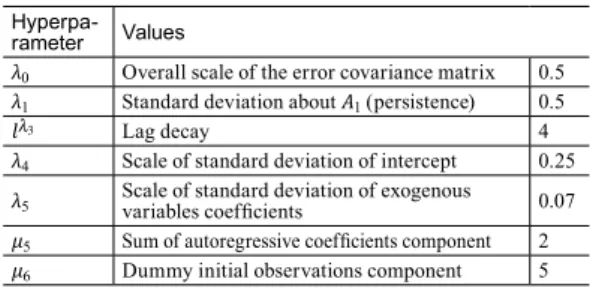
Responding to this need, a Bayesian Structural Vector Autoregressive (B-SVAR) model will be introduced in the first empirical analysis in order to comprehensively grasp the partial simultaneity of the politico-economic system, with shrinking the esti-mations of a number of parameters with respective to lags. Introducing an impulse-response function (IRF) lets us know the direction of economic and accountability shocks on political outcomes(Brandt & Freeman 2006, 2009, Sims & Zha 1998, 1999). The detailed setting of B-SVAR model is described in Appendix A.
Furthermore,the nuanced transition between economic and accountability voting in retrospection should be made to reflect estimations and not limited to a simultaneous relationship. Hence, the second empirical analysis will compute a historical decom-position (HDC) for the movement of cabinet approval ratings based on the B-SVAR estimation results23.
Besides checking multivariate shocks, IRF responses, and the shocks’ contributions to variances, an HDC can yield results of each variable’s contribution (public works spending, government expenditures, GDP) for the variable in question (approval ratings), which change over time. The HDC shares its foundation with the IRF, identifying which shock most reli-ably impacts the structural innovation of the versant variable. By using an HDC, the volatility of cabinet approval ratings can be decomposed into individual structural innovations of cabinet approvals and each component’s shock.
Frequently, an HDC is applied to calculate the decomposition of the GDP contribution ratio. In order to compute the simple GDP contribution ratio, contribution ratios of all factors such as private and
government final consumption expenditures, private and public fixed- capital formations, and private and public stock increases are identified with such as (the case of private final consumption 𝐶𝑡 ). A
decomposition of the contribution ratio is the most powerful method, but it is postulated that the GDP is equal to the summation of all elements. Further, the simple decomposition of contributions cannot capture each variable shock’s contributions. In this analysis, based on an SVAR setting, the main aim is the decomposition of the cabinet approval’s motion by each variable’s shock. Thus, an HDC is used rather than simple decomposition in formulating contributions. An HDC is expected to offer very nuanced transitions of the contributions of economic and accountability voting on cabinet approval vola-tility. Further information on the HDC’s setting is explained in Appendix B.
4 Empirical Analyses
4.1 The Case of Public Works
Based on the above settings, the estimated IRFs are shown in Figure 124. These are IRFs among cabinet
approvals, percentage changes from previous quar-ters of public works, and accountability relating to public works ([the actual percentage change of public investments(t)]-[the proposed percentage change of public investment in EPBS (t-1)]). Error bands are set at 10%, and each upper and lower level as 5%. According to the cell in the first row and the second column in Figure 1, the public investment IRF of one point of standard deviation shock is likely to lead to an approximate 0.10% rise in the cabinet approval’s rating response two quarters (half a year) later. Simi-larly, almost the same response can be enumerated from the shock of accountability relating to public investments; i.e., the positive deviation from the government proposed value. As pointed out in the literature on Japanese politics, citizens seem to prefer an increase of public works, which is regarded as the quid pro quo of social welfare.
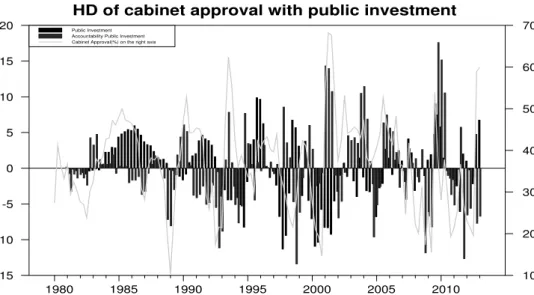
Further, in order to decompose each structural shock’s contribution to the volatility of cabinet approval, which varies over different periods, the HDC’s result with respect to public investment is
23 For HDC, see, Burbidge & Harrison (1985), Fackler & Parker (1994), Ocampo & Rodríguez (2012), and Doan (2010). 24 The calculation of B-SVAR models and their IRFs are conducted by “MSBVAR” package in R 3.0.1.
reported in Figure 225. Black bars represent the actual
public works’ contribution, i.e., economic voting, blue bars represent accountability and the green line represents the cabinet approval rating (percentage). Within the range of a quarterly period, black and blue bars are positioned in parallel and the relative contri-bution can be interpreted according to the length of each bar. For instance, in the last period, the first quarter of 2013, the black bar– i.e., the public works shock’s contribution–indicates a contribution ratio on cabinet approval of about +6%, while the blue bar–i.e., accountability respective to public invest-ment–is about -7.5. An interesting transition can be extrapolated according to this interpretation: at least during the 1980s, public investments per se (economic voting) is likely to predominate over accountability voting on public investments. Particularly from 1983
to 1988, the contributions of economic voting are exemplified through public investments (black bars) that correspond to cabinet approval. Against this, after 1993-94, it can be seen that accountability bars become increasingly accentuated and contributions of accountability of public investment (blue bars) are more in tandem with approval behavior, with a few exceptions during the period of 1999-2001. Clearly, when focusing on public investment, the decomposi-tion of cabinet approval with economic and account-ability voting reveals the importance of Japanese political context: after the electoral institutional reform in 1993- 94, accountability, i.e. the differ-ence between what the government says and what the government does, makes larger contributions to retrospective voting.
25 HDC were computed by RATS 8.30. Scripts for computations are available upon request.
4.2 The case of government expenditure
In contrast with the public works model, almost opposite IRFs are confirmed in the government expenditure model. In the very initial period–e.g., a quarter (three months) later–a one-point increase in the standard deviation of the government expen-diture’s shock leads to responses of a rise in cabinet approval by about 0.025%. But, after two quarters, it decreases to -0.05% and remains constant. Regarding accountability of government expenditure, almost same result can be found: an ascension of IRF appears about a quarter later. If the government tries to match what it proposes with what it supplies, it does not merely cause a reduction of public support but may cause an immediate rise in support. This IRF result also corroborates longstanding knowledge about Japanese politics: fiscal discipline is seen as the most important issues of political economy in Japan. Since the mid-1960s, the question of whether the Japanese government should issue construction bonds and to whom it should issue has been disputed. Because the issuance of bonds is prohibited by the Financial Acts in principle, citizens are disinclined to accept the issuance of bonds, and the Japanese government has long been cautious about finance debt. By the end of the 1990s, financial balance had become seriously deteriorated and citizens realized this. As the debt increased, an increase ingovern-ment expenditure per se was regarded as a dete-rioration of fiscal discipline, and thought to evoke disapproval (Fujimura 2009). This theoretical rela-tionship between debt issuance and approval ratings is backed by the IRF result in Figure 3
Interestingly, as shown in Figure 4, the HDC shows a different tendency from the public invest-ment model: accountability voting (blue bars) seems to predominate during almost all periods. This result likely fits the abovementioned context of Japan. Japanese voters have been apt to sanction the expansion of expenditures. The correspondence between accountability and cabinet approval ratings means rises in ratings are affected by an increase in accountability and falls in ratings by a decrease in it. Thus, in regard to government expenditures as a whole, rewards and punishments for the Japanese government have been clearly influenced by the aspect of accountability, depending on the extent to which the government promises to spend what it actually spends. “Talk the talk and walk the walk” seems to be mostly observed in the case of govern-ment expenditure.
Figure 3: B-SVAR: IRF of Government Expenditure Model
4.3 The case of GDP
Finally, as shown in Figure 5, the actual GDP shock forces approval ratings up immediately after the shock, but accountability relating to GDP seems not to. GDP has long functioned as the typical operation-alization and measurement of sociotropic economic voting. However, GDP per se does not directly embody what government implements for citizens. GDP is the product of comprehensive public and private economic activities. Hence, if emphasizing the aspect of what voters can obtain as an economic benefit from government distributions, the index of GDP is posed as the indirect operationaliza-tion benefit rather than a direct benefit of economic voting. In Figure 5, the actual GDP shock seems to reflect this indirect property and the original GDP shock does not bring about a continuing response of cabinet approval rating. However, the periods
sand-wiched between the significant intervals remain for two quarters and show positive signs. This indicates that socio-tropic economic voting relating to GDP is confirmed, albeit for only a short time.
In Figure 6, the contribution of accountability shocks is ascendant over the actual GDP shock from the initial periods to all periods. However, marginal effects are zigzagged around the zero line. These results are controversial and the impulse-response relationship between accountability on GDP and approval ratings seem limited, although account-ability makes up a large part of the residuals relating to cabinet approval ratings.
After organizing the relationships between each of the economic and accountability shocks and cabinet approvals, interpretations for IRFs–i.e., other shocks and responses–should be organized. The most obvious observation is that cabinet approval shocks do not evoke any significant response of public investments, government expenditures, or GDP, nor do the respective accountability shocks.
For other impulses and responses, the same holds for all three types of models, and accountability shocks reduce economic indicators themselves. In contrast, when the economy per se rises, account-ability is likely to rise as well. For example, in the cell in the second row and third column of Figure 1, a shock from accountability respective to public investment causes a negative response of public investment from -2 to -4%. In contrast, in the same Figure 1, the cell in the third row and second column, the shock from accountability causes about a 2% rise in public investment.
What causes this contrast? It seemingly occurs due to coordination by the government. When a posi-tive deviation from the proposed values in EPBS become large, this indicates that the government supplies more public investment and this places downward pressure on additional expenses for public works. When the economy is booming, in regard to the economic impulse on accountability’s response, the proposed values in EPBS should increase and
naturally cause more deviation between the proposed and actual values. As a result, the cell in the second row and third column shows a positive marginal response. The same interpretations can be applied to the results in Figure 3 and 5.
5 Discussions and Conclusions: Interpreting
Empirical Results in the Context of Japan
This research has performed an analysis of nuanced fluctuant change between economic and account-ability voting behaviors. In the empirics of retrospec-tive voting, economic voting is considered as the core by most voters, but those who scrutinize the correspondence between what government prom-ises and what it actually implements might lean toward accountability voting. In order to analyze the nuanced, critical, and policydimensional transi-tions between economic and accountability voting in developed countries, the author has highlighted Japan’s postwar politics. An electoral institutional change in Japan was presumed to yield implica-tions for retrospective voting: a critical change from economic voting to accountability voting. For inves-tigating the differences along the policy dimension, the author chooses three aspects of policy sphere: public works referring to private goods sphere, and government expenditure and GDP regarded as in public goods sphere. Using a B-SVAR model andHDC, nuanced voters’ transitions between economic/ accountability voting were confirmed in some anal-yses.
Based on a theoretical perspective of the elec-toral institutional change that occurred in 1993-94 in Japanese politics, a readily apprehensible and analyz-able change of economic voting and accountability voting was presumed to have occurred. Regarding the public works, as Figure 2 of the HDC analysis shows, this change was relatively corroborated. But the other two analyses–government expenditures and GDP analyses–do show emphatic contributions from accountability voting. As previously mentioned, public investment has functioned as a substitute policy for social welfare (Estévez-Abe 2008, Miura 2012, Kitayama 2003, Kohno & Nishizawa 1990). Public works in Japan have functioned as an arche-typal targeted private goods for voters. As the elec-toral institutional reform was intended to ameliorate the process by which pork is distributed, the graded transition between economic and accountability voting was expected to clearly change after the reform in the area of public works. Our positive finding can be posed as corroborating previous empirical evidence that private goods have more appeal to voters (e.g. McCubbins & Rosenbluth 1995, Saito 2010, Tatebayashi 2004). Direct deliberation of how goods are distributed seems to affect retrospec-tive voting more as a whole, regardless of whether economic or accountability voting is predominant.
As discussed in Section 4.2, however, entire government expenditures seem to call for account-ability retrospection, not economic retrospection. In actuality, general expenditure policy embraces expenditures for social welfare that are partially regarded as private goods, thus an increase is thought to make approval ratings rise. Because Japanese voters have been disinclined to see a financial expan-sion, the aim of government expenditures is not to too much increase government expenditures. Further, regarding the HDC analysis, the accountability-related contribution is clearer than the contribution of expenditures. When a deviation from the prospec-tive value is sufficiently small, voters reward the government and when it is large, they sanction the government. In regard to economic growth, the same tendency with government expenditures can be found in the HDC analysis.
In sum, in the case of public works, the
predomi-nance of economic voting seems to change sharply to accountability voting after the 1994 reform. But in other cases, clear-cut transitions before and after the reform do not appear and contributions of account-ability remain constant. Since nuanced transitions are positively confirmed in one case–public works, but not in the other two cases, the change after insti-tutional reform is not necessarily accentuated.
Why does the difference occur in public invest-ments and other economic aspects? The key is thought to be the degree in which economic indica-tors are related to the economic climate. In Japan, major industrial groups such as the Japan Federation of Economic Organizations, the Japan Association of Corporate Executives and the Japan Federation of Employers’ Associations promoted the need for public works projects as pump-priming measures and the LDP government responded vigorously, mainly with an eye to electoral outcomes. Public works, hence, has been closely linked to economic trends through the rise of employment (Miura 2012, Estévez-Abe 2008, Chaps. 8-9). Specifically focusing on the period from 1993 to 2000, the main trend relates to regulatory reform and small government orientation, and promotes the shrinkage of public investments. However, there is an opposing trend that is affected by political pressure from the above economic groups, and brings about the expansion of public works. The wild fluctuation of public works expenditures is likely to reflect fierce clashes between these two trends. Sometimes the shrinkage of public works deviates less from promised values as a mani-festation of accountability voting is highly evaluated, while in other times, the expansion of public works causing higher employment and an economic boost is more favored. In the former period, retrospective voting is expected to tend toward accountability voting and in the latter, toward economic voting. In fields heavily tinged by the economic climate through the amount of private goods such as public works, accountability retrospection tends to elapse, and economic voting seems activate. This in turn causes the nuanced change between economic/account-ability voting to vary at different time periods.
The impulse of whole government expenditure on the response of approval, however, is not quite as simple as in the case of public works. While govern-ment expenditure as a whole is not necessarily linked to the rise and fall of economic boom per se, an
increase in social welfare fulfills aspects of govern-ment expenditure that necessarily raise (corporate, income, consumption) tax rates, and can squeeze the private sector. As mentioned previously, an increase in government expenditure tends to be regarded as an erosion of fiscal discipline and conjures up the possi-bility of tax increases and then recession. In the case of government expenditure as a whole with respect to corporate income tax, influence from the economic groups that are sensitive to economic trends moti-vates the government to retrench expenditures and behave accountably. Voter behaviors are supposed to reflect accountability in response to government expenditure. Further, this simultaneously indicates that accountability voting as highly sophisticated retrospective voting is likely to predominate in matters of economic indicators including the public goods sector. In addition, along the line of classifica-tions, “talk-the-talk”/“walk-the-walk” politics (as explained in section 3.1) is highly evaluated in the public goods sphere. In contrast, in the private goods sphere, just “walk-the-walk politics” seems more desirable to voters. However, importantly, even in the private goods sphere, the electoral institutional change intended to transform resource distribution did alter voters’ retrospections from economic voting to accountability voting as shown in Figure 2 of public works case.
While this research considered endogeneity deeply and tries to account for it through the B-SVAR model, the endogeneity problem still remains. First, endogeneity in the measurement of economic and accountability indexes remains. The degree of accountability is computed as [the realized value of economic indicators]- [the proposed value of economic indicators in EPBS]. The realized value per se is set as the economic voting’s index, hence, the [β1𝑥economic + β2𝑥accountability] can be decomposed into [β1𝑥economic + β2𝑥economic − β2𝑥accountability]. In this research, this possible bias has not been consid-ered so that the pure impulse of accountability may not be understood. The accountability index should be conceptually defined as the deviation of the observed value from the government’s prom-ised value. Thus, the endogeniety stemming from the measurement should inevitably remain and be treated as the decomposed impulse of both economic and accountability indexes. Second, this research focused on government expenditures and emphasized
the importance of fiscal discipline. However, the government deficit shock on retrospective voting is also believed to be a prominent factor. Based on the present operationalization of accountability, which is defined as the difference between promise and imple-mentation, the proposed (promised) values of deficits cannot be set due to the limitation of the employed data. Thus, in order to compute the IRF and HDC between the deficitrelated- accountability and cabinet approval rating, other research designs should be employed. Large deficits compared with other devel-oped countries have now become a core issue in the Japanese political economy. Deficit shocks on retro-spection, thus, should be analyzed in future research with a new, well-considered study design.
A The Bayesian Structural Vector
Autoregressive Model
In this research, the estimating SVAR model setting with three-dimensional multivariate time-series model is as follows;
(1) Eq. (1) is the structural form of SVAR. Note that 𝑦𝑡
=(𝑦cabinet,t , 𝑦econ,t , 𝑦account,t)′means the 3 × 1 stacked row vector: cabinet approval, economic indicator (e.g. GDP, public investments, or government expen-ditures) , and its respective accountability. 𝐵0
repre-sents the 3 × 3 matrix of simultaneous effects, which diagonal components are 1. 𝑐 is the 3 × 1 vector of the constant term and 𝐵1, 𝐵2, 𝐵3 are 3 × 3 of the
coeffi-cient matrix of each lag. Regarding structural distur-bance terms, 𝜇t follows white noise with covariance matrix Σ. It also signifies normal structural shocks. Restricting identifications on some parameters of 𝐵0,
for example, the first line of equation in Eq. (1) can be set as the one for cabinet approval rating. For this set, 𝜇1t directly means a deviation from an expected
approval ratings attributed to economic and account-ability shocks. The structural form of SVAR cannot be solved in this form, because a simultaneous equa-tion embraces the bias, so it must be transformed into the reduced form with lagged components. The reduced form of SVAR can be represented as;