Preparing for Large Natural Catastrophes:
The current state and challenges of earthquake insurance in Japan
*Nobuyoshi YAMORI**, Taishi OKADA*** and Takeshi KOBAYASHI****
Abstract
Global incidents of major natural catastrophes are becoming increasingly common in recent years. Seismological research has shown earthquake-prone Japan to be at particular risk from not only inland earthquakes, but also from repeated incidents of major earthquakes such as the Tokai, Tonankai, and Nankai earthquakes. In such an eventuality, earthquake insurance is expected to play a part in nothing in the dictionary for this term may be “Post” or “Ex-post facts” recovery efforts from the damage caused by these earthquakes, with the Japanese government developing special support programs. The previously low penetration rate of earthquake insurance in Japan, however, meant that it did not play a significant role in recovery efforts following the 1995 Great Hanshin-Awaji Earthquake. Despite recent progress in improving the system and an increasing awareness of the risks from earthquakes, the penetration rate of earthquake insurance in Japan remains at approximately 20%. In this study we discuss the current state and issues of earthquake insurance in Japan.
1. Introduction
Recent years have witnessed the considerable damage caused by natural catastrophes such as earthquakes and strong winds (e.g., typhoons, hurricanes, and tornadoes). This is reflected in the number of natural catastrophes (excluding earthquakes) affecting Japan that have resulted in insurance payments of over 50 billion yen. Such large catastrophes occurred six times, with all of these coming after 1990 and four of these cases occurring after 1998. Of course, the intensification of such natural catastrophes caused by changes in the global environment is a global phenomenon and this trend is not only limited to Japan.
However, Japan is not only affected by natural catastrophes resulting from changes in climatic conditions, but also additional fears over damage resulting from seismic and volcanic activity. The country is currently facing a situation where there has yet to be any incidence of activity from the great Tokai Earthquake in over 150 years, and any repeat occurrence is * This research is financially supported by Grant-in-Aid for Scientific Research (KAKENHI).
** Professor, Graduate School of Economics, Nagoya University
*** Professor, School of Business Administration, Kwansei Gakuin University **** Professor, School of Economics, Chukyo University
expected to cause considerable damage over a wide area. Recent research has also indicated the possibility of very large-scale earthquakes, including the great Tokai Earthquake, great Tonankai Earthquake, and great Nankai Earthquake, affecting one another in the form of coupling between earthquakes, leading to the increasing likelihood of the scale of damage increasing.
In the event of a major earthquake in Japan, the government has no provision in place for providing direct financial assistance to those affected. In place of such direct aid, the government has looked to provide earthquake insurance backed by a certain degree of state involvement for rebuilding the affected area’s basic infrastructure. However, getting the affected populace back on track after an actual earthquake or other natural disaster such as wind and flood damage is not expected to proceed easily, and it is often said that the present insurance system is insufficient for playing the role expected of it. This has led to extremely pressing public demand for the development of an insurance system that can provide an efficient and inexpensive method of financial support for community recovery. In this study we examine how to provide an earthquake insurance system capable of creating a secure society, with a special focus on the role of government.
In Part 2, we examine the growing risk facing Japan from very large earthquakes, especially the threat from a future occurrence of the Tokai Earthquake type. In Part 3 we focus on the government’s role in implementing earthquake insurance and the structure and current state of earthquake insurance in Japan. Part 4 will discuss the government’s role in terms of issues facing the current earthquake insurance system in Japan and offer a conclusion.
2. Risks from the Rising Number of Natural Catastrophes 2.1 Earthquake Damage in Japan
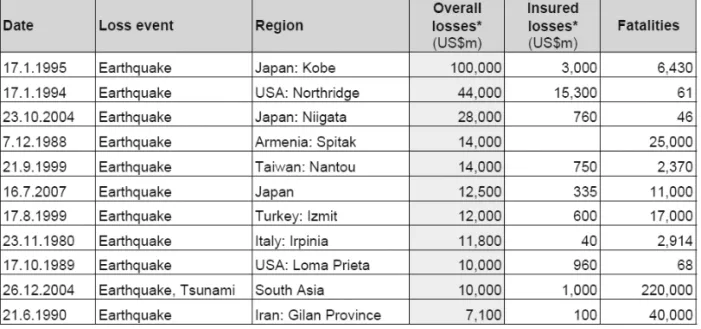
Examining the list of the 10 costliest global earthquakes from 1980 to 2007 in terms of financial loss as shown in Table 1, three of these can be see to have hit Japan. Seen in this light, then it is only natural to see an increasing interest in the topic of earthquake insurance in Japan.
Table 1 lists the amount of insured losses from these earthquakes. In contrast to the $3 billion in losses from the 1995 South Hyogo Prefecture Earthquake (Great Hanshin-Awaji Earthquake), insured losses from the 1994 Northridge Earthquake in California far exceeded them despite overall losses being less than half of those of the Kobe earthquake. This stark comparison indicates the extent to which losses from seismic damage in Japan in the event of an earthquake are the subject of considerably less compensation than in the United States.
Kunreuther and Michel-Kerjan (2007) highlights the ratio of total losses to insured losses for the South Hyogo Prefecture Earthquake being extremely high (27 times as much) among
developed countries, indicating a similar level to that of China (based on flood damage in China in 1996 and 1998 giving respective ratios of 30 and 50). This is in contrast to corresponding ratios of 2.8 for the Northridge Earthquake and 1.5 for damage from Hurricane Andrew (1992) in the United States. This indicates Japan’s unique position among developed countries in not providing sufficient compensation in the event of natural catastrophes such as earthquakes.
2.2 Concerns over Major Earthquakes
Japan’s position as a country prone to earthquake damage is reflected in statistics indicating a total of 24 earthquakes having caused damage to over 500 separate buildings since the Second World War (including volcanic activity), with the 1995 South Hyogo Prefecture Earthquake as the largest earthquake during that period. Of these 24 earthquakes, of interest is the recent frequent seismic activity, with 10 such major earthquakes having occurred since 2000 – indicative of the Japanese islands having entered a period of active
Table 1 Global Earthquake Damage (1980 to 2007)
Note: Fatalities/missing from the 2007 Niigataken Chuetsu-oki Earthquake currently stand at 15 (Japan’s Fire and Disaster Management Agency).
seismic activity.
People are concerned about an earthquake occurring directly below the Tokyo Capital Region, an re? of the Tokai Earthquake, or the Tonankai and Nankai coupling earthquake (Japanese Government’s 2008 White Paper on Disaster Management).
(1) Earthquake occurring directly below the Tokyo Capital Region
The forecast impending magnitude 7-class major earthquake (a 70% likelihood in the next 30 years according to forecasts from the Headquarters for Earthquake Research Promotion), will – depending on the actual conditions – lead to up to 11,000 fatalities and approximately 66.6 trillion yen in direct damages, with indirect damages coming to 45.2 trillion yen.
(2) Tokai Earthquake
Forecasts from the Headquarters for Earthquake Research Promotion provide an 87% likelihood of an earthquake in the Tokai region over the next 30 years. Damage arising directly from tremors alone will result in damage to 170,000 properties, with a further 30,000 buildings being affected by liquefaction, and up to 50,000 buildings being damaged by fire (given a wind speed of 15 m/s), resulting in damages to an estimated 260,000 properties. Maximum forecast fatalities are estimated at approximately 9200.
Looking to the scale of economic impact of such an earthquake, direct damages (including individual residences, businesses, and social infrastructure) will amount to approximately 26 trillion yen, compounded by indirect damages – such as damages from suspended industrial production, the disruption caused by stoppage of the east-west line shinkansen train service, and other factors impacting the nation’s economy) – expected to be roughly in the range of 11 trillion yen.
(3) Tonankai and Nankai coupling earthquake
In the event of strong tremors from a future Tonankai and Nankai coupling earthquake impacting the area stretching all the way from the Tokai to Kyushu regions, building damage from the tremors alone is forecast at up to 170,000 properties, with total building damage affecting between 330,000 to 370,000 properties. Maximum fatalities are expected to reach 18,000, with an estimated 43 trillion yen in direct damages and a further 14 trillion yen in indirect damages.
All of the estimated figures provided here far outstrip the corresponding figures for damages arising from the South Hyogo Prefecture Earthquake and there is an extremely high likelihood of a major earthquake hitting Japan. In terms of post-quake economic recovery, this is also expected to take place on a never-before-seen scale. As the damages will exceed the
degree envisioned for emergency measures, it is essential to take pre-disaster precautions. 3. Earthquake Insurance in Japan
3.1 The insurance Market for Major Earthquake Damage in Japan and the Need for Government Intervention
As outlined above, there are limits to private insurance companies’ provisions of insurance for large-scale risk in response to major natural catastrophes. This has led to a number of countries in which the government has intervened in a variety of differing ways in the insurance market . these are outlined in Table 2.
Examples of state intervention in providing coverage for damage arising from earthquakes and other natural disaster insurance – other than Japan – include New Zealand, Taiwan, Iceland, Turkey, Mexico, and the United States. New Zealand’s Earthquake Commission provides public earthquake insurance as a mandatory supplement to fire insurance (maximum coverage: 100,000 NZD for buildings; 20,000 NZD for personal effects), with private insurance firms offering coverage for areas not covered by public earthquake insurance.
Taiwan also requires earthquake insurance to be automatically included of as part of fire insurance policies . This also applies to mandatory earthquake insurance policies for urban housing in both Iceland and Turkey. Among other countries mentioned here, China is currently examining the creation of an insurance system that involves the government responding to major natural disasters1.
The United States, in addition to federal assistance programs such as the National Flood Insurance Program (NFIP), has state-level official bodies such as California’s California Earthquake Authority (CEA) and Florida’s Florida Hurricane Catastrophe Fund (FHCF) that provides re-insurance for hurricane-related damage. Florida also maintains the state-run Citizens Property Insurance Corporation that provides public flood insurance for the residual market.
3.2 History of Earthquake Insurance in Japan
Despite the need for insurance in post-earthquake recovery being well documented, commercial insurance companies did not offer earthquake insurance in Japan2. This led to the launch of Japan’s earthquake insurance system in 1966 (Table 3) following a political initiative after the 1964 Niigata Earthquake. This has resulted in the Japanese government adopting a special structure for contributing to earthquake insurance that is aimed at 1 For further information regarding international earthquake insurance systems, refer to Jishin Hoken
Kenkyu, Non-Life Insurance Rating Organization of Japan.
2 Obstacles to this include factors commonly pointed out as 1. Possibility of significant loss; 2. Difficulty in predicting timing and frequency of earthquakes; and 3. Possibility of widespread disaster.
T
able 2 International Ear
thquake Insurance Systems
Note:
Created based on Non-Life Insurance Rating Or
ganization of Japan’
s
Earthquake Insurance System in Japan
and Jishin Hoken Kenkyu . Country New Zealand T aiwan T urkey Japan Iceland Mexico California (CEA) Coverage Property , Property Housing in Property , All structures Property , Property , contents land, specific regions contents contents contents Mandatory Y es Y es Compulsory No Compulsory No No part of fir e participation participation insurance Government Guarantees Provides Oversees TCIP Provides Managed by Oversees Managed by CEA involvement payment of reinsurance (T urkey reinsurance wholly-owned private portion Catastrophe government insurance exceeding Insurance Pool) corporation companies
that payable by EQC
Insurance Uniform Uniform Categorized by Categorized Uniform Categorized Categorized by pr emium risk by risk by risk risk rate Private Private Private earthquake earthquake earthquake insurance insurance insurance also available also available also available
households3.
3.3 Structure of Earthquake Insurance in Japan
The subject of earthquake insurance in Japan is based on housing and home contents, with coverage against damage from fire, destruction, landslides, and flooding arising from earthquakes, volcanic activity, and tsunami. This form of earthquake insurance cannot be entered into independently and must be agreed to as part of a package with fire insurance coverage. Total insurance coverage from earthquake insurance ranges from 30% to 50% of fire insurance coverage, with an upper limit of 50 million yen for buildings and 10 million yen for home contents. Payment of insurance coverage for complete loss provides complete coverage (with an upper limit taken as the property’s market value), while half loss provides 50% of the insured total (with the same upper limit for property). Partial loss only provides for 5% of the total (with the same upper limit for property).
The structure in place for insuring properties against earthquakes in Japan is as follows. The contracting party concludes an earthquake insurance policy with a private nonlife insurance company. Although this company will normally purchase reinsurance coverage to transfer the risk assessed by the company to an external party, for earthquake insurance, the company will mandatorily reinsure the total amount with Japan Earthquake Reinsurance Co., Ltd.
Japan Earthquake Reinsurance was formed through a joint investment by insurance companies operating in Japan for the purpose of assuming reinsurance for earthquake insurance. For each reinsurance policy taken on by Japan Earthquake Reinsurance, part of the risk is borne by the original insurance company, part is shifted to the Japanese government’s special account for earthquake insurance, with the remaining risk assumed by Japan Earthquake Reinsurance.
In order to prevent payments of earthquake insurance becoming too large and leading to the bankruptcy of insurance companies or of the insurance system itself, an upper limit to insurance loss payments is in place for each of the insurance companies, government, and Japan Earthquake Reinsurance for each occurrence of an earthquake (providing a maximum total payout of 5.5 trillion yen).
This scheme is summarized in Figure 1. In case of payable insurance claims coming to less than 110 billion yen for each earthquake, the total amount is borne by Japan Earthquake 3 For earthquake insurance other than for housing, such as for factories and office buildings, earthquake preparation can be made through attaching an earthquake hazard special contract to regular fire insurance or storekeepers’ comprehensive insurance. This differs from the earthquake insurance for residential housing outlined here, with the government making no contribution and this is only provided by private insurance companies.
Reinsurance. In the case of claims exceeding 110 billion yen, both the government and insurance companies will also be responsible for payment. For example, in the case of payable insurance claims in the event of an earthquake totaling 1 trillion yen, in line with the structure shown in Figure 1, Japan Earthquake Reinsurance will bear 110 billion yen of this sum, insurance companies will pay 445 billion yen, with the Japanese government responsible for the remaining 445 billion yen. In the event of total payable losses rising into the trillions of yen, the government will bear the majority of payouts. This system has been developed to ensure that commercial insurance companies avoid entering difficult financial circumstances in the event of a major earthquake.
Table 3 History of Earthquake Insurance in Japan
1964 Niigata Earthquake (highlights increasing demand for establishing an earthquake insurance system in Japan)
1966 Earthquake Insurance Law enacted, launch of earthquake insurance system (compensation only in case of complete loss)
1980 Coverage expanded (compensation for both complete loss and half loss)
1991 Coverage expanded (compensation for complete loss, half loss, and partial loss) 1996 Content of home contents coverage improved, upper limit to coverage increased 2001 Earthquake insurance premiums partially reduced, discount system for buildings’
aseismic capacity introduced (highly earthquake-resistant discount, building age discount)
2007 Earthquake insurance premium deductions created (certain amount of insurance premiums are tax deductable, provision of tax incentives)
2007 Earthquake insurance premiums revised (comprehensive review of method used for calculation), discount system expanded (seismic isolation building discount, earthquake-proof diagnosis discount)
3.4 Earthquake Insurance Premiums
The public nature of earthquake insurance makes it different from normal commercial insurance products, operating on the principle of no-profit, no-loss for insurance companies to set the relevant insurance premiums.
The framework for earthquake insurance premiums is as follows. Insurance premiums for earthquake insurance are set at a price based on rates that differ by prefecture and calculated according to factors such as the probability of an earthquake occurring in that district. Japan is essentially divided into four different regions for the purposes of determining insurance premiums based on the size of earthquake risk. The region with the lowest risk of an earthquake occurring is Region 1 centered in the northern part of Japan in Iwate, while Region 4 – the area with the highest likelihood of an earthquake occurring – runs through the densely populated urban area from Tokyo to Nagoya and Osaka. While the probability of a seismic event also differs on an individual prefectural level, prefectures that are recognized as having similar characteristics are categorized together under this system.
Insurance premiums also differ depending on building construction (whether properties are Figure 1
timber or non-timber buildings). As an example, the annual insurance premium for each 1000 yen of earthquake insurance coverage in Akita Prefecture – which is in the region with the lowest probability of an earthquake occurring – comes to 1.0 yen for a timber house and 0.5 yen for a non-timber structure. Applying these figures to total insured coverage of 10 million yen would provide annual insurance premiums of 10,000 yen and 5000 yen, respectively, for timber and non-timber properties. These figures rise to 3.13 yen for timber structures and 1.69 yen for non-timber buildings per 1000 yen of annual insurance coverage in Tokyo, Kanagawa, and Shizuoka prefectures, which have the highest earthquake insurance rates in Japan.
Buildings that meet specific standards are also eligible for a reduction in their earthquake insurance premiums through the highly earthquake-resistant buildings and building age discounts. These not only provide for a reduction in insurance premiums, but are also intended to act as an incentive for increasing the number of earthquake-resistant buildings. 3.5 Earthquake Insurance Products Offered Independently by Commercial Insurance
Companies
Recent years have seen commercial insurance companies also offer their own insurance products that provide coverage for earthquake damage4. For example, short-term and small amount insurers provide simple insurance products where consumers and insurers can enter into a separate agreement from traditional earthquake insurance. A fire insurance product that increases the upper limit of insurance payments for earthquake fire insurance from 5% to between 30% to 50% is also available. Furthermore, a new fire insurance whose coverage for fire damage from an earthquake can be set at the same amount as insurance payments of the fire insurance is sold.
3.6 Mutual Aid Offered by Local Municipalities
Due to its being severely affected by the South Hyogo Prefecture Earthquake, the prefectural government of Hyogo Prefecture has created a compensation system for housing damage caused by natural catastrophes, including by earthquakes, known as the Hyogo Prefecture House Rehabilitation Mutual Aid Fund. This system provides for members who pay a 5000 yen annual insurance premium per property to receive up to a maximum of 6 million yen in compensation in the event of their house being more than partially destroyed from an earthquake.
4 While JA Kyosai’s mutual benefit aid for building rehabilitation was originally intended to provide coverage for damage from earthquakes, JA Kyosai differs from private insurance companies in not benefitting from government involvement but rather utilizes the global reinsurance market to diversify risk in providing safeguards from earthquakes.
3.7 Consumer Awareness
The “Consumer Awareness Survey Regarding the Danger of Major Earthquakes” (Jishin Hoken Kenkyu, No.5, August, 2004) conducted by the Non-Life Insurance Rating Association of Japan has been one of the few large-scale surveys of attitudes regarding household earthquake insurance conducted in Japan. In this section we will focus on consumer awareness of household earthquake insurance among Japanese consumers based on the findings of this survey.
This nationwide survey was conducted in September 2003 in 3700 households. Respondents consisted of 1435 policyholders of earthquake insurance, 961 with only fire insurance, and a further 965 who were not covered by nonlife insurance, giving the total number of respondents as 3361.
First, we calculate average survey values by awarding a series of points for respondents’ subjective answers to the potential of damage to residential property caused by an earthquake. Respondents answering “Extremely high potential of damage” were awarded 2 points; “High potential of damage” were awarded 1 point; “Low potential of damage” were given -1 points; “Extremely low potential of damage” were given -2 points; and “Neither/Don’t Know” were awarded 0 points. Average values for earthquake insurance policyholders came to 0.3, while for policyholders of fire insurance only this fell to 0.0, but came to 0.1 for the uninsured. Despite the subjective probability rate of earthquake damage being higher among those covered by earthquake insurance, this was not sufficient to indicate any significant difference.
At the same time, the survey revealed that a majority of respondents thought that there was a high risk of such damage occurring, while not buying any form of earthquake coverage. Looking at the results by region, the Chubu region had the highest score of 0.5, while respondents of Hokkaido had the lowest score at -0.4.
When asked regarding their preparedness for a major earthquake, 86.8% of respondents who had earthquake insurance coverage responded that they “Had entered earthquake insurance or mutual insurance coverage,” while 33.3% replied that they “Had considered the method of construction and manufacturing of residential property at time of construction.” Respondents with earthquake insurance coverage displayed progress in preparedness for a major earthquake, indicating this group’s strong awareness of the risk associated with earthquakes. For example, in looking at the ratio of responses to the question “Had they considered the method of construction and manufacturing of residential property at time of construction,” only 27.2% of fire-only insured respondents replied positively, while the figure fell to 17.9% for non-insured respondents. These results also confirm the lack of moral hazard in earthquake insurance; namely, entering into earthquake insurance does not indicate any deterioration in policyholders’ preparedness towards earthquake risk. For example, in looking at the ratio of responses to the question of “Changes in layout and fall prevention measures to
fix furniture etc.,” 28.8% of respondents covered by earthquake insurance had taken such measures, while this fell to 24.3% of respondents only covered by fire insurance and 23.7% of non-insured respondents.
Turning next to the results of questions asked regarding awareness of earthquake insurance, recognition that “Fire insurance does not provide compensation for fires caused by earthquakes” was 83.8% among earthquake insurance policyholders, falling to 80.6% among respondents only with fire insurance, and 70.3% among respondents lacking nonlife insurance. While a recognition rate of over 80% can be seen as relatively high, the fact that up to 20% of those not covered by fire insurance are unaware that they will not receive compensation in the event of fire damage caused by an earthquake is an issue that cannot be ignored.
To the question of “Necessity of earthquake insurance,” respondents who held earthquake insurance naturally tended to answer “Necessary,” with 78.7% of such respondents answering in this way. Of particular interest is the response of “Don’t know” with response rates of 47.3% for those only covered by fire insurance and 46.7% for the uninsured, indicating the possibility that consumer awareness of earthquake insurance remains insufficient in Japan. 3.8 Challenges Facing Earthquake Insurance in Japan
3.8.1 Low Penetration Rate
Figure 2 shows changes in the penetration rate of earthquake insurance in Japan. At the time of the 1995 South Hyogo Prefecture Earthquake, the penetration rate of earthquake insurance stood at only 7%, falling to 3% when limited to Hyogo Prefecture – the epicenter of the earthquake. Since then, rising awareness of earthquake risk has seen this penetration rate increase to a nationwide average of 21.52% as of March 2008 (which is 41.7% of the number of fire insurance policies). In order to support individual efforts in preparing for loss due to earthquake damage, Japan’s existing nonlife insurance premium deduction in terms of income tax was overhauled from January 2007, and an earthquake insurance premium deduction was established (earthquake insurance premium deduction from income system). While a number of factors make detailed analysis difficult, the participation rate in earthquake insurance has shown firm signs of an increase, from a nationwide figure of 20.1% at the end of 2005 (March 2006) to 20.8% at the end of the 2006 financial year and up to 21.4% at the end of FY 2007.
Prefectures that are expected to witness significant earthquake damage, in particular, are showing a high penetration rate for earthquake insurance, led by Tokyo at 28.84%, followed by Kanagawa (27.39%), Shizuoka (24.15%), and Aichi (33.42%) (as of March 2008; survey conducted by Japan Earthquake Reinsurance).
natural catastrophes and the building renovation mutual fund provided by JA Kyosai also cover damages and loss due from earthquakes in the same way as earthquake insurance, so that the effective penetration rate of preparedness for earthquakes through insurance is increasing. However, while it remains at the level of 20% this penetration rate cannot be said to be sufficient.
Reasons for this low level of penetration of earthquake insurance are threefold: adverse selection, underestimation of earthquake risk, and lack of trust in earthquake insurance. Turning to the issue of adverse selection first, although location and house structure are different in terms of risks from earthquake damage, these differences are not sufficiently reflected in the insurance premiums. This, therefore, means that the more risky the individual, insurance premiums will become relatively cheaper and the individual willing to purchase insurance, but despite this in order to maintain an insurance system this requires setting insurance premiums highly, so that the number of people thinking they are relatively high will increase. The fact that there are regions having high earthquake insurance penetration rates and having low rates probably reflects this fact.
The second issue of underestimating the risk posed by earthquakes involves many people believing that the risk from extremely rare earthquakes stands at zero, with a subsequent tendency to ignore efforts to prepare for such an eventuality. Underestimation of earthquake risk can be seen from the sudden increase in insurance participation rates following an earthquake, despite there being no seismological change in earthquake risk.
Thirdly, the low level of penetration indicates a lack of trust in Japan’s earthquake insurance system. This is partly due to the strict conditions imposed on payment of earthquake insurance, such as significant differences in assessing the extent and value of damage to property following an earthquake by the policyholder and the insurance company. While the insured party may feel that they have to repair and rebuild the entire property in order to provide a home suitable for living, the insurance company takes the view that the losses are not as severe as the policyholder feels. As earthquake insurance differs from other forms of insurance in actual incidences of earthquakes being comparatively rare, this means that few consumers have the actual experience of receiving an earthquake insurance payment. Therefore, newspaper reports about trouble regarding payment issues in turn lead to a spreading sense of mistrust and a diluting of the brand associated with earthquake insurance5.
One other factor behind the low level of penetration of earthquake insurance has been pointed out as being that purchasing earthquake insurance for holders of fire insurance 5 Fujimi and Tatano (2006) conducted an independent questionnaire in Kyoto Prefecture that highlighted vagueness in insurance payments from earthquake insurance as significantly reducing demand for such insurance. Results from this study indicated that a 1% rate of non-payment probability led to reduction in respondents’ value of earthquake insurance by almost half.
policies is optional in Japan. In countries such as Taiwan and New Zealand, the insurance system requires earthquake insurance to be automatically provided as part of fire insurance policies.
For a country such as Japan that is prone to damage from earthquakes, however, premiums for earthquake insurance are unavoidably higher than those for fire insurance. This therefore makes any automatic addition of earthquake insurance to fire insurance policies extremely expensive, and has provoked concerns that many consumers may be put off from actually purchasing fire insurance due to the prohibitive cost of such an increase. Seen in this light, it is not necessarily the case that mandatory earthquake insurance will lead to benefits for the consumer.
3.8.2 Effects of 2007 Reform
Japan’s earthquake insurance system underwent reform in October 2007, which involved the introduction of new features such as discounts for seismic isolation buildings (30%) and for earthquake-proof diagnosis (10%). This was accompanied by a review of earthquake risk in each prefecture and significant revision of insurance premiums.
The largest increase in the October 2007 revision to insurance premiums was seen in Chiba, Aichi, Mie, and Wakayama prefectures. For non-timber buildings this resulted in a 3400 yen increase (i.e., from 13,500 yen to 16,900 yen) in annual earthquake insurance premiums for cover of 1 million yen. Timber houses subject to these highest insurance
Figure 2 Changes in Percentage of Earthquake Insurance Policyholders
premiums also witnessed a significant increase of 7100 yen.
Figure 3 demonstrates the relationship between this change in insurance premiums and an increase in the earthquake insurance coverage rate from 2005 to the end of 2007. This clearly shows a downward slope during this period, indicating that coverage increased the most in areas that experienced a reduction in the insurance premium. For example, Shiga Prefecture saw a reduction in insurance premiums by over 50%, from 13,500 yen to 6500 yen, and subsequently witnessed strongest growth in coverage among all of Japan’s 47 prefectures.
3.8.3 Low Upper Limits on Insurance Coverage
Earthquake insurance in Japan has a fixed upper ceiling of 50% of the total insurance coverage for fire insurance payments. It also differs from fire insurance in having no option to provide a value agreement, with the market value of the property in question being assessed as the amount of damages making up the basis of the insurance payment. This leads to a high likelihood of the earthquake insurance policyholder being unable to rebuild his property even after receiving the insurance payment following an earthquake.
The reason for restricting insurance payments in this manner is based on consideration of the potential for substantial insurance payments in the event of a major earthquake, and this can be understood in terms of the insurance system’s economic viability. However, when viewed from the perspective of consumers, such payments are insufficient to provide for Figure 3 Relationship between increase in earthquake insurance coverage rate from
2005 to the end of 2007 and revision to insurance premiums in October 2007
Note: Revision to insurance premium rates is based on coverage of 10 million yen for non-timber buildings
economic recovery.
Due to the recent launch of insurance products that provide additional coverage for damages from earthquakes by commercial insurance companies, this means that if insurance premiums burdens are not a concern, then combining such products with government-supported earthquake insurance alleviates the issue of upper limits on insurance payments from earthquake damage to a certain extent. The important issue is whether insurance companies will actually make payment for damages as stipulated in the insurance policy, when a major earthquake occurs.
3.8.4 Upper Limits on Total Insurance Payments for One-off Earthquake
At the time of the South Hyogo Prefecture Earthquake in 1995, the upper limit on total insurance payments for earthquake insurance in Japan totaled 1.8 trillion yen. In the event of total insurance payments exceeding this amount, the sums payable to each contracted party would have to be reduced. In the case of the South Hyogo Prefecture Earthquake, total damages covered by earthquake insurance came to 783 billion yen. The reason for the total insurance payments being smaller in comparison to actual damage in this case was due to the extremely low penetration rate of earthquake insurance at the time.
However, in the event of a major earthquake in the more densely populated Tokyo metropolitan region with its comparatively higher penetration rate of earthquake insurance, there is a risk that insurance payments would exceed this upper limit on payments and total payments have to be reduced. Faced with this reality, the upper limit on insurance payments was gradually increased following the South Hyogo Prefecture Earthquake and as of April 2008 it had been raised to 5.5 trillion yen. This is an amount expected to provide for full payment even in the event of a major earthquake comparable to the 1923 Great Kanto Earthquake. However, if required, insurance payments to individuals may be reduced and this issue still remains as a factor for some consumers in diminishing the attraction of purchasing earthquake insurance.
4. Conclusions: The Role of Government in Earthquake Insurance 4.1 Setting Insurance Premium Rates
Considering what the role of the state should be in providing insurance for major earthquake damage, Cummins (2006) states that in order to remove roadblocks to comercial insurance companies involvement in this field, the government should set insurance premiums by considering the same risk and margin as commercial insurance companies for insurance and reinsurance.
Picard (2008) highlights the importance of risk-proportionate insurance premiums. According to Picard, an insurance premium system that does not reflect any risk (for example
a uniform nationwide system) hinders the movement of individuals from high risk regions to low risk regions and is therefore not desirable. Setting high insurance premiums for regions most at risk of an earthquake acts as an incentive for residents to move to areas that are less at risk, allowing for a reduction of the population located in high risk regions that require measures to deal with earthquake damage. Picard regards some element of disparity in insurance premiums as necessary and concluded by recommending a combination of competitive insurance premiums reflecting risk, taxes, and subsidies.
In contrast, a study by Grace, Klein and Kleindorfer (2004) found that price elasticity of demand for insurance that covers damage from major earthquakes – and especially in regions that had a high insurance premium (due to frequent seismic activity) – was large. This line of argument concludes with the idea that in order to disseminate insurance for major earthquakes, controlling insurance premiums in regions with a high risk or high insurance premium rates is effective (although this may present a financial problem and require solutions for dealing with distortion on the market).
Insurance premium rates for earthquake insurance in Japan vary from prefecture to prefecture, with the maximum disparity between regions coming to 3.38 (as of 2008). According to the “General Seismic Hazard Map Covering the Whole of Japan” produced by the Headquarters for Earthquake Research Promotion, the likelihood of an over magnitude 6 earthquake affecting Japan in the next 30 years varies drastically from region to region from as much as 26% to less than 0.1%. Regarding this point, the Nonlife Insurance Rating Organization of Japan’s “Outline of Basic Earthquake Insurance Rates” states that “Calculation of earthquake insurance rate is based on data used in the creation of the ‘General Seismic Hazard Map Covering the Whole of Japan’ produced by the Japanese government’s Headquarters for Earthquake Research Promotion.” Despite this, it remains unclear as to whether earthquake insurance premium rates are being applied consistently in line with this General Seismic Hazard Map. The likelihood of an earthquake occurring also differs within a prefecture, which leads to an argument over the validity of setting prefecture-base insurance rates.
4.2 Mandatory Participation and Addition of Earthquake Insurance
Examples of earthquake insurance systems from countries other than Japan – such as the mandatory participation system in place in Iceland and Turkey, or compulsory supplement to fire insurance implemented in both New Zealand and Taiwan – continue to provoke debate among researchers in this field. Faure (2006) notes that the fact that a mandatory insurance system generally deprives the consumer of any freedom of choice is one defect of such a system, while in cases of entrusting consumers with the freedom as to whether to purchase earthquake insurance, there is a negative externality (i.e., consumers who did not purchase
earthquake insurance transfer their losses to other people after the event. In many cases, the financial assistance of the government is demanded). A further study involving the same author (Van den Berge and Faure (2006)), also noted that ad-hoc governmental assistance (or provided by a fund established before the event) was a false incentive for consumers in terms of factors such as encouraging earthquake-proofing improvements to properties and was therefore not desirable. In spite of such a system’s competitive disadvantage in depriving consumers of any freedom, they argue that a system of compulsory addition of earthquake insurance to other insurance policies for compensating damages from natural catastrophes would be a better option in terms of encouraging preparation for such an eventuality.
Kunreuther and Pauly (2006) make the point that taking on multiple risk makes it difficult for insurance companies to bring about diversification of risk and to identify the cause of damage (specifically, the authors use the example of properties lost in Hurricane Katrina in the U.S., which were difficult to determine whether they had been destroyed by wind or flood damage). The authors accordingly recommend provision of comprehensive insurance for residential properties that provide cover for both earthquake and flood damage. The sale of insurance products that encompass multiple risks would raise the frequency of making insurance payments, thereby relieving the issue of ignorable events, and provide an incentive for consumers to actually purchase such insurance policies. The same authors (Kunreuther and Pauly (2006)) also put forward a four stage insurance system, which consists of the self-reliant part (or the indemnity), the risk covered by policies from commercial insurance companies, the risk being transferred to reinsurance or CAT bonds, and the reinsurance of the federal or state government.
In contrast, a study by Harrington and Niehaus (2001) found that government provision of insurance or reinsurance was not effective due to factors such as its susceptibility to political pressure, observing that an alternative approach of preparing a taxation-based incentive that eased accumulation of capital was preferable for commercial insurance companies in dealing with large scale risk.
From January 2007, in order to support independent efforts among Japanese consumers towards preparing for losses arising from natural catastrophes, revisions to the existing nonlife insurance premium deductions were performed, and a deduction for earthquake insurance premiums was created (earthquake insurance premium deduction from income system). This allows for consumers to deduct a maximum of 50,000 yen regarding income tax (national tax) and up to 25,000 yen regarding local inhabitants’ tax (regional tax) from their gross income. This is intended to promote further independent efforts among consumers to obtain earthquake insurance coverage. For consumers able to bear the cost of such insurance premiums, this is thought to be a beneficial system for promoting efforts to prepare for such an eventuality through earthquake insurance.
4.3 Potential Use of Market Function
While the ability of individual consumers to make direct use of financial markets to transfer earthquake risk is difficult, the potential for indirect use of the securities market through securitization is increasing with developments in financial technology. In this section we will discuss use of catastrophe (CAT) bonds that are becoming an increasingly popular tool in Japan in looking to hedge against earthquake risk.
CAT bonds (so called for their use in time of CATastrophe) are a type of bond that, in the event of a major natural catastrophe meeting predetermined conditions, have attached provisions exempting the issuing company from payment of all or part of the bond’s interest or principal. CAT bonds are frequently used to provide cover for damages from natural disasters such as earthquakes and hurricanes. Such damage can cause companies to experience loss of profits and have an adverse effect on management, and by issuing CAT bonds, companies can alleviate the burden of having to pay back principal when affected by such circumstances and contribute to management stability. Nonlife insurance companies who have taken on nonlife insurance risk can also issue CAT bonds as an alternative to reinsurance when looking to transfer this risk to other parties.
One well known case of a Japanese company utilizing CAT bonds was the bond issued in 1999 by Oriental Land Co., Ltd. – the management company running Tokyo Disney Resort. This provided for two types of CAT bonds, up to a 100% exemption on payment of the bond’s principal or an extension of the redemption date, depending on the magnitude and distance to the source from the location of Tokyo Disney Resort in the event of an earthquake.
The structure of the bond was as follows6. The bond provided provisions in the event of an earthquake occurring within a given inner radius of Tokyo Disneyland of 10 kilometers, a middle band of 50 kilometers, and an outer ring of 75 kilometers. An earthquake occurring within the innermost ring exempted the company from payment of the original principal. In this case, an earthquake of magnitude 6.5 would exempt the company from repayment of 25% of the principal, with each increase in magnitude of 0.1 increasing the exemption rate by 7.5%. This would continue up to an earthquake of 7.5 magnitude or above, which would exempt the company entirely from repaying the bond’s original principal. An earthquake occurring within the inner radius and middle band would exempt the company from paying back 25% of the original principal of the bond in the event of a magnitude 7.1 earthquake, with a 12.5% rise in the exemption rate for each 0.1 increase in magnitude after that. Forgiving the bond’s principal was also subject to specific exemptions in the event of an earthquake occurring between the middle band and outer ring.
6 Hijikata, K. (2001) Explaining Insurance Derivatives, Nikkei Publishing Inc., and Ministry of Economy, Trade and Industry’s Report of the Risk Finance Group, Toward the Prevalence of Risk Finance (see http://www.meti.go.jp/report/data/g60630aj.html).
This type of bond allows Oriental Land to prepare for a recovery in the event of a major earthquake having detrimental effects on management due to declining visitor numbers through providing an exemption from repayment of part of the original bond. By also providing for extending the bond’s repayment deadline, the company can also maintain the necessary capital required for management in the immediate future. This bond attaches beneficial conditions for the issuing party while trading this off in the form of higher than normal payment of interest to holders of such bonds, which can actually be seen as an insurance premium. These CAT bonds can also be thought of as a financial product that combines straight corporate bonds and earthquake derivatives.
CAT bonds can be seen as one way of avoiding the risk that commercial insurance companies do not accept. These bonds offer the opportunity to avoid risk with beneficial conditions for the issuer through issuing bonds in the extremely competitive corporate bond market that not only includes insurance companies, but general investors as well. Seen from the point of view of the investor, CAT bonds and weather derivatives are attractive because their price fluctuation is not found in other financial products such as stocks, corporate bonds, crude oil, or agricultural-related financial instruments. Products such as CAT bonds that offer price fluctuation due to changes in the likelihood of a natural catastrophe are relatively rare among existing financial products. Following the basic principles of finance, undertaking a diversified investment in a variety of financial products with differing price movements is effective in limiting risk from investment. Existing financial products that offer price fluctuation such as CAT bonds and weather derivatives can be seen as an attractive product for investors wishing to assume a diversified investment.
Transferring risk in this way through use of the securities market traditionally provides advantages for taking on competitive risk for diverse investors, but in a similar fashion to the commercial paper market following the collapse of the U.S. investment bank Lehman Brothers in September 2008, it can also be said that the number of recipients of risk from the securities market has been decreasing. Moreover, in contrast to insurance companies, in the case of general investors taking on such risk, this requires a method to confirm that these investors can actually take on this earthquake risk. One of these methods is through bond rating, which is, however, faced with rising uncertainty over its usefulness.
The CAT bond issued by Oriental Land, which allows Oriental Land not to repay when the earthquake damage occurs, does not concern over credit risk on the issuer side. However, as investors looking at CAT bonds, in addition to the burden of earthquake risk shifting to investors, they also have to be aware of shouldering the issuing company’s credit risk. Even for those investors who are fully aware of taking on earthquake risk, in case of assessment of credit risk (of the issuer) being difficult, this will lead to investors in CAT bonds decreasing.
effective and establishing such a system is expected to take time. References
Botzen, W. J. W. and van den Bergh, J. C. J. M. (2008) “Insurance against Climate Change and Flooding in the Netherlands: Present, Future and Comparison with Other Countries” Risk Analysis. Vol.28, No.2, pp.413-426.
Conning Research and Consulting (2006) “The Economic and Insurance Impact of an Avian Flu Pandemic” Conning Commentary, Vol.15, No.6. pp.1-3.
Cummins, J. D. (2006) “Should the Government Provide Insurance for Catastrophes?” Review, Federal Reserve Bank of St. Louis, July/August pp.337-380.
Dreyer, A., G. Kritzinger, and J. D. Decker (2007) “Assessing the Impact of a Pandemic on the Life Insurance Industry in South Africa” RGA Reinsurance Group of South Africa.
Faure, M. G. (2006) “Economic Criteria for Compulsory Insurance” Geneva Papers, Vol.31, pp.149-168. Froot, K. A. and S. E. Posner (2002) “The Pricing of Event Risks with Parameter Uncertainty” Geneva
Paper on Risk and Insurance Theory, Vol.27, pp.153-165.
Fujimi, T., and H. Tatano (2006) “Ambiguity, Risk and Earthquake Insurance Premiums: An Empirical Analysis,” Journal of Disas. Prev. Res. Inst., Kyoto University, No.49 C pp.137-145.
Grace, M. F., R. W. Klein, and P. R. Kleindorfer (2004) “Homeowners Insurance with Bundled Catastrophe Coverage” Journal of Risk and Insurance Vol.71. No.3 pp.351-379.
Hallstrom, D.G. and V. K. Smith (2005) “Market Responses to Hurricanes” Journal of Environmental Economics and Management, Vol.50, pp.541-561.
Harrington, S. E. and G. Niehaus (2001) “Government Insurance, Tax Policy, and the Affordability and Availability of Catastrophe Insurance” Journal of Insurance Regulation, Vol.19, pp.591-612.
Hubbard, R. G. and B. Dean (2004) “The Economic Effects of Federal Participation in Terrorism Risk” Analysis Group. September.
Jaffe, D. M. and T. Russell (1997) “Catastrophe Insurance, Capital Markets, and Uninsurable Risks” Journal of Risk and Insurance, Vol. 64, No.2, pp.205-230.
Jaffe, D. M. and T. Russell (2004) “Should Governments Support the Private Terrorism Insurance Market?” The Financier, Vol,11-12 pp.20-28.
Kunreuther, H. (1996) “Mitigating Disaster Losses through Insurance” Journal of Risk and Uncertainty, Vol.12 pp.171-187.
Kunreuther, H. (2001) “Mitigation and Financial Risk Management for Natural Hazards” Geneva Papers on Risk and Insurance, Vol.26, No.2, pp.277-296.
Kunreuther, H. (2006) “Rules Rather Discretion: Lessons from Hurricane Katrina” Journal of Risk and Uncertainty, Vol.33 pp.101-116.
Kunreuther, H. and M. Pauly (2006) “Rules Rather than Discretion: Lessons from Hurricane Katrina” Journal of Risk and Uncertainty Vol.33 pp.101-116.
Kunreuther, H. C. and E. O. Michel-Kerjan (2007) “Climate Change, Insurability of Large-Scale Disasters, and the Emerging Liability Challenge” University of Pennsylvania Law Review, Vol.155 pp.1795-1842. Michel-Kerjan, E. and B. Pedall (2005) “Terrorism Risk Coverage in the Post-9/11 Era: A Comparison of
New Public-Private Partnership in France, Germany and the U.S.” Geneva Papers, Vol.30, pp.144-170. Michel-Kerjan, E. and B. Pedall (2006) “How Does the Corporate would Cope with Mega-Terrorism?
Puzzling Evidence from Terrorism Insurance Markets” Journal of Applied Corporate Finance, Vol. 18, No.4 pp.61-75.
Risk Management Solutions (2006) “Catastrophe Mortality in Japan”.
Picard, P. (2008) “Natural Disaster Insurance and the Equity-Efficiency Trade-Off” Journal of Risk and Insurance, Vol.75. No.1. pp.17-38.
Sawada, Y. and S. Shimizutani (2007) “Consumption Insurance against Natural Disasters: Evidence from the Great Hanshin-Awaji (Kobe) Earthquake” Applied Economics Letters Vol.14 pp.303-306.
Sawada, Y. and S. Shimizutani (2008) “How Do People Cope with Natural Disasters? Evidence from the Great Hanshin-Awaji (Kobe) Earthquake in 1995” Journal of Money, Credit and Banking, Vol.40, No.2-3 pp.46No.2-3-488.
Smith, V. K., J. C. Carbone, J. C. Pope, D. G. Hallstrom, and M E. Darden (2006) “Adjusting to Natural Disasters” Journal of Risk and Uncertainty, Vol. 33 pp.37-54.
Van den Bergh, R. and M. Faure (2006) “Compulsory Insurance of Loss to Property Caused by Natural Disasters: Competition or Solidarity?” World Competition, Vol. 29, No.1, pp.25-54.
Yamori, Nobuyoshi, and Takeshi Kobayashi (2002), “Do Japanese Insurers Benefit from a Catastrophic Event? Market Reaction to the 1995 Hanshin-Awaji Earthquake” Journal of Japanese and International Economies 16, pp.92-108.