新規キノロン系抗菌薬 lascufloxacin 錠の 薬剤プロファイル
舘田 一博1)・谷岡幸代子2)・戸塚 恭一3)・河野 茂4)
1)東邦大学医学部微生物・感染症学講座*
2)杏林製薬株式会社創薬本部研究開発管理部
3)大坪会北多摩病院
4)長崎大学
受付日:2019 年 10 月 30 日 受理日:2020 年 7 月 22 日
ラスクフロキサシン塩酸塩(lascufloxacin:LSFX)は,呼吸器・耳鼻咽喉科領域感染症の新たな治療 薬として杏林製薬株式会社が創製した新規キノロン系合成抗菌薬である。
本薬は呼吸器感染症の主要な原因菌に強い抗菌力を示し,加えて近年市中肺炎の新たな原因菌として 注目されている口腔レンサ球菌や嫌気性菌に対しても従来のキノロン系薬に比べ良好な活性を示した。
健康成人を対象とした第 I 相臨床試験および臨床薬理試験では,消化管からの速やかで良好な吸収と 1 日 1 回投与に適した半減期,さらに従来のキノロン系薬と比べ肺に高く移行する特徴的な体内動態が 確認された。これらの抗菌力と薬物動態プロファイルおよび用量設定試験の成績に基づき,本薬の用法・
用量は 75 mg 1 日 1 回経口投与と設定した。
呼吸器・耳鼻咽喉科領域感染症患者を対象とした臨床試験における本薬 75 mg 1 日 1 回投与の臨床 効果は,市中肺炎 92.1%,慢性呼吸器病変の二次感染 86.8%,急性気管支炎 92.3%,副鼻腔炎 84.8%,
中耳炎 92.9%,扁桃炎 89.3%,咽頭・喉頭炎 91.7% であり,市中肺炎および副鼻腔炎を対象とした比 較試験では,いずれもレボフロキサシン 500 mg 1 日 1 回投与に対する非劣性が検証された。これらの 試 験 結 果 に 基 づ く Pharmacokinetics/Pharmacodynamics 解 析 の 結 果 か ら,LSFX が 有 効 性 を 示 す AUC0-24/MIC のターゲット値は既存同系薬よりも低値のf AUC0-24/MIC>3.9 と推定された。また,臨床試 験において本薬投与時に特に高頻度で発現する副作用は認められず,キノロン系薬の主な副作用である 胃腸障害,神経系障害の発現率は対照薬に比べて低い傾向を示した。
本薬は,薬剤が適応疾患の感染組織へ高濃度に分布するため,低い投与量でも有効性が発揮される,
新しいスタイルの感染症治療を可能にする薬剤と考えられた。
Key words:lascufloxacin,respiratory tract infection,otolaryngological infection
● ● ● ● ● ● ● ● ● ● ● ● ● ● ● ● ● ● ● ● ● ● ● ● ● ● ● ● ● ● ● ● ● ● ● ● ●
はじめに
フルオロキノロン系薬は,グラム陽性菌から陰性 菌さらに非定型病原体もカバーする幅広い抗菌スペ クトルと殺菌的な作用を有することから,医療現場 において
β
―ラクタム系薬などと同様に広く用いられている合成抗菌薬である1)。本系統薬剤は尿路感 染症や呼吸器感染症をはじめとした各種感染症の治 療において重要な役割を果たしているが,安全性面 での課題も知られており,多くの抗菌薬に認められ る胃腸障害や肝障害に加えて,中枢神経系症状,光 線過敏反応,QT延長,血糖値異常,腱関節障害な
*東京都大田区大森西 5―21―16
Fig. 1. Structure of lascufloxacin N
O O
F CO2H
N F
·HCl F NH H
HH3C
ど特有の副作用も知られている2〜4)。また他系統抗 菌薬と同様,発売から時間が経過している薬剤が多 く,それら既存薬剤に耐性を示す菌の増加が報告さ れつつある5〜8)。特に尿路感染症の主要原因菌であ る
Escherichia coli
ではキノロン耐性化が進み,さ らにこれまでキノロン耐性菌の分離頻度が低かった 呼吸器感染症領域でも,既存薬であるレボフロキサ シン(LVFX)等への感受性が低下したStreptococ-
cus pneumoniae
が徐々にではあるが検出されてきている5〜8)。
感染症を取り巻く最近の課題として高齢化に伴う 高年齢層での肺炎の増加が指摘されており9),入院 の長期化や繰り返しが社会的・経済的に大きな問題 となっている10,11)。杏林製薬株式会社では,高齢者 の肺炎にも有効で,かつ安全性面と耐性化のリスク が低い新たな治療薬の開発を目指し研究が行われ,
キノロン骨格の
1
位に2―フルオロエチル基,7
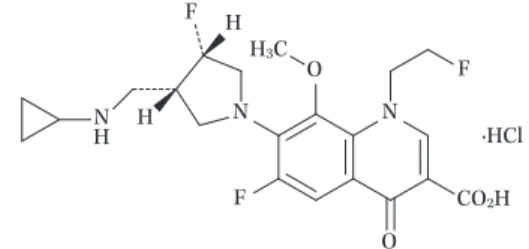
位に(3S,4S)―3―シクロプロピルアミノメチル―4―フル オロピロリジニル基という特有の置換基を有する新 規化合物ラスクフロキサシン塩酸塩(LSFX,Fig.
1)が創製された。キノロン系薬では血中濃度の上
昇に伴い副作用リスクが増すことが知られている2,4)。 そのため,血中濃度を抑えても十分な有効性を示す 薬剤となるよう,気道組織への移行性と,呼吸器感 染症の原因菌に対する抗菌力を指標に本薬の構造は 決定された。LSFX
はS. pneumoniae
をはじめとする呼吸器感 染症の主要原因菌,および嫌気性菌に対する抗菌活 性が高く,従来のキノロン系薬と比べても高い肺移 行を示すことが非臨床試験,臨床薬理試験において 確認された。強い抗菌力と良好な体内動態に基づくPharmacokinetics/Pharmacodynamics
(PK/PD)解 析の結果から,本薬の用法・用量は,既存同系薬で あるLVFX,ガレノキサシン(GRNX)の 1/5
以下に相当する
75 mg 1
日1
回経口投与と設定し,呼 吸器感染症,耳鼻咽喉科領域感染症患者を対象とし た臨床試験を実施した。本稿では,これまでに得られた基礎的,臨床的評 価結果から
LSFX
の抗菌薬としてのプロファイル とその特徴をまとめた。I. 抗菌作用12,13)
各種臨床分離株に対する
LSFX
の抗菌力の成績 をTable 1
に示す。1.好気性菌12)
本薬は市中呼吸器感染症の主要な原因菌である
S.
pneumoinae
,Haemophilus influenzae
,Moraxella
catarrhalis
などに強い抗菌力を示し,特にグラム陽性菌に対する抗菌力は優れていた。メチシリン耐 性
Staphylococcus aureus
を含むグラム陽性菌に対 するLSFX
のMIC
90は0.015〜2 μ g/mL
であり,測 定したすべての菌種に対してLVFX
と比べ16
倍以 上,GRNXと比べても同等以上の活性を示した。ま た,グラム陰性菌に対する抗菌力はLVFX,GRNX
と 比 べ て 同 等 か や や 弱 か っ た も の の,E. coli
とPseudomonas aeruginosa
を除くとMIC
90は0.06〜
0.5 μ g/mL
であり,本薬は市中で遭遇する呼吸器 感染症の原因菌に対して十分な抗菌力を示した。さ らに,近年本邦の市中感染症でも問題となっているβ
―ラクタム系薬やマクロライド系薬の耐性菌に対 してもLSFX
は感受性菌に対する抗菌力と同様の 活 性 を 示 し,penicillin-resistantS. pneumoniae
(PRSP),
β -lactamase negative ampicillin resistant
(BLNAR)
H. influenzae
に対するMIC
90は共に0.06 μ g/mL
であった。2.嫌気性菌13)
近年,市中肺炎の網羅的細菌叢解析において,培 養を中心とした従来の検査法では検出が難しかった 嫌気性菌等の重要性が報告されており14,15),新たな 市中肺炎の原因菌として注目されている口腔レンサ 球菌(
Streptococcus anginosus
群)や嫌気性菌に 対しても本薬は良好な活性を示した。LSFXのS.
anginosus
群に対するMIC
90はLVFX
に比べ8〜32
倍,GRNX,モキシフロキサシン(MFLX)に比べ2〜8
倍低値であり,Prevotella
属菌に代表される 偏性嫌気性菌についても,測定したほぼすべての菌 に対してLSFX
は従来のキノロン系薬よりも高い 活性を示した。Table 1. In vitro antibacterial activities of lascufloxacin against clinical isolates (aerobic organisms)
Organism (no. of isolates)
MIC (μg/mL)
Lascufloxacin Levofloxacin Garenoxacin Azithromycin Cefcapene MIC50 MIC90 MIC50 MIC90 MIC50 MIC90 MIC50 MIC90 MIC50 MIC90
Staphylococcus aureus
MSSA (30) 0.015 0.015 0.25 0.25 0.015 0.03 2 >64 1 2 MRSA (100) 0.5 2 64 >128 8 64 NT* NT NT NT
Staphylococcus epidermidis (30) 0.03 0.12 0.25 4 0.06 1 0.5 >64 0.5 8
Streptococcus pneumoniae
PSSP (30) 0.06 0.06 1 1 0.06 0.06 >16 >16 0.25 0.5 PRSP (30) 0.06 0.06 1 1 0.06 0.06 >16 >16 1 2
Streptococcus pyogenes (30) 0.03 0.06 0.5 1 0.06 0.12 0.12 16 <_0.008 <_0.008
Streptococcus agalactiae (30) 0.06 0.5 1 >16 0.06 4 0.06 >16 0.03 0.06
Enterococcus faecalis (30) 0.06 0.12 1 2 0.12 0.25 >64 >64 >128 >128
Moraxella catarrhalis (30) 0.06 0.06 0.03 0.03 <_0.008 0.015 <_0.06 <_0.06 0.5 1 Haemophilus influenzae
BLNAS (30) 0.03 0.06 0.015 0.03 0.008 0.015 1 2 0.015 1 BLNAR (30) 0.03 0.06 0.015 0.03 0.008 0.015 1 2 2 2
Klebsiella pneumoniae (30) 0.25 0.25 0.06 0.06 0.12 0.12 16 16 0.5 1
Enterobacter spp. (30) 0.25 0.25 0.06 0.06 0.12 0.12 16 16 0.5 32
Acinetobacter spp. (30) 0.25 0.5 0.06 0.25 0.03 0.12 1 64 16 16
Escherichia coli (30) 0.25 >16 0.06 16 0.12 >16 8 64 0.5 128
Pseudomonas aeruginosa (30) 4 >16 0.5 >16 1 >16 64 >64 32 >128
Mycoplasma pneumoniae (50) 0.12 0.25 0.5 0.5 0.015 0.03 8 16 NT NT
Legionella pneumophila (85) 0.03 0.06 0.015 0.015 0.008 0.008 0.03 0.25 NT NT
*NT, not tested
Table 1. (continued) (anaerobic organisms)
Organism (no. of isolates)
MIC (μg/mL)
Lascufloxacin Levofloxacin Garenoxacin Moxifloxacin Clindamycin MIC50 MIC90 MIC50 MIC90 MIC50 MIC90 MIC50 MIC90 MIC50 MIC90
Streptococcus anginosus (20) 0.06 0.25 2 2 0.25 1 0.5 1 0.12 >64
Streptococcus constellatus (20) 0.06 0.06 1 2 0.12 0.25 0.5 0.5 0.25 16
Streptococcus intermedius (20) 0.06 0.12 1 2 0.06 0.25 0.25 0.5 0.12 0.25
Clostridium difficile (49) 1 2 16 >64 1 32 4 16 64 >64
Finegoldia magna (23) 1 4 32 64 32 >64 8 32 0.25 >64
Peptoniphilus asaccharolyticus (19) 0.25 2 4 64 0.12 16 0.25 16 0.25 >64
Parvimonas micra (23) 0.25 2 0.25 2 0.12 0.5 0.25 1 0.06 0.25
Prevotella melaninogenica (21) 0.25 0.5 0.5 16 0.06 1 0.5 8 <_0.03 64
Prevotella intermedia (39) 0.12 0.5 0.5 2 0.12 0.5 0.25 4 <_0.03 0.06
Prevotella bivia (47) 1 2 4 8 2 4 4 8 <_0.03 >64
Fusobacterium nucleatum (16) 0.06 1 1 16 0.5 2 0.25 4 0.06 0.12
Bacteroides fragilis (50) 1 4 2 32 0.5 4 1 8 >64 >64
Bacteroides thetaiotaomicron (40) 1 4 8 >64 1 8 4 64 4 >64
Veillonella spp. (20) 2 8 4 8 2 8 2 8 0.06 0.12
(Modification from references 12, 13)
3.非定型病原体
呼吸器感染症の重要な原因菌の一つである
Myco- plasma pneumoniae
に 対 す るLSFX
のMIC
90は0.25 μ g/mL
であり,LVFX
よりも2
倍優れていた12)。Legionella pneumophila
および非定型抗酸菌に 対する抗菌力は本稿で新たに試験成績を報告する。1994〜2014
年 に 本 邦 の 医 療 機 関 で 分 離 さ れ たL.
pneumophila 85
株に対する抗菌力をJonas
らの方 法16)に 従 い 測 定 し た。L. pneumophila
に 対 す るLSFX
のMIC
90は0.06 μ g/mL
であり,十分な抗菌 力を有していた。公益財団法人結核予防会結核研究所に保管されて
Table 2. Antibacterial activity of lascufloxacin against quinolone-resistant strains
Straina QRDR mutationb MIC (μg/mL)
GyrA ParC Lascufloxacin Levofloxacin Garenoxacin Ciprofloxacin S. aureus
MS5935 None None 0.015 0.125 0.015 0.25 MS5935 gyrA mutant S84L None 0.03 0.25 0.06 0.25 MS5935 1st None S80F 0.03 0.5 0.03 2 MS5935 2nd S84L S80F 0.125 8 2 16 MS5935 3rd S84L S80F, E84K 0.5 32 8 32 MS5935 4th S84L, E88V S80F, E84K 2 128 32 32 S. pneumoniae
IID553 None None 0.06 1 0.06 1
CF9842 None D83N 0.06 2 0.125 2
SF9863 S81F None 0.06 2 0.25 2
SN9981 S81F D83Y 0.25 16 1 32
a The mutant strains of S. aureus and S. pneumoniae were sequentially selected from quinolone-susceptible strains
b QRDR, quinolone resistance-determining region
(Modification from reference 12)
いた
Mycobacterium tuberculosis 43
株[薬剤感受 性株(イソニアジド,リファンピシン感受性株)20 株,薬剤耐性株(イソニアジド,リファンピシン両 剤に耐性を獲得した多剤耐性株)23株]と非結核 性抗酸菌56
株(Mycobacterium avium 20
株,My- cobacterium intracellulare 17
株,Mycobacterium kansasii 19
株)に 対 す る 抗 菌 力 をMiddlebrook 7H10
寒天培地を用いて測定した。薬剤感受性M. tu- berculosis
に 対 す るLSFX
のMIC
90は0.25 μ g/mL
でありLVFX
と同等の活性を示した。薬剤耐性M.
tuberculosis
に 対 す るLSFX
のMIC
90は8 μ g/mL
で あ っ た。M. avium
,M. intracellulare
,お よ びM. kansasii
に対するLSFX
のMIC
90はそれぞれ8,
16,および 0.5 μ g/mL
でありLVFX
と同等の活性 を示した。II. 作用機序:標的酵素阻害作用12,17)
キノロン系薬は,細菌の
DNA
ジャイレースおよ びトポイソメラーゼIV
に作用しDNA
複製を阻害 することにより抗菌作用を発揮する。これら標的酵 素の遺伝子上に変異が生じると細菌は耐性化し,そ の変異した数の増加に従い薬剤のMIC
値は段階的 に上昇する18)。LSFXも,標的酵素遺伝子の変異に よりS. aureus
,S. pneumoniae
のMIC
は上昇した が,類薬と比べて野生株とキノロン耐性変異を有す る変異株のMIC
変動が小さいという特徴を示し,他 剤に低感受性を示す多段階変異株に対しても本薬は 良好な抗菌活性を保持していた(Table 2)。LSFX は点変異によりキノロン耐性となったS. aureus
の変異酵素に対しても強い阻害活性を有し(Table 3),
この強い酵素阻害活性が,LSFXがキノロン低感受 性株を含むグラム陽性菌に強い抗菌力を示す要因と 考えられた。
また,菌体内で
2
つの標的酵素(DNAジャイレー ス,トポイソメラーゼIV)を同レベルで阻害する
(dual targeting property)薬剤は酵素遺伝子変異 による耐性化の影響を受けがたく耐性菌を選択しが たいことが知られている17,18)。トポイソメラーゼ
IV
の点変異を有するS. pneumoniae
の第一段階変異 株を用いた試験では,LSFXは他のキノロン系薬に 比べ耐性株の出現頻度が低いという結果が得られ,このバランスのよい
dual targeting property
によ り高度耐性化を起こしがたいことが確認された17)(Table 4)。
III. 薬物動態19〜23)
健康成人を対象とした第
I
相臨床試験および臨床 薬理試験において,本薬は速やかで良好な消化管か らの吸収,1日1
回投与に適した比較的長い半減期 を示し,さらに従来のキノロン系薬と比べ肺に高く 移行する特徴的な体内動態が確認された。1.血中動態
(1)用量漸増試験19)
健康成人男性各群
3
例にLSFX 20,50 mg,各群
6
例に100,200,400,800 mg
を空腹時単回経口投 与して体内動態を検討した。本薬の血漿中濃度は用 量にほぼ比例して上昇し,いずれも1〜3
時間で最 高血漿中濃度(Cmax)に達し,消失半減期は15.6〜
Table 3. Inhibitory activities of lascufloxacin against DNA gyrase and topoisomerase IV of S. aureus
Drug
IC50 (μg/mL)a IC50 ratio of QR for wild-type strain Wild-type
DNA gyrase
QRb DNA gyrase
Wild-type Topoisomerase IV
QRb Topoi-
somerase IV DNA gyrase Topoisomerase IV
Lascufloxacin 1.7±0.4 17±3 0.73±0.06 2.8±0.3 10 3.8
Levofloxacin 16±6 1,300±100 2.8±0.9 86±19 81 31
Garenoxacin 11±1 420±80 1.9±0.6 27±1 38 14
Ciprofloxacin 25±5 >1,200 1.8±0.7 69±7 >48 38
a n=3, average±SD
b QR, quinolone-resistant. Mutations of DNA gyrase and Topoisomerase IV were GyrA Ser84Leu and ParC Ser80Phe, respectively (Modification from reference 12)
Table 4. Frequencies of appearance of resistant strains after exposure of S. pneumoniae clinical strains possessed mutation in ParC to lascufloxacin, levofloxacin, and garenoxacin
Strain QRDR mutationa
Drug MIC
(μg/mL)
Frequency at drug concn of (×MIC)
ParC GyrA 2 4 8 16
G21 S79F None Lascufloxacin 0.12 6.3×10⁻⁸ NDb ND ND
Levofloxacin 2 1.4×10⁻⁷ 1.4×10⁻⁸ ND ND
Garenoxacin 0.06 1.9×10⁻⁷ 1.1×10⁻⁷ ND ND
G27 S79F None Lascufloxacin 0.12 8.1×10⁻⁸ ND ND ND
Levofloxacin 1 4.6×10⁻⁷ 2.4×10⁻⁷ 2.3×10⁻⁸ ND
Garenoxacin 0.06 3.7×10⁻⁷ 1.0×10⁻⁷ 7.0×10⁻⁸ ND
G39 D83V None Lascufloxacin 0.12 ND ND ND ND
Levofloxacin 2 ND ND ND ND
Garenoxacin 0.06 1.2×10⁻⁸ 5.8×10⁻⁹ ND ND
G11 D83Y None Lascufloxacin 0.12 ND ND ND ND
Levofloxacin 2 3.7×10⁻⁸ ND ND ND
Garenoxacin 0.06 1.3×10⁻⁷ 3.7×10⁻⁸ ND ND
a QRDR, quinolone resistance-determining region
b ND, not detected
(Modification from reference 17)
18.2
時間であった(Table 5)。(2)臨床用量での単回投与試験19,20)
検証試験の用量として用いた
LSFX 75 mg
を健 康成人男性に空腹時単回経口投与したところ,本薬 は 約2.5
時 間 で0.592 μ g/mL
のC
maxに 達 し,消 失 半減期は13.9
時間であり,投与後144
時間までに 未変化体として尿中に投与量の8.38%
が排泄された(Table 6)。本薬は,軽度から重度の腎機能低下者 と機能正常者間で体内動態に大きな差がないことが 確認されており(Table 7),同様に腎機能の低下が 予想される高齢者においても体内動態に若年者との 大きな差は認められなかった。これは
LSFX
の腎 排泄率が約10%
と低いことが一因と推定され,そ の多くが代謝物として肝・胆道系および腎を介して 排泄されるため,腎機能低下による血中濃度への影 響が少ないものと考えられた。また,本薬は食後に単回経口投与した場合も体内動態に大きな差はみら れておらず,LSFXの吸収に及ぼす食事の影響も小 さいことが確認されている。
2.組織分布・移行性
(1)肺移行性21)
肺炎の感染組織である肺への移行性を検討するた め,健康成人男性
30
例にLSFX 75 mg
を単回経口 投与し,投与後1,2,4,6,24
時間後に各6
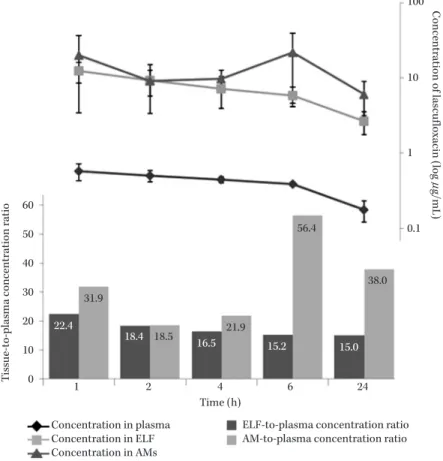
例の 血漿,肺胞上皮被覆液(ELF)および肺胞マクロ ファージ(AMs)中の薬物濃度を測定した。LSFX の血漿,ELF
およびAMs
中のC
maxはそれぞれ0.576,
12.3,21.8 μ g/mL
であり,投与後1〜24
時 間 を と おしてELF
およびAMs
中では血漿中に比べて15
倍以上高い濃度推移が得られることが確認された(Fig. 2)。LSFXの血漿タンパク結合率を
74%
21)と して,この時のELF
およびAMs
中の血漿中薬物Table 5. Pharmacokinetic parameters of lascufloxacin after single oral administration of 20 to 800 mg of lascufloxacin in healthy subjects
Dose (mg) Cmax (μg/mL) tmax (h) t1/2 (h) AUCinf (μg.h/mL) %UR0−72h (%)
20* 0.122±0.0394 1.33±0.289 — — —
50* 0.417±0.107 1.50±0.500 — — —
100 0.732±0.114 1.50±0.447 16.1±1.00 12.7±2.24 11.8±2.45
200 1.50±0.247 2.50±1.05 15.6±2.39 30.2±4.23 11.7±2.75
400 2.88±0.360 1.76±0.280 15.8±2.28 65.5±11.5 13.8±0.989
800 6.00±0.844 2.58±1.11 18.2±2.10 144±18.2 15.0±0.419
*pilot study, n=3
Each values represents the mean and SD
(Modification from reference 19)
Table 6. Pharmacokinetic parameters of lascufloxacin after single oral administration of 75 mg of lascufloxacin in healthy subjects
Cmax (μg/mL) tmax (h) t1/2 (h) AUCinf (μg.h/mL) %UR0-144h*(%)
0.592±0.162 2.48±1.09 13.9±1.35 10.2±2.02 8.38±1.50
*%UR was assessed by 6 subjects, other parameters were assessed by 24 subjects Each values represents the mean and SD
(Modification from reference 19)
Table 7. Pharmacokinetic parameters of lascufloxacin after single oral administration of 75 mg of lascu- floxacin in patients with renal dysfunction
Ccr (mL/min) n Cmax (μg/mL) tmax (h) t1/2 (h) AUCinf (μg.h/mL) Normal (90 ≦ Ccr) 6 0.868±0.209 1.17±0.408 16.8±2.54 14.7±2.65 Mild (60 ≦ Ccr<90) 6 0.918±0.178 1.17±0.408 16.0±2.26 16.8±2.22 Moderate (30 ≦ Ccr<60) 4 0.615±0.117 2.25±1.26 17.2±1.84 12.3±2.03 Severe (15 ≦ Ccr<30) 6 0.615±0.0681 1.00±0 17.9±2.64 11.8±1.61 Each values represents the mean and SD
(Modification from reference 20)
濃 度―時 間 下 曲 線(AUC)を 血 漿 中 非 結 合 型 の
f AUC
と比べると,それぞれELF
中では61.7
倍お よびAMs
中では163
倍高い値を 示 し(Table 8),LSFX
は論文発表されている従来のキノロン系薬(ELF対血中非結合型
AUC
比:LVFX,2.45〜4.14,GRNX,5.38,MFLX,9.11〜9.59)
24)に 比 べ 高 い 肺 移行を示す薬剤であると考えられた。(2)肺移行のメカニズム検討22)
臨床薬理試験で確認された
LSFX
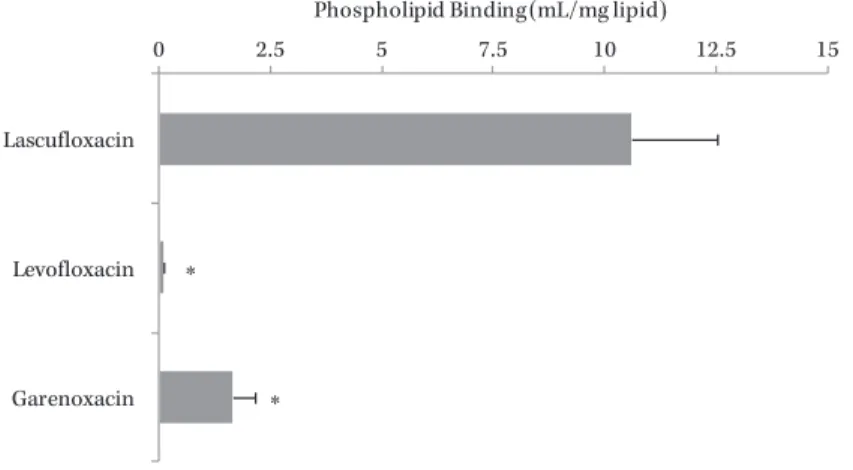
に特徴的な高 い肺移行の機序を基礎的に検討したところ,LSFX は肺サーファクタント中の1
成分であるホスファチ ジルセリン(PhS)に特異的な強い結合能を示すこ とが明らかとなった(Fig. 3)。検討した他のキノ ロン系薬はほとんど結合能を示さなかったことから,この
LSFX
に特異的な作用が,本薬が高い肺移行 を示す要因と考えられた。なお,同じように肺サーファクタントに結合能を有する抗菌薬としてダプト マイシン(DAP)が知られているが,DAPは肺サー ファクタントと不可逆的に結合するため肺内では抗 菌力が大きく低下することが報告されている25)。し かし
LSFX
の抗菌力は肺サーファクタントおよびPhS
添加条件下でもまったく変化がみられず,DAP
とは結合様式が異なることが推定された。(3)耳鼻咽喉組織移行性23)
耳鼻咽喉組織への移行性を検討するため,副鼻腔 粘膜,中耳粘膜または口蓋扁桃組織の摘出手術施行 患者各
5
例にLSFX 75 mg
を単回経口投与し,1〜2
時間後に血中および摘出した組織中のLSFX
濃度 を測定した。各組織中のLSFX
濃度は,血漿中に 比べてそれぞれ副鼻腔粘膜で2.12
倍,中耳粘膜で2.04
倍および口蓋扁桃組織で2.76
倍高値を示し,耳 鼻咽喉組織においてもLSFX
は類薬と同等またはFig. 2. Concentrations of lascufloxacin in plasma, epithelial lining fluid, and alveo- lar macrophages, and site-to-plasma concentration ratios.
Each drug concentration represents the mean and SD for six subjects in each time points.
100
10
1
0.1
Concentration of lascufloxacin (log μg/mL)
60 50 40 30 20 10 0
22.4
1 2 4
Time (h)
6 24
31.9
18.4 18.5 16.5
Concentration in plasma Concentration in ELF Concentration in AMs
ELF-to-plasma concentration ratio AM-to-plasma concentration ratio 21.9
15.2 56.4
15.0 38.0
Tissue-to-plasma concentration ratio
(Modification from reference 21)
Table 8. Site-to-plasma and Site-to-free plasma AUC ratios of lascufloxacin AUCelf /AUCp AUCelf /AUCfp AUCcell /AUCp AUCcell /AUCfp
16.0 61.7 42.4 163
AUCp, AUC in plasma; AUCfp, AUC in free plasma
(Modification from reference 21)
それ以上の良好な移行性を示すことが確認された。
IV. 検証試験における用法・用量の設定
抗菌薬投与を設計するための有効な手法である
PK/PD
解析において,キノロン系薬の有効性に相関 す る 主 要 な パ ラ メ ー タ と し て
24
時 間AUC
とMIC
の比(AUC0-24/MIC)が知られており
26,27),既 存キノロン系薬におけるAUC
0-24/MIC
のターゲッ ト値はS. pneumoniae
感染患者で30
28),グラム陰 性菌等の感染患者で100〜125
26,27)と報告されている。本薬の第
I
相臨床試験で得られた薬物動態パラメー タと市中呼吸器感染症主要原因菌に対するMIC
90を用いて
PK/PD
解析を行った結果,本薬は既存同系薬である
LVFX,GRNX
の1/5
以下に相当する75 mg 1
日1
回投与で有効性が期待できると推定され た。また,上述したように本薬の感染組織内におけ る薬物濃度は血漿中よりも高いことから,組織中で はさらに大きなAUC
0-24/MIC
の値が期待できると 考えられた。この考えに基づき臨床用量
75 mg
とその倍量の150 mg
で市中肺炎患者を対象とした用量設定試験を実施した。当該試験で確認された本薬
75 mg 1
日1
回投与における治癒判定時(Test of cure;Fig. 3. Binding of lascufloxacin and the other quinolones to PhS.
Binding data represent mean±SD from 3 samples. Dunnettʼs test was used to compare data against PhS binding of lascufloxacin.
*, P<0.001
0 2.5 5 7.5 10 12.5 15
Lascufloxacin
Levofloxacin
Garenoxacin
Phospholipid Binding (mL/mg lipid)
*
*
(Modification from reference 22)
Table 9. Clinical efficacy and microbiological effect by subject (PPS/BPPS)
Category of infection
Clinical response at TOC (Cure rate)
Clinical efficacy at EOT (Effective rate)
Microbiological response by subject
n/N % n/N % n/N %
Respiratory infection
Community-acquired pneumonia 174/189 92.1 187/194 96.4 56/58 96.6
Bacterial pneumonia 127/139 91.4 137/142 96.5 53/55 96.4
Atypical pneumonia 47/50 94.0 50/52 96.2 3/3 ---
Mycoplasma pneumonia 35/38 92.1 37/39 94.9 2/2 ---
Legionella pneumonia 2/2 --- 2/2 --- 0/0 ---
Atypical pneumonia 9/9 --- 9/9 --- 0/0 ---
Bacteria+Mycoplasma pneumonia 1/1 --- 2/2 --- 1/1 ---
Secondary infection in chronic respiratory diseases 33/38 86.8 35/38 92.1 21/25 84.0
COPD 20/24 83.3 22/24 91.7 13/14 92.9
Bronchiectasis 6/6 --- 6/6 --- 4/6 ---
Old pulmonary tuberculosis 3/3 --- 3/3 --- 2/2 ---
COPD+Bronchiectasis 1/1 --- 1/1 --- 0/0 ---
COPD+Old pulmonary tuberculosis 1/1 --- 1/1 --- 0/1 ---
Bronchiectasis+Pulmonary fibrosis 1/1 --- 1/1 --- 1/1 ---
COPD+Diffuse panbronchiolitis+Bronchiectasis 0/1 --- 0/1 --- 0/0 ---
COPD+Bronchiectasis+Old pulmonary tuberculosis 1/1 --- 1/1 --- 1/1 ---
Acute bronchitis 12/13 92.3 12/13 92.3 6/8 ---
Otolaryngological infection
Sinusitis ---* ---* 117/138 84.8 60/65 92.3
Acute sinusitis --- --- 105/123 85.4 55/59 93.2
Acute exacerbation of chronic sinusitis --- --- 12/15 80.0 5/6 ---
Otitis media 13/13 100.0 13/14 92.9 7/7 ---
Acute otitis media 11/11 100.0 11/12 91.7 6/6 ---
Acute exacerbation of chronic otitis media 2/2 --- 2/2 --- 1/1 ---
Tonsillitis 22/26 84.6 25/28 89.3 25/26 96.2
Laryngopharyngitis 21/22 95.5 22/24 91.7 21/21 100.0
*Recurrence rate of subjects who were assessed “very effective” or “effective” at EOT was evaluated. The rate was 4.5%
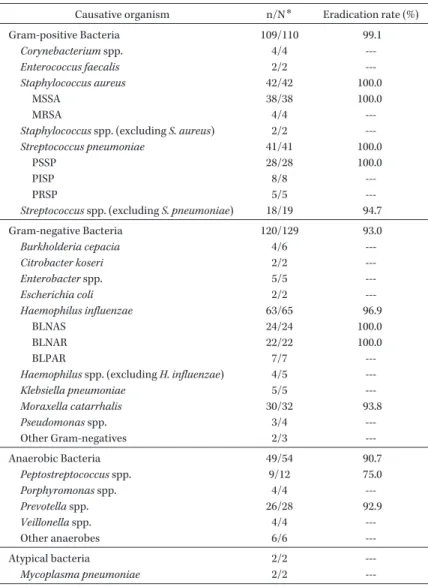
Table 10. Microbiological effect by causative organisms (BPPS) Causative organism n/N* Eradication rate (%)
Gram-positive Bacteria 109/110 99.1
Corynebacterium spp. 4/4 --- Enterococcus faecalis 2/2 --- Staphylococcus aureus 42/42 100.0
MSSA 38/38 100.0
MRSA 4/4 ---
Staphylococcus spp. (excluding S. aureus) 2/2 --- Streptococcus pneumoniae 41/41 100.0
PSSP 28/28 100.0
PISP 8/8 ---
PRSP 5/5 ---
Streptococcus spp. (excluding S. pneumoniae) 18/19 94.7
Gram-negative Bacteria 120/129 93.0
Burkholderia cepacia 4/6 --- Citrobacter koseri 2/2 --- Enterobacter spp. 5/5 --- Escherichia coli 2/2 --- Haemophilus influenzae 63/65 96.9
BLNAS 24/24 100.0
BLNAR 22/22 100.0
BLPAR 7/7 ---
Haemophilus spp. (excluding H. influenzae) 4/5 --- Klebsiella pneumoniae 5/5 --- Moraxella catarrhalis 30/32 93.8 Pseudomonas spp. 3/4 --- Other Gram-negatives 2/3 ---
Anaerobic Bacteria 49/54 90.7
Peptostreptococcus spp. 9/12 75.0 Porphyromonas spp. 4/4 --- Prevotella spp. 26/28 92.9 Veillonella spp. 4/4 --- Other anaerobes 6/6 ---
Atypical bacteria 2/2 ---
Mycoplasma pneumoniae 2/2 ---
*n/N=No. of “Eradicated and Presumed eradicated”/No. of organisms
Table 11. Sensitivity distribution of all causative organisms (MFAS)
Organism (no. of isolates)
MIC (μg/mL)
Lascufloxacin Levofloxacin Garenoxacin Clarithromycin Azithromycin Cefcapene MIC50 MIC90 MIC50 MIC90 MIC50 MIC90 MIC50 MIC90 MIC50 MIC90 MIC50 MIC90
Staphylococcus aureus (60) 0.03 0.25 0.25 8 0.03 2 0.5 >64 2 >64 1 4
Streptococcus pneumoniae (75) 0.06 0.06 1 1 0.06 0.06 >16 >16 >16 >16 0.25 1
Haemophilus influenzae (90) 0.03 0.12 0.015 0.03 0.008 0.03 8 16 1 4 0.25 2
Moraxella catarrhalis (45) 0.12 0.12 0.03 0.06 0.015 0.015 0.12 0.25 ≦0.06 0.12 0.5 1
All pathogens (420)* 0.06 0.5 0.25 2 0.03 1 4 >64 2 32 0.5 4
*All pathogens included Staphylococcus spp., Streptococcus spp., Corynebacterium spp., Enterococcus faecalis, Haemophilus spp., Morax- ella catarrhalis, Acinetobacter baumannii, Burkholderia cepacia, Citrobacter koseri, Enterobacter spp., Escherichia coli, Klebsiella spp., Pro- teus mirabilis, Pseudomonas spp., Serratia spp., Stenotrophomonas maltophilia, Eggerthella lenta, Peptostreptococcus spp., Fusobacterium nucleatum, Porphyromonas endodontalis, Prevotella spp., Veillonella spp., GNR-anaerobes, Mycoplasma pneumoniae
TOC)の臨床効果,投与終了時(End of treatment;
EOT)の臨床効果,および被験者別の微生物学的
効果(検出された原因菌すべてが消失または推定消 失と判定された被験者の割合;陰性化率)は
90.0%,
Table 12. Probability of target attainment of parameters using the Monte Carlo Simulation and distribu- tion of bacteria detected in patient with respira- tory tract infections from the clinical study
Parameters Probability (%)
Day 1 Day 2 Day 3 Day 7 AUC0-24/MIC>15 91.3 91.9 92.1 92.3
Cmax/MIC>5* 95.4 97.8 98.1 98.3
Ctrough>0.12* 85.9 95.8 97.4 98.6
*Simulation based on the MIC distribution for only S. pneu- moniae
(Modification from reference 35)
96.1%,96.0%
といずれも9
割を上回り,加えて副 作用発現率は150 mg
投与群よりも低値であったこ とを考慮し,本薬の 用 法・用 量 に は75 mg 1
日1
回投与を選択し,第III
相の臨床試験を実施した。V. 臨床試験成績:有効性23,29〜31)
感染症患者に対する
LSFX 75 mg
の有効性は,用 量設定試験(1試験),LVFXを対照とした第III
相 比較試験(2試験),および第III
相一般臨床試験(2 試験)における臨床効果および微生物学的効果の成 績より評価した。有効性の主たる解析対象集団は治 験実施計画書に適合した対象集団(Per ProtocolSet;PPS)とした。また,PPS
のうち投与開始日 に原因菌が特定された症例集団を微生物学的PPS
解析対象集団(Bacteriological Per Protocol Set;BPPS)とし,BPPS
の他,原因菌が特定された最大の解析対象集団(Modified Full Analysis Set;
MFAS)から得られた臨床分離株を用いて各原因菌
に対する本薬のMIC
測定を実施した。主要評価項 目は試験当時の各種ガイドライン32〜34)に従い,市中 肺炎と慢性呼吸器病変の二次感染では「TOCの臨 床効果(治癒率)」,急性気管支炎,副鼻腔炎,中耳 炎,扁桃炎,咽頭・喉頭炎では「EOTの臨床効果(有効率)」として評価を行った。
上記
5
試験に基づく本薬の臨床効果と陰性化率の 成績をTable 9
に示す。各疾患の主要評価項目の臨 床効果は,市中肺炎92.1%(174/189
例),慢性呼吸 器病変の二次感染86.8%(33/38
例),急性気管支炎92.3%(12/13
例),副 鼻 腔 炎84.8%(117/138
例),中耳炎
92.9%(13/14
例),扁桃炎89.3%(25/28
例),咽頭・喉頭炎
91.7%(22/24
例)であり,市中肺炎 および副鼻腔炎を対象とした比較試験ではいずれも 対照薬のLVFX 500 mg 1
日1
回投与に対する非劣性が検証された(市中肺炎:LSFX 92.8%,LVFX
92.3%,副鼻腔炎:LSFX 84.8%,LVFX 84.6%)。
主な原因菌別の消失率は,
S. aureus
,S. pneumo- niae
,Klebsiella pneumoniae
でいずれも100%
(42/42
株,41/41株,5/5株),H. influenzae
で96.9%
(63/65株),
M. catarrhalis
で93.8%(30/32
株),Prevotella spp.で 92.9%(26/28
株)で あ り,好 気 性菌と嫌気性菌に対し共に90%
以上の消失率が確 認された(Table 10)。特にS. aureus
とS. pneumo- niae
では100%
の消失率が得られたことから,こ れら菌種に起因する感染症に対する高い有効性がLSFX
の特徴の一つに位置づけられると考える。ま た,培養検査で菌推移が確認されたM. pneumoniae
の消失率は2/2
株,培養以外(迅速抗原検査,免疫 血清学検査,または遺伝子学的検査)の検査結果に 基づき診断されたマイコプラズマ肺炎およびレジオ ネラ肺炎患者の治癒率は92.1%(35/38
例)および2/2
例であり(Table 9),非定型病原体に対する優 れた効果も本薬の特徴の一つと考えられた。特に,注射用薬を用いる入院治療が原則となる1)レジオネ ラ肺炎患者が,2例いずれも本薬
75 mg 1
日1
回経 口投与で治癒したことは特筆すべき結果と考える。さらに臨床試験で得られた全原因菌に対する
LSFX
のMIC
90は0.5 μ g/mL
とキノロン系薬の中でも優 れており,本薬の対象疾患原因菌に対する強い抗菌 作用が薬剤感受性の面からも確認された(Table 11)。VI. 呼吸器感染症患者での母集団薬物動態/薬力 学解析35)
臨床試験結果に基づき構築した母集団薬物動態
(PPK)モデルと,呼吸器感染症患者を対象とした 臨床試験で得られた臨床分離株の
MIC
値を用いてPK/PD
パラメータを算出し,微生物学的効果から本薬の
AUC
0-24/MIC
のターゲット値を検討した。そ の結果,本薬のターゲット値は従来のキノロン系薬 で 報 告 さ れ て い るf AUC
0-24/MIC(LVFX,60.9,
GRNX,28)
36,37)よ り も 低 値 のf AUC
0-24/MIC>3.9
(AUC0-24
/MIC>15)と推定された。PPK
モデルか ら予測した呼吸器感染症患者の薬物動態パラメータ(AUC0-24,15.12
μ g・h/mL)を ふ ま え る と,本 薬
はMIC
がおよそ1 μ g/mL
までの菌株に対し高い 効果が期待できると考えられた。キノロン耐性菌の発現抑制には
C
max/MIC
を5
以 上にすること38)や,血中濃度がMPC
以下で長時間Table 13. Adverse reactions LSFX all subjects
(N=531)
Comparative study
LSFX 75 mg (N=280) LVFX 500 mg (N=276)
System Organ Class, Preferred Terma n Events %b n Events %b n Events %b
Total 62 70 11.7 33 37 11.8 40 56 14.5
Blood and lymphatic system disorders 1 1 0.2 0 0 0.0 0 0 0.0
Leukopenia 1 1 0.2 0 0 0.0 0 0 0.0
Ear and labyrinth disorders 2 2 0.4 1 1 0.4 0 0 0.0
Vertigo 1 1 0.2 1 1 0.4 0 0 0.0
Ear discomfort 1 1 0.2 0 0 0.0 0 0 0.0
Gastrointestinal disorders 14 15 2.6 9 10 3.2 20 24 7.2
Abdominal discomfort 1 1 0.2 1 1 0.4 4 4 1.4
Abdominal distension 1 1 0.2 0 0 0.0 0 0 0.0
Abdominal pain 0 0 0.0 0 0 0.0 1 1 0.4
Abdominal pain upper 1 1 0.2 1 1 0.4 0 0 0.0
Constipation 1 1 0.2 1 1 0.4 2 2 0.7
Diarrhea 7 7 1.3 3 3 1.1 4 4 1.4
Dyspepsia 1 2 0.2 1 2 0.4 0 0 0.0
Gastritis 0 0 0.0 0 0 0.0 1 1 0.4
Nausea 2 2 0.4 2 2 0.7 7 7 2.5
Vomiting 0 0 0.0 0 0 0.0 4 4 1.4
Faeces soft 0 0 0.0 0 0 0.0 1 1 0.4
General disorders and administration site conditions 2 2 0.4 0 0 0.0 0 0 0.0
Feeling abnormal 1 1 0.2 0 0 0.0 0 0 0.0
Malaise 1 1 0.2 0 0 0.0 0 0 0.0
Hepatobiliary disorders 0 0 0.0 0 0 0.0 1 1 0.4
Hepatic function abnormal 0 0 0.0 0 0 0.0 1 1 0.4
Infections and infestations 3 3 0.6 2 2 0.7 1 1 0.4
Cheilitis 1 1 0.2 1 1 0.4 0 0 0.0
Oral herpes 1 1 0.2 1 1 0.4 1 1 0.4
Ear infection fungal 1 1 0.2 0 0 0.0 0 0 0.0
Investigations 30 35 5.6 15 16 5.4 16 18 5.8
Alanine aminotransferase increased 5 5 0.9 1 1 0.4 1 1 0.4
Aspartate aminotransferase increased 2 2 0.4 0 0 0.0 0 0 0.0
Blood bilirubin increased 1 1 0.2 0 0 0.0 1 1 0.4
Blood creatine phosphokinase increased 0 0 0.0 0 0 0.0 1 1 0.4
Blood creatinine increased 1 1 0.2 0 0 0.0 0 0 0.0
Blood glucose increased 1 1 0.2 0 0 0.0 0 0 0.0
Blood insulin increased 2 2 0.4 1 1 0.4 1 1 0.4
Blood potassium increased 1 1 0.2 0 0 0.0 1 1 0.4
Blood triglycerides increased 1 1 0.2 0 0 0.0 1 1 0.4
Blood uric acid increased 0 0 0.0 0 0 0.0 1 1 0.4
Eosinophil count increased 7 7 1.3 6 6 2.1 3 3 1.1
Gamma-glutamyltransferase increased 3 3 0.6 1 1 0.4 0 0 0.0
Blood urine present 1 1 0.2 0 0 0.0 1 1 0.4
Insulin C-peptide increased 1 1 0.2 0 0 0.0 0 0 0.0
Liver function test abnormal 1 1 0.2 1 1 0.4 0 0 0.0
Lymphocyte count decreased 0 0 0.0 0 0 0.0 1 1 0.4
Neutrophil count decreased 0 0 0.0 0 0 0.0 1 1 0.4
White blood cell count decreased 4 4 0.8 4 4 1.4 2 2 0.7
Platelet count increased 1 1 0.2 0 0 0.0 0 0 0.0
Protein urine present 2 2 0.4 1 1 0.4 1 1 0.4
Cystatin C increased 0 0 0.0 0 0 0.0 1 1 0.4
Blood alkaline phosphatase increased 1 1 0.2 1 1 0.4 0 0 0.0
Renal function test abnormal 0 0 0.0 0 0 0.0 1 1 0.4
Musculoskeletal and connective tissue disorders 3 3 0.6 2 2 0.7 1 1 0.4
Neck pain 1 1 0.2 1 1 0.4 0 0 0.0
Pain in extremity 1 1 0.2 1 1 0.4 0 0 0.0
Limb discomfort 0 0 0.0 0 0 0.0 1 1 0.4
Tendon pain 1 1 0.2 0 0 0.0 0 0 0.0
(Continued)
LSFX all subjects (N=531)
Comparative study
LSFX 75 mg (N=280) LVFX 500 mg (N=276)
System Organ Class, Preferred Terma n Events %b n Events %b n Events %b
Nervous system disorders 2 2 0.4 1 1 0.4 5 5 1.8
Dizziness 0 0 0.0 0 0 0.0 1 1 0.4
Headache 2 2 0.4 1 1 0.4 4 4 1.4
Reproductive system and breast disorders 0 0 0.0 0 0 0.0 1 1 0.4
Metrorrhagia 0 0 0.0 0 0 0.0 1 1 0.4
Respiratory, thoracic and mediastinal disorders 2 2 0.4 2 2 0.7 1 1 0.4
Asthma 1 1 0.2 1 1 0.4 0 0 0.0
Hemoptysis 0 0 0.0 0 0 0.0 1 1 0.4
Organizing pneumonia 1 1 0.2 1 1 0.4 0 0 0.0
Skin and subcutaneous tissue disorders 5 5 0.9 3 3 1.1 4 4 1.4
Erythema 1 1 0.2 0 0 0.0 0 0 0.0
Pruritus 2 2 0.4 1 1 0.4 0 0 0.0
Rash 2 2 0.4 2 2 0.7 2 2 0.7
Rash generalized 0 0 0.0 0 0 0.0 1 1 0.4
Urticaria 0 0 0.0 0 0 0.0 1 1 0.4
a MedDRA/J V18.0
b Incidence rate (%)=(n÷N)×100
Table 13. (Continued)
保持されないよう投与設計すること39,40)が有効と報 告されているため,呼吸器・耳鼻咽喉科領域感染症 の主要菌種であり,近年
LVFX
等への感受性低下 が懸念されているS. pneumoniae
の耐性菌発現リ スクをPK/PD
解析により検討した。その結果,S.
pneumoniae
が分離された全症例がC
max/MIC>5
および
C
trough>MPC(0.12μ g/mL)を満たしており,
本薬投与による
S. pneumoniae
の耐性菌発現リス クは低いと推定された。さらに,より一般的な患者集団での臨床効果と
S.
pneumoniae
耐性菌発現リスクを予測するため,モンテカルロシミュレーションにより
PK/PD
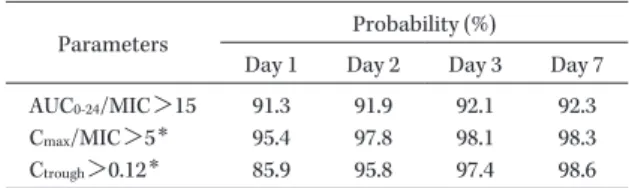
パラ メータが上記の有効性および耐性菌発現抑制のター ゲット値を達成する確率を評価した。その結果,75mg 1
日1
回 投 与 時 のAUC
0-24/MIC>15,C
max/MIC
>5,および
C
trough>0.12μ g/mL
の達成確率はいず れも9
割を超えており,PK/PD解析の結果は本薬 の用法・用量の妥 当 性 を 支 持 す る も の で あ っ た(Table 12)。なお,従来のキノロン系薬に比べて本 薬の有効性ターゲット値が低値であった理由として,
LSFX
の高い肺移行性が寄与していることが推察さ れた。今回の結果は血中濃度によるPK/PD
解析だ けでなく,組織中濃度レベルでのPK/PD
解析の重 要性を示唆する結果と考えられる。VII. 臨床試験成績:安全性23,29〜31)
臨床試験の中で治験薬の投与を受け,かつ投与後
の安全性データを有するすべての症例を安全性解析 対象集団として本薬の安全性を評価した。LSFXが 投与された感染症被験者計
531
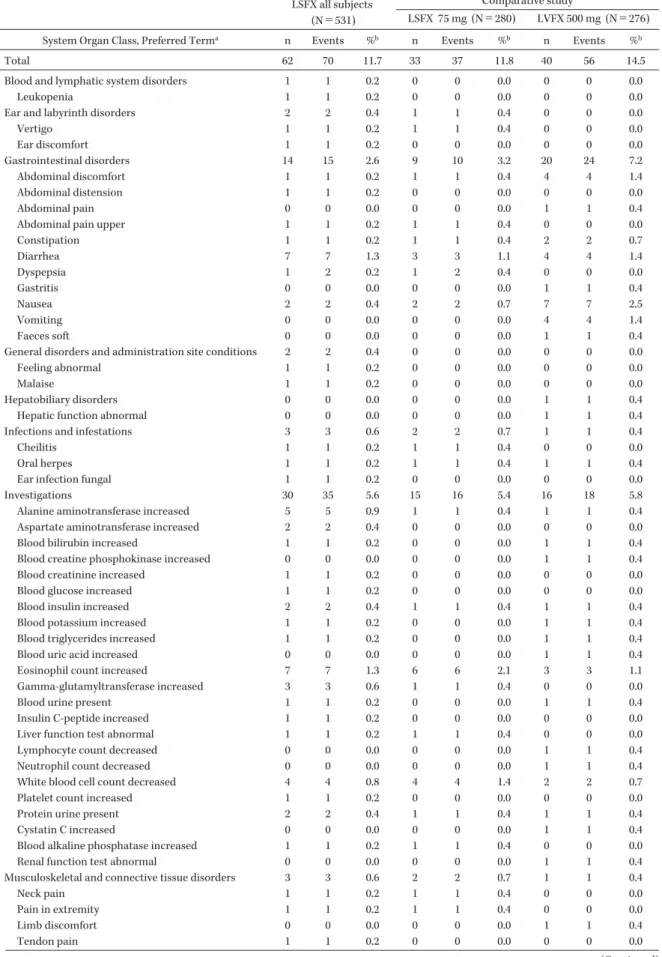
例における副作用発 現率は,臨床検査値異常変動を含めた全体で11.7%
(62/531例)であった。また,LVFXとの比較試験 における両群の副作用発現率は
LSFX
群11.8%
(33/280
例),LVFX群14.5%
(40/276例)であった(Ta-ble 13)。臨床試験の中で本薬投与時に特に高頻度
で発現する副作用は認められず,1%以上の頻度で 認められた副作用は下痢と好酸球数増加の各1.3%
(7/531例)であった。重症度別の副作用発現率は,
軽 度 が
10.2%(54/531
例),中 等 度 が1.5%(8/531
例)であり高度の副作用は認められなかった。この うち重篤な有害事象と判定されたのは,本薬75 mg
投与群で認められた器質化肺炎と回転性めまい(各1
例),用量設定試験における150 mg
投与群で認め られた白血球減少症(1例)で,いずれも重症度は 中等度で処置後に回復した。比較試験で認められた
LSFX
群とLVFX
群の副 作用を器官別大分類に基づき比較すると,本薬はキ ノロン系薬の主な副作用である2〜4)胃腸障害[LSFX 群3.2%(9/280
例),LVFX群7.2%(20/276
例)]と 神 経 系 障 害[LSFX群
0.4%(1/280
例),LVFX 群1.8%(5/276
例)]の発現率がLVFX
の半分以下 と低く,その他は両群同程度であった(Table 13)。臨床試験の中で光線過敏性反応が疑われた事象はな
く,また血糖,腎機能,肝機能に関連した臨床検査 項目,およびバイタルサインや心電図検査について も本薬投与後に臨床上問題となるような変化は認め られなかった。
● ● ● ● ● ● ● ● ● ● ● ● ● ● ● ● ● ● ● ● ● ● ● ● ● ● ● ● ● ● ● ● ● ● ● ● ●
おわりに
LSFX
は,キノロン系薬がもたらす高い有効性を 損なわずに,その副作用ならびに耐性化リスクの低 減を目指し,標的菌種に対する抗菌力と感染組織へ の移行性の両面を向上させた薬剤として開発された。血中濃度を低く抑えて非感染部位に対する不要な薬 剤曝露を低減しながら,感染部位には高濃度に分布 して作用する,いわば標的組織集中型の作用を示す 本薬は,抗菌薬適正使用の重要性が高まる今日にお いて有用な薬剤になると考えられる。ただし,承認 申請までに行われた臨床試験の範囲で本薬が投与さ れた患者数は限られているため,安全性や耐性化リ スクについては今後行われる製造販売後の使用成績 調査等に基づき,継続的に評価していくことが重要 と考える。
謝 辞
本薬の基礎・臨床試験にご協力いただいた先生方 ならびに開発に際して貴重なご意見を賜りました先 生方に深くお礼申し上げます。
利益相反自己申告:舘田一博,戸塚恭一,河野茂 は杏林製薬(株)より講演料を受けている。
文献
1) JAID/JSC感染症治療ガイド・ガイドライン作
成 委 員 会 編:JAID/JSC感 染 症 治 療 ガ イ ド 2014,日本感染症学会・日本化学療法学会,東 京,2014
2) Lipsky B A, Baker C A: Fluoroquinolone toxic- ity profiles: a review focusing on newer agents.
Clin Infect Dis 1999; 28: 352-64
3) Ball P, Mandell L, Niki Y, Tillotson G: Compara- tive tolerability of the newer fluoroquinolone antibacterials. Drug Saf 1999; 21: 407-21 4) 堀 誠治:レスピラトリーキノロンの安全性―
痙攣,低血糖,QT延長を中心に―。化療の領 域 2007; 23: 133-40
5) 山口惠三,大野 章,石井良和,舘田一博,岩 田守弘,神田 誠,他:2004年に 全 国77施 設 から分離された臨床分離株18,639株の各種抗菌 薬に対する感受性サーベイランス。Jpn J Anti- biot 2006; 59: 428-51
6) 山口惠三,大野 章,石井良和,舘田一博,岩
田守弘,神田 誠,他:2007年に 全 国72施 設 から分離された臨床分離株12,919株の各種抗菌 薬に対する感受性サーベイランス。Jpn J Anti- biot 2009; 62: 346-70
7) 山口惠三,大野 章,石井良和,舘田一博,岩 田守弘,秋沢宏次,他:2010年に全国72施設 の臨床材料から分離された12,866株の各種抗菌 薬に対する感受性サーベイランス。Jpn J Anti- biot 2012; 65: 181-206
8) 山口惠三,舘田一博,大野 章,石井良和,村 上日奈子:2013年に全国69施設の臨床材料か ら分離された11,762株の各種抗菌薬に対する感 受性サーベイランス。Jpn J Antibiot 2016; 69: 1- 25
9) Teramoto S, Fukuchi Y, Sasaki H, Sato K, Seki- zawa K, Matsuse T: High incidence of aspira- tion pneumonia in community- and hospital- acquired pneumonia in hospitalized patients: a multicenter, prospective study in Japan. J Am Geriatr Soc 2008; 56: 577-9
10) 片岡 愛,山本 寛:高齢者の市中肺炎の特徴 と診断・治療。Geriatr Med 2014; 52: 1311-5 11) 前本英樹,上村恭生,木口和明,平田奈穂美,
牛 島 淳,吉 永 健,他:高 齢 者 肺 炎 患 者 の ADL低下に影響を与える要因の検討。理学療 法学 2007; 34: 16-20
12) Kishii R, Yamaguchi Y, Takei M: In vitro ac- tivities and spectrum of the novel fluoroqui- nolone lascufloxacin (KRP-AM1977). Antimicrob Agents Chemother 2017; 61: e00120-17
13) Yamagishi Y, Matsukawa Y, Suematsu H, Mi- kamo H: In vitro activity of lascufloxacin, a novel fluoroquinolone antibacterial agent, against various clinical isolates of anaerobes and Streptococcus anginosus group. Anaerobe 2018; 54: 61-4
14) Yamasaki K, Kawanami T, Yatera K, Fukuda K, Noguchi S, Nagata S, et al: Significance of anaerobes and oral bacteria in community- acquired pneumonia. PLoS One 2013; 8: e63103 15) 日本呼吸器学会成人肺炎診療ガイドライン2017
作 成 委 員 会 編:成 人 肺 炎 診 療 ガ イ ド ラ イ ン 2017,日本呼吸器学会,東京,2017
16) Jonas D, Engels I, Friedhoff C, Spitzmüller B, Daschner F D, Frank U: Efficacy of moxiflox- acin, trovafloxacin, clinafloxacin and levoflox- acin against intracellular Legionella pneumo- phila . J Antimicrob Chemother 2001; 47: 147-52 17) Murata M, Kosai K, Yamauchi S, Sasaki D,
Kaku N, Uno N, et al:In vitro activity of lascu- floxacin against Streptococcus pneumoniae with mutations in the quinolone resistance- determining regions. Antimcrob Agents Che- mother 2018; 62: e01971-17
18) Hooper D C: Mechanisms of action of antimi- crobials: focus on fluoroquinolones. Clin Infect Dis 2001; 32 (Suppl 1): S9-15
19) Totsuka K, Sesoko S, Fukase H, Ikushima I, Odajima M, Niwayama Y: Pharmacokinetic study of lascufloxacin in non-elderly healthy men and elderly men. J Infect Chemother 2020;
26: 231-9
20) 松本哲朗,池田 徹,川原和也,深瀬広幸,石 原雄人:腎機能低下者におけるlascufloxacinの
体内動態。日化療会誌 2020; 68(S-1): 16-23 21) Furuie H, Tanioka S, Shimizu K, Manita S,
Nishimura M, Yoshida H: Intrapulmonary phar- macokinetics of lascufloxacin in healthy adult volunteers. Antimcrob Agents Chemother 2018;
62: e02169-17
22) Ohya K, Takano J, Manita S: In vitro mecha- nistic study of the distribution of lascufloxacin into epithelial lining fluid. Antimcrob Agents Chemother 2019; 63: e02208-18
23) 川内秀之,黒野祐一,堀 誠治,舘田一博,戸 塚恭一,小田島正明,他:耳鼻咽喉科領域感染 症患者におけるlascufloxacinの一般臨床試験―
有効性・安全性および組織移行性―。日化療会 誌 2020; 68(S-1): 81-95
24) Kiem S, Schentag J J: Interpretation of antibi- otic concentration ratios measured in epithelial lining fluid. Antimcrob Agents Chemother 2008; 52: 24-36
25) Silverman J A, Mortin L I, Vanpraagh A D, Li T, Alder J: Inhibition of daptomycin by pulmo- nary surfactant: in vitro modeling and clinical impact. J Infect Dis 2005; 191: 2149-52
26) Craig W A: The role of pharmacodynamics in effective treatment of community-acquired pathogens. Advanced Studies in Medicine 2002;
2: 126-34
27) Jacobs M R: Optimisation of antimicrobial ther- apy using pharmacokinetic and pharmacody- namic parameters. Clin Microbiol Infect 2001; 7:
589-96
28) Nightingale C H, Grant E M, Quintiliani R:
Pharmacodynamics and pharmacokinetics of levofloxacin. Chemotherapy 2000; 46 (Suppl 1):
6-14
29) 三木 誠,三笠桂一,門田淳一,迎 寛,藤田 次郎,堀 誠治,他:市中肺炎患者におけるlas- cufloxacinとlevofloxacinの第III相二重盲検比 較試験。日化療会誌 2020; 68(S-1): 41-54 30) 三木 誠,三笠桂一,門田淳一,迎 寛,藤田
次郎,堀 誠治,他:慢性呼吸器病変の二次感 染および急性気管支炎患者におけるlascuflox- acinの一般臨床試験。日化療会誌 2020; 68(S-1): 55-67
31) 黒野祐一,川内秀之,堀 誠治,舘田一博,戸
塚恭一,浅野 恵,他:副鼻腔炎患者における lascufloxacinとlevofloxacinの第III相二重盲検 比較試験。日化療会誌 2020; 68(S-1): 68-80 32) 日本化学療法学会 呼吸器感染症における新規抗
微生物薬の臨床評価法見直しのための委員会:
呼吸器感染症における新規抗菌薬の臨床評価法
(第二版)。日化療会誌 2012; 60: 29-45
33) 日本化学療法学会 抗菌薬臨床評価法制定委員会 呼吸器系委員会:呼吸器感染症における新規抗 微生物薬の臨床評価法(案)。日化療会誌 1997;
45: 764-78
34) 馬場駿吉:臨床薬効評価。砂原茂一,植木昭和 監,臨床薬物治療学大系,情報開発研究所,東 京,1987; 320-32
35) 戸塚恭一,高野順市,増田裕一:経口用lascuflox- acinの母集団薬物動態/薬力学解析。日化療会 誌 2020; 68(S-1): 96-108
36) Drusano G L, Preston S L, Fowler C, Corrado M, Weisinger B, Kahn J: Relationship between fluoroquinolone area under the curve: minimum inhibitory concentration ratio and the probabil- ity of eradication of the infecting pathogen, in patients with nosocomial pneumonia. J Infect Dis 2004; 189: 1590-7
37) Tanigawara Y, Nozawa K, Tsuda H: Optimal dose finding of garenoxacin based on popula- tion pharmacokinetics/pharmacodynamics and Monte Carlo simulation. Eur J Clin Pharmacol 2012; 68: 39-53
38) Madaras-Kelly K J, Demasters T A: In vitro characterization of fluoroquinolone concentra- tion/MIC antimicrobial activity and resistance while simulating clinical pharmacokinetics of levofloxacin, ofloxacin, or ciprofloxacin against Streptococcus pneumoniae . Diagn Microbiol In- fect Dis 2000; 37: 253-60
39) Dong Y, Zhao X, Domagala J, Drlica K: Effect of fluoroquinolone concentration on selection of resistant mutants of Mycobacterium bovis BCG and Staphylococcus aureus . Antimicrob Agents Chemother 1999; 43: 1756-8
40) Zhao X, Drlica K: Restricting the selection of antibiotic-resistant mutants: a general strategy derived from fluoroquinolone studies. Clin In- fect Dis 2001; 33 (Suppl 3): S147-56
An overview of oral lascufloxacin, a novel quinolone antibiotic
Kazuhiro Tateda
1), Sayoko Tanioka
2), Kyoichi Totsuka
3)and Shigeru Kohno
4)1)Department of Microbiology and Infectious Diseases, Toho University School of Medicine, 5―21―16 Omori-Nishi, Ota-ku, Tokyo, Japan
2)Discovery Research Management, Kyorin Pharmaceutical Co., Ltd.
3)Department of Internal Medicine, Kita-tama Hospital
4)Nagasaki University