ORIGINAL ARTICLE
Relationship between trunk range of motion and back extensor strength for postural alignment in community-dwelling older adults
Atsumi Fukuda1),Eiki Tsushima2),and Kanichiro Wada3)
Abstract
Objectives: To clarify the relationship between trunk range of motion (ROM) and back extensor strength (BES) for postural alignment in community-dwelling older adults.
Methods: Postural alignment in the sagittal plane (thoracic kyphosis angle, lumbar lordosis angle, sacral inclination angle, overall inclination angle, knee flexion angle), trunk ROM, and BES were measured in 52 subjects. We analyzed the relationship between trunk ROM and BES for each of the postural alignment variables and the group of postural alignment variables.
Results: After adjusting for age, body mass index (BMI), and 5-repetition sit-to-stand test (SS-5), all postural alignment variables except for the sacral inclination angle were affected by the thoracolumbar ROM. The postures with decreased lumbar lordosis, forward-tilted trunk, and knee flexion were influenced by lumbar ROM, age, BMI, and SS-5. The postures with increased thoracic kyphosis, lumbar lordosis, and sacral forward tilt were affected by only thoracolumbar ROM.
Conclusions: Postural alignment was related to trunk ROM, but there was not enough evidence to say that it is related to BES. Depending on postural characteristics, there may be no relationship with BES.
Hirosaki Med.J. 70:109―118,2020 Key words: postural alignment; trunk range of motion; back extensor strength; older adults.
1) Doctoral Program, Graduate School of Health Science, Hirosaki University, Hon-cho 66-1, Hirosaki, Aomori, 036-8564, Japan.
2) Graduate School of Health Science, Hirosaki University, Hon-cho 66-1, Hirosaki Aomori, 036-8564, Japan.
3) Department of Orthopedic Surgery, Hirosaki University Graduate School of Medicine, Zaifu-cho 5, Hirosaki Aomori, 036-8562, Japan.
Correspondence: A. Fukuda
Received for publication, November 11, 2019 Accepted for publication, November 22, 2019
Introduction
Aged-related hyperkyphosis is regarded as a geriatric syndrome 1) and is the target of intervention. One effective intervention method is exercise-based intervention 2), and various exercises including back muscle strengthening are often selected 3). Some reports have mentioned that effective interventions include exercises combining back muscle strengthening with trunk stretching 4-7).
A meta-analysis 8) examining the effects of exercise on thoracic kyphosis and lumbar lordosis revealed that stretching and muscle
strengthening improved the thoracic kyphosis angle but did not significantly improve the lumbar lordosis angle. Since the meta-analysis involved studies targeting young people, the effects on older adults are not clear. In clinical practice, however, strength training and stretch- ing are often combined in exercises for postural management in older adults. This is because the more severe the kyphosis posture, the weaker the back extensor strength (BES), and the lower the range of motion (ROM).
There is a negative correlation between BES and kyphosis posture 9-11). In these studies, only one part of the spinal alignment, such as the
coefficients (ICC) 15). The right one-leg standing time (OLS) ICC (1,1) had substantially low reliability 16), but the other items had very high reliability 16). To fulfill the high reliability of OLS, the number of times to measure was calculated with the Spearman-Brown formula and decided to use the average of three measurements. For the other items, we used the averages of two measurements. All measurements and records were managed by the study supervisor.
Baseline date
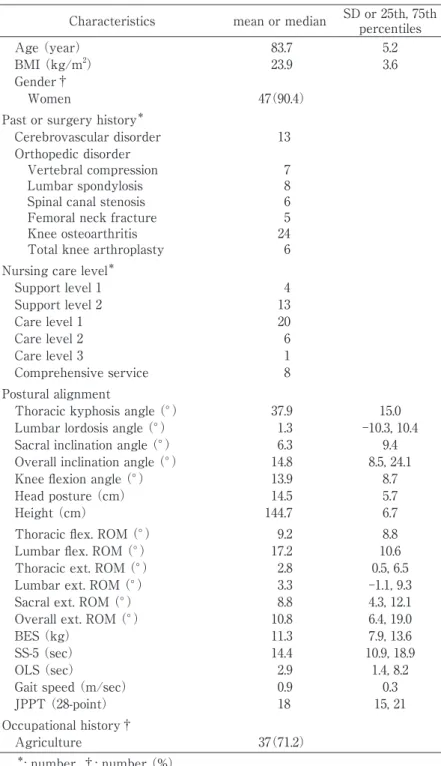
From interviews and primary doctor and personal long-term care manager information records, we confirmed the subjects’ ages, nurs- ing care level, and medical information (Table 1).
Postural alignment in standing
Spinal curvature angle for each part on the sagittal plane
We used a spinal column shape measurement analyzer (SpinalMouse®; Idiag) and measured the thoracic kyphosis angle (angle between the T1 and T12 vertebrae), the lumbar lordosis angle (between the T12 and S1 vertebrae), the sacral inclination angle (angle between the dorsal surface of the sacrum and the vertical line), and the overall inclination angle (angle between a straight line from T1 to S1 and the vertical line). Spinal lordosis is shown with a minus sign, and spinal kyphosis with a plus sign.
For the sacrum and trunk, the forward tilt is shown with a plus sign and the backward tilt with a minus sign.
We instructed each subject to keep their legs a shoulder-width apart, to keep their line of sight directed horizontally forward, to stand as relaxed as possible.
Earlobe-to-heel distance and angle of knee flexion We photographed each subject’s standing posture along the sagittal plane using a digital thoracic kyphosis angle or the occipital-wall
distance was evaluated to indicate the degree of kyphosis posture. This may apply for older adults in the United States, because many have increased thoracic kyphosis, but may not be true for Japanese older adults who have in- creased lumbar kyphosis12). Trunk ROM has been reported to be related to BES13) and quali- ty of life14), but its relation to postural alignment has not been studied sufficiently.
The purpose of this study was to clarify the relationship between trunk ROM and BES with each postural alignment variable and the influ- ences of trunk ROM and BES on the postural alignment variable group in community-dwelling older adults receiving services from the senior’s day service center (day service center).
Methods
Participants
The study subjects were 52 older adults who attended a single day service center in Aomori, Japan, from April to June 2018. The inclusion criteria were those with no past history of frac- tures or surgeries within 6 months, who were able to stand and/or walk without assistance, and who were able to agree to participate in this study. The exclusion criteria were those with a history of fractures or surgeries within 6 months, who could not agree to participate in this study, or who were not standing or walking independently.
We explained the study’s aims and proce- dures to the subjects, and all subjects provided written consent. This study was approved by the Committee of Medical Ethics of Hirosaki University Graduate School of Health Sciences, Hirosaki, Japan (reference no. 2017-048).
Measures
The intra-rater reliability of each measurement variable was measured by intraclass correlation
still camera (α6000; Sony). Based on the photographed image, the earlobe-to-heel distance
(head posture) and knee flexion angle were calculated using ImageJ ver.1.51 (freeware; NIH).
Trunk range of motion
Using a SpinalMouse®, we measured the spinal curvature angle in the trunk’s maximum flexion and maximum extension positions. We calculated the trunk flexion ROM and the trunk extension
Table 1. Baseline data
Characteristics mean or median SD or 25th, 75th percentiles
Age (year) 83.7 5.2
BMI (kg/m2) 23.9 3.6
Gender†
Women 47(90.4)
Past or surgery history*
Cerebrovascular disorder 13
Orthopedic disorder
Vertebral compression 7
Lumbar spondylosis 8
Spinal canal stenosis 6
Femoral neck fracture 5
Knee osteoarthritis 24
Total knee arthroplasty 6
Nursing care level*
Support level 1 4
Support level 2 13
Care level 1 20
Care level 2 6
Care level 3 1
Comprehensive service 8
Postural alignment
Thoracic kyphosis angle (°) 37.9 15.0
Lumbar lordosis angle (°) 1.3 ‒10.3, 10.4
Sacral inclination angle (°) 6.3 9.4
Overall inclination angle (°) 14.8 8.5, 24.1
Knee flexion angle (°) 13.9 8.7
Head posture (cm) 14.5 5.7
Height (cm) 144.7 6.7
Thoracic flex. ROM (°) 9.2 8.8
Lumbar flex. ROM (°) 17.2 10.6
Thoracic ext. ROM (°) 2.8 0.5, 6.5
Lumbar ext. ROM (°) 3.3 ‒1.1, 9.3
Sacral ext. ROM (°) 8.8 4.3, 12.1
Overall ext. ROM (°) 10.8 6.4, 19.0
BES (kg) 11.3 7.9, 13.6
SS-5 (sec) 14.4 10.9, 18.9
OLS (sec) 2.9 1.4, 8.2
Gait speed (m/sec) 0.9 0.3
JPPT (28-point) 18 15, 21
Occupational history†
Agriculture 37(71.2)
*: number, †: number (%).
BMI: body mass index; head posture: earlobe-to-heel distance, flex.: flexion;
ext.: extension; ROM: range of motion; BES: back extensor strength; SS-5:
5-repetition sit-to-stand; OLS: one-leg standing time; Gait speed: 5-m maximum gait speed; JPPT: Japanese Physical Performance Test.
ROM for each section of the spinal column.
Back extensor strength
BES was measured using a manual muscle strength testing device (Mobie MT-100; SAKAI Medical Co.) invented by Endo et al 17). The subjects were instructed to cross both arms in front of their chests in a sitting posture and conduct a 3-second isometric contraction.
Physical function
5-repetition sit-to-stand test
We measured the time taken to complete five repetitions of a standing and sitting movement from a 40-cm table as quickly as possible 18). One-leg standing time
We measured the length of time for which the subjects could hold a one-leg standing position with their eyes open and both hands on their hips. The measurement ended when the raised foot touched the supporting leg or the floor, when the support leg was displaced, or when the hands were moved from the hips.
5-meter maximum gait speed
Subjects were instructed to walk as quickly as possible along a walking path, and we measured the time it took from starting to the point at which they completed a measured distance of 5 m.
Japanese version of the physical performance test
We used a Japanese version of the physical performance test 19). This consists of seven items:
writing a sentence (“I live in Tokyo”), simulated eating, lifting a book and putting it on a shelf, putting on and removing a jacket, picking up a penny from the floor , turning 360 degrees, and a 50-foot walk, and then calculating the total score (range 0 ─ 28 points). Higher scores indicate a better physical performance.
Statistical analysis
Association between postural alignment and each measurement variable
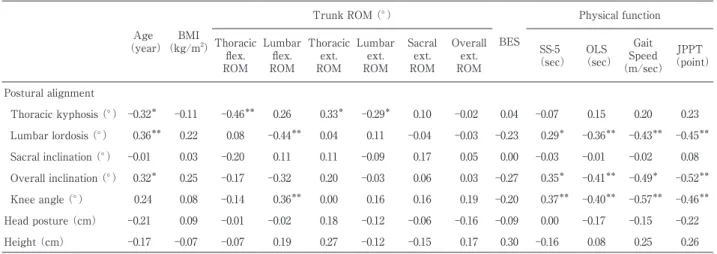
The relationship between trunk ROM and BES for postural alignment was analyzed using correlation coefficients. To clarify the character- istics of each subject, we also analyzed the cor- relation between postural alignment and age, BMI, and physical function. After confirming whether or not the data was normally distribut- ed by the Shapiro-Wilk test, Pearson’s correla- tion coefficients were calculated when the data was normally distributed and Spearman’s rank correlation coefficients when it was not.
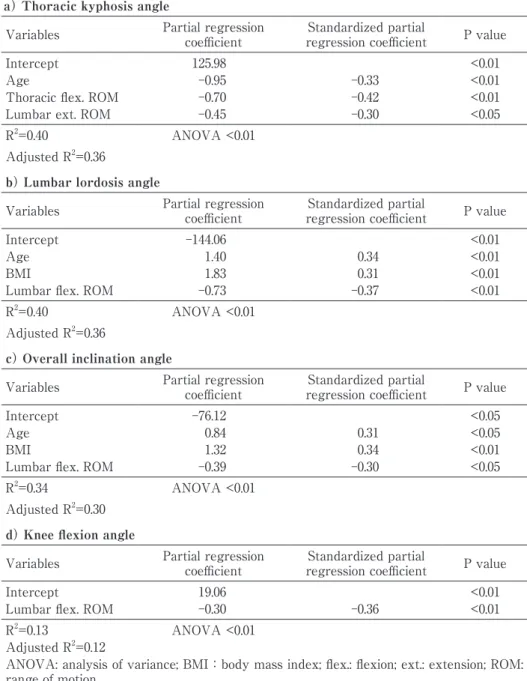
Impact for each variable of postural alignment In order to examine the influence of trunk ROM and BES on each postural alignment vari- able, we analyzed the data through a for- ward-backward stepwise selection multiple re- gression analysis. The postural alignment variables (thoracic curvature angle, lumbar cur- vature angle, sacral inclination angle, overall incli- nation angle, and knee flexion angle) were de- fined as dependent variables. Independent variables were trunk ROM and BES, and kypho- sis-related factors such as age, BMI, and the 5-repetition sit-to-stand test (SS-5).
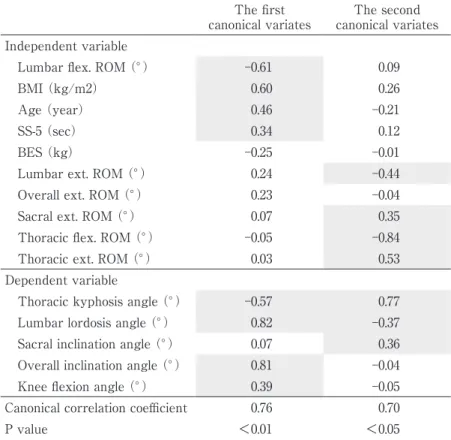
Impact on the variable group of postural alignment In order to examine how the trunk ROM and BES affect the postural alignment variable group, we analyzed the data using a canonical correlation analysis. The dependent variables were the variable group of the thoracic curva- ture angle, lumbar curvature angle, sacral incli- nation angle, overall inclination angle, and the knee flexion angle. The independent variables were trunk ROM, BES, age, BMI, and SS-5.
For the above analysis, we used R 2.8.1 (free- ware; CRAN) and statistical significance level was 0.05.
Results
Association between postural alignment and each measurement variable
1. Age, BMI, and physical function
The thoracic kyphosis angle, lumbar lordosis angle, and overall inclination were associated to age but not BMI. The lumbar lordosis angle, overall inclination angle, and knee flexion angle were correlated with all physical function vari- ables (Table 2). In other words, changes such as decreased thoracic kyphosis or lumbar lordo- sis tended to occur with age, but changes in de- creased lumbar lordosis, forward trunk tilt, or knee flexion were related to a decline in physi- cal function.
2. Trunk ROM and BES
The thoracic kyphosis angle was correlated with the thoracic flexion ROM, thoracic exten- sion ROM, and lumbar extension ROM. Both lumbar lordosis and knee flexion angles were correlated with lumbar flexion ROM, but there was no correlation with thoracic flexion ROM or extension ROM in other regions. There were no significant correlations between each postural
alignment variable and BES (Table 2). In fact, subjects with more severe thoracic kyphosis had a lower thoracic flexion ROM and lumbar extension ROM, but many had an increased thoracic extension ROM. Furthermore, subjects with reduced lumbar lordosis tended to have smaller lumbar flexion ROM, and those with knee flexion tended to have larger lumbar flexion ROM.
Impact for each variable of postural alignment
Factors affecting the thoracic kyphosis angle were age, thoracic flexion ROM, and lumbar extension ROM. Age, BMI, and lumbar flexion ROM affected both the lumbar lordosis angle and overall inclination angle. Lumbar flexion ROM also affected the knee flexion angle (Table 3). No significant variables were selected for the sacral inclination angle. In summary, effects of the thoracolumbar ROM on all postural alignment variables except the sacral inclination angle were observed.
Impact on the group of postural alignment variables Table 4 shows the results of the canonical correlation coefficients and variables. In the first canonical variable, lumbar flexion ROM, BMI,
Table 2. Association between each measurement variable
(year)Age BMI
(kg/m2)
Trunk ROM (°)
BES
Physical function Thoracic
flex.
ROM
Lumbar flex.
ROM
Thoracic ext.
ROM
Lumbar ext.
ROM
Sacral ext.
ROM
Overall ext.
ROM
(sec)SS-5 OLS
(sec)
SpeedGait
(m/sec)
(point)JPPT
Postural alignment
Thoracic kyphosis (°) ‒0.32* ‒0.11 ‒0.46** 0.26 0.33* ‒0.29* 0.10 ‒0.02 0.04 ‒0.07 0.15 0.20 0.23 Lumbar lordosis (°) 0.36** 0.22 0.08 ‒0.44** 0.04 0.11 ‒0.04 ‒0.03 ‒0.23 0.29* ‒0.36** ‒0.43** ‒0.45**
Sacral inclination (°) ‒0.01 0.03 ‒0.20 0.11 0.11 ‒0.09 0.17 0.05 0.00 ‒0.03 ‒0.01 ‒0.02 0.08 Overall inclination (°) 0.32* 0.25 ‒0.17 ‒0.32 0.20 ‒0.03 0.06 0.03 ‒0.27 0.35* ‒0.41** ‒0.49* ‒0.52**
Knee angle (°) 0.24 0.08 ‒0.14 0.36** 0.00 0.16 0.16 0.19 ‒0.20 0.37** ‒0.40** ‒0.57** ‒0.46**
Head posture (cm) ‒0.21 0.09 ‒0.01 ‒0.02 0.18 ‒0.12 ‒0.06 ‒0.16 ‒0.09 0.00 ‒0.17 ‒0.15 ‒0.22
Height (cm) ‒0.17 ‒0.07 ‒0.07 0.19 0.27 ‒0.12 ‒0.15 0.17 0.30 ‒0.16 0.08 0.25 0.26
Values are shown as Pearson’s product moment correlation coefficient or Spearman rank correlation coefficient. *p<0.05, **p<0.01.
BMI:body mass index; head posture: earlobe-to-heel distance; flex.: flexion; ext.: extension; ROM: range of motion; BES: back extensor strength;
SS-5: 5-repetition sit-to-stand; OLS: one-leg standing time; Gait speed: 5-m maximum gait speed; JPPT: Japanese Physical Performance Test.
age, and SS-5 (in order of greatest influence)
greatly influenced the variable group of the thoracic kyphosis angle, lumbar lordosis angle, overall inclination angle, and knee flexion angle.
In the second canonical variable, the thoracic flexion ROM, the thoracic extension ROM, the lumbar extension ROM, and the sacral exten- sion ROM (in order of influence) had a high in- fluence on the variable group of the thoracic ky- phosis angle, the lumbar lordosis angle, and the
sacral inclination angle.
As a result, the lumbar ROM, age, physical condition, and lower limb muscle strength affect- ed posture with thoracic kyphosis decreased, lumbar kyphosis and forward trunk tilt in- creased, and knee flexion. Furthermore, the tho- racolumbar and sacral ROM affected posture in- volving increased thoracic kyphosis, lumbar lordosis, and sacral forward inclination.
Table 3. Impact for each variable of postural alignment a) Thoracic kyphosis angle
Variables Partial regression
coefficient Standardized partial
regression coefficient P value
Intercept 125.98 <0.01
Age ‒0.95 ‒0.33 <0.01
Thoracic flex. ROM ‒0.70 ‒0.42 <0.01
Lumbar ext. ROM ‒0.45 ‒0.30 <0.05
R2=0.40 ANOVA <0.01
Adjusted R2=0.36
b) Lumbar lordosis angle
Variables Partial regression
coefficient Standardized partial
regression coefficient P value
Intercept ‒144.06 <0.01
Age 1.40 0.34 <0.01
BMI 1.83 0.31 <0.01
Lumbar flex. ROM ‒0.73 ‒0.37 <0.01
R2=0.40 ANOVA <0.01
Adjusted R2=0.36
c) Overall inclination angle
Variables Partial regression
coefficient Standardized partial
regression coefficient P value
Intercept ‒76.12 <0.05
Age 0.84 0.31 <0.05
BMI 1.32 0.34 <0.01
Lumbar flex. ROM ‒0.39 ‒0.30 <0.05
R2=0.34 ANOVA <0.01
Adjusted R2=0.30 d) Knee flexion angle
Variables Partial regression
coefficient Standardized partial
regression coefficient P value
Intercept 19.06 <0.01
Lumbar flex. ROM ‒0.30 ‒0.36 <0.01
R2=0.13 ANOVA <0.01
Adjusted R2=0.12
ANOVA: analysis of variance; BMI:body mass index; flex.: flexion; ext.: extension; ROM:
range of motion.
Discussion
Association between postural alignment and each measured variable
Many previous studies have reported the re- lationship between postural alignment and phys- ical function. Previously, we also reported that lumbar lordosis and overall inclination showed a significant correlation with physical function, and that there was a significant association even after adjusting for age, BMI, and spinal dis- ease20). In this study, the knee flexion angle was added as a variable for postural alignment, and its relationship to head posture and height (used as posture evaluation indices) was analyzed. As a result, it was shown that the physical function was correlated not only with the lumbar lordo- sis angle and the overall inclination angle but also with the knee flexion angle. These results
clarified that the part of the spinal column relat- ed to physical function was the same as that in our previous study20) and is related to lower limb alignment. Although these results may be characteristic in Japanese older adults, the fact that similar results were obtained in a different population is a new finding.
In this study, we hypothesized that the postural alignment of older adults is related not only to BES but also to the trunk ROM. First, we examined the relationship with each variable of postural alignment. After adjusting for confounding variables such as age, BMI, and SS- 5, we found that age and thoracolumbar ROM significantly affected the thoracic kyphosis angle.
Age, BMI, and lumbar ROM affected the lumbar lordosis angle and the overall inclination angle, but only the lumbar ROM significantly affected the knee flexion angle. This indicates that spinal
Table 4. Impact on the variable group of postural alignment The first
canonical variates The second canonical variates Independent variable
Lumbar flex. ROM (°) ‒0.61 0.09
BMI (kg/m2) 0.60 0.26
Age (year) 0.46 ‒0.21
SS-5 (sec) 0.34 0.12
BES (kg) ‒0.25 ‒0.01
Lumbar ext. ROM (°) 0.24 ‒0.44
Overall ext. ROM (°) 0.23 ‒0.04
Sacral ext. ROM (°) 0.07 0.35
Thoracic flex. ROM (°) ‒0.05 ‒0.84
Thoracic ext. ROM (°) 0.03 0.53
Dependent variable
Thoracic kyphosis angle (°) ‒0.57 0.77
Lumbar lordosis angle (°) 0.82 ‒0.37
Sacral inclination angle (°) 0.07 0.36
Overall inclination angle (°) 0.81 ‒0.04
Knee flexion angle (°) 0.39 ‒0.05
Canonical correlation coefficient 0.76 0.70
P value <0.01 <0.05
BMI:body mass index; flex.: flexion; ext.: extension; ROM: range of motion;
BES: back extensor strength; SS-5: 5-repetition sit-to-stand.
alignment, excluding the sacrum, is not only related to trunk ROM, but also to age and BMI.
Conversely, the knee flexion angle is less affected by age, BMI, and SS-5. As the prevalence of orthopedic diseases such as knee osteoarthritis in the participants was high, the individual differences in age, physique, and muscle strength of the lower limbs were probably large.
The postural alignment variables were not significantly associated with BES. One reason for this may be that the thoracolumbar spine
(i.e. spinal alignment) was affected by age. In the United States, the prevalence of thoracic ky- phosis increases with age 1), and BES decreases in a kyphotic posture 9-11). On the other hand, among the Japanese also, thoracic kyphosis in- creases with age; however, the apex of the cur- vature gradually lowers, and finally changes in the lumbar spine so that posterior hatching is shown 21). This subject also tended to have age-related decrease in thoracic kyphosis and lumbar lordosis. In such a posture, a ROM that extends the lumbar spine is required to mea- sure the BES. However, the lumbar lordosis an- gle did not show an association with the lumbar extension ROM (Table 2). Therefore, there was a large individual difference in the BES when the lumbar spine was extended; we believe that there was no association between postural align- ment and BES.
Impact for postural alignment
Next, we examined whether the influence of trunk ROM and BES differed for each charac- teristic of postural alignment. In addition to age, flexion postures involving lumbar kyphosis were associated with lumbar ROM, physique, and leg strength. These factors were likely affected by age-related and individual factors. However, pos- tures involving enhanced thoracic kyphosis were only associated with thoracolumbar ROM.
This may indicate that trunk ROM easily influ- ences the posture. Since BES had little influence
on any posture, it might not affect the differenc- es in postural alignment characteristics. Based on previous studies, this result may be due to old age and may also be biased toward frail old- er adults. Although previous studies have re- ported that posture was related to BES, if the samples are different, the posture may not be related to BES and may be associated with trunk ROM, rather than BES. In other words, postural alignment and BES are not necessarily related.
Research limitations
The population of participants in this study were community-dwelling older adults who used day service centers. However, the participants those who were able to stand up and walk inde- pendently and had a certain level of cognitive function that allowed them to answer a ques- tionnaire survey. Furthermore, many partici- pants engaged in agriculture and were in an ad- vanced age group. These characteristics must be considered when generalizing these results.
Since this study was a cross-sectional study, it is not possible to clarify the causal relationship between trunk ROM and posture changes. We cannot determine whether the posture changed due to changes in the trunk ROM. Future studies should seek to clarify these causal relationships;
we think these relationships can be reflected in an exercise program.
Conclusion
We investigated the relationship between trunk ROM and BES on the postural alignment of 52 community-dwelling older adults using the day service center. Postural alignment variables such as thoracic kyphosis angle, lumbar lordosis angle, and knee flexion angle were correlated with trunk ROM. After adjusting for age, BMI, and SS-5, the thoracic kyphosis angle was affected by the thoracic ROM, but other postural
alignment variables with the exception the sacral inclination angle were affected by the lumbar ROM. Furthermore, considering postural alignment for each characteristic, postures with decreased lumbar lordosis, a forward-tilted trunk, and a flexed knee were affected by lumbar ROM, age, BMI, and SS-5. Postures with increased thoracic kyphosis and with lumbar lordosis and sacral forward tilt were affected by thoracolumbar ROM. Each variable and variable group of postural alignment was related to trunk ROM, but there was not enough evidence to support a relationship with BES. Depending on postural characteristics, it may not be related to BES.
Disclosure statement
All authors have no conflicts of interest directly relevant to the content of this article.
Acknowledgements
We sincerely thank all the subjects who gave us their understanding and cooperation in this study as well as all of the staff at the Hiraka Day Service Center.
References
1) Kado DM, Prenovost K, Crandall C. Narrative review: hyperkyphosis in older person. Ann Intern Med. 2007;147:330-8.
2) Katzman WB, Wanek L, Shepherd JA, Sellmeyer DE. Age-related hyperkyphosis: its causes, conse- quences, and management. J Orthop Sports Phys Ther. 2010;40:352-60.
3) Bansal S, Katzman WB, Giangregorio LM. Exercise for improving age-related hyperkyphotic posture: a systematic review. Arch Phys Med Rehabil. 2014;
95:129-40.
4) Bergström I, Bergström K, Grahn Kronhed AC, Karlsson S, Brinck J. Back extensor training
increases muscle strength in postmenopausal women with osteoporosis, kyphosis and vertebral fractures. J Adv Physiother. 2011;13:110-7.
5) Ball JM, Cagle P, Johnson BE, Lucasey C, Lukert BP. Spinal extension exercises prevent natural progression of kyphosis. Osteoporos Int. 2009;20:
481-9.
6) Benedetti MG, Berti L, Presti C, Frizziero A, Giannini S. Effects of an adapted physical activity program in a group of elderly subjects with flexed posture: clinical and instrumental assessment. J Neuroeng Rehabil. 2008;5:32. doi: 10.1186/1743-0003- 5-32.
7) Katzman WB, Sellmeyer DE, Stewart AL, Wanek L, Hamel KA. Changes in flexed posture, muscu- loskeletal impairments, and physical performance after group exercise in community-dwelling older women. Arch Phys Med Rehabil. 2007;88:192-9.
8) González-Gálvez N, Gea-García GM, Marcos-Pardo PJ. Effects of exercise programs on kyphosis and lordosis angle: A systematic review and meta- analysis. PLoS One. 2019;14:e0216180.
9) Sinaki M, Itoi E, Rogers JW, Bergstralh EJ, Wahner HW. Correlation of back extensor strength with thoracic kyphosis and lumbar lordosis in estrogen-deficient women. Am J Phys Med Rehabil.
1996;75:370-4.
10) Mika A, Unnithan VB, Mika P. Differences in thoracic kyphosis and in back muscle strength in women with bone loss due to osteoporosis. Spine.
2005;30:241-6.
11) Kasukawa Y, Miyakoshi N, Hongo M, Ishikawa Y, Kudo D, Suzuki M, Mizutani T, et al. Age-related changes in muscle strength and spinal kyphosis angles in an elderly Japanese population. Clin Interv Aging. 2017;12:413-20.
12) Hongo M, Miyakoshi N, Shimada Y, Sinaki M.
Association of spinal curve deformity and back extensor strength in elderly women with osteopo- rosis in Japan and the United States. Osteoporos Int. 2012;23:1029-34.
13) Miyakoshi N, Hongo M, Maekawa S, Ishikawa Y, Shimada Y, Okada K, Itoi E. Factors related to spinal mobility in patients with postmenopausal osteoporosis. Osteoporos Int. 2005;16:1871-4.
14) Miyakoshi N, Hongo M, Maekawa S, Ishikawa Y, Shimada Y, Itoi E. Back extensor strength and lumbar spinal mobility are predictors of quality of life in patients with postmenopausal osteoporosis.
Osteoporos Int. 2007;18:1397-403.
15) Shrout PE, Fleiss JL. Intraclass correlations: uses in assessing rater reliability. Psychol Bull. 1979;
86:420-8.
16) Landis JR, Koch GG. The measurement of observer agreement for categorical data. Biometrics. 1977;33:
159-74.
17) Endo T, Tsusima E, Omata J, Iwabuchi M, Shirado O, Ito T. The reliability of trunk extensor strength measurements, utilizing hand held dynamometer, of geriatric patients presenting kyphosis. Annual
Rep Tohoku Sect J Phys Ther Assoc. 2014;26:172-6.
18) Csuka M, McCarty DJ. Simple method for mea- surement of lower extremity muscle strength.
Am J Med. 1985;78:77-81.
19) Morala D, Shiomi T. Assessing reliability and validity of physical performance test for the Japanese elderly. J Phys Ther Sci. 2004;16:15-20.
20) Fukuda A, Harada K, Nihei K, Kobayashi M, Saito K. Relationship of spinal curvature with physical functions and history of falls in elderly Japanese women. Phys Ther Japan. 2013;40:465-72.
21) Fujita H. Postural characteristics of the elderly and relationship with falling. J Phys Ther Sci.
1995;10:141-7.