Post-IFRS Outcome on Financial Reporting
Information : Early Evidence from Indonesian
Stock Exchange
著者(英)
Elok Heniwati
学位名
博士(先端マネジメント)
学位授与機関
関西学院大学
学位授与番号
34504甲第606号
URL
http://hdl.handle.net/10236/00025152
Doctoral Dissertation
for Doctoral Degree
Kwansei Gakuin University
Post-IFRS Outcome on Financial Reporting Information:
Early Evidence from Indonesian Stock Exchange
Advisor: Professor Noriaki Yamaji
December 2015
Graduate Department of Advanced Management (PhD)
Institute of Business and Accounting
ii
Table of Contents
Table of Contents ... ii
Acronyms and Abbreviations ... v
List of Tables ... vi
List of Figures ... vii
CHAPTER 1: INTRODUCTION ... 1
1.1 Background ... 1
1.2 The Objective of the Study ... 2
1.3 Motivation of the Study ... 2
1.3.1 The Implementation of the IFRS-based PSAK ... 3
1.3.2 Research Gap ... 4
1.3.3 Support the IAI’s Program ... 5
1.4 Research Problem ... 7
1.5 Research Questions ... 7
1.6 Theoretical Framework and Hypotheses ... 7
1.7 Research Methodology ... 11
1.8 Contributions of the Study ... 12
1.9 Structure of the Thesis ... 12
CHAPTER 2: THE ACCOUNTING ENVIRONMENT IN INDONESIA ... 15
2.1 Introduction ... 15
2.2 The Republic of Indonesia ... 17
2.3 Gernon and Wallace’s Accounting Ecology ... 18
2.4 The Framework of Accounting Ecology in Indonesia ... 21
2.4.1 Social Environment ... 21
2.4.2 Organizational Environment ... 28
2.4.3 Professional Environment ... 34
2.4.4 Individual Environment... 37
2.4.5 Accounting Environment ... 40
2.5 Links between Accounting and Cultural Dimensions ... 47
2.5.1 Impact on the Accounting Values ... 47
2.5.2 Impact on the Standards ... 49
2.6 Conclusions ... 50
CHAPTER 3: IFRS-BASED PSAK: CONVERGENCE ISSUES ... 52
3.1 Introduction ... 52
3.2 Conceptualizing Convergence ... 53
3.2.1 The Framework: Neo-Institutional Theory ... 53
iii
3.3 Research Methodology ... 57
3.3.1 Data Collection ... 57
3.3.2 Analysis ... 57
3.4 Setting the Stage for Convergence in Indonesia ... 58
3.4.1 Motivation to Convergence ... 58
3.4.2 Making PSAKs Comparable to IFRSs ... 59
3.4.3 Degree of Convergence in Indonesia ... 63
3.5 Conclusions ... 67
CHAPTER 4: COMPANIES’ COMPLIANCE WITH IFRS-BASED PSAK DISCLOSURES ... 69
4.1 Introduction ... 69
4.2 Literature Review ... 70
4.2.1 The Disclosure of Financial Reporting... 71
4.2.2 Motivation for Compliance with the Disclosures of Financial Reporting ... 73
4.2.3 The Regulation of Financial Accounting Disclosures ... 80
4.2.4 The Disclosure Studies ... 83
4.3 Theoretical Framework and Hypotheses Development ... 89
4.3.1 Internal-related Variables ... 89
4.3.2 External-related Variables ... 93
4.4 Research Design ... 95
4.4.1 Data Collection ... 95
4.4.2 The Disclosure Index ... 96
4.4.3 Index Construction ... 99
4.4.4 Empirical Specification ... 103
4.5 Results and Discussion ... 105
4.5.1 Compliance Levels of Indonesian Non Financial Listed Companies with IFRS Disclosures... 105
4.5.2 The Model ... 107
4.5.3 Evidence from Indonesian Non-listed Companies ... 108
4.6 Conclusions ... 111
CHAPTER 5: THE VALUE RELEVANCE OF ACCOUNTING INFORMATION AND COMPANIES’ COMPLIANCE WITH IFRS-BASED PSAK DISCLOSURES ... 113
5.1 Introduction ... 113
5.2 Accounting Quality and Value Relevance... 113
5.3 Literature Review ... 115
5.3.1 Value Relevance: Definitions ... 115
5.3.2 Types of Value Relevance Study ... 119
5.3.3 Value Relevance Studies Contributions ... 120
iv
5.4 Theoretical Framework and Hypothesis Development ... 129
5.4 Research Design ... 130
5.4.2 Data and Sample Description ... 130
5.4.3 Variable Measurement ... 131
5.4.4 Empirical Specification ... 133
5.5 Results and Discussion ... 138
5.5.2 Descriptive statistics ... 138
5.5.3 The Models... 140
5.5.4 The Value Relevance of Nonfinancial: IFRS-based PSAK Compliance ... 145
5.6 Conclusions ... 146
CHAPTER 6: CONCLUDING REMARKS ... 147
6.1 Summary of Findings ... 147
6.1.1 Findings of the First Study ... 148
6.1.2 Findings of the Second Study ... 148
6.1.3 Findings of the Third Study ... 149
6.2 Limitations and Future Research ... 150
v
Acronyms and Abbreviations
AAOFI Accounting and Auditing Organization of Islamic Financial Institutions
AICPA American Institute of Certified Public Accountants
AusAID Australian Agency for International Development
Bapepam-LK Badan Pengawas Pasar Modal dan Lembaga Keuangan (Capital Market and
Financial Institution Supervisory Agency
BEI Bursa Efek Indonesia (Indonesian Capital Market)
BEJ Bursa Efek Jakarta (Jakarta Capital Market)
BES Bursa Efek Surabaya (Surabaya Capital Market)
BI Bank Indonesia (Indonesian Central Bank)
BRM Badan Review Mutual (Quality Review Board)
CPA Certified Public Accountant
DKP Dewan Kehormatan Profesi (Profession Honorary Board)
DKSAK Dewan Konsultatif Standar Akuntansi Keuangan (Financial Accounting
Standards Consultative Board)
DPN Dewan Pengurus Nasional (IAI National Council)
DSAK Dewan Standar Akuntansi Keuangan (Indonesian Financial Accounting
Standards Board)
DSAS Dewan Standar Akuntansi Syariah (Indonesia Sharia Board)
GAAP Generally Accepted Accounting Practices
IAASB International Auditing and Assurance Standards Board
IAI Ikatan Akuntan Indonesia (Indonesian Institute of Accountants)
IAPI Ikatan Akuntan Publik Indonesia (Indonesian Institute of Public Accountants)
IAS International Accounting Standard
IASB International Accounting Standards Board
IDX Indonesia Stock Exchange
IDR Indonesian Rupiah (currency)
IFAC International Federation of Accountants
IFRIC International Financial Reporting Interpretations Committee
IFRS International Financial Reporting Standards
IPSAS International Public Sector Accounting Standards
KERPPA Komite Evaluasi dan Rekomendasi Penyelenggaraan Pendidikan Akuntansi
(Committee of Evaluation and Recommendation of Professional Accounting Education)
KSAP Komite Standar Akuntansi Pemerintah
MoF Ministry of Finance
MUI Majelis Ulama Indonesia (Indonesian Council of Ulemas)
PAPI Pedoman Akuntansi Perbankan Indonesia (Accounting and reporting guidelines
for banking)
PAPSI Pedoman Akuntansi Perbankan Syariah Indonesia (Accounting and reporting
guidelines for sharia banking)
PP Peraturan Pemerintah (Government Regulation)
PPAJP Pusat Pembinaan Akuntan dan Jasa Penilai (Center for Supervision of
Accountants and Appraiser Services in MoF)
PPAk Pendidikan Profesional Akuntan (Professional accounting education)
PSAK Pernyataan Standar Akuntansi Keuangan (Indonesian Financial Accounting
Standards)
SAK Standar Akuntansi Keuangan (Accounting standards)
SAK ETAP Standar Akuntansi Keuangan Entitas Tanpa Akuntabulitas Publik (Accounting
standards for non-public interest entities)
SME Small and Medium-sized Enterprises
SPAP Standar Profesional Akuntan Publik (Indonesian public accountant professional
vi List of Tables
Table 1 Listed Companies in the Indonesian Capital Market as 2012 ... 3
Table 2 Indonesia IFRS Convergence Roadmap ... 6
Table 3 IFRS-based PSAK Implementation and Accounting Quality ... 9
Table 4 Research Issues of Second Study ... 10
Table 5 Rankings of Cultural Values of Power Distance and Individualism ... 21
Table 6 Key Governing Laws and Regulations for Private Sector in Indonesia ... 26
Table 7 Number of Public Accountants in Firms Registered with Bank Indonesia and Bapepam-LK ... 35
Table 8 Four Pillars of Indonesian Accounting Standards ... 38
Table 9 Financial Reporting and Disclosure Requirements ... 41
Table 10 Summary of Indonesian Environment Values ... 51
Table 11 Degree of Formal Convergence between PSAK and IFRS... 64
Table 12 Summary of Sample Selection Process ... 95
Table 13 Extract from PSAK 19 [IAS 38] – Paragraph 119 (sub-paragraphs a – e)... 99
Table 14 Extract from the disclosure checklist: PSAK 19 [IAS 38] – Paragraph 119 (sub-paragraphs a – e) ... 100
Table 15 IFRS-based PSAK Disclosure Checklist ... 102
Table 16 Descriptive Statistics of Disclosure Scores ... 106
Table 17 The Findings of Multivariate Analyses ... 107
Table 18 Firm-year Observation for Prices and Returns Models Based on Industry ... 131
Table 19 Descriptive Statistics for Firm-Year Observations 2012* ... 139
Table 20 Price Regression on Earnings, Book Value and IFRS-based PSAK Compliance Level 141 Table 21 Regression of Annual Returns on Earnings Levels, Earnings Changes and IFRS-based PSAK Compliance Level ... 143
vii List of Figures
Figure 1 Research Frameworks ... 8
Figure 2 Organization of Chapter 2 ... 15
Figure 3 Gernon and Wallace’s Ecological Accounting Environment ... 20
Figure 4 Accounting Standards History in Indonesia ... 42
Figure 5 Approaches of Convergences and Harmonization ... 56
Figure 6 Structure of Indonesian GAAP as of June 31, 2002 ... 61
Figure 7 Progress Report of IFRS/IAS Convergence in Indonesia ... 62
1
CHAPTER 1: INTRODUCTION
1.1 Background
This research examines the effect of the implementation of IFRS-based PSAK in Indonesia on the quality of financial reporting. In this regards, the perspective of the quality of financial reporting refers the qualitative characteristics as stated in the IASB (2010), that is, comparability, transparency, and value relevance. The study focuses on the investigation of the setting stage for convergence in Indonesia, companies' compliance with IFRS-based PSAK disclosure, and the usefulness of financial and nonfinancial information.
The adoption of the PSAK (Indonesian GAAP) that is converged with IFRS in Indonesia is an example of accounting standardization in the developing country with different institutional frameworks and enforcement rules. This issue allows investigating matters relating to the IFRS adoption process and the implementation of IFRS-based PSAK by Indonesian non-financial companies listed on the Indonesian Stock Exchange (IDX) or Bursa Efek Indonesia (BEI). By using hypothesis deduction approach, this study develops a hypothesis and empirically examines them to explain a relationship between the implementation of IFRS-based PSAK and accounting quality in Indonesia.
Several studies have investigated the effect of adoption IAS/IFRS on the quality of financial information in single qualitative characteristics such as comparability (De Franco, Kothari, and Verdi, 2011), transparency (Barth, Konchitchki, and Landsman 2013), and value-relevance (Koonce, Nelson, and Shakespeare 2011). Other works of literature analyze a pair of two primary qualitative characteristics, which jointly test relevance and reliability (Kadous, Koonce, and Thayer 2012, Barth, Beaver and Landsman 2001). Another pair of qualitative characteristics is timeliness and conservatism (Dechow, Ge, and Schrand 2010). Kinds of literature that investigate more than two qualitative characteristics also exist (Nobes and Stadler 2014, Dichev, et al. 2013).
A few types of research have addressed the convergence of Indonesian GAAP with IFRS in Indonesia. Sulistyanto (2008) studies about accounting quality produced by the companies listed on the Indonesia Stock Exchange. The findings suggest that the accounting quality in Indonesia is still low. Mayangsari (2010) that investigates whether the information on IFRS adjustments is value relevant concluded that mandatory adoption of IFRS increases the perceived quality of financial statements and IFRS reconciliations seem to be of the greatest importance for the valuation. Kraal
2
(2012) that uses a qualitative study examined the impact of the convergence of local accounting standards with IFRS for companies in the ASEAN countries, including Indonesia. The result of this study reveals that authorities in Indonesia do not take into account cultural, religious and societal variations around the globe. Moreover, Indonesia faced the sensitive issue of whether IFRS and
Shari'a Law principles can be reconciled. Furthermore, Lasmin (2011) conducted empirical research
that measures and compares the levels and progress of formal and material harmonization in Indonesia. This study found that the extents of formal and material harmonization are great, although some divergences still occur.
Prior studies in Indonesia concerning qualitative characteristics shows that investigate more than two variables of accounting quality are limited. The present study examines qualitative aspects of Indonesian nonfinancial listed companies' accounting information after implementing IFRS-based PSAK to fill the gap.
1.2 The Objective of the Study
The main aim of the present study is to evaluate comprehensively the impact of IFRS-based PSAK implementation on the quality of accounting information by non-financial companies listed on the Indonesian Stock Exchange (IDX). In doing so, this study focuses on three characteristics of accounting quality and set three specific objectives as follows:
1. To evaluate issues relating to comparability by exploring convergence program of national accounting standards (Indonesian GAAP) with international accounting standards (IFRS). 2. To evaluate issues relating to transparency by examining companies’ compliance level with
IFRS disclosures.
3. To evaluate issues relating to value relevance of IFRS-based PSAK accounting information by examining other information represented by compliance level.
1.3 Motivation of the Study
There are three primary motivations for conducting this research. The first is the implementation of IFRS-based PSAK for listed companies in Indonesian Capital Market for their financial reporting yearly-ended December 2012. The second motivation is the lack of existing research on IFRS implementation issues in Indonesia. The third is to support IAI's program, which is investigating the impact of implementing IFRS-based PSAK.
3
1.3.1 The Implementation of the IFRS-based PSAK
Soderstrom and Sun (2007) in their research about accounting quality stated that accounting standards choice is one of the determinants of accounting quality. Since standard setter continues to improve the quality of accounting standards i.e. IFRS, it is expected that the financial statement under this standard become increasingly reliable and relevant value.
After the implementation of IFRS by all publicly listed companies in the European Union as of January 1, 2005, several studies have been conducted to examine the relationship between IFRS and accounting quality in those countries (Gebhardt and Novotny-Farkas 2011, Pope and McLeay 2011, Chen, Cheng and Lo 2010). Following that notion, the present study is intended to analyze the quality of financial reporting in Indonesia after companies listed on the Indonesian Stock Exchange implement IFRS-based PSAK for their financial reporting yearly ended December 31, 2012.
As of 2012, there were 459 issuers in the Indonesian capital market (IDX 2012). It consists of nine sectors (see Table 1 for detail). The decision to implement IFRS-based PSAK for companies' financial accounts yearly-ended December 31, 2012, is the primary motivation why the study is conducted. Considering that IFRS would improve the quality of financial statements among listed companies, thus, comparability of financial information would be enhanced, resulting in the attraction of foreign investors.
Table 1 Listed Companies in the Indonesian Capital Market as 2012
No. Industry Sector Number
1 Agriculture 16
2 Mining 37
3 Basic Industry and Chemicals 58
4 Miscellaneous Industry 41
5 Consumer Goods Industry 36
6 Property, Real Estate and Building Construction 53
7 Infrastructure, Utilities and Transportation 42
8 Finance 76
9 Trade, Service and Investment 100
Total 459
4
1.3.2 Research Gap
A switch to international accounting standards has stipulated academics and practices to examine whether the implementation of the standards influences financial reporting information. Numerous studies have attempted to explain the issues as stated by Pope and McLeay (2011) ranging into three research themes namely studies of compliance and enforcement, comparative analysis of IFRS-related accounting quality changes, and economic consequences of IFRS adoption.
The results of the above studies were a mix; it could be beneficial or detrimental. Several studies documented a positive outcome. Asbhaugh and Pincus (2001) that investigated the relationship between accounting standards variation and financial analyst forecast by developing indexes of differences show the change to IAS has reduced analyst forecast errors. Similarly, C. Leuz (2003), Leuz and Verrecchia (2000) comparing firms that use U.S. generally accepted accounting principles (GAAP) to those that use international accounting standards (IAS) show that there is a reduction of information asymmetry between insiders and outside minority shareholders. Other studies by Armstrong, et al. (2008), Daske, et al. (2007), Kim and Shi (2007) suggest that implementation of IAS leads to the lower cost of equity capital. It also makes it relatively easy to cross-list in the well-developed international capital markets (e.g. NYSE, NASDAQ or LSE) (Cuipers and Buinjik 2005) and allows for a more efficient allocation of savings worldwide (Street, Gray and Bryant 1999).
In contrast, the study of Jeanjean and Stolowy (2008) that analyzed the effect of the mandatory introduction of IFRS standards on earnings quality by using a sample from three IFRS first-time adopter countries, found that pervasiveness of earnings management did not decline after the introduction of IFRS, and in fact increased in France. Similarly, using a sample from 14 European Union member states from the year 1990 to 2005, Beuselinck, Joos and van der Meulen (2008) examined the comparability of accounting earnings by using accruals-cash flows association as a proxy for earning comparability. It found that accruals measurement was significantly affected by business cycle stages and firm-specific reporting incentives. In general, the findings show that earnings comparability across Europe did not improve after mandatory IFRS adoption.
Much work relating to the consequences of IFRS adoption has been done to date but all studies focused on developed nations. Saudagaran and Meek (1997) argued that additional research that addresses developing countries is needed. Even when research has focused on developing
5
countries, it has focused on aggregates, making it difficult to discern the reporting practices in particular countries. This study focuses on single country, Indonesia, and uses data from Indonesian Stock Exchange.
A few types of research have addressed the convergence of Indonesian GAAP with IFRS in Indonesia. For example, Mayangsari (2010) that investigates whether the information on IFRS adjustments is value relevant concluded that mandatory adoption of IFRS increases the perceived quality of financial statements and IFRS reconciliations seem to be of the greatest importance for the valuation. Kraal (2012) that uses a qualitative study examined the impact of the convergence of local accounting standards with IFRS for companies on the ASEAN countries, including Indonesia. The result of this study reveals that authorities in Indonesia do not take into account cultural, religious and societal variations around the globe. Moreover, Indonesia faced the sensitive issue of whether IFRS and Shari'a Law principles can be reconciled. Furthermore, Lasmin (2011) conducted empirical research that measures and compares the levels and progress of formal and material harmonization in Indonesia. This study found that the extents of formal and material harmonization are great, although some divergences still occur.
Following the concern expressed above as well as the lack of IFRS adoption research in Indonesian context, this study attempts to evaluate comprehensively the effects of the first time implementation of all Indonesian GAAP (PSAK), which have been converged with IFRS version 2009 since January 1, 2012. This study proposes to extend previous studies in Indonesia by updating and employing large data of listed companies.
1.3.3 Support the IAI’s Program
Academic research is a valuable tool for standards setters and policymakers as it can provide evidence helpful to informing the debate and the decision-making process on financial reporting issues. The purpose of this review is, therefore, to present a comprehensive overview of accounting studies investigating the effect of mandatory IAS/IFRS adoption on accounting quality, to assist accounting researchers and all the participants in the financial reporting process. In doing so, this research focuses on three studies namely comparability, transparency, and value-relevance studies, which investigate the setting stage for convergence in Indonesia, the extent of companies' compliance with IFRS-based PSAK, and the usefulness of accounting information after implementing IFRS-based PSAK, respectively (Palea 2013).
6
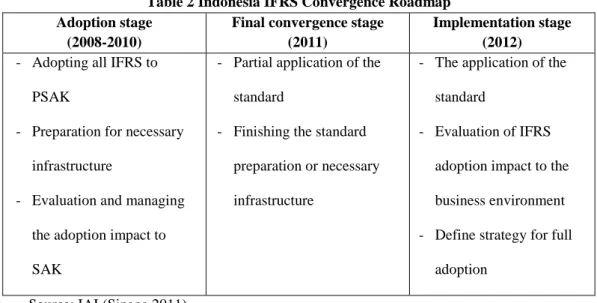
The Indonesian Institute of Accountants (Ikatan Akuntan Indonesia, IAI) in 2008 announced that Indonesian Generally Accepted Accounting Principles (hereafter Ina GAAP) would be gradually converged with IFRS with the aim to eliminate the differences between them; and the newest Indonesian GAAP (the 2012 PSAK) has significantly converged with IFRS. According to the roadmap of convergence program in Indonesia, the year of 2012 is the period of implementing the standards by all listed companies in Indonesia (see Table 2). Following this implementation, it is expected that the quality of companies' financial reporting improves.
Table 2 Indonesia IFRS Convergence Roadmap Adoption stage
(2008-2010)
Final convergence stage (2011)
Implementation stage (2012)
- Adopting all IFRS to PSAK
- Preparation for necessary infrastructure
- Evaluation and managing the adoption impact to SAK
- Partial application of the standard
- Finishing the standard preparation or necessary infrastructure
- The application of the standard
- Evaluation of IFRS adoption impact to the business environment - Define strategy for full
adoption Source: IAI (Sinaga 2011)
According to the plan, the IAI has decided that the year 2012 was the time for both listed and unlisted companies to implement local accounting standards that have been converged with IFRS. Corresponding to the change of accounting standards in Indonesia, the Indonesia Capital Market and Financial Institutions Supervisory Board (Badan Pengawas Pasar Modal dan Laporan
Keuangan, Bapepam-LK) issue regulation No. KEP-346/BL/2011 requiring publicly listed
companies to establish financial statements based on the new development of accounting standards in Indonesia. The rule also states that the fiscal periods ending in or after June 2011 is the effective time to implement the policy.
The plan has called furthermore for evaluation of IFRS adoption impact to the business environment. In this regards, empirical research is immediately required to evaluate whether or not the provided information after implementing IFRS is useful for users of financial reporting. As Nobes and Parker (2012) stated, there is varying in IFRS practice among nations, though, the financial statements are claimed to comply with international standards (IFRS). Understanding of the motivation of different IFRS practice in an individual country can be useful to assess whether or
7
not the change has impacts on the quality of financial reporting and market outcomes. Concisely, the research will provide a better understanding to users that concern in assessing the costs and benefits, and the successes and failures of IFRS implementation (Pope and McLeay 2011). In addition, they have signaled that topic discussed along these lines consists of three themes, namely studies of compliance and enforcement, comparative analysis of IFRS-related accounting quality changes, and economic consequences of IFRS adoption. Following these research opportunities, the paper is regarded to explore Indonesian experience in implementing IFRS and examine whether the quality of financial reporting improves.
1.4 Research Problem
Based on the issue of implementing IFRS-based PSAK in Indonesia and research gap presented in the previous sections (1.3.1 – 1.3.3), the present study proposes a research problem as follows:
What are the consequences of implementing IFRS-based PSAK on accounting quality in Indonesia?
1.5 Research Questions
To deal with the above research problem, the study is set into three specific research questions as follows:
RQ1. How does the IAI eliminate national differences in accounting standards?
RQ2. To what extent are non-financial companies listed on the Indonesian Stock Exchange (IDX) discloses information in their financial reporting after implementing IFRS-based PSAK? RQ3. Is accounting information and companies’ compliance with IFRS-based PSAK disclosures
value relevant to firm value?
1.6 Theoretical Framework and Hypotheses
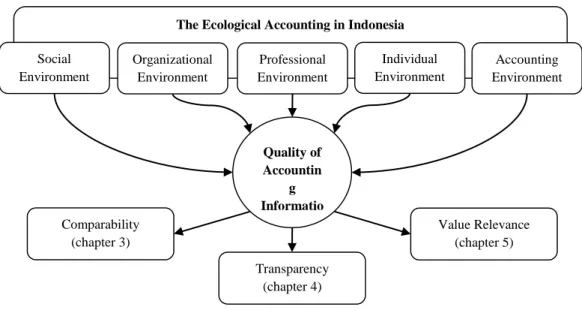
This study develops a basic of the theoretical framework based on intensive literature review. See the proposed model of a framework in Figure 1. The model shows the relationship between domestic environments and accounting quality. Moreover, the model will be empirically examined by using data collected from companies' financial reporting that is listed on the Indonesian Stock Exchange (IDX).
The research framework is developed based on the assumption that implementing IFRS will improve the quality of accounting information. According to IASB (2008), the primary
8
qualitative characteristics of information in financial statements are relevance and faithful representation. Information in financial statements is relevant when it is capable of making a difference to a financial statement user's decisions. Relevant information has confirmatory or predictive value. Faithful representation means that the information reflects the real-world economic phenomena that it purports to represent. Relevance and faithful representation make financial statements useful to the reader. There are also some enhancing qualitative characteristics, which are complementary to the basic features: comparability, variability, timeliness, and understandability. Enhancing qualitative characteristics distinguish more useful information from less useful information. They enhance the decision-usefulness of financial reporting information that is relevant and faithfully represented.
In this study, the quality of accounting information is referred to the definition of IASB's work regarding the qualitative characteristics, particularly, comparability, transparency, and relevance. Specifically, by making a change in the level of companies' compliance with IFRS-based PSAK disclosures, thus, it would be helpful for a number of user groups in supplying economic information, so that enable them to do decision-making process about the allocation of scarce resources.
9
The above research frameworks clearly stated about conceptual issues with regard to the quality of accounting information that the present study to discuss, that is, comparability, transparency, and value-relevance. Then, premises to deal with the issues are proposed in this thesis as follows (see Table 3 for detail information)
Table 3 IFRS-based PSAK Implementation and Accounting Quality
Conceptual Issues Premise
Comparability Convergence national accounting standards with IFRS will eliminate differences in financial reporting.
Transparency Compliance with IFRS-based PSAK requirements calls for entities to disclose more disclosures.
Value relevance Considering that accounting information based on IFRS-based PSAK and companies’ compliance with the disclosure is increased, informational environment in the IDX is value relevant to investors.
Within the above framework and conceptual issues provided, three studies and seven hypotheses are developed to capture the relationship between adoption of IFRS and accounting quality in Indonesia. The first study deals with comparability issues after convergence program in Indonesia. This descriptive study aims to investigate the setting stage of IFRS adoption in Indonesia. The study focuses on three issues, namely, motivation for convergence, how to make national standards comparable to IFRS, and the remaining differences between PSAK and IFRS after they
Transparency (chapter 4) Value Relevance (chapter 5) Comparability (chapter 3)
The Ecological Accounting in Indonesia
Quality of Accountin g Informatio Social Environment Organizational Environment Professional Environment Individual Environment Accounting Environment
10
are converged. To address the issues, the 2012 PSAK, the 2009 IFRS and archival documents that are relevant with the issues were examined by using content analysis.
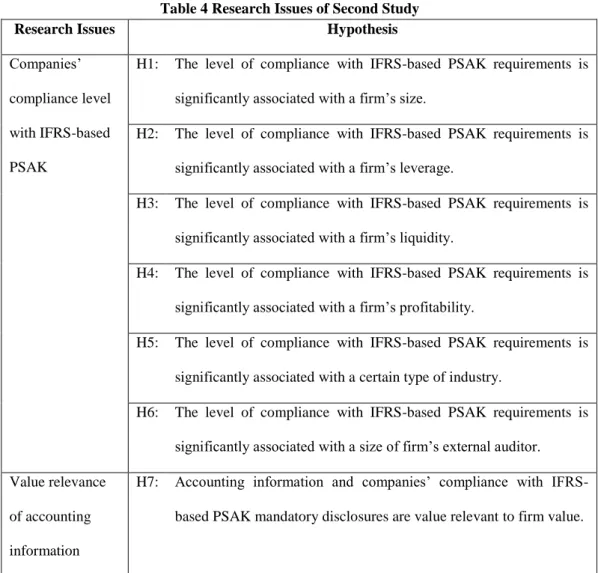
The second study discusses issues relating to transparency. This exploratory study aims to (a) measure the degree of listed-non-financial companies’ compliance with IFRS-based PSAK disclosure, and (b) identify the explanatory factors for non-compliance. To address the issue, a self-constructed disclosure index that is containing the applicable and relevant IAS/IFRS for Indonesian financial reporting environment and study period be constructed to measure the extent of companies’ compliance with IFRS in 2012. Six hypotheses dealing with the degree of companies’ compliance with IFRS disclosures, which are suitable to answer research questions (RQ2) of the present study, were developed (see Table 4). Then, by using regression analysis, the study examines factors that cause for non-compliance.
Table 4 Research Issues of Second Study
Research Issues Hypothesis
Companies’ compliance level with IFRS-based PSAK
H1: The level of compliance with IFRS-based PSAK requirements is significantly associated with a firm’s size.
H2: The level of compliance with IFRS-based PSAK requirements is significantly associated with a firm’s leverage.
H3: The level of compliance with IFRS-based PSAK requirements is significantly associated with a firm’s liquidity.
H4: The level of compliance with IFRS-based PSAK requirements is significantly associated with a firm’s profitability.
H5: The level of compliance with IFRS-based PSAK requirements is significantly associated with a certain type of industry.
H6: The level of compliance with IFRS-based PSAK requirements is significantly associated with a size of firm’s external auditor. Value relevance
of accounting information
H7: Accounting information and companies’ compliance with IFRS-based PSAK mandatory disclosures are value relevant to firm value.
The third study discusses issues relating to value relevance of accounting information. This exploratory research aims to investigate whether accounting information and companies’
11
compliance with IFRS-based PSAK value relevant to firm value. To address the issue, an empirical evaluation is conducted to test the association among accounting information and companies’ compliance with IFRS-based PSAK and firm value by employing Ohlson (1995) models that are extended. A hypothesis dealing with those relationships, which is suitable to answer research questions (RQ3) of the present study, was developed (see Table 4).
1.7 Research Methodology
This research consists of three studies designed to address research questions. 1. Study to explore issues relating to convergence process in Indonesia.
The first study deals with comparability issues after convergence program in Indonesia. This study aims to investigate the setting stage of IFRS adoption in Indonesia. It is a descriptive study focuses on three issues, namely, motivation for convergence, how to make national standards comparable to IFRS, and the remaining differences between PSAK and IFRS after they are converged. To address the issues, the 2012 PSAK, the 2009 IFRS and archival documents that are relevant to the issues were examined by using content analysis.
2. Study to evaluate the impact of IFRS implementation on the compliance level with IFRS disclosure of non-financial companies listed on the IDX.
This study discusses issues relating to transparency. It is an exploratory study aims to (a) measure the degree of listed-non-financial companies' compliance with IFRS-based PSAK disclosure, and (b) identify the explanatory factors for non-compliance. To address the issue, a self-constructed disclosure index that is containing the applicable and relevant IAS/IFRS for Indonesian financial reporting environment and study period be constructed to measure the extent of companies' compliance with IFRS in 2012. Six hypotheses are dealing with the degree of companies' compliance with IFRS disclosures, which are suitable to answer research questions (RQ2) of the present study, were developed. Then, by using regression analysis, the study examines factors that cause for non-compliance.
3. Study to examine the value relevance of IFRS-based accounting information of non-financial companies listed on the IDX.
This study discusses issues relating to value relevance. It is an exploratory research aims to investigate whether accounting information and companies' compliance with IFRS-based PSAK value relevant to firm value. To address the issue, an empirical evaluation is conducted
12
to test the association between accounting information and companies' compliance with IFRS-based PSAK and firm value by employing Ohlson (1995) models that are extended. A hypothesis is dealing with those relationships, which is suitable to answer research questions (RQ3) of the present study, was developed.
1.8 Contributions of the Study
The findings from this study contribute to the ongoing debate on whether the adoption of IFRS enhances the quality of financial reporting by providing evidence from Indonesian setting. For Indonesia, to the best of my knowledge, this study is the first study to examine the effect of implementing IFRS since it was fully required to be implemented on January 1, 2012. Hence, it could be useful to contribute to accounting harmonization literature in Indonesia. Next, the move to IFRS is one of the most important policy issues in financial accounting. As the study provides insight into such issues, particularly on the result of implementing IFRS, it would also be essential to Indonesian regulators and policy makers in guiding the decision-making process. For instance, this study will provide a contemporary portrait of the effects of IFRS implementation on the 2012 financial statements, disclosures, and other accounting information.
The findings may also be relevant to international regulators and institutions involved in the process since the results provide an example of how firms required to applying IFRS have approached the process in the particular country. The finding might suggest the IASB's objective, particularly its third objective ‘to promote convergence between national accounting standards and IFRS' has been accomplished in developing countries. It can also use the results of this study to better comprehend the extent of harmonization of IFRS among developing economies so that the IASB can devise more suitable strategies and apt accounting standards (Lasmin, 2011). In sum, this research contributes to the global discussion on the quality of IFRS-based accounting standards.
1.9 Structure of the Thesis
The remaining of this dissertation is divided into five chapters. Chapter 2 explains institutional factors that influenced the development of accounting system in Indonesia causing differences in accounting rules and practices from other countries. It provides a brief discussion regarding environmental factors such as social, organizational, professional, individual, and accounting environments shaping the development of accounting practices in Indonesia. By using Gernon and
13
Wallace's perspective, this section explains the issue. A review of these factors provides a basis for the construction of a model or theoretical framework of the relationship between IFRS implementation and its impact on the quality of financial reporting information. It also serves as a basis for the development of hypotheses in this study.
Chapter 3 discusses the quality of financial reporting regarding comparability issues after implementing IFRS-based PSAK by answering RQ1: How does the IAI eliminate national differences in accounting standards? The specific objective is to investigate the setting stage of IFRS adoption in Indonesia. By using content analysis, it analyzes the 2012 PSAK and the 2009 IFRS to explore the differences between the two standards. In doing so, we first talk about the setting stage for convergence in Indonesia, which in particular discusses the reasons why Indonesia chooses to adopt international accounting standards and methods to make Indonesian accounting standards comparable with international accounting standards before talking about the remaining differences that may exist after adopting IFRS. After that, the remaining differences between the two standards were analyzed.
Chapter 4 discusses the quality of financial reporting concerning transparency issues after implementing IFRS-based PSAK by answering RQ2: To what extent are non-financial companies listed on the Indonesian Stock Exchange (IDX) discloses information in their financial reporting after implementing IFRS-based PSAK? The specific objectives are 1) to assess the degree of compliance with the disclosure requirements of the IFRS-based PSAK financial accounting standards among listed companies of the Indonesian Stock Exchange for the year ending 2012, and 2) to assess whether a number of independent variables (liquidity, size, ROE, leverage, audit firm size, and manufacturing sector) are associated with the levels of financial disclosures. By employing two disclosure indexes scoring system, the PC and Cooke method, it discusses the analysis of Indonesia listed companies' compliance with IFRS disclosure requirements and identifies the explanatory factors for non-compliance. To do so, firms' characteristics representing internal and external factors are used as variables to explain the variability of the company in complying with disclosure requirements.
Chapter 5 discusses the quality of financial reporting regarding value relevance issues after implementing IFRS-based PSAK by answering RQ3: Are accounting information and companies' compliance with IFRS disclosures value relevant to firm value? The specific objective is to
14
investigate whether accounting information and companies' compliance with IFRS-based PSAK value pertinent to firm value. By incorporating dummy variable i.e. a compliance level to represent as another information to the Ohlson (1995) models, the price and returns, the models is designed to capture the relationship between compliance level and firm value as well as to explain firm characteristics that significantly influence to stock price and returns.
Chapter 6 summarizes empirical findings of the study and outlines limitations and future research
15
CHAPTER 2: THE ACCOUNTING ENVIRONMENT IN INDONESIA
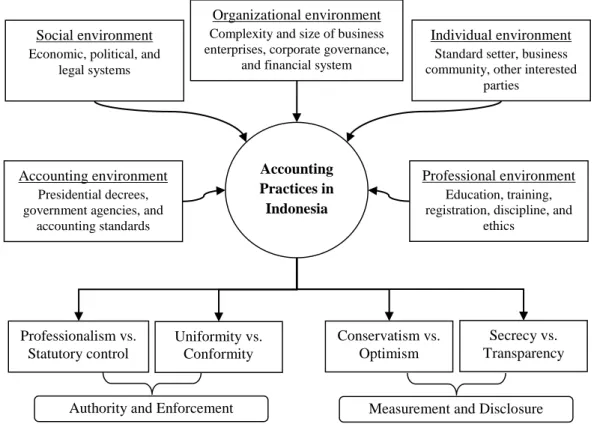
Figure 2 Organization of Chapter 2
2.1 Introduction
In this chapter, we investigate environmental factors in Indonesia that are likely to influence accounting quality. This provides an understanding of why IFRS implementation in Indonesia might differ from other countries.
The development of accounting practices in Indonesia experiences several changes from its beginning to these days. It is assumed that environment within Indonesian context has directly or indirectly influenced on the development of accounting practices in this country. The section particularly comments on social, organizational, professional, individual, and accounting environments that are likely to continue into consolidated reporting where scope for this exist within IFRS rules, and which will provide opportunities for “the survival of accounting differences” (C. Nobes 2006) within Indonesian context.
Accounting is a product of the environment in which it operates (G. G. Mueller 1965). This notion has led the way to a wave of research studies aimed at identifying the various environmental
Individual environment
Standard setter, business community, other interested
parties
Accounting Practices in Indonesia
Organizational environment
Complexity and size of business enterprises, corporate governance,
and financial system
Accounting environment
Presidential decrees, government agencies, and
accounting standards
Professional environment
Education, training, registration, discipline, and
ethics
Social environment
Economic, political, and legal systems Conservatism vs. Optimism Professionalism vs. Statutory control Secrecy vs. Transparency Uniformity vs. Conformity
Measurement and Disclosure Authority and Enforcement
16
factors, including those related to cultural orientation of the preparers and users of accounting reports that are likely to influence accounting in a particular country (Nobes and Parker 2006, Radebaugh, Gray and Black 2006, L. H. Radebaugh 1975). Among them, Radebaugh’s (1975) study was one of the first to provide a detailed description of that the environmental factors influencing the development of accounting objectives, standards, and practices in a developing country. Other works of influential factors are provided in a theoretical grounding for this reason (Doupnik and Salter 1995, C. W. Nobes 1988, Schweikart 1985).
Gray’s (1988) work has much referred in explaining relationship between societal values and accounting values. He initiated the building of a theoretical model of the relationship between Hofstede’s cultural values and accounting values. Through the model, he explained that there were the possible reciprocal relationships among the constructs. In this regard, he proposed that since accounting values represent a subset of societal values, accounting values would reflect a microcosm of the broader societal values. In turn, these values are translated into the practice of financial reports and accounting standards (Sudarwan 1995). On this perspective, accounting is likely to be influenced by a much broader range factors than what is often assumed in the literature (Perera and Baydoun 2007).
Further, Gernon and Wallace (1995) expanded on the Gray’s (1988) framework and provided taxonomy of accounting ecology that was designed to reflect the association between accounting and its environment in a holistic manner. According to them, the concept of accounting ecology encompasses five separate but interacting slices of the environment, i.e., social, organizational, professional, individual, and accounting. This perspective differs from that Gray’s (1985, 1988) framework in term of its taxonomy. While Gray’s taxonomies rely on a causal theory that sees accounting as strictly dependent on the environment, Gernon and Wallace’s (1995) taxonomies incorporates both causes and effects of accounting. Moreover, the additional taxonomy, individual and accounting slices, recognizes the notion of the environment not only as a source of ideas and concepts but also as an animate repository of causes and effects. In addition, under the organizational, professional, and accounting slices, Gernon and Wallace (1995) include the narrow regulatory focus of recent international research, which consists of all mandated constraints such as regulations, accreditation, legal development, professional code of conduct and so on (Perera and Baydoun 2007).
17
In the beginning, general features about Republic of Indonesia were discussed. Then, a perspective of accounting ecology framework developed by Gernon and Wallace (1995) was discussed to provide fundamental theory for analyzing problems. After that, a holistic analysis of the accounting ecology consisting of social, organizational, professional, individual, and accounting milieu that are likely to have an effect on accounting values in Indonesia was explored. Identifying these factors might explain the difference of implementing IFRSs in this country. The rest of this chapter concluded the discussion above.
2.2 The Republic of Indonesia
Astronomically, Indonesia is situated between 6° 08’ North latitude and 11° 15’ South latitude, and between 94° 45’ and 141° 05’ East longitude and straddles the equator line located at 0° latitude line. Indonesia is the world’s largest archipelago consisting of 17,504 islands (of which an estimated 957 are inhabited) with an area of ocean 3,544,743.9 km2 and land 1,910,931.32 km2. With more
than 243.74 million (BPS 2012) people of population and approximately 86 percent (KMPG 2012) of them are Muslims, making Indonesia as the world’s fourth largest population as well as the world’s largest Islamic country, respectively.
Indonesia has 355,856 kilometers of roads, consisting of 36,4318 kilometers of national roads, 50,004 kilometers of provincial roads, 268,772 kilometers of municipal and city roads, and 772 kilometers of toll roads. As at September 30, 2009, Indonesia has 6,810 kilometers of railways of which 4,622 kilometers were in operation. The land transportation system included 431 bus stations that were serviced by 19,862 inter-provincial and 10,477 tourist buses. In terms of sea transportation, as at September 30, 2009, Indonesia had 2,125 ports, 105 of which served as international ports that facilitated the export-import cargo traffic. There were 212 inland waterway transport routes with a total navigable length of 35,342 kilometers, serviced by 196 vessels consisting of 175 roll-on, roll off (“ro-ro”) transport vessels, 10 landing craft tanks and 11 fast passenger vessels. As at September 30, 2009 Indonesia operated 187 airports, of which 272 were international airports (Mundi 2012).
Under controlling of colonial Dutch for almost 350 years has influenced on the socio-economic and political development in Indonesia. A large power distance, a considerable dependence of subordinates on superiors (Hofstede 1980), is a colonial heritage that continues to involve in various behavioral aspects in society including in legal system. Indonesian legal system
18
is based on the Roman-Dutch system, characterizing the regulation with a large extent of a law branch and only seeks to formulate a general rule for the future than provide answer to a specific case. Otherwise, the rule tends to be separated from the law and deals with a precise case in the common law countries (Nobes and Parker 2012).
Indonesia is a country with enormous cultural diversity and complexity. With highly diverse of ethnics and more than 300 distinct local languages, this social inclusiveness can be easily to be found within Indonesian boundaries. Religions as well as more traditional animist beliefs systems play an important role within Indonesian society and in the daily lives of the people as well. However, with the Indonesian national motto Bhinneka Tunggal Ika (Unity in Diversity) referring to the variety in the country's internal composition as well as the differences in its multicultural society though, they are of the same kind, there is a true sense of unity (Indonesianness) among the people of Indonesia.
Nowadays, after experiencing with two crises, Indonesia’s economy has shown strong foundations with GDP (2012) at current market prices, reaching IDR 8,241,864.3 billion, or grows up around 6.2 percent compared to those on the previous year (BPS 2012). This condition continues to stable making Indonesia’s economic growth ranked third behind China and India among developing countries in Southeast Asia (Basri and Hill 2011). Furthermore, the Indonesian Stock Exchange has grown steadily with 464 listed companies as a member of the capital market (IDX 2012). The average Indonesian rupiah exchange rate for the U.S. dollar in the month of September 2011 is Rp. 8,900 to Rp.9,000.
2.3 Gernon and Wallace’s Accounting Ecology
Gray’s works (1985, 1988) with regard to environmental factors that influences the development of accounting systems in certain countries has provided theoretical grounding for understanding accounting system from an ecological perspective. He argues that:
a. accounting is influenced by societal values, which in turn are affected by ecological influences through geographic, historical, technological, and urbanization factors;
b. these in turn are influenced by external factors, such as forces of nature, trade, investment, and conquest; and
19
c. both ecological factors and societal values influence a society’s institutional arrangements for legal and political systems, corporate ownership, capital markets, professional associations, education, and religion, which affect accounting values and accounting practices.
Gernon and Wallace (1995) expand the Gray’s work perspective then. They provide taxonomy of accounting ecology that is designed to reflect the association between accounting and its environment in a holistic manner. They explain the concept of accounting ecology as follows:
A national accounting ecology is a multidimensional system in which no one factor occupies a predominant position and in which the perception held by actors on some unfolding accounting phenomena, as well as the accounting phenomena themselves, are the objects of study and analysis. Such a synthesis would emphasize the interrelationships of the environmental factors, which influence and are influenced by accounting and would focus on the importance of perceptional as well as non-cultural factors such as population and land area (Gernon and Wallace, 1995).
According to Gernon and Wallace, the concept of accounting ecology encompasses five separate but interacting slices of the environment, i.e., social, organizational, professional, individual, and accounting. The social environment refers to the structural (economic system, political system, and legal system), cultural and non-cultural (geographic and demographic features) elements within a society. The organizational environment refers to organizational size, technology, complexity and culture, and human and capital resources. The professional environment refers to such aspects of the profession as education, training, registration, discipline, and ethics. The individual environment refers to the total setting in which reporting enterprises, professionals, and other non-professional members of society lobby standard setters and use accounting numbers to their respective advantage. The accounting environment refers to the disclosure and measurement requirements and practices, types and frequency of accounting reports, and accounting infrastructure (See Figure 3).
20
Structural variables
(e.g. economic, political, legal systems)
Actor environment
Values of individuals such as standard setters, preparers, auditors,
and users of financial statements
Professional environment Cultural variables
(e.g. language, ethnic origin, religion, belief systems, roles, knowledge, norms, attitudes, all sets of shared
values)
Non–cultural variables
(e.g. land area, population, government, economy, technology)
Societal environment Annual reports Accounting standards Accounting environment Internal factors External factors Organizational environment
21
Furthermore, Gernon and Wallace (1995) explain the differences between their taxonomy and the previous ones as follows:
a. Previous taxonomies rely on a casual theory that sees accounting as strictly dependent on the environment, whereas Gernon and Wallace’s taxonomy incorporates both causes and effects of accounting.
b. The addition of the individual and accounting slices of the environment, in this taxonomy, recognizes the notion of the environment as a source of ideas and concepts and not only as an inanimate repository of causes and effects.
c. The narrow regulatory focus of recent international accounting research studies is subsumed under the organizational, professional, and accounting slices of this taxonomy which is broader than just government information, thereby encompassing all mandated constraints such as regulations, accreditation, legal development, professional code of conduct and so on (Gernon and Wallace, 1995).
2.4 The Framework of Accounting Ecology in Indonesia
2.4.1 Social Environment
The social environment refers to the structural (economic system, political system, and legal system), cultural and non-cultural (geographic and demographic features) elements within a society that affect the demand for financial accounting services.
Table 5 Rankings of Cultural Values of Power Distance and Individualism
Country Power Distance Individualism
Indonesia 43-44 6-7 United States 16 50 United Kingdom 10-12 48 Australia 13 49 New Zealand 4 45 Canada 15 46-47
Source: Perera and Baydoun (2007)
Indonesia is a country with a large power distance and small individualism (Hofstede 1983). Large power distance implies that there is a considerable dependence of subordinates on superiors. In this regard, the relationship between both parties is more autocratic or paternalistic.
22
Consequently, subordinates are unlikely to approach and contradict their superiors. Meanwhile, small individualism indicates that Indonesian societies have strong and cohesive integration in groups (Sudarwan 1995). These values in turn have an effect on societal behavior particularly that deals with economic, political, and legal systems.
(a) The economic systems
Indonesia is one of the emerging market economies in the world. Having the largest economy in Southeast Asia, the country is a member of G-20 major economies, which also classified as a newly industrialized country. Indonesian economy pursues a capitalist approach with the government playing a dominant role. In fact, the country still depends on the domestic market, and government budget spending and its ownership of stated-owned enterprises (the central government owns 141 enterprises). The government administrates prices of a range of basic goods that plays a significant role in the country market economy such as fuel, rice, and electricity. However, since the 1990s, private Indonesians and foreign companies have controlled 80 percent of the economy. In 2012, Indonesian Gross Domestic Product (GDP) was 6.2 for which services sector contributes the highest value added, 7.7 percent followed by industry and agriculture sectors, 5.4 % and 4.0 % respectively (BPS 2012).
Indonesian economy has experienced several reforms since independence, particularly during the New Order regime. A major program of economic reforms aimed at deregulating the economy consisting of capital investment (domestic and foreign), taxation systems, and financial services was taken. In the world investment, capital market was re-established, and foreign investors were allowed to have 100 percent of ownership in certain areas. This development continues to the current government, introducing significant reforms in the financial sector, including tax and customs reforms, the use of Treasury bills, and capital market development and supervision. Nevertheless, in this market-based economy, the government still plays a significant role by administering prices on several basic goods, including fuel, rice, and electricity.
The significant changes in Indonesian economic system throughout those periods are a critical influence on accounting development in Indonesia. The nature of the accounting system in Indonesia has also reflected the country's economic system (e.g. central planning versus private enterprises). In addition, as a country with large Muslim population (KMPG 2012, Perera and Baydoun 2007) in the world, the influence of this religion on Indonesian economic activities was
23
significant. Even, many businesses with Islamic basis nowadays are more and more increasing in this country. In the banking sector, the growth of Sharia banking asset reaches 38 percent, exceeding the national banking growth of around 18 percent (Tempo 2013). This community has required a particular rule to run its business based on Sharia (Islamic law), which sometimes differs from a general rule. For example, Islam advocates good behavior in conducting business and discourages Moslems to advertise the fact that they have behaved that way, at the same time. This matter is likely to cause challenges in enforcing the disclosure requirements of IFRS.
(b) The political systems
The political system in Indonesia is based on executive, legislative, and judicative powers (Trias Politica), which are the power of supremacy held by the People's Consultative Assembly, the President, and the Supreme Court, respectively. The governmental system of Indonesia follows a presidential system with parliamentary characteristics. The President and Vice-president are elected by direct popular vote. The president is the Chief Executive, the Head of State, and Commander-in-Chief of the Armed Forces, as well as appoints Cabinet Ministers, who are responsible for him/her. Legislative power consists of three chambers, the Dewan Perwakilan Rakyat (DPR), the Dewan
Perwakilan Daerah (DPD), and the Majelis Permusyawaratan Rakyat (MPR). While the DPR
comprises representatives of the political parties, which is tasked with enacting laws together with the president, the DPD comprises representatives of the country's provinces; and the MPR comprises members of both the DPR and the DPD. Moreover, Indonesia's current judicial system has been built under a separation-of-power concept. The Indonesian court system comprises the Common Court, the Corruption Court, the Industrial Relation Court, the Administration Court and the Commercial Court.
According to Perera and Baydoun (2007), Indonesia's political system is the reflection of pre-colonial Javanese kingdom culture, which fits the patrimonial state in Max Weber's Model1. In
such a view, the involvement of the ruler's personal household and staff have in the central government is unyielding. Moreover, bureaucrats have their positions and the associated privileges,
24
even their dismissal based on the ruler's personal desire. The New Order regime reflected this picture2.
However, after student-led riots in early 1998 that have forced the leader of the New Order administration to stand down, there was a major political reform. It significantly changes the governmental structure from centralized- to decentralized-system. The military did not dominate the government, and there have been some attempts to decentralize the local government and fiscal policy by the enactment of Law No. 22/1999 and No. 25/1999, respectively. The reform has also included imposing a limit of two five-year terms for both the President and Vice President, and the country had its first-ever direct presidential election in September 2004. In spite of this, according to Perera and Baydoun (2007), Indonesia politically continues to be a large power distance society. This value confirms that Indonesians tend to accept that power in institutions and organizations is distributed unequally.
(c) The legal systems
Indonesia is the Roman-Dutch law country with a complex legal system. Diga and Yunus (1997) make clear some of the unique features of the Indonesian legal system as follows:
The legal system is based upon Roman-Dutch law. The Criminal Law is codified, applying equally to all, but application of the Civil Law depends upon membership in one of three groups: Muslim, European and Alien Orientals (a classification, which owes something to the Dutch colonial influence). The judicial system gives wide powers to the Shari’ah courts over Muslims in civil matters, although Muslims have the right to elect to be dealt with by the secular courts (283).
Moreover, Lev (1972) explains the concepts of justice within the Indonesian context as follows:
Justice is not understood as the weighing of distinct interests in like cases, as the European goddess of justice does; she stands for a formal, ethical view of justice, the evolution of which depended upon a well-developed concept of private interests. In 1960, at a time of ideological concern for the expression of specifically Indonesian traditions, the goddess was replaced as Indonesia’s symbol of justice by a banyan tree inscribed with the Javanese word pengajoman – shelter, succor – which connotes paternalistic protection (299)
The passage shows how Indonesian legal system is complex in term of the main sources which are a confluence of three distinct systems, Syari’ah or Islam laws (a form of adat), adat (the traditional customary laws of many ethnic and religious groups in Indonesia), and the Dutch colonial law and European jurisprudence. Until now, these three strands of the laws still co-exist in
25
Indonesian modern law, including commercial law (Tabalujan 2002). Moreover, the culture of Javanese has also underlain the justice concept, which is different from the Anglo-Saxon concept.
The official hierarchy of Indonesian legislation (from top to bottom) is regulated in
Ketetapan MPR No. III Tahun 2000 tentang Sumber Hukum dan Tata Urutan Peraturan Perundang-Undangan (MPR Decree of 2000 on The Source of Law and Hierarchy of Laws). The basic hierarchy
includes UUD 1945 (the Constitution), Ketetapan Majelis Permusyawaratan Rakyat (the Decree of the People’s Representative Assembly), Undang-Undang (the Laws), Peraturan Pemerintah
Pengganti Undang-Undang or PERPU (the Law in Lieu of a Law or an Interim Law), Peraturan Pemerintah (the Government Regulation), Keputusan Presiden (Presidential Decree), and Peraturan Daerah (Regional Regulation). However, there are also other legislative instruments
currently use in practice such as Presidential Instructions (Instruksi Presiden), Ministerial Decrees (Keputusan Menteri) and Circular Letters (Surat Edaran)
.
Once legislative products are promulgated, the State Gazette of the Republic of Indonesia (Lembaran Negara Republik Indonesia) is issued from the State Secretariat. Sometimes Elucidation (Penjelasan) accompanied some legislations in a Supplement of the Gazette. The Government of Indonesia also produces State Reports (Berita Negara) to publish government and public notices.
Legislation in Indonesian modern law, the judiciary is based on the Supreme Court and separate courts for public administration and military, religious and civil matters. A comprehensive system of civil laws has replaced most of the statutes established by the Dutch. In addition, there is an extensive range of decrees and regulations developed and applied by government departments.
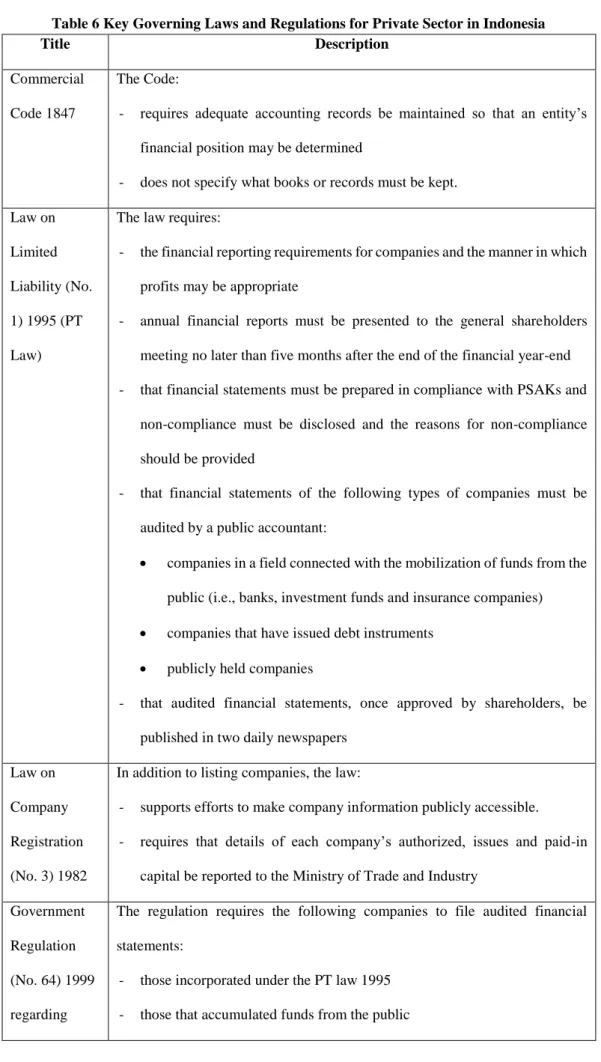
With regard to accounting regulations, as a country with code law system, Indonesian law affecting commercial activities is in contrast to some other countries that have the same law system. Indeed, the laws are formulated through the Presidential decrees and regulations issued by government agencies. The main regulations affecting present financial accounting practices includes the companies and investment laws, income tax laws, and securities market regulation. The following table presents the key of governing laws and regulations for private sector:
26
Table 6 Key Governing Laws and Regulations for Private Sector in Indonesia
Title Description
Commercial Code 1847
The Code:
- requires adequate accounting records be maintained so that an entity’s financial position may be determined
- does not specify what books or records must be kept. Law on
Limited Liability (No. 1) 1995 (PT Law)
The law requires:
- the financial reporting requirements for companies and the manner in which profits may be appropriate
- annual financial reports must be presented to the general shareholders meeting no later than five months after the end of the financial year-end - that financial statements must be prepared in compliance with PSAKs and
non-compliance must be disclosed and the reasons for non-compliance should be provided
- that financial statements of the following types of companies must be audited by a public accountant:
companies in a field connected with the mobilization of funds from the public (i.e., banks, investment funds and insurance companies) companies that have issued debt instruments
publicly held companies
- that audited financial statements, once approved by shareholders, be published in two daily newspapers
Law on Company Registration (No. 3) 1982
In addition to listing companies, the law:
- supports efforts to make company information publicly accessible. - requires that details of each company’s authorized, issues and paid-in
capital be reported to the Ministry of Trade and Industry Government
Regulation (No. 64) 1999 regarding
The regulation requires the following companies to file audited financial statements:
- those incorporated under the PT law 1995 - those that accumulated funds from the public
27
Company Financial Statements
- those that issue debt instruments
- those that have total or net assets exceeding Rp 25 billion In accordance with the regulation:
- audited financial statements, comprising a balance sheet, income statement, cash flow statement, statement of changes in equity, and notes to the financial statements (including a list of liabilities and capital participation) must be reported
- information is more easily available, including through the Internet and in hard copy as local Company Registry Offices
Law on Capital Markets (No. 8) 1995
The law governs the preparation, presentation and audit of financial statements that is supported by Bapepam Rules that include:
- Preemptive Rights (IX.D.1)
- Conflicts of Interest on Certain Transaction (IX.E.1)
- Material Transactions and Changes in Major Line(s) of Business (IX.E.2) - Mergers and Consolidations of Public Companies and Issuers (IX.G.1) - Planning and Conducting the General Meeting of Shareholders (IX.I.I) - The Main Articles of Association of Companies Offering their Equities to
the Public and of Publicly Listed Companies (X.K.1)
- Disclosure of Information that Must Immediately be Made Public (IX.K.4) Banking Law
(No. 7) 1992
This law states Bank Indonesia (BI) may assign a public accountant, for and on behalf of BI, to perform an audit on any bank, either on a periodical basis, or at any time required. In relation to this, public accountants are delegated BI authority (Article 31A).
Law on Bank Indonesia (No.23) 1999
This law repeats the Banking Law (No. 7) 1992 delegation of BI authority to public accountants (Article 30(1)
Law on Pension Funds (No. II) 1992
Article 52(1)(a) of this law implies that the Minister of Finance shall receive the financial statements of pension funds that have been audited by public accountants.