Graduate School of Engineering
Application of Fuzzy Logic for Actor Node
Selection in Wireless Sensor and Actor
Networks: Implementation and
Performance Evaluation of Proposed
Intelligent Simulation Systems and a
Testbed
by
Donald Elmazi
PhD Supervisor
Prof. Leonard Barolli
Graduate School of Engineering
Fukuoka Institute of Technology
Japan
2018
Contents
List of Figures v List of Tables vi Abstract vii Acknowledgement ix 1 Introduction 1 1.1 Background . . . 11.2 Thesis Purpose and Contribution . . . 2
1.3 Thesis Outline . . . 3
2 Wireless Networks 5 2.1 Introduction . . . 5
2.2 Ad-hoc Networks and MANETs . . . 5
2.3 Wireless Sensor Networks . . . 10
2.4 Wireless Mesh Networks . . . 13
2.4.1 Network Architecture . . . 14
2.4.2 Advantages of Wireless Mesh Networks . . . 16
3 Wireless Sensor and Actor Networks 18 3.1 WSAN Architectures . . . 18 3.2 WSAN Challenges . . . 18 3.3 Features of WSANs . . . 21 3.4 WSANs Applications . . . 21 3.4.1 Military Applications . . . 22 3.4.2 Environmental Applications . . . 23
Contents
3.4.3 Health Applications . . . 24
3.4.4 Home Applications . . . 25
3.4.5 Other Commercial Applications . . . 26
4 Fuzzy Logic 28 4.1 Introduction . . . 28
4.2 Meaning of FL . . . 29
4.3 Essentials of FL . . . 30
4.4 Basics of Fuzzy Set Theory . . . 31
4.4.1 Quantification of Ambiguity . . . 32
4.4.2 Fuzzy Set Definitions . . . 33
4.5 FC . . . 37
4.5.1 Linguistic Variables . . . 38
4.5.2 FC Rules . . . 39
4.5.3 Coding the Inputs: Fuzzification . . . 39
4.5.4 Control Knowledge Base . . . 40
4.5.5 Conflict Resolution and Decision Making . . . 41
4.5.6 Defuzzification Methods . . . 42
5 Proposed Fuzzy-based Systems for Actor Node Selection in WSANs 45 5.1 Problem Description . . . 45 5.2 System Parameters . . . 46 5.3 Systems Implementation . . . 49 5.3.1 Description of FBSANS1 . . . 49 5.3.2 Description of FBSANS2 . . . 50 5.3.3 Description of FBSANS3 . . . 54 5.3.4 Description of FBSANS4 . . . 57
6 Evaluation of Proposed Systems 61 6.1 Simulation Results for FBSANS1 . . . 61
6.2 Simulation Results for FBSANS2 . . . 62
6.3 Simulation Results for FBSANS3 . . . 64
Contents 7 Testbed Implementation 75 7.1 Testbed Settings . . . 75 7.2 Testbed Parameters . . . 75 7.3 Fuzzy-based Testbed . . . 78 7.4 Evaluation Results . . . 79 8 Concluding Remarks 87 8.1 Conclusions and Future Work . . . 87
References 90
List of Figures
1.1 Thesis structure. . . 4
2.1 Ad-hoc network technology [11]. . . 6
2.2 MANET [12]. . . 6
2.3 A wireless sensor network [19]. . . 11
2.4 Infrastructure/Backbone meshing [25]. . . 15
2.5 Client meshing [25]. . . 15
2.6 Hybrid meshing [25]. . . 16
3.1 Wireless Sensor and Actor Network (WSAN). . . 19
3.2 WSAN Architectures . . . 19
4.1 a) Grade of “tall”, b) Grade of “old”. . . 33
4.2 Fuzzy subset A. . . 35
4.3 Membership functions for “short”, “about average”, “tall”. . . 36
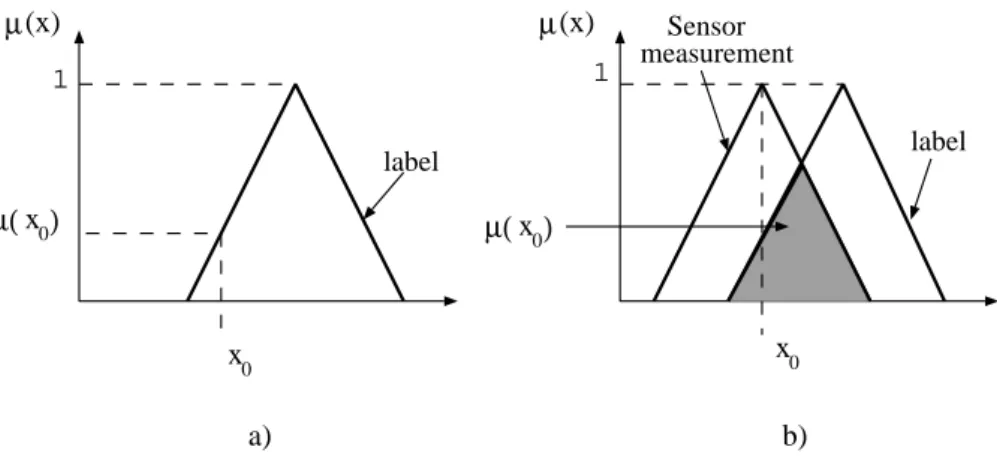
4.4 Fuzzification step. a) Crisp sensor reading, b) Fuzzy sensor reading. . 40
4.5 Inference process with different fuzzy variable membership functions . 43 5.1 Structure of implemented FBSANS1. . . 46
5.2 FLC structure. . . 47
5.3 Triangular and trapezoidal membership functions. . . 47
5.4 Fuzzy membership functions. . . 48
5.5 Structure of implemented FBSANS2. . . 51
5.6 Structure of implemented FBSANS3. . . 54
5.7 Fuzzy membership functions of FBSANS3. . . 55
5.8 Proposed system model. . . 57
List of Figures
6.1 Simulation results of FBSANS1 for DE. . . . 63
6.2 Simulation results of FBSANS1 for DE = 0.1. . . 66
6.3 Simulation results of FBSANS2 for DE = 0.5. . . 67
6.4 Simulation results of FBSANS2 for DE = 0.9. . . 68
6.5 Simulation results of FBSANS3 for DE = 0.1. . . 69
6.6 Simulation results of FBSANS3 for DE = 0.5. . . 70
6.7 Simulation results of FBSANS3 for DE = 0.9. . . 71
6.8 Simulation results of FBSANS4 for DE = 0.1. . . 72
6.9 Simulation results of FBSANS4 for DE = 0.5. . . 73
6.10 Simulation results of FBSANS4 for DE = 0.9. . . 74
7.1 Testbed overview. . . 76
7.2 Monitored field. . . 77
7.3 Proposed fuzzy-based testbed model. . . 78
7.4 Membership Functions . . . 81
7.5 Evaluation results (JT=0.1). . . 83
7.6 Evaluation results (JT=0.5). . . 84
7.7 Evaluation results (JT=0.9). . . 85
7.8 Detection of actors. . . 86
List of Tables
5.1 FRB of FBSANS1. . . 52
5.2 FRB of FBSANS2. . . 53
5.3 FRB of FBSANS3. . . 56
5.4 FRB of FBSANS4. . . 60
7.1 Parameters and their term sets for FLC. . . 79
7.2 FRB of proposed fuzzy-based testbed. . . 80
Abstract
The Wireless Sensor and Actor Networks (WSANs) are composed of sensors and actors. The sensors gather information about the physical events, while actors perform appropriate actions based on the sensed data from sensors. In order to provide effective sensing and acting, we need a coordination mechanism among sen-sors and actors. Also, there are many issues for WSANs such as energy saving, routing efficiency, sensor-actor coordination and actor node selection to carry out a job. However to deal with these problems should be considered many parameters, which make the problem NP-Hard. Thus, the heuristic and intelligent algorithms are good solutions. In this research work, we focus on actor node selection problem in WSANs. We consider and propose new parameters and implement different in-telligent systems based on Fuzzy Logic (FL) to select the actor nodes in order to perform the required tasks. The proposed systems can be used in different envi-ronments and applications. We carried out many simulations and found that the performance of implemented systems is good. The implemented systems improves the energy saving and congestion situation and they can be used for mobile WSANs. We also compared the complexity of different fuzzy-based systems and found that when we use many parameters the complexity is increased, but the performance also is increased. We implemented a testbed and performed experiments in real environment. The experimental results show that the implemented testbed makes a good decision for actor node selection. This thesis contributes in the research field as following: 1) Proposal of new parameters for actor node selection in WSANs. 2) Proposal and implementation of intelligent systems based on FL for making appro-priate actor node selection in WSANs. 3) Performance evaluation of implemented systems for different scenarios. 4) Comparison of implemented intelligent simulated systems. 5) Implementation of a testbed for WSANs and its application in a real scenario. 6) Give insights about future developments and application of WSANs as an important technology for wireless communications. The thesis has 8 Chapters.
Chapter 1 presents the background, motivation and thesis structure. Chapter 2 introduces general aspects of wireless networks and describes Wireless Sensor Net-works (WSNs), Mobile Ad-hoc NetNet-works (MANETs) and Wireless Mesh NetNet-works (WMNs) as related work. In Chapter 3, we introduce the architecture, challenges and applications of WSANs. In Chapter 4, we present FL, Fuzzy sets and Fuzzy memberships functions. In Chapter 5, we present our proposed fuzzy-based sim-ulation systems for actor node selection in WSANs. In Chapter 6 are shown the performance evaluation results of proposed simulation systems. In Chapter 7, we show testbed implementation and evaluation. In Chapter 8, we conclude this thesis and give the future work.
Keywords: Wireless Networks, Wireless Sensor Networks, Wireless Sen-sor and Actor Networks, Fuzzy Logic, Intelligent Algorithms, Intelligent Systems.
Acknowledgement
First, I would like to express my sincere gratitude towards my advisor Prof. Leonard Barolli for the continuous support of my Ph.D study and research, for his patience and motivation. Besides my advisor, I would like to thank my thesis inspection committee members: Prof. Hiroshi Maeda, Dr. Makoto Ikeda and Prof. Kei Eguchi, for their encouragement and insightful comments.
My sincere thanks also goes to Prof. Fatos Xhafa, Dr. Evjola Spaho and Dr. Elis Kulla for offering me valuable advices throughout my PhD period. I would like to thank also my friends in INA Lab: Miralda Cuka, Shinji Sakamoto, Yi Liu and Kosuke Ozera for the simulating discussions and their friendship.
A big gratitude goes to the Heiwa Nakajima Foundation and NEC C&C Foun-dation for the financial support of my research.
Last but not least, I am grateful to my mother and my father for their moral and emotional support in my life. Without their support, I couldn’t make it through these years.
Chapter 1
Introduction
1.1
Background
Recent technological advances have lead to the emergence of distributed Wireless Sensor and Actor Networks (WSANs) which are capable of observing the physical world, processing the data, making decisions based on the observations and per-forming appropriate actions[1].
With the advancement of new technologies such as 5G [2, 3] and ZigBEE [4], WSANs have emerged as a variation of WSNs. WSANs are capable of monitoring physical phenomenons, processing sensed data, making decisions based on the sensed data and completing appropriate tasks when needed. WSAN devices deployed in the environment are sensors able to sense environmental data, actors able to react by affecting the environment or have both functions integrated [5]. For example, in the case of a fire, sensors relay the exact origin and intensity of the fire to actors so that they can extinguish it before spreading in the whole building or in a more complex scenario, to save people who may be trapped by fire.
Unlike WSNs, where the sensor nodes tend to communicate all the sensed data to the sink by sensor-sensor communication, in WSANs, two new communication types may take place. They are called sensor-actor and actor-actor communications. Sensed data is sent to the actors in the network through sensor-actor communication. After the actors analyse the data, they communicate with each other in order to as-sign and complete tasks. To provide effective operation of WSAN, is very important that sensors and actors coordinate in what are called sensor-actor and actor-actor coordination. Coordination is not only important during task conduction, but also
during network’s self-improvement operations, i.e. connectivity restoration [6, 7], reliable service [8], Quality of Service (QoS) [9, 10] and so on.
Sensor-Actor (SA) coordination defines the way sensors communicate with ac-tors, which actor is accessed by each sensor and which route should data packets follow to reach it. Among other challenges, when designing SA coordination, care must be taken in considering energy minimization because sensors, which have lim-ited energy supplies, are the most active nodes in this process. On the other hand, Actor-Actor (AA) coordination helps actors to choose which actor will lead perform-ing the task (actor selection), how many actors should perform and how they will perform. Actor selection is not a trivial task, because it needs to be solved in real time, considering different factors. It becomes more complicated when the actors are moving, due to dynamic topology of the network.
1.2
Thesis Purpose and Contribution
In this thesis, we propose and implement four fuzzy-based systems to solve actor node selection problem in WSANs. In WSANs, sensors gather information about the physical events, while actors perform appropriate actions upon the environment, based on the sensed data shared by sensors. In order to provide effective sensing and acting, a distributed local coordination mechanism is necessary among sensors and actors.
In this work, we focus on actor selection problem and we propose a meta-heuristic platform based on fuzzy-logic in order for actors to decide whether they will perform required tasks, refuse or call other actors for help, based on data supplied by sensors and actual actor condition.
We propose and implement four fuzzy-based systems. In the first Fuzzy-Based System for Actor Node Selection 1 (FBSANS1), we use 3 input parameters: Job Type (JT), Distance to Event (DE), Remaining Energy (RE). The output parameter is Actor Selection Decision (ASD). In the second Fuzzy-Based System for Actor Node Selection 2 (FBSANS2), we used as input parameters Job Type (JT), Distance to Event (DE), Remaining Energy (RE), Actor Node Speed (ANS) and as output Actor Selection Decision (ASD). In the third Fuzzy-Based System for Actor Node Selection 3 (FBSANS3), we added Density of Actors (DOA) as fourth parameter. In the fourth Fuzzy-Based System for Actor Node Selection 4 (FBSANS4), we added
Congestion Situation (CS) parameter. Comparing complexity of FBSANS1 with FBSANS2, FBSANS3 and FBSANS4, the three systems with four parameters are more complex than FBSANS1. However, they are more flexible than FBSANS1. Our contributions are summarized in following:
• Proposal of new parameters for actor node selection in WSANs.
• Proposal and implementation of intelligent systems based on FL for making
appropriate actor node selection in WSANs.
• Performance evaluation of implemented systems for different scenarios. • Comparison of implemented intelligent simulated systems.
• Implementation of a testbed for WSANs and its application in a real scenario. • Give insights about future developments and application of WSANs as an
important technology for wireless communications.
1.3
Thesis Outline
This thesis consists of 8 chapters and its structure is given in Fig. 1.1. The thesis is organized as follows.
Chapter 1 presents the background, motivation and thesis structure.
Chapter 2 introduces general aspects of wireless networks and describes Wireless Sensor Networks (WSNs), Mobile Ad-hoc Networks (MANETs) and Wireless Mesh Networks (WMNs) as related work.
In Chapter 3, we introduce the architecture, challenges and applications of WSANs.
In Chapter 4, we present FL, Fuzzy sets and Fuzzy membership functions. In Chapter 5, we present our proposed fuzzy-based simulation systems for actor node selection in WSANs.
In Chapter 6, are shown the performance evaluation results of proposed simula-tion systems.
In Chapter 7, we show testbed implementation and evaluation.
Chapter 1 Introduction Chapter 2 Wireless Networks Chapter 4 Fuzzy Logic Chapter 3
Wireless Sensor and Actor Networks
Chapter 5
Proposed Fuzzy-based System for Actor Node Selection
Chapter 6
Evaluation of Proposed Systems
Chapter 8
Conclusions and Future Work
FBSANS1 FBSANS2 FBSANS3 FBSANS4
Chapter 7
Testbed Implementation and Evaluation
Chapter 2
Wireless Networks
2.1
Introduction
Wireless networks have evolved with great speed during the last decades and it seems like in the future this speed will keep going. A telecommunication network, in which no wires are used to create the interconnections, is referred to as Wireless Network. Compared with classical wired networks, wireless networks have mobility, flexibility and cost saving advantages.
In this chapter, we will describe some of basic concepts of wireless networks and some of their applications.
2.2
Ad-hoc Networks and MANETs
In Fig. 2.1 is shown the Ad-hoc network technology. The Ad-hoc networks can be fixed and mobile.
The Mobile Ad-hoc Networks (MANETs) are a continuing research area in the computing community. Along with the development of the next generation of wire-less communication systems, there will be a need for the rapid deployment of in-dependent mobile users. Some examples of possible uses include students using laptops to participate in an interactive lecture, business associates sharing informa-tion during a meeting and emergency disaster relief personnel coordinating efforts after a hurricane or earthquake. Such network scenarios cannot rely on centralized and organized connectivity, and can be conceived as applications of MANETs. A MANET is an autonomous collection of mobile users that communicate over
rela-Figure 2.1: Ad-hoc network technology [11].
Figure 2.2: MANET [12].
tively bandwidth constrained wireless links. Because of the mobility of the nodes, the network topology may change rapidly and unpredictably. In Fig. 2.2 is shown a mobile Ad-hoc network. A mobile Ad-hoc network has following features:
• Autonomous Terminal
In MANET [13], each mobile terminal is an autonomous node, which may function as both a host and a router. In other, since there is no background network words, besides the basic processing ability as a host, the mobile nodes can also perform switching functions as a router. So usually endpoints and switches are indistinguishable in MANET.
• Distributed Operation
For the central control of the network operations, the control and management of the network is distributed among the terminals. The nodes involved in a MANET should collaborate amongst themselves and each node acts as a relay as needed, to implement functions e.g. security and routing.
• Multihop Routing
Basic types of Ad-hoc routing algorithms can be single-hop and multihop, based on different link layer attributes and routing protocols. Single-hop MANET is simpler than multihop in terms of structure and implementation, with the cost of lesser functionality and applicability. When delivering data packets from a source to its destination out of the direct wireless transmission range, the packets should be forwarded via one or more intermediate nodes
• Dynamic Network Topology
In these types of networks, the topology changes rapidly and unpredictably because of the nodes mobility. The connectivity among the terminals changes with time. MANET should adapt to the traffic and propagation conditions as well as the mobility patterns of the mobile network nodes. The mobile nodes in the network dynamically establish routing among themselves as they move about, forming their own network on the fly.
• Light-weight Terminal
In most cases, the MANET nodes are mobile devices with less CPU pro-cessing capability, small memory size, and low power storage. Such devices need optimized algorithms and mechanisms that implement the computing and communicating functions.
MANET Characteristics
MANETs are new paradigm of networks, offering unrestricted mobility without any underlying infrastructure. Basically, MANETs are a collection of nodes communi-cating with each other by forming a multi-hop network. In the following we show the characteristics of a MANET:
• Dynamic Topologies
ran-domly and have no restriction on their distance from other nodes. As a result of this random movement, the whole topology is changing in an unpredictable manner, which in turn gives rise to both directional as well as unidirectional links between the nodes.
• Energy Constrained Operation
Almost all the nodes in an Ad-hoc network rely on batteries or other exhaustive means for their energy. The battery reduces due to extra work performed by the node in order to increase the lifetime of the network. Therefore, energy conservation is an important design optimization criterion.
• Bandwidth Constraint
Wireless links have significantly lower capacity than infrastructures networks. Throughput of wireless communication is much less because of the effect of the multiple access, fading, noise, interference conditions. As a result of this, congestion becomes a obstacle in bandwidth utilization.
• Limited Physical Security
MANETs are generally more vulnerable to physical security threats than wire-less networks because the Ad-hoc network is a distributed system and all the security threats relevant to such a system are pretty much present, as a re-sult, there is an increased possibility of intrusion, spoofing, masquerading, and denial-of-service type attacks.
The set of applications for MANETs is diverse, ranging from small, static networks that are constrained by power sources, to large-scale, mobile, highly dynamic net-works. The design of network protocols for these networks is a complex issue. Re-gardless of the application, MANETs need efficient distributed algorithms to de-termine network organization, link scheduling, and routing. However, determining viable routing paths and delivering messages in a decentralized environment where network topology fluctuates is not a well-defined problem. While the shortest path (based on a given cost function) from a source to a destination in a static network is usually the optimal route, this idea is not easily extended to MANETs. Factors such as variable wireless link quality, propagation path loss, fading, multiuser in-terference, power expended, and topological changes, become relevant issues. The network should be able to adaptively alter the routing paths to alleviate any of
these effects. Moreover, in a military environment, preservation of security, latency, reliability, intentional jamming, and recovery from failure are significant concerns. Military networks are designed to maintain a low probability of intercept and/or a low probability of detection. Hence, nodes prefer to radiate as little power as necessary and transmit as infrequently as possible, thus decreasing the probability of detection or interception. A lapse in any of these requirements may degrade the performance and dependability of the network.
MANET Challenges
• Routing
Since the topology of the network is constantly changing, the issue of routing packets between any pair of nodes becomes a challenging task. Most protocols should be based on reactive routing instead of proactive. Multicast routing is another challenge because the multicast tree is no longer static due to the random movement of nodes within the network. Routes between nodes may potentially contain multiple hops, which is more complex than the single hop communication [14].
• Security and Reliability
In addition to the common vulnerabilities of wireless connection, an Ad-hoc network has its particular security problems due to e.g. nasty neighbor relaying packets. The feature of distributed operation requires different schemes of authentication and key management. Further, wireless link characteristics introduce also reliability problems, because of the limited wireless transmission range, the broadcast nature of the wireless medium (e.g. hidden terminal problem), mobility-induced packet losses, and data transmission errors.
• Quality of Service (QoS)
Providing different quality of service levels in a constantly changing environ-ment will be a challenge. The inherent stochastic feature of communications quality in a MANET makes it difficult to offer fixed guarantees on the services offered to a device. An adaptive QoS must be implemented over the traditional resource reservation to support the multimedia services.
• Internetworking
between MANET and fixed networks (mainly IP based) is often expected in many cases. The coexistence of routing protocols in such a mobile device is a challenge for the harmonious mobility management [15], [16], [17].
• Power Consumption and Conservation
For most of the light-weight mobile terminals, the communication related func-tions should be optimizedfor lean power consumption. Conservation of power and power-aware routing must be taken into consideration.
2.3
Wireless Sensor Networks
A Wireless Sensor Network (WSN) consists of a number of sensors spread across a geographical area (see Fig. 2.3). Each sensor has wireless communication capabil-ity and some level of intelligence for signal processing and networking of the data. Some examples include a group of soldier establishing communication for tactical communication or a measurement of the air pollution. Both, MANETs and sensor networks [18] can be further classified into two broad types: homogeneous and het-erogeneous networks. In homogeneous networks, all nodes are identical in terms of battery energy and hardware complexity. While in a heterogeneous sensor network, two or more different types of nodes with different battery energy and functionality are used. The motivation is that the more complex hardware and the extra battery energy can be embedded in some nodes, thereby reducing the hardware cost of the rest of the network. Some examples of wireless sensor networks are the following.
• Military sensor networks to detect and gain as much information as possible
about enemy movements, explosions, and other phenomena of interest.
• Sensor networks to detect and characterize Chemical, Biological, Radiological,
Nuclear, and Explosive (CBRNE) attacks and material.
• Sensor networks to detect and monitor environmental changes in plains, forests,
oceans, and so on.
• Wireless traffic sensor networks to monitor vehicle traffic on highways or in
congested parts of a city.
• Wireless surveillance sensor networks for providing security in shopping malls,
Figure 2.3: A wireless sensor network [19].
• Wireless parking lot sensor networks to determine which spots are occupied
and which are free.
The above list suggests that WSNs offer certain capabilities and enhancements in operational efficiency in civilian applications as well as assist in the national effort to increase alertness to potential terrorist threats.
Two ways to classify WSNs are whether or not the nodes are individually ad-dressable, and whether the data in the network is aggregated. The sensor nodes in a parking lot network should be individually addressable, so that one can determine the locations of all the free spaces. This application shows that it may be necessary to broadcast a message to all the nodes in the network. If one wants to determine the temperature in a corner of a room, then addressability may not be so important. Any node in the given region can respond. The ability of the sensor network to ag-gregate the data collected can greatly reduce the number of messages that need to be transmitted across the network.
The basic goals of a WSNs generally depend upon the application, but the fol-lowing tasks are common to many networks.
• Determine Value of Some parameters at a Given Location
In an environmental network, one might want to know the temperature, atmo-spheric pressure, amount of sunlight, and the relative humidity at a number of locations. This example shows that a given sensor node may be connected
to different types of sensors, each with a different sampling rate and range of allowed values.
• Detect Occurrence of Events of Interest and Estimate Parameters
of the Detected Event or Events
In the traffic sensor network, one would like to detect a vehicle moving through an intersection and estimate the speed and direction of the vehicle.
• Classify a Detected Object
A vehicle in a traffic sensor network is a car, a mini-van, a light truck or a bus.
• Track an Object
In a military sensor network, track an enemy tank as it moves through the geographic area covered by the network.
In these four tasks, an important requirement of the sensor network is that the required data be disseminated to the proper end users. In some cases, there are fairly strict time requirements on this communication. For example, the detection of an intruder in a surveillance network should be immediately communicated to the police so that action can be taken.
WSNs requirements include the following.
• Large Number of Sensors
Aside from the deployment of sensors on the ocean surface or the use of mo-bile, unmanned, robotic sensors in military operations, most nodes in a smart sensor network are stationary. Networks of 10,000 or even 100,000 nodes are envisioned, so scalability is a major issue.
• Low Energy Use
Since in many applications the sensor nodes will be placed in a remote area, service of a node may not be possible. In this case, the lifetime of a node may be determined by the battery life, thereby requiring the minimization of energy expenditure.
• Network Self-organization
Given the large number of nodes and their potential placement in hostile loca-tions, it is essential that the network be able to self-organize (manual configu-ration is not feasible). Moreover, nodes may fail (either from lack of energy or
from physical destruction) and new nodes may join the network. Therefore, the network must be able to periodically reconfigure itself so that it can con-tinue to function. Individual nodes may become disconnected from the rest of the network, but a high degree of connectivity must be maintained.
• Collaborative Signal Processing
Yet another factor that distinguishes these networks from MANETs is that the end goal is detection/estimation of some events of interest, and not just communications. To improve the performance of detection/estimation, it is often quite useful to fuse data from multiple sensors. This data fusion requires the transmission of data and control messages, and so it may put constraints on the network architecture.
• Querying Ability
A user may want to query an individual node or a group of nodes for in-formation collected in the region. Depending on the amount of data fusion performed, it may not be feasible to transmit a large amount of the data across the network. Instead, various local sink nodes will collect the data from a given area and create summary messages. A query may be directed to the sink node nearest to the desired location.
With the coming availability of low cost, short range radios along with advances in wireless networking, it is expected that wireless Ad-hoc sensor networks will become commonly deployed. In these networks, each node may be equipped with a variety of sensors, such as acoustic, seismic, infrared, still/motion video camera, etc. These nodes may be organized in clusters such that a locally occurring event can be detected by most of, if not all, the nodes in a cluster. Each node may have sufficient processing power to make a decision, and it will be able to broadcast this decision to the other nodes in the cluster. One node may act as the cluster master, and it may also contain a longer range radio using a protocol such as IEEE 802.11 or Bluetooth.
2.4
Wireless Mesh Networks
WMNs are a relative novel technology that is gaining significant attention. In con-trast to traditional wireless networks, a WMN is dynamically self-organized and
self-configured. In other words, the nodes in the mesh network automatically estab-lish and maintain network connectivity. Additionally, all nodes have the capability to rely packets to other nodes on behalf of their neighbors, that is, every node of the network can act as a router. These features bring many advantages such as low up-front cost, easy network maintenance, robustness, and reliable service coverage. Moreover, the gateway functionality contained in some of the WMNs nodes enables the integration of this kind of networks with various existing technologies like In-ternet, cellular, IEEE 802.11, Wi-MAX, etc. Consequently, through an integrated wireless mesh network, the end-users can take advantage of multiple wireless net-works [20]. WMNs are emerging as a possible solution for numerous applications. The most remarkable applications are the substitution of the wire line last mile broadband Internet service delivery, the backhaul of 3G and IEEE 802.11 ’x’ hot spots and transient networking.
2.4.1
Network Architecture
WMNs [21], [22], [23], [24] consist of mesh routers and mesh clients connected through wireless links. As mentioned before, both kind of nodes act as routers, forwarding packets on behalf of other nodes that may not be within direct wireless transmission range of their destinations. Mesh routers have minimal mobility (or no mobility at all) and form the backbone of WMNs. They are also the nodes that provide network access to mesh and conventional clients. Gateway and bridging functions also rely on this kind of nodes. Consequently, mesh routers are usually equipped with multiple interfaces.
On the other hand, mesh clients can be mobile and they only have one interface. Also, mesh clients usually suffer from power consumption constraints. The architec-ture of WMNs can be classified into three main groups based on the functionality of the nodes.
Infrastructure/Backbone Meshing
This type of infrastructure is only comprised of mesh routers, which form an infras-tructure for clients that connect to them. The gateway functionality of the routers permits to integrate the wireless mesh network with clients employing existing tech-nologies such as Ethernet or Wi-MAX among others. This architecture is shown in Fig. 2.4.
Figure 2.4: Infrastructure/Backbone meshing [25].
Figure 2.5: Client meshing [25].
Only mesh clients are contained in this type of architecture, as shown in Fig. 2.5. Client meshing provides peer-to-peer networks among client devices. This architec-ture is very similar to the Ad-hoc network architecarchitec-ture.
Hybrid Meshing
The combination of the backbone architecture with the client meshing results in the hybrid architecture. Mesh clients can access the network either through the mesh routers or directly meshing with other mesh clients. Furthermore, mesh routers can provide connectivity to networks with different technologies such as Wi-Fi, Wi-MAX and cellular networks (see Fig. 2.6).
Figure 2.6: Hybrid meshing [25].
2.4.2
Advantages of Wireless Mesh Networks
The core advantages of a wireless mesh-based approach include the following.
• Adaptive Backhaul Provisioning
One of the best features of a WMNs is the lack of the requirement to provide a wired backhaul connection to every node. Rather, user traffic is relayed over the air between nodes until it reaches its destination or a node with a connection to another network (like the Internet). Thus, one could deploy, for example, a Wi-Fi mesh to provide service over a large geographic area, but only very limited backhaul initially. As more users come online, and thus generate revenue, backhaul can be added as required in a very cost effective way.
• Fault-tolerance
Meshes are very adaptable to failures in nodes or dropouts in radio coverage - traffic is simply re-routed dynamically. The self organizing functions run continuously, so when changes occur to connections and reception the mesh will automatically re-route around blockages in real time.
• Bandwidth Scaling
Unlike most wireless networks, adding more nodes to a mesh increases overall network capacity and total available bandwidth.
• Organization and Business Models
The decentralized nature of WMNs lends itself well to a decentralized owner-ship model wherein each participant in the network owns and maintains their own hardware, which can greatly simplify the financial and community aspects of the system.
• Affordable
Each mesh node is inexpensive. As there are no central controllers needed the costs are linear. The fact that each mesh node runs both as a client and as a repeater potentially means saving on the number of radios needed and thus the total budget.
• Ease and Simplicity
If you have a box that is pre-installed with wireless mesh software and uses standard wireless protocols such as 802.11b/g, the setup is extremely simple. Since routes are configured dynamically, it is often enough to simply drop the box into the network, and attach whatever antennas are required for it to reach one or more existing neighboring nodes (assuming that we can solve the issue of IP address allocation).
Chapter 3
Wireless Sensor and Actor Networks
3.1
WSAN Architectures
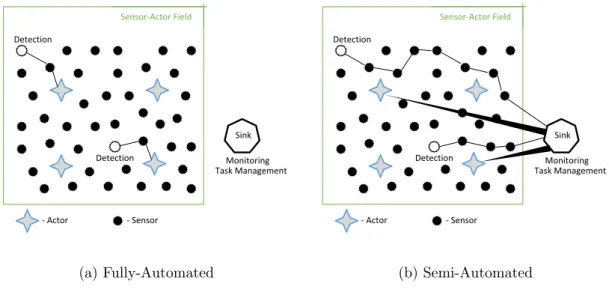
A WSAN is shown in Fig. 3.1. The main functionality of WSANs is to make ac-tors perform appropriate actions in the environment, based on the data sensed from sensors and actors. When important data has to be transmitted (an event oc-curred), sensors may transmit their data back to the sink, which will control the actors’ tasks from distance or transmit their data to actors, which can perform actions independently from the sink node. Here, the former scheme is called Semi-Automated Architecture and the latter one Fully-Semi-Automated Architecture, as seen in Figs. 3.2(a) and 3.2(b), respectively. Obviously, both architectures can be used in different applications. Fully-Automated Architecture, which is considered in this thesis, emerges the need to develop new sophisticated algorithms, in order to pro-vide appropriate coordination between nodes of WSAN. On the other hand, it has advantages, such as low latency, low energy consumption, long network lifetime [5],
higher local position accuracy, higher reliability and so on.
3.2
WSAN Challenges
The WSAN is shown in Fig. 3.1. Some of the key challenges in WSAN are related to the presence of actors and their functionalities.
Deployment and Positioning: WSAN are heterogeneous networks [26], where
actors and sensors have different processing powers, mobility abilities and func-tionalities. Thus, at the moment of node deployment, algorithms must consider
Sensor-Actor Field
- Actor - Sensor
Monitoring Task Management
Sink
Figure 3.1: Wireless Sensor and Actor Network (WSAN).
Sensor-Actor Field - Actor - Sensor Monitoring Task Management Sink Detection Detection (a) Fully-Automated Sensor-Actor Field - Actor - Sensor Monitoring Task Management Sink Detection Detection (b) Semi-Automated
Figure 3.2: WSAN Architectures
to optimize the number of sensors and actors and their initial positions based on applications [27, 28].
Architecture: The main functionality of WSANs is to make actors perform
appro-priate actions in the environment, based on the data sensed from sensors and actors [29, 30]. When important data has to be transmitted (an event occurred), sensors may transmit their data back to the sink, which will control the actors’ tasks from distance or transmit their data to actors, which can perform actions independently from the sink node.
Real-Time: The purpose of using WSANs in most of the applications is mainly
is physically difficult or time-restricted [10, 31]. In other words, there are a lot of applications that have strict time requirements. In order to fulfill them, real-time limitations must be clearly defined for each application and system.
Coordination: Unlike WSN, where sensors coordinate with each-other to send
data to the sink [32], in WSAN, sensor-actor coordination occurs as well, because all sensed data control actor’s behavior. Also, actor-actor coordination is important in cases when actors collaborate on performing tasks together. In order to provide effective sensing and acting, a distributed local coordination mechanism is necessary among sensors and actors [30, 33].
Power Management: Similar to energy-constrained WSNs [34], in WSANs
sen-sors have limited power supplies, which limits the network lifetime. Actors have more powerful power supplies but their functionalities are more sophisticated, so they spend more energy for complicated tasks. Thus, WSAN protocols should be designed with minimized energy consumption for both sensors and actors [10, 35].
Mobility: In WSANs, nodes, especially actors can be mobile [36]. For example,
robots used in industrial monitoring sites or flying drones aver a disaster recovery area. Therefore, protocols developed for WSANs should support the mobility of nodes, [7, 37, 38], where dynamic topology changes, unstable routes and network isolations are present.
Self Healing: One of the main problems in mobile Self-Organizing Networks
(SON) is the high probability of node isolations during network runtime. An actor failure may lead to partitioning the network and thus hinder the satisfaction of the application requirements. Many works have been done on connectivity restoration, by using actors ability to move without using much energy [7, 6]. Actors may also be specialized to carry extra energy supplies, in order to charge sensors or other actors in the network.
Scalability: Smart Cities are emerging fast and WSAN, with its practical func-tions of simultaneous sensing and acting, are a key technology. The heterogeneity is not limited and most of the systems will continue to grow together with cities. In order to keep the functionality of WSAN applicable, scalability should be considered when designing WSAN protocols and algorithms. Data replication, clustering and so on, can be used in order to support growing networks [28, 38].
3.3
Features of WSANs
However, due to the presence of actors, WSANs have some differences from wireless sensor networks (WSNs) as outlined below:
• While sensor nodes are small, inexpensive devices with limited sensing,
com-putation and wireless communication capabilities, actors are usually resource-rich devices equipped with better processing capabilities, stronger transmission powers and longer battery life.
• In WSANs, depending on the application there may be a need to rapidly
re-spond to sensor input. Moreover, to provide right actions, sensor data must still be valid at the time of acting. Therefore, the issue of real-time com-munication is very important in WSANs since actions are performed on the environment after sensing occurs.
• The number of sensor nodes deployed in studying a phenomenon may be in
the order of hundreds or thousands. However, such a dense deployment is not necessary for actor nodes due to the different coverage requirements and physical interaction methods of acting task. Hence, in WSANs the number of actors is much lower than the number of sensors.
• In order to provide effective sensing and acting, a distributed local coordination
mechanism is necessary among sensors and actors.
3.4
WSANs Applications
WSANs may consist of many different types of sensors such as seismic, low sam-pling rate magnetic, thermal, visual, infrared, acoustic and radar, which are able to monitor a wide variety of ambient conditions that include the following:
• temperature • humidity
• vehicular movement • lightning condition
• pressure • soil makeup • noise levels
• the presence or absence of certain kinds of objects • mechanical stress levels on attached objects
Sensor nodes can be used for continuous sensing, event detection, event ID, lo-cation sensing and local control of actuators. The concept of micro-sensing and wireless connection of these nodes promise many new application areas. We catego-rize the applications into military, environment, health, home and other commercial areas. It is possible to expand this classification with more categories such as space exploration, chemical processing and disaster relief.
3.4.1
Military Applications
WSANs can be an integral part of military command, control, communications, computing, intelligence, surveillance, reconnaissance and targeting(C4ISRT) sys-tems. The rapid deployment, self-organization and fault tolerance characteristics of sensor networks make them a very promising sensing technique for military C4ISRT. Since sensor networks are based on the dense deployment of disposable and low-cost sensor nodes, destruction of some nodes by hostile actions does not affect a military operation as much as the destruction of a traditional sensor, which makes sensor net-works concept a better approach for battlefields. Some of the military applications of sensor networks are monitoring friendly forces, equipment and ammunition; bat-tlefield surveillance; reconnaissance of opposing forces and terrain; targeting; battle damage assessment; and nuclear, biological and chemical (NBC) attack detection and reconnaissance.
Monitoring friendly forces, equipment and ammunition: Leaders and
comman-ders can constantly monitor the status of friendly troops, the condition and the availability of the equipment and the ammunition in a battlefield by the use of sensor networks. Every troop, vehicle, equipment and critical ammunition can be attached with small sensors that report the status. These reports are gathered in sink nodes and sent to the troop leaders. The data can also be forwarded to the
upper levels of the command hierarchy while being aggregated with the data from other units at each level.
Battlefield surveillance: Critical terrains, approach routes, paths and straits can
be rapidly covered with sensor networks and closely watched for the activities of the opposing forces. As the operations evolve and new operational plans are prepared, new sensor networks can be deployed anytime for battlefield surveillance.
Reconnaissance of opposing forces and terrain: WSANs can be deployed in
criti-cal terrains, and some valuable, detailed, and timely intelligence about the opposing forces and terrain can be gathered within minutes before the opposing forces can intercept them.
Targeting: WSANs can be incorporated into guidance systems of the intelligent
ammunition.
Battle damage assessment: Just before or after attacks, sensor networks can be
deployed in the target area to gather the battle damage assessment data.
Nuclear, biological and chemical attack detection and reconnaissance: In
chem-ical and biologchem-ical warfare, being close to ground zero is important for timely and accurate detection of the agents. WSANs deployed in the friendly region and used as a chemical or biological warning system can provide the friendly forces with critical reaction time, which drops casualties drastically. We can also use sensor networks for detailed reconnaissance after an NBC attack is detected. For instance, we can make a nuclear reconnaissance without exposing a recce team to nuclear radiation.
3.4.2
Environmental Applications
Some environmental applications of sensor networks include tracking the movements of birds, small animals, and insects; monitoring environmental conditions that affect crops and livestock; irrigation; macro instruments for large-scale Earth monitoring and planetary exploration; chemical/biological detection; precision agriculture; bio-logical, Earth, and environmental monitoring in marine, soil, and atmospheric con-texts; forest fire detection; meteorological or geophysical research; flood detection; biocomplexity mapping of the environment; and pollution study.
Forest fire detection: Since sensor nodes may be strategically, randomly, and
densely deployed in a forest, sensor nodes can relay the exact origin of the fire to the end users before the fire is spread uncontrollable. Millions of sensor nodes can be deployed and integrated using radio frequencies/ optical systems. Also, they may be
equipped with effective power scavenging methods, such as solar cells, because the sensors may be left unattended for months and even years. The sensor nodes will collaborate with each other to perform distributed sensing and overcome obstacles, such as trees and rocks,that block wired sensors’ line of sight.
Biocomplexity mapping of the environment: A biocomplexity mapping of the
environment requires sophisticated approaches to integrate information across tem-poral and spatial scales. The advances of technology in the remote sensing and automated data collection have enabled higher spatial, spectral, and temporal res-olution at a geometrically declining cost per unit area. Along with these advances, the sensor nodes also have the ability to connect with the Internet, which allows remote users to control, monitor and observe the biocomplexity of the environment. Although satellite and airborne sensors are useful in observing large biodiversity, e.g., spatial complexity of dominant plant species, they are not fine grain enough to observe small size biodiversity, which makes up most of the biodiversity in an ecosystem. As a result, there is a need for ground level deployment of wireless sen-sor nodes to observe the biocomplexity. One example of biocomplexity mapping of the environment is done at the James Reserve in Southern California. Three mon-itoring grids with each having 25-100 sensor nodes will be implemented for fixed view multimedia and environmental sensor data loggers.
Flood detection: An example of a flood detection is the ALERT system deployed
in the US. Several types of sensors deployed in the ALERT system are rainfall, wa-ter level and weather sensors. These sensors supply information to the centralized database system in a pre-defined way. Research projects, such as the COUGAR Device Database Project at Cornell University and the DataSpace project at Rut-gers, are investigating distributed approaches in interacting with sensor nodes in the sensor field to provide snapshot and long-running queries.
Precision Agriculture : Some of the benefits is the ability to monitor the
pesti-cides level in the drinking water, the level of soil erosion, and the level of air pollution in real time.
3.4.3
Health Applications
Some of the health applications for sensor networks are providing interfaces for the disabled; integrated patient monitoring; diagnostics; drug administration in hospitals; monitoring the movements and internal processes of insects or other small
animals; telemonitoring of human physiological data; and tracking and monitoring doctors and patients inside a hospital.
Telemonitoring of human physiological data: The physiological data collected
by the sensor networks can be stored for a long period of time, and can be used for medical exploration. The installed sensor networks can also monitor and detect elderly people’s behavior, e.g., a fall. These small sensor nodes allow the subject a greater freedom of movement and allow doctors to identify pre-defined symptoms earlier. Also, they facilitate a higher quality of life for the subjects compared to the treatment centers. A “Health Smart Home” is designed in the Faculty of Medicine in Grenoble - France to validate the feasibility of such system.
Tracking and monitoring doctors and patients inside a hospital: Each patient
has small and light weight sensor nodes attached to them. Each sensor node has its specific task. For example, one sensor node may be detecting the heart rate while another is detecting the blood pressure. Doctors may also carry a sensor node, which allows other doctors to locate them within the hospital.
Drug administration in hospitals: If sensor nodes can be attached to
medica-tions, the chance of getting and prescribing the wrong medication to patients can be minimized. Because, patients will have sensor nodes that identify their allergies and required medications. Computerized systems as described in have shown that they can help minimize adverse drug events.
3.4.4
Home Applications
Home automation: As technology advances, smart sensor nodes and actuators can
be buried in appliances, such as vacuum cleaners, micro-wave ovens, refrigerators, and VCRs. These sensor nodes inside the domestic devices caninteract with each other and with the external network via the Internet or Satellite. They allow end users to manage home devices locally and remotely more easily.
Smart environment: The design of smart environment can have two different
perspectives, i.e., human-centered and technology-centered. For human-centered, a smart environment has to adapt to the needs of the end users in terms of in-put/output capabilities. For technology-centered, new hardware technologies, net-working solutions, and middleware services have to be developed. A scenario of how sensor nodes can be used to create a smart environment. The sensor nodes can be embedded into furniture and appliances, and they can communicate with each other
and the room server. The room server can also communicate with other room servers to learn about the services they offered, e.g., printing, scanning, and faxing. These room servers and sensor nodes can be integrated with existing embedded devices to become self-organizing, self-regulated, and adaptive systems based on control theory models. Another example of smart environment is the “Residential Laboratory” at Georgia Institute of Technology. The computing and sensing in this environment has to be reliable, persistent, and transparent.
3.4.5
Other Commercial Applications
Some of the commercial applications are monitoring material fatigue; building vir-tual keyboards; managing inventory; monitoring product quality; constructing smart office spaces; environmental control in office buildings; robot control and guidance in automatic manufacturing environments; interactive toys; interactive museums; fac-tory process control and automation; monitoring disaster area; smart structures with sensor nodes embedded inside; machine diagnosis; transportation; factory instru-mentation; local control of actuators; detecting and monitoring car thefts; vehicle tracking and detection; and instrumentation of semiconductor processing chambers, rotating machinery, wind tunnels, and anechoic chambers.
Environmental control in office buildings: The air conditioning and heat of most
buildings are centrally controlled. Therefore, the temperature inside a room can vary by few degrees; one side might be warmer than the other because there is only one control in the room and the air flow from the central system is not evenly distributed. A distributed wireless sensor network system can be installed to control the air flow and temperature in different parts of the room. It is estimated that such distributed technology can reduce energy consumption by two quadrillion British Thermal Units (BTUs) in the US, which amounts to saving of 55 dollar billion per year and reducing 35 million metric tons of carbon emissions.
Interactive museums: In the future, children will be able to interact with objects
in museums to learn more about them. These objects will be able to respond to their touch and speech. Also, children can participate in real time cause-and-effect experiments, which can teach them about science and environment. In addition, the wireless sensor networks can provide paging and localization inside the museum. An example of such museums is the San Francisco Exploratorium that features a combination of data measurements and cause-and-effect experiments.
Detecting and monitoring car thefts: Sensor nodes are being deployed to detect
and identify threats within a geographic region and report these threats to remote end users by the Internet for analysis.
Managing inventory control: Each item in a warehouse may have a sensor node
attached. The end users can find out the exact location of the item and tally the number of items in the same category. If the end users want to insert new inventories, all the users need to do is to attach the appropriate sensor nodes to the inventories. The end users can track and locate where the inventories are at all times.
Vehicle tracking and detection: There are two approaches as described in to track
and detect the vehicle: first, the line of bearing of the vehicles determined locally within the clusters and then it is forwarded to the base station, and second, the raw data collected by the sensor nodes are forwarded to the base station to determine the location of the vehicle.
Chapter 4
Fuzzy Logic
4.1
Introduction
For a long time, classical logic has been felt too limited as a framework for modeling all facets of human reasoning. So far, probability has been the only uncertainty with which mathematics has worked, but recently the uniqueness of probability theory as a model for capturing uncertainty and vagueness has been questioned. The uncertainty of probability generally relates to the occurrence of phenomena, as symbolized by the concept of randomness. Randomness and fuzziness differ in nature from probability. That is, they are different aspects of uncertainty. The uncertainty lies in the meaning of the words, and since it is an essential characteristic of the words, it always follows them around to some extend.
Many attempts have been made, especially in this century, for augmenting the representational capabilities of logic, or for proposing non-additive models of uncer-tainty. One of the most radical and fruitful of these attempts was initiated by Prof. Lotfi Zadeh in 1965 with publication of his paper “Fuzzy Sets” [39, 40, 41]. Fuzzy set theory has became accepted in the literature as a tool for dealing with certain forms of imprecision that frequently occur in decision making environments, but for which probability calculus is inadequate. Fuzzy theory use linguistic variables to describe the control parameters. By using relatively simple linguistic expressions is possible to describe and grasp very complex problems. A very important property of the linguistic variables is the capability of describing imprecise parameters.
This chapter is devoted to fuzzy set theory. We will introduce the meaning of FL and the essentials of FL. Next, we will give the basics of fuzzy set theory.
Finally, we will illustrate the Fuzzy Control (FC) principles by treating the linguistic variables, FC rules, fuzzification, control knowledge base, conflict resolution and decision making, and the defuzzification methods, which are the theoretical need in the design of the FL-based proposed systems.
4.2
Meaning of FL
When discussing FL, there is a semantic issue which requires clarification. The term "fuzzy logic" is currently used in two different sense. In a narrow sense, FL is a logical system that aims at a formalization of approximate reasoning. As such, it is rooted in multivalued logic, but its agenda is quite different from that of traditional multivalued logical systems. In this connection, what should be noted is that many of concepts which account for the effectiveness of FL as a logic of approximate reasoning are not a part of traditional multivalued logical systems. Among these are the concept of a linguistic variable, canonical form, fuzzy if-then rules, fuzzy quantifiers, and such modes of reasoning as interpolative reasoning, syllogistic reasoning and dispositional reasoning.
In a broad sense, FL is almost synonymous with fuzzy set theory. Fuzzy set theory, as its name suggests, is basically a theory of classes with unsharp boundaries. Fuzzy set theory is much broader than FL in its narrow sense and contains the latter as one of its branches [42, 43, 44]. Among the other branches of fuzzy set theory are e.g., fuzzy arithmetic, fuzzy mathematical programming, fuzzy topology, fuzzy graph theory, and fuzzy data analysis. What is important to recognize is that any crisp theory can be fuzzified by generalizing the concept of a set within that theory to the concept of a fuzzy set. Indeed, it is very likely that eventually most theories will be fuzzified in this way. The impetus for the transition from crisp theory to a fuzzy one derives from the fact that both are generality of a theory and its applicability to real-wold problems are substantially enhanced by replacing the concept of a set with that of a fuzzy set. Today, the growing tendency is to use the term "fuzzy logic" in its broad sense. In part, this reflects the fact that fuzzy set theory sounds less euphonious than FL.
4.3
Essentials of FL
FL is the logic underlying modes of reasoning which are approximate rather then exact. The importance of FL derives from the fact that most modes of human reasoning and especially common sense reasoning are approximate in nature.
The essential characteristics of FL relate to the following.
• In FL, exact reasoning is viewed as a limiting case of approximate reasoning. • In FL everything is a matter of degree.
• Any logic system can be fuzzified.
• In FL, knowledge is interpreted as a collection of elastic or, equivalently, fuzzy
constraints on a collection of variables.
• Inference is viewed as a process of propagation of elastic constrains.
FL is different from other traditional logical systems in some details. The prin-cipal differences are mentioned as follows.
• Truth
In bivalent logical systems, truth can have only two values : true or false. In multivalued systems, the truth value of a proposition may be an element of a) a finite set; b) an interval such as [0, 1]; or c) a boolean algebra. In FL, the truth value of a proposition may be a fuzzy subset of any partially ordered set but usually it is assumed to be a fuzzy subset of the interval [0, 1] or more simple a point in this interval. The so-called linguistic truth values expressed as true, very true, not quite true, etc., are interpreted as labels of fuzzy subsets of the unit interval.
• Predicates
In bivalent systems, the predicates are crisp. In FL, the predicates are fuzzy, e.g., tall, old, much longer than. It should be noted that most of the predicates in a natural language are fuzzy rather than crisp.
• Predicate modifiers
In classical systems, the only widely used predicate modifier is the negation
very, more or less, quite, rather, extremely. Such predicate modifiers play an
essential role in the generation of the values of linguistic variables, e.g., very
young, not very young, more or less young. • Quantifiers
In classical logical systems there are just two quantifiers : universal and
exis-tential. FL admits in addition, a wide variety of fuzzy quantifiers exemplified
by few, several, most, almost, always, about five, etc. In FL, a fuzzy quantifier is interpreted as a fuzzy number or fuzzy proportion.
• Probabilities
In classical logical systems, probability is numerical or interval-valued. In FL, one has the additional option of employing linguistic or, more generally, fuzzy probabilities exemplified by likely, unlikely, very likely, around 0.8, etc. Such probabilities may be interpreted as fuzzy numbers which may be manipulated through the use of fuzzy arithmetic.
• Possibilities
In contrast to classical logic, the concept of possibility in FL is graded rather than bivalent. Furthermore, as in the case of probabilities, possibilities may be treated as linguistic variables with values such as possible, quite possible, almost
impossible, etc. Such values may be interpreted as labels of fuzzy subsets in
the real line.
It is important to observe that in every instance FL adds to the options which are available in classical logical systems. In this sense, FL may be viewed as an extension of such systems rather than a system of reasoning which is in conflict with the classical systems [41, 45, 46].
4.4
Basics of Fuzzy Set Theory
The concept of a fuzzy set deals with the representation of classes whose bound-aries are not determined. It uses a characteristic function, taking values usually in the interval [0, 1]. The fuzzy sets are used for representing linguistical labels. This can be viewed as expressing an uncertainty about the clear-cut meaning of the
label. But important point is that the valuation set is supposed to be common to the various linguistic labels that are involved in the given problem.
The fuzzy set theory uses the membership function to encode a preference among the possible interpretations of the corresponding label. A fuzzy set can be defined by examplification, ranking elements according to their typicality with respect to the concept underlying the fuzzy set [47, 48, 49]. The prototypical element receives the greater membership grade. Fuzzy set naturally appears in non-strict specification. It may be soft constraints or flexible requirements for which slight violations can be tolerated (e.g., the dead line is today, but tomorrow is still acceptable although less good), or elastic classes of objects, approximate descriptions of types of situation to which a given procedure can be applied, or even procedures with fuzzy stated instructions. In each case fuzzy sets preserve a gradual and smooth transition from one category into another and avoid abrupt discontinuities that would be caused by the assignment of precise boundaries for the considered subsets. The specification thus becomes more robust and adaptive. In this case, fuzzy sets provide a tool for bridging the gap between the perceived continuity of the world and human discrete cognitive representation. In particular, fuzzy sets help with interfacing numerical data and symbolic labels.
4.4.1
Quantification of Ambiguity
Most natural languages contain ambiguity and multiplicity of meaning. The ob-jects of adjectives, especially, are not clearly specific, and are ambiguous in terms of breath of meaning. If we say “tall person”, we can’t clearly determine who is tall or who is not tall. The ambiguity of “old person” comes from the adjective “old”. Words are usually qualitative, but ones like “tall” and “old” are perceived in connection with amounts of height or age. If we leave out abstract adjectives like “ambiguous”, “vague” and “uncertain”, adjectives that involve amounts are common. In engineering, especially, the adjectives that describe the states and conditions of various things are almost always connected to amounts in this way.
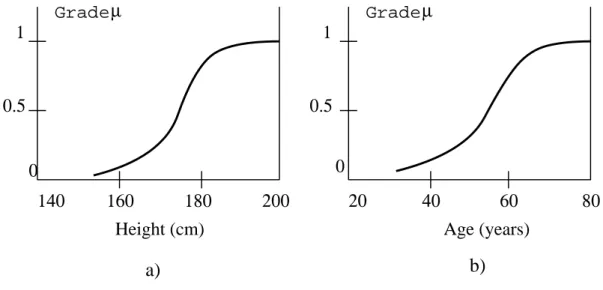
Let’s take a look at the ambiguity of the meanings of “tall” and “old” in terms of expression of amount. With a range of height of 140 cm to 200 cm, the degree to which heigh x[cm] can be called “tall” is µ, that is, we make height x correspond to degree µ (0 ≤ µ ≤ 1). If the horizontal axis is x and the vertical axis is µ, the
Grade µ µ 1 1 0 0 0.5 0.5 40 60 80 200 180 160 20 140 Grade
Height (cm) Age (years)
a)
b)
Figure 4.1: a) Grade of “tall”, b) Grade of “old”.
graph would be drawn as in Fig. 4.1(a). This graph expresses the ambiguity of “tall” in terms of quantity. In the same way the ambiguity of “old” is expressed in Fig. 4.1(b). The amount in the horizontal axis is the age in years, and the vertical axis shows the degree to which a person can be labeled “old”. The horizontal axis is the quantification of the word, the expression of height or age in one dimensional space, and the vertical axis is the quantification of the degree of ambiguity. This kind of representation of a word is called quantification of meaning. The meaning of the word is quantified over a specific range; for height this range is 140 cm to 200 cm, and for age it is 20 to 80 years.
4.4.2
Fuzzy Set Definitions
A fuzzy set is a class with fuzzy boundaries, that is a class in which the transition from membership to non-membership is gradual rather than abrupt. Fuzzy set theory works with quantification of the meanings of words in graphs within the framework of set theory. It is an attempt to express the adjectives meaning by means of the concept of sets. This is because set theory is a very basic concept and has connection with all fields of contemporary mathematics. In following are some of the essential notations for the introduction of the fuzzy set theory:
• X whole set (the universe of discourse);
• E subset of X ;
• ⊘ empty set;
• {0, 1} the set of zero and 1;
• [0, 1] the real number interval from zero to 1;
• χE characteristic function of set E ;
• a ∧ b the min of a and b;
• a ∨ b the max of a and b.
A fuzzy set is an extension of a crisp set. Crisp sets only allow full membership or no membership at all, whereas fuzzy sets allow partial membership. In other words, an element may partially belong to a set. In a crisp set, the membership or non-membership of an element x in set E, where E is a crisp subset of X, is described by the following characteristic function:
χE =
{
1; x∈ E
0; x not∈ E. (4.1)
This corresponds to the membership function of E. The grade is two-valued; if x is included in E it is 1; if not is zero.
On the other hand, a fuzzy set is a class with fuzzy boundaries. An abstract representation of a fuzzy subset of set X would look something like Fig. 4.2. The rectangular frame represents set X, the dotted circle represents the subset of X that we denote by A. Fuzzy set theory defines the degree to which element x of the set X is included in this subset. The function that gives the degree to which it is included is called the membership function. A more precise definition of a fuzzy set may be stated as follows:
Definition 1
Let X ={x } be the universe of discourse (i.e. a collection of objects), denoted generically by x ; then a fuzzy subset of X, A, is a set of ordered pairs (x, µA(x)) , x
A
X
x
Figure 4.2: Fuzzy subset A.
ϵ X, where µA(x) is the grade of membership of x in A, and µA : X → [0, 1] is the
membership function.
Since a fuzzy set is always defined as a subset of a general set X, the “sub” is frequently abbreviated, and is just called a fuzzy set. From the definition we see that the function over the interval [0, 1] has a one-to-one correspondence with the fuzzy set. This function is a quantification of the ambiguity of area A. In fact, this function has the same characteristics as the graphs in Fig. 4.1(a,b). Fig. 4.1(a) can be thought of as a representation of the membership functions of the “group of heights that can be thought of as tall” fuzzy set within the set of heights of 140 cm to 200 cm. Fig. 4.1(b) can be viewed as the membership function of the fuzzy set which is “the group of ages that can be considered old” in the range from 20 to 80 years. However, there are an infinite number of fuzzy sets and any form of membership functions is possible, so fuzzy sets do not always have to correspond to words.
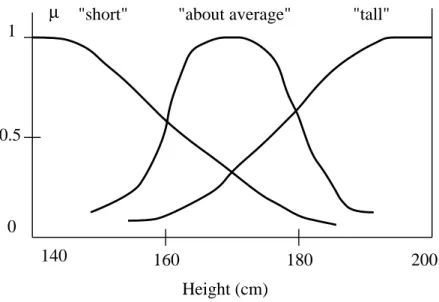
If we think about the membership function of the fuzzy set not only for “tall”, but also for “about average” and “short”, we come up with something which will look like Fig. 4.3. As can been seen from this figure, there are two basic things that control fuzzy sets. The first is the horizontal axis, that is, the whole set X.
X is called the support set of the fuzzy set, or simple support. The second is the
membership function. Anyone would probably think of the membership function of “about average” as rising in the middle, but the grade of about 150 cm or 170 cm would probably vary subjectively with the person doing the thinking. In this way, fuzzy sets can be seen as being subjective, as opposed to standard sets, which are objective.
![Figure 2.3: A wireless sensor network [19].](https://thumb-ap.123doks.com/thumbv2/123deta/6496831.1125078/21.892.263.644.181.456/figure-a-wireless-sensor-network.webp)
![Figure 2.5: Client meshing [25].](https://thumb-ap.123doks.com/thumbv2/123deta/6496831.1125078/25.892.210.714.536.723/figure-client-meshing.webp)