Report
Literature review on realities of difficulties Japanese families with a child
with developmental disabilities face and required support
Hiroshi Fujioka
1, Rie Wakimizu
2, Ayano Ebihara
3, Megumi Nakano
4 1Department of Nursing, Faculty of Health Science, Tsukuba International University
2
Division of Health Innovation and Nursing, Faculty of Medicine, University of Tsukuba
3
Department of Nursing, University of Tsukuba Hospital
4
Department of Nursing, Heart Life Hospital
──────────────────────────────────────────── Abstract
Purpose: Summarizing the existing research on realities of difficulties faced by Japanese families having a child with developmental disabilities (DDs) and necessary support for them, ascertaining findings of the research, and comprehensively examining specific intervention methods for corresponding families in Japan. Methods: PubMed and CINAHL were utilized to search for English literature on the subject whereas Japan Medical Abstracts Society (web edition, ver. 5) was used for Japanese literature. The original and review articles for 2005–2014 were reviewed.
Results: Realities of difficulties were classified into six categories, with “difficulties concerning the child’s behavior” being extracted the most. Overall, this category was shown to greatly affect the lives of families with a child with DDs. Such families require four categories of support. Particularly, mental and emotional support for parents was desired.
Conclusion: The review suggested that specialists needed to assess everyday difficulties of families with a child with DDs from various perspectives, using issues related to behaviors of children with DDs as a beginning. Further, parents’ mental and emotional stabilities need to be supported more actively. Japanese research focusing on families with children with DDs should be continually accumulated. Based on findings from such an accumulation, support for both the parents and the child or comprehensive support focusing on the family collective should be planned.
Keyword:developmental disability, dif゙culties, family, literature review, support
────────────────────────────────────────────
───────────────────── Corresponding author: Hiroshi Fujioka
Department of Nursing, Faculty of Health Science, Tsukuba International University,
6-8-33, Manabe Tsuchiura, Ibaraki 300-0051, Japan. Phone / Fax: +81–29–826–6622
Introduction
In Japan, the number of children with developmental disabilities (DDs) is steadily increasing (Japan League on Developmental Disabilities, 2013). The results of the National Survey on School Children with Special Educational Needs in a Regular Class reported that 6.5% of all children have “mild DDs” that cause significant difficulty in learning and behavior without mental retardation (Ministry of Education, Culture, Sports, Science and Technology, 2012).
In addition, as shown by the enforcement of special needs education and the recent establishment of the Act on Support for Persons with Developmental Disorders (Ministry of Health, Labour and Welfare, 2005), the supportive environment for DDs has improved, with a better understanding of disability emerging in Japanese society. In Japan, DDs are defined as “autism, Asperger’s syndrome, other p ervasive developmental diso rders, le ar ning disorders, attention deficit hyperactivity disorder (ADHD), and similar higher cerebral dysfunctions that usually present symptoms at an early age.” The qualitative definition is “a disorder that typically causes behaviour, communication, and social adjustment problems during the development process” (Hiraiwa, 2009).
Children with DDs often cause (or are involved in) problems (e.g., trouble with friends, isolation from other children, and falling behind others) in the community or school one or more times (Takahashi, 2008). Parents of such children need to deal with problems caused by them due to the DD and undergo more stress associated with child rearing than other parents (Anderson, 2008; Nachshen & Minnes, 2005). The pressure of child rearing felt by these parents is considerable (Karst & Van Hecke, 2012; Raina, 2004). The presence of a child with DDs can also be a source of stress for the child’s kin and siblings (Karst & Van Hecke, 2012; Schuntermann,
2007). Though a large majority of parents adjust to raising these children, some fail to adapt; the latter are said to be potential child abusers (Raina, 2004). Karst and Van Hecke reported that raising a child with DDs can cause higher stress in the family (Karst & Van Hecke, 2012).
In Japan, nuclear families comprise over 60% of the population, and their burden of child caring is substantial (Ministry of Health, Labour and Welfare, 2012). There are cases where children are abused by their parents because they do not have a person or organization that they can consult with when it is difficult for them to handle child care and when they experience depressive tendencies. (Ministry of Health, Labour and Welfare, 2014a; Ministry of Health, Labour and Welfare, 2013). In particular, p arents raising a child with DDs have be en reported to undergo difficulties in child caring and stress more strongly as compared with families raising a healthy child (Ministry of Health, Labour and Welfare, 2014b). Japan’s Children’s Charter advocates that “all children are to be raised healthily, both in mind and body, and have their livelihood guaranteed” (Ministry of Education, Culture, Sports, Science and Technology, 1951). However, to adhere to this policy, support for the entire family, and not just for the child within its perspective, is necessary for families raising children with DDs. Clarifying the everyday difficulties of members of such families and the supp o r t they require is a cr ucial task when providing familial support in various fields such as education, medical concerns, and welfare. Until now, several papers referring to family’s difficulties and necessary supp o r t in e ach p osition and perspective were found. However, there were no literature-based papers summarizing these contents. Therefore, this study summarizes the existing research (including case example reports) on realities of difficulties faced by Japanese families with a child with DDs and necessary support for them,
ascer tains the findings of the rese arch, and comprehensively examines specific intervention methods for corresponding families in Japan.
Methods ─ Parti ─ cipa ─ nts
PubMed and CINAHL were used for searching English papers on the subject, and “developmental
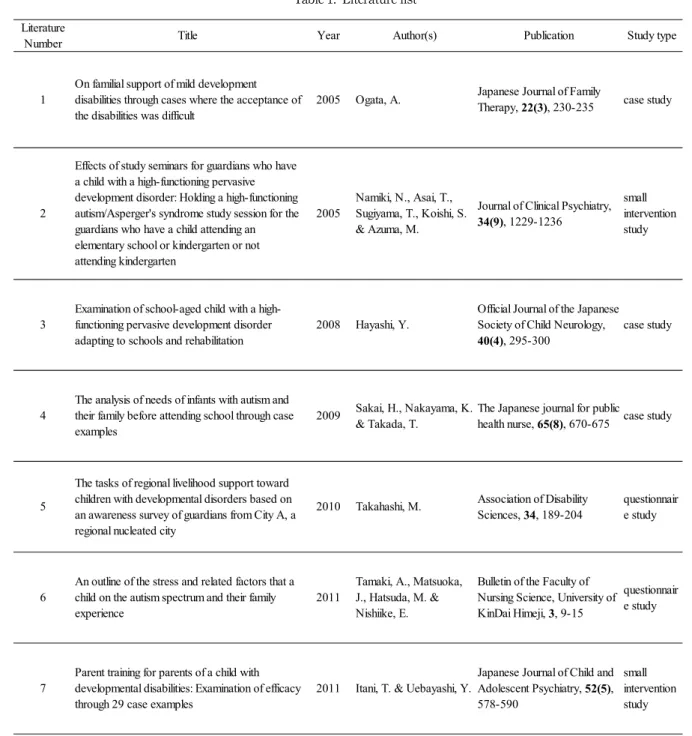
disorders,” “families,” and “Japan” (in Japanese) were used as keywords to search for original and review articles published between 2005 and 2014. The Japan Medical Abstracts Society (web edition, ver. 5) was utilized to search for Japanese literature using “developmental disorders,” “families,” and “Japan” as keywords to search for original and review ar ticles published betwe en 2005 and December 2014. Therefore, 38 pieces of English literature and 33 pieces of Japanese literature were found. Excluding literature that did not have Table 1. Literature list
families with a child with DDs as the subject or does not mention everyday difficulties of families, a total of 26 pieces of literature were used as analysis participants (Table 1). ─ Ana ─ lysi ─ s me ─ thod ─ s
Each selected piece of literature was classified according to “year published,” “subject” (i.e., children, family), “the disability of the child,” “the state of
difficulties,” “support and needs,” and “familial support given.” Thereafter, an analysis form was developed, and each piece of literature was read intensively, with its content summarized—the points of analysis being realities of difficulties, required support and needs, and familial support being performed for families with a child with DDs. These analyzes were promoted by researchers continuous discussing. Results ─ ─ Rese ─ arch ─cont─ents 1. Realities of difficulties
As a result of the analysis, the difficulties that families having a child with DDs face were classified into six categories as follows. Each category was further classified by focal themes (Table 2).
Everyday difficulties
Regarding everyday difficulties, it was first indicated that the participants had to quit their wo rk to prio ritiz e taking care of their child. Furthermore, even in cases where they did not quit their job, the results demonstrated a reality in which taking care of their child affected their jobs, such as being called away while working or having to take leave from work.
Next, it was shown that there was deterioration in participants’ mental and physical health because of issues such as concerns related to problematic behaviors of their child. There have been statements by participants complaining about their physical problems (e.g., “I feel that my body is aching” and “my weight is decreasing”) as well as an increase in psychological stress and the development of psychological illnesses.
The results also indicated the reality in which spending their daily lives with a child with DDs increased the participants’ exhaustion from child rearing and household cho res. This included instances such as the parents having to carry their child home after grocery shopping because the child did not want to go home and the child making the younger brother cry by te asing him without considering his feelings. Moreover, the analysis revealed causes of participants’ exhaustion, such as having to spend considerable time helping with their child’s homework or having to spend many
hours looking after their child every day at home. Fu r ther mo re , interview results showed that participants felt that their lives stopped during periods when their child or they themselves were ill or during pregnancy. An awareness of difficulties was discussed regarding raising their child, including having to communicate visually using pictures and charts in light of the child’s development or constantly having to make small adjustments.
There have also been reports on the participants’ life rhythms being disrupted because of reasons such as having to remain awake through the night for children whose night and day is reversed.
Difficulties associated with the child’s behavior
Impacts on one’s lives included families falling into a confused state when their child threw a tantrum, having a panic attack, or child caring becoming difficult because of their child’s behavior. In addition, there have been reports of things in the house getting broken or family members being physically attacked because of the child’s rough or aggressive and impulsive behaviors. The anxiety and fixations of such children are strong. To be specific, there have been cases where families have had to stock specific food products in their refrigerator, and remove all mirrors in their house because of their child’s strong drive to lose weight, and because they could not go out with their daughter who would pursue a perfect appearance. As such, the
characteristics of the child’s disorder also affected the families’ lives.
The participants worried about dealing with their child (e.g., “I do not know how to deal with the delay in development,” and “I don’t know how to deal with my child’s problematic behavior”) and also about the child’s growth and changes (i.e., “changes that occur during puberty” and “sexual interest and concer n”). The state in which participants worried about their relationship with their child (i.e., “difficulties in interacting with their child,” “difficulties in raising the child,” and “difficulties in feeling an attachment [to the child]”) was also indicated.
Issues that made the participants concerned included the conspicuous behavior of their child that caused annoyance to the people around them. Furthermore, difficulties within the child’s social life were also raised, including the difficulties in sustaining concentration, prematurity in verbal expression, and the child’s attendance or non-attendance at school. The issues that the child faced in inter p ersonal and social asp ects, such as difficulties in communication, were perceived as difficulties on the part of both the child and the families.
Difficulties related to family relationships
There were many complaints from mothers regarding their husband’s lack of understanding, such as “my husband does not understand our child’s disability and cannot accept it” and “my husband does not understand the difficulties of child caring.” Furthermore, the review showed the state in which the entire family left the responsibility of dealing with the child with DDs to the mother without attempting to understand the child’s disabilities.
Difficulties related to education
The analysis result showed that participants
faced many concerns and anxieties when selecting schools and facilities because of the inability to identify schools and classes suitable for the child.
Furthermore, participants felt that “our requests are not being heard” and “we cannot voice our dissatisfaction” regarding educational institutions. There were also concerns such as the teaching staff at school did not understand the disability and the participants could not receive continuous support. Complaints were also made stating that the school could not ascertain the support needed by children with DDs or their families.
There were complaints of difficulties faced in providing learning support for the children at home and spending too much time helping them with their homework.
In association with the child’s school attendance, the participants’ source of concerns gradually changed to “being unable to fit with the group” and “bullying and secondary disabilities.” Parents were concerned because they were unaware of effective methods of supporting the child’s school life. The participants wished that classmates would know how to interact with their child. Though there were participants who knew the specific state of their child’s school life, there were also those who did not know the state of their child because of the lack of status reports provided by the school.
Par ticip ants also mentioned difficulties in establishing a positive relationship with other guardians.
Difficulties related to rehabilitation
Participants had a sense of difficulties in carrying on with the rehabilitation of the child because of the lack of information related to rehabilitation. Furthermore, they were experiencing financial, physical, and time-related burdens and emotional conflicts for the continuation of such rehabilitation. In addition, they possessed the understanding that the disabilities of their child could not be cured with
their care.
Concerning the treatment of their child, there were families who could not receive treatment, despite desiring treatment, because of limited resources, such as doctors and hospitals (e.g., “there are few doctors who specialize in developmental disabilities,” “the special hospital is far away,” and “it is difficult to secure a reservation”).
There were also cases where the participants felt suspicious toward the specialized organization they attended for rehabilitation and cases where the participants could not find an appropriate specialist to deal with their child’s disability.
In addition, there was a situation where public assistance was unsuitable for the participant’s child.
Psychological burden
The participants had a long-lasting anxiety concerning their children. Specifically, they had worries such as “Will my child be able to become self-sufficient in the future and hold a job?” and “Will my child commit a crime?”
Moreover, there were participants who became pessimistic by comparing their child with other children, wondering “whether my child can keep up with studies” or “whether my child is having difficulties interacting with friends or being part of a group.”
Furthermore, there were participants who felt guilty for being unable to accept their own children’s disabilities despite being mothers and being unable to tell the people around them about the disabilities.
2. Support and needs
Support required by mothers and families having children with DDs includes physical support, psychological support, and support focused on the child. There were also needs for appropriate measures at facilities and specialized organizations (Table 3).
Physical support
Physical support includes financial support for the families, including rehabilitation fees. Further-more, participants sought services in which options would be given to guardians and families raising the child, such as providing information related to social resources and notifying them about how to use such resources. In addition, the participants also required support from specialists, such as “explanations in which parents can appropriately understand the developmental state and behavioral characteristics of the child” and “support that can depict the future state as much as possible.” Moreover, participants wished for physical support from their spouses and other family members.
Psychological support
Psychological support required by the participants includes mo re active supp o rt fo r mental and emotional stability of parents and families. The need for diagnosis and treatment of mental illnesses concerning psychological complaints that were manifested has been indicated. A support that understands participants’ emotions and consoles
them by becoming involved with families facing difficulties in a sympathetic manner was also sought. Furthermore, the analysis result suggested the importance of providing mental health support for the participants in a long-term and continuous manner. An assistance method that provides a place for interaction among guardians and enables them to consult regarding their concerns and support one another, thus helping them gain emotional support, is required. Another method mentioned was to provide time during which mothers can leave housework and child caring behind, leading to emotional support. Literature 16 reported situations where participants were supported by those around them (e.g., “I am supported by the understanding and cooperation from my husband and my parents,” “I am supported by the help of those who understand in the community,” and “I am supported by the interaction and advice from mothers who also have a child with DDs.”)
Support focused on the children
Concerning support focused on the children, the participants wished for further enhancement of welfare support toward children. In particular, they desired support that focused on the strength and positive characteristics of those with DDs and further strengthened these characteristics.
Support sought from facil ities and special ized institutions
From facilities and specialized institutions, participants desired support such as the enforcement of connections with external specialized institutions, the enforcement of DD-related training of staff members, and the allocation of designated specialists. In addition, when the child could do more things with training, the participants felt that their child was slowly growing and moving forward. The
participants stated that being informed of the positive aspects and development of their child verbally by the members of the institution and the specialists became a source of encouragement and support for child caring.
3. Support focused on families
Among the examined literature, there were some that conducted research with the aim of providing familial support (Table 4).
Literature 1 discusses an intervention that promotes acceptance by school advisors and doctors in a case involving difficulty in the acceptance of disabilities. However, it was ineffective and instead reported that the family was rather in conflict with the school and medical team concerning the aspect of support.
Literature 2 involved conducting a study seminar on high-functioning autism and Asperger’s syndrome for families. Consequently, the understanding of the families toward their children was promoted. Furthermore, the effect of the study seminar was sustained even after some lapse of time.
Literature 7, 8, and 20 reported that, as a result of examining the efficacy of parent training, the sense of difficulties parents felt toward dealing with their children with DDs was alleviated, and their mental health improved. It was also suggested that the secondary disability of the child was reduced due to the training. Moreover, it was reported that the training was also important from the perspective of providing an early rehabilitation support before consulting a medical institution.
Literature 16 stated that a camp was held to stimulate the sensory perception of children with DDs and promote exercises, providing comprehensive familial support. The literature reported that through the camp activities, the autonomic nervous system activities of the children were stabilized and their stress was reduced along with the promotion of the activation of the frontal lobe’s restraining function. However, no intervention was implemented for parents or other family members, and the literature did not mention any changes in the outcome with families before and after the camp.
Discussion ─ Rese ─ arch ─ tren ─ ds a ─ nd p ─ artic ─ ipan ─ ts
The amount of literature focusing on families
with a child with DDs has been increasing in recent years. This can be attributed to the impact of the Act on Support for Persons with Developmental Disabilities (Ministry of Education, Culture, Sports, Science and Technology, 2004), the 2005 revision of the Child Welfare Act (Ministry of Health, Labour and Welfare, 1947), and the 2011 revision of the Child Welfare Act (Ministry of Health, Labour and Welfare, 2011). However, such literature is sparse, and further accumulation of results is required.
The majority of participants in the research considered were the main rearers. Given that Schuntermann reported the burden on the siblings of children with DDs, findings on each family member’s reality of life and on the support required by them need to be accumulated in Japan as well (Schuntermann, 2007). ─ Rese ─ arch ─ cont ─ ents 1. Realities of difficulties
As a result of the analysis, the difficulties of families with a child with DDs were classified into six categories: everyday difficulties, difficulties related to the child’s behavior, difficulties concerning the familial relationship, education-related difficulties, rehabilitation-related difficulties, and psychological burden.
Among these categories, difficulties related to the child’s behavior were mentioned most frequently. Most of the child’s behaviors mentioned as problematic were symptoms of DDs. The participant family felt g reat difficulties with the child’s problematic behavior pertaining to DDs and also indicated it as the fundamental cause for everyday difficulties, education-related difficulties, and psychological bu rden. In general, it was observed that the difficulties related to the behavior of the child greatly impacted the lives of families with a child with DDs.
relationships, education-related, and rehabilitation-related difficulties reported in Table 2 infers a situation in which participants do not have a person or lack opportunities to consult their household or school, thus becoming isolated in terms of childcare. In particular, there were many statements that indicated the isolation of mothers, such as “my husband does not understand how difficult childcare is” and “my husband does not accept the child’s disability.” There was also a case of conflict between a participant and the school officials concerning the guidance and support provided to the child. To prevent the isolation of participants with regard to childcare, it is crucial to hold seminars on disabilities for parents and family members as well as set up a regular place for discussion that provides a connection between each specialist and other parents.
Based on the fact that Table 2 shows “the lack of specialists on developmental disorders” regarding rehabilitation-related difficulties and “the lack of the understanding of developmental disorders in educational institutions” regarding education-related difficulties, the participants experienced difficulties in raising the child without being able to rely on specialists or public institutions. However, these rehabilitation-related and education-related difficulties that parents face are believed to also decrease the qualities of the child and not just the p arents. The analysis showed that there are discrepancies in the content of rehabilitation and the quality that the participants received depending on their residential area because of the lack of specialists and specialist institutions on DDs in Japan. It is necessary to develop a system in which participants can attain services of a certain level, irrespective of where they live.
2. Support and needs
Literature 8 had a case of a mother who attended sessions at a psychosomatic medicine and psychiatric
practice after having lost her confidence because of having a strong sense of rehabilitation-related difficulties. Literature 9 reported on parents’ depres-sion, neurosis, personality disorder, schizophrenia, and alcohol dependency based on survey results. It was believed that the behavior and conduct of children with DDs affected the state of parents’ health, including mental health. Thus, the literature suggested that providing psychological support and intervention for families that have a child with DDs is indispensable.
What is considered most important is support that understands parents’ emotions and provides accompaniment. In reality, the evaluation and understanding of parents who have a child with DDs were different than those of specialists. Literature 11 showed that specialists evaluated children based on observation and research conducted in one setting whereas parents evaluated their children over a long period of time. Therefore, the parents’ evaluation was higher than that of the specialists. In contrast, parents also felt that specialists did not understand the difficulties of raising their child. Specialists should consider the possibility of there being discrepancies between their judgment and parents’ perception of their children and their sense of difficulties in child caring. Thereafter, such specialists should actively provide support to further stabilize parents’ mental and emotional aspects. Providing an opportunity for guardians to interact is one way in which specialists can support them in a feasible manner within a community.
Regarding the support focusing on the children, the analysis demonstrated that participants’ need of support also extended to the future of the child (i.e., school attendance and employment) and not just the child’s current phase of life. In particular, they sought support that focused and built on the strength and positive aspects characteristic to DDs. Many concerns were raised on how school teaching staff lacked the understanding of DDs and did not comprehend how
to deal with them. Furthermore, based on statements that stipulated that the child’s quality of life differed depending on the teacher’s qualities, the improvement and support sustained at school, where children sp end their time outside the household, was considered indispensable. It is essential for all teachers to support children with DDs during their school life and deal with their families. Moreover, promoting the teachers’ understanding of DDs for such support to continue in future was deemed to be an issue.
Participants viewed hospitals and rehabilitation institutions as essential support resources. They perceived the growth and progress of their child when their child could do more things through rehabilitation. Furthermore, they obtained encour-agement and support by having the strength and development of the child pointed out objectively by staff members. On the other hand, there were participants who could not receive specialized support despite wanting to proceed with rehabilitation (Literature 13). First and foremost, an institutional environment is required for rehabilitation support. Thereafter, the improvement of specialized support (i.e., rehabilitation) needs to be planned, along with increasing its quantity and quality, such that more children and parents can receive such services.
3. Support focusing on families
It is crucial to ascertain the needs of the families when providing support. Literature 15 mentions such situations where information does not reach families. These scenarios include the participants not receiving any info r mation at all at their kindergarten (such as lectures related to DDs) and on the education of children with DDs in schools that the participants have to select for their children. The literature also discusses a situation where the public assistance provided varies from the needs of the participants. It is necessary to conduct preliminary research on the types of disabilities suffered by the
children who are the target of the assistance and the type of assistance they need.
In addition, it is crucial to plan the support to be provided in conjunction with society’s events. Literature 11 reports the support for children and adults with DDs during the Great Tohoku Disaster that occurred on March 11, 2011 and proposed “registered evacuation sites,” in which evacuation sites are to be determined in advance. Planning support for unusual events in such a manner may lead to reducing the family’s anxiety as well as providing psychological assistance to them.
It is inferred that alleviating the symptoms of children with DDs (Literature 16) will also alleviate the difficulties of dealing with a child with DDs in everyday life (Table 2). Parents themselves attending seminars (Literature 2) to develop the acceptance and understanding of disabilities and acquiring specific childcare skills in parent training (Literature 7, 8, 20) are believed to be able to alleviate the difficulties in dealing with their child in daily life. On the basis of these findings, it can be concluded that familial support should be provided to both children and family members and not just either one of them. Some of the literature consulted in this study also discussed support given to only one party. However, the findings from the analysis suggested the necessity of providing comprehensive support to both parents and children or focusing on the family collective.
Conclusion
In this review, difficulties in families’ daily life were classified into six categories, and support that families required was classified into 4 categories. The results suggested that specialists need to assess everyday difficulties of families with a child with DDs from various perspectives, using issues related to the behaviors of children with DDs as a
beginning. Furthermore, they also suggested that parents’ mental and emotional stabilities need to be promoted more actively. Though the review clarified the overall picture of the realities of life of Japanese families having children with DDs, the support they want, and the actual assistance they receive, the research is still inadequate. Further research needs to be conducted in Japan in future. Based on the findings of such research, support for both the parents and the child and comprehensive support focusing on the family collective should be planned and executed.
Acknowledments
This study was funded by the Ministry of Education, Culture, Sports, Science and Technology, Japan (Grant-in-Aid for Young Scientists (A), 2014–2017, No. 26713057). The authors declare that they have no competing interests.
References
Anderson LS (2008) Predictors of parenting stress in a diverse sample of parents of early adolescents in high-risk communities. Nurs Res. 57:340–350. Hiraiwa M (2009) A statement about children’s mental
and behavioral issue. The Journal of Child Health. 68:329–336.
Japan League on Developmental Disabilities (2013) Hattatsu Shougai Hakusho. Akashi Shoten, Tokyo. pp.216.
Karst JS, Van Hecke AV (2012) Parent and family impact of autism spectrum disorders: A review and proposed model for intervention evaluation. Clin Child Fam Psychol Rev. 15:247–277. Ministry of Education, Culture, Sports, Science and
Technology (1951) The Children’s Charter. Available from: http://www.mext.go.jp/b_menu
/shingi/chukyo/chukyo3/004/siryo/attach/1298 450.htm [cited 2016 Aug 16]
Ministry of Education, Culture, Sports, Science and Technology (2004) Act on Support for Persons with Developmental Disabilities. Available from: http://www.mext.go.jp/a_menu/shotou/tokubet u/material/001.htm [cited 2016 Aug 16]
Ministry of Education, Culture, Sports, Science and Technology (2012) Report on national survey on school children with special educational needs in a regular class. Available from: http:// www.mext.go.jp/a_menu/shotou/tokubetu/mat erial/__icsFiles/afieldfile/2012/12/10/1328729_0 1.pdf [cited 2016 Aug 16]
Ministry of Health, Labour and Welfare (1947) The Child Welfare Act. Available from: http://www. mhlw.go.jp/bunya/kodomo/dv22/04.html [cited 2016 Aug 16]
Ministry of Health, Labour and Welfare (2005) Establishment of the support law for people with developmental disorders. Available from: http://www.mhlw.go.jp/english/wp/wp-hw2/ part2/p2c8s2.pdf [cited 2016 Aug 16]
Ministry of Health, Labour and Welfare (2011) About the latest revisions on laws related to child abuse. Available from: http://www.mhlw.go.jp/ seisaku/2011/07/02.html [cited 2016 Aug 16] Ministry of Health, Labour and Welfare (2012)
Regional childcare support center businesses project. Available from: http://www.mhlw.go. jp/bunya/kodomo/dl/kosodate_sien.pdf [cited 2016 Aug 16]
Ministry of Health, Labour and Welfare (2013) A Guidebook on Handling Child Abuse (August 2013-updated version). Chapter 2: Occurrence Prevention. Available from: http://www.mhlw. go.jp/bunya/kodomo/dv12/02.html [cited 2016 Aug 16]
Ministry of Health, Labour and Welfare. (2014a) The Ears of the Heart: Depression. Available from: http://kokoro.mhlw.go.jp/about-depression/002.
html [cited 2016 Aug 16]
Ministry of Health, Labour and Welfare. (2014b) Priority suject A: Consoling support for parents who feel difficulties in child caring (priority subject: 1). Available from: http://www.mhlw. go.jp/file/05-Shingikai-11901000-Koyoukintou jidoukateikyoku-Soumuka/0000045657.pdf [cited 2016 Aug 16]
Nachshen JS, Minnes P (2005) Empowerment in parents of school-aged children with and without developmental disabilities. J Intellect Disabil Res. 49:889–904.
Raina P, O’Donnell M, Schwellnus H, Rosenbaum P, King G, Brehaut J, Russell D, Swinton M, King
S, Wong M, Walter SD, Wood E (2004) Caregiving process and caregiver burden: Conceptual models to guide research and practice. BMC Pediatr. 4:1. Schuntermann P (2007) The sibling experience: Growing up with a child who has pervasive developmental disorder or mental retardation. Harv Rev Psychiatry. 15:93–108.
Takahashi S (2008) School maladjustment and problems of educational support for students with mild developmental disabilities: A survey of resource rooms for students with emotional disturbances in elementary and lower secondary schools in Tokyo. Jpn J Spec Educ. 45:527–541.