タイトル
北海道ALTとEFL学習者の現状から分析する英語教育へ
の関心意欲
著者
ノーデル, ジョン スティーブン; John Stephen,
KNODELL
引用
北海学園大学人文論集(62): 171-196
発行日
2017-03-31
Motivation in English Language Classes:
Perspectives of Hokkaido ALTs and EFL Learners
John Stephen Knodell
Abstract
This study investigates one group of assistant language teachers (ALTs)who are currently working for the Japan Exchange and Teach-ing Programme (JET) in Hokkaido Prefecture. The goal of the research is to study levels of motivation ALTs have towards their work as English language teachers and participants in the internationaliza-tion of Japan,as well as to receive feedback from ALTs related to their students level of motivation and interest to learn English. In particu-lar, this study examines ALT sentiment and motivation to teach English within the Japanese education system. In order to be accepted into the JET Programme, two criteria for applicants are a) to be motivated to participate in international exchanges within the local community,and b)to be qualified as a language teacher or be strongly motivated to take part in the teaching of foreign languages (JET, 2010). In light of these aspirations, this study seeks evidence to deter-mine the extent to which ALTs are motivated to work within the JET Programme in order to promote cultural exchanges and improve Japanese students English language skills.
Keywords: ALTs, cultural exchange, English language education, JET Programme, motivation
1. Introduction
Since the 1980s,the Ministry of Education,Culture,Sports,Science and Technology(MEXT)has attempted to improve English instruction in Japanese secondary schools by implementing two measures:commu-nicative language teaching (CLT) approaches, and the use of native speakers from various countries as assistant language teachers (ALTs) in classrooms through programs such as the Japan Exchange and Teaching Programme (JET). However,researchers such as Galloway (2009),Law (2014)and McConnell (1996)believe the overarching goal of the JET Programme is not to improve language proficiency,but rather to recruit individuals who have preexisting enthusiasm for Japan in order to benefit the country for political gain (Law, 2014, p.64). Be that as it may, ALTs are hired to assist Japanese teachers of English (JTEs)in classrooms across Japan,and are thus important agents in the broader project of improving English language skills amongst Japanese elementary and secondary school students. It remains to be seen whether the implementation of CLT and use of ALTs have led to the improvement of proficiency levels in Japanese students English lan-guage abilities.
In Asia, Japan ranked 5 from bottom on the 2015 TOEFL iBT test,ahead of Afghanistan,Cambodia,Laos,and Tajikistan ( Test and score, 2015). Invariably, some criticism is leveled against the rele-vance and efficiency of the Japan Exchange and Teaching Programme (JET)and the ALTs placed in schools across Japan each year (Jeon & Lee, 2006).
Relevant to this study, criticisms leveled at English language classes in Japan focus primarily on the qualifications of teachers (JTEs and ALTs)and the methodological approach employed to teach English
(Galloway, 2009;Ohtani,2010). Some in this field comment that there are ALTs who do not care about their jobs (Readers lament, July 10, 2012)and point out that ALTs are not required to have teacher training, are not trained prior to commencing work in Japan,and only require a B. A. to be accepted into the JET Programme ( Application related FAQs, 2016). Others have discussed the faults of English instruction in Japan, of its overemphasis on passing tests, its focus on memoriza-tion, unsuitable teaching methods and under-qualified instructors (Honna, 2014;Miller, 2014). Under the assumption that earlier educa-tion leads to higher proficiency, many point to the fact that English is a mandatory subject at elementary school from 5 grade, yet the number of students with strong English language abilities remains low (Yoshida, 2013).
Another criticism of English language classes in Japan is that students may no longer be as able or interested to learn English as in the past. Since the economic crash of the 1980s in Japan,local govern-ments are no longer able to pay proper salaries to ALTs,with the result that English language teaching is increasingly seen as a short-term, part-time, cheap service (Budmar, 2012). The bankruptcies of two of Japan s largest language institutes, Nova and Geos, may further indi-cate a lack of demand and/or interest for English language skills in an economy still recovering from the 1990s economic downturn.
As the preceding arguments demonstrate, the state of English language education in Japan appears to be facing several justifiable criticisms with regards to test scores, methods of teaching, as well as social and economic factors that may be demotivating to English language learners.
Within this challenging context, ALTs are brought to Japan each year to foster cultural exchanges and improve students language skills.
The JET Programme employed 4,476 participants in 2014, and cele-brated its 30 anniversary in 2016. With over 60,000 participants having joined the program from 63 countries since the program s incep-tion in 1987, the government has stated that it intends to increase the number of ALTs to 6,400 by 2019 (Watanabe, 2015). Despite intense criticism the program has received from within Japan and abroad,there is no indication that the JET Programme will be terminated any time soon. As indicated above, the government plans to expand the pro-gram to include an even greater number of ALTs teaching in schools across Japan.
1.1. Purpose of Study
The goals of this study are to ascertain levels of motivation ALTs have towards their work as English language teachers and participants in the internationalization of Japan,as well as to receive feedback from ALTs related to their students level of motivation and interest to learn English. In particular, this study examines ALT sentiment towards the methods employed to teach English within the Japanese education system. It is intended to reveal that ALTs and students may not be motivated to participate in the language learning process to the detri-ment of one JET Programme objective:improving Japanese students English language proficiency. Integral to this study is the assumption that unmotivated ALTs and students may be negatively influencing learner proficiency in the L2. This study attempts to answer the following research questions:
1.To what extent are ALTs motivated to perform their duties as second-language instructors?
2. What is the range of views held by ALTs regarding their stu-dents motivation to learn the L2?
174
取
字
て
り
入
れ
➡
1.2 Rationale for Study
One of the challenges of learning a foreign language is that learners may not value or perceive the need for acquiring the language,and this challenge is particularly significant in places where opportunities to use the L2 are minimal (Cooke, 2008; Katayama, 2007; McKinley, 2010). For these reasons, it was assumed that, for the purpose of the current study, motivation needed to be examined with regards to both ALTs and Japanese students,and to see whether ALTs are sufficiently inter-ested to educate and whether students are motivated to learn. Another rationale behind this study was the breadth,costs,and future expansion of a program related to English language education that has been accused of being unable to attain its stated objectives, including profi-ciency targets and learner motivation goals (Honna, 2014; Test and score, 2015;Wakabayashi,2015). As a result,it is important that we recognize potential faults in this program in order to improve schools that have,according to Toshiaki Endo,head of the Liberal Democratic Partys education reform panel, failed to teach students practical English and train them to communicate in the language (Yoshida, 2013).
Identity-related issues are another important analytical focus in the current study. As Pennycook (2007) notes, what matters is not the community one is born into, but how identity is created through lan-guage use. As English becomes more pervasive in Japanese society, and as more and more people become multilingual speakers,new types of identities are also emerging. CLT is based on the assumption that learners are already motivated to learn the target language, and that language acquisition is accomplished through tasks that incorporate different learning components to reach stated language goals (Nunan, 1988). Is it possible to develop an identity when language use is limited
to tasks that are highly memorized and lacking in authenticity and free expression? To answer this, the current study also aims to reveal insight into the relationship between CLT and ALT/learner motivation.
2. Review of Literature
2.1 Background of the JET Programme
Until the Meiji Restoration (1869-1912), Japan was under self-imposed isolation from the outside world. Beginning with the Meiji Restoration,Japanese officials decided that in order for the country to protect itself from the West,they needed to learn from it. Therefore, representatives were sent to America and Europe to gather information on military, business, medicine, education, and law, using these coun-tries as models to develop Japan into a nation of the first rank (Sumik-awa,1999). As more and more experts arrived in Japan from Western countries, acquiring Western knowledge became one of Japan s main priorities.
Carpenter (2009) points to two events that propelled the use and popularity of English in Japan:the Japanese surrender to Americans in 1945,and the occupation that lasted until 1952. This occupation led to a growing perception amongst the Japanese public of the need to learn English, and that those with English language skills were also more enlightened than the commoners, thus creating an elite of Japanese English language users. The impetus to learn English continues to this day as English is perceived as the internationally common language (Honna,2014),and learned in elementary,junior high,and high schools through initiatives such as the JET Programme.
Criticism of the JET Programme
Programme was established in 1987 by the Japanese ministries of Foreign Affairs (MoFA), Home Affairs, and Education (Roth, 2001). Each ministry had its own motives for commencing the JET gramme, for example, the Home Affairs ministry saw the JET Pro-gramme as a way to get into the internationalization act and expand its bureaucratic functions (Roth,2001,p.225). In parallel,the Ministry of Foreign Affairs viewed the program as a useful way to promote Japan abroad. However,MEXT appeared most reluctant to administer such a program due to the strength of Japan s teachers union,which feared losing classroom authority to foreign assistants,and was last to support the JET Programme (Roth, 2001). As Galloway (2009)points out, the three ministries espoused the notion that the JET Programme would promote and deepen international understanding through co-operation between native English speaking Assistant Language Teachers and Japanese people (p.169), and improve Japanese students communica-tive abilities in English. From its start,however,the program lacked focus and acceptance by those who would become the primary care-takers of the program and of ALTs in classrooms across Japan. As Ohtani (2010)notes,ALTs are often unaided by overworked JTEs who do not have extra time to engage in communication or lesson planning with their ALTs (p.43).
Testing and CLT
ALTs work with JTEs to introduce Japanese students to communi-cative pedagogical approaches to learning English. However,as noted by McConnell (p.450), this has caused conflict for many of the JTEs who have to give up valuable class time in order to play games and conduct communicative activities that are not perceived by many teachers and students as constructive in preparing for examinations, both to Japanese teachers and students. Likewise, the educational
norms of the Japanese education system, which stress collectivism, teacher-centeredness, and the importance of memorization, may con-flict with the communicative approaches espoused by the educational reform of 1987, and which are part of the mission of ALTs. Many analysts agree that oral communication does not play a large part of high-school students national and/or local examination criteria, and students continue to be tested based on reading comprehension, listen-ing, vocabulary memorization, and multiple-choice examinations. Japanese Educational Pedagogy and CLT
Further conflict with the delivery of English language classes may be found in the implementation of a communicative language approach to learning that focuses on output and production, and which is not necessarily aligned with existing educational norms and practices in Japanese schools. As Larsen-Freeman (1999) points out, teaching methods are socially constructed and must be seen as a product of particular social,cultural,economic and political forces (p.1). These aspects of method, Larsen-Freeman explains, may not be compatible with the cultural norms of another country since the context in which it is applied is quite different from the regular standards present in that culture. Research examined in the current study points to a failure in the way English language classes are conducted (Honna, 2014;Ohtani, 2010;Wakabayashi,2015;Yoshida,2013),and yet,CLT continues to be used throughout Japan in English language classrooms led by ALTs and JTEs.
As communicative competence involves authentically using the language in communicative activities, past Japanese educational pol-icies did not make this transition to communicative language teaching (CLT) easy for both teachers and students. Currently, many of the communication activities conducted in elementary, junior high, and
high schools deal with providing students with targeted content that is used to exchange information. These tasks involving the use of vocab-ulary and sentence patterns to exchange information are sometimes referred to as a quotation game. As scholars such as Wakabayashi (2015)point out, it is unclear whether real communication is occurring in these contrived situations,and yet this is the form CLT has taken in Japan. At present, another focus of English education in Japanese elementary, junior high, and high schools is that most students are simply studying to pass tests. The result is that students test scores may be progressing,but this is not to say their abilities to communicate in English are improving.
With problematic understandings of CLT, and conceptual differ-ences between CLT approaches and test-oriented EFL education, it is no wonder the JET Programme has had a limited impact on the development of learners L2 communicative skills.
3. Theory
A mixed-method approach was used to conduct the subsequent evaluation on how motivation affects English language classes in Japan. Because of the scope of this evaluation,involving ALTs across one prefecture in Japan, quantitative means were first used to collect and analyze data through structured surveys. Quantitative evaluation seeks to quantify general laws of human organization (Mertens & Wilson, 2012, p.57) where hypotheses can be tested in other environ-ments (Pole,2007,p.35). Quantitative researchers hold the belief that reality exists independent from human perception and is generalizable. In this study, generalizability may prove difficult to reach since this evaluation focuses on one prefecture (Hokkaido), and involves the
views of nine participants out of an estimated five thousand across Japan. Nevertheless, this study provides an indication into the views held by ALTs currently working in this prefecture. I have four justifi-cations for this argument:the 9 ALTs come from countries where the educational traditions and customs vary, they are stationed across the prefecture,they have stayed in Japan as ALTs for different lengths of time, and they all have varying educational backgrounds.
After data collection and coding was completed,qualitative means were applied to analyze the data. Considering the time and distance constraints of the ALTs throughout Japan, structured surveys were used in this research under the assumption that generalizability in qualitative research involves the application of specific research tools and methods to a variety of contexts. As Tesch (1990) argues in regards to qualitative research, The question of its validity does not depend on replicable outcomes. It depends on the employment of a data reduction process that leads to a result that others can accept as representing the data (p.304).
Data collected from ALTs focused on motivation for several reasons. First, interest and motivation towards learning are key fac-tors in a student s ability to acquire linguistic skills (Roessingh, 2005; Schiefele,1991;Wong & Nunan,2011). At the same time,Tella (2007) and Brown and Shepherd (1997) conclude that job satisfaction cannot exist without motivation,their research demonstrating a positive corre-lation between motivation and job satisfaction. Therefore, this study looked at the extent to which ALTs are motivated to work as English language instructors,and the views held by the ALTs on their students motivation to learn the L2.
4. Methodologies
4.1 Participants
This study consists of nine participants who have taught from one to four years in Hokkaido,Japan within the JET Programme. Of the participants, one is from Australia, five are from the USA, and three are from Canada. In terms of gender,five are male,three are female, and one participant did not provide that information. Eight of the nine ALTs in this study do not have any teaching experience or educational backgrounds in teaching. The ALTs in this study had various educa-tional backgrounds such as journalism, music, graphic design, agricul-ture, Japanese studies and English literature.
4.2 Research Instruments
This study is formative as it was conducted while participants were working within their assigned schools. The collection of data was conducted through an email questionnaire. Data was analyzed using a probability-based approach[which] involves the selection of a sample from a population (Mertens & Wilson, p.419). As quantita-tive research ideally involves probability sampling to permit statistical inferences to be made,oriented toward the development of nomothetic knowledge,from generalizations from samples to populations (Sandel-owski,2000,p.248),it is hoped that the studys findings can be general-ized and tested in other areas so as to confirm external validity (Mer-tens & Wilson, p.420). Assurances of ethical conduct regarding con-sent, confidentiality, and anonymity (Mertens & Wilson, p.412) that adhere to basic research principles as outlined in the Tri-Council Policy Statement 2:Course on Research Ethics accompanied the questionnaire (TCPS, 2013).
4.3 Formation of Questionnaire and Data Analysis
The questionnaire consisted of ten questions formulated after reviewing the relevant literature related to CLT and language acquisi-tion,as well as the role of ALTs in the JET Programme. Participants were asked to respond to seven questions by selecting a number from 1 to 5 on a Likert scale, 1 being strong disagreement and 5 being strong agreement . In addition,three questions asked participants to provide additional explanations regarding their working conditions, relationship with JTEs, and opinions on student motivation. After tabulating the data,the resulting information from these analyses was categorized and further examined.
5. Findings
In order to determine the extent to which ALTs in the JET Programme are motivated to teach and participate in cultural exchanges,view motivation in their students,and what factors might be inhibiting the development of language skills in Japanese students,data collected from the participants in this study was analyzed with regard to two criteria of the JET Programme:motivation towards teaching and participating in cultural exchanges,and an interest in the Japanese education system and in the Japanese way of teaching foreign lan-guages (JET, 2010). The background information of the ALTs is provided below.
Table 1:ALT profiles -Total sample size, n=9 Gender Unknown -1 Female -3 Male -5 Nationality American -5 Australian -1 Canadian -3
Educational background Journalism, Italian, Music, TESOL certificate & Anthropology, BA, Agriculture, Japanese Studies, Graphic Design, English Literature Alts Japanese level Extremely low -1
Low -3 Average -2 High -3 Plan to continue career in education Unsure -3
No -2 Yes -4
Are students motivated to learn English?
A majority of ALTs in this study indicate that their students demonstrate low to extremely low levels of motivation in regards to English language learning. As shown in table 2, five of the nine respondents in the survey feel their students exhibit below average motivation to learn English,indicative of a possible correlation between interest/motivation and low English proficiency levels.
As one ALT explained,
Students do not practice their English,so they get frustrated and
Table 2: To what extent do you believe your students are motivated to learn? Student motivation Extremely low -1
Low -4 Average -1 High -3
discouraged that they can t speak, read, or understand English after so many years. There are entirely too many tests and a disproportionate focus of translation and testing over communica-tion and proficiency, which leaves many students simply throwing their arms up and giving up by the time they enter junior high. This is supported by some Japanese educators who believe that most children are simply studying for tests in their English classes (Wa-kabayashi, 2015).
Conversely,of the ALTs in this study,six of the nine provided some positive evidence of student motivation. When asked to provide in-sight into the overall impact English classes were having on improving students English language abilities, one ALT found students to be motivated to learn English, particularly when having an ALT they want to communicate with and through seeing the ALT and JTE interact in English. However, the same ALT noted that unruly students had a negative impact on overall motivation in class, and found discipline -as carried out at his/her school -not strict enough to deal with this situation appropriately.
In addition, another ALT commented on the belief among some students that learning English was unnecessary for their futures. This ALT reported that some students showed disinterest in learning since they felt this skill would not be useful because they planned to remain in Japan their whole lives. As one ALT explained, students feel English is useless in their lives. They also feel it s very difficult and boring. Why should they be motivated to do something that is very difficult and useless? My students constantly tell me they will never use English. Another ALT supported this view by noting, I live in the countryside and many of my students don t intend to go into fields where English is widely used. The same ALT explained that there
are very few instances in modern Japanese life where opportunities to use English arise. I feel it s easy for students to think that English isn t a useful skill in contemporary Japan. The results in table 3 indicate no clear tendency in expressed opinions by ALTs of their students English language progress.
Researchers such as Cooke (2008),Katayama (2007),and McKinley (2010) support this view that learners may not value or perceive the need to acquire English language skills, especially in contexts where opportunities to use these skills are minimal. And yet, another ALT noticed students were motivated when the need to use English skills was made clear to them. This ALT observed that interest is present before the ALT enters the equation. The ALT may provide an outlet for these interests and a way to pursue them.
Three of the ALTs in this study found the methodological approach to learning English to be demotivating for students. To one ALT, Students are often taught English as something to memorize,not how to break down the parts so they don t have to memorize so much. They are never really taught how to make English easier on them-selves.
Over half of the ALTs in this study commented on the importance of the JTE-ALT relationship in class through team teaching to encour-age students to participate in class activities. One ALT mentioned,
Table 3: Do you feel your students English lan-guage skills are improving?
Are students improving? Extremely low -2 Low -1
Average -3 High -2
Students are happy to have a Team Taught English lesson. They know they will have an opportunity to use English with me,and will have an opportunity for group work. They know that they can ask me anything, and some of my answers will always be surprising. My students stay engaged in class because the JTE and I are actively engaged.
So far, the above analysis has revealed that ALTs perceive stu-dents motivation levels increase when presented with opportunities to use English, and that demotivation is caused by the methodological approach taken to teach English.
Are ALTs motivated to teach?
While job satisfaction is a broad category involving many factors (i.e.salary,work conditions),the results of table 5 indicate ALTs have positive levels of job satisfaction,fulfilling one of the criteria set out in the JET Programme.
As Goodman (2007)notes,the JET Programme was used by MoFA
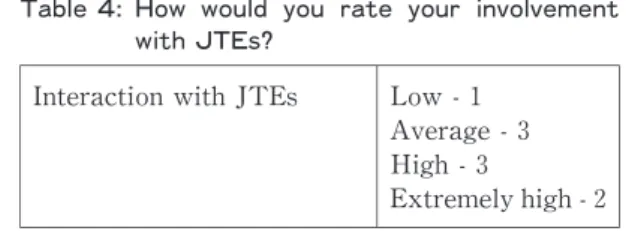
Table 4: How would you rate your involvement with JTEs?
Interaction with JTEs Low -1 Average -3 High -3
Extremely high -2
Table 5: Are you satisfied with your working con-ditions?
Work satisfaction of ALTs Extremely low -1 Low -1
Average -3 High -2
as a means of showcasing Japan to young, educated Westerners who would return home with a positive impression of Japan. Based on these findings,motivation and job satisfaction can be seen as part of the MoFA-intended positive impression ALTs will take home after their time in the JET Programme is over.
Course Planning and ALTs
Only one of nine ALTs in this study has experience or training in teaching English as a second or foreign language. As a group, when asked their level of involvement in curriculum development, seven of the nine participants wrote that their participation in curriculum development was limited or extremely low. However, as table 6 indicates, ALTs in this study responded that they have a much higher level of contribution to lesson planning,with only two ALTs contribut-ing less than average involvement in day-to-day preparation of classes.
With regards to curriculum development,this appears to follow the requirement stipulated in the JET Programme Eligibility section that states ALTs have to follow and respect existing Japanese concepts of teaching English (JET, 2010). However, it appears that JTEs are allowing ALTs to participate in the creation of lesson plans. ALTs in this study reported having good relationships with their JTEs,and this contributed to the ALTs overall satisfaction with their working condi-tions and roles in the classroom. As one ALT wrote, I am lucky to
Table 6: To what extent are you involved in les-son planning?
ALT lesson planning involvement Extremely low -1 Low -1 Average -2 High -3 Extremely high -2
work at one junior high school with very supportive JTEs who have a high level of English and an interest in internationalizing the students. As table 4 shows,only one ALT reported having below average interac-tion with his/her JTE, which indicates a high level of communicainterac-tion and teamwork. And yet,a majority of the ALTs in this study felt their students lacked motivation to learn, and provided no clear indication whether they could perceive improvement in their students English language skills. It would appear that participation in lesson planning may be contributing to ALTs sense of job satisfaction,but may not be positively affecting students motivation to learn English language skills.
Not all ALTs admitted to being motivated to work within the Japanese education system. One ALT explained, I don t find my job fulfilling, but I think that s more to do with the Japanese English education system. Three of the ALTs in this study shared this senti-ment of having difficulties with how English communication activities are carried out. As one ALT explained, I know that the way English is being taught in the schools is not working and am powerless to change it.
Two of the ALTs in this study voiced frustration at their role within their classes. As one acknowledged,
From this April I ve been relegated to human tape recorder status. During class at my three junior high schools, I just stand around until I m asked to read the textbook. I don t understand why am[sic]at my junior high schools,and I think it is a waste of time and money to pay me to be there if the JTEs don t want to use me in their classes. Thus, I am dissatisfied with my working conditions.
Similarly, another ALT voiced frustration at the realization that the biggest challenge for me with my job was accepting that as an
ALT, my job was not to teach English. Clearly, not all ALTs are satisfied with their roles as English language teachers, particularly when they deem that role to be unproductive in terms of facilitating learners development of L2 communication skills. This raises one question:to what extent should ALTs be considered language teachers on par with JTEs?
6. Discussion
The findings in this study demonstrate that Japanese students may be lacking in motivation and a sense of purpose with regards to English language learning. One ALT believed that students did not see the value of learning English as they supposed they would not need this skill in their futures. Another ALT blamed the method of English instruc-tion commonly used at his/her school as a demotivating reason,admit-ting, I wouldn t be motivated to read and repeat the textbook either. English is a language, but it s not taught as one. If the students can t see its practical application, then why bother learning it? Indeed, as John Dewey, influential in the formation of Task-Based Instruction, pointed out, interest-oriented education leads to meaningful learning, promotes long-term storage of knowledge,and provides motivation for further learning (Schiefele, 1991, p.300). Wong and Nunan (2011) explain that a positive attitude towards learning is the key differ-entiating factor between more effective and less effective learners (p. 155).
This study also revealed a need to view motivation as a significant factor in inspiring successful language learners and educators to achieve their linguistic and professional goals (Roessingh, 2005;Tella, 2007; Wong & Nunan, 2011). Overall, it appeared that ALTs were
satisfied with their jobs and experiences within their school environ-ments,believing they were contributing to the growth of their students English language abilities. One ALT suggested that ALTs and JTEs should interact with each other in English to demonstrate to students the usefulness of learning English. Another noted how enthusiastic students were when interacting with the ALT outside of class where they could freely speak Japanese, but not in class where they were made to use English. ALTs might feel less stress at their work if they understood that their role may not be so much as teachers but as facilitators of cultural exchanges.
7. Scope and Limitations
Data analyzed in this study was gathered from an attitude survey completed by nine ALTs currently working in Hokkaido Prefecture, Japan. Since data was collected by means of an email questionnaire sent to the ALTs who participated in this study,it is important to state that findings from the current study might not reflect the range of opinions held by ALTs across Japan. Due to logistical and financial constraints, only data provided by these nine ALTs was analyzed. However, it is also assumed that the data examined is somewhat representative of the views held by ALTs in Hokkaido since the participants work in a variety of areas across Hokkaido. Among these nine ALTs,five were males and four were females,all from three countries: USA, Canada and Australia. Furthermore, these ALTs experience in the JET Programme varied from one to four years in the program. Another limitation in this study is the use of an attitude survey as the single data collecting tool. Again, due to logistical and financial constraints,the subsequent analysis concentrates only on this
body of data. Further research using a broader range of analytical tools is therefore needed to fully explore the two research questions stated earlier.
8. Conclusion and Recommendations
The JET Programme is a large organization consisting of three government agencies hiring thousands of ALTs each year. As such,it is not easy to reach conclusions regarding the day-to-day reality faced by JET ALTs based on a small sampling of members based exclusively in Hokkaido Prefecture.
This research failed to reveal ALT dissatisfaction with their work conditions,as only 22% of participants surveyed claimed to have low to extremelylow job satisfaction. The study did discover ALTs perceive their students as having low motivation levels to develop English language skills. Stated reasons for this were:
students poor attitude towards learning English language skills; an overemphasis on translation;
a feeling in students of the worthlessness and degree of difficulty in learning English;
frustration with their inability to speak or read after so many years of studying;
difficulties of ALTs to teach communication activities conducted in elementary, junior high, and high schools;and
an overemphasis on memorized exchanges that do not encourage students to ask their own questions or give their own responses, resulting in a minimal amount of authentic opportunities for commu-nication.
these concerns regarding students low motivation and lack of interest in learning English language skills.
As explained earlier, the JET Programme seeks to accomplish several objectives related to internationalizing Japan through cultural exchanges with young Westerners. As researchers such as Galloway (2009)and Goodman (2007)point out,JET teachers may be hired more as potential advocates of Japan abroad than as English teachers. Similarly,ALTs could be used more as cultural facilitators and less as language instructors with the unrealistic goal of developing their Japanese students into native-like English language speakers. As Honna (2014) discusses, it is this inclination of the English language system in Japan that has led to low achievement levels in Japanese students as well as an undue amount of stress. As reported in this study,only one of the nine ALTs had prior teaching experience before coming to Japan. And yet,five of the nine participants indicated that they are highly involved in lesson planning. As such, lower expecta-tions should be placed on ALTs regarding the improvement of Japanese students linguistic skills since few have either training or experience working in the Japanese education system.
As the program seeks to gradually internationalize Japan through interaction with ALTs (McConnell, 1996), it also has as its goal to expose ALTs to Japan with the purpose of enhancing the ALTs appre-ciation of Japan (JET, 2010). With this in mind, it is all the more important for the program to create a positive, motivating, and dynamic work environment for ALTs in order to reach these aspira-tions while simultaneously improving Japanese students English lan-guage abilities. In order to improve English lanlan-guage education, the program could establish a training program for ALTs that better prepares them, for example, to work in tandem with JTEs and to
become familiar with the methods used to teach English language classes in Japan.
In addition,the program could revise criteria for selecting ALTs so as to choose individuals with stronger backgrounds in the education field,given that one of the central objectives of the JET Programme is to improve English education in the country. The JET Programme could also establish an evaluation process to find out whether teachers are accomplishing their purposes (Nowakowski,1983,p.26). Establi-shing educational norms that focus on the specification of objectives and measurement of outcomes (Alkin & Christie, 2004, p.18), better preparing JTEs to both interact and work with ALTs in more construc-tive ways,and selecting ALTs with educational backgrounds related to teaching are some of the central goals this program could focus on to improve the quality of English language classes that all Japanese students deserve.
References
Alkin, M. & Christie, C. (2004). An evaluation theory tree. Retrieved from http://www.sagepub.com/upm-data/5074 Alkin Chapter 2.pdf
Application related FAQs.(2016).Retrieved from http://www.jetprogramme. org/e/aspiring/faq.html♯ 4.17
Brown, J. & Sheppard, B. (1997). Teacher librarians in learning organiza-tions. Paper Presented at the Annual Conference of the International Association of School Librarianship, Canada. August 25-30.
Budmar, P. (July 3, 2012). The curious case of the eroding eikaiwa salary. The Japan Times. Retrieved from http://www.japantimes.co.jp/ community/2012/07/03/issues/the-curious-case-of-the-eroding-eikaiwa-salary/♯.U0NUnFwRurp
Carpenter,W.(2009).Japan and English: communication and culture, history and power. Retrieved from http://www.asia-u.ac.jp/cele/cele assets/
➡
る
字
取
り
入
れ
て
CELE%20Journal%202009%20Vol%2017/002%20Japan%20and%20English. pdf
Cooke, S. (2008). Introducing writing to Japanese high-school students. Retrieved from http://www.materialswriters.org/betweenthekeys/16 2/ cooke.php
Galloway,N.(2009).A critical analysis of the JET programme.The Journal of Kanda University of International Studies,21(169-207).Retrieved from http://www.kandagaigo.ac.jp/kuis/about/bulletin/en/021/pdf/009.pdf Goodman, R. (2007). The concept of Kokusaika and Japanese educational
reform. Globalisation, Societies and Education, 5(1), 71-87.
Honna,N.(2014).Challenging issues in English language teaching in Japan. Retrieved from www.oecd.org/edu/ceri/41478726.pdf
Jeon, M., & Lee, J. (2006). Hiring native-speaking English teachers in East Asian countries: A review of a vast and complex recruiting program. English Today 88, 22(4), 53-58.
JET Programme:The Japan Exchange and Teaching Programme. (2010). Retrieved from JET Programme Web site: http://www.jetprogramme. org/
Katayama,A.(2007).Japanese EFL students preferences toward correction of classroom oral errors. Asian EFL Journal, 9 (4), 289-305. Retrieved from http://web.ebscohost.com.ezproxy.lib.ucalgary.ca/ehost/results? sid=6b7811e8-7bc5-40c5-b3a3 6d15673b91bd%40sessionmgr12&vid=2& hid=20&bquery=JN+ Asian+E
Larsen-Freeman, D. (1999). On the appropriateness of language teaching methods in language and development. Retrieved from http://www. Languages.ait.ac.th/hanoi proceedings/Larsen-freeman.htm
Law,W.W.(2014).Hidden motives:an analysis of online ESL teacher hiring practices in Japan and Hong Kong. Retrieved from https://dr.library. brocku.ca/bitstream/handle/10464/5358/W innie%20Law%20M RP% 20final%20copy%20-%20Hidden%20Motive.doc?sequence=1.
McConnell, D. (1996). Education for global intergration in Japan: A case study of the Jet Program. Human Organization, 55(4), 446-457.
McKinley, J. (2010). English language writing centres in Japanese univer-sities: What do students really need? Studies in Self- Access Learning
取
字
て
る
り
入
れ
➡
Journal, 1(1), 17-31.
Mertens, D. M. & Wilson, A. T. (2012). Program evaluation theory and practice. A comprehensive guide. New York, NY:The Guildford Press. Miller, K. K. (2014, October 7). What s wrong with English education in
Japan? Pull up a chair. Japan Today. Retrieved from https://www. japantoday.com/category/lifestyle/view/whats-wrong-with-english-education-in-japan-pull-up-a-chair
Nowakowski, J. (1983). On educational evaluation: A conversation with Ralph Tyler. Retrieved February 27, 2014 from http://www.ascd.org/ ASCD/pdf/journals/ed lead/el 198305 nowakowski.pdf
Nunan, D. (1988). centered curriculum development. The Learner-Centered Curriculum, Cambridge;Cambridge University Press.
Ohtani, C. (2010). Problems in the assistant language teacher system and English activity at Japanese public elementary schools. Educational Perspectives, 43(1 and 2), 38-45. Retrieved from http://scholarspace. manoa.hawaii.edu/bitstream/handle/10125/30968/EDPVol43 1-2 38 45. pdf?sequence=1
Pennycook, A. (2007). Global Englishes and transcultural flows.New York: Routledge.
Readers lament the ever-shrinking eikaiwa salary.(July 10,2012).The Japan Times. Retrieved from http://www.japantimes.co.jp/community/2012/ 07/10/community/readers-lament-the-ever-shrinking-eikaiwa-salary/♯. U0NS0lwRurp
Roessingh, H. (2005). The intentional teacher: The mediator of meaning making. The Journal of Educational Thought, 39 (2), 111-134.
Roth,J.(2001).Importing diversity:Inside Japan s JET program.American Ethnologist, 28(1), 225-225. Retrieved from http://onlinelibrary.wiley. com/doi/10.1525/ae.2001.28.1.225/abstract
Samimy, K. K. & Kobayashi, C. (2004). Toward the development of inter-cultural communicative competence:theoretical and pedagogical implica-tions for Japanese English teachers. JALT Journal, 26(2), 245-261. Sandelowski, M. (2000). Combining qualitative and quantitative sampling,
data collection, and analysis techniques in mixed-method studies. Retrieved from https://axis.cdrewu.edu/axis
doc/functions/research-design-biostatistics/sampling collection analysis.pdf
Schiefele,U.(1991).Interest,Learning,and Motivation.Educational Psychol-ogist, 26(3-2):229-323.
Sumikawa, S. (1999). The Meiji Restoration: Roots of Modern Japan. Retrieved from www.lehigh.edu/ rfw1/courses/1999/spring/ir163/ Papers/pdf/shs3.pdf
TCPS 2 Tutorial Course on Research Ethics (CORE).(2013).Retrieved from http://www.pre.ethics.gc.ca/eng/education/tutorial-didacticiel/
Tella, A. (2007). Work motivation, job satisfaction, and organisational commitment of library personnel in academic and research libraries in Oyo State,Nigeria.Library Philosophy and Practice (e-journal), 118. 1-16. Tesch, R. (1990). Qualitative Research: Analysis types & software tools.
Abingdon, Oxon:Routledge Falmer.
Test and Score Data for the TOEFL iBT Tests. (2015). Retrieved from https://www.ets.org/s/toefl/pdf/94227 unlweb.pdf
Vygotsky, L. S. (1978). Mind in society: The development of higher psycho-logical processes. (M.Cole,V.John-Steiner,S.Scribner,& E.Souberman, Eds.). Cambridge, Massachusetts: Harvard University Press. Retrieved from http://www.gobookee.net/vygotsky-mind-in-society/
Wakabayashi, S. (2015, August 15). What is lacking in English language education in Japan?The Japan News.Retrieved from http://www.yomiur-i.co.jp/adv/chuo/dy/opinion/20150817.html
Watanabe, H. (2015). JET Streams. Retrieved from jetprogramme.org/ wp-content/themes/biz-vektor/pdf/jst/jst2014-15.pdf
Wong,L.& Nunan,D.(2011).The learning styles and strategies ofeffective language learners. System, 39 , 144-163.
Yoshida, R. (2013). Required English from third grade eyed. The Japan Times. Retrieved from http://www.japantimes.co.jp/news/2013/10/23/ national/required-english-from-third-grade-eyed/♯.U0OLRFwRuro