Boussinesq convection and motions of boundary spheres in a rotating spherical shell
By
Keiji KIMURA
January 2013
R ESEARCH I NSTITUTE FOR M ATHEMATICAL S CIENCES
KYOTO UNIVERSITY, Kyoto, Japan
Boussinesq convection
and motions of boundary spheres in a rotating spherical shell
Keiji Kimura
Research Institute for Mathematical Sciences, Kyoto University, Kyoto, Japan
January 2013
Abstract
Boussinesq thermal convection in rotating spheres or spherical shells has been investigated for over half a century, not only as one of the fundamen- tal models for global thermal convection, which is considered to occur in astronomical bodies, but also as a purely fluid mechanical problem.
There are a lot of researches for this convection problem, but most of the studies performed so far assume that the inner and outer spheres co-rotate, that is, both spheres rotate with the same angular velocity. However, the spheres need not be co-rotating in the actual astronomical bodies. It is a more natural setup that both spheres rotate freely due to the viscous torques operating on the surface of these spheres from the fluid. Therefore, in this thesis, we consider effects of the rotation of the inner and outer spheres on a fundamental behaviour of convective solutions of this Boussinesq thermal convection model.
First, we numerically evaluate torques on the inner and outer spheres induced by thermal convection in a co-rotating system in order to assess to what extent the convective motion changes the rotation rates of the spheres (Chap.2). We use stable traveling wave solutions which bifurcate at the criti- cal points and propagate in the azimuthal direction (Kimuraet al., 2011). We find that the direction of the torque on the inner sphere is prograde when the rotation rate is small, while it becomes retrograde when the rotation rate is large. We also find that the torque on the inner sphere can be large enough to change the angular velocity of the inner sphere significantly even in a period of rotation. At the same time, using numerical weakly nonlinear analyses, we also examine generation mechanisms of mean zonal flows excited by thermal convection, since shear stress of the mean zonal flows on the spheres induces the axial component of the torques. We find that the nonlinear term in the energy equation is most effective to generate the global distribution of mean zonal flows, however, the azimuthal component of the nonlinear term in the Navier-Stokes equation becomes most important for generation of the torque on the inner sphere when the rotation rate is large.
Second, we develop a model of Boussinesq thermal convection in a rotat- ing spherical shell allowing the inner sphere rotation (Chap.3). We obtain a bifurcation diagram of traveling wave solutions which bifurcate at the critical point and propagate in the azimuthal direction, by the Newton method and numerical eigenvalue calculations. These traveling wave solutions are stable in the region Rc ≤ R . 1.2−2Rc depending on the rotation rate, where R and Rc are the Rayleigh number and the critical value, respectively. The inner sphere rotates in the prograde direction when the rotation rate is small while it rotates in the retrograde direction when the rotation rate is large.
i
of convective motions of these solutions, such as the radial component of velocity, are also quantitatively similar to those in the co-rotating system, but amplitude of mean zonal flows and propagating velocity of this traveling wave solutions are effectively changed by the inner sphere rotation. This tendency can be explained that the nonlinear effect by convective motions is small because these traveling wave solutions are stable only near the critical curve.
Third, we construct a model of the Boussinesq thermal convection allow- ing the rotation of both the inner and outer spheres (Chap.4). We perform numerical simulations in the range 4Rc . R . 5Rc at moderately rotating case. In this parameter region finite-amplitude convective solution transits from an equatorially symmetric pattern to an equatorially asymmetric one as the Rayleigh number is increased. We find that the route of this tran- sition in the system allowing rotation of both spheres is different from that in the co-rotating system: QPS → QPA → CA in the co-rotating system while QPS → CS → CA in the system allowing rotation of both spheres, as the Rayleigh number is increased, where QPS is an equatorially symmetric quasi-periodic solution, QPA an equatorially asymmetric quasi-periodic solu- tion, CS an equatorially symmetric chaotic solution, and CA an equatorially asymmetric chaotic solution. The transition route in the system where only the inner sphere rotation is permitted is exactly same as that in the sys- tem allowing rotation of both the spheres. Therefore, we conclude that the inner sphere rotation causes the different transition route from that in the co-rotating system.
ii
Contents
1 Introduction 1
1.1 Research history of Boussinesq thermal convection in rotating
spheres and spherical shells . . . 3
1.2 Summary of Kimuraet al. (2011) . . . 5
1.3 Motivation and summary of this thesis . . . 7
2 Torques on the inner and outer spheres induced by the Boussinesq thermal convection in a rotating spherical shell 11 2.1 Introduction . . . 11
2.2 Model and numerical method . . . 12
2.3 Torques operating on the inner sphere and its rotation . . . . 15
2.4 Generation mechanism of mean zonal flows and torques . . . . 19
2.4.1 Results of weakly nonlinear analyses . . . 19
2.4.2 The validity of the weakly nonlinear analyses at super- critical regime . . . 26
2.5 Conclusion and discussion . . . 30
3 Stability and a bifurcation diagram of Boussinesq thermal convection in a moderately rotating spherical shell allowing rotation of the inner sphere 33 3.1 Introduction . . . 33
3.2 Model and numerical method . . . 34
3.3 Results . . . 37
3.3.1 Bifurcation diagram and inner sphere rotation . . . 38
3.3.2 Structure of convective motion . . . 40
3.3.3 Structure of mean zonal flow . . . 44
3.4 Conclusion and discussion . . . 49
4 Emergence of equatorially asymmetric convection pattern 55 4.1 Introduction . . . 55
4.2 Model and numerical method . . . 57 iii
4.3 Results . . . 60 4.3.1 Transition from equatorially symmetric pattern to equa-
torially asymmetric pattern . . . 60 4.3.2 Convection patterns around the transition region . . . 64 4.4 Conclusion and discussion . . . 77
5 Conclusion and discussion 81
A Numerical method 85
A.1 Numerical method for obtaining the traveling wave solutions . 85 A.2 The expansion functions in the radial direction . . . 87
Acknowledgements 89
References 91
iv
List of Figures
1.1 A bifurcation diagram of the stable finite-amplitude solutions which have four-fold symmetry in the azimuthal direction. . . 6 2.1 A schematic picture of the configuration of the Boussinesq
thermal convection problem in co-rotating spheres. . . 12 2.2 The axial component of torques operating on the inner sphere
induced by the stable TW4s. . . 16 2.3 Distributions of mean zonal flow of the stable TW4s. . . 18 2.4 The patterns of the critical modes at τ = 52, 500 and 800. . . 22 2.5 The results of the weakly nonlinear analyses atτ = 500. . . . 23 2.6 The results of the weakly nonlinear analyses atτ = 52. . . 24 2.7 The results of the weakly nonlinear analyses atτ = 800. . . . 25 2.8 Comparison of the results of the weakly nonlinear analyses at
τ = 52, 500 and 800. . . 28 2.9 The axial component of torque operating on the inner sphere
generated by each group of nonlinear terms. . . 29 2.10 Comparison of the zonal flow profiles of TW4 with those ob-
tained by weakly nonlinear analyses. . . 29 3.1 A schematic picture of the configuration of the Boussinesq
thermal convection problem allowing the rotation of the inner sphere. . . 34 3.2 The stable region of the finite-amplitude TW4 solutions with
the inner sphere rotation rate in the system allowing the inner sphere rotation. . . 39 3.3 The axial component of the angular velocity of the inner sphere
induced by the stable TW4 solutions. . . 40 3.4 A bifurcation diagram of the stable finite-amplitude TW4 so-
lutions in the system allowing the inner sphere rotation. . . . 41 v
3.5 The convection patterns of stable TW4s in the system allow- ing the inner sphere rotation when the Rayleigh numbers are slightly below the marginal Rayleigh numbers of TW4 solu- tions. . . 43 3.6 The azimuthal component of the velocity of the stable TW4
solutions in the system allowing the inner sphere rotation on the equatorial plane when the Rayleigh numbers are slightly below the marginal Rayleigh numbers of the TW4 solutions. . 43 3.7 The radial profiles of the azimuthal component of velocity of
stable TW4 solutions in the system allowing the inner sphere rotation and those in the co-rotating system on the section. . 45 3.8 Meridional distributions of mean zonal flow of the stable TW4
solutions in the system allowing the inner sphere rotation and in the co-rotating system. . . 45 3.9 The radial profiles of the mean zonal flow in the sections la-
beled with the dashed lines (A) and (B) shown in Fig. 3.8. . 47 3.10 The difference of the mean zonal flows in the system allowing
the inner sphere rotation from those in the co-rotating system
∆hUφi/Uin. . . 48 3.11 The radial profile of ∆hUφi/Uin in the equatorial plane. . . . 49 3.12 Comparison between the difference of the flow in the system
allowing the inner sphere rotation from those in the co-rotating system and the flow in the rotating spherical shell with slightly differential inner sphere rotation when τ = 500. . . 53 4.1 A schematic picture of the configuration of the Boussinesq
thermal convection problem allowing the rotation of both the spheres. . . 57 4.2 The property of the convective solution at each Rayleigh num-
ber R. . . . 61 4.3 Time series of kinetic energy density at R = 3.1×10⁴ in the
co-rotating system. . . 62 4.4 Time series of the mean kinetic energy densities, those of an-
gular velocities of both spheres, the energy spectra and typical convection patterns at R = 2.6×10⁴ in the system allowing the rotation of both spheres. . . 65 4.5 Time series of the mean kinetic energy densities, those of
torques on both spheres, the energy spectra and typical con- vection patterns at R= 2.6×10⁴ in the co-rotating system. . 66
vi
LIST OF FIGURES 4.6 Time series of the mean kinetic energy densities, those of an-
gular velocities of both spheres, the energy spectra and typical convection patterns at R = 3.0×10⁴ in the system allowing the rotation of both spheres. . . 69 4.7 Time series of the mean kinetic energy densities, those of
torques on both spheres, the energy spectra and typical con- vection patterns at R= 3.0×10⁴ in the co-rotating system. . 71 4.8 Time series of the mean kinetic energy densities, those of an-
gular velocities of both spheres, the energy spectra and typical convection patterns at R = 3.4×10⁴ in the system allowing the rotation of both spheres. . . 73 4.9 Time series of the mean kinetic energy densities, those of
torques on both spheres, the energy spectra and typical con- vection patterns at R= 3.4×10⁴ in the co-rotating system. . 74 4.10 Distributions of the mean zonal flows of the unstable traveling
wave solutions TW4 and TW5 with that of chaotic solution with equatorial symmetry. . . 79
vii
List of Tables
1.1 Comparison of non-dimensional control parameters of Boussi- nesq thermal convection in rotating spherical shells with those of the estimated astronomical bodies. . . 4 2.1 The values of the Rayleigh number of the panels in Fig. 2.3. . 17 2.2 The maximum amplitudes of the torque on the inner sphere
and the maximum rate-of-change of the angular velocity of the inner sphere induced by the stable TW4s. . . 18 2.3 The ratio of contribution of each group of nonlinear terms to
the axial component of the torque on the inner sphere. . . 26 3.1 The critical Rayleigh numbers, the marginal Rayleigh numbers
of TW4 solutions in the co-rotating system and the marginal Rayleigh numbers of TW4 solutions in the system allowing the inner sphere rotation. . . 42 3.2 The control and resulting parameters of the typical stable
TW4 solutions in the system allowing the inner sphere ro- tation. . . 44 3.3 The comparison of the propagating velocity of the stable TW4
solutions in the azimuthal direction in the system allowing the inner sphere rotation and that in the co-rotating system. . . . 46
ix
Chapter 1 Introduction
There are a lot of astronomical bodies in the universe and they possibly show a great wide variety of their features. However, global thermal convection is thought to occur commonly in many of these astronomical bodies, due to the internal heat sources and/or the external cooling. For example, the Sun has a convective envelope around the radiative core, the band structure observed in the giant planets is considered to be generated by the internal thermal convection, and fluid motions in the liquid metallic cores of the terrestrial planets would be the origin of their intrinsic magnetic fields.
The Boussinesq thermal convection in rotating spheres and spherical shells, proposed by Chandrasekhar [1], is one of the fundamental frameworks to investigate behaviour of this kind of global thermal convection. This con- vection model has been vigorously investigated for over half a century.
The critical Rayleigh numbers, critical frequencies and critical modes
1 have been investigated theoretically and numerically, and now their be- haviours come to be known in wide parameter ranges. Finite-amplitude con- vection patterns also have been actively investigated through numerical sim- ulations. Thanks to the recent remarkable progress of computational ability, some recent large scale numerical simulations with high-resolutions obtained finite-amplitude convective solutions similar to the observed flow fields, such as the zonal-band structures2 of the solar planets. Although these solutions could propose possible dynamics realized in the atmospheres of the planets,
1The Rayleigh number means the degree of thermal instability in a thermal convection system. As the Rayleigh number is increased, thermal convection occurs at a certain Rayleigh number. This Rayleigh number is called the critical Rayleigh number, and the emerging convection patterns are referred to the critical modes.
2Zonal-band structure means a structure consists of alternating prograde (eastward) and retrograde (westward) jets, where prograde means the direction same as the rotation direction of reference, while retrograde does the opposite direction against the rotation direction of reference.
1
they may not reproduce the atmospheric flow fields adequately, because con- trol parameters of these large scale numerical simulations are still far from the expected values of the parameters in actual astronomical bodies. It is severe to perform numerical simulations with realistic parameters for actual astronomical bodies even when computational ability is highly developed in the near future.
On the other hand, using numerical time integrations, some researchers have been investigating fundamental behaviour of convection patterns, i.e., what kinds of convection patterns appear or disappear as the Rayleigh num- ber is increased from the critical value. Transition of convective solutions from critical modes to chaotic solutions has been gradually revealed. Never- theless, global behaviour of the convective solutions in this system is not yet well understood. Especially, stability and a bifurcation structure of convec- tive solutions of this model have not been investigated, which are one of the fundamental information to understand global behaviour of convective solu- tions. We consider this is because most of the researchers have used the time integration method to study the finite-amplitude convection patterns. This method has two difficulties: (i) the unstable solutions cannot be obtained, (ii) it requires quite long integration time to find the marginal stability point.
As a result, it is difficult to investigate many cases in wide parameter ranges.
Therefore, in order to investigate the bifurcation structure of this con- vection model, we used the Newton method instead of the time integration method, and obtained stability and the bifurcation diagram of traveling wave solutions propagating in the azimuthal direction which bifurcate at the criti- cal points (Kimuraet al. [2]). The bifurcation structure can be investigated systematically and efficiently with the Newton method, thanks to the fol- lowing advantages: (i) not only stable but also unstable solutions can be obtained, (ii) the number of the steps for convergence of the solutions is small (less than 10 steps in our calculations).
Based on the results of Kimuraet al. (2011) [2], in this thesis, we consider effects of the rotation of the inner and outer spheres on fundamental be- haviour of convective solutions of this Boussinesq thermal convection model.
There are many researches to investigate this thermal convection in rotating spherical shells, but most of the studies performed so far assume that the inner and outer spheres co-rotate, that is, both spheres rotate with the same angular velocity. However, the spheres need not be co-rotating in the actual astronomical bodies. It is a more natural setup that both the spheres rotate freely due to the torques operating on the surface of these spheres from the fluid.
Therefore, in this thesis, we construct a model of Boussinesq thermal convection in a rotating spherical shell allowing rotation of the inner and
2
1.1 Research history of Boussinesq thermal convection in rotating spheres and spherical shells outer spheres, and investigate fundamental behaviour of convective solutions through comparing with those in the co-rotating system.
In the following of the introduction, we briefly summarize previous works for Boussinesq thermal convection in rotating spheres and spherical shells in Sec. 1.1. The summary of our previous study, Kimura et al. [2], is described in Sec. 1.2. The motivation, viewpoint and results in this thesis are summarized in Sec. 1.3.
1.1 Research history of Boussinesq thermal convection in rotating spheres and spher- ical shells
The critical Rayleigh numbers, critical frequency and critical modes of Boussi- nesq thermal convection in rotating spheres and spherical shells have been investigated theoretically [3, 4, 5, 6, 7, 8, 9] and numerically [10], since the pioneering works by Chandrasekhar [1], Roberts [11] and Busse [12, 13], and their behaviours come to be known in wide parameter ranges.
When the rotation rate is small, retrograde propagating convection pat- tern bending along the shell emerges as a critical mode [12, 14] except for the cases of thick shells and large Prandtl numbers, where the axisymmetric convection pattern appears as a critical mode [15]. When the rotation rate is large, various convection patterns emerge as critical modes: a prograde propagating columnar mode [13], a spiralling columnar mode which has a spiralling structure spreading from inner to outer sphere [16], an equatorially attached mode which concentrates near the equatorial surface [4, 5, 17], and a multi-cellular mode which have some convection cells in the radial direc- tion [18, 19]. However, behaviour of critical parameters and critical modes in extremely rapid rotation region are still challenging due to necessary massive computational resources for large scale eigenvalue calculations [20, 21].
Finite-amplitude convection has also been studied actively by using nu- merical time integrations thanks to the recent massive powerful computers [22, 23, 24, 25]. Especially, finite-amplitude convection solutions similar to the observed zonal-band structures of the solar planets were obtained by recent large scale numerical simulations. Heimpel and Aurnou [23] showed that the multiple zonal-band structure on the outer sphere can be obtained in rapidly rotating thin shell cases; this flow structure corresponds to that in the previous studies by Busse [26, 27, 28]. Their surface flows are simi- lar to the zonal-band structure observed on the surface of Jupiter [29] and
3
Radius ratio Prandtl Taylor Rayleigh Heimpel et al. [23] 0.85−0.9 0.1 ∼1011 .109 Aurnou et al. [24] 0.75 0.1−1 .1010 .1011
Ice giants 0.80−1 0.1 1030 1029
Gas giants 0.80−1 0.1 1036 1033
Table 1.1: Comparison of non-dimensional control parameters of Boussinesq thermal convection in rotating spherical shells with those of the expected as- tronomical bodies. The second and third rows show the control parameters used in Heimpel and Aurnou [23] and Aurnou et al. [24]. The fourth and fifth rows show the expected values of these parameters for corresponding astronomical bodies, which are described in Aurnou et al. [24], while the actual physical values are highly uncertain. Here the radius ratio is defined as rin/rout, the Prandtl number ν/κ, the Taylor number (2Ωd2/ν)2 and the Rayleigh number αgout∆T d3/(νκ). rin and rout are radii of the inner and outer spheres, respectively. ν is the kinematic viscosity, κ the thermal dif- fusivity, α the thermal expansion coefficient, gout the gravity given on the outer sphere, Ω the rotation rate of the reference frame, ∆T the temperature difference of the inner sphere from the outer sphere.
Saturn [30]. Aurnou et al. [24] showed that retrograde zonal flows 3 can be generated near the outer sphere around the equatorial region when the shell is thin and the Rayleigh number is sufficiently large. This zonal flow struc- ture could explain that in the ice giants, Uranus [31, 32] and Neptune [33].
Note that, however, the parameters used in these numerical simulations are far from the expected values of the actual planets (Table 1.1), although the expected value of the parameters for the planets are uncertain. Therefore, these convective solutions may not represent the flow fields of the planetary atmospheres adequately.
On the other hand, transition of convective solutions from critical solu- tions to chaotic solutions has been gradually revealed in the parameter space [18, 19, 34, 35].
Ardes et al. [18] showed that, as the Rayleigh number is increased, tran- sition occurs from traveling wave solutions which propagate in the azimuthal direction to vacillating solutions, quasi-periodic solutions and chaotic solu- tions succeedingly. Grote and Busse [35] showed that, as the Rayleigh number is increased larger than that in Ardes et al. [18], localized turbulent convec-
3Zonal flow means the azimuthally averaged azimuthal component of velocity.
1.2 Summary of Kimuraet al. (2011) tion pattern appears and is sustained. As the Rayleigh number is further increased, the relaxation oscillation occurs, i.e., kinetic energy slowly decays periodically after its rapid increasing.
Simitev and Busse [19] showed that, when the Prandtl number is relatively small, the spiralling columnar convection emerging in rapidly rotating cases becomes unstable at a certain large Rayleigh number, and found that the amplitude vacillations, shape vacillations and the chaotic behaviours occur when the Rayleigh number is further increased. On the other hand, when the Prandtl number becomes small, the equatorially attached convection pattern emerging as a critical mode becomes modulate but keeps still concentrated near the outer sphere at a larger Rayleigh number. As the Rayleigh number is further increased, the equatorially attached eddies spread into interior region and are detached in some cases.
Chossat [36] mathematically investigated a bifurcation point of conduc- tive rest state (basic state) using asymptotic analyses by expanding the gov- erning equations both with the Rayleigh number and the rotation rate. He showed that, when the rotation rate is small but positive and the ratio of the inner and outer radii is 0.3, the degeneracy of solution space can be re- solved and an axisymmetric solution bifurcates. This bifurcation is slightly transcritical. He also showed the conditions that the stable region of this bifurcated solution exists4 . However, due to limit of the perturbation anal- yses, the behaviour and stable region of the bifurcated solutions could not be known.
In the next section we summarize our previous work, Kimura et al. [2], and show a bifurcation diagram of finite-amplitude convective solutions.
1.2 Summary of Kimura et al. (2011)
In our previous work [2], we obtained the bifurcation diagram of the finite- amplitude traveling wave solutions with the Newton method in supercritical and moderately rotating cases, because the convective solutions can be re- solved with relatively low spatial degree of freedom (Fig. 1.1). We chose the boundary condition as impermeable, no-slip and isothermal on both spheres.
The ratio of the inner and outer radii of the shell and the Prandtl number are fixed to 0.4 and 1 respectively, while the Taylor number is varied from 522 to 5002 and the Rayleigh number is from about 1500 to 10000. In this parameter region, the critical azimuthal wavenumber is always 4. The finite-amplitude
4Chossat [36] also showed that, when a spherical shell do not rotate, the bifurcation occurs supercritically but the solution space keeps degenerated. He showed the conditions that the stable region of this supercritically bifurcated solution exists.
0 2000 4000 6000 8000 10000
0 100 200 300 400 500
T he Ra yl ei gh num be r R
The rotation rate τ
Prograde RetrogradeStationary
Figure 1.1: A bifurcation diagram of the stable TW4s, which is shown in Fig.
4 of Kimuraet al. [2]. The propagating direction of the solution is shown by a blue circle (retrograde) and a red triangle (prograde). The lower solid curve shows the marginal stability of the stationary (conductive) solution, where the blue curve (τ <340) shows that the propagating direction is retrograde, and the red curve (τ ≥ 340) prograde. All circles and triangles mean that the nonlinear solutions are stable. TW4s become unstable above the upper black solid line. The propagating velocityvp vanishes on the dashed line. The blue crosses mean that the nonlinear solutions propagating in the retrograde direction are unstable.
traveling wave solutions, which have four-fold symmetry in the azimuthal direction, bifurcate supercritically from the critical point. Hereafter we call these traveling wave solutions TW4s.
Figure 1.1 shows the obtained bifurcation diagram, which indicates stable TW4s and their propagating directions in τ −R parameter space, where τ is the square root of the Taylor number and R is the Rayleigh number.
TW4s bifurcate supercritically from the conductive rest state at the critical points and are stable in the region Rc ≤ R . 1.2−2Rc depending on the rotation rate τ, where Rc is the critical Rayleigh number. TW4s propagate in the retrograde direction for τ ≤ 330. On the other hand, in τ ≥ 340, where the propagating direction of the critical modes becomes prograde,
1.3 Motivation and summary of this thesis the propagating direction of TW4s changes to retrograde as the Rayleigh number is increased. These all the transitions of the propagating velocity are continuous, and the associated transitions of the convection structures are also continuous.
We also found that the transition of the propagating direction of TW4s near the critical curve can be interpreted with the vortex stretching/shrinking mechanism proposed by Takehiro [37]. On the other hand, we confirmed quantitatively that the transition of the propagating direction of TW4s in finite-amplitude region can be interpreted with the advection of the vortex tube by the mean zonal flow, which is generated by the nonlinear effect of thermal convection. The comprehensive studies in τ −R parameter space by the Newton method made it possible to find this advection mechanism through detailed comparison between different solutions in different param- eters.
1.3 Motivation and summary of this thesis
Based on the results of Kimuraet al. (2011) [2] shown in the previous section, in this thesis, we consider effects of the rotation of the inner and outer spheres on fundamental behaviour of convective solutions of this Boussinesq thermal convection model. It is a more natural setup that both the spheres rotate freely due to the torques operating on the surface of these spheres from the fluid, because the spheres need not be co-rotating in the actual astronomical bodies. For instance, it is discussed whether the Earth’s inner core differen- tially rotates with respect to the mantle in this decade [38, 39, 40]. However, most of the studies on thermal convection in rotating spherical shells per- formed so far assume that the inner and outer spheres co-rotate. This is possibly due to simplification of the configuration of the problem, although some MHD dynamo models permit differential rotation of the inner sphere [41, 42, 43, 44, 45]. Araki et al. [46] investigated the bifurcation structure of the axisymmetric steady thermal convection patterns in a spherical shell with the inner sphere differential rotation using the Newton method, but they fixed the rotation rate of the inner sphere.
Therefore, in this thesis, we construct a model of Boussinesq thermal convection in a rotating spherical shell allowing rotation of the inner and outer spheres, and investigate fundamental behaviour of convective solutions comparing with those in the co-rotating system.
In Chap. 2, we first evaluate torques on the inner and outer spheres induced by thermal convection in a co-rotating system in order to assess to what extent the convective motion changes the rotation rates of the spheres.
We use stable traveling wave solutions TW4s which bifurcate at critical points and propagate in the azimuthal direction (shown in Sec.1.2). We find that the direction of the torque on the inner sphere is prograde when the rotation rate is small, while it becomes retrograde when the rotation rate is large.
We also find that the torque on the inner sphere can be large enough to change the angular velocity of the inner sphere significantly even in a period of rotation. At the same time, we also examine generation mechanisms of mean zonal flows excited by thermal convection using the numerical weakly nonlinear analyses proposed by Takehiro and Hayashi [10, 47], since shear stress of the mean zonal flows on the spheres induces the axial component of the torques. Weakly nonlinear analyses show that the nonlinear term in the energy equation is most effective to generate the global distribution of mean zonal flows, however, the azimuthal component of the nonlinear term in the Navier-Stokes equation becomes most important for generation of the torque on the inner sphere when the rotation rate is large.
In Chap. 3, we develop a model of Boussinesq thermal convection al- lowing the inner sphere rotation and investigate effects of the inner sphere rotation on a bifurcation structure and convection patterns. We use the New- ton method and numerical eigenvalue calculations, and obtain a bifurcation diagram of the finite-amplitude traveling wave solutions TW4s, which bifur- cate at critical points, have four-fold symmetry in the azimuthal direction and propagate in the azimuthal direction. These traveling wave solutions are stable in the region Rc ≤ R . 1.2−2Rc depending on the rotation rate, whereRand Rc are the Rayleigh number and the critical value, respectively.
The inner sphere rotates in the prograde direction due to the viscous torque of the fluid when the rotation rate is small while it rotates in the retrograde direction when the rotation rate is large. The stable region of these traveling wave solution TW4s is quantitatively similar to that in the co-rotating sys- tem, shown in Fig. 1.1. The structures of convective motions of these TW4 solutions, such as the radial component of velocity, are also quantitatively similar to those in the co-rotating system, but amplitude of mean zonal flows and propagating velocity of TW4s are effectively changed by the inner sphere rotation. This tendency can be explained that the nonlinear effect is small because the traveling wave solutions are stable only near the critical curve.
In Chap. 4, we extend the model of Boussinesq thermal convection to allow rotation of both the inner and outer spheres. We perform numerical time integrations in the range 4Rc .R .5Rc at a moderately rotating case, and investigate the difference of the convective solutions, especially focusing on the emergence of the equatorially asymmetric convection patterns. In this parameter region, the pattern of the finite-amplitude convective solu- tion transits from equatorial symmetric one to equatorial asymmetric one
1.3 Motivation and summary of this thesis as the Rayleigh number is increased. We find that the route of this tran- sition in the system allowing rotation of both spheres is different from that in the co-rotating system: QPS → QPA → CA in the co-rotating system while QPS → CS → CA in the system allowing rotation of both spheres, as the Rayleigh number is increased, where QPS is an equatorially symmetric quasi-periodic solution, QPAan equatorially asymmetric quasi-periodic solu- tion, CS an equatorially symmetric chaotic solution, and CA an equatorially asymmetric chaotic solution. The transition route in the system where only the inner sphere is permitted is exactly same as that in the system allowing rotation of both the spheres. Therefore, we conclude that the inner sphere rotation causes the different transition route from that in the co-rotating system.
Chapter 2
Torques on the inner and outer spheres induced by the
Boussinesq thermal convection in a rotating spherical shell 1
2.1 Introduction
There are many researches to investigate the Boussinesq thermal convection in rotating spherical shells, however, most of the ones performed so far assume that the inner and outer spheres co-rotate, that is, both spheres rotate with the same angular velocity. It is a more natural setup that both the spheres rotate freely due to the torques operating on the surface of these spheres from the fluid, because the spheres need not be co-rotating in the actual astronomical bodies. For instance, it is discussed whether the Earth’s inner core differentially rotates with respect to the mantle in this decade [38, 39, 40]. Few researches on thermal convection have focused on the torques on the rotating spheres, although some MHD dynamo models permit differential rotation of the inner sphere [41, 42, 43, 44, 45].
Accordingly, in this chapter, we evaluate torques on the inner and outer spheres induced by thermal convection in a rotating spherical shell in order to assess to what extent the convective motion changes the rotation rates of the spheres. At the same time, we also examine generation mechanisms of mean zonal flows excited by thermal convection using the numerical weakly nonlinear analyses proposed by Takehiro and Hayashi [10, 47], since shear stress of the mean zonal flows on the spheres induces the axial component of
1Published in Kimuraet al. (2012) [48].
O
Figure 2.1: A schematic picture of the configuration of the Boussinesq ther- mal convection problem in co-rotating spheres.
the torques.
For the analyses, we use the finite-amplitude nonlinear traveling wave so- lutions investigated by Kimuraet al[2], whose bifurcation structure is shown in Fig. 1.1. These solutions are obtained systematically by the Newton method at moderate rotation rates, and their stability and bifurcation dia- gram is established successfully. Since the solutions have four-fold symmetry in the azimuthal direction, we call them TW4s (Traveling Wave 4) hereafter.
In the following, the model, governing equations and numerical method are described in Sec.2.2. In Sec.2.3, we evaluate the torques on the inner and outer spheres induced by the stable TW4s and estimate the rate-of-change of the angular velocity of the inner sphere. In Sec.2.4, we perform the weakly nonlinear analyses numerically to investigate the generation mechanism of the mean zonal flows and the axial torque operating on the inner sphere.
Conclusions and discussions are given in Sec.2.5.
2.2 Model and numerical method
Let us consider a Boussinesq fluid in a spherical shell whose radii of the inner and outer spheres are rin and rout, respectively (Figure 2.1). Both spheres
2.2 Model and numerical method are rotating with angular velocity Ω about the fixed unit vector k. Since the fluid contains the uniform heat sourceH per unit mass, the temperature distribution of the basic conductive state Ts(r) is
Ts(r) =−1
2βr2+T0, (2.1)
whereβ ≡H/(3κCp),κis the thermal diffusivity,Cp the specific heat capac- ity, r the distance from the center of the spherical shell and T0 a constant.
We consider the self-gravitational field of homogeneous media whose density is ρ, that is,
g=−γr, (2.2)
where γ ≡ 4πGρ/3 is a positive constant (G is the universal gravitational constant) and r the position vector with respect to the center of the shell.
We choose the thickness of the spherical shell d≡rout−rin as the length scale, the viscous dissipation time d2/ν as the time scale, and ν2/(γαd4) as the temperature scale, where ν is the kinematic viscosity and α the thermal expansion coefficient. The pressure is normalized with (ρν2)/d2. The non- dimensional governing equations for the deviations from the conductive state (rest state) in the rotating frame of reference moving with the spherical shell are as follows:
∇ ·u= 0, (2.3)
∂u
∂t + (u· ∇)u+τk×u=−∇π+ Θr+∇2u, (2.4) P
(∂Θ
∂t + (u· ∇)Θ )
=Ru·r+∇2Θ, (2.5) whereuis the non-dimensional velocity,π the non-dimensional pressure and Θ the non-dimensional temperature deviation from the basic stateTs(r). The non-dimensional parameters in the above equations are
τ =√
T = 2Ωd2
ν , P = ν
κ, R= αβγd6
νκ , (2.6)
where T is the Taylor number, P the Prandtl number and R the Rayleigh number.
Since the velocity field is solenoidal, it can be represented with the toroidal and poloidal potentials w and v as follows:
u≡ ∇ × {∇ ×(rv)}+∇ ×(rw). (2.7)
The governing equations for the potentials and Θ become [(
∆− ∂
∂t )
Lˆ2+τ(k×r)· ∇ ]
w−τQvˆ
=r·[∇ ×((u· ∇)u)], (2.8) [(
∆− ∂
∂t )
Lˆ2+τ(k×r)· ∇ ]
∆v+τQwˆ −Lˆ2Θ
=−r·[∇ × ∇ ×((u· ∇)u)], (2.9) P
(∂Θ
∂t + (u· ∇)Θ )
=RLˆ2v + ∆Θ, (2.10)
where ˆL2 and ˆQ are the operators defined as Lˆ2 =− 1
sin2θ [
sinθ ∂
∂θ (
sinθ ∂
∂θ )
+ ∂2
∂φ2 ]
, (2.11)
Qˆ ≡k· ∇ − 1 2
[Lˆ2(k· ∇) + (k· ∇) ˆL2 ]
. (2.12)
Here, θ is the colatitude (zenith) and φ is the longitude (azimuth) with respect to the rotation axis. These governing equations are equivalent to those of Simitev and Busse [19] with Re = 0.
We apply impermeable, no-slip, and fixed temperature conditions at the inner and outer spheres.
u= Θ = 0, at r = η
1−η, 1
1−η, (2.13)
whereη =rin/rout, is the ratio of the inner and outer radii of the shell. The boundary conditions for potentials are as follows:
v = ∂v
∂r =w= 0, at r= η
1−η, 1
1−η. (2.14)
We will fix the values ofηandP as the standard valueη= 0.4 andP = 1, while the rotation rate is varied in the range of 52≤τ ≤500.
The Galerkin-spectral method is applied to the toroidal and poloidal po- tentials and the temperature disturbance. They are expanded with the spher- ical harmonics in the horizontal (azimuthal and zenith) directions, and with the combinations of Chebyshev polynomials which satisfy the boundary con- ditions in the radial direction. The truncation wavenumber of spherical har- monicsLand the maximum degree of the Chebyshev polynomialsN are both fixed to 16, while (N, L) = (16,21) or (21,16) are used in some calculations
2.3 Torques operating on the inner sphere and its rotation to spot-check the results and the accuracy is confirmed to be less than 0.5%.
The nonlinear terms are evaluated in the physical space and are converted back into the spectral space (the spectral transform method). The numbers of the grid points on the physical space are fixed to (Nr, Nθ, Nφ) = (65,32,64) in order to eliminate the aliasing errors, whereNr,Nθ andNφare the number of grid points in the radial, zenith (colatitudinal) and azimuthal (longitudinal) directions, respectively. Note that the traveling wave solution propagates in the azimuthal direction, so denoting the propagating velocity is vp, this solution becomes the stationary solution in the frame of reference moving with the azimuthal velocity vp with respect to the rotating frame. Thus we transform the time t and longitude φ intoT ≡t and Φ≡ φ−vpt, and seek the stationary solution in this moving frame of reference. However, one ar- bitrariness corresponding to the arbitrariness of the origin of the longitude Φ remains, so we lock the phase of the complex spectral coefficient whose absolute value is maximum among all the spectral coefficients in the crit- ical state (actually we lock the phase as 0 [rad]). The detailed numerical method is described in the Appendices. Torques operating on the spheres are calculated for each stable TW4s, and the rate-of-change of angular ve- locity of the inner sphere is evaluated. After that, weakly nonlinear analyses are performed by using TW4s on the critical points to assess the generation mechanism of mean zonal flows and the axial torque on the inner sphere.
2.3 Torques operating on the inner sphere and its rotation
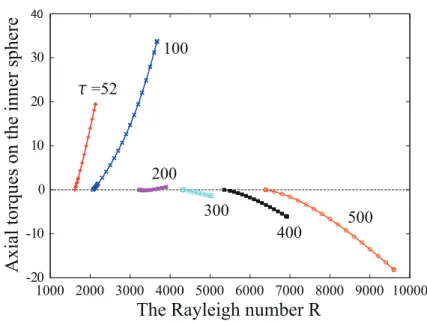
When 52 ≤ τ ≤ 500, TW4s bifurcate supercritically at the critical points and become unstable when the Rayleigh number is increased up to about 1.2 to 2 times the critical Rayleigh numbers. The bifurcation diagram of TW4s is shown in Fig. 1.1. Note that TW4s induce only the axial compo- nent of the torque on the inner sphere because of their equatorial symmetry.
Moreover, since TW4s are stationary waves in the frame of reference moving with their propagation speed, the summation of the torques on the inner and outer spheres is equivalent to zero due to the conservation of the angular momentum. Therefore, we evaluate only the axial component of torque Nin
operating on the inner sphere, which is calculated as, Nin = 2πrin3
∫ π
0
[∂huφi
∂r ]
r=rin
sin2θdθ, (2.15)
-20 -10 0 10 20 30 40
1000 2000 3000 4000 5000 6000 7000 8000 9000 10000
The Rayleigh number R
Axial torques on the inner sphere
τ=52
100
200
300
400
500
Figure 2.2: The axial component of torques operating on the inner sphere Nin induced by the stable TW4s for eachτ.
where hfi(r, θ) means the azimuthal (longitudinal or zonal) average defined as
hfi(r, θ)≡ 1 2π
∫ 2π 0
f(r, θ, φ)dφ. (2.16) Figure 2.2 shows Nin for each τ induced by the stable TW4s. This figure shows that when τ = 52 and 100, Nin is positive, that is, the inner sphere tends to be rotated in the prograde direction, and is strengthened as the Rayleigh number is increased. However, when τ is increased to 200, Nin almost vanishes and the torque becomes quite weak. Asτis further increased, Nin becomes negative, that is, the inner sphere tends to be rotated in the retrograde direction, and is strengthened again as the Rayleigh number is increased.
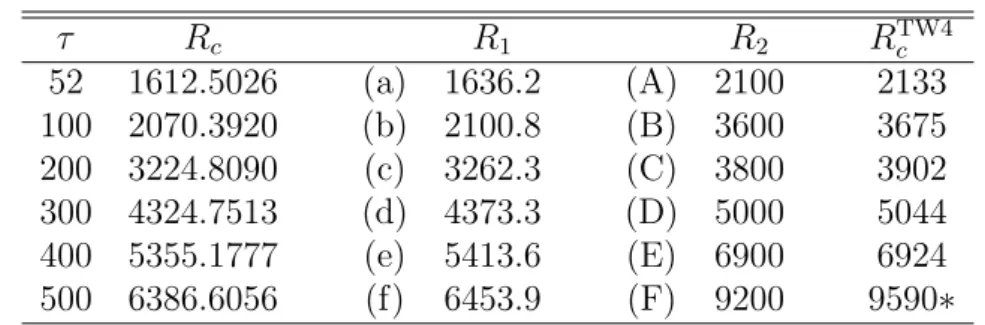
Figure 2.3 shows the distributions of mean zonal flow huφi of the stable TW4s at slightly supercritical statesR =R1and below the marginal stability states R = R2. The detailed parameters are shown in Table 2.1. Note that since these mean zonal flows are generated by the nonlinear effects of TW4s, the torques at the critical states (R = Rc) are equivalently zero as seen in Fig. 2.2. From Fig. 2.3, we can find that the distributions of mean zonal flow at R = R1 and R = R2 are quite similar except for the difference of their amplitudes. When the rotation rate is small as τ = 52 and 100 (Figs.
2.3 Torques operating on the inner sphere and its rotation
τ Rc R1 R2 RTW4c
52 1612.5026 (a) 1636.2 (A) 2100 2133
100 2070.3920 (b) 2100.8 (B) 3600 3675 200 3224.8090 (c) 3262.3 (C) 3800 3902 300 4324.7513 (d) 4373.3 (D) 5000 5044 400 5355.1777 (e) 5413.6 (E) 6900 6924 500 6386.6056 (f) 6453.9 (F) 9200 9590∗
Table 2.1: The values of the Rayleigh number of the panels in Fig. 2.3. Rc
is the critical Rayleigh numbers, RTW4c is the marginal stability Rayleigh numbers of TW4s, R1 is the typical Rayleigh numbers near the critical states (R1 ' 1.01Rc), and R2 is typical Rayleigh numbers slightly below the marginal states. Values labeled with asterisk appearing in casesτ = 500 are calculated with the truncation wavenumbers (N, L) = (21,28). Rc and RTW4c have already been shown in Table 3 of Kimura et al. (2011) [2], but these values on this table are more accurate (nearly 0.1% or less).
2.3 (a), (b), (A) and (B)), the prograde zonal flows appear near the whole surface of the inner sphere. As the rotation rate is increased as τ = 200 and 300, however, the strong retrograde zonal flows appear near the outer sphere around the equator and move inward (Figs. 2.3 (c), (d), (C) and (D)).
Finally, the strong retrograde zonal flows attach to the equatorial region of the inner sphere (Figs. 2.3 (e), (f), (E) and (F)). Such transition of the distribution of mean zonal flows contributes to the transition of the direction of the torques on the inner sphere with increasing the rotation rate.
In order to examine the significance of the axial torques on the inner sphere evaluated above, let us calculate the rate-of-change of angular velocity of the inner sphere in a period of rotation. For this purpose, we have to define the inertial moment of the inner sphere. Here, we assume that density of the inner sphere is homogeneous and equivalent to that of fluid in the shell ρ.
Then, the non-dimensional inertial moment of the inner sphere Iin can be calculated as
Iin= 8 15π
( η 1−η
)5
'0.22, (2.17)
where we chooseρd5 as the scale of the inertial moment. Then, if the order of magnitude of the torque on the inner sphere is assumed to remain the same when the inner sphere rotates against the outer sphere, the rate-of-change of angular velocity of the inner sphere in a period of rotation is estimated as
(A) (B) (C) (D) (E) (F)
(a) (b) (c) (d) (e) (f)
Figure 2.3: Distributions of mean zonal flow of the stable TW4s at each value ofτ and the Rayleigh number shown in Table 2.1. The upper six panels show the zonal flows at slightly supercritical states R = R1 ' 1.01Rc, while the lower six panels show zonal flows slightly below the marginally stable states R=R2.
follows:
∆Ωin
Ω ∼
(Nin Iin · 2π
τ /2
) /τ
2 '0.11 (Nin
10 ) ( τ
100 )−2
. (2.18) Table 2.2 shows the maximum amplitude of the torque on the inner sphere
|Nin|maxand the maximum rate-of-change of the angular velocity of the inner sphere|∆Ωin/Ω|max induced by the stable TW4s for each τ. When the rota- tion rate is small asτ = 52 and 100, the rate-of-change of the angular velocity of the inner sphere becomes several tens percent. This means the torque on
τ |Nin|max |∆Ωin/Ω|max
52 +19.5 82%
100 +33.8 39%
200 +0.64 0.18%
300 −1.42 0.18%
400 −6.08 0.43%
500 −18.2 0.83%
Table 2.2: The maximum amplitudes of the torque on the inner sphere
|Nin|maxand the maximum rate-of-change of the angular velocity of the inner sphere|∆Ωin/Ω|max induced by the stable TW4s for eachτ.
2.4 Generation mechanism of mean zonal flows and torques the inner sphere is sufficiently large enough to rotate the inner sphere. When the rotation rate is large asτ = 400 and 500, the rate-of-change is less than 1 percent. However, it can be effective for changing the angular velocity of the inner sphere after 1 non-dimensional time (the viscous diffusion time scale), because both spheres rotate τ /(4π) times in 1 non-dimensional time.
2.4 Generation mechanism of mean zonal flows and torques
2.4.1 Results of weakly nonlinear analyses
In this section, we investigate the generation mechanism of mean zonal flows and the axial torques on the inner sphere through the numerical weakly non- linear analyses using the critical modes [10, 47]. It is interesting to examine the mean zonal flow generation mechanisms because their characteristics are related to several aspects of phenomena in the system. As mentioned in the previous section, they are directly related to the axial component of the torque and determine its direction. Kimuraet al. [2] shows that advection of mean zonal flows presumably affects to the propagation direction of TW4s when the rotation rate is large (τ ≥340).
Following the procedure of Takehiro and Hayashi [10, 47], we expand the dependent variables u,T,π and the Rayleigh numberR with the amplitude around the critical state, that is,
u(r, t) =u(1)+2u(2)+· · · , (2.19) T(r, t) =Ts(r) +Θ(1)+2Θ(2)+· · · , (2.20) π(r, t) =πs(r) +π(1)+2π(2)+· · · , (2.21) R =Rc+R(1)+2R(2)+· · · . (2.22) The axial component of torque on the inner sphereNincan also be expanded as
Nin=Nin(1)+2Nin(2)+· · · , (2.23) where
Nin(j)= 2πrin3
∫ π
0
∂ D
u(j)φ E
∂r
r=rin
sin2θdθ, (2.24)
herej is an any positive integer. First, we obtain the critical Rayleigh num- bers and critical modes from the O() equations of the governing equations (2.3) –(2.5), that is, the linearized equations around the conductive state.
Assuming the solution of the form as eσt and solving the eigenvalue prob- lem with respect to the growth rate σ repeatedly, we can obtain the critical Rayleigh numbers and critical modes. Note that in the parameter ranges of our calculations (η = 0.4, P = 1 and 52 ≤ τ ≤ 860), the critical az- imuthal wavenumber mc is 4, not zero. Therefore
D u(1)φ
E
vanishes due to sinusoidal oscillation of u(1)φ in the azimuthal direction. Then Nin(1) must be zero. Secondly, we find the second order zonal mean steady solutions induced by the critical modes by solving O(2) equations. Taking the zonal average h·i and dropping the time derivative term in the O(2) equations, we obtain the following equations:
1 r2
∂
∂r (r2
u(2)r )
+ 1
rsinθ
∂
∂θ (
sinθ D
u(2)θ E)
= 0, (2.25) [(u(1)· ∇)u(1)]
r
−τ D
u(2)φ E
sinθ=−∂ π(2)
∂r + Θ(2)
r+[
∇2 u(2)]
r, (2.26) [(u(1)· ∇)u(1)]
θ
−τ D
u(2)φ E
cosθ=−1 r
∂ π(2)
∂θ +[
∇2 u(2)]
θ, (2.27) D[(u(1)· ∇)u(1)]
φ
E +τ
(D u(2)θ
E
cosθ+ u(2)r
sinθ )
=[
∇2 u(2)]
φ, (2.28) P
(u(1)· ∇)Θ(1)
=Rc r u(2)r
+∇2 Θ(2)
, (2.29) where (r, θ, φ) mean the radius, zenith (colatitude) and azimuth (longitude) of the spherical coordinates. The above equations can be rewritten as
0= ˆL x(2)
+
n(x(1))
, (2.30)
wherex(1) and x(2) are the vectors of dependent variables of O() andO(2) respectively, ˆL a linear operator and n a nonlinear term. Since we have already obtained the vector x(1) as the critical mode, we can obtain the vector
x(2)
by solving the above linear equations.
Four nonlinear terms in eqs. (2.26) –(2.29) can be classified into three groups as follows:
2.4 Generation mechanism of mean zonal flows and torques (i) the azimuthal (longitudinal) component of the nonlinear term in the
Navier-Stokes equation (the nonlinear term in eq. (2.28)),
(ii) the zenith (colatitudinal) and radial components of the nonlinear term of the Navier-Stokes equation (the nonlinear terms in eqs. (2.26) and (2.27)),
(iii) the nonlinear term in the energy equation (2.29).
Each nonlinear term generates the mean zonal flow through the following mechanism:
(i): the meridional transfer of the angular momentum by the Reynolds stress directly generates the mean zonal flow,
(ii): the Coriolis force against the mean meridional flow induced by the Reynolds stress generates the mean zonal flow,
(iii): the Coriolis force against the mean meridional flow induced by the zenith (colatitudinal) gradient of the secondary mean temperature dis- turbance, which is caused by the convective heat transfer, generates the mean zonal flow.
Considering the conservation of the angular momentum, the mechanism (i) can be understood more easily. Multiplying rsinθ to eq. (2.28) and taking the zonal average, we can obtain
∇ ·[τ
2r2sin2θ u(2)
+rsinθ D
u(1)φ u(1) E]
=rsinθD[
∇2u(2)]
φ
E
. (2.31) The first term in the left hand side means the advection flux of the absolute angular momentum due to the rotation of the shell and the second term means the Reynolds stress induced by the critical mode. The mechanism (iii) can be understood more easily through the curl of eqs. (2.26) and (2.27), that is,
−τ(k· ∇) D
u(2)φ E
=−∂ Θ(2)
∂θ +[
∇ × ∇2 u(2)]
φ. (2.32) Here, we have neglected the nonlinear terms in eqs. (2.26) and (2.27). When the rotation rate is small, mean meridional flow is induced by the latitudinal gradient of the secondary mean temperature disturbance through the viscous term in the above equation (2.32), and the mean zonal flow is generated due to the Coriolis force against this mean meridional flow. On the other hand, when the rotation rate is large enough, the latitudinal gradient of
τ=52 500 800
52 500 800
500 800
52
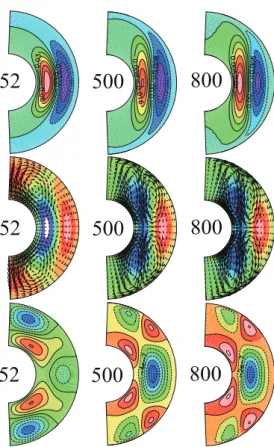
Figure 2.4: The patterns of the critical modes at τ = 52, 500 and 800. The upper three panels show the distributions of the radial velocity u(1)r in the equatorial plane (θ = 90◦), the middle three panels show the distributions of the temperature disturbance Θ(1) in the equatorial plane, while the lower three panels show the axial component of vorticity ωz =k·(∇ ×u(1)) in a meridional plane.
the secondary mean temperature disturbance generates the mean zonal flow directly through thermal wind balance, that is, the balance between the term in the left hand side and the first term in the right hand side in the equation (2.32). By comparing the amplitudes of the mean zonal flow
D u(2)φ
E
generated by these three groups of the nonlinear terms, we can quantitatively diagnose the principal nonlinear effect on the generation of the mean zonal flow.
Figure 2.4 shows the distributions of the radial velocity in the equato- rial plane and the axial component of vorticity in a meridional plane of the critical modes atτ = 52, 500 and 800. We find that evenτ = 500 the convec- tion cell already becomes the spiralling columnar shape, which is a typical characteristic of the convection cell in rapidly rotating cases [13].
2.4 Generation mechanism of mean zonal flows and torques
(a) (b) (c) (d)
-90 -60 -30 0 30 60 90
0 all
(i) (ii) (iii)
The mean zonal flow
Latitude
(e)
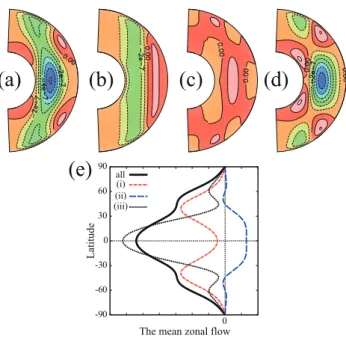
Figure 2.5: The results of the weakly nonlinear analyses atτ = 500. (a) The mean zonal flow
D u(2)φ
E
generated by the all nonlinear terms (i), (ii) and (iii).
(b) The mean zonal flow generated only by the nonlinear term (i). (c) The mean zonal flow generated only by the nonlinear terms (ii). (d) The mean zonal flow generated only by the nonlinear term (iii). (e) The latitudinal (zenith) distributions of the mean zonal flows at r= (rin+rout)/2 generated by the all nonlinear terms and by each group of the nonlinear terms.
Figure 2.5 shows the mean zonal flow D
u(2)φ E
generated by all the nonlinear terms (Fig. 2.5(a)), and that only by one group of the nonlinear terms (Figs.
2.5 (b), (c) and (d)). Comparison of the latitudinal (zenith) distributions of the mean zonal flow at r = (rin +rout)/2 is shown in (e). From Fig.
2.5(e), we find that the amplitude of the mean zonal flow generated by the nonlinear term (iii) is several times larger than those generated by (i) and (ii) around the equator. This means that the nonlinear effect (iii) is the principal generation mechanism of the strong retrograde zonal flow in the middle of the shell around the equator when τ = 500.
Figures 2.6 and 2.7 compare the meridional distribution of the mean zonal flows generated by all the nonlinear terms and by each group of nonlinear terms at τ = 52 and 800, respectively. From these figures, we can find that the amplitude of the mean zonal flow generated by the nonlinear effect (iii) is larger than those generated by (i) and (ii) at both τ = 52 and 800. This