RIMS-1719
Topics Surrounding the Combinatorial Anabelian Geometry of Hyperbolic Curves I:
Inertia Groups and Profinite Dehn Twists
By
Yuichiro HOSHI and Shinichi MOCHIZUKI
April 2011
R ESEARCH I NSTITUTE FOR M ATHEMATICAL S CIENCES
KYOTO UNIVERSITY, Kyoto, Japan
ANABELIAN GEOMETRY OF HYPERBOLIC CURVES I:
INERTIA GROUPS AND PROFINITE DEHN TWISTS
YUICHIRO HOSHI AND SHINICHI MOCHIZUKI APRIL 2011
Abstract. Let Σ be a nonempty set of prime numbers. In the present paper, we continue our study of the pro-Σ fundamen- tal groups of hyperbolic curves and their associated configuration spaces over algebraically closed fields of characteristic zero. Our first main result asserts, roughly speaking, that if an F-admissible automorphism [i.e., an automorphism that preserves thefiber sub- groupsthat arise as kernels associated to the various natural pro- jections of the configuration space under consideration to config- uration spaces of lower dimension] of a configuration space group arises from anF-admissibleautomorphism of a configuration space group [arising from a configuration space] ofstrictly higher dimen- sion, then it is necessarily FC-admissible, i.e., preserves the cus- pidal inertia subgroups of the various subquotients corresponding to surface groups. After discussing various abstract profinite com- binatorial technical tools involving semi-graphs of anabelioids of PSC-type that are motivated by the well-known classical theory oftopological surfaces, we proceed to develop a theory ofprofinite Dehn twists, i.e., an abstract profinite combinatorial analogue of classical Dehn twists associated to cycles on topological surfaces.
This theory of profinite Dehn twists leads naturally tocomparison results between the abstract combinatorial machinery developed in the present paper and more classical scheme-theoretic construc- tions. In particular, we obtain a purely combinatorial description of theGalois actionassociated to a [scheme-theoretic!] degenerat- ing family of hyperbolic curves over a complete equicharacteristic discrete valuation ring of characteristic zero. Finally, we apply the theory ofprofinite Dehn twiststo prove a“geometric version of the Grothendieck Conjecture”for — i.e., put another way, we compute the centralizer of the geometric monodromy associated to — the tautological curve over the moduli stack of pointed smooth curves.
Contents
Introduction 2
0. Notations and Conventions 10
2000 Mathematics Subject Classification. Primary 14H30; Secondary 14H10.
The first author was supported by Grant-in-Aid for Young Scientists (B) (22740012).
1
1. F-admissibility and FC-admissibility 13 2. Various operations on semi-graphs of anabelioids of
PSC-type 28
3. Synchronization of cyclotomes 45
4. Profinite Dehn multi-twists 67
5. Comparison with scheme theory 83
6. Centralizers of geometric monodromy 111
References 139
Introduction
Let Σ ⊆ Primesbe a nonempty subset of the set of prime numbers Primes. In the present paper, we continue our study [cf. [SemiAn], [CmbGC], [CmbCsp], [MT], [HM]] of the anabelian geometry of semi- graphs of anabelioids of [pro-Σ] PSC-type, i.e., semi-graphs of anabe- lioids that arise from apointed stable curveover an algebraically closed field of characteristic zero. The notion of a semi-graph of anabelioids of PSC-type may be thought of as a sort ofabstract profinite combina- torial analogue of the notion of a hyperbolic topological surface of finite type, i.e., the underlying topological surface of a hyperbolic Riemann surface of finite type. One central object of study in this con- text is the notion of an outer representation of IPSC-type [cf. [HM], Definition 2.4, (i)], which may be thought of as an abstract profinite combinatorial analogue of the scheme-theoretic notion of adegenerating family of hyperbolic curves over a complete discrete valuation ring. In [HM], we studied a purely combinatorial generalization of this notion, namely, the notion of an outer representation of NN-type [cf. [HM], Definition 2.4, (iii)], which may be thought of as an abstract profinite combinatorial analogue of the topological notion of a family of hy- perbolic topological surfaces of finite type over a circle. Here, we recall that such families are a central object of study in the theory of hyperbolic threefolds.
Another central object of study in the combinatorial anabelian ge- ometry of hyperbolic curves [cf. [CmbCsp], [MT], [HM]] is the notion of a configuration space group [cf. [MT], Definition 2.3, (i)], i.e., the pro-Σ fundamental group of the configuration space associated to a hy- perbolic curve over an algebraically closed field of characteristic zero, where Σ is either equal toPrimesor of cardinality one. In [MT], it was shown [cf. [MT], Corollary 6.3] that, if one excludes the case of hyper- bolic curves of type (g, r)∈ {(0,3), (1,1)}, then, up to a permutation of the factors of the configuration space under consideration, any au- tomorphism of a configuration space group is necessarily F-admissible [cf. [CmbCsp], Definition 1.1, (ii)], i.e., preserves the fiber subgroups that arise as kernels associated to the various natural projections of
the configuration space under consideration to configuration spaces of lower dimension.
In §1, we prove our first main result [cf. Corollary 1.9], by means of techniques that extend the techniques of [MT], §4. This result as- serts, roughly speaking, that if an F-admissible automorphism of a configuration space group arises from anF-admissible automorphism of a configuration space group [arising from a configuration space] of strictly higher dimension, then it is necessarily FC-admissible [cf. [CmbCsp], Definition 1.1, (ii)], i.e., preserves the cuspidal inertia subgroups of the various subquotients corresponding to surface groups.
Theorem A (F-admissibility and FC-admissibility). Let Σ be a set of prime numbers which is either of cardinality one or equal to the set of all prime numbers; n a positive integer; (g, r) a pair of nonnegative integers such that 2g−2 +r >0; X a hyperbolic curve of type (g, r)over an algebraically closed field k of characteristic6∈Σ; Xn
the n-th configuration space of X; Πn the maximal pro-Σ quotient of the fundamental group of Xn; “OutFC(−)”, “OutF(−)” ⊆ “Out(−)”
the subgroups of FC- and F-admissible [cf. [CmbCsp], Definition 1.1, (ii)] outomorphisms [cf. the discussion entitled “Topological groups” in
§0] of “(−)”. Then the following hold:
(i) Let α ∈OutF(Πn+1). Then α induces the same outomorphism of Πn relative to the various quotients Πn+1 Πn by fiber sub- groups of length1[cf. [MT], Definition 2.3, (iii)]. In particular, we obtain a natural homomorphism
OutF(Πn+1)−→OutF(Πn). (ii) The image of the homomorphism
OutF(Πn+1)−→OutF(Πn) of (i) is contained in
OutFC(Πn)⊆OutF(Πn).
In§2 and§3, we develop varioustechnical toolsthat will play a crucial role in the subsequent development of the theory of the present paper.
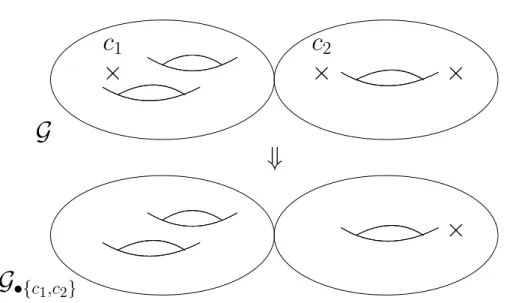
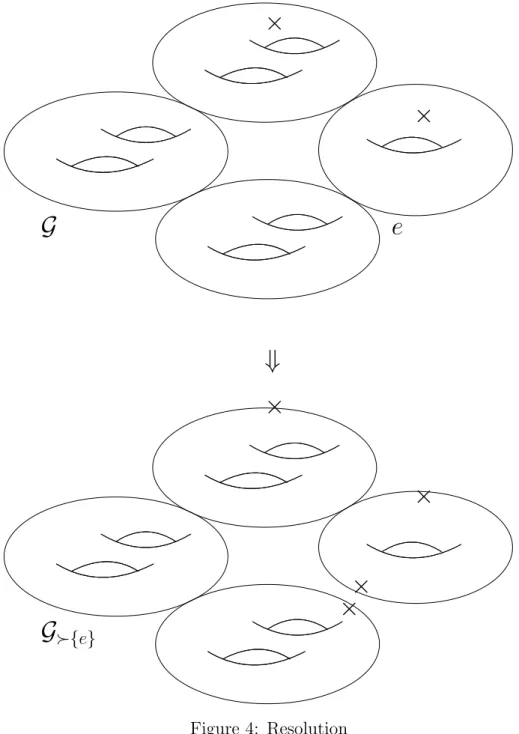
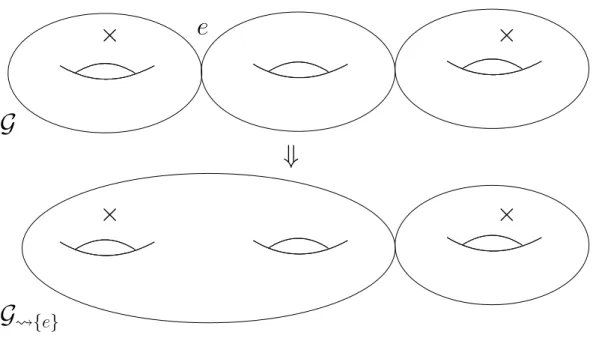
In §2, we study various fundamental operations on semi-graphs of anabelioids of PSC-type. A more detailed description of these opera- tions may be found in the discussion at the beginning of §2, as well as in the various illustrations referred to in this discussion. Roughly speaking, these operations may be thought of asabstract profinite com- binatorial analoguesof various well-known operations that occur in the theory of “surgery” on topological surfaces — i.e.,
• restriction to a subsurfacearising from a decomposition, such as a “pants decomposition”, of the surface or to a [suitably positioned] cycle;
• partially compactifyingthe surface by adding “missing points”;
• cutting a surface along a [suitably positioned] cycle;
• gluing together two surfaces along [suitably positioned] cy- cles.
Most of§2 is devoted to the abstract combinatorial formulation of these operations, as well as to the verification of various basic properties involving these operations.
In §3, we develop the local theory of the second cohomology group with compact supports associated to various sub-semi-graphs and com- ponents of a semi-graph of anabelioids of PSC-type. Roughly speaking, this theory may be thought of as a sort of abstract profinite combina- torial analogue of the local theory of orientations on a topological surface S, i.e., the theory of the locally defined cohomology modules
(U, x) 7→ H2(U, U \ {x};Z) (∼=Z)
— where U ⊆ S is an open subset, x ∈ U. In the abstract profinite combinatorial context of the present paper, the various locally defined second cohomology groups with compact supports give rise to cyclo- tomes, i.e., copies of quotients of the once-Tate-twisted Galois module Z(1). The main result that we obtain inb §3 concerns various canoni- cal synchronizations of cyclotomes [cf. Corollary 3.9], i.e., canoni- cal isomorphisms between these cyclotomes associated to various local portions of the given semi-graph of anabelioids of PSC-type which are compatible with the various fundamental operations studied in§2.
In §4, we apply the technical tools developed in§2, §3 to define and study the notion of aprofinite Dehn [multi-]twist[cf. Definition 4.4;
Theorem 4.8, (iv)]. This notion is, needless to say, a natural abstract profinite combinatorial analogue of the usual notion of a Dehn twist in the theory of topological surfaces. On the other hand, it is defined, in keeping with the spirit of the present paper, in a fashion that is purely combinatorial, i.e., without resorting to the “crutch” of considering, for instance, profinite closures of Dehn twists associated to cycles on topological surfaces. Our main resultsin §4 [cf. Theorem 4.8, (i), (iv);
Proposition 4.10, (ii)] assert, roughly speaking, that profinite Dehn twists satisfy a structure theoryof the sort that one would expect from the analogy with the topological case, and that this structure theory is compatible, in a suitable sense, with the various fundamental operations studied in §2.
Theorem B (Properties of profinite Dehn multi-twists). Let Σ be a nonempty set of prime numbers andG a semi-graph of anabelioids
of pro-Σ PSC-type. Write
Aut|grph|(G)⊆Aut(G)
for the group of automorphisms of G which induce the identity auto- morphism on the underlying semi-graph of G and
Dehn(G)def= {α ∈Aut|grph|(G)|αG|v = idG|v for any v ∈Vert(G)}
— where we write αG|v for the restriction of α to the semi-graph of anabelioidsG|v of pro-Σ PSC-type determined by v ∈Vert(G) [cf. Def- initions 2.1, (iii); 2.14, (ii); Remark 2.5.1, (ii)]; we shall refer to an element of Dehn(G) as aprofinite Dehn multi-twist of G. Then the following hold:
(i) (Normality) Dehn(G) is normal in Aut(G).
(ii) (Structure of the group of profinite Dehn multi-twists) Write
ΛG
def= HombZΣ(Hc2(G,ZbΣ),ZbΣ)
for the cyclotome associated to G [cf. Definitions 3.1, (ii), (iv); 3.8, (i)]. Then there exists a natural isomorphism
DG: Dehn(G)−→∼ M
Node(G)
ΛG
that is functorial, in G, with respect to isomorphisms of semi- graphs of anabelioids of pro-ΣPSC-type. In particular,Dehn(G) is afinitely generated free bZΣ-module of rank Node(G)]. We shall refer to a nontrivial profinite Dehn multi-twist whose image ∈L
Node(G)ΛG lies in a direct summand [i.e., in a single
“ΛG”] as a profinite Dehn twist.
(iii) (Exact sequence relating profinite Dehn multi-twists and glueable outomorphisms) Write
Glu(G)⊆ Y
v∈Vert(G)
Aut|grph|(G|v)
for the [closed] subgroup of “glueable” collections of outomor- phisms of the direct product Q
v∈Vert(G)Aut|grph|(G|v) consisting of elements (αv)v∈Vert(G) such that χv(αv) = χw(αw) for any v, w ∈ Vert(G) — where we write G|v for the semi-graph of anabelioids of pro-Σ PSC-type determined by v ∈ Vert(G) [cf.
Definition 2.1, (iii)] and χv: Aut(G|v) → (ZbΣ)∗ for the pro- Σ cyclotomic character of v ∈ Vert(G) [cf. Definition 3.8, (ii)]. Then the natural homomorphism
Aut|grph|(G) −→ Q
v∈Vert(G)Aut|grph|(G|v)
α 7→ (αG|v)v∈Vert(G)
factors through Glu(G) ⊆ Q
v∈Vert(G)Aut|grph|(G|v), and, more- over, the resulting homomorphismρVertG : Aut|grph|(G)→Glu(G) [cf. (i)] fits into an exact sequence of profinite groups
1−→Dehn(G)−→Aut|grph|(G)ρ
VertG
−→Glu(G)−→1. The approach of §2, §3,§4 ispurely combinatorialin nature. On the other hand, in §5, we return briefly to the world of [log] schemes in or- der tocomparethepurely combinatorialconstructions of§2,§3,§4 to analogous constructions from scheme theory. Themain techinical result [cf. Theorem 5.7] of §5 asserts that the purely combinato- rial synchronizations of cyclotomes constructed in §3, §4 for the profinite Dehn twists associated to the various nodes of the semi-graph of anabelioids of PSC-type under consideration coincidewith certain natural scheme-theoretic synchronizations of cyclotomes. This technical result is obtained, roughly speaking, by applying the various fundamental operations of §2 so as to reduce to the case where the semi-graph of anabelioids of PSC-type under consideration admits a symmetry that permutes the nodes [cf. Fig. 6]; the desired co- incidence of synchronizations is then obtained by observing that both the combinatorial and the scheme-theoretic synchronizations are com- patible with this symmetry. One way to understand this fundamental coincidence of synchronizations is as a sort of abstract combinatorial analogue of thecyclotomic synchronizationgiven in [GalSct], Theorem 4.3; [AbsHyp], Lemma 2.5, (ii) [cf. Remark 5.9.1, (i)]. Another way to understand this fundamental coincidence of synchronizations is as a statement to the effect that
the Galois action associated to a [scheme-theoretic!]
degenerating family of hyperbolic curvesover a complete equicharacteristic discrete valuation ring of characteris- tic zero — i.e., “an outer representation of IPSC-type”
— admits a purely combinatorial description [cf.
Corollary 5.9, (iii)].
That is to say, one central problem in the theory of outer Galois repre- sentations associated to hyperbolic curves over arithmetic fields is pre- cisely the problem of giving such a “purely combinatorial description”
of the outer Galois representation. Indeed, this point of view plays a central role in the theory of theGrothendieck-Teichm¨uller group. Thus, although an explicit solution to this problem is well out of reach at the present time in the case of number fields or mixed-characteristic local fields, the theory of §5 yields a solution to this problem in the case of complete equicharacteristic discrete valuation fields of characteristic zero. One consequence of this solution is the following criterion for an outer representation to be of IPSC-type [cf. Corollary 5.10].
Theorem C(Combinatorial/group-theoretic nature of scheme- theoreticity). Let (g, r) be a pair of nonnegative integers such that 2g −2 +r > 0; Σ a nonempty set of prime numbers; R a complete discrete valuation ring whose residue field k is separably closed of char- acteristic 6∈ Σ; Slog the log scheme obtained by equipping S def= SpecR with the log structure determined by the maximal ideal of R; (Mg,r)S
the moduli stack of r-pointed stable curves of genus g over S whose r marked points are equipped with an ordering; (Mg,r)S ⊆(Mg,r)S the open substack of (Mg,r)S parametrizing smooth curves; (Mlogg,r)S the log stack obtained by equipping (Mg,r)S with the log structure associ- ated to the divisor with normal crossings(Mg,r)S\(Mg,r)S ⊆(Mg,r)S; x ∈ (Mg,r)S(k) a k-valued point of (Mg,r)S; Ob the completion of the local ring of (Mg,r)S at the image of x; Tlog the log scheme obtained by equipping T def= SpecOb with the log structure induced by the log struc- ture of (Mlogg,r)S; tlog the log scheme obtained by equipping the closed point of T with the log structure induced by the log structure of Tlog; Xtlog the stable log curve over tlog corresponding to the natural strict (1-)morphism tlog →(Mlogg,r)S; ITlog the maximal pro-Σ quotient of the log fundamental group π1(Tlog) of Tlog; ISlog the maximal pro-Σ quo- tient of the log fundamental group π1(Slog)of Slog; GXlog the semi-graph of anabelioids of pro-Σ PSC-type determined by the stable log curve Xtlog [cf. [CmbGC], Example 2.5]; ρuniv
Xtlog: ITlog → Aut(GXlog) the nat- ural outer representation associated to Xtlog [cf. Definition 5.5]; I a profinite group; ρ: I → Aut(GXlog) an outer representation of pro-Σ PSC-type [cf. [HM], Definition 2.1, (i)]. Then the following conditions are equivalent:
(i) ρ is of IPSC-type [cf. [HM], Definition 2.4, (i)].
(ii) There exist a morphism of log schemes φlog: Slog → Tlog over S and an isomorphism of outer representations of pro- Σ PSC-type ρ →∼ ρuniv
Xtlog ◦Iφlog [cf. [HM], Definition 2.1, (i)]
— where we write Iφlog: ISlog → ITlog for the homomorphism induced by φlog — i.e., there exist an automorphism β of GXlog and an isomorphism α: I →∼ ISlog such that the diagram
I −−−→ρ Aut(GXlog)
α
yo yo ISlog
ρXlog t
◦Iφlog
−−−−−−→ Aut(GXlog)
— where the right-hand vertical arrow is the automorphism of Aut(GXlog)induced by β — commutes.
(iii) There exist a morphism of log schemesφlog: Slog →Tlog overS and an isomorphism α: I →∼ ISlog such that ρ=ρuniv
Xlogt ◦Iφlog◦α
— where we write Iφlog: ISlog → ITlog for the homomorphism induced by φlog — i.e., the automorphism “β” of (ii) may be taken to be the identity.
Before proceeding, in this context we observe that one fundamen- tal intrinsic difference between outer representations of IPSC-type and more general outer representations of NN-type is that, unlike the case with outer representations of IPSC-type, the period matrices associ- ated to outer representations of NN-type may, in general, fail to be nondegenerate — cf. the discussion of Remark 5.9.2.
Finally, in§6, we apply the theory ofprofinite Dehn twistsdeveloped in §4 to prove a “geometric version of the Grothendieck Con- jecture” for — i.e., put another way, we compute the centralizer of the geometric monodromy associated to — the tautological curve over the moduli stack of pointed smooth curves [cf. Theorems 6.13; 6.14].
Theorem D (Centralizers of geometric monodromy groups arising from moduli stacks of pointed curves). Let (g, r) be a pair of nonnegative integers such that 2g−2 +r > 0; Σ a nonempty set of prime numbers; k an algebraically closed field of characteris- tic zero. Write (Mg,r)k for the moduli stack of r-pointed smooth curves of genus g over k whose r marked points are equipped with an ordering; Cg,r → Mg,r for the tautological curve over Mg,r
[cf. the discussion entitled “Curves” in §0]; ΠMg,r
def= π1((Mg,r)k) for the ´etale fundamental group of the moduli stack (Mg,r)k; Πg,r for the maximal pro-Σ quotient of the kernel Ng,r of the natural surjection π1((Cg,r)k) π1((Mg,r)k) = ΠMg,r; ΠCg,r for the quotient of the ´etale fundamental group π1((Cg,r)k) of (Cg,r)k by the kernel of the natural surjectionNg,r Πg,r;OutC(Πg,r)for the group of outomorphisms [cf.
the discussion entitled “Topological groups” in §0] of Πg,r which induce bijections on the set of cuspidal inertia subgroups of Πg,r. Thus, we have a natural exact sequence of profinite groups
1−→Πg,r−→ΠCg,r −→ΠMg,r −→1, which determines an outer representation
ρg,r: ΠMg,r −→Out(Πg,r). Then the following hold:
(i) LetH ⊆ΠMg,r be an open subgroup of ΠMg,r. Suppose that one of the following two conditions is satisfied:
(a) 2g−2 +r >1, i.e., (g, r)6∈ {(0,3),(1,1)}.
(b) (g, r) = (1,1), 2∈Σ, and H = ΠMg,r.
Then the composite of natural homomorphisms
Aut(Mg,r)k((Cg,r)k)−→AutΠMg,r(ΠCg,r)/Inn(Πg,r)
−→∼ ZOut(Πg,r)(Im(ρg,r))⊆ZOut(Πg,r)(ρg,r(H))
[cf. the discussion entitled “Topological groups” in §0] deter- mines an isomorphism
Aut(Mg,r)k((Cg,r)k)−→∼ ZOutC(Πg,r)(ρg,r(H)).
Here, we recall that the automorphism groupAut(Mg,r)k((Cg,r)k) is isomorphic to
Z/2Z×Z/2Z if (g, r) = (0,4);
Z/2Z if (g, r)∈ {(1,1),(1,2),(2,0)};
{1} if (g, r)6∈ {(0,4),(1,1),(1,2),(2,0)}. (ii) Let H ⊆ OutC(Πg,r) be a closed subgroup of OutC(Πg,r) that
contains an open subgroup of Im(ρg,r) ⊆ Out(Πg,r). Suppose that
2g−2 +r >1, i.e., (g, r)6∈ {(0,3),(1,1)}.
ThenH isalmost slim[cf. the discussion entitled “Topological groups” in §0]. If, moreover,
2g−2 +r >2, i.e., (g, r)6∈ {(0,3),(0,4),(1,1),(1,2),(2,0)}, thenH isslim [cf. the discussion entitled “Topological groups”
in §0].
0. Notations and Conventions
Sets: If S is a set, then we shall denote by 2S the power set of S and by S] the cardinality of S.
Numbers: The notation Primes will be used to denote the set of all prime numbers. The notation N will be used to denote the set or [ad- ditive] monoid of nonnegative rational integers. The notation Zwill be used to denote the set, group, or ring of rational integers. The notation Q will be used to denote the set, group, or field of rational numbers.
The notation Zb will be used to denote the profinite completion of Z.
If p ∈Primes, then the notation Zp (respectively, Qp) will be used to denote the p-adic completion of Z (respectively, Q). If Σ ⊆ Primes, then the notation ZbΣ will be used to denote the pro-Σ completion of Z.
Monoids: We shall write Mgp for the groupification of a monoid M.
Topological groups: Let Gbe a topological group and Pa property of topological groups [e.g., “abelian” or “pro-Σ” for some Σ ⊆Primes].
Then we shall say that Gis almostPif there exists an open subgroup of G that is P.
Let G be a topological group and H ⊆ G a closed subgroup of G.
Then we shall denote by ZG(H) (respectively, NG(H); CG(H)) the centralizer (respectively, normalizer; commensurator) ofH inG, i.e.,
ZG(H)def= {g ∈G|ghg−1 =h for any h∈H}, (respectively, NG(H)def= {g ∈G|g·H·g−1 =H};
CG(H)def= {g ∈G | H ∩ g·H·g−1 is of finite index in H and g·H·g−1});
we shall refer to Z(G) def= ZG(G) as the center of G. It is immediate from the definitions that
ZG(H)⊆NG(H)⊆CG(H) ; H ⊆NG(H).
We shall say that the closed subgroup H is centrally terminal (respec- tively, normally terminal;commensurably terminal) inGifH =ZG(H) (respectively, H = NG(H); H =CG(H)). We shall say that G is slim if ZG(U) ={1} for any open subgroup U of G.
LetGbe a topological group. Then we shall writeGabfor theabelian- ization of G, i.e., the quotient of G by the closure of the commutator subgroup of G.
Let G be a topological group. Then we shall write Aut(G) for the group of [continuous] automorphisms of G, Inn(G) ⊆ Aut(G) for the group of inner automorphisms of G, and Out(G) def= Aut(G)/Inn(G).
We shall refer to an element of Out(G) as an outomorphismof G. Now
suppose thatGiscenter-free[i.e.,Z(G) ={1}]. Then we have an exact sequence of groups
1−→G(→∼ Inn(G)) −→Aut(G)−→Out(G)−→1.
If J is a group and ρ: J →Out(G) is a homomorphism, then we shall denote by
Gouto J
the group obtained by pulling back the above exact sequence of profi- nite groups via ρ. Thus, we have a natural exact sequence of groups
1−→G−→Gouto J −→J −→1.
Suppose further that Gisprofinite andtopologically finitely generated.
Then one verifies easily that the topology of G admits a basis ofchar- acteristic open subgroups, which thus induces a profinite topology on the groups Aut(G) and Out(G) with respect to which the above exact sequence relating Aut(G) and Out(G) determines an exact sequence of profinite groups. In particular, one verifies easily that if, moreover, J is profinite and ρ: J →Out(G) is continuous, then the above exact sequence involving G outo J determines an exact sequence of profinite groups.
Let G, J be profinite groups. Suppose that G is center-free and topologically finitely generated. Let ρ: J → Out(G) be a continuous homomorphism. Write AutJ(G outo J) for the group of [continuous]
automorphisms of G outo J that preserve and induce the identity auto- morphism on the quotientJ. Then one verifies easily that the operation of restricting to Gdetermines an isomorphismof profinite groups
AutJ(Gouto J)/Inn(G)−→∼ ZOut(G)(Im(ρ)).
Let Gand H be topological groups. Then we shall refer to a homo- morphism of topological groups φ: G→H as a split injection(respec- tively, split surjection) if there exists a homomorphism of topological groups ψ: H →G such that ψ◦φ (respectively, φ◦ψ) is the identity automorphism of G (respectively, H).
Log schemes: When a scheme appears in a diagram of log schemes, the scheme is to be understood as the log scheme obtained by equipping the scheme with the trivial log structure. If Xlog is a log scheme, then we shall refer to the largest open subscheme of the underlying scheme of Xlog over which the log structure is trivial as the interior of Xlog. Fiber products of fs log schemes are to be understood as fiber products taken in the category of fs log schemes.
Curves: We shall use the terms “hyperbolic curve”, “cusp”, “stable log curve”, “smooth log curve”, and “tripod” as they are defined in [CmbGC], §0; [Hsh], §0. If (g, r) is a pair of positive integers such that 2g −2 +r > 0, then we shall denote by Mg,r the moduli stack of r-pointed stable curves of genus g over Z whose r marked points are equipped with an ordering, by Mg,r ⊆ Mg,r the open substack of Mg,r parametrizing smooth curves, by Mlogg,r the log stack obtained by equipping Mg,r with the log structure associated to the divisor with normal crossings Mg,r\ Mg,r ⊆ Mg,r, by Cg,r → Mg,r the tautological curve over Mg,r, and by Dg,r ⊆ Cg,r the corresponding tautological divisor of marked pointsof Cg,r → Mg,r. Then the divisor given by the union ofDg,rwith the inverse image inCg,r of the divisorMg,r\Mg,r⊆ Mg,r determines a log structure on Cg,r; denote the resulting log stack by Clogg,r. Thus, we obtain a (1-)morphism of log stacks Clogg,r → Mlogg,r. We shall denote by Cg,r ⊆ Cg,r the interior of Clogg,r. Thus, we obtain a (1-)morphism of stacksCg,r → Mg,r. LetS be a scheme. Then we shall write (Mg,r)S def= Mg,r×SpecZS, (Mg,r)S def= Mg,r×SpecZS, (Mlogg,r)S def= Mlogg,r ×SpecZS, (Cg,r)S
def= Cg,r ×SpecZ S, (Cg,r)S
def= Cg,r ×SpecZ S, and (Clogg,r)S def
= Clogg,r×SpecZS.
Let n be a positive integer and Xlog a stable log curve of type (g, r) over a log scheme Slog. Then we shall refer to the log scheme obtained by pulling back the (1-)morphism Mlogg,r+n→ Mlogg,r given by forgetting the last n points via the classifying (1-)morphism Slog → Mlogg,r ofXlog as the n-th log configuration space of Xlog.
1. F-admissibility and FC-admissibility
In the present §, we consider the FC-admissibility [cf. [CmbCsp], Definition 1.1, (ii)] of F-admissible automorphisms [cf. [CmbCsp], Def- inition 1.1, (ii)] of configuration space groups [cf. [MT], Definition 2.3, (i)]. Roughly speaking, we prove that if an F-admissible automor- phism of a configuration space group arises from an F-admissible auto- morphism of a configuration space group [arising from a configuration space] ofstrictly higher dimension, then it is necessarilyFC-admissible, i.e., preserves the cuspidal inertia subgroups of the various subquotients corresponding to surface groups [cf. Theorem 1.8, Corollary 1.9 below].
Lemma 1.1 (Representations arising from certain families of hyperbolic curves). Let (g, r) be a pair of nonnegative integers such that 2g−2 +r > 0; l a prime number; k an algebraically closed field of characteristic 6=l; B and C hyperbolic curves over k of type (g, r);
n a positive integer. Suppose that (r, n) 6= (0,1). For i = 1,· · · , n, let fi: B →∼ C be an isomorphism over k; si the section of B ×kC pr→1 B determined by the isomorphism fi. Suppose that, for any i 6= j, Im(si)∩Im(sj) =∅. Write
Z def= B×kC \ [
i=1,···,n
Im(si) ⊆ B×kC
for the complement of the images of the si’s, where i ranges over the integers such that 1 ≤i ≤n; pr for the composite Z ,→ B ×kC pr→1 B [thus, pr : Z →B is afamily of hyperbolic curvesof type(g, r+n)];
ΠB (respectively, ΠC; ΠZ) the maximal pro-l quotient of the ´etale fun- damental group π1(B) (respectively, π1(C); π1(Z)) of B (respectively, C; Z); pr : ΠZ ΠB for the surjection induced by pr; ΠZ/B for the kernel of pr; ρZ/B: ΠB → Out(ΠZ/B) for the outer representation of ΠB on ΠZ/B determined by the exact sequence
1−→ΠZ/B−→ΠZ
−→pr ΠB −→1.
Letb be a geometric point ofB andZb the geometric fiber ofpr : Z →B at b. For i = 1,· · · , n, fix an inertia subgroup [among its various conjugates] of the ´etale fundamental group π1(Zb) of Zb associated to the cusp of Zb determined by the sectionsi and denote by
Isi ⊆ΠZ/B
the image inΠZ/B of this inertia subgroup ofπ1(Zb). Then the following hold:
(i) (Fundamental groups of fibers) The quotient ΠZ/B of the
´etale fundamental group π1(Zb) of the geometric fiber Zb coin- cides with the maximal pro-l quotient of π1(Zb).
(ii) (Abelianizations of the fundamental groups of fibers) For i= 1,· · · , n, write Jsi ⊆ΠabZ/B for the image of Isi ⊆ΠZ/B in ΠabZ/B. Then the composite Isi ,→ΠZ/B ΠabZ/B determines an isomorphism Isi
→∼ Jsi; moreover, the inclusions Jsi ,→ ΠabZ/B determine an exact sequence
1−→( Mn
i=1
Jsi)/Jr −→ΠabZ/B −→ΠabC −→1
— where
Jr ⊆ Mn
i=1
Jsi
is a Zl-submodule such that Jr '
Zl if r= 0, 0 if r6= 0,
and, moreover, if r= 0 and i= 1,· · · , n, then the composite Jr ,→
Mn i=1
Jsi
prsi
Jsi
is an isomorphism.
(iii) (Unipotency of a certain natural representation) The action of ΠB on ΠabZ/B determined by ρZ/B preserves the exact sequence
1−→( Mn
i=1
Jsi)/Jr −→ΠabZ/B −→ΠabC −→1
[cf. (ii)] and induces the identity automorphisms on the subquotients (Ln
i=1 Jsi)/Jr and ΠabC; in particular, the natural homomorphismΠB →AutZl(ΠabZ/B)factors through auniquely determined homomorphism
ΠB−→HomZl
ΠabC,( Mn
i=1
Jsi)/Jr .
Proof. Assertion (i) follows immediately from the [easily verified] fact that the natural action of π1(B) on π1(Zb)ab ⊗Zb Zl is unipotent — cf., e.g., [Hsh], Proposition 1.4, (i), for more details. [Note that al- though [Hsh], Proposition 1.4, (i), is only stated in the case where the hyperbolic curves corresponding to B and C are proper, the same proof may be applied to the case where these hyperbolic curves are
affine.] Assertion (ii) follows immediately, in light of our assumption that (r, n) 6= (0,1), from assertion (i), together with the well-known structure of the maximal pro-l quotient of the fundamental group of a smooth curve over an algebraically closed field of characteristic6=l. Fi- nally, we verify assertion (iii). The fact that the action of ΠB on ΠZ/B
preserves the exact sequence appearing in the statement of assertion (iii) follows immediately from the fact that the surjection ΠabZ/B ΠabC isinduced bythe open immersionZ ,→B×kCoverB. The fact that the action in question induces the identity automorphismon (Ln
i=1 Jsi)/Jr
(respectively, ΠabC) follows immediately from the fact that the fi’s are isomorphisms (respectively, the fact that the surjection ΠabZ/B ΠabC is induced by the open immersion Z ,→B×kC over B).
Lemma 1.2 (Maximal cuspidally central quotients of certain fundamental groups). In the notation of Lemma 1.1, fori= 1,· · · , n, write
ΠZ/B Π(Z/B)[i] ( ΠC)
for the quotient of ΠZ/B by the normal closed subgroup topologically normally generated by the Isj’s, where j ranges over the integers such that 1≤j ≤n and j 6=i;
Π(Z/B)[i] E(Z/B)[i]
for the maximal cuspidally central quotient [cf. [AbsCsp], Defi- nition 1.1, (i)] relative to the surjection Π(Z/B)[i] ΠC determined by the natural open immersion Z ,→B×kC;
IsEi ⊆ E(Z/B)[i]
for the kernel of the natural surjection E(Z/B)[i]ΠC; and EZ/B def= E(Z/B)[1] ×ΠC · · · ×ΠC E(Z/B)[n]. Then the following hold:
(i) (Cuspidal inertia subgroups) Let 1 ≤ i, j ≤ n be integers.
Then the homomorphism Isi → IsEj determined by the compos- ite Isi ,→ ΠZ/B E(Z/B)[j] is an isomorphism (respectively, trivial) if i=j (respectively, i6=j).
(ii) (Surjectivity) The homomorphism ΠZ/B → EZ/B determined by the natural surjections ΠZ/B E(Z/B)[i] — where i ranges over the integers such that 1≤i≤n — is surjective.
(iii) (Maximal cuspidally central quotients and abelianiza- tions) The quotient ΠZ/B EZ/B of ΠZ/B [cf. (ii)] coin- cides with the maximal cuspidally central quotient [cf.
[AbsCsp], Definition 1.1, (i)] relative to the surjection ΠZ/B ΠC determined by the natural open immersion Z ,→ B ×kC.
In particular, the natural surjection ΠZ/B ΠabZ/B factors through the surjection ΠZ/B EZ/B, and the resulting sur- jection EZ/B ΠabZ/B fits into a commutative diagram
1 −−−→ Ln
i=1 IsEi −−−→ EZ/B −−−→ ΠC −−−→ 1
y y y 1 −−−→ (Ln
i=1 Jsi)/Jr −−−→ ΠabZ/B −−−→ ΠabC −−−→ 1
— where the horizontal sequences are exact, and the vertical arrows are surjective. Moreover, the left-hand vertical arrow coincides with the surjection induced by the natural isomor- phisms Isi →∼ Jsi [cf. Lemma 1.1, (ii)] and Isi →∼ IsEi [cf. (i)].
Finally, if r6= 0, then the right-hand square iscartesian.
Proof. Assertion (i) follows immediately from the definition of the quo- tient E(Z/B)[j] of ΠZ/B, together with the well-known structure of the maximal pro-l quotient of the fundamental group of a smooth curve over an algebraically closed field of characteristic 6= l [cf., e.g., [MT], Lemma 4.2, (iv), (v)]. Assertion (ii) follows immediately from asser- tion (i). Assertion (iii) follows immediately from assertions (i), (ii) [cf.
[AbsCsp], Proposition 1.6, (iii)].
Lemma 1.3 (The kernels of representations arising from cer- tain families of hyperbolic curves). In the notation of Lemmas 1.1, 1.2, suppose that r 6= 0. Then the following hold:
(i) (Unipotency of a certain natural outer representation) Consider the action of ΠB on EZ/B determined by the natural isomorphism
EZ/B −→∼ ΠabZ/B×Πab
C ΠC
[cf. Lemma 1.2, (iii)], together with the natural action of ΠB
on ΠabZ/B induced by ρZ/B and the trivial action of ΠB on ΠC. Then the outer action of ΠB on EZ/B induced by this action coincides with the natural outer action of ΠB on EZ/B in- duced by ρZ/B. In particular, relative to the natural identifica- tion Isi
→∼ IsEi [cf. Lemma 1.2, (i)], the above action of ΠB on EZ/B factors through the homomorphism
ΠB −→HomZl
ΠC,
Mn i=1
Isi
∼
−→HomZl
ΠabC,
Mn i=1
Isi
obtained in Lemma 1.1, (iii).
(ii) (Homomorphisms arising from a certain extension) For i= 1,· · · , n, write φi for the composite
ΠB −→HomZl
ΠabC, Mn
j=1
Isj
−→HomZl
ΠabC, Isi
— where the first arrow is the homomorphism of (i), and the second arrow is the homomorphism determined by the projection pri: Ln
j=1 Isj Isi. Then the homomorphism φi coincides with the image of the element of H2(ΠB×ΠC, Isi) determined by the extension
1−→Isi −→ΠZ[i]E −→ΠB×ΠC −→1
— where we writeΠEZ[i]def= ΠZ/Ker(ΠZ/B EZ/B[i]) — ofΠB× ΠC by Isi →∼ IsEi [cf. Lemma 1.2, (i)] via the composite
H2(ΠB×ΠC, Isi)→∼ H1(ΠB, H1(ΠC, Isi))→∼ Hom
ΠB,Hom(ΠC, Isi)
— where the first arrow is the isomorphism determined by the Hochschild-Serre spectral sequence relative to the surjectionΠB× ΠC
pr1
ΠB.
(iii) (Factorization) Write B (respectively, C) for the compactifi- cation of C (respectively, B) and ΠB (respectively, ΠC) for the maximal pro-l quotient of the ´etale fundamental group π1(B) (respectively, π1(C)) of B (respectively, C). Then the homo- morphism φi of (ii) factors as the composite
ΠB ΠabB →∼ ΠabC →∼ HomZl
ΠabC, Isi
,→HomZl
ΠabC, Isi
— where the first (respectively, second; fourth) arrow is the ho- momorphism induced by B ,→ B (respectively, fi: B →∼ C;
C ,→ C), and the third arrow is the isomorphism determined by the Poincar´e duality isomorphism in ´etale cohomology, rela- tive to the natural isomorphism Isi
→∼ Zl(1). [Here, the “(1)”
denotes a “Tate twist”.]
(iv) (Kernel of a certain natural representation) The kernel of the homomorphism ΠB → AutZl(ΠabZ/B) determined by ρZ/B coincides with the kernel of the natural surjection ΠB ΠabB. Proof. Assertions (i), (ii) follow immediately from the various defini- tions involved. Next, we verify assertion (iii). It follows from assertion (ii), together with [MT], Lemma 4.2, (ii), (v) [cf. also the discussion surrounding [MT], Lemma 4.2], that, relative to the natural isomor- phism Isi
→∼ Zl(1), the image of φi ∈ Hom(ΠB,HomZl(ΠabC, Isi)) via
the isomorphisms
Hom(ΠB,HomZl(ΠabC, Isi))→∼ Hom(ΠB,HomZl(ΠabC,Zl(1)))
←∼ H2(ΠB×ΠC,Zl(1)) →∼ H2(B×kC,Zl(1))
— where the first (respectively, second) isomorphism is the isomor- phism induced by the above isomorphism Isi →∼ Zl(1) (respectively, the Hochschild-Serre spectral sequence relative to the surjection ΠB× ΠC
pr1
ΠB) — is thefirst Chern class of the invertible sheaf associated to the divisor determined by the scheme-theoretic image of si: Bi ,→ B ×k C. Thus, since the section si extends uniquely to a section si: B ,→ B×kC, whose scheme-theoretic image we denote by Im(si), it follows that the homomorphism φi ∈ Hom(ΠB,HomZl(ΠabC, Isi)) co- incides with the image of the first Chern class of the invertible sheaf on B×kC associated to the divisor Im(si) via the composite
H2(B×kC,Zl(1))←∼ H2(B×kC, Isi)→H2(B ×kC, Isi)
←∼ H2(ΠB×ΠC, Isi)→∼ Hom
ΠB,HomZl(ΠC, Isi)
— where the first arrow is the isomorphism induced by the above iso- morphism Isi
→∼ Zl(1), and the second arrow is the homomorphism in- duced by the natural open immersionB×kC ,→B×kC. In particular, assertion (iii) follows immediately from [Mln], Chapter VI, Lemma 12.2 [cf. also the argument used in the proof of [MT], Lemma 4.4]. Finally, we verify assertion (iv). To this end, we recall that by Lemma 1.1, (iii), the homomorphism ΠB →AutZl(ΠabZ/B) factors through the homomor- phism ΠB → HomZl
ΠabC ,Ln i=1 Jsi
of assertion (i). Thus, assertion (iv) follows immediately from assertion (iii). This completes the proof
of assertion (iv).
Definition 1.4. For∈ {◦,•}, let Σbe a set of prime numbers which is either of cardinality one or equal to the set of all prime numbers;
(g, r) a pair of nonnegative integers such that 2g−2 +r >0;X a hyperbolic curve of type (g, r) over an algebraically closed field of characteristic 6∈Σ;da positive integer; Xd the d-th configuration space ofX[cf. [MT], Definition 2.1, (i)]; Πdthe pro-Σconfiguration space group [cf. [MT], Definition 2.3, (i)] obtained by forming the maximal pro-Σ quotient of the ´etale fundamental group π1(Xd) of Xd.
(i) We shall say that an isomorphism of profinite groupsα: Π◦d◦
→∼
Π•d• is PF-admissible [i.e., “permutation-fiber-admissible”] if α induces a bijection between the set of fiber subgroups [cf. [MT], Definition 2.3, (iii)] of Π◦d◦ and the set of fiber subgroups of
Π•d•. We shall say that an outer isomorphism Π◦d◦
→∼ Π•d• isPF- admissible if it is determined by a PF-admissible isomorphism.
(ii) We shall say that an isomorphism of profinite groupsα: Π◦d◦
→∼
Π•d•isPC-admissible[i.e., “permutation-cusp-admissible”] if the following condition is satisfied: Let
{1}=Kd◦ ⊆Kd◦−1 ⊆ · · · ⊆Km ⊆ · · · ⊆K2 ⊆K1 ⊆K0 = Π◦d◦
be the standard fiber filtration of Π◦d◦ [cf. [CmbCsp], Definition 1.1, (i)]; then for any integer 1≤a≤ d◦, the imageα(Ka)⊆Π•d•
is a fiber subgroup of Π•d• of length d◦ −a [cf. [MT], Defini- tion 2.3, (iii)], and, moreover, the isomorphism Ka−1/Ka
→∼
α(Ka−1)/α(Ka) determined by α induces a bijection between the set of cuspidal inertia subgroups of Ka−1/Ka and the set of cuspidal inertia subgroups of α(Ka−1)/α(Ka). [Note that it follows immediately from the various definitions involved that the profinite group Ka−1/Ka (respectively, α(Ka−1)/α(Ka)) is equipped with a natural structure of pro-Σ◦ (respectively, pro- Σ•) surface group [cf. [MT], Definition 1.2].] We shall say that an outer isomorphism Π◦d◦
→∼ Π•d• is PC-admissible if it is de- termined by a PC-admissible isomorphism.
(iii) We shall say that an isomorphism of profinite groupsα: Π◦d◦
→∼
Π•d•isPFC-admissible[i.e., “permutation-fiber-cusp-admissible”]
if α is PF-admissible and PC-admissible. We shall say that an outer isomorphism Π◦d◦
→∼ Π•d• is PFC-admissible if it is deter- mined by a PFC-admissible isomorphism.
(iv) We shall say that an isomorphism of profinite groupsα: Π◦d◦
→∼
Π•d• is PF-cuspidalizableif there exists a commutative diagram Π◦d◦+1
−−−→∼ Π•d•+1
y
y Π◦d◦ −−−→∼
α Π•d•
— where the upper horizontal arrow is a PF-admissible iso- morphism, and the left-hand (respectively, right-hand) vertical arrow is the surjection obtained by forming the quotient by a fiber subgroup of length 1 [cf. [MT], Definition 2.3, (iii)] of Π◦d◦+1 (respectively, Π•d•+1). We shall say that an outer isomor- phism Π◦d◦
→∼ Π•d• is PF-cuspidalizable if it is determined by a PF-cuspidalizable isomorphism.
Remark 1.4.1. It follows immediately from the various definitions in- volved that, in the notation of Definition 1.4, an automorphism α of
Π◦d◦ is PF-admissible (respectively, PC-admissible; PFC-admissible) if and only if there exists an automorphism σ of Π◦d◦ that lifts the outo- morphism [cf. the discussion entitled “Topological groups” in §0] of Π◦d◦
naturally determined by a permutation of the d◦ factors of the config- uration space involved such that the composite α◦σ is F-admissible (respectively, C-admissible; FC-admissible) [cf. [CmbCsp], Definition 1.1, (ii)]. In particular, a(n) F-admissible (respectively, C-admissible;
FC-admissible) automorphism of Π◦d◦ is PF-admissible (respectively, PC-admissible; PFC-admissible):
F-admissible ⇐= FC-admissible =⇒ C-admissible
⇓ ⇓ ⇓
PF-admissible ⇐= PFC-admissible =⇒ PC-admissible.
Proposition 1.5 (Properties of PF-admissible isomorphisms).
In the notation of Definition 1.4, letα: Π◦d◦
→∼ Π•d• be an isomorphism.
Then the following hold:
(i) Σ◦ = Σ•.
(ii) Suppose that the isomorphism α is PF-admissible. Let 1 ≤ n ≤ d◦ be an integer and H ⊆ Π◦d◦ a fiber subgroup of length n of Π◦d◦. Then the subgroup α(H)⊆Π•d• is a fiber subgroup of length n of Π•d•. In particular, it holds thatd◦ =d•.
(iii) Write Ξ◦ ⊆ Π◦d◦ (respectively, Ξ• ⊆Π•d•) for the normal closed subgroup ofΠ◦d◦ (respectively,Π•d•) obtained by taking the inter- section of the various fiber subgroups of length d◦−1 (respec- tively, d•−1). Then the isomorphism α is PF-admissible if and only if α induces an isomorphism Ξ◦ ∼→Ξ•.
Proof. Assertion (i) follows immediately from the [easily verified] fact that Σmay be characterized as the smallest set of primes Σ∗ for which Πd is pro-Σ∗. Assertion (ii) follows immediately from the various definitions involved. Finally, we verify assertion (iii). The necessity of the condition follows immediately from assertion (ii). The sufficiency of the condition follows immediately from a similar argument to the argument used in the proof of [CmbCsp], Proposition 1.2, (i). This
completes the proof of assertion (iii).
Lemma 1.6 (C-admissibility of certain isomorphisms). In the notation of Definition 1.4, let α2: Π◦2 →∼ Π•2, α11: Π◦1 →∼ Π•1, α21: Π◦1 →∼ Π•1 be isomorphisms of profinite groups which, for i = 1, 2, fit into a