English Sentences Appropriate for Junior High School Students?
著者 Yano Jun
journal or
publication title
Bulletin of Faculty of Education, Shizuoka University. Kyoka kyoiku series
volume 43
page range 41‑53
year 2012‑03
出版者 Shizuoka University. Faculty of Education URL http://doi.org/10.14945/00006485
Abstract
Conventionally, five sentence patterns (hereafter, FSPs) of English sentences have long been introduced to first-year high school students in Japan. In accordance with the 2008 Course of Study, new EFL textbooks have been prepared for junior high school students.
Among them, the FSPs are now introduced in an EFL textbook authorized by the Japanese ministry of education for third-year junior high school students (hereafter, JHS Ⅲ .)
Therefore, this introduction is a new trial, and it is necessary to examine whether the introduction of the FSPs is appropriate or not. This study, which was conducted prior to the use of the textbook in 2012, analyzed the data of 114 junior high school third-year junior high school students, focusing on the relationship between their ability to understand English sentences and their ability to recognize sentence patterns. The result shows a similar tendency as that of high school freshmen in Yano (1996), which suggests that it is not inappropriate to introduce the FSPs to JHSⅢ.
1 Background
This study examines the relationship between two abilities of Japanese junior high school students: the ability to understand the meaning of English sentences and the ability to recognize the sentence pattern of English sentences. In the history of TEFL in Japan, the five sentence patterns (hereafter, FSPs) of English sentences have long been introduced in EFL textbooks for high school students in order to explain the structure of English sentences.
Kasajima and Seki (2011) introduce each of the FSPs in the EFL textbook New Horizon English Course 3 to JHS Ⅲ with a colored illustration of a train. This EFL textbook is authorized by the Ministry of Education, Sports, Science, and Technology (hereafter, MEXT). This is the first time the FSPs have used outside of an appendix.
Each car of the train carries one of the four elements that comprise English sentences:
subject, verb, object, and complement (See Appendix 1). Such designations as “the first sentence pattern” of FSPs are not emphasized.
Yano (1996) conducted research on the usefulness of the FSPs in understanding English.
The subjects were made up of three groups: high school freshmen, technical college students,
Is Introducing the Five Sentence Patterns of English Sentences Appropriate for Junior High School Students?
中学生への5文型の導入は適当か?
Jun YANO 矢 野 淳
(平成 23 年 10 月6日受理)
and university freshmen majoring in English. The study came to the following conclusions:
1. Understanding English and recognizing the FSPs of English sentences are independent abilities.
2. The two abilities are more independent in the case of high school freshmen than in the case of university freshmen. The former have a shorter history of EFL learning, and the latter are believed to be more advanced learners of English among the three groups of the subjects.
Yano (1996) suggested that EFL teachers should not put great importance on classifying English sentences into FSPs because the subjects were already competent in understanding the meaning of the English sentences, which is more essential than recognizing sentence patterns.
2 Literature Study
Onions (1924) put forward the FSP theory in Advanced English Syntax. In this grammar book, English sentences are classified by the form of the predicate, which assumes five principle forms. Below are the five forms followed by an example sentence listing the parts of speech that comprise the sentences:
(1) the first form: Day dawns. Subject + Verb
(2)the second form: Croesus was rich. Subject + Verb + Predicate Adjective or Predicate/ Noun or Predicate Pronoun,
(3)the third form: Cats catch mice. Subject + Verb + Object
(4)the fourth form: We taught the dog tricks. Subject + Verb + Two Objects
(5)the fifth form: Nothing makes a Stoic angry. Subject + Verb + Object + Predicate Adjective or Predicate Noun
Ando (1983) reports that the FSPs have been widely taught as a part of school grammar in Japanese high schools since the publication of Eibumpo hanron. This grammar book, written by Itsuki Hosoe in 1917, classifies English sentences into five forms, from daiichi- keishiki (the first form), through daigo-keishiki (the fifth form). The FSPs of English sentences have been explained in almost the same way as they are introduced in today's MEXT-authorized EFL textbooks for high school students.
Watanuki, Miyakawa, Sugai, and Takamatsu (2010) introduce five basic sentence patterns- as follows (pp. 34-39):
Ⅰ.< S + V > Everybody laughed.
Ⅱ.< S + V + C > His eyes are blue.
Ⅲ.< S + V + O > Foreigners admire Mt. Fuji.
Ⅳ.< S + V + O1 + O2 > I gave him my address.
Ⅴ.< S + V + O + C > I found the box empty.
S: Subject; V: Verb; C: Complement; O: Object (O1: Indirect Object, O2: Direct Object)
*<S+V+A> is added toⅠ, <S+V+C+A> is added to Ⅱ, <S+V+O+A> is added to Ⅲ respectively. The sample sentences are as follows:
<S+V+A> : Mother is in the kitchen.
<S+V+C+A> : He is fond of playing the guitar.
<S+V+O+A> : He put his hands in his pockets.
Instead of using the term sentence, Quirk, Greenbaum, Leech, and Svartvik (1985) use the term clause. They introduce seven “clause” types, explaining, “This set of patterns is the most general classification that can be usefully applied to the whole range of English clauses whether main or subordinate” (p.53). The set of clause types is as follows:
S(ubject) V(erb) O(bject(s)) C(omplement) A(dverbial) Type SV Someone was laughing Type SVO My mother enjoys parties Type SVC The became totally
country independent Type SVA I have been in the garden Type SVOO Mary gave the visitor
a glass
of milk Type SVOC Most consider these rather
people books expensive Type SVOA You must put all the upstairs
Toys
Watanuki, Sugai, Miyakawa, and Takamatsu (2010) classify English sentences into five plus three patterns, while Quirk, Greenbaum, Leech, and Svartvik (1985) classify them into seven, which means the number of patterns vary according to the expert.
Some EFL experts point out the widespread popularity of teaching FSPs (Ikegami, 1991;
Araki, 1983), while Kanatani (1992) claims that it is difficult to categorize all English sentences into five categories(pp.28-29).
In general, teachers spend quite some time explaining these sentences using the sentence forms and grammatical terms such as subject, verb, object, and so forth. Some teachers criticize the teaching of FSPs, suggesting they might have a negative influence (Matsuhata 1991 ; Mochizuki, 1992).
In the present study, Japanese EFL learners’ ability to understand the meaning of short English sentences and their ability to recognize the sentence patterns are tested.
3 Research Method 3.1. Purpose of This Study
The aim of this study is to examine students ability to understand the meaning of English sentences and recognize sentence patterns of English sentences.
This study intends to investigate the following two questions:
1. Is there any relationship between the two abilities of Japanese EFL junior high school students learning EFL?
2. Is introducing FSPs of English sentences appropriate for Japanese junior high students learning EFL?
3.2. Definition
Following Yano (1996), “Understanding the meaning of the English sentence” is determined by the students’ translation. “Recognizing sentence patterns” refers to subjects’
choosing the same sentence patterns as are presented in the question sentences. Since this ability was measured by an objective test, guessing answers was not avoided. Junior high school students are the third graders of a Japanese junior high school, who are studying EFL.
3.3. Hypothesis
There is no significant relation between the JHSs’ ability to understand the meaning of English sentences and their ability to recognize sentence patterns of English sentences.
3.4. Subjects
The subjects were 144 Japanese EFL junior high school third graders. The test data of 114 students was analyzed. The data of 30 students was excluded for such reasons as lack of Japanese translation, or obviously knowing FSPs judging from notes on the test sheets. Since the introduction of FSPs is the first trial for the 2012 textbooks for junior high school students, this study wanted subjects who didn’t know anything about the FSPs of English sentences before taking the test.
3.5. Materials
The same test that Yano (1996) employed was used in this study. The test was made up of two parts: a Translation-into-Japanese test (TIJ) and a Sentence-Pattern-Recognition test
(SPR). Mochizuki (1992) suggests that one of the easiest and fastest ways to measure whether students understand the sentence patterns is to have them translate English sentences into Japanese. For each sentence, the subjects were also asked to choose the same sentence pattern among the English sentences listed at the bottom of the test sheet (see
Appendix 3).
On the test sheet twelve short English sentences numbered one through twelve were listed. These sentences are typical of ones which introduce the FSPs in high school EFL textbooks authorized by MEXT or reference books for Japanese EFL learners. No grammatical terms were used on the test sheet.
3.6. Procedure
The 114 subjects worked on the test around 25 minutes. The test was administered over the course of three days in December, 2010. The subjects’ translations were scored on an all- or-nothing basis in the same way as Yano (1996).
3.7. Data Analysis
Cross tables such as the following were obtained for each test item as the result of the test given to 114 JHSⅢ. Zero means that a subject failed to understand the meaning of the sentence, or that a subject didn’t recognize the sentence pattern.
s e n t e n c e p a t t e r n
0 1
meaning of 0 A B
the sentence 1 C D
In theory, the subjects could be distributed into four cells above in equal percentages: the numbers of A, B, C, and D could be all equal. However, the ratios were different from the theoretical ones. In order to find some tendencies for biased distributions of the number of the subjects and reasons to explain the tendencies, the data gained here was analyzed using two research tools: percentage and Fisher’s exact test.
Like Yano (1996), groups B and C are focused on because the subjects’ performance on the test doesn’t show their two abilities well-balancedly. It seems to be easier to find whether the subjects’ two abilities have any relation or not in groups B and C. In group B, the subjects are those who failed to understand the meaning of the sentence, but succeeded in recognizing the sentence pattern. This group is named Pattern Only Group (POG).
Similarly, group C is named Meaning Only Group (MOG).
4 Results and Discussion 4.1. Distributions of MOG and POG and cross tables
Table 1 shows the percentages of MOG and POG concerning all the twelve questions. In the same way as the result of Yano (1996,) as expected, the number of subjects in MOG is greater than that in POG concerning all the questions in the test.
Next, in order to investigate the relationship between the two abilities, cross tables were obtained for all items on the test. Each cross table is listed in Appendix 3. Regarding the 114
JHSⅢ, the number of MOG is greater than that of POG in all twelve cases (see Appendix 3).
Table 1: The results of 114 JHSⅢ
4.2. Fisherʼs exact test for independence
Hatch and Lazaraton (1991) suggests, “In cases where you have small sample sizes, some of the expected cell frequencies may dip below five. If this happens and your design has only 1 df, the best thing to do is to use Fisher’s Exact test” (p.409). Therefore, the test results in the present study are examined through Fisher’s exact test for independence because some cells in the cross-tables of the test result have the smaller number of the subjects than five.
Yano (1996) employed the chi-square test. Both studies examined the same null hypothesis below. The Statistical Program for the Social Sciences (SPSS) was used for the analysis in both studies. Suppose A represents a subject able to understand the meaning of the sentence, and B represents a subject able to recognize the pattern of the sentence. The null hypothesis is stated as follows:
The null hypothesis: A and B are independent.
The null hypothesis is tested following Hatch and Lazaraton (1991):
The practice in most applied linguistics research is not to reject the null hypothesis unless there are fewer than 5 chances in 100 (.05 probability level) of obtaining these results. (So that’s what the p < .05 means in all those tables in articles in our journals!) The .05 probability tells us there are fewer than 5 chances in 100 that we are wrong in rejecting the Ho. If the probability level is set at p < .01, there is only 1 chance in 100 of error in rejecting the Ho. If the probability level is set at p < .001, there is 1 chance in 1,000. We can have confidence in rejecting the null hypothesis.
(Hatch and Lazaraton,1991, p. 229)
Q1 through Q12 MOG > POG by 25.1%
Q FSPs MOG (%) POG (%) Comparison Percentage
Q1 SVOO 12.3 9.6 MOG > POG by 2.7%
Q2 SVOO 9.6 3.5 MOG > POG by 6.1%
Q3 SVOC 37.7 1.8 MOG > POG by 35.9%
Q4 SVOO 32.5 3.5 MOG > POG by 29.0%
Q5 SVC 9.6 0 MOG > POG by 9.6%
Q6 SVOO 13.2 7.0 MOG > POG by 6.2%
Q7 SVOO 28.1 1.8 MOG > POG by 26.3%
Q8 SVOC 33.3 0.9 MOG > POG by 32.4%
Q9 SVO 67.6 0 MOG > POG by 67.6%
Q10 SVOC 66.6 4.4 MOG > POG by 62.2%
Q11 SVOO 21.1 0.9 MOG > POG by 20.2%
Q12 SVOC 8.8 6.1 MOG > POG by 2.7%
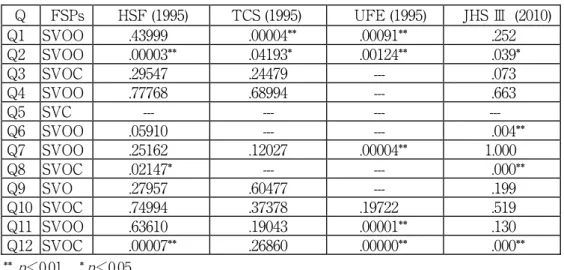
Table 2 shows the statistic values p gained through SPSS. If the significance level is set at .01, p has **, and if it is set at .05, p has *(df=1). In the cross tables we designed, the figures were not computed when the number of non-empty rows or columns was one. The values of JHS are obtained through Fisher’s exact test.
Table 2 : The statistical values gained in Chi-square (1995) and Fisherʼs exact test
Table 3: The number of cases in which the hypothesis is accepted or rejected
Regarding JHSⅢ, the null hypothesis is accepted in seven cases (Q1, 3, 4, 7, 9, 10, and 11), which means the two abilities have turned out to be independent, while the null hypothesis is rejected in four cases (Q2, 6, 8, and 12), which means the two abilities are not proven to be independent. This result with JHSⅢ is remarkably similar to that of HSF in Yano’s (1996)
study (see Table 1 and 2) in two aspects: one is the number of cases where the null hypothesis is accepted and rejected, and the other is that the result shows almost the same patterns for whether the null hypothesis is accepted or rejected. Question 6 of HSF (1995)
makes the two patterns different whether the null hypothesis is accepted or rejected.
However, if p is set at 0.06, the two tendencies are the same (see Table 4). Therefore, even Q6 can be said not to make a big difference in the two tendencies of HSF and JHSⅢ.
Table 4: The number of cases in which the hypothesis is accepted or rejected
**p<0.01 ,*p<0.05
Q FSPs HSF (1995) TCS (1995) UFE (1995) JHS Ⅲ (2010) Q1Q2
Q3Q4 Q5Q6 Q7Q8 Q9Q10 Q11Q12
SVOOSVOO SVOCSVOO SVC SVOOSVOO SVOCSVO SVOCSVOO SVOC
.43999 .00003**
.29547 .77768 --- .05910 .25162 .02147*
.27957 .74994 .63610 .00007**
.252.039*
.073.663 ---
.004**
1.000 .000**
.199.519 .130.000**
.00091**
.00124**
--- --- --- --- .00004**
--- --- .19722 .00001**
.00000**
.00004**
.04193*
.24479 .68994 --- --- .12027 --- .60477 .37378 .19043 .26860
JHS Ⅲ (2010)
Accepted 8 8 1 7
Rejected 3 1 5 4
Null Hypothesis: HSF (1995) TCS (1995) UFE (1995)
Null Hypothesis: HSF (1995) JHS Ⅲ(2010)
Accepted 7 7
Rejected 4 4
p<0.06
In this research, what makes sentence pattern recognition difficult was not investigated.
Further research is necessary to determine this.
5 CONCLUSION
The present study was intended to answer the following two research questions:
1.Is there any relationship between the two abilities of Japanese EFL junior high school students learning EFL?
2.Is introducing FSPs of English sentences appropriate for Japanese JHS learning EFL?
In respect to research question 1, the two abilities of JHS could be said to be independent:
the ability to understand English and the ability to recognize the FSPs of English sentences.
The result is similar to the result of HSF in Yano (1996).
Concerning the research question 2, it has not turned out to be inappropriate to introduce FSPs of English to JHSⅢ learning EFL because the results of JHSⅢ has a similar tendency as the ones of HSF. In many cases, JHSⅢ understand English sentences without recognizing the sentence patterns of English sentences.
This study only focused on understanding English sentences, and whether using the FSPs of English sentences is effective or not was not clearly confirmed. However, using the FSPs of English sentences might be effective in producing English sentences. Further study is necessary on this point.
Using the FSPs of English sentences should not be the objective but only an aid to EFL learners to understand the meanings of English sentences, especially in explaining the structures of English sentences.
Hopefully, this research can provide some useful information for a better way of teaching EFL to Japanese junior high school students.
Acknowledgement
I would like to express my sincere gratitude thanks to the junior high school English teachers and students for their cooperation for the this research, Dr. Peter Clements for his good comments and proofreading, and Dr. Ken-ichi Yumino, a professor emeritus at Shizuoka University for his valuable advice on my statistical analysis.
References
Ando, S. (1983). Eigo kyoshi no bumpo kenkyu [Grammar study for English teachers].
Tokyo: Taishukan Shoten.
Araki, K. (1983, May). Gakko eibumpo no mondaiten (2) [Problems with school grammar part 2]. Modern English Teaching, 20(2). 17-19.
Hatch, E., & Lazaraton, A. (1991). The research manual: Design and statistics for applied linguistics. Boston: Heinle & Heinle Publishers. 229, 409.
Hosoe, I. (1966). Shosetsu eibumpo hanron, (new ed.) [An advanced English syntax]. Tokyo:
Shinozaki Shorin (Original work published 1917).
Ikegami, Y. (1991). Eibumpo wo kangaeru [Thinking about English Grammar]. Tokyo:
Chikuma Shobo.
Kanatani, K.(Ed.). (1992). Gakushu bumpo ron [A theory of learning English grammar].
Tokyo: Kagensha. 28-29.
Kasajima, J., & Seki, N., (2011). New horizon English course 3. Tokyo: Tokyo Shoseki. 71.
Matsuhata, K. (1991, September). Seito no naze to bumpo shido. [Students’ “Why” and teaching English grammar]. Modern English Teaching, 28(6). 14-18.
Onions, C. T. (1924). An advanced English syntax, (3rd ed.,1st ed. 1904). London: The Macmillan Company.
Quirk, R., Greenbaum, S., Leech, G., & Svartvik, J. (1985). A comprehensive grammar of the English language. London and New York: Longman. p.53.
Mochizuki, M. (1992, November). Goi・bunkei・koubun no test [Tests on vocabulary, sentence types, sentence structures]. Modern English Teaching, 21(8). 12-15.
Yano, J. (1996). The usefulness of five sentence patterns in understanding English
(Unpublished master’s thesis). Tokyo Gakugei University, Tokyo.
Watanuki, YA., Miyakawa, Y., Sugai, T., & Takamatsu, N. (2010). Royal eibumpo [Royal English grammar] . Tokyo: Obunsha. 34-39.
Appendix 1
Kasajima and Seki (2011) New Horizon English Course 3, p.71.
Appendix 2
The distribution of 114 subjects of JHS(%)
Q1 through Q12 sentence pattern 0 1 meaning of 0 66 (4.8) 45 (3.3) the sentence 1 388 (28.4) 869 (63.5)
Q1 sentence pattern 0 1 meaning of 0 4 (3.5) 11 (9.6) the sentence 1 14 (12.3) 85 (74.6)
Q2 sentence pattern 0 1 meaning of 0 3 (2.6) 4 (3.5) the sentence 1 11 (9.6) 96(84.3)
Q3 sentence pattern 0 1 meaning of 0 6 (5.3) 2 (1.8) the sentence 1 43 (37.7) 63 (55.2)
Q4 sentence pattern 0 1 meaning of 0 1 (0.9) 4 (3.5) the sentence 1 37 (32.5) 72 (63.1)
Q5 sentence pattern 0 1 meaning of 0 0 (0) 0 (0) the sentence 1 11 (9.6) 103 (90.4)
Q6 sentence pattern 0 1 meaning of 0 8 (7.0) 8 (7.0) the sentence 1 15 (13.2) 83 (72.8)
Q7 sentence pattern 0 1 meaning of 0 1 (0.9) 2 (1.8) the sentence 1 32 (28.1) 79 (69.2)
Q8 sentence pattern 0 1 meaning of 0 12 (10.5) 1 (0.9) the sentence 1 38 (33.3) 63 (55.3)
Q9 sentence pattern 0 1 meaning of 0 8 (7.0) 0 (0) the sentence 1 77 (67.6) 29 (25.4)
Q10 sentence pattern 0 1 meaning of 0 10 (8.8) 5 (4.4) the sentence 1 76 (66.6) 23 (20.2)
Q11 sentence pattern 0 1 meaning of 0 2(1.8) 1 (0.9) the sentence 1 24 (21.1) 87 (76.2)
Q12 sentence pattern 0 1 meaning of 0 11 (9.6) 7 (6.1) the sentence 1 10 (8.8) 86 (75.5)
Appendix 3
The Test Sheet of the Present Study
次の各英文を和訳し、その文と最も似た文の型を持つ文を下のアからオより一つ選んで、
( )に記入して下さい。
1. John told Mary the way to the station. ( )
2. John showed Mary some pictures. ( )
3. People call him John. ( )
4. John teaches Mary how to cook. ( )
5. John is a good tennis player. ( )
6. John sent Mary a small box. ( )
7. John made Mary a pretty doll. ( )
8. John named his dog Candy. ( )
9. John gave an interesting book to Mary. ( )
10. John keeps his room clean. ( )
11. John made Mary some coffee. ( )
12. The music made John sad. ( )
ア.John is Mary's brother. イ.John gave Mary some flowers.
ウ.John made Mary happy. エ.John likes music. オ.John sang.