(ARTICLES)
Comparison of the EFL Learning Contexts of Japanese Junior High School and University Students
Masako Nishikawa-Van Eester 西川(ヴァンエーステル)雅子
Abstract
Noticing the general lack of English capabilities of Japanese business people, I have been exploring EFL learning contexts. This specific study investigates the difference in learning context between Japanese Junior High Schools and Japanese Universities. More in particular, it investigates how the perception of it differs between different age groups by analyzing the responses of 136 first-year junior high school students (age 12 -13) and 55 second- and third-year university students (age 19 -22) to the same questionnaire.
The results indicated few but significant differences how they feel about learning English and their EFL contexts. The junior high school participants more strongly felt that they are in a good EFL learning context and felt less anxious when speaking English than the university participants.
Introduction and Literature Review
The diffusion of “Global English” has been advocated by a number of authorities based on the idea that English has become the global language that plays the role of a Lingua Franca. This has occurred notwithstanding the mixed or negative feelings many non-native speakers of English have about this phenomenon Crystal (pp. 2 -3) writes “If English is not your mother tongue, you may still have mixed feelings about it. You may be strongly motivated to learn it … and you may begrudge that effort. Having made progress, you will feel pride in your achievement.” Despite such feelings, many persons, especially those in academic and business fields, have a strong need to use English. Furthermore, the widespread use of English in political and intellectual areas creates pressure on nations in which English is not the native language to educate its citizens in that language for purposes of economic development (McKay, 2002, p. 17).
For the above reasons, teaching English as a Global or International Language is important in
today’s world.
Japan is no exception to this trend; however, in Japan English plays an integral role in the educational system, because it is used to measure the academic ability of students and to select those who can enter academically competitive secondary and tertiary institutions.
McKay and Bokhorst-Heng (2008) stated that “in Japan, English is a de facto requirement for higher education since almost all entrance examinations for high schools, colleges and universities include some type of English assessment. … Many contend that the exams have had a deleterious washback effect on language teaching since classroom teachers feel under tremendous pressure to teach for the exam.” (p. 14). Although the entrance admission system has become more flexible in some private high schools and universities through the use of new selection systems, conventional entrance examinations still play a dominant role in the Japanese educational system.
However, the situation surrounding English as a Foreign Language (EFL) in Japan has been changing dramatically for the last twenty years. The original significance of learning and teaching English—besides its function as a way to select students for admission into academic programs—has caught the attention of the national government and school administrators.
First and foremost, English is a tool for communication with the rest of the world. In 1988, the mean TOEFL score of Japanese students ranked 180th out of 189 countries despite the fact that English is a compulsory subject for the six years of secondary school, and often for two more years for those who attend a university (Gottlieb, 2005, pp. 67 -68). The poor performance on the TOEFL caused a stir in Japan beyond the field of education, and it led many Japanese to discuss how they should respond to the increasing prestige of English as a world Lingua Franca. As the consequence of those discussions, some large Japanese corporations, such as Nissan and Marubeni, started placing employees in different classes and assigning them different jobs in the company based on their TOEIC scores (pp. 68 -69).
Also, Goto Butler and Iino (p. 25, 2005) stated that “It is widely believed that Japanese people must be equipped with better communicative skills in English.” As a result of similar earlier critiques, educational reform was implemented in 2002 by the Ministry of Education, Culture, Sports, Science and Technology (MEXT) in Japan, in order to “cultivate Japanese with English abilities” (MEXT, 2002). In 2011, MEXT made English a compulsory course for fifth and sixth grade elementary school students. Detailed guidelines were never issued and it was left to each school district to set their own guidelines for teaching these courses.
Another reason for the low English proficiency of Japanese students is that they study
English to acquire the “right” knowledge, primarily about English grammar, instead of acquiring
English skills (e.g., reading and writing). (McKay and Bokhorst-Heng, 2008, p. 14). As the result,
many Japanese students become uninterested and unmotivated to study English as an object
of analysis and these same students often lose hope that they will ever become fluent English
users. In this state, many are unfamiliar with the communicative forms of English used by much
of the world. Motivation to learn English, except for the ambition to enter a competitive school,
suffers. This is worrisome given the strong positive correlation observed between motivation
and achievement (Dörnyei, 2005).
Furthermore, Hawley-Nagatomo pointed out that the learner’s “Anxiety” is listed as one of the main causes of the reluctance to learn English that the students hold (Hawley-Nagatomo, 2012, p. 17). Also this study will show that Japanese students are extremely reluctant to speak out in English during classes because they fear “losing face” when making mistakes. As many English teachers (including myself) have experienced, this anxiety effectively complicates the task of the teacher and the process of learning.
Although there are many articles describing questionnaires for motivational studies such as Horwitz, E. (1999), Dörnyei, Z. (2005) and Nikitina, L & Furuoka, F. (2006), most of them discuss the internal consistency of the questionnaires or do an extensive factor analysis.
None or few actually discuss research that is making use of such questionnaires to analyze the difference between groups of students. This article positions itself in that gap, analyzing and comparing the motivation and beliefs of two age groups.
The major purpose of this study is to investigate differences in the attitudes of young English language learners toward learning English at school in the early stages of and towards the end of the process of being educated in a monolingual Japanese society.
Terminology
In this study we define the word “context” as the personal environment of the learner with a main focus on his/her family situation and their personal feelings in the classroom.
Research Questions
The research questions that guide this study are as follows:
1. Is there any difference between Japanese junior high school and university students regarding how they perceive their English learning context and their feelings about learning English?
2. If there is an observable difference between the two groups, how do they differ from each other?
Method
Participants and Participating Institutions
The first group of participants consists of 136 first-year Japanese junior high school
students between 12 and 13 years of age. The junior high school is a public co-educational junior
high school with around 380 students. It is surrounded by shopping centers, supermarkets,
and large, tranquil residential areas with a number of small, neat parks. This school is for the
children of local residents, but it has been able to compete with well-known private schools
because it produces good results in the annual entrance examinations for prestigious senior
high schools. The junior high respondents were the first group in the district to receive English
lessons as an official subject in elementary school. Similar to the observations of Goto Butler and
Iino (pp. 29 -30, 2005), the curriculum in this school complies with the standards of the public
junior high schools as set by MEXT. As such these students got four hours of English per week
The 55 Japanese university students, between 19 and 22 years of age, are in their second- or third year of their studies, and are non-English majors. The university has two faculties, both in the field of humanities. The target university participants are in a department with around 470 students. Although it is a small private institution, it is a relatively old college that has a good reputation and status in the history of the Japanese higher education; as such, it attracts students from all over the nation. The standardized score (hensachi) by which schools are ranked in Japan is 53, which places the school just above the average. The students are admitted via several routes, including entrance examinations and recommendations from high school teachers (the candidates do not need to be particularly good at English). Of the students entering this university, less than 25% had to go through rigorous English tests.
Instrumentation
The 29-item questionnaire (see the Appendix) was designed to measure environmental factors related to their EFL experience as well as their reaction to it in the form of beliefs and attitudes. As such, the design hoped to identify constructs such as: Environment, Beliefs, Anxiety, Importance. Responses were made using a 4-point Likert scale: 1 = Strongly disagree; 2
= Somewhat disagree; 3 = Somewhat agree; 4 = Strongly agree. The questionnaire was originally written in English, and it was translated into Japanese. The version in appendix is a back- translation of the Japanese version that was administered to the participants.
Procedures
The questionnaire was administered at the junior high school in early July 2012 and at the university in end July 2012, as requested by the school authorities because time for it could be most easily found in that period. The same procedure was used with both groups of participants. The course instructors explained the procedure for responding to the questionnaire, distributed it to the students, and the students completed it in approximately 15 minutes during a regular class in the presence of the course instructors. The course instructors collected the answered sheets after the students finished answering.
Statistical Background
This study makes use of several statistical tools. Although an oversimplification, one could say that factor analysis is used to find underlying groupings in the data; Cronbach’s alpha is used to verify if data in an assumed group are consistent or not; analysis of variance and multivariate analysis of variance are used to determine if the two groups statistically differ or not.
A more appropriate description of the background and procedures for using these statistical tools can be found in the work of Field (Field, A., 2005).
Results
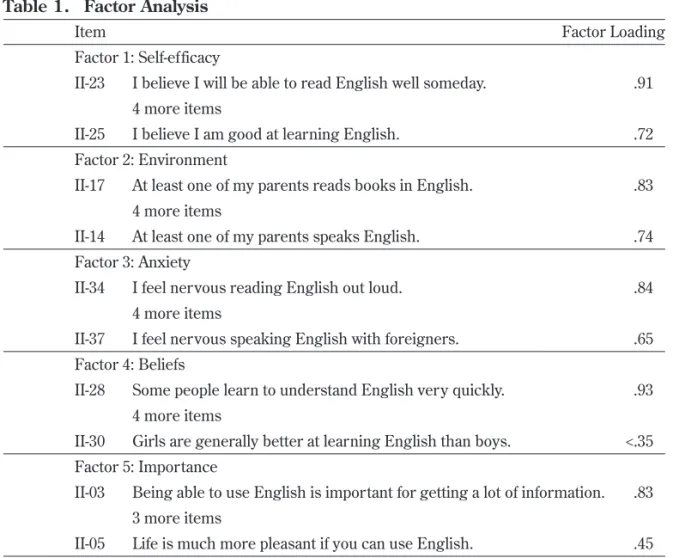
A factor analysis was done, resulting in 5 factors. (See Table 1.)
Table 1. Factor Analysis
Item Factor Loading
Factor 1: Self-efficacy
II-23 I believe I will be able to read English well someday. .91 4 more items
II-25 I believe I am good at learning English. .72
Factor 2: Environment
II-17 At least one of my parents reads books in English. .83 4 more items
II-14 At least one of my parents speaks English. .74 Factor 3: Anxiety
II-34 I feel nervous reading English out loud. .84
4 more items
II-37 I feel nervous speaking English with foreigners. .65 Factor 4: Beliefs
II-28 Some people learn to understand English very quickly. .93 4 more items
II-30 Girls are generally better at learning English than boys. <.35 Factor 5: Importance
II-03 Being able to use English is important for getting a lot of information. .83 3 more items
II-05 Life is much more pleasant if you can use English. .45
The following factors were extracted.
Factor 1, Self-efficacy (6 items): Self-efficacy is interpreted as the confidence of a student that he/she will succeed in the task of learning English. A sample item is: I believe I will be able to read English well someday. The Cronbach’s alpha reliability estimate of this factor was .95.
Factor 2, Environment (6 items): Environment is interpreted as a measure for the extent to which the student is exposed to an environment that is favorable for learning English. A sample item is: At least one of my parents reads books in English. The Cronbach’s alpha reliability estimate of this factor was .90.
Factor 3, Anxiety (6 items): Anxiety is interpreted as a measure for the reluctance and anxiety for performing some of the tasks that are deemed essential for the learning of English. A sample item is: I feel nervous reading English out loud. The Cronbach’s alpha reliability estimate of this factor was .84.
Factor 4, Beliefs (6 items): Beliefs is interpreted as a measure for the general confidence (not necessary applicable to the student him/herself) that it is possible to learn English. A sample item is: Some people learn to understand English very quickly. The Cronbach’s alpha reliability estimate of this factor was .81.
Factor 5, Importance (5 items): Importance is interpreted as a measure of the level of
necessity the student perceives regarding the learning of English. A sample item is: Being able to use English is important for getting a lot of information. The Cronbach’s alpha reliability estimate of this factor was .80.
The reliability estimates met Field’s (2005, p. 668) criterion of .80 for acceptable reliability. Further analysis will use these five factors as measures to evaluate the research questions. First the Mean and Standard Deviation of each factor are calculated for each of the two groups separately (see Table 2). As the factors are not independent, these numbers as such are not suited to judge whether the groups are different or not. However, the values are interesting for their own sake. At this point it, for instance, is interesting to note that the factor Importance scores rather high, with a limited standard deviation, indicating a general consensus that “learning English is important.”
Table 2. Mean and SD for Each of the Factors in Both Groups Separately
Junior High UniversityFactor M SD M SD
Self-efficacy 2.59 .86 2.51 .95
Environment 2.27 1.03 1.82 .88
Anxiety 2.18 .76 2.72 .79
Beliefs 2.50 .79 2.72 .65
Importance 3.21 .68 3.31 .57
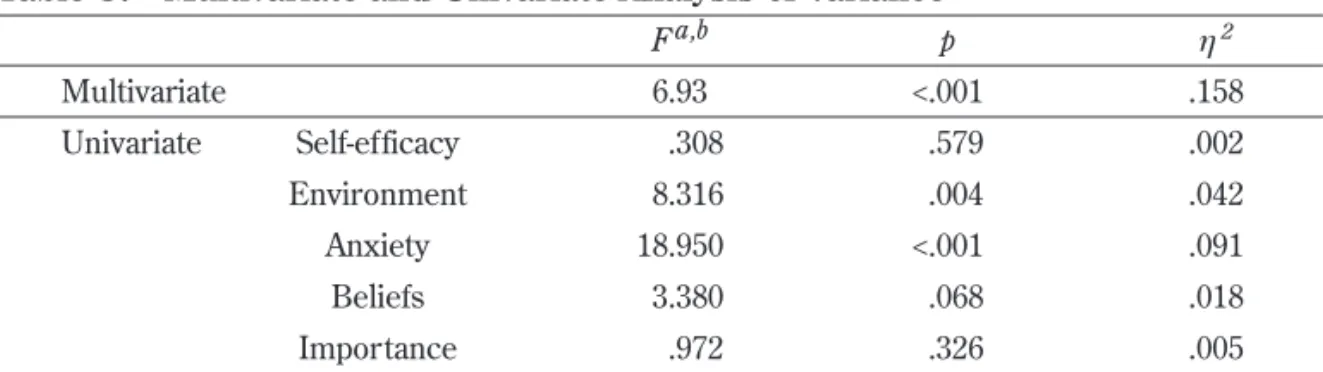
Research question 1, “Is there any difference between Japanese junior high school and university students regarding how they perceive their English learning context and their feelings about learning English?,” requires to get an overall comparison of the two groups versus each other. Because the question items – and the factors that result from them – are not independent of each other, this question can only be answered by an analysis of variance, taking into consideration the multiplicity of items (MANOVA). We can now try to answer the first research question by doing a multivariate analysis of variance. Results of this are shown in Table 3.
Table 3. Multivariate and Univariate Analysis of Variance
F
a,bp η
2Multivariate 6.93 <.001 .158
Univariate Self-efficacy .308 .579 .002
Environment 8.316 .004 .042
Anxiety 18.950 <.001 .091
Beliefs 3.380 .068 .018
Importance .972 .326 .005
Note: F-ratios were generated from Pilai’s statistic.
aMultivariate df=5, 185.
bUnivariate df=1, 189.
The results were significant, F (5, 185) = 6.93, p < .001, η
2= .16; thus, the two groups differ significantly.
Research question 2, “If there is an observable difference between the two groups, how do they differ from each other?” is answered through a follow-up ANOVA on each of the factors (since the MANOVA indicates a difference between the two groups.) The ANOVA on each of the factors will indicate which of the factors is causing a difference between the two groups and which factors do not significantly contribute to the difference between the groups. Addressing Research Question 2, the univariate analysis of Table 3 only shows a significant difference for the factors Environment, F (5, 189) = 8.32, p = .004, η
2= .04, and Anxiety, F (5, 189) = 18.95, p < .001, η
2= .09.
Discussion
It is, to some extent, natural to think that there might be a significant difference in the way the junior high first graders (age 12 -13) and the second and third-year university students (age 19 -22) feel about learning English and their learning contexts, because they usually learn many things by going through a number of experiences in their daily life, which could consequently affect their ways of feeling, thinking, reasoning and behaving while learning English.
The data analyses indicated that there is a small but significant difference between the two groups. The significant difference between the two groups is caused exclusively by the factors Environment and Anxiety whereas the factors Self-efficacy, Beliefs, and Importance were similar among the two groups.
Regarding the variable Environment of the target population, the younger group recorded a statistically significant higher score (2.27) than the elder group (1.81) on the Likert scale, as shown in Table 2. This implies that the junior high school students feel stronger that they are in a good situation as far as the English learning conditions are concerned than the university students do, and it is presumably because of their homogeneous and somewhat more international background as described earlier.
As to the variable of Anxiety, it turned out that the junior high students have significantly less anxiety (2.18) than their counterpart at university level (2.72) when they actually have to use – mainly speak – English. This could be explained, first, by the fact that the younger group has not yet encountered an actual situation in which they must perform entirely in English while the university students have to take courses in which they have to do, for instance, presentations in English and so on. At the junior high level such courses simply do not exist, except for several occasions per term when their assigned “native speaking” ALT (Assistant Language Teacher) visits the school for the special class as “English Conversation”
or “English Activities” that are often simply fun for the students without gaining much feeling of
achieving something academic. It is fun partially because those classes are often well thought out
by the ALT to interest the students, and partially because this kind of classes is not the straight
target of assessment in the framework of the regular English classes run by the regular Japanese
teaching staff of English. As Dörnyei (p.201) stated, “anxiety influences language behavior negatively”.
Thus, it is possible that the junior high students do not fully realize the complexities and hardship, whereas the university participants are going through it in their daily classroom.
Furthermore, it is the fact that the junior high students, after their two years’ happy experiences of “the first encounter” to the English language at the elementary level as reported earlier in the section of “General Background” in this district, only just began studying English. The academic year started in April, just three months before the survey was administered. Therefore the junior high respondents were presumably still slightly excited (new textbooks, new teaching staff, new classmates and wearing a new school uniform outfit for the first time…) with their new school life, and certainly with the new course of “the English language”. In short, the junior high students who have still fewer experiences in studying English do not yet have a clear perspective on what they will be taught and how they should take it. They also know little about – certainly much less than their counterpart at university – their future possibility and aptitude as English learners in Japan, which makes them less realistic, or rather positively optimistic, about the actual daily life. Consequently, they are less anxious about English in general.
All these “immeasurable” elements and aspects in the respondents’ learning contexts in the current study could be further investigated, explored, analyzed and interpreted for a holistic approach towards this theme. To do that, we eventually would need to do a qualitative study, in which, for example, interviews of some cases of the target population are to be planned for better and deeper understanding of what they think and how they feel about learning English and their learning environment. The dataset collected in this way could then be embedded and the studies from various perspectives could be merged into forming analyses and views as an integrated research program.
Conclusion
The results indicated that the Japanese junior high and university students differ from each other in the way they perceive English learning and their EFL learning environment.
The results show that although they differ overall, this difference is focused in Environment and Anxiety and is not seen in Self-efficacy, Beliefs, and Importance. A qualitative study would be needed to better understand the “immeasurable” elements and aspects in the respondents’
learning contexts.
We saw that anxiety in the classroom was higher at the university level than at the
junior high level. As main pedagogical implication of this study, we could conclude that teachers
might benefit by actively using techniques to reduce this phenomenon.
References
Crystal, D. (2003). English as A global language (2nd ed.). New York, NY: Cambridge University Press.
Dörnyei, Z. (2005). The psychology of the language learner: Individual differences in second language acquisition.
Mahwah, NJ: Erlbaum.
Field, A. (2005). Discovering statistics using SPSS (2nd ed.). London: Sage.
Goto Butler, Y. & Iino, M. (2005). Current Japanese reforms in English language education: the 2003 “Action Plan”.
Language Policy, 4, 25-45.
Gottlieb, N. (2005). Language and society in Japan. New York, NY: Cambridge University Press.
Hawley-Nagatomo, D. (2012). Exploring Japanese university English teachers’ professional identity. New York, NY:
Multilingual Matters.
Horwitz, E. (1999). Cultural and situational influence on foreign language learners’ beliefs about language learning: A review of BALLI studies. System, 27(4), 557 – 576.
Knipprath, H. (2004). The role of parents and community in the education of the Japanese child. Educational Research for Policy and Practice, 3, 95 -107.
McKay, S. L. (2002). Teaching English as an international language. New York, NY: Cambridge University Press.
McKay, S. L., & Bokhorst-Heng, W. D. (2008). International English in its sociolinguistic contexts. New York, NY:
Routledge.
Ministry of Education, Culture, Sports, Science & Technology (MEXT). (2002). Developing a strategic plan to cultivate “Japanese with English abilities,” retrieved October 12, 2012, from http://www.mext.
go.jp/english/news/2002/07/020901.htm
Ministry of Education, Culture, Sports, Science & Technology (MEXT). (2012). Notice on the development of “Hi, friends” –New Materials for introducing Foreign Language Activities in Elementary Schools, retrieved January, 2012, from http://www.mext.go.jp/english/topics/1315411.htm
Nikitina, L & Furuoka, F. (2006). Re-examining Horwitz’s Beliefs about Language Learning Inventory (BALLI) in the Malaysian Context. Electronic Journal of Foreign Language Teaching, 3, 2, 209 - 219.
The Japanese Association of College English teachers SLA Kenkyukai. (2013). Daini gengo shutoku to eigoka kyoikuho [SLA and TESOL]. Tokyo. Kaitakusha.
Appendices
1. Questionnaire (Back-translated from Japanese)
QuestionnaireDate, Tokyo, Japan The purpose of this questionnaire is to ask you your opinion about “English” and “learning English”.
I. Please mark one circle in black as response for each question (O
→●):
1. Gender: O male O female
2. Age: O 11 O 12 O 13 O 14 O 15 O 16 O 17 O 18-21 O older than 21 3. How long have you been studying English with a teacher/teachers?
O less than 1 year
O 1 year
O 2 years
O 3 years O 4 years O 5 years O more than 5 years 4. How many languages have you been learning besides Japanese?
O One
O Two
O Three
O More than three II. For each question, select one O and mark it (
●).
Strongly
disagree Disagree Agree Strongly agree 1 Being able to use English is important for getting a good job. O O O O 2 Being able to use English is important for going to a good
school. O O O O
3 Being able to use English is important for getting a lot of
information. O O O O
4 Being able to use English is important for communicating with
many people. O O O O
5 Life is much more pleasant if you can use English. O O O O
14 At least one of my parents speaks English. O O O O
15 At least one of my parents watches TV or movies in English. O O O O 16 At least one of my parents speaks English with a friend
sometimes. O O O O
17 At least one of my parents reads books in English. O O O O
18 At least one of my parents writes English sometimes. O O O O
19 At least one of my parents uses English at work. O O O O
20 I believe I will learn to speak English well someday. O O O O
21 I believe I will be able to understand spoken English well
someday. O O O O
22 I believe I will be able to write English well someday. O O O O
23 I believe I will be able to read English well someday. O O O O
24 I believe I will have a large English vocabulary someday. O O O O
25 I believe I am good at learning English. O O O O
26 Some people have a special talent for learning foreign
languages. O O O O
27 Some people learn to speak English very quickly. O O O O
28 Some people learn to understand English very quickly. O O O O
29 Some people learn English vocabulary very quickly. O O O O
30 Girls are generally better at learning English than boys. O O O O
Strongly
disagree Disagree Agree Strongly agree 31 Children can learn to speak English more easily than adults. O O O O 32 I feel nervous speaking English in front of all of my classmates. O O O O
33 I feel nervous speaking English to my English teacher. O O O O
34 I feel nervous reading English out loud. O O O O
35 I feel nervous speaking English to one classmate (in a pair
activity). O O O O
36 I feel ner vous speaking English at the same time as my
classmates. O O O O
37 I feel nervous speaking English with foreigners. O O O O
Thank you very much!
2. Original (Japanese) questionnaire
アンケート
〇月 〇日 日本 東京
このアンケートの目的は「英語」と「英語学習」についてあなたのご意見を聞くことです。
I. それぞれの答えの1つの○を黒く塗ってください。(●)
1. 性別: ○ 男性 ○ 女性
2. 年齢: ○ 11 ○ 12 ○ 13 ○ 14 ○ 15 ○ 16 ○ 17 ○ 18-21 ○ 21 歳以上 3. 英語を先生と学んでどれぐらいですか?
○ 1 年以内 ○ 1 年 ○ 2 年 ○ 3 年 ○ 4 年 ○ 5 年 ○ 5 年以上 4. 日本語以外にいくつ言語(ことば)を学んでいますか?
○ 1 つ ○ 2 つ ○ 3 つ ○ 3 つ以上
II. 各質問の答えをそれぞれ 1 つ選んで○を黒く塗ってください。
全然そう 思わない そう
思わない そう思う すごくそ う思う
1 英語が使えることは良い仕事を得るために重要だ ○ ○ ○ ○
2 英語が使えることは良い学校に行くために重要だ ○ ○ ○ ○
3 英語が使えることはたくさんの情報を得るために重要だ ○ ○ ○ ○
4 英語が使えることは多くの人たちとコミュニケーション
をとるために重要だ ○ ○ ○ ○
5 もし英語が使えれば人生はもっと楽しい ○ ○ ○ ○
6 私は、いつか外国人観光客を助けたり、また自分が助け を求めるために、英語を話さなければならないことがあ
ると思う ○ ○ ○ ○
7 私の両親の少なくとも 1 人は英語を話す ○ ○ ○ ○
8 私の両親の少なくとも 1 人は英語でテレビや映画を見る ○ ○ ○ ○
9 私の両親の少なくとも 1 人は時々(ときどき)友だちと
英語を話す ○ ○ ○ ○
10 私の両親の少なくとも 1 人は英語の本を読む ○ ○ ○ ○
11 私の両親の少なくとも 1 人は時々英語を書く ○ ○ ○ ○
12 私の両親の少なくとも 1 人は仕事で英語を使う ○ ○ ○ ○
13 私はいつか英語をうまく話すようになると思う ○ ○ ○ ○
14 私はいつか英語で話を聞いてよく理解できるようになる
と思う ○ ○ ○ ○
15 私はいつか英語をうまく書けるようになると思う ○ ○ ○ ○
16 私はいつか英語をよく読めるようになると思う ○ ○ ○ ○
17 私はいつか英語の単語をたくさん知っているようになる
と思う ○ ○ ○ ○
18 私は自分が英語を学ぶのが得意だと思う ○ ○ ○ ○
19 外国語を学ぶのに特別な能力を持った人たちがいる ○ ○ ○ ○
20 英語を話すのを学ぶのがとてもはやい人たちがいる ○ ○ ○ ○
21 英語がわかるようになるのがとてもはやい人たちがいる ○ ○ ○ ○
22 英語の単語を学ぶのがとてもはやい人たちがいる ○ ○ ○ ○
23 子どもの方が大人より英語を簡単に話せるようになる ○ ○ ○ ○
24 私は、クラスのみんなの前で英語を話すのは緊張する ○ ○ ○ ○
全然そう思わない そう
思わない そう思う すごくそ う思う
25 私は、英語の先生に英語で話すのは緊張する ○ ○ ○ ○
26 私は、英語を音読するのは緊張する ○ ○ ○ ○
27 私は、(二人組での活動で)クラスメートに英語を話す
のは緊張する ○ ○ ○ ○
28 私は、クラスのみんなと同時に英語を話すのは緊張する ○ ○ ○ ○
29 私は、外国人と英語を話すのは緊張する ○ ○ ○ ○
ありがとうございました!