
An Action Research Study on Communication Strategies in Japanese Junior High School English Classes with ALTs
66
0
0
全文
(2) later, after giving consciousness-raising activities to. with his or her AIiT, `Dependence' strategy in the. CS, in order to investigate the infiuence ofthem.. sense that a student depended on his or her friends. We roughly analyzed the CS used by the. before speakng with his or her ALT, and `Text. students after the fust lesson videotaped. Based. referral' strategy by means of which a student read. on that analysis, we found that `Paraphrase' was. the text on his or her handout, notebook, or. Rever used, and that `Appeal for Assistance'. blackboard when speaking with his or her AI)T.. occurred very rarely in terms of frequency.. With respect to the effect of raising the. Therefore we attempted to mise the students'. learner's consciousness to the use of CS, we came. consciousness about using the two CS mentioned. to the following conclusioAs. First, in the actual. above, four imes in total over a period of two. use ofCS, we found a positive effect not in the fust. weeks.. year students but in the second year students with. Chaptef 3 dealt with the analysis of the CS. regard to `Appeal for assistance'. The increase of. actua11y used in both the frrst aiid second. the use of `Appeal for assistance' in terms of. videotaped lessons. Showing examples ofthe use. frequency refiected the difference of quality of. of CS, we checked them based eR Tarone's. interaction. In other words, the interaction in the. typology.. second lesson was more communicative than that in. Chapter 4 was cencerned with the examination of the effect of consciousness-raising. the first lesson in terms of acquiiing information.. Second, regarding the students' views to CS,. to CS from the qualitative analysis of actuai use in. we noticed a change, again in the second year. the classroom. Also in this chapter, we. students, with respect to the source ofCS use. The. investigated the students' views on using CS,. second year students intended to use L2-based. through a questionnaire about them.. strategies instead ofLl-based strategies wheR they. In the concluding chapter, we discussed more in detail the results of {he Emalysis, and the effect of. felt diff7iculties in speaking to their ALT as well as. in understanding what their ALT said.. raising the students' consciousness to the CS use.. We saw the effect of raising the students'. We also referred to some limitations of the present. consciousness to the CS in both the actuai use of. research and offered suggestions for further. CS and also the students' views on using CS.. research.. Therefore we were able to conclude that it is very. As a result of our study, we found tkat the CS used by the students consisted of seveR types in al1,. usefu1 to raise the studeRts' consciousness to CS in the interactions with ALTs.. and that three of them were peculiar to the context. of the Japanese junior high school classroom.. S{IEF.ige#ifi=glt' tilma f2Xsb<btili'. Those three strategies were: `Silence' strategy in wkich a student remained silent instead of speaking. tvH \ig W '=B" l-Llma f2)fsSLSI'ili`.
(3) An Action Research Study on Communication Strategies in Japanese Junior High School English Classes with ALTs. #fi • 6ft ts2#fi i# llk. S'ha.fk=-J<. M99457K va Bi( Hg ik.
(4) An Action Research Study on CommunicatioR Strategies iR Japanese Junior High School English Classes with ALTs. A Thesis Pfesented to The Faculty of the Graduate Course at. Hyogo University of Teacher Education. In Partial Fulfillment. of the Requirements for the Degree of. Master of School Educatien. by Akio Takehara (Student Number:M99457K). December 2000.
(5) i. Acknowledgements This thesis could not have been completed without the help and encouragement previded by many people.. First aRd foremost, I would like to express my deepest. gratitude to Professor Toshihiko Yamaoka, my seminar supervisor, for his valuable suggestions and insightful advice. I would never have beeR able to finish this thesis witheut his. warm-hearted support.. My special thanks are due to Ms. Mayumi Yamamoto, Mr. Hidenori Kakutani, of Nakatsu Junior High School, and. two ALTs, Alison Christina Campbell and Andrew Abele. They kindly gave me the opportunity to get a great number of. data. I would also like to thank the students whe participated in the lessons for providing me with valuable data.. I would like to thank again Alison ChristiRa Campbell who generously examined and corrected the entire draft as a native speaker of English.. I further wish to express my appreciation to the teaching staff of the DepartmeRt of English Language at Hyogo University of Teacher Education, aRd my colleagues in the graduate department for their constant encouragement.. My thaRks are also extended to the Fukuoka Board of Education for providing me with the opportunity to study at.
(6) ti. Hyogo University of Teacher Education.. Last, but not least, I would like. who supported and encouraged me all. to. thaRk my family,. the time during these. past two years.. Akie Takehara Yashiro, Hyogo. December, 2000.
(7) bi. Abstract The startling progress of internationalization these. days has increased the necessity for the practical communicatioR ability of the students to be raised in. Japanese ERglish classes. The Ministry of EducatioR (Monbusho) has decided to pfovide Japanese students with. the opportunity to come iRto close contact with native speakers in foreign language classes. In fact, the students. are experieRcing more and more communicative activities and team-teaching with Assistant Language Teachers (ALTs) iR ERglish classes.. A variety of problems, however, can arise in carrying. out such activities in the classroom. When obligated to cemmunicate in ERglish in the classreom, Japanese junior high school students, who have just started learning English,. are at a loss with their poor kAowledge of vocabulary and grammar.. Generally speaking, the rnethods we use to communicate when there is a limited cemmand of a language are called commuRicatien strategies (CS). In this research. we analyze how the Japanese junior high school students manage to converse with ALTs in English classes, that is to say, how they use CS when interacting with native speakers. in order to soive problems faced during communicative activities in the classroom. Furthermore we consider how.
(8) iv. the use of CS is influenced after teachers raise the learner's. consciousAess to some of them.. We defined CS referring to definitions made by some respected SLA researchers, aRd classified CS relying mainly. on Tarone's typology, which was typical of those that followed because her classification was explicit with plentifu11y illustrative examples (Bialystok 1990).. IR Chapter 1, we reviewed recent studies of CS, which had been conducted from varieus aspects.. Chapter 2 presented our research questiens: (1) What. kinds of CS are used by the studeRts to communicate with. ALTs in English classes? (2) How do the CS use and the. students' views on using CS change after consciousness-raisiRg to some CS? The research subjects were 89 second yeaf students and 102 first year students ofa. junior high school iR Japan. Each of the two year-groups coRsisted of three classes.. In order to collect data, twelve lessoRs were videotaped and transcribed. The lessons were held twice for each class. The first lesson took place early in February 2000, to observe. the status quo of the use ofCS by Japanesejunior high school. students. The second lesson was held a month later, after giving consciousness-raising activities to CS, in order to iRvestigate the influence of them.. We roughly aRalyzed the CS used by the students after.
(9) v. the first lesson videotaped. Based on that analysis, we found that `Paraphrase' was never used, and that `Appeal for. AssistaRce' cccurred very rarely in terms of frequency. Therefore we attempted to raise the students' consciousness about using the two CS mentiened above, four times in total.. Chapter 3 dealt with the analysis of the CS actually. used iA both the first and second videotaped lessons. Showing examples of the use of CS, we checked them based on Tarone's typology.. Chapter 4 was concerned with the examination of the effect of consciousness-raising to CS from the qualitative analysis of actual use in the classroom. Also in this chapter,. we investigated the students' views on using CS, through a questiennaire about them.. In the concludiRg chapter, we discussed more in detail. the results ef the analysis, and the effect of raising the students' consciousness to the CS use. We also referred to. some limitations of the present research and offered suggestiens for further research.. As a resuk of our study, we found that the CS used by the studeAts censisted of seven types in all, and that three of. them were peculiar to the context of the Japanesejunier high. scheol classroom. Those three strategies were: `Silence'. strategy in which a student remained silent instead of speaking with his or her ALT, `Dependence' strategy in the.
(10) vi. sense that a student depended on his or her friends before speaking with his or her ALT, and `Text referral' strategy by means of which a studeRt read the text on his or her handout,. notebook, or blackboard when speaking with his or her ALT.. With respect to the effect of raising the learner's censcio"sness to the use of CS, we came to the followiRg. coRclusions. First, in the actual use of CS, we found a positive effect not ifl the first year students but in the second. year students with regard to `Appeal for assistance'. The increase of the use of `Appeal for assistance' in terms of frequency reflected the difference of quality of interaction. In other words, the interaction in the second lesson was more. communicative than that in the first lesson in terms of acquiring iRformation.. Second, regardiAg the students' views to CS, we noticed a change, agaiR in the second year students, with respect to the source of CS use. The second year students. intended to use L2-based strategies instead of Ll-based strategies when they felt difficulties in speaking to their ALT. as well as in understandiRg what their ALT said.. We saw the effect of raising the studeAts' consciousness to the CS in both the actual use of CS and also. the students' views oR using CS. Therefore we were able to. conclude that it is very useful to raise the students' consciousness to CS in the interactions with ALTs..
(11) ni. Contents. Acknowledgements '''''''•''•'•••••••••••••••••••••••. 1. Abstract •••e•••••••••................................ m. CoRtents '''''''•••••••••••te••••..................... va. List of Tables ''''''''''''''''''''''''''''''''''•'''''. x. ListofFigures''''••••••••••••••••••••••••••••••••e••. m. List of Examples •••••••••••t•••••••••••••••••••••..... xu. Introduction'''''''''''''''''''''''''''''''''''''''''1 Chapter 1 Communieation Strategies. Ll. Introduction''•'''''''''''''''''''''''''''''4. 1.2. Definitions of CS '''''''••"••••••••••t•••••••4. l.3. ClassificatioRs of CS ''''''''''''''''''''''''' 6. l.4. Several Evidential Studies CoRcemed with CS ' ' ' ' 7. 1.5. Summary''''''''''''''''''''''''•''''''''''7. Chapter2 Research 2.1 Introduction ''•''''''''''''•''''''''''''''''9 2.2 Research Questions '''"''''''''''''''''''''''9. 2.3 Subjects''''''''''''''''''''''''''''''''''''9 2.4 Data Collection and Analysis'''''''''''''''''''10. 2.4.I Data Collectien ''''"'''''''''''''''''''''10.
(12) ni. 2.4.2. The Content of the Lesson '''''•''''''''''' 11. 2.4.3. Consciousness-raising te the CS Use''''''''' l2. 2.4.4. Data Analysis '''''''''''''''''''''''''''13. 2.4.5. Interview with Students Using CS ''''''''''' l4. 2.4.6. Questionnaire about the CS Use'''''''''''''14. Chapter 3 ARalysis and Results (1):. The Use of CS by the Students. 3.1 IRtreduction ''''''''''''''''''''''''''''''''l5 3.2 Results ofAnalysis'''''''''''''''''''''''''''15 3.3 Examples ofthe Seven CS Actually Used by the Students''''''''''''''''''''''''' i9 3.3.1 Examples ofCS Categorized iA. Tarone's Taxonomy '''''''''''''''''''''' 19 3.3.2 Examples ofCS Which Are Peculiar '''''''''25. 3.4 Summary'''''''''''''''''''''''''''''''''''28 Chapter 4 Analysis and Results (2): The Effeet of Censciousness-raising to CS 4.1. IRtroduction ''''''''''''''''''''''''''''''''30. 4.2. The Quantitative Change of Actual Use of CS '''''30. 4.3. The Qualitative Change of Actual Use of CS ''''''31. 4.4. The ChaRge of the StudeRts'. Views on Using CS '''''''''''''''''''''''''33 4.5. Sum m ary ''''''''`'''''''''''''''''''''''''' 40.
(13) ix. Chapter 5 Conclusien 5.I. CeRclusion '''''''''''''''''''''''''''''''''41. 5.2. Discussion''''''''''''''''''•••'•e•e••e`••••42. 5.3. Limitations and Suggestions. for Further Research '''''''''''''''''''''''`'44. Bibliography''''''''''''''''''''''''''''''•''''''''''46. Appendix ''''''''''''''''''''''''''''''''''•''•'''''49.
(14) x. List of Tables Table 1 Classification of CS by Tarone (1977) ''''''''''''6. Table 2 The Schedule for Data Collection''''''''''''''''IO. Table 3 The Flow ofthe LessoRs Videotaped '''''''''''''il Table 4 The Expressions as the CS '''''''''''''''''`'''l3 Table 5 The Frequeficy ofCS Used by the First Year Students `'''''''''''''''''''''''l6 Table 6 The Frequency of CS Used by. the Second Year Students '''''`''''''''''''''''18 Table 7 Transcription Conventions '''''''''''''''''''''20 Table 8 The CS ChoseA by the First Year Students(1) ''''''34. Table 9 The CS Chosen by the Second Year Students(l) ''''36. Table 10 The CS Chosefi by the First Year Students(2)'''''''37. Table 11 The CS Chosen by the SecoRd Year Students(2)'''''39.
(15) xi. List of Figures. Figure 1. The Frequency ef CS Used by. the First Year StudeRts '''''''''''''''•''''''''17. Figure 2. The Frequency of CS Used by. the Second Year Students '''''''''''''''''''''' 19. Figure 3. The CS Chosen by the First Year Students(1) '''''35. Figure 4. The CS Chosen by the Second Year StudeRts(1) '''36. Figure 5. The CS Chosen by the First Year Students(2) '''''38. Figure 6. The CS Chosen by the Second Year StudeRts(2) '''39.
(16) ni. List of Examples. Exarnple l. Language Switch'''''''''''''''''''''''•'''20. Example 2. Message Abandonment''''''''''''''''''''''21. Exarnple 3. Mime''''''''''''''''''•'''''''''''''''''22. Example 4. Appeal for Assistance ''''''''''''''''''''''23 '. Example 5. Dependence ''''''''''''''''''•'''''''''''25. Example 6. Silence''''''•'''''''''''''•''''''''''''''26 '. Example 7. Text Referral''''''''''''''''''''''''''''''27. Example 8. The Dialogue in the First Lesson. Videotaped without `Appeal for Assistance' '''''32.
(17) i Introductien The startling progress of internationalization these days has. iRcreased the necessity for practical corRmunication ability of the studeRts to be raised in Japanese English classes. The. ministry ef Educatien (Monbusho) has designated the study of foreign language learning as a compulsory subject in the new Course of Study for secondary schools aRd the aim is as fo1lows:. Placing particular emphasis on speaking and listening,. Monbusho has improved the content ef foreign language education by stressing practical communicative abilities. which correspond with the language used in everyday sltuatloRs.. Monbusho has decided to provide Japanese students with the opportunity to come into clese contact with native speakers. in fereign language classes. In fact, the students are experiencing more and mere communicative activities and team-teachiRg with assistant language teachers (ALTs) in ERglish classes.. A variety of problems, however, can arise iR carrying. out such activities in the classroem. Kinue Hirano (1993) poiRted out like this:.
(18) 2. The students do not know what to do when they are expected to communicate actively in English classes with. their peor knowledge of vocabulary and grammar, because. they have been raised in the Japanese culture in which silence is considered to be golden and they are generally expected to take part in other classes by just listening te. what teachers say.. In additien, Japanese junior high schoel students, who have. just started learning English, are at a loss when they are obligated to communicate in English in the classroom.. GeRerally speaking the methods we use to communicate. when there is a limited command of a language are called cemmunication strategies (CS). In this research we analyze. how the Japanese junior high school students maRage to converse with ALTs iR English classes, that is to say, how they use CS when interacting with native speakers in order to. solve problems duriRg corr}muRicative activities in the classroom. Furthermore we consider how the use of CS is influenced after teachers raise the learner's consciousness to. some of them.. in Chapter 1, we would like to review CS studies, touching upon the origin, the definition, the classification and so on..
(19) 3. Chapter 2 presents our research questioRs and describes our research method, with explaRations of subjects, procedures, and implementation of coflsciousness-raising. -r. , Chapter 3 deals with the analysis of the CS used by the. JapanesejuRior high school students. We show examples of the use of CS by the students, and check them based on a traditional classificatioR.. Chapter 4 is concerned with the examination of the .effect of consciousness-raisiRg to CS from the qualitative aRalysis of actual use in the classreom. Also in this chapter,. we investigate the students' views on using CS, through a questionnaire about them.. In the cencluding chapter, we discuss more in detail the results of the analysis, and the effect of raising the students'. consciousness to the CS use. We also refer to some limitatiofis of the presefit research and offer suggestions for further research..
(20) 4 Chapter 1 CemmunicatioR Strategies 1.1 Introduction This chapter summarizes communication strategies (CS) in. terms of origin, defiRitions and classifications. This chapter also reviews recent studies of CS which have been conducted from varieus aspects.. Strategies of communication were first invoked by Selinker (1972) in his paper `Interlanguage', to account for. certain classes of errors made by learners of a second language (Corder 1983). Since then, a host of researchers such as Varadi, Corder, Tarene, Faerch and Kasper, Bialystok,. and so oR, have studied CS from various perspectives. First of all, let us examiRe some definitions of CS.. 1.2 DefinitionsefCS When we identify CS,'we face a fundameRtal problem, in that. it is very difficult to define CS because the phenomena or. criteria which are considered to be important vary among researchers (Iwai 2000). So seme investigators have tried. to define CS from their own points of view. Some definitioRs given are as follows:.
(21) 5 A systematic technique employed by a speaker to express. his meaning when faced with some difficulty; (Corder,. 1977). A mutual attempt of two interlocutors to agree on a meaniRg in situatieRs where requisite meaning structures are not shared; (Tarone, 1980). Potentially conscious plans for solving what to an individual presents itself as a problem in reaching a particular communicative goal;(Faerch and Kasper, 1983). Techniques of coping with difficulties in communicating in an imperfectly known second language;(Stern, 1983). PsycholiRguistic plans which exist as part of the. language user's commuRicative competence. They are potentially conscious and serve as substitutes for production plans which the learner is unable to implement. (Ellis, 1985). There are various definitiens with a wide range ef approaches: rangiRg from an interactional approach to a psycholinguistic one..
(22) 6 l.3 ClassificatioRs efCS. The taxonemy ef CS has also beeR studied by a lot of researchers. Categories, although named differently by each of them, seem to be largely corr}mon in characteristics.. Tarone's typelogy is typical of those that followed because her classifications are explicit with plentifully illustrative. examples (Bialystok 1990). The taxonomy is shown in Table 1.. Table 1:. Classificatien of CS. by Tarone (1977). l. Avoidance (a) Topic avoidance. (b) Message abandonment 2. Paraphrase. (a) Approximation (b) Word coinage (c) Circumlocution 3. Censcious transfer (a) Literal traRslation. (b) Language switch 4. Appeal for assistance. 5. Mime.
(23) 7. The classification has five major categories with subcategories for three of them. Each of the five major categories reflects a different sort of decisioR about how to. solve the communication problem (Bialystok 1990).. V5radi (1983) classified CS based on the speaker's. production, whereas Corder (l983), Faerch and Kasper (1983) based their classification on the source of information.. Bialystok's classification (1983) depended on the source of. information which was divided into two types. One type was Ll-based (mother tongue) strategies and the other was L2-based (target language).. I.4 Several Evidential Studies Concerned with CS Varieus aspects of CS have come under scrutiny since these definitions and classifications were made. For example, L2. learners' proficiency and CS use (Tarone 1977; Bialystok l983; Paribakht 1985; Chen 1990), CS in Ll and L2 (Poulisse. 1990; Iwai 1995), CS by NS and NNS (Paribakht 1985; Bongaerts et al. I987), Effectiveness of CS (Bialystok 1983), and Task effects to CS (Fakhri 1984).. 1.5 Summary Much of the research conducted on CS has been rather narrow,. in that it has focused predominantly on learners' gaps in lexis (Williams l997). Actually, only a few studies of CS.
(24) 8 use in aR interactional context have been investigated. Even amongst those studies conducted in an interactional. centext, the subjects have been adults cr the methed of investigatioR has beeA under coRtrolled circumstances. One of these interactional studies was conducted by Williams et. al. (1997), who analyzed the interaction between a NNS. teaching assistant and NS undergraduates in chemistry laboratory sessioRs. In the Williams' CS study the subjects were adults, but in this study the subjects are junior high school students whose proficieRcy in the target language is. relatively poor. Therefore it is difficult to consider the analysis made by WMiams with regard to this study..
(25) 9 Chapter 2 Research 2.1 Introduction This chapter identifies the aim of our research and then explains our research method. The purpose of this study is to investigate how Japanese junior high school students cope with the conversatienal difficulties in English classes with. ALTs, and how their CS use is influenced by receiviRg instruction to raise their consciousness to the fundamental. CS. The fellowing two questions are posed fer the present study.. 2.2 ResearchQuestioRs t• 1.What kinds ef CS are used by the students to comrr}unicate with ALTs in English classes?. 2. How do the CS use and the students' views on usiRg them change after consciousness-raisiAg to some CS?. 2.3 Subjeets The subjects are 89 second year students and 102 first year. students of ajunior high school in Fukuoka. Each of the. two year-groups consists of three classes. They learn English as a foreign language from two different Japanese.
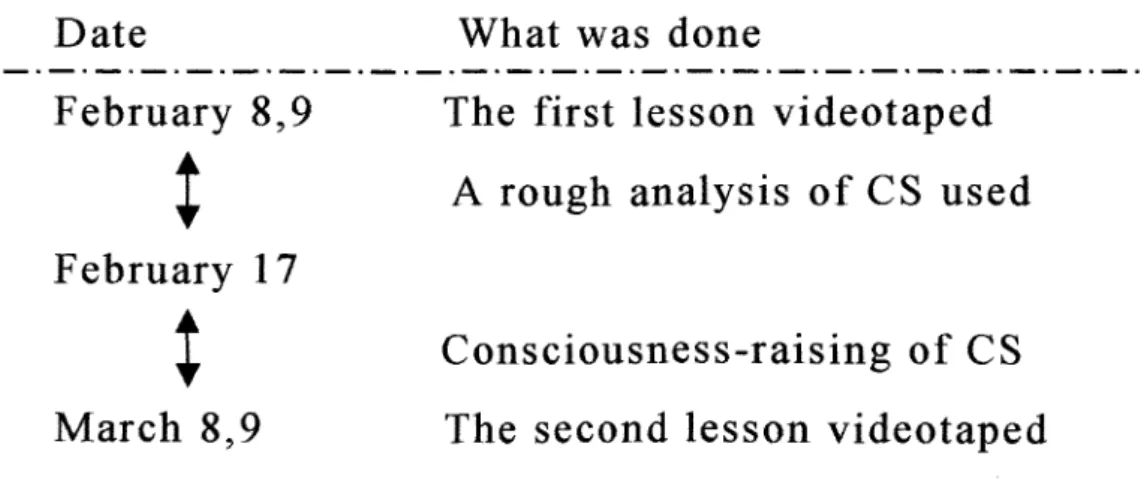
(26) 10. English teachers and two differeRt ALTs. One ALT, who is in charge of the second year, is an English woman whe has. been an ALT for seven years. The other ALT, whe is an. American man and who has been an ALT for two years, teaches the first year students. The students in every class have two lessons per moRth with their respective ALT.. 2.4 Data Collection and Analysis. 2.4.1 DataCollection In erder to collect data, twelve lessons were videotaped and. transcribed. The lessons were held twice for each class. The first lesson took place early in February 2000, te observe the status quo of the use of CS by Japanese junior high school. students. And the secend Iesson was held a month later after giving consciousRess-raisiRg activities to CS, in order. to investigate the infiuence of them. The schedule for data collection was as follews.. Table 2: [lrhe Sehedule fer Data CollectioR. Date February 8,9. :. What was done The first lessoR videotaped. A rough aAalysis of CS used. February 17. : March 8,9. Consciousness-raising of CS The second lesson videotaped.
(27) 11. 2.4.2 The Content of the Lessons. The content of the lessons was the same in each class. All lessons mainly consisted of communication activities as shown in Table 3, but were different in detail for each grade.. Table 3:. The Flow of the Lessons Videotaped. Secend Year. tLlzs!t-!.gsL Vdtd Stage 1: Easy English ConversatieR Including Greetings. Stage 2: Questions and Answers using Comparative. Structures Stage 3: `Guess-Who' Game using Comparative. Structures Stage 4: Check of the Answers to Stage 3. Stage 1: Easy English Conversation Including Greetings. Stage 2: `Three Hints' Game Stage 3: `Association' Game First Year First Lesson Videota ed Stage l: Easy English Conversation Including Greetings Stage 2: Practice in the Usage of `can'. Stage 3: Demonstration of Stage 2. Stage 4: `Who am I?' Game.
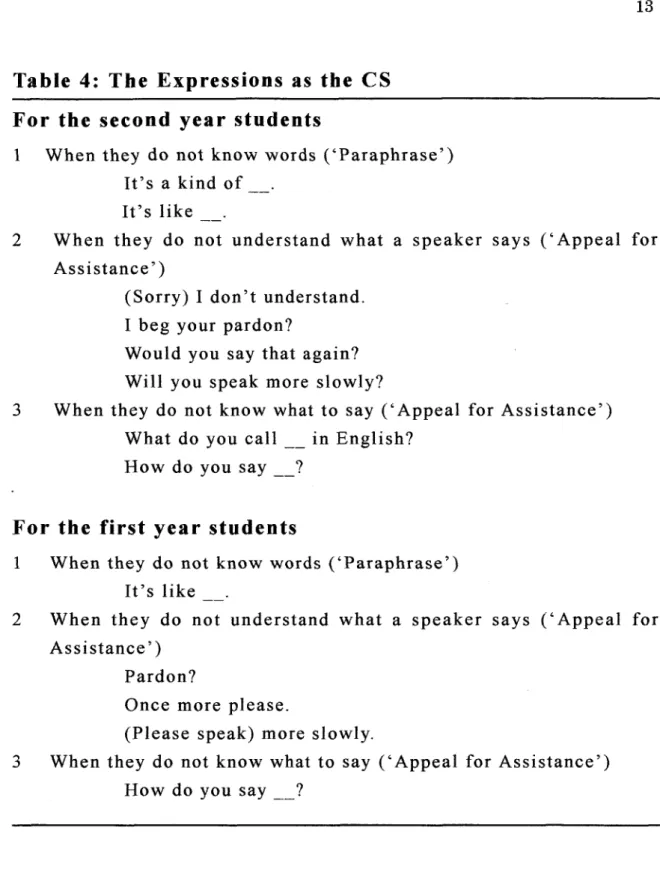
(28) 12. Second Lesson Videota ed Stage 1: Easy English Conversation Including Greetings Stage 2: `Line' Game (English Conversation) Stage 3: Practice of the Telephone Dialogue Stage 4: Demonstration of Stage 3. 2.4.3 ConsciousRess-raising to the CS Use. As shewn in Table 2, we roughly analyzed CS used by the students after the first lesson videotaped. Based on that analysis, we fognd that `Paraphrase' was never used, and that. `Appeal for Assistance' occurred very rarely in terms of frequeRcy. Therefere we attempted to raise the students' consciousness about using the twe CS mentioned above, four times over a period of two weeks. The first time, we let the studeRts recall how to use the CS, because although they had. previously learned it as classfoom English, they had forgotten a lot of the expressions. From the second to the fourth time, the studeRts practiced the strategies in pairs. while playing games such as `Information gap' game, `DescriptioR' game, and so on.. We raised the students' consciousness to the two CS by giving examples of the following expressions..
(29) l3. Table 4: The Expressions as the. cs. For the seceRd year students 1 When they do not know words (`Paraphrase') It's a kind of .. It'slike . 2 When they do not understand what a speaker says (`Appeal for Assistance') (Sorry) I don't understand.. I beg your pardon?. Would you say that again? ' Will you speak more slewly? 3 WheR they do Ret know what to say (`Appeal for Assistance') What do you call m- iR English? How do you say --?. For the first year students 1 When they do not knew words (`Paraphrase') It's like . 2 When they do not understand what a speaker says (`Appeal for Assistance'). Pardon? Once more please. (Please speak) more slowly. 3 When they do not know what to say (`Appeal for AssistaRce') How do you say --?. 2.4.4 DataAnalysis In collecting data, interactions to be analyzed were basically. restricted to those betweeR one student and his or her ALT.. This was because we could not observe CS in interactions.
(30) 14 between groups of students and the ALT. In the case of interactiens between students, we enly expected `Language switch' to be used.. The CS use was classified according to Tarone's taxonomy (Table l on p.6), as it was the most typical and her approach to CS was iRteractional.. 2.4.5 Interview with Students Using CS Some of the students who had used CS in the lessons were interviewed after school. They were shown the videotape of. them actually using CS, and were asked why they had used the strategy in the interactions.. 2.4.6 Questionnaire about the CS Use In addition to observing CS actually used by the students on. the transcriptien, we let all the students answer a questionnaire about CS use after the first and secoRd lessons.. We investigated what kinds of CS they intended to use and whether their use of CS had changed or not (See Appendix)..
(31) 15. Chapter 3 Analysis and Results (1):. The Use ef CS by the Students. 3.1 IntreductioR In the previous chapter, two research questions were posed for the current study. This chapter focuses on one of them. It shows the analysis ef the CS actually used by the students. in the classroom for the purpese of responding to the first research question, `What kinds of CS are used by the students. to communicate with ALTs in ERglish classes?'. Results of the aRalysis are shovvn with tables and figures, and iRdividual explanations of all the CS analyzed are given with examples.. 3.2 Results ofAnalysis The CS, which were used by the students in the iRteractions. with an ALT, were aRalyzed according to Tarone's taxonomy (Table 1 on p.6). We found four major categories ofthe five. in Tarone's, but `Paraphrase' could net be observed. These. four categories included `Message abandonment' (`Avoidance'), `Language switch' (`Conscious transfer'), `Appeal for assistance', and `Mime'. In addition to these,. three CS which did not beleng to Tarone's categories, were.
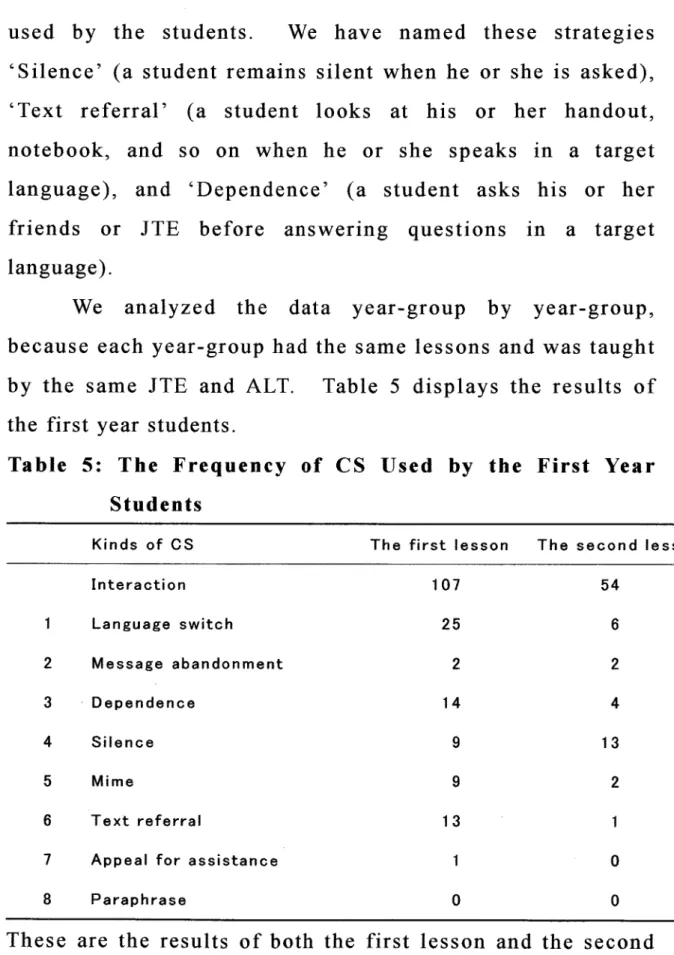
(32) 16. used by the students. We have named these strategies `Silence' (a student remains silent when he or she is asked),. `Text referral' (a student looks at his or her handout,. notebook, and so on when he or she speaks in a target language), and `Dependence' (a student asks his or her. friends or JTE before answering questions in a target language).. We analyzed the data year-group by year-group, because each year-group had the same lessons and was taught. by the same JTE and ALT. Table 5 displays the results of the first year students.. Table 5: The Frequency ef CS Used by the First Year Students Kinds of CS Interaction. The first lesson The second 1e7. lesson. 54. 1. Language switch. 25. 6. 2. Message abandonment. 2. 2. 3. Dependence. 14. 4. 4. Silence. 13. 5. Mime. 9 9. 6. Text referral. 13. 1. 7. Appeal for assistance. 1. e. 8. Paraphrase. o. e. These are the results of both the lessoR for the. first year students.. 2. first lesson aRd the second. The second lesson shows.
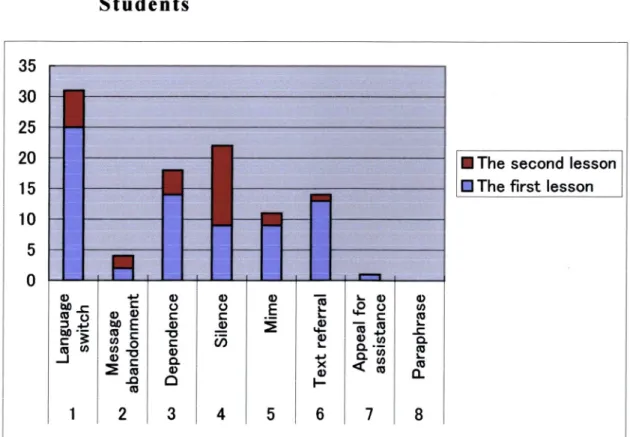
(33) 17 the results after the instruction of consciousness-raising to. CS. The number (107,54) for `Interaction', means how many times interactions between a student and his or her ALT. were attempted. The number for the second lesson is about a halfof that of the first lesson. This may have been caused by the content of the class. One third of the content of the. second lesson was the interaction between students. Other. numbers are the frequency of each strategy. We could not directly compare the numbers because the activities were not. the same. But we were able to roughly estimate the results by looking at Figure 1, which is shown as abar graph.. Figure 1: The FrequeRcy of CS Used by the First Year Students 35. 30 25. 20. 1 The second lesson. 15. g The first lesson. 10 5. o. ... ,E.t'. otusNO=ey-;otoJ1. v=eoboES,E•2fi. t.. '. ttt eE}-5. t---. -N. LO oov=-N.,N.,eto.aa'k•7.
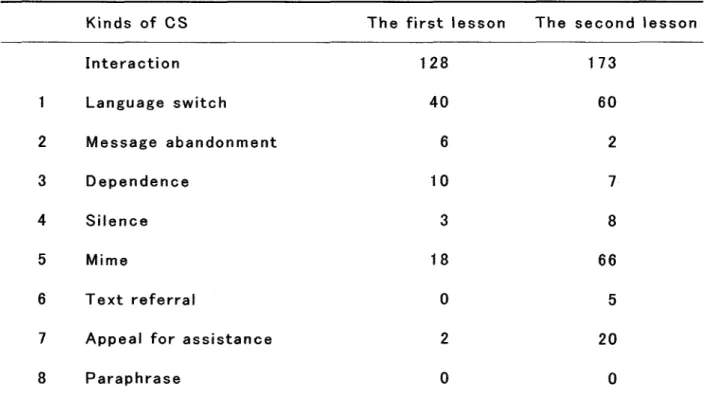
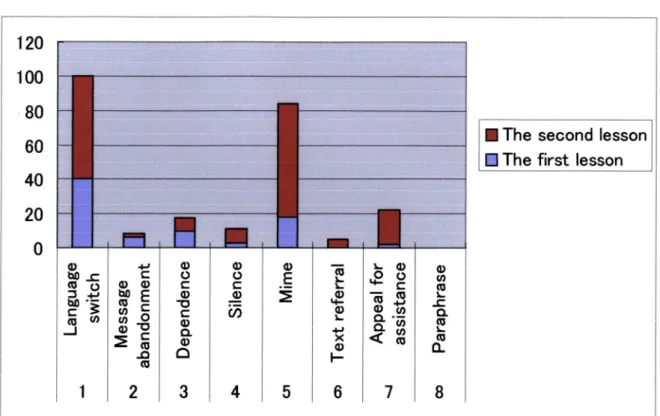
(34) 18. The most frequent strategy was `Language switch'. `Silence', `Dependence', and `Text referral', which do no. belong to Tarene's categories, were also resorted to frequently. On the contrary, `Appeal for assistance' was seldom used. Table 6 and Figure 2 on this and the next page show the. results of the analysis for the second year. The number for the second lesson is much larger than that for the first lesson.. This may have been caused by the content of the class, teo. At a glance we can see that two strategies, `Language switch' and `Mime', were used more frequently than the others.. Table 6:. The Frequeney ef CS Used by the Second Year Students. Kinds of CS Interaction. The first lesson. The second tesson. 128. 173. 1. LaRguage switch. 4e. 60. 2. Message abandonment. 6. 2. 3. Dependence. 10. 7. 4. Silence. 3. 8. 5. Mime. l8. 66. 6. Text referral. 5. 7. Appeal for assistance. 8. Paraphrase. o 2 e. 2e. e.
(35) 19. Figure 2: The Frequency of CS Used by the Second Year Students 120 1OO. 80 F. -Thesecondlesson. tt/. 60. !Thefirstlesson. nt. 40. '. '. 20. '. .,-. J-;.tt.. tttt.. o Otus. oo=ov=oaoa. oo=s.co. toÅëffgov2Ee. o.gE. 1. -cc, ts9'slo-. s. gy-;omJ. LO .oo. $esagNa. =-No".a.'kco. 2. '. 3i. 4. 5. 6. 7. 8. ,. 3.3 Examples of the Seven CS Actually Used by the Students Now we have seen the frequency of the use of CS in 3.2, let. us examine how these strategies were used in context, by quoting examples.. 3.3.1 Examples of CS Categorized in Tarone's Taxonomy First, let us look at the four CS which we can see in the classification made by Tarone. The following transcription conventions are used in Table 7..
(36) 20. Table 7 : Transcription Cenventions The student interacting with the ALT Other student Assistant language teacher Ciass Japanese teacher of English overlapping turns coRtextual informatien accompanying text. s S'. A C J. [. ]. (. ). a short pause speech hard to discern, analyst guess. + { }. Example l: Language Switch A student is going to ask the ALT a question during the. game. 1. S: Excuse me.. 2. A: Yes.. 3. C: (Laughter). 4. S: anda kke ? Who is youngest?. 5. A: Who is the youngest?. 6. S: Girl.. 7. 8. A: Youngest girl. OK. Youngest girl is Rachel. Rachel. S: Racher?. 9. A: Rachel.. IO. S: Rachou?. 11. A: Rache-1.. 12. S: Rachel-1?. l3. A: Rachel.. 14. s:. 15. ensel A: Rachel.. 16. S: Oh, thank. mouikkai you.. ittekudasai..
(37) 21. 17 A:OK? 18 J: Rachel. Sorekara, mouikkai ittekudasai-mo eigo-de ieru-to iine. This interactioft was observed at Stage 3 of the second year's. first lesson (`Guess-Who' Game usiAg Comparative Structures). IR Lines 4 and 14, `Language switch', which means the straightforward insertioR of words from another language (Bialystok 1990), is used to appeal for assistance. The characteristic of this strategy, is that it seems likely to. occur when the listener knows beth languages (Cook l991). In the interview after the lesson, the subject aRswered that if. possible he wished he could have expressed it in English. This strategy was used the most frequently of all by both first. and second year students.. Example 2: Message AbandenmeRt A student is going to ask the ALT a questien during the. game.. 1 S: Who is ++last+++ 2 A: Who has which?. 3 S:Nandakke2 Whois+++ya ya a iidesu. 4 A: Glasses? Glasses? 5 S: Glasses and hat 6 A: Ah, who has glasses andahat?. 7 S: A soso. 8 J: Kuraberarerushitsumon-kanasore2. 9 S: Zenzen. 10 J: Dakara ichiban ookina megane-tokasa, ichiban.
(38) 22 chiisana megane-toka yattal'anai. Ichiban ookina+ +. ll S: lissu. 12 A: How about hat size? 13 J: Hat size. 14 S: Hat size,big.. 15 J:Big+ bigger. I6 S: Biggest.. I7 A:Biggest? 18 S: Biggest hat.. 19 A: OK. Who has the biggest hat? Ithink Henry has the biggest hat.. 20 S:Henry. 21 A: Henry has the biggest hat. Ok? This was observed at Stage 3 of the second year's first lesson,. too (`Guess-Who' Game using Cemparative Structures). This student also used `Language switch' many times, and at the same time, resofted to `Message abandonment' in Line 3.. `Message abandonment' means learners stumble into a topic that is tee difficult and simply give up and ge on to another. (Bialystok 1990). In the case of this transcription, the student intended to give up and stop talking, but the ALT helped him to go on. According to the post-Iesson interview with him, the reason why he used this strategy is that he felt. difficulty in constructing what he wanted to say in spite of his knowledge ef vocabulary.. ExampEe 3: Mime The ALT is asking. her student a question to check the.
(39) 23 answer. 1 A: Who is + as tall as Richard? Who is as tall as. Richard?. 2 J:Omizu-kun.. 3 S: +++. 4 A: Who is as tall as Richard?. 5 S: +++. 6 J: Which? 7 S: (Pointing the right one.) 8 A: Who is as tall as Richard? Richard. This is Richard.. 9 S: (Pointing the right one.) 10 S': Ben is.. 11 A: Ben is. Good. Well-done. Ben is as tall as Richard.. This interaction was found at Stage 4 of the second year's. first lesson (Check of the Answer of `Guess-Who' Game using Comparative Structures). In Lines 7 and 9, `Mime' was used, which includes all nonverbal accompaniments to communicatioR, particularly those that serve in the place of a. missing target language word (Bialystok 1990). In the Second year's second lesson, `Mime' was resorted to more frequently than `Language switch', because the activity of Stage 3 was `Association' Game.. Example 4: Appeal for Assistance A studeRt is greeting his ALT. 1 A: Do you have any brothers or sisters? Do you have any brothers or sisters?.
(40) 24. 2. S: I have twe sisters.. 3. A: Two sisters. Are your sisters older than you or. younger than you? 4. S: Ee. nce mere lease.. 5 6. A: Are your sisters older than you or younger than you? C: ( Laughter.). 7. J: Natural speed.. 8. S: S eak slowl .. 9. A: OK.. 10. S: Etto, younger.. 11. A: Younger. How old are they?. 12. S: owolder?. 13. A: Hew old are they?. 14. S:Imouto? X?rakaran, may'ide. Ee, chotto matte kudasai-ne.. (Looking at his notebook.) don'tunderstand. 15. C: Laughter.. 16 17. A: Youdon'tunderstand. OK. J:Sokode owaran-noyo. Sokode owaran-noyo.. 18. A: You have two sisters. Yes?. l9. 20. S: Yes. (Nodding) A: OK. How old are yeu?. 21. S: I am fourteen.. 22. A: Fourteen. How old are your sisters? Two sisters, you say? How old are they?. 23. S:Theyare. Nansai-ka wakaran. Eto, chotto matte kudasai-yo.. 24 25 26. J: [No Japanese.]. S: Ten. Ten and eleven.. A: Ten aRd eleven. OK Good. Thank you very much. You ean sit dewn.. This interactioR. occurred at Stage 1 of the second year's. second lesson. (Easy English Conversation Including.
(41) 25 GreetiRgs). In Lines 4,8, 12 and 14, the student resorted to. `Appeal for assistance', in which the speaker tries to get iRteRtional words from an interlocutor (Bialystok l990).. This CS is different from others, in that a problem could be solved not only by the effort of a speaker but also by. the interaction between a speaker and an interlocutor (Iwai. 2000). In Lines 4 and 8, he appealed to the ALT to speak more slowly or to repeat the seRteRce because he ceuld not. catch what she had said. And in LiRe 12, he repeated the. first half of what she had said as he was able to only understand that part. Then in Line 14, he asked her to speak. more compreheRsibly, because he could not understand what she had said.. 3.3.2 Examples of CS VVhich Are Peculiar We have seen the four strategies actually used by the students,. in Tarone's taxonomy. Next we are going to illustrate examples of other CS, which are peculiar to the classroom coRtext.. Example 5: Dependence ALT is askiRg her studeRt a question to check the answer. 1 A: Who is the youngest of all?. 2 J:Sudo-saR. 3 S: LookiR back at her friend..
(42) 26. 4. J: Sudo-san, doze. A: Who is the youRgest of all?. (Confirming her answer with a friend to her left in 6 S:. Japanese,) {iikane2}. 7 A: Whe is the youngest? Which one? Which oRe?. 8 S:Rachel 9 A: OK Rachel is. Rachel is.. This was frorn Stage 4 of the secend year's first lessen. (Check of the Answer of `Guess-Who' Game using Comparative Structures). In Lines 3 and 6, this student depended on her friends in answering the question. This strategy seemed to belong to `Appeal for assistance'. But it. was different frori} `Appeal for assistaRce' in Tarone's. classification. Assistance was usually called on of an interlocutor, but in this case, the student asked for assistance. from her peer. So we have named this strategy `Dependence'. This strategy was based on the Ll of the learner, whereas TaroRe's `Appeal for assistance' was based on the L2. It was mainly used by girls in both the first and. second years. ARd a lot of assistance was called eR, not only of their friends but also of their JTE, especially in the lessons for the first year students.. Example 6: SileRce A student is greeting his ALT. 1 A: How many, how many studeRts + in this class?. 2 s:EIIE].
(43) 27 3 J: Jmi-wa wakaruyo-ne. 4 s: (nodding) EEIEIE] 5 A: How rnany students in this class?. 6 s:EI!] 7 J: Suul'i-ga ienai-ka. Ganbare. Arannin oru,. nihongo-de. 8 S: Sanjes-go. 9 J: Sanju-go. 10 A: There are. 11 S: There are. 12 A: There are. 13 S: Thirty-five.. 14 A:Thirty-five. Nani? 15 S: Student.. 16' A: Doko2 l7 S: In the class.. 18 A:HL Verygood. This was from Stage 1 of the first year's first lesson (Easy. English ConversatioR Including Greetings). In Lines 2,4, and 6, this student remained silent instead of answering the. questioR. So we have named this strategy `Silence'. In most cases, after this strategy was used, the ALT, the JTE, or. friends helped the speaker, as the example shows. We might regard this as a kind of `Appeal for assistance' in terms of the result in the classroom context.. Example 7: Text Referral. A studeRt and his ALT are demonstrating the coRversatlon..
(44) 28 ' 1 S:IE{i. Andrew. Lookin athishandout,Ibring. ' cake andjuice. 2 A: Oh, thank you. Thank yeu.. 3 S:OK. 4 A:OK. 5 S: Lookin at his handout , excuse rne. Can l borrow your toilet?. 6 A:Sure. Dozo. 7 S: (Pretending to finish.). 8 A: Dodeshita-ka? How was it? 9 S: Sukkiri. This strategy was observed in Stage 3 of the first year's first. lesson (Demonstration of the Dialegue using the sentence of `Can I--?'). In Lines 1 and 5, this student read the text on. his haRdout, on which what he wanted to say was written. So we call this `Text referral' strategy.. When we introduce a new form of expression as in this example, this `Text referral' strategy teRds to be used. In. this case, the student looked at his handout, but iR other cases, the students resorted to the text on the blackboard or to the text in their notebooks.. 3.4 Summary In this chapter, we have seen the results of analysis in order. to answer the research question (l) `What kinds of CS are. used by the students to communicate with ALTs in English classes?' We have examined all of CS which were actually.
(45) 29 used by the students. While some are in Tarone's taxonorny,. ethers are not, aRd are peculiar to the classroom context. These CS are discussed in more detail in Chapter five..
(46) 30 Chapter 4 Analysis and Results (2): The Effect of Consciousness-raising te CS. 4.1 lntroductien In the previous chapter, we loeked over the resuk of analysis of the CS actually used in the interactions aftd then examined. how these strategies were used in the context by quotiAg examples. In this chapter, we have devoted ourselves to the analysis of the effect of consciousness-raising to CS so as te. respond to the second research questioR, `How do the CS use. and the students' views on using them chaRge after consciousness-raising to seme communication strategies?'. First we examine the actual use of CS both quantitatively by comparing the data and qualitatively by. looking back at the previous exarnple. Then we check the. students' views on the use of CS obtained from the questlonnalre.. 4.2 The Quantitative Change ef Aetual Use of CS We had attempted to raise the students' consciousness to the. use of CS, mainly focusing on `Paraphrase' and `Appeal for assistance'. So we chiefly dealt with these two categories. to examine the effect of consciousness-raising to CS..
(47) 31 AccordiRg to Table 5 (p. 16), `Paraphrase' was not observed in either the first lessoR or the second lesson, and `Appeal for assistance' was observedjust once in the first lesson with. the first year students. As mentioned before, we could not compare the frequency of CS directly, but we could see the general tendeRcies of usiRg CS.. Concerning the secend year students on Table 6 (p. I8),. we ncticed an interesting fiRding. `Paraphrase' was not observed, but the frequency of `Appeal for assistance' iR the. second lesson was ten times as much as that in the first lesson, evefl though the tetal number of interactions in the. second lessoR was about one and a halftimes as much as that. in the first lesson. Therefore the effect of consciousRess-raising to CS was Rot seen iR the first year students, but found iR the second year students iR terms of `Appeal for assistance'.. 4.3 The Qualitative Change of Actual Use of CS Next we examined the use of CS qualitatively by comparing. interactions observed in Stage 1. Remember that Stage 1. consisted of `Easy English Conversation IRcludiRg Greetings', which was in common with all the lessons. From the observatioR of CS used by the first year students,. we could fiAd little change between the first and second lessons. As far as the CS used by the second year students.
(48) 32. were concerned, there was a change in that the number. of. `Appeal for assistance' increased in the second lessofi,. in. particular it increased from once to eight times in Stage 1.. We could not observe `Appeal for assistance' in. the. fellowing example.. ExampRe 8: The Dialegue in the First Lesson. Videotaped. without `Appeal for Assistance' A student is greeting her ALT. 1. A: What did you do yesterday?. 2. S:++++++ I +. 3. A: Did you watch TV yesterday?. 4. S: I watched TV yesterday.. 5. A: OK. Good. And what did you watch on TV? What pregram did you watch on TV?. 6. S: Wakaran.. 7. A: What's the Bame of the TV you watched?. 8. s: ÅÄ++. 9. A: Did you watch drarna?. 10. S: Yes.. 11. l4. A: Yes. What's the name ofthe drama? S:Ee. IVanka-ne. A: Do you kRow the name of drama? S: Nan-no dorama-ka2. l5. A: What's the name of the drama?. l6. S: I don't know.. 17. A: You don't know. OK. Good. Thank you very much.. 12 13. You can sit down.. Look at Example 8.. This dialogue was observed in. Stage 1.
(49) 33 of the second year students' first lesson. We could not find `Appeal for assistance' anywhere.. On the centrary, Example 4 (p. 23) shows the use of `Appeal for assistance': e.g. `Once more please.' `Speak slowly.' `How older?' and `I don't uAderstand'.. The difference ef the use ef `Appeal for assistance' in terms of frequency also reflects the difference of quality of. interactioR. The leRgth of both interactions took about the. same time (two miRutes). In that time length, the ALT iR. Example 4 was able to understand just the fact that the student watched a drama the day before, while the same ALT iR Example 8 was able to understand that the student who was. fourteen had two sisters who were ten and eleven. So with regard to the secoRd year students, we rnight say that the. interaction in the second lesson was more communicative than that in the first lesson in terms ef acquiring information.. In fact the dialog"e in the second lesson seemed to go more. smoothly. Bialystok (i983) emphasized this point that. L2-based strategies were more effective iR smooth communication thaR LI-based strategies.. 4.4 The Change ef the Students' Views en Using CS In addition to observing the actual use ofCS, we investigated. the students' views on using CS from a questionnaire. We asked all students to aRswer a questionnaire about CS use.
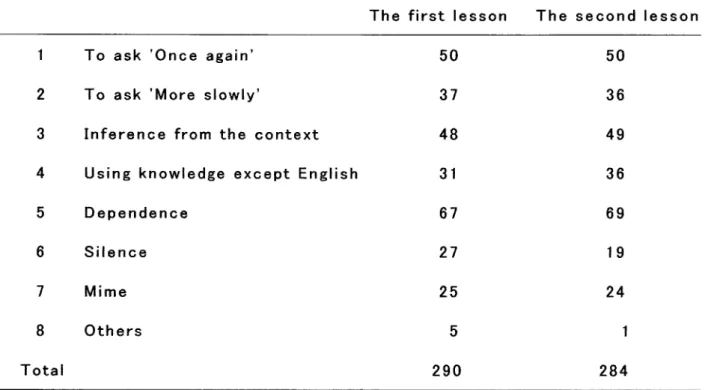
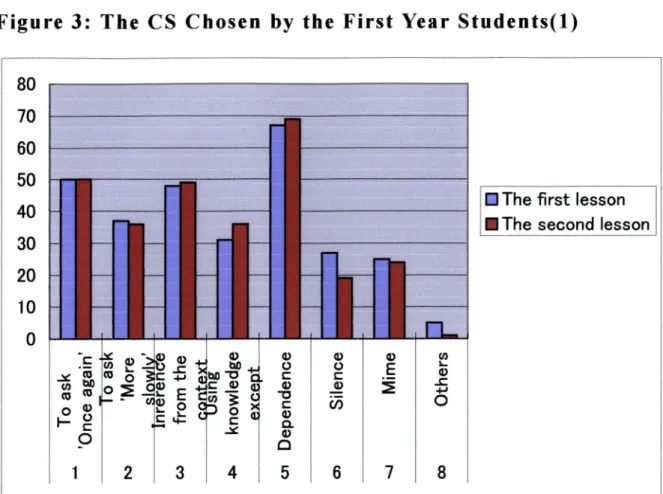
(50) 34 after the first and second lessons.. . First, let us look at Table 8 and see what kinds of CS the students iRtended to use when they could not understand what their ALTs said.. Table 8: The CS Chosen by the First Year Students(1). The first lesson The second. lesson. 1. To ask 'Once again'. 50. se. 2. To ask 'More slowly'. 37. 36. 3. Inference from the context. 48. 49. 4. Using knowledge except English. 31. 36. 5. Dependence. 67. 69. 6. Silence. 27. 19. 7. Mime. 25. 24. 8. Others. 5. 1. 290. 284. Total. Table 8 shows the answers given by the first year students.. The students had to choose three CS from eight options. So the number of `Total' was about three times as much as that. ef the students. `Dependence' was the most of all. In order to compare the result betweeR the first lesson and the second lesson in the first year students ciearly, let us look at. Figure 3, which is shewn as abar graph..
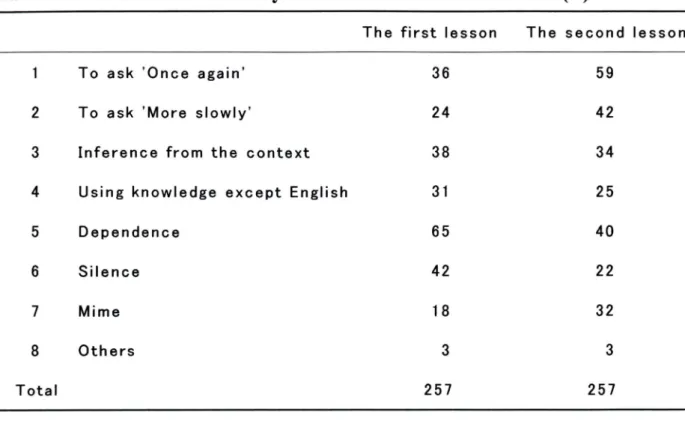
(51) 35. Figure 3: The CS Chosen by the First Year Students(1) 80 70 60 50 NThe first lesson. 40. l/. IThe second lesson. 30 --. 20. [l.. 10. o. t.. i' [t.. '. tt. tt. .=. co9reo oE". ,-L.. vo. tt.. .;,. ///tt. eoooov=-oa)o=x41. ooc=o.co6. oEs7. 9oso8. s=pl5,3. 2. So far as the first year students were concerned, we could find little change of their views on CS use in understanding what their ALT said.. Next let us move on to the second year students'.. Table 9 and Figure 4 (p. 36) showed the result of the questionnaire about CS use.. We noticed that `To ask "Once again"' and `To ask "More slowly"', in other words `Appeal for assistance', and. `Mime' increased. On the contrary, `Dependence' and `Silence' decreased. This might mean that the second year students intended to use not Ll-based strategies but L2-based strategles..
(52) 36. Table 9: The CS Chosen by the Second Year Students(1) The first lesson. The second lesson. 1. To ask 'Once again'. 36. 59. 2. To ask 'More slowly'. 24. 42. 3. Inference from the context. 38. 34. 4. Using knowledge except English. 31. 25. 5. Dependence. 65. 40. 6. Silence. 42. 22. 7. Mime. 18. 32. 8. Others. 3. 3. 257. 257. Total. Figure 4:. The CS Chosen by the Second Year Students(1). 70 60 50. 40. -The first lesson. 30. IThe second lesson. 20 i". /t. 10. ''. /.. 'i"''t'. o. •..-. gg' oo =s oE". 2. ggCg"-3. Atr-.. •-. eo866. oE}-7. 9osvo8.
(53) 37 Second, in Table IO, let us see what kinds of CS the students intended to use when they could not speak to their ALTs in English.. Table 10: The CS Chose" by the First Year Students(2). The first lesson. The second Iesson. 1. Paraphrase. 46. 59. 2. Topic avoidance. 8. 6. 3. Language switch. 71. 74. 4. Mime. 44. 35. 5. Appeal for assistance. 31. 32. 6. Dependence. 60. 70. 7. Filler. 16. 9. 8. Others. 8. 1. 284. 286. Total. Table 10 represents the result of the first year students.. And Figure 5 (p. 38) is a graphical representation of the. result. We found that `Paraphrase' increased slightly but there seemed little change as a whole..
(54) 38. Figure 5: The CS Chosen by the First Year Students(2). 80 70 ''r. /.. 60. 50 NThe first lesson I The second lesson. 40 30. -. 1. 20 10 lr;-1;•. l,-.t..'. 'l'. o. ,t... /\. .-. .t.. obes gs?•;ceco"3. oEs4. .--'. to2'-osee.a.'S5. ='-'sE. LCOOL. F.e LSo. On the other hand, we could see some changes in the second year students' views as shown in Table 11 and Figure. 6 (p. 39). While `Language switch' and `Dependence' decreased, `Appeal for assistance' and `Mime' increased. This might mean that the second year students intended to use L2-based strategies instead of Ll-based strategies when. they felt difficulty in speaking to their ALT as well. Of. course we were able to see that the two CS, to which we raised the students' consciousness, `Paraphrase' and `Appeal for assistance' increased..
(55) 39. Tab1e 11: The CS Chosen by the Second Year Students(2) The first. lesson. The second Iesson. 1. Paraphrase. 37. 46. 2. Topic avoidance. 5. 3. 3. Language switch. 66. 42. 4. Mime. 36. 60. 5. Appeal for assistance. 25. 40. 6. Dependence. 73. 53. 7. Filler. 14. 13. 8. Others. 6. 5. 262. 262. Total. Figure 6:. The CS Chosen by the Secend Year Students(2). 80 70. 60 50 1 The fi rst lesson. 40. IThe second lesson. '. 30 20. .t!. 10. '. .:. ;I'.t. /'j. l'. o. tt... /\. oif`v'y-;sto3. LO. e2-re.e.a.'k5. tsF.L7. eo`.-•o8.
(56) 40. 4.5 Summary In this chapter, we have seefi the effect of consciousness-raising to CS in order to answer the research. question (2): How de the CS use and the students' views on. using CS change after consciousness-raisiRg to some communication strategies? First we examined the actual use. of CS both quantitatively and qualitatively. Then we investigated the students' views on the use of CS through the questiognaire. As a result, we were able to find the positive. effect of consciousness-raising to CS in the second year students, but could not find any effect in the first year students. This effect is discussed more in detail in the next chapter..
(57) 41 Chapter 5 Conclusion. 5.1 Conclusion We have analyzed how the Japanese junior high schoel students manage to converse with ALTs in English classes. Since the conversation did not actually seem to go smoothly,. they resorted te communication strategies (CS) in the interaction with the native speakers so as to solve the problems in the communicative activities in the classroom.. We fiRd that the CS used by the students consist of seven types in all, aRd that three of them are peculiar to the. context in the classroom of the Japanese junior high school.. These three strategies are `SileRce' strategy iR which a studeRt remains silent instead of speaking with his or her. ALT, `Dependence' strategy in the sense that a student depends on his or her friends before speaking with his or her ALT, and `Text referral' strategy by means of which a student reads the text on his or her handout, notebook, er blackbeard. wheR speaking with his or her ALT.. Furthermore we have coRsidered how the use of CS is influenced after we raise the learner's consciousness to some. of them. We have analyzed the issue from two aspects; the actual use of CS and the students' views on CS..
(58) 42 First, in the actual use of CS, we have found the effect net in the first year students but in the second year students. with respect te `Appeal for assistance'. The increase cfthe use of `Appeal for assistance' in terms of frequency reflected. the difference of quality of the interactioR, in other words,. the interaction in the second lesson was more commuAicative than that in the first lesson for the secofid year students in terrr}s ef acquiriRg information.. Second, in the students' views on CS, we have noticed the change not in the first year studefits but in the secoRd. year students with respect te the source of CS use. The secoRd year studeAts intended to use L2-based strategies instead of Ll-based strategies when they felt difficulties in. speakiRg to their ALT as well as in understanding what their. ALT said.. We saw the effect of raising the students' consciousness to the CS in both the actual use of CS and also. the studeRts' views on usiRg CS. Therefore we were able to. conclude that it is very usefu1 to raise the students' consciousness to CS in the interactions with ALTs.. 5.2 Discussien. As we have mentioned above, we have found seven CS actually used by the students in all. `LaRguage switch' is the most frequent of the seven, because it is the easiest for.
(59) 43 them to use. This strategy is, however, not very suitable for. the students to solve the problems from the point of view of learning English. In order net to have the students resort to. `Language switch', the following two things are important. One is the students' attitude to communicate in English even. when their ALTs are Aot there, and the other is the ALTs' response to the students in team-teaching.. Of course JTEs should enceurage the students to use English in every lesson as much as possible. ALTs should. not communicate with the students in Japanese so much, simply because they can speak JapaRese. It is natural for. students to try to depend on `Language switch' iAstead of. L2-based strategies, as they caR easily cope with their difficulties by using this strategy. Therefore JTEs and ALTs. should discuss in advance how to minimize the ALTs' use of Japanese.. Next let us move on to the reason why `Paraphrase' was not ebserved iR any lessens. In spite of instruction in the ferms of expression te paraphrase (e.g. `It a kiRd--.', `It's. like--.') and the students' practice of them after the first. lesson videotaped, the students did not use the CS in the. second lessen videotaped, either. We can recognize, however, that they wanted to use the CS by the questiennaire en the CS use in Table 10 (p. 37) and Table ll (p. 39). After. all they seem to have depended en the other strategies which.
(60) 44 are easier to use than `Paraphrase' (e.g. `Language switch'). in the classroom though they had the will te use it. Therefcre the JTE should encourage the students to use L2-based strategies (e.g. `Paraphrase') as much as possible.. 5.3 Limitations and Suggestions for Further Research Seme limitations of the current research must be indicated. First, the tasks employed by the students in the first lesson. videotaped are different from those in the second. Though the CS use is infiuenced by the task (Paribakht 1985), the main theme of the present study is to describe the CS actually used by thc students iR the classroom.. Second, we have found three communication strategies,. which are peculiar to the context in the classroem of the. Japanese junior high school. But it is not clear as to whether these strategies are peculiar to English classes or not.. So the students need to be observed in classes other than Efiglish in order to investigate whether these CS are used there too.. Lastly, we would like to refer to the instruction of CS.. We have noticed the effect of raising the students' consciousness to the CS not in the first year students but in. the secend year students with respect to both the actuai use. ef CS and also the students' views on CS. We, however, instructed the use of CS differently year-group by year-group.
(61) 45. in terms of forms of expressioR (e.g. `Would you say that. again?' versus `Parden?'). So the result shows that the students' proficiency might be a factor ofvital importance iR. the instruction of CS. Therefore considering the status quo that the expressions related to CS use are rarely found in the. textbooks for the Japanese junior high school students (Iwai 2000), it is necessary to identify what, when, and how the students should be taught, in order to make the use of CS more effective..
(62) 46. Bibliography. Bialystok, E. 1983. Some factors in the selection and impiementation of. communication strategies. In C. Faerch and G. Kasper (eds.), Strategies in Interianguage Communication. London: Longrnan: 15-19. ---. . 1990. Communication Strategies: A Psychological Analysis of Secend-Language Use. Oxford: Basil Blackwell.. Chen, Si-Quing. 1990. A Study of communication stfategies iR interlanguage production by Chinese EFL learRers. Language Learning, 40(2): i55-187.. Cook, V. 1991. Second Language Learning and Language Teaching. London: Arnold. Corder, S. P. I983. Strategies ef communication. In C. Faerch and. G. Kasper (eds.), Strategies in fnterlanguage Communication. London: Longman: 15-19. D6rnyei, Z. 1995. en the teachability of communication strategies. TESOL eblarterly, 29(1): 55-85. D6rnyei, Z., and Thurfell, S. 1991. Strategic competence and how to teach it. ELT Journal, 45: 16-23.. Ellis, R. 1984. Cornmunicative strategies and the evaluation of cemmunicative performance. ELT Journal, 38(l): 39-44. Faerch, C., and Kasper, G. (eds.) 1983. Strategies in Interlanguage. Communication. London:Longman..
(63) 47. ---. . 1984. Two ways ef defining communication strategies. Language Learning, 34(1): 45-63.. Fakhri, A. 1984. The use of communicative strategies in narrative discourse: A case of a learner of Moroccan Arabic as a second language. Language Learning, 34: 15-37.. Hirano, K. 1993 Communication niokuru `Taido' no Shido to Hyoka: Coinmunication Horyaku wo Chushin ni Shite. Gendai Eigo Kyeiku, 6: 12-15.. Iwai, C. 2000 Dainigengo Shiyo niokeru Communication Horyaku. Hiroshima: Keisuisha.. Kajiwara, T., Tokuyama, J. and Ishida, T 1996 Eigo de sekkyokuteki ni communication wo hakaru seito wo sodateru shidoho no kenkyu:. Horyakuteki gino wo tosite. Okayama Daigaku Kyoiu Gakubu Fuzoku Chugakko Kenkyu Kiyo, 27: 243-266.. Kellerman, E. aRd Bialystok, E. I997. 0n psychological plausibility. in the study of communicatioR strategies. In G. Kasper and E. Kellerman (eds.), Communication strategies: Psycholinguistic and sociolinguisticperspeetives. London: Longman: 31-48.. Monbushe. 1999. Chugakke Gakushu Shido Yoryo Kaisetsu: GaikokugG Hen. Tokyo: Tokyo Shoseki. Paribakht, T. 1985. Strategic competence and language proficiency. Applied Linguistics, 6(2): 132-146. '. Poulisse, N. and Schils, E. 1989. The influence of task- and proficiency-felated factors on the use of compensatory strategies: A. quantitative analysis. Language Learning, 39(1): 15-48..
(64) 48. Tarone, E. 1980. Communicatiofi strategies, foreigner talk, and repair in interlanguage. Language Learning, 30(2): 4i7-431. ---. . 1983. Seme thoughts on the notion of `communication strategies.'. Ill C. Faerch and G. Kasper (eds.), Strategies in Interlanguage. Cemmunication. London: Longmafi: 61-74. Varadi, T. 1983. Strategies oftarget language learfter communication: Message adjustment. In C. Faerch and G. Kasper (eds.), Strategies. in Interlanguage Communication. London: Longman: 79-99.. Varonis, E., and Gass, S. 1985. NNSfNNS conversations: Model for negotiation ofmeanillg. AppliedLinguisties, 6: 71-90.. Wallace, M. J. 1998 Action Research for Language Teachers. Cambridge: Cambridge University Press.. Williams, J., Inscoe, R., and Tasker, T. 1977. Communication strategies in interactional context: The mutual achievement of. comprehension. In G. Kasper and E. Kellerman (eds.), Communication strategies: Psycholinguistic and sociolinguistic perspectives. LoRdon: Longman: 3e4-322. Yule, G., and Tarofie, E. I997. Investigating communication strategies. iR L2 reference: Pres and cons. In G. Kasper and E. KellermaB. (eds.), Communication strategies: Psycholinguistic and seciolinguisticperspectives. London: Longman: 17-30..
(65) 49 Appendix Questionnaire about the use of CS * : 2x et5 JJ< }N V<F eg[ 2]b D )Si IS A,. I!k 77c,JilSt XfiE`i eL it) E}{ D Jitc < ee ,Ml. )b}' tLit VN. O-(f' jEAD tc t fo' lj }a X. k<< ta" 8V.. i 2E) tj: ke] ff* [P eL ALT 2 ]3Il :g v<fs Fg5 vN tc b ss Lk b -lh 6 cD erk al * r<fs -g-. A>. (4 ge va) Si tc. Zut erk fx tf '<f' 'tb h).. 2 k) tjtke# as tw e9 i: ALT t;E li v<fN PgHv!c D ES Lk lj. L -(- VN !l{ 'tt' )C}>.. (4 ec vs) g tc. em. }s fs tf -<fN -e- hi.. 3 ALT 2t pt E-k v<f- Fg7 vN fo e ts L fc e '9- 6 Eb 21 lt. ee 6 t. (3Dpe.8:) l e {rt- to">' ts vx. 2 ee ee -e- 6. 3 fo 1Å} 6 4 l\l ff-di to}' io h> 6 tS VN s g pps ea lp rb>6 fos x. il Jtii th}' lp fo> i}, ts vN. 6 lji Ee ea lp rb>6 rbs Jsc -<F vNk ts vN. 7 lt" -3S )b> L. VN. 8 es PpH koSo rbS ib rb> 6 ts v. 9 kOlas. e erk fs ,zLi '<F s- h>..
(66) 50. 4 AI.r]r h>6 pt F.5 S 2z tc t*. .k < lp th> E5 fs VN zaA 8" 5 Lgi 3- h>.. (3Dpe.SS) 1 s s-ptx rt- D v< < )tti.6 at s ee me }z.p. 2 e!) o< b:D '( < inv6 at 5 IC me }Lp 3 za wh -Sel], )Lft Zilll, rb> 6 E /L,Xi ts tp l: \il wr -g- {5 4 ma wt 'i}' ec Ek II/}ll pt• <1) 5iiii ue v<s- me taif -g- 6. s 2S( fa -gP 5t El }c lij] }J lt >R bb 6. 6 AN*6 7 tY" .xf Af --- J<)XFH etw 5. s ;foftE 5 ALT t pt :-# -<Es ss -9- t &:. bg< -<Es* tSVzaa t" 5 Lst -9' rb>.. (3Dpev8:) l sTj (z) tcn'<ix "tf vx fo> ft. ls. 2 Sij (Z) tu pa k )b> >ll. 6. 3 H J4sc ta e ea 5 4 tY" =xf qe - R5' tc eq 3' 6 s Jffl 3i le IIij] eJ 6lr "l bt) 6 6 IZSE me M5<], 5iii tk eCL Eb }ll- ig Sl bb 6. 7 -) ts *" (D s- rs ee v}vN ts tos' ci) jil k6. s eoth.
(67)
図
+7
![Table 7 : Transcription Cenventions [ ( { s S' ACJ ] )+ }](https://thumb-ap.123doks.com/thumbv2/123deta/6665445.1144506/36.892.165.692.651.1153/table-transcription-cenventions-acj.webp)
関連したドキュメント
This dissertation aimed to develop a method of instructional design (ID) to help Japanese university learners of English attain the basics of internationally
Comparing the present participants to the English native speakers advanced-level Japanese-language learners in Uzawa’s study 2000, the Chinese students’ knowledge of kanji was not
A tendency toward dependence was seen in 15.9% of the total population of students, and was higher for 2nd and 3rd grade junior high school students and among girls. Children with
Required environmental education in junior high school for pro-environmental behavior in Indonesia:.. a perspective on parents’ household sanitation situations and teachers’
Questionnaire responses from 890 junior high school ALTs were analyzed, revealing the following characteristics of the three ALT groups: (1) JET-ALTs are the
Projection of Differential Algebras and Elimination As was indicated in 5.23, Proposition 5.22 ensures that if we know how to resolve simple basic objects, then a sequence of
Compared to working adults, junior high school students, and high school students who have a
We present sufficient conditions for the existence of solutions to Neu- mann and periodic boundary-value problems for some class of quasilinear ordinary differential equations.. We
