Inflation Regime Shifts and Relative Price
Variability
journal or
publication title
経済学論究
volume
65
number
3
page range
59-81
year
2011-12-20
URL
http://hdl.handle.net/10236/9037
Inflation Regime Shifts and
Relative Price Variability
∗
Eiji Fujii
This study provides a detailed empirical investigation of the relationship between inflation and relative price variability (RPV) using the Japanese consumer price sub-index data. In so doing, we pay particular attention to implications of inflation regime shifts. Over the past four decades, the Japanese economy has gone through diverse phases of inflation environment − the oil shocks in the 1970s, the bubble economy in the 1980s, the burst of the bubble and the financial turmoil in the 1990s, and the subsequent era of protracted deflation. These dramatic shifts in the inflation environment implicate changes in underlying disturbances, policies, and agents’ reaction. The empirical evidence we obtain suggests that the inflation-RPV nexus has indeed been transformed.
Eiji Fujii
JEL:E31
キーワード:相対価格の変動、構造変化、インフレーション・レジーム、消費者物価指数 Keywords: relative price variability, structural break, inflation regime, CPI
1. Introduction
The nexus between inflation and relative price variability (RPV) has been a significant research issue. In the market system, relative prices assume a pivotal role in allocating resources to competing purposes. If changes in nominal prices intrinsically lead to variation of relative prices,
* The author gratefully acknowledges the financial support from the Zengin Foun-dation.
Address for correspondence: [email protected]; Eiji Fujii, School of Economics, Kwansei Gakuin University, 1-155 Uegahara Ichiban-cho, Nishinomiya, Hyogo 662-8501, Japan.
then there is real cost to inflation and deflation in terms of reduced effi-ciency in the resource allocation. Thus, the ramifications of the issue are imperative.
While a plethora of studies have examined the nexus between inflation and RPV, there is surprisingly little consensus in the extant literature regarding the nature of the relationship and its significance. Numerous studies (Fischer 1981, 1982; Parks 1978; Parsley 1996) report significant positive association between inflation and RPV albeit in various forms. Others, however, suggest that they are in fact negatively associated with one another (Fielding and Mizen 2000, Reisndorf 1994). Yet, some others argue that the association is insignificant or unstable (Lastrapes 2006).
A particular complication for the empirical investigations of the issue is that, as Fischer (1981) points out, there is not likely to be a single stable relation between inflation and RPV. The relation may vary depending on the nature of disturbances that dominate in particular periods in shaping
the dynamics of inflation and RPV.1)In this sense, it is only conceivable
that the preceding studies report substantially varying empirical results since they differ in their sample countries and periods. A comprehensive investigation of the issue, therefore, requires a careful account of effects of changes in inflation environment. The point, despite its importance, is not
adequately addressed by many extant studies.2)
In the current study, we provide a detailed empirical investigation of the inflation-RPV association using the Japanese consumer price sub-index data. In so doing, we pay particular attention to implications of inflation
regime shifts. Over the past decades, the Japanese economy has gone
1) For instance, Lastrapes (2006) finds that the inflation-RPV relationship in the US broke down in the mid-1980s.
2) For a few exceptions, see Becker and Nautz (2009), Dab´us (2000), and Lastrapes (2006).
Fujii:Inflation Regime Shifts and Relative Price Variability
through diverse phases of inflation environment − the oil shocks in the
1970s, the bubble economy in the 1980s, the burst of the bubble and the financial turmoil in the 1990s, and the subsequent era of protracted defla-tion. These dramatic changes in the inflation environment may implicate changes in underlying disturbances, policies, and agents’ reaction. Hence, the Japanese experience may reveal different aspects of the inflation-RPV nexus.
We acknowledge that the current study is not the first to consider implications of inflation regime shifts in the context of the inflation-RPV
relationship. Dab´us (2000), for instance, examines the issue for Argentina
by breaking the sample into the moderate, high, very high inflation and hyperinflation sub-periods. However, the study limits its scope only to implications of changes in average inflation rates across the sub-samples. Also, the study relies on subjective judgment in identifying the number and the timing of shifts in inflation regimes.
In exploring implications for the inflation-RPV relationship, the cur-rent study defines inflation regime shifts in a more general framework. Specifically, by modeling inflation as a time series, we consider both changes in its mean and/or persistence as regime shifts. Furthermore, we conduct formal econometric tests to endogenously determine the number and tim-ing of the inflation regime shifts.
2. Theories and Extant Empirical Evidence
2.a Theories
By definition, inflation (and deflation alike) is no more than changes in nominal prices. Nevertheless, the fact that they generate significant pol-icy debates suggests that nominal price movement tends to be accompa-nied by relative price changes that obstruct efficient resource allocations.
Suppose that the economy is initially in equilibrium attaining the opti-mal resource allocation. Then, inflation as equiproportional nominal price changes across all markets will generate no changes in relative prices, and thus, the resource allocation stays put. As long as prices change in this manner, inflation is neutral to real economic activity, and hence, immate-rial.
However, price change of this sort is an exception rather than a rule. In reality, prices usually change in a non-equiproportional fashion across mar-kets, altering relative prices among goods, and hence, leading to changes in resource allocation. For instance, Reis and Watson (2007) find with the US data that pure inflation (i.e. equiproportional movement of all prices) account only for 15-20% of the variability in overall inflation, and hence, most changes in inflation are associated with changes in relative prices of goods and services.
There are various theoretical views on how inflation is related to rel-ative price variation that is unrelated to relrel-ative scarcities of resources, and thus, inefficiency. First, the models assuming costs to price adjust-ment (Mussa 1977, Sheshinski and Weiss 1977, Rotemberg 1983) imply that faster inflation or deflation is likely to be accompanied by more sub-stantial RPV. According to this view, RPV is related to the actual infla-tion/deflation, and it does not matter if price changes are anticipated or not. As long as there are costs to price adjustment, even perfectly antici-pated inflation should be associated with RPV.
Second, according to the signal extraction models (Lucas 1973, Barro 1976, Hercowitz 1981, Cukierman 1983), unanticipated changes in the price level and increased RPV are both the result of unanticipated changes in the money stock. Unanticipated changes in money lead to changes in prices in individual markets. Market participants view them in part as changes in relative prices. Thus, though there are no changes to real economic
Fujii:Inflation Regime Shifts and Relative Price Variability
conditions, the misperceived changes in relative prices will result in ac-tual changes in relative prices given that demand and supply elasticities differ across markets. In sum, unanticipated money changes create sur-prise inflation and confusion of market participants, which lead to resource misallocations.
Third, the relative shock models (Stockton 1988) suggest that shocks that affect relative prices also lead to inflation. For instance, supply shocks occur typically in specific industries. As a result, there will be a demand shift between industries. However, if short-run supply elasticities differ between industries, the price adjustments will not be equal, and hence, will alter the aggregate price level. In this view, disturbances that affect relative prices will also change the aggregate price level at least in the short-run.
2.b Previous empirical findings
Many studies analyze the relationship between inflation and inter -market relative price variability. Others are focused on that between infla-tion and intra-market relative price variability. In this study, we limit our scope to the ones addressing the inter-market relative price variability and its relation to inflation.
The empirical literature on the relationship between inflation and inter-market RPV has evolved over time, from merely documenting statisti-cally significant association between the two to more sophisticated analyses that attempt to differentiate predictions by alternative theories.
Vining and Elwertowski (1976) show graphically for the post-war econ-omy that the general inflation and the variance of the relative prices are positively associated with each other, contrary to what Lucas (1973) claims. Parks (1978) finds that deflation has more substantial effect on RPV than inflation in the Netherlands. For the US data, he reports significant
positive association between inflation and RPV. Furthermore, by modeling inflation to be a constant plus a random shock, he finds for the US that unanticipated inflation rate (and real income) has a strong positive effect on RPV. The actual inflation is also found to exert significant (but of a smaller magnitude) positive effect in the presence of the unanticipated inflation variable.
While most studies consider the inflation-RPV in time series, Debelle and Lamont (1997) report that a synonymous positive correlation exists
in a cross-section of U.S. cities. Based on the empirical findings, they
argue that at least part of the relationship between inflation and relative price variability cannot be accounted for by national factors such as the monetary policy.
It is noted that the average rate of inflation alone may not fully define agents’ behavior that may generate the inflation-RPV association in the theories. For instance, the speed at which inflation shocks decay should matter to the inflation-RPV relationship. Also, the persistence of inflation, reflecting the durability of effects of inflation shocks, can significantly affect agents’ inflation anticipation.
Many of the extant studies examine the US data to analyze the inflation-RPV association. While some others adopt the data on other countries such as Germany (Fischer 1982, Hercowitz 1981), Israel (Van Hoomissen 1988), the Netherlands (Parks 1978), the UK (Domberger 1987), and a group of European countries (Silver and Ioannidis 2001), few preceding study addresses the issue using the Japanese data that encompass the recent
pe-riod.3) Given the experience of the prolonged deflation, the Japanese
ex-perience may offer some valuable information regarding the inflation-RPV nexus.
3) Fischer (1981) briefly refers to the Japanese data from the earlier periods as part of international comparison of the US analyses.
Fujii :Inflation Regime Shifts and Relative Price Variability
3. Data
In 2005, the Japanese government published the new CPI data which adopt 2005 as the base year to connect the historical series starting from 1970. The CPI data are available (at http://www.stat.go.jp/data/cpi/index .htm) in aggregate and by subgroups. Using these data for the 1970-2009 period, we construct quarterly inflation series and inflation variability se-ries (i.e. variance across subgroups of the CPI).
The CPI data we adopt allow us to calculate RPV using the sub-index of forty-nine categories (at the third level) of the CPI. These sub-categories, listed in the appendix, completely encompass the CPI basket. However, the data on two subgroups “water and sewerage charges” and “tutorial fees for study” are available only from 1985 and 1976, respectively. To maximize sample coverage, we exclude the two subgroups and use the remaining forty-seven in calculating RPV. In terms of the assigned weights, the two subgroups compose only 0.6 % and 0.81% of the CPI basket. Thus, their exclusion should not have material impact on the empirical results. We note that the level of disaggregation of the data is substantially finer than that of many preceding studies. For instance, Fisher (1981) uses the RPV data based on disaggregation with eight to sixteen components.
Using the CPI and its subgroup index data, we first examine the re-lationship between the general inflation and RPV. We follow the standard practice in measuring inflation as
πt= ln Pt− ln Pt−1 (1)
where Pt is the CPI in period t. The commonly used measure of RPV at
time t is4) σ2t = XN i=1ωi(πi,t− πt) 2 (2) 4) This measure of RPV is used, for instance, by Parks (1978), Fischer (1981), and
where i indexes commodity groups in the CPI basket, and ωiis the weight
assigned to the i-th subgroup. In our data, the CPI consists of a total of 47 subgroups so that N = 47. To check robustness of the empirical results,
we also consider an unweighted version of RPV5)
e σ2t = XN i=1 1 N(πi,t− πt) 2 . (3)
Figure 1 depicts πt and σ2t in the quarterly frequency. (The inflation
rates are not annualized.) The real line indicates inflation with the left-hand scale, whereas the dotted line measures RPV by the right-left-hand scale. By casual inspection, we notice that the both variables exhibit fairly erratic movement in the 1970s. It is, nevertheless, hard to determine the nature of the relationship between the two variables by simply glancing at the figure. This is chiefly because there appear both incidents of two variables moving in tandem and those moving in the opposite directions. In the following sections, we examine the inflation-RPV relationship in a more detailed fashion.
4. Baseline results
As a preliminary step, we first conduct unit root tests for the inflation series. Both the augmented Dickey-Fuller (ADF) test and the ADF-GLS test (Elliot, Rothenberg and Stock, 1996) reject the null hypothesis of a unit root at the 10 percent significance level using the finite sample critical values (Cheung and Lai 1995). Based on the test results, we fit a variety of stationary time series models to the inflation process. Adopting the information criteria-based selection procedure and diagnostic checking on the residuals, we select AR(4) as an adequate specification to capture the 5) The unweighted version of RPV is adopted by Hercowitz (1981) and Grier and Perry (1996) among others. Vining and Elwertowski (1976) adopts its square root (i.e. standard deviation). Use of the unweighted RPV obtains qualitatively similar results. They are not reported to save space.
Fujii :Inflation Regime Shifts and Relative Price Variability
Figure 1. Inflation and Relative Price Variability
-0.02 0 0.02 0.04 0.06 0.08 0.1 Ju n -7 0 Ju n -7 2 Ju n -7 4 Ju n -7 6 Ju n -7 8 Ju n -8 0 Ju n -8 2 Ju n -8 4 Ju n -8 6 Ju n -8 8 Ju n -9 0 Ju n -9 2 Ju n -9 4 Ju n -9 6 Ju n -9 8 Ju n -0 0 Ju n -0 2 Ju n -0 4 Ju n -0 6 Ju n -0 8 In fl a ti o n 0 0.002 0.004 0.006 0.008 0.01 0.012 0.014 0.016 0.018 R el ati v e p ri ce v ar ia b ilit y
Inflation Relative price variability
salient dynamics of the inflation process. Due to paucity of direct measures of inflation expectations, we follow the tradition in the literature to use the fitted values as the anticipated inflation while treating the residual series
as the unanticipated component.6)
In reviewing the alternative theories that imply links between inflation and RPV, Fischer (1981) suggests a battery of choices for inflation variables
in empirical investigations. They include inflation rate πt, absolute value
of inflation rate|πt|, and absolute value of changes in inflation rate |∆πt|
for which ∆πt = πt− πt−1. In addition, the signal extraction models
suggest importance of differentiating the anticipated and unanticipated components of the inflation.
In considering the aforementioned inflation variables, we make one modification. Namely, we include inflation and deflation separately and 6) One alternative approach may be to use survey data on inflation expectations if available. Taking this approach, however, Fischer (1982) reports that part of his results are hard to explain logically, and thus, doubts if the survey data precisely capture market expectations.
exclude absolute value of inflation|πt| for two reasons. First, as Hartman
(1991) points out, using the absolute value of inflation (as well as inflation in a quadratic form) can create artificial correlation with RPV. Second, it should be tested, rather than assumed, if inflation and deflation exert
sym-metric effects on RPV.7) The recent Japanese experience provides ample
observations of deflation, making a desirable case for testing the symmetry hypothesis.
The baseline specification we estimate is
σ2t = α + β1πE+t + β2πE−t + β3πU +t + β4πU−t + εt (4)
for which πE+
t (π U +
t ) and πE−t (πU−t ) denote the expected (unexpected)
inflation and deflation, respectively.8) We begin by estimating (4) while
imposing various coefficient restrictions. Namely, they include β1= β2 =
β3= β4, (β1+ β3) =−(β2+ β4), and β1+ β2= β3+ β4.
Table 1 summarizes the estimations results. The result for the baseline
specification (specification 1 which imposes β1 = β2 = β3 = β4) confirms
with the Japanese data what has previously been reported with the data on the US and other countries. That is, inflation and RPV are significantly positively associated with each other. We note, however, that the signif-icant positive association does not mean that negative inflation reduces RPV. According to the estimation result of specification 2 (that imposes
β1 = β3 and β2 = β4), inflation has a highly significant positive effect
on RPV while deflation does a significant negative one. In other words, increase in the magnitude of price changes in either direction is associated with increase in RPV. While the size of the point estimates differ somewhat 7) Use of absolute value of inflation as a regressor imposes a restriction that inflation and deflation have symmetric effects on RPV. Such a restriction, however, needs to be empirically tested.
8) We also considered ∆πt= πt− πt−1, changes in inflation, as a regressor. However, the variable attains no statistical significance, and hence, it is not included.
Fujii:Inflation Regime Shifts and Relative Price Variability
(i.e. .08 versus -.11), the symmetry restriction between inflation and
defla-tion effects (i.e. β1+ β3=−(β2+ β4)) is not rejected at the conventional
level of statistical significance. Thus, we tentatively interpret the results that both inflation and deflation boost RPV with a similar magnitude.
To evaluate the relevance of signal extraction model, it is necessary to differentiate the effects of anticipated and unanticipated inflation. The results of specification 3 in Table 1 indicate that both the anticipated and unanticipated inflation series are significantly positively related to RPV.
The magnitudes of the effects, however, vary significantly. The χ2 test statistic soundly rejects equality of the coefficients between the anticipated and unanticipated inflation. In fact, the anticipated inflation has more
substantial effect on the RPV than the unanticipated one. The result
appears inconsistent with the prediction of the signal extraction models. Finally, the entries under specification 4 summarize the results when we estimate (4) without coefficient restrictions. Once we allow for dif-ferences in the effects between inflation and deflation and those between anticipated and unanticipated price changes simultaneously, the results suggest somewhat different picture. Specifically, only expected inflation and unexpected deflation exert significant influence on the RPV. Further-more, the sign of the coefficient on the unexpected deflation turns positive, implying a diminishing effect on the RPV.
Thus far, the regression results indicate that inflation and RPV are significantly associated with each other in various ways. The problem with the results, as is the case with those of many preceding studies, is that they do not lead us to an unambiguous conclusion. The results can be summarized only in equivocal terms that, over the past several decades, inflation and RPV in Japan are significantly related to each other in some forms. To gain further insight into the issue, in the following sections we examine implications of inflation regime shifts.
5. Identifying shifts in inflation regimes
The relationship between inflation and RPV is thought to be derived by shocks, policy action, and agents’ reaction. Therefore, when inflation environment is significantly altered by changes in underlying shocks and policy conduct, the nature of the inflation-RPV relationship can also shift. To take this point into consideration, we test for significant shifts in the inflation process, and then, re-estimate the inflation-RPV equation under
Fujii :Inflation Regime Shifts and Relative Price Variability
alternative inflation regimes.
While we need to identify whether or not and when inflation regime shifts occurred, neither the number nor the timing of such structural shifts is known a priori. We, therefore, conduct the tests of multiple structural change tests at unknown timing developed by Bai and Perron (1998, 2003).
Specifically, for the inflation process πt= φ0+
X4
i=1φiπi−1+ εt, (5)
we test for shifts in the constant φ0 and the AR parameters φi’ s at
un-known dates. Shifts in the constant indicate changes in the mean inflation rate, whereas shifts in the AR parameters imply changes in inflation dy-namics, including its persistence.
For comparison purposes, we initially estimate a constrained model
that imposes φi = 0 for all i > 0, and test for shifts in φ0.9) In other
words, we model the inflation to be constant within a regime while allowing for multiple regime shifts. Then, we consider an unconstrained AR model
that allows for shifts in φi for all i, that is allowing for shifts in the mean
inflation rate and the AR dynamics.
While the Bai and Perron (BP) procedure generates several test statis-tics, BP recommends to check first the UD max and/or WD max tests to see if at least one break is present, then to follow the sequential testing
procedure using the sup F (l + 1|l) test statistics to identify the number of
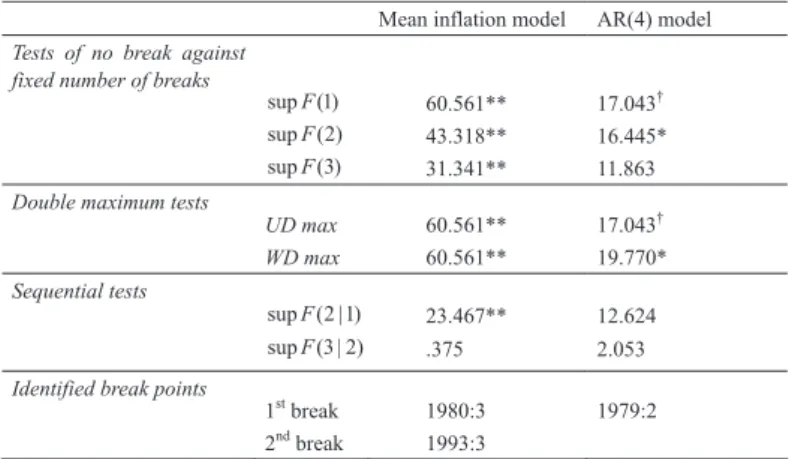
breaks.10) The results of these tests are summarized in Table 2. We find
that both the UD max and WD max tests indicate presence of at least one structural break in the mean inflation process. Further, in implementing
the sequential procedure, the sup F (l + 1|l) test identifies two structural
9) While similar in spirit to Dab´us (2000), our approach adopts the formal statistical testing without instead of relying upon subjective judgment regarding inflation regimes.
Table 2. Results of Bai-Perron Structural Break Tests
break points. The first break is in the third quarter of 1980, and the second in the third quarter of 1993.
When fitting an AR(4) specification to the quarterly inflation data, the BP test identifies one break point. The timing of the break is estimated to be around the second quarter of 1979 which is close to the first break point identified by the mean inflation model.
Table 3 provides some sample statistics for the inflation process per regime separated by the structural breaks. They reveal that the mean inflation rate has declined substantially and monotonically. In the third sub-period since 1994:1, the average inflation rate has been negative though it is insignificantly different from zero. Unlike the high inflation era of the 1970s, the number of incidents of price decline overweighs that of price increase.
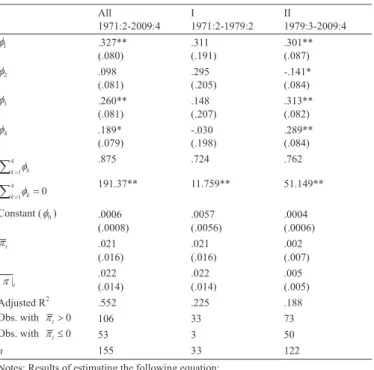
In Table 4 similarly, we present the sample statistics and the AR co-efficient estimates by inflation regime. Since the multicollinearity makes it
Fujii:Inflation Regime Shifts and Relative Price Variability
Table 3. Mean Inflation Rates by Sub-sample
difficult to observe significance of the individual AR coefficient estimates, we additionally report the sum of the AR coefficients for each sub-period
and the χ2-test statistics under the null hypothesis that the AR coefficients
sum up to zero. As the entries in the table indicate, the inflation dynamics was different between the two sub-samples. In other words, there are clear indications that the autoregressive inflation dynamics (i.e. persistence), in addition to the average inflation rate, has experienced significant regime shifts over the four decades we consider.
6. Implications of inflation regime shifts for the inflation-RPV relationship
In view of the evidence for inflation regime shifts in the previous sec-tion, we re-estimate (4) by inflation regimes to look for implications for the inflation-RPV relationship. Table 5 presents the estimation results for the three samples divided by the break points identified in the mean infla-tion rate. As cross-regime comparison of the estimainfla-tion results reveals, the
Table 5. Estimates of RPV-Inflation Relationship with Breaks in Mean Inflation Rates
Fujii:Inflation Regime Shifts and Relative Price Variability
inflation-RPV relationship turns out far from a stable one. More
specifi-cally, the simple linear specification with πt as the sole regressor (that is
when imposing β1= β2= β3= β4) attains significant effect of the inflation
on RPV only in the first sub-sample. Furthermore, the significant effect is driven only by incidents of positive inflation. We note that the effect in the first sub-sample constitutes the main empirical evidence in many earlier studies that inflation boosts RPV.
On the other hand, in the second and third periods it is the downward price movement that plays a significant role in generating the inflation-RPV association. Indeed, the coefficient restriction of the symmetry
be-tween the effect of inflation and deflation (i.e. (β1+ β3) = −(β2 + β4))
is soundly rejected in the latter two sub-periods. Apparently, deflation exerted significant and more substantially amplifying effect on RPV in the more recent period. The finding suggests that price movements in the al-ternative inflation regimes are intrinsically different in terms of their effects on RPV.
Table 6 contains the estimation results of (4) using the sub-samples defined by the structural break point in the AR(4) inflation process. Again, there is a discernible difference between the results for the pre- and post-break samples. In the pre-post-break sample, inflation exhibits a positive and linear effect on RPV. The effect is attributed to upward and expected price movement. Neither deflation nor inflation surprise exerts significant effect on RPV. In the post-break sample, however, while inflation retains its significant positive effect, deflation becomes to exert a highly significant negative effect on RPV. In other words, downward price movement has
a significantly amplifying effect on RPV. The χ2 test statistics suggests
that we fail to reject at the conventional significance level the hypothesis that inflation and deflation exert symmetric effects on RPV. In other words, price changes in either direction tend to boost RPV on a similar magnitude.
Table 6. Estimates of RPV-Inflation Relationship with Breaks in AR(4) Inflation Processes
All in all, the empirical results above reveal the regime-specific nature of the inflation-RPV relationship. That is, as the inflation process experi-ences structural shifts, its relationship with RPV is also re-defined. This is, in a sense, quite natural given that shifts in inflation process are likely to be accompanied by shifts in re-action by economic agents. The point, despite its importance, is not well addressed in many preceding studies. This is likely a significant reason for the lack of consensus among numerous studies in their evidence on the inflation-RPV relationship.
7. Conclusion
The nexus between inflation and RPV has been among central issues in macroeconomics. Despite its importance, however, the preceding stud-ies yield little consensus regarding the issue by reporting widely varying empirical evidence. One significant drawback of the extant studies is that they do not sufficiently take into account ramifications of shifts in infla-tion environment, by implicitly assuming in empirical investigainfla-tions that
Fujii:Inflation Regime Shifts and Relative Price Variability
the nexus between inflation and RPV is immune to any effect arising from them.
Using the Japanese consumer price sub-index data, the current study conducts a detailed empirical investigation of the inflation-RPV associa-tion, while paying particular attention to implications of inflation regime shifts. Given the diverse phases of inflation environment the country has experienced over the past several decades, the Japanese experience well serves our purpose to reveal different aspects of the inflation-RPV nexus.
Using the multiple structural break tests developed by Bai and Perron (1998, 2003), we identify the number and timing of the structural break tests in the Japanese CPI inflation process endogenously with the data. In so doing, we allow not only the mean inflation rate but also the inflation persistence in the form of autoregressive dynamics to experience structural shifts.
When the inflation-RPV relationship is re-estimated separately for each inflation regime, the empirical results point to a few important factors. First, the linear positive relationship between inflation and RPV, often re-ported in many extant studies, is a product of the high inflation experience most in the 1970s. Second, in more recent periods characterized by sta-ble inflation environment, downward price movement has become to boost RPV significantly. The trend is particularly evident in the period after the end of the bubble economy in Japan. In terms of its magnitude, we find the effect of deflation to be at least as substantial as that of inflation. Finally, though some theory suggests that unexpected inflation affects RPV, there is little indication that inflation surprise leads to increase in RPV once the structural shifts in inflation regime is properly accounted for.
The dramatic changes in the Japanese inflation environment over the past several decades implicate changes in underlying disturbances, policies, and agents’ reaction. Overall, our empirical results suggest the importance
of their ramifications for understanding the long-debated inflation-RPV relationship.
References
Bai, Jushan and Pierre Perron, 1998, Estimating and testing linear models with multiple structural change, Econometrica 66: 47-78.
Bai, Jushan and Pierre Perron, 2003, Computation and analysis of multiple structural change models, Journal of Applied Econometrics 18: 1-22. Barro, Robert, 1976, Rational expectations and the role of monetary policy,
Journal of Monetary Economics 2, 1-32.
Becker, Sascha S. and Dieter Nautz, 2009, Inflation and Relative Price Vari-ability: New Evidence for the United States, Sothern Economic Journal 76: 146-164.
Cuikerman, Alex, 1983, Relative Price Variability and Inflation: A Survey and Further Results, Carnegie Rochester Series on Public Policy, 103-158. Cheung, Yin-Wong and Kon S. Lai, 1995, Lag Order and Critical Values of a Modified Dickey-Fuller Test, Oxford Bulletin of Economics and Statistics 57: 411-419.
Dab´us, Carlos, 2000, Inflationary Regimes and Relative Price Variability:
Evidence from Argentina, Journal of Development Economics 62: 535-547.
Debelle, Guy and Owen Lamont, 1997, Relative price variability and inflation: Evidence from U.S.cities, Journal of Political Economy 105: 132-152. Domberger, Simon, 1987, Relative price variability and inflation: A
disaggre-gated analysis, Journal of Political Economy 95: 547-566.
Elliott, Graham, Thomas J. Rothenberg and James H. Stock, 1996, Efficient Tests for an Autoregressive Unit Root, Econometrica 64: 813-836. Fielding, David, and Paul Mizen, 2000, Relative Price Variability and
Infla-tion in Europe, Economica 67: 57-78.
Fischer, Stanley, 1981, Relative shocks, relative price variability, and infla-tion, Brooking Papers on Economic Activity 2: 381-441.
Fischer, Stanley, 1982, Relative price variability and inflation in the United States and Germany, European Economic Review 18: 171-196.
Fujii:Inflation Regime Shifts and Relative Price Variability
Grier, Kevin B. and Mark J. Perry, 1996, Inflation, inflation uncertainty, and relative price dispersion: Evidence from bivariate GARCH-M models,
Journal of Monetary Economics 38: 391-405.
Hartman, Richard, 1991, Relative price variability and inflation, Journal of
Money, Credit and Banking 23: 185-205.
Hercowitz, Zvi, 1981, Money and the dispersion of relative prices, Journal of
Political Economy 89: 328-356.
Lastrapes, William D., 2006, Inflation and the Distribution of Relative Prices: The Role of Productivity and Money Supply Shocks, Journal of Money,
Credit and Banking 38: 2159-2198.
Lucas, Robert E., Jr. 1973, Some International Evidence on Output-Inflation Tradeoffs, American Economic Review 63: 326-343.
Mills, Frederick C., 1927, The Behavior of Prices, New York: NBER. Mussa, Michael, 1977, The welfare cost of inflation and the role of money as
a unito of account, Journal of Money, Credit and Banking 9: 276-286. Parks, Richard W., 1978, Inflation and relative price variability, Journal of
Political Economy 86: 79-95.
Parsley, David C., 1996, Inflation and relative price variability in the short and long run: New evidence from the United States, Journal of Money,
Credit and Banking 28: 323-341.
Reinsdorf, Marshall, 1994, New evidence on the relationship between inflation and price dispersion, American Economic Review 84: 720-731.
Reis, Ricardo and Mark W. Watson, 2007, Relative Goods’ Prices and Pure Inflation, NBER Working Paper No. 13615.
Rotemberg, Julio, 1983, Aggregate consequences of fixed costs of price ad-justment, American Economic Review 73: 433-436.
Sheshinski, Eytan and Yoram Weiss, 1977, Inflation and costs of price ad-justment, Review of Economic Studies 44: 287-303.
Silver, Mick, and Christos Ioannidis, 2001, Intercountry Differences in the Re-lationship between Relative Price Variability and Average Prices, Journal of Political Economy 109: 35-374.
Stockton, David J., 1988, Relative price dispersion, aggregate price move-ment, and the natural rate of unemploymove-ment, Economic Inquiry 26(1): 1-22.
Van Hoomissen, Theresa, 1988, Price Dispersion and Inflation: Evidence from Israel. Journal of Political Economy 96: 1303-1314.
Vining, Daniel R., Jr. and Thomas C. Elwertowski, 1976, The relationship between relative prices and the general price level, American Economic
Fujii:Inflation Regime Shifts and Relative Price Variability