The Debate on English Language Education in
Elementary Schools : Systematizing the Pros
and Cons for Future Discussions
journal or
publication title
関西学院大学社会学部紀要
number
135
page range
71-93
year
2020-10-31
URL
http://hdl.handle.net/10236/00029131
1. Introduction
The purpose of this paper is to (1) systematically organize the debate surrounding English educa tion in elementary schools that has taken place since the late 1990s, and (2) provide implications for future discussions. The term “English education in elementary schools” (EEES) is used throughout this paper to refer to all types of English instruction conducted in the standard curriculum of public ele mentary schools. That is, it not only includes English as a formal subject but also English education in a broad sense, including English Language Activity in the Period for Integrated Studies (20022010) and Foreign Language Activities (since 2011). It therefore does not include English instruction in pri vate elementary schools or extracurricular activities.
1.1. A brief history of EEES
Here I will present a brief history of EEES in Japan (which I discussed in great detail; see Terasawa, 2020). For many years after the Second World War, English was not taught as a regular curriculum subject in public elementary schools. Since 1992, however, public elementary schools des ignated as Research and Development Schools began to teach English, although this did not become a national trend (only less than 0.5 % of the all public elementary schools taught English). In 2002, the Ministry of Education, Culture, Sports, Science and Technology (MEXT) changed the curriculum and elementary schools were allowed to introduce English Language Activity within the Period for Inte grated Studies (PIS), resulting in the explosive growth of the number of schools that began teaching English. According to the MEXT’s Survey of English Activities in Elementary Schools, 88.3% of schools had launched some form of English language teaching (ELT) program by 2003, and this per centage reached 97.1% in 2007. This expansion led to the implementation of compulsory onceaweek Foreign Language Activities for fifth and sixth graders in 2011. This program is a kind of foreign lan guage experience or exploratory programs (FLEX) rather than foreign languages in elementary schools (FLES) or English as a formal subject, and thus it does not formally evaluate students’ performance. In April 2020, however, English as a formal subject was made compulsory for fifth and sixth graders (twice a week), and Foreign Language Activities became mandatory for third and fourth graders (once a week).
The introduction of English education in elementary schools was not a smooth process. Although
The Debate on English Language Education in Elementary Schools:
Systematizing the Pros and Cons for Future Discussions*
Takunori TERASAWA
**─────────────────────────────────────────────────────
*Key Words: English language education in elementary schools, ELT in Japan, Qualitative content analysis **Associate Professor, School of Sociology, Kwansei Gakuin University
it was welcomed by many people, it also received strong opposition from others. The pros and cons of EEES have been heatedly debated since the late1990s by policymakers and educators as well as intel lectuals, ordinary people, and even teenagers (as a part of a debate education program at school), so it can be regarded as a kind of national debate (Terasawa, 2020). Despite its ubiquity, however, this de bate has not generally been wellorganized; in some cases, it has been entirely chaotic. In fact, even many policymakers and researchers have made emotional rather than analytical arguments, which has created countless unproductive discussions.
This paper problematizes this characteristic of the debate surrounding EEES. In order to untangle these chaotic discussions and make them more productive, I will thoroughly analyze and systematize the debate and provide a general picture of the arguments.
1.2. Previous work
A considerable amount of literature has examined this debate around the pros and the cons of EEES. Academic papers that examine EEES often include a brief history of EEES, and some of them refer to the debate, citing several typical opinions or voices (e.g., Butler, 2007). However, these stud ies have failed to provide an adequate account of the debate in the following respects. First, the litera ture typically does not provide a sufficient volume of analyses. Although some studies briefly illustrate the debate, they seldom analyze it in detail. Second, previous studies have not comprehensively ex tracted the opinions and issues raised in the debate. Since most of such studies have picked out a few representative arguments (arguments that the authors of such studies regard as representative), the se lection of issues/opinions may be biased. Third, the literature is generally nonanalytical; it merely lists the selected issues/opinions without examining the relationship between them.
This paper will appropriately address the problems raised above. In particular, I will comprehen sively extract issues from the debate, organize and systematize them, and present the broader picture of the debate. I will explain this methodology in detail in Section 2. Next, I will provide a detailed analysis for the arguments in favor of the introduction of EEES in Section 3 and for those against the introduction in Sections 4 and 5. Finally, Section 6 will summarize and discuss the findings.
2. Method
This study employed a qualitative content analysis of the related literature. Its basic strategy is quite simple: summarization based on extensive and intensive reading. In particular, I followed the procedures discussed below.
The first step was to extensively survey the literature mentioning the pros and cons of EEES (all types of literature including academic articles, general books, newspaper, magazine articles, and Inter net articles) to obtain as wide a variety of opinions as possible. It is impossible to collect all the exist ing literature, so I completed the literature survey at the time when it was theoretically saturated.1) The
second step was to identify and organize the issues. The original literature includes a huge number of unformulated arguments−for example, different people support/oppose it on virtually the same ───────────────────────────────────────────────────── 1 ) I have conducted EEES policy studies since 2004, and I have published many articles on this subject including a doctoral thesis (Terasawa, 2013) and a singleauthored book (Terasawa, 2020). I have surveyed and examined a great volume of relevant literature, and I have experienced theoretical saturation many times.
grounds but used quite different phrases and rhetoric, whereas a single person argues for/against it for many different reasons. In order to classify these unformulated arguments into proper categories, I identified each argument and placed different arguments into different categories and the same argu ments into the same category.2) As a result, I successfully extracted a finite number of arguments, as
shown in the next sections. The third step involved examining the relationship between each argument and revealing the broader structure of the debate.
In this procedure, I conducted a descriptive analysis rather than a normative one, but I added some critical and normative comments on each argument. As discussed in the next sections, some ar guments in the debate were highly problematic because they misrepresented a variety of facts in terms of the Japanese society, language learning mechanisms, and educational theories. These problematic arguments should not be presented “neutrally” without any value judgements, but should be described with strict criticism.
3. Arguments in favor of EEES
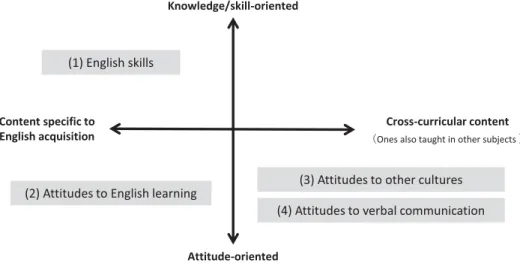
This section analyzes the arguments in favor of EEES. Despite the complexity of the debate, the pros of EEES are relatively easy to organize because the four main goals of EEES, as I revealed in Terasawa (2020), help us understand the relative position of each argument. Figure 1 plots the four EEES goals in a twodimensional figure with the horizontal axis of “an educational content that is spe cific to English learning vs. one that is crosscurricular” and the vertical axis of “knowledge/skill oriented vs. attitudinaldevelopmentoriented.”
As Figure 1 shows, the pros of EEES are, in a nutshell, the arguments that EEES should be intro duced because it is important to foster (1) English language skills, (2) positive attitudes toward Eng lish learning, (3) positive attitudes toward different cultures, or (4) positive attitudes toward verbal ───────────────────────────────────────────────────── 2 ) I did not summarize each argument based on by whom it was argued, because this was less important than what is
ar-gued on what basis. However, this by whom question is helpful in interpreting what each argument actually intended to
argue, so I always referenced the background of the person who made each argument. Figure 1 The four objectives of elementary school English
communication.
These normative arguments usually involve several supportive arguments, which are normally de scriptive (i.e., statements of fact). The latter arguments are easier to verify than the former ones be cause the validity of descriptive statements can be determined based on empirical data, unlike norma tive statements, which depend on value judgments.
I illustrate this structure by using the first type of proEEES arguments, that is, “EEES should be introduced in order to develop English language skills” (hereafter referred to as PR1). PR1 can be bro ken down into several descriptive statements, as shown in Figure 2.
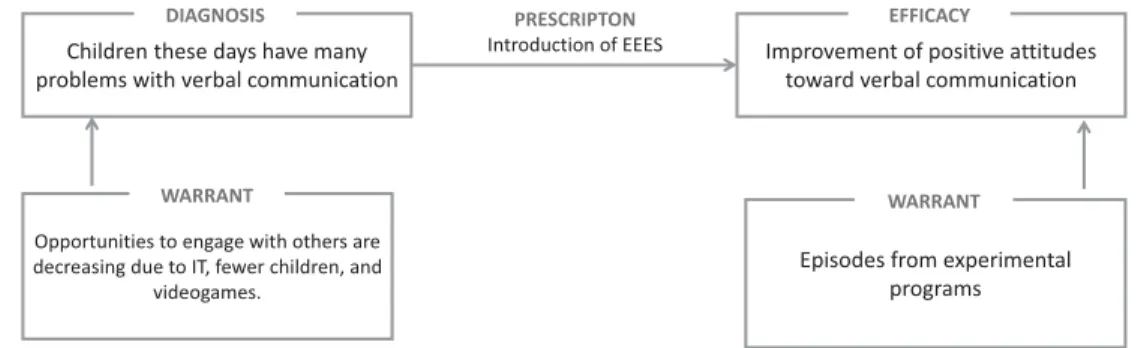
In diagramming, I use the medical analogy of “diagnosis → prescription → efficacy.” This means that proEEES debaters have some sense of crisis about the current social/educational situation (this is corresponding to the “diagnosis” of disease). This sense of crisis drives them to propose EEES as a measure to solve the problem (i.e., “prescription”), which should have a positive effect (“efficacy”) in ameliorating the problem. Both the sense of crisis (“diagnosis”) and the expected effect (“efficacy”) usually consist of some additional warrants. Structured based on this medical analogy, the arguments in favor of EEES can be organized into six patterns, which are illustrated below.
3.1. PR1: EEES for English skills development
The first pattern of proEEES arguments, PR1, is illustrated as follows (see Figure 2 above). In creasing internationalization and globalization have boosted the importance of English language skills; thus, Japanese people should obtain a much higher level of English proficiency than ever. This is why English language teaching should start earlier (e.g., in elementary schools). This is probably the most common proEEES argument, which has been articulated by a wide variety of people ranging from academic researchers, to politicians, to intellectuals, to ordinary people.
Behind this “diagnosis” is an assumption that is seldom explicitly articulated. This assumption is that the average low level of English proficiency among Japanese people is the reason for their inabil ity to adapt to globalization. Without this assumption, one can argue that even if the Japanese are gen erally not proficient in English on average, it does not matter because a small fraction of Japanese people who speak English fluently may be able to engage in globalized activities. In other words, this argument is only valid if one has a nationalistic sense of crisis that indicates that the lack of English proficiency among the average Japanese person may damage the national interest.
Figure 2 Pro-EEES argument 1: EEES to promote English language skills
3.2. PR2/PR3: EEES for positive attitudes toward different cultures or conversation
The second and third proEEES arguments recognize that globalization has increased the impor tance of international exchange (see Figures 3 and 4).
Like PR1, the proponents of PR2 and PR3 explicitly or implicitly assume that the Japanese have problems regarding international and intercultural communication, and that these problems make it hard for the Japanese to cope with globalization. These debaters argue that the Japanese are so inward looking, homogeneous, and even xenophobic that their personality traits function as an impediment to internationalization. They assert that these problems can be solved through experience in English con versation; that is, intercultural experiences through English communication activities can promote in ternational and intercultural understanding (PR2) and a positive attitude toward linguistic exchange (PR3).
These claims may sound odd because they largely diverge from a typical ELT program that aims to develop learners’ English language skills. Considering the history of EEES in Japan, however, this is not a necessarily exceptionally peculiar argument. Rather, these arguments are common in Japanese ELT contexts because Japanese EEES was originally developed as a part of international education (a kind of FLEX), and because ELT in senior and junior high schools have officially announced that in ternational understanding is one of its goals.
Figure 3 Pro-EEES argument 2: EEES to promote positive attitudes in different cultures
Figure 4 Pro-EEES argument 3: EEES to promote positive attitudes verbal communication
3.3. PR4: EEES to solve communication problems among children
The fourth argument, PR4, is quite dissimilar to the previous proEEES arguments. As Figure 5 shows, the supporters of PR4 argue that an increasing number of children (as well as adults) today are hesitant to exchange their opinions and feelings with others in their own language (i.e., Japanese lan guage), damaging their (firstlanguage) communication skills. To solve this problem, they argue, chil dren should develop a positive attitude toward verbal communication by engaging in English conver sation activities.
Although this may sound nonsensical, it is regarded as one of the government’s official goals of EEES. For example, the Guidelines for the Course of Study for Elementary Schools: Foreign
Lan-guage Activities, published by MEXT in 2008, states that:
It is believed that children these days lack the abilities to express and accept their own and others’ feelings and thoughts. In order for children to build rich human relationships, they are re quired to acquire verbal communication skills. Therefore, it is significant that Foreign Language Activities make students aware of the importance of these skills through the experience of com municating with language rather than memorizing many expressions or understanding detailed grammatical items. It is important to let students use a foreign language, which they are unfamil iar with using, and provide them with an opportunity to experience the difficulty of communica tion and realize its importance. (MEXT, 2008, p.13; my translation)
A similar account has been expressed in a more straightforward manner by various MEXT offi cials (the following quotes are my translations). For example, Kan Masataka, a former MEXT Senior Specialist for Curriculum, states that the background to the introduction of Foreign Language Activi ties is children’s “lack of communication skills” (Yanoura, 2009). He says that due to the declining birth rate as well as the growing popularity of video games, the number of children who “have few opportunities to engage with others and are unable to keep an appropriate distance with others” has in creased. Since they “lack the ability to communicate with others through words,” he argues, “they re sort to violence or bullying”; “in order to solve this problem, the Ministry has introduced English Lan guage Activities in elementary schools.”
A similar argument was made by Naoyama Yuko, thenEducational Supervisor in Kyoto City and the present Senior Specialist for Curriculum of MEXT. Naoyama (2006) argues that we have seen an increase in “the situations in which we do not have to interact with people verbally, including conven
Figure 5 Pro-EEES argument 4: EEES to solve communication problems among children
ience stores and vending machines,” and this means that “we are less and less able to relate to people verbally and our zest for living gets weaker and weaker.” This is why “it is important for children to experience the joy of interacting with people through Foreign Language Activities.”
Both assertions assume that English conversation activities can promote positive attitudes toward the verbal exchange of opinions and feelings. In this sense, they seem to be a kind of assertiveness training in psychotherapy.
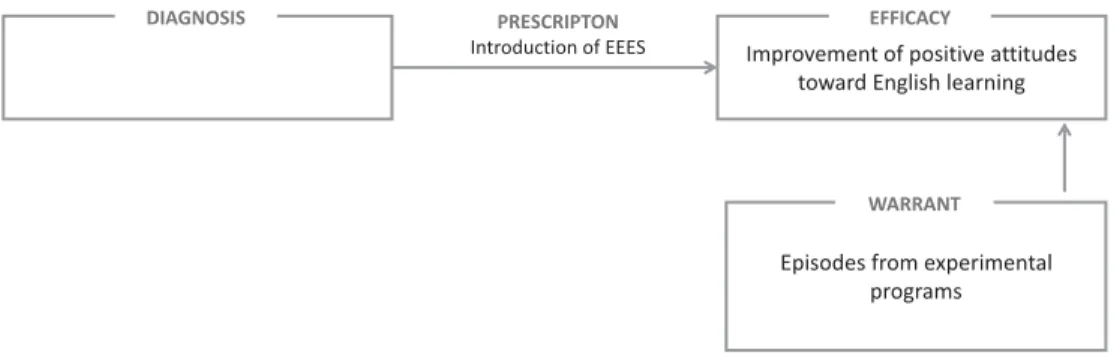
3.4. PR5: EEES for positive attitudes toward English learning
The fifth type (PR5) emphasizes the development of positive attitudes toward English learning (Figure 6). PR5 argues that EEES should be introduced to make children familiar with English lan guage and to reduce children’s resistance to or dislike of learning. It should be noted that PR5 does not have “diagnosis” in its rhetoric, as shown in the figure. In other words, it does not explicitly ar ticulate why it is important to develop positive attitudes toward English learning. In this sense, this rhetoric, exemplified by “It matters because it matters,” is unsophisticated, but the flaws in this logic do not seem to be wellrecognized in the debate.
However, it is not difficult to speculate the implicit rationale for promoting positive attitudes to ward English learning; PE5 probably assumes that these positive attitudes are important because they help children develop English skills. Although this rationale is understandable, it has also caused a considerable amount of dissonance with English Activities in PIS, which has officially announced that its central goal is international education through English language conversation rather than English language learning itself. This suggests that an excessive emphasis on positive attitudes toward English learning can contradict the goals of FLEXtype EEES programs. Despite this serious flaw, this contra diction is neglected by both supporters and opponents of EEES. Therefore, it is necessary to create a less contradictory theory to enable a robust conception of EEES’s objectives.
3.5. PR6: EEES for equal opportunities in ELT
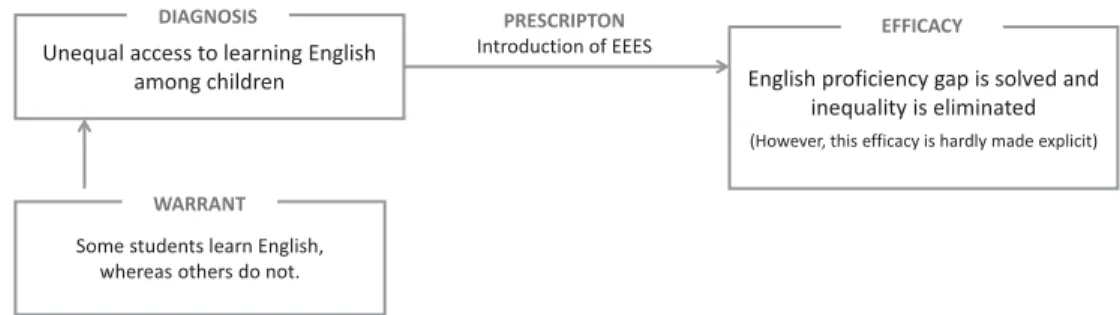
The sixth type (PR6) argues for the introduction of EEES on the grounds that it will alleviate dis parities in access to ELT and help create equal opportunities in English learning (Figure 7). In this sense, PR6 is largely different from the five types above, all of which emphasize the development of specific skills or attitudes.
Figure 6 Pro-EEES argument 5: EEES for positive attitudes toward English learning
The supporters of this argument call into question the situation in which some elementary school students learn English and others do not and criticize it for inequality. This disparity, they say, should be improved by making ELT mandatory for all elementary school students. This argument is not only articulated by the “recipient” side such as parent groups, but also the “provision” side such as the Japanese government; indeed, this is one of the official rationales that MEXT explicitly articulated for the introduction of Foreign Language Activities (MEXT, 2008).
It should be noted here that supporters rarely state what kind of equality should be achieved by EEES. However, discussions of equal opportunities in education normally make explicit what type of equality should be achieved. For example, a scholarship has been proposed to alleviate the educational disparities created by income gaps between families. In this context, scholarships are expected to en sure equality by increasing the percentage of students from lowincome families that advance to higher education, ideally reaching the average level. Regardless of the effectiveness of this measure, the state of equality it aims to achieve is highly specific and tangible.
In the debate around EEES, on the other hand, there are very little substantial discussion regard ing equality. The type of equality EEES is expected to achieve is rarely discussed (regarding whether it is an improvement in English language skills among children from lowincome families, an im provement in crosscultural understanding among these children, or another aspect of equality). Indeed, a considerable number of people, including MEXT, emphasize the importance of equal opportunities in EEES, but seem to fail to analytically discuss this issue. Rather, most of their arguments are senti mental, complaining of a vague sense of unfairness.
In contrast, the discussion of EEES in other countries is more straightforward. In South Korea, for example, where the issue of unequal opportunities in ELT has received much attention from poli cymakers as well as citizens, the English proficiency gap has been seen as a source of inequality (Crookes, 2017; Enever, 2018). Indeed, the South Korean government has taken a variety of measures to narrow the gap in English proficiency between lessaffluent or rural children and their affluent or urban counterparts. In the field of the sociology of education, a notion called “parentocracy” has been developed, which signifies that children’s educational attainment is greatly influenced by their parents’ attributes such as educational aspiration or educational investment. Enever (2018), who conducted an international comparative study of EEES policies, points out that many countries, including South Ko rea, have observed “linguistic parentocracy,” in which parental factors have a great impact on the de velopment of English proficiency. On the other hand, the EEES debate in Japan has failed to discuss this issue as seriously as other countries.
Figure 7 Pro-EEES argument 6: EEES for equal opportunities
4. Arguments against EEES: “It’s not effective.”
This section and those that follow examine arguments against EEES. The medical analogy men tioned above is also useful for organizing the opposing arguments. We can distinguish between the criticism against the logic of “prescriptions” and the concern about “side effects.” In other words, the former calls into question the effectiveness of the introduction of EEES regarding a specific outcome, arguing that it will not produce the results that proponents expect, and the latter is concerned about adverse effects of EEES, claiming that it may cause unintended harmful consequences, which propo nents usually do not mention.
The majority of the opposing arguments are the latter type, i.e., “It’s harmful” type of arguments (HM), although a significant number of people criticize EEES with the former type of arguments, i.e., “It’s not effective” (NE). More importantly, antiEEES debaters do not comprehensively offer a rebut tal to every issue the proponents have raised. Rather, they tend to only focus on a few proEEES argu ments. This lack of comprehensiveness might suggest that people tend to selectively make rebuttals against issues that are relatively easy to refute. These type of arguments, known as “straw man argu ments,” seem to be one of the reasons for the lack of productivity in the debate. Below, I will exam ine the NE type of criticisms in this section and the HM type of criticisms in the next section.
4.1. Nine types of “It’s not effective” arguments
The NE type of criticisms can be classified as (a) it is not effective because its “diagnosis” (i.e., the perception of the current social situation) is wrong and (b) it is not effective because its “efficacy” (i.e., expected outcomes) is wrong. The proEEES arguments, as Figures 2 to 7 show, have four types of “diagnosis” and five types of “efficacy.” This means that in theory, opponents can offer a total of nine types of counterarguments. These theoretical counterarguments are summarized as NE1 to NE9 in Table 1.
4.2. Pros and cons concerning the effect of EEES on English language skills
The biggest issue in dispute may be whether the introduction of EEES will improve children’s English language skills (and English skills of Japanese people in the long run) (i.e., NE5 vs. PR1).
Table 1 Nine types of “It’s not effective” arguments (NE1-NE9) Criticism against “diagnosis” Criticism against “efficacy” NE1: It is incorrect to assume the low English profi
ciency among Japanese people is an obstacle to interna tionalization
NE5: EEES will not improve English proficiency
NE2: It is incorrect to assume that the Japanese gener ally have negative attitudes toward different cultures and that this is an obstacle to internationalization.
NE6: EEES will not improve positive attitudes toward different cultures
NE3: It is incorrect to assume that today’s children have problems with communicational attitudes and skills.
NE7: EEES will not improve positive attitudes toward verbal communication
NE8: EEES will not improve positive attitudes toward English language learning
NE4: It is incorrect to assume that there is a disparity in children’s opportunities to learn English
NE9: EEES will not reduce the English proficiency gap; it will not create equal opportunities.
The conflict between the pro and antiEEES groups can be summarized, in a nutshell, as PR1, who believe that the EEES program has a significant effect on the development of English language profi ciency vs. NE5, who argue that such an effect cannot be expected or, if any, the size of the effect will be negligibly small taking into consideration the current educational environment of public elementary schools (number of class hours, curriculum, quality and quantity of ELT instructors, etc.).
The benefits of an early start can be classified into two issues: quantity and quality. The quantity issue concerns the fact that that the earlier children start to learn the language, the more time they spend learning and therefore the more proficient they become, while the quality issue is that the earlier they start, the more efficiently they learn the language for some developmental (i.e., biological and/or psychological) reasons. Generally speaking, both issues are important, but the examination of the de bate of EEES should only focus on the qualitative issue, because the proEEES arguments almost al ways presuppose the qualitative benefit of an early start. Japanese elementary school curricula only al low for 12 classes of English instruction per week (no matter how radical a reform is implemented, it will certainly not exceed three hours). It seems almost impossible for such a small increase in the amount of learning to be regarded as quantitatively beneficial.
The qualitative benefits of an early start claimed by the proponents can be roughly classified into three categories: (a) anecdotal evidence, such as “my kids (or my friends’ kids) started to learn Eng lish early, and they became fluent,” (b) “scientific” evidence such as neuroscience and developmental psychology, and (c) empirical evidence of studies that statistically compare children who experienced EEES and children who did not.
Of these, (a) and (b) do not seem to deserve serious consideration because the evidence they offer is similar to urban legends or myths. Indeed, some of the claims are typically what OECD calls “neuromyths,” such as “You should start early because your brain loses flexibility after age X.” Thus, what truly deserves consideration is (c) empirical evidence. This type of empirical research, called age effect studies, has been conducted around the world (e.g., Muñoz, 2006; Pfenninger & Singleton, 2017), and has also been conducted in Japan since the 1980s. The oldest study is probably that con ducted by JASTEC Project Team (1986). In fact, some of the empirical studies of Japanese children’s English development have successfully shown the effectiveness of early exposure to English (e.g., JASTEC Project Team, 1986; Shinohara, 1998, Uematsu, 2015). Thus, they are often cited by propo nents of EEES.
However, empirical studies also have some serious limitations. First, they have a problem regard ing subject selection. Many studies, especially those conducted in the 1980s90s, selected subjects/par ticipants that were quite different from ordinary public elementary school students (e.g., those who at tended private elementary schools or MEXT’s Research and Development Schools), making it difficult to generalize the research findings. Second, although some studies showed the positive effects of EEES, others showed negative effects. Thus, the empirical findings are totally mixed and fail to show conclusive evidence in terms of the effectiveness of EEES. Unfortunately, people in favor of EEES typically tend to selectively reference studies that successfully demonstrated effectiveness, whereas people against EEES tend to focus on studies that failed to do so. This “cherrypicking of evidence” may be one of the reasons for the chaotic nature of this debate. To tackle this problem, therefore, re searchers should conduct adequate review studies that assess diverse findings and then synthesize them, although such studies, whether narrative or systematic reviews, are not yet available.
4.3. The “diagnosis,” a void of controversy
In contrast to the heated debate on English language skills improvement (i.e., NE5 vs. PR1), other issues are not necessarily scrutinized by either proEEES or antiEEES people. In particular, there are relatively fewer criticisms of the “diagnosis.” Among several issues neglected in the debate, the following four issues are worth noting.
On globalization.
First, few people question the assumption that globalization or internationalization is progressing. Although this is often taken for granted in the debate, globalization scholars do not necessarily presup pose it (Held, McGrew, Goldblatt, & Perraton, 1999; Steger, 2013). Indeed, globalization theories have proposed a variety of definitions and perspectives on the term. Diverse definitions and perspectives, therefore, can lead to diverse evaluations of the phenomena, ranging from hyperglobalization to anti globalization.
A typical example of antiglobalization in recent years is the global financial crisis of 20072008, during which global trade and migration stagnated. In addition, as I statistically revealed (Terasawa, 2018a, 2018b), this led to a decrease in the necessity for Japanese people to use English. Moreover, Brexit and the election of a US president that is hostile to free trade (both emerged in 2016) reflect some sorts of antiglobalization. Furthermore, the current global spread of COVID19 has paralyzed a variety of global activities. In the debate of EEES, the possibility of antiglobalization or similar phe nomena are seldom mentioned and (hyper)globalization is treated as an unquestionable truth. This one sided discussion, however, is so unsound that ELT scholars should critically examine the relationship between globalization and the introduction of EEES.
On Japanese mentality (Nihonjinron) myths
Second, the assumption is rarely disputed that the Japanese do not have positive attitudes toward different cultures and communication and this causes problems with international exchanges and global activities (PR2/PR3), but it should be critically examined. It has frequently been said that Japanese people are inwardlooking, homogeneous, and poor at expressing their opinions in their own words due to an excessive dependence on implicit communication, but these descriptions of Japanese people have been termed Nihonjinron and severely criticized as a myth by Japanese studies scholars and cul tural anthropologists (Mouer & Sugimoto, 1990). This myth has also been rejected by an empirical study. Mabuchi (2002), through a statistical analysis of international surveys, found that Japanese peo ple are less homogeneous in their opinions than people in other countries.
On equal opportunity.
Third, there are few arguments against the claim that EEES should be introduced for equal oppor tunities to learn English (PR6). Although this claim might appear to be undeniable because it is based on the supreme value of equality, it in fact needs to be analytically and critically examined.
Generally speaking, every difference in experience is not always regarded as unequal. For exam ple, the experience of a violin lesson is obviously differentiated by family and social factors (for in stance, children from wealthy family or living in an urban area are more likely to do), but this differ ence is hardly regarded as unequal because violinlesson experiences are not normally seen as linked to one’s subsequent social, economic, and political success. In other words, the proEEES argument
for an equal opportunity to learn English (PR6) is based on the implicit premise that differences in English proficiency or other skills, in turn, will affect one’s future education, employment, and life paths3).
However, this premise leads to another contradiction. PR6, which argues that EEES will help eliminate the inequality in the English proficiency gap, is predicated on another premise that EEES helps foster students’ English proficiency. This has commonalities with the same premise with PR1 (EEES for English skill development), but, as seen above, this is regarded as questionable by many opponents as well as some supporters (i.e., NE5). Therefore, PR6 is also not infallible but can be in stark contrast to other arguments.
On children’s poor communication skills.
Fourth, the perception that children today are less communicative (PR4) is actually dubious, al though few people problematize it. This claim seems to be similar to what can be called the discourses on children/youths (the discourses that view them as inferior, nonenergetic, and asocial/antisocial).
To understand PR4 concisely, however, it is necessary to identify the social contexts in which the argument was made (mainly in the 2000s) because during this time, children’s and youths’ communi cation style became a major social issue in Japan. For example, “seventeenyearolds bursting into fury” (kireru 17-sai) was nominated as one of the most influential vogue words of 2000. As this case exemplifies, a specific image of children who easily lose their temper and resort to violence without dialogue began to circulate throughout Japan around the turn of the century. The terms “acute social withdrawal” (hikikomori) and “NEET,” which were also in vogue at the time, also have labeled people in these situations as experiencing communication problems. On the other hand, as the labor environ ment has become more fluid and complicated, young people have been required to obtain more ab stract and less standardized skills than ever. “Communication skills,” which have been discussed fre quently, is a prime example of these socalled 21st century skills (Honda, 2005). All these factors above−the discourses on children, a fear of juvenile crimes, children’s behaviors that adults hardly understand, and the fluid and complicated labor environment−have made people focus on children and youths’ communication. Excessive attention to their communication style and skills, then, seems to change our view of children. Kids who once used to be regarded as “quiet” or “a bit odd” seem to be more likely to be envisaged as experiencing communication difficulties.
A serious problem here, however, is that the children’s or youths’ communication difficulties are not predicated on any plausible evidence except for anecdotal episodes. In other words, this is some thing like a child/youth myth, but this myth has often been cited in the EEES debate and reproduced by some EEES proponents but hardly criticized by opponents. Unfortunately, it has been included in some governmental documents such as the Guidelines for the Course of Study (see 3.3). This situation is so academically and politically unsound that it should be critically examined in the future discus sion.
───────────────────────────────────────────────────── 3 ) Although this causal effect of English proficiency on income or job promotion is often taken for granted, this is not nec essarily true of Japan. I have statistically analyzed a Japanese labor dataset and showed that the causal impact is not sig nificant or, if present, quite small (Terasawa, 2018b: Chapter 10).
4.4. Controversy over “efficacy”
This section examines the criticisms against “efficacy” (i.e., NE5NE9). However, except for the abovementioned skepticism against English skills development (i.e., NE5), this type of criticism is not frequently articulated.
More criticisms of NE6/NE7 against PR2/PR3 (i.e., skepticism regarding EEES’s effects on posi tive attitudes toward different cultures or verbal communication) should have been made. Indeed, PR2 and PR3 are worth critically examining because they lack empirical evidence. Hence, it is completely uncertain whether the EEES experience actually promotes the attitudes proposed. Furthermore, as dis cussed earlier, EEES was originally developed in Japan as a part of international education, so PR2/PR 3 perspectives are of considerable importance. Despite the theoretical significance, however, these is sues are hardly discussed in depth.
On the other hand, the criticism of NE8 against PR4 (i.e., skepticism regarding the idea that EEES will improve positive attitudes toward English learning) are sometimes made by some oppo nents. Indeed, among the most common counterarguments against EEES is that an early start will in crease the number of children who dislike, rather than like, English. This is not a simplistic argument, however. It claims that although the introduction of EEES do not directly make children unwilling to learn, this might be caused by a variety of difficulties and inadequate conditions in current elementary schools.
This issue is also pointed out by those who support EEES. In fact, they seldom express exces sively optimistic views such as stating that EEES unconditionally stimulates children’s motivation to learn; rather, they often emphasize the crucial roles of welltrained teachers, a sufficient amount of learning, quality learning materials, school curriculum with consistency, etc. Although the importance of these factors is undeniable, debates based on such ideal conditions do not seem very productive be cause these ideal environments will always promote positive attitudes regardless of the type of ELT− ELT in elementary or secondary schools, or a public education ELT program or private tutoring. It would be more productive, therefore, to take realistic conditions as a premise of the discussion and ex amine the possibility that EEES will foster the skills and attitudes in such a given environment. How ever, this point does not seem to be fully recognized in the debate.
NE6, NE7, and NE8 are all concerned with a factual statement regarding the presence/absence of positive effects of EEES. In other words, their conflict with proEEES arguments (especially, PR2, PR3, and PR4) do not necessarily reflect different values among them on, for example, which goal EEES should focus on−English skills development vs. international understanding. Due to their em pirical nature, therefore, these points in dispute are relatively easy to untangle, but they have not been empirically examined. This seems to result in a sterile debate in which the proponents of PR2/PR3/ PR4 argue for EEES in a highly abstract and idealistic manner, whereas the opponents do not offer counterevidence.
4.5. Summary of “It’s not effective” arguments
In summary, although many of the proEEES arguments contain some questionable premises, they have been left without criticism, with the exceptions of the English skills development (PR1) and attitudes toward English learning (PR5). This seems to fully illustrate that the participants in the de bate have been greatly interested in an aspect of English language acquisition despite the fact that MEXT has consistently emphasized that the primary goals of English Activities in PIS and Foreign
Language Activities are to foster attitudinal factors rather than English skills development. This gov ernmental stance, however, does not necessarily reflect the actual debate.
Obscured by the heated debate on these issues on English language acquisition, many problematic discourses or myths have been circulated without much criticism (such as Nihonjinron and the dis courses on children’s communication), some of which have even been included in governmental docu ments. The academic community (especially Japanese ELT scholars) seems to have a huge responsibil ity for allowing these problematic discourses to prosper.
5. Arguments against EEES: “It’s harmful”
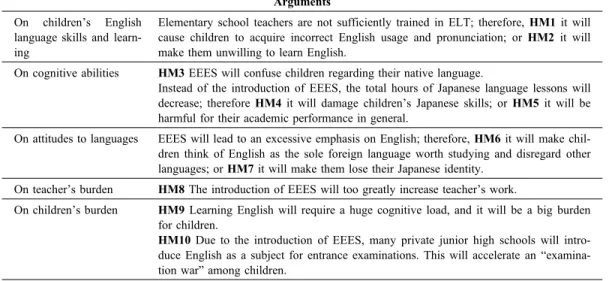
This section examines the “it’s harmful” arguments. Since this type includes a wide variety of ar guments that are difficult to systematically analyze, I will examine each argument individually. Table 2 shows all of the “it’s harmful” arguments that are examined (HM1 to HM10).
5.1. HM1/HM2: Negative effects on English skills and learning
One of the most typical antiEEES arguments is the criticism that, since public elementary schools generally lack an adequate learning and educational environment for ELT, teaching English in such schools is harmful rather than beneficial for children’s English language skills and learning (HM1 and HM2). These arguments reflect widespread concerns about the teaching of EEES by homeroom teachers, who are not usually trained in English language instruction. Since the 1990s in Japan, it has been standard for homeroom teachers, rather than English language teachers, to teach English in ele mentary schools. This has led to two main concerns: one concerns the limited level of English profi ciency among homeroom teachers and the other is related to their skills and experience for English in struction (e.g., knowledge of secondlanguage teaching methods and English linguistics and phonetics). Among them, the concern is often voiced that such teachers might teach children the wrong pronun ciation and grammar.
Table 2 Ten types of the “It’s harmful” objections Arguments
On children’s English language skills and learn ing
Elementary school teachers are not sufficiently trained in ELT; therefore, HM1 it will cause children to acquire incorrect English usage and pronunciation; or HM2 it will make them unwilling to learn English.
On cognitive abilities HM3 EEES will confuse children regarding their native language.
Instead of the introduction of EEES, the total hours of Japanese language lessons will decrease; therefore HM4 it will damage children’s Japanese skills; or HM5 it will be harmful for their academic performance in general.
On attitudes to languages EEES will lead to an excessive emphasis on English; therefore, HM6 it will make chil dren think of English as the sole foreign language worth studying and disregard other languages; or HM7 it will make them lose their Japanese identity.
On teacher’s burden HM8 The introduction of EEES will too greatly increase teacher’s work.
On children’s burden HM9 Learning English will require a huge cognitive load, and it will be a big burden for children.
HM10 Due to the introduction of EEES, many private junior high schools will intro duce English as a subject for entrance examinations. This will accelerate an “examina tion war” among children.
Responses to objections
In response to the HM1/HM2 arguments, proponents have mainly reacted in the following two ways. The first is an optimistic response that states that the concerns raised in HM1/HM2 will not be come a reality. They argue that even if elementary school teachers lack experience in teaching Eng lish, it will not be highly problematic because the instruction is limited to a basic level and can be compensated for by a variety of supportive measures such as teaching assistants, instructional devices, and welldeveloped teachers’ guides. The second response, on the other hand, concerns a more funda mental ELT philosophy. Some proponents criticize HM1/HM2 for their misunderstanding of the real goals of EEES, arguing that we should not recognize teachers’ lack of experience of ELT as a prob lem, but should focus on their special techniques and profound experience as homeroom teachers.
Here is a further explanation on the second response. As discussed earlier, EEES in Japan has de veloped as a part of international education (a kind of FLEX), rather than a traditional ELT (i.e., FLES) that aims at promoting learners’ English proficiency (and this FLEXlike orientation was the government’s official stance at least until the 2010s). For this reason, some (although not many) of the proponents have emphasized the experiential aspect of the EEES activities and attitudinal development rather than English skills development. For these proponents, therefore, the accusations against ele mentary school teachers’ lack of English skills and teaching experiences are too FLESoriented and too biased toward the traditional view of ELT, and hence fail to recognize the real objectives of EEES. Matsukawa Reiko, one of the leading proponents of the FLEXtype EEES programs, states that it is worthwhile for English to be taught by homeroom teachers, who are not necessarily proficient in English (Matsukawa, 2004, pp. 3637). She argues that it is particularly essential that EEES should be taught by “ordinary” elementary school teachers (i.e., homeroom teachers: HRTs) rather than Assistant Language Teachers (ALTs) or Japanese Teachers of English (JTEs). According to her, HRTs have much greater advantages than ALTs or JTEs, as they are more skillful at managing classrooms, pro viding children with adequate feedback and assessments, and developing a feasible but innovative cur riculum.
Critical comments on the two counter-arguments against HM1/HM2
Since both proponents and opponents admit that HRTs generally do not have sufficient experi ence of ELT, the point in dispute on this issue can be divided into the following three positions. The first position is HM1/HM2, which asserts that this lack of experience is in fact problematic. The sec ond is held by some proponents who argue that, although it appears to be a problem, it can be solved by relying on various human resources outside classrooms such as ALTs, Englishspeaking volunteers, and junior/senior high school English language teachers. The third position is held by other proponents who stress that their lack of experience does not matter for a FLEXtype English education program. The conflict between the proponents (the second vs. the third positions above) illustrates the diversity of the proEEES arguments, which means that those with totally different views of English education have supported the introduction of EEES based on totally different grounds.
The second position above (i.e., the introduction of external human resources can solve the prob lem), which appears plausible in general terms, should be evaluated in terms of its feasibility. In other words, this proposal should be scrutinized from the perspectives of, for example, how practical the measures are for compensating for HRTs’ lack of teaching experience and how likely it is to be achieved. However, these questions are seldom raised, partly because there is little information and
data on the feasibility. Even the proponents of this proposal seldom provide any information on finan cial estimates or successful cases of the introduction of external human resources, making the debate highly idealistic and abstract. Taking into consideration the recent school circumstance, however, this proposal seems to prove to have been an overly optimistic prediction. The introduction of external hu man resources into classrooms involves multiple legal and institutional obstacles, making it difficult to adopt a radical measure to recruit a sufficient number of teachers and teaching assistants−in short, the proposal was something like a pie in the sky.
The third position (i.e., the statement that HRTs have more advantages in EEES) was a compel ling argument at least in the 1990s to the 2000s, as the government also supported this position. If a program is officially established as FLEX, then it should be strictly criticized to evaluate HRTs’ roles only in terms of English language tutors and underestimate their capabilities. In the 2010s, however, the Japanese government decided to introduce English as a formal subject in 2020 and explicitly shifted its orientation away from FLEX to FLES. Thus, these FLEXoriented counterarguments seem to have become obsolete in the late 2010s. In fact, the educational and academic communities of the 2010s were flooded with arguments that repeatedly referred to an urgent need for HRTs to improve English language skills and English teaching experience.
5.2. HM3/HM4/HM5: Negative effects on cognitive abilities
Probably the most wellknown antiEEES argument is the claim that EEES will damage chil dren’s Japanese language skills. This argument can be found in a great variety of media, ranging from newspaper editorials, to intellectuals’ essays, to politicians’ statements, to blog posts by ordinary peo ple. In 2006, one of the most wellknown statements was made by Ibuki Bunmei, an influential politi cian and thenMinister of MEXT, who said “beautiful Japanese is important and we do not need to make EEES compulsory.” In the previous year, in his recordbreaking bestselling book, Fujiwara Masahiko, a mathematician and conservative intellectual, also criticized EEES for its possible threat to Japanese language development among children (Fujiwara, 2005).
It should be noted that concerns about decline in Japanese language skills can be divided into two patterns. The first type (HM3) is concerned about the possibility that early exposure to a foreign lan guage confuses children’s mother tongue (Japanese in this case) and not only their second language but first language may also remain underdeveloped (socalled “semilingualism”). The second type (HM4) is concerned about the possibility that the introduction of EEES will lead to a reduction in the number of classes for other subjects, especially, Japanese language, and this will negatively affect chil dren’s Japanese skills. The difference, in a nutshell, is that whereas HM4 focuses on the school cur riculum system, HM3 focuses on linguistic and cognitive development. However, no theories in sec ond language acquisition or cognitive sciences support HM3’s claim that an early exposure to second language leads to linguistic confusion, and notions like semilingualism have been totally rejected as myths (MacSwan, 2000).
This means that some antiEEES arguments are, in fact, awkward, poorlygrounded, and full of fallacies, and this seems to stimulate proponents to make rebuttals to these fallacious arguments. For example, some proponents cite the existence of a huge number of bilingual people who have fully de veloped two languages and argue that learning multiple languages does not confuse learners regarding their native language. Others criticize the notion of socalled “semilinguals” for its prejudice against bilingual people as well as its misunderstanding of secondlanguage learning. This myth has been
sometimes criticized by even antiEEES debaters. Otsu Yukio, a linguist and cognitive scientist as well as one of the leading opponents of EEES, has also expressed his frustration with the fact that his argu ment is sometimes equated with this fallacious claim (Otsu, 2006).
In contrast, HM4’s logic, that is, “the introduction of EEES → fewer hours of Japanese language instructions → decrease in Japanese language skills,” does not contradict second language acquisition and cognitive sciences. In reality, however, the introduction of EEES did not lead to the reduction in Japanese language classes. In 2011, when Foreign Language Activities was introduced, and in 2020, when English as a formal subject was introduced, it was PIS, not Japanese, that reduced the total num ber of classes in exchange for an increase in English classes. This is partly because the government al ways recognized Japanese language as an essential subject. Indeed, the government’s English educa tion policies have long been nationalist in nature, aiming at fostering Japanese people with English abilities who are strong enough to compete in a globalized world with their Japanese identity steadily maintained, rather than cosmopolitans who are proficient in two or more languages (Kubota, 2012). Therefore, it is understandable that the introduction of EEES did not reduce the total hours spent on Japanese language education.
5.3. HM6/HM7: A biased view of English and other languages
Both HM6 and HM7 are concerned about the possibility that EEES may make children envisage English as the sole language worth studying, but the assumptions on which both are based are quite different. HM6 is related to a concern from a cultural relativist perspective. It argues that early expo sure to English language will inculcate into children the belief that only English is of a special value, a belief that is sharply contradicted with the fact that all languages and cultures are equal. HM7, on the other hand, is a kind of Japanese cultural nationalism. It argues that the overemphasis of English language and AngloAmerican culture leads children to disregard Japanese language and Japanese cul ture, which makes them lose their Japanese identity.
These two explanations illustrate that HM6 and HM7 are ostensibly similar but quite different in their view of language, that is, what language should be the first priority in education. Rather, they may even be totally opposed to each other in terms of cultural/language relativism. HM6 rejects the idea that a certain language is more valuable than others, whereas HM7 explicitly states that Japanese public education should give priority to learning Japanese language and culture over learning English and AngloAmerican culture.
Counter-arguments against HM6/HM7
Although the criticism of EEES fostering biased attitudes toward English is very abstract (indeed, no debater provides empirical evidence for this assertion), the counterarguments are also highly ab stract. One counterargument is an optimistic view that asserts that such biased attitudes are avoidable if instruction is based on appropriate curriculum, materials, and teaching methods. Some proponents propose, for example, that a teacher should not plan an international education program as a study program of ALTs’ own culture and home country (they are often from Australia, Canada, NZ, UK, or the US), that a teacher should not unreasonably prohibit Japanese language use in classrooms, and that a teacher should design an international education curriculum that includes the understanding of oth ers, rather than superficial culture learning (called “threeFs”).
Although this counterargument appears highly cogent, it should be questioned whether these pro
posals alone can solve the problem. In fact, it is unclear whether such a biased attitude toward English can be overcome by instructional efforts in classrooms because a heavy emphasis on English language is not only a classroom phenomenon but is also deeply embedded in the social structure of Japanese society.
Some proponents make another counterargument against the doublestandard of HM6/HM7 and throw doubt on the implicit presumption that whereas a biased attitude toward English can be fostered in elementary schools, it does not matter in secondary or higher education. This counterargument is plausible taking into consideration the fact that almost all junior high schools and the vast majority of senior high schools in Japan formally teach only English as a foreign language and higher education has placed the greatest emphasis on learning of English over other languages. There seems to be no difference in terms of vulnerability to the biased attitude between primary and secondary/higher educa tion; thus, the counterargument above is convincing. In order to effectively respond to the criticism, it is necessary to assert some “auxiliary theories” such as that secondary school students, unlike elemen tary school students, have developed a mental tolerance or immunity that prevents them from develop ing a biased attitude to English. This is a rather unrealistic claim, however, because there is no evi dence in developmental science that such a mental or psychological tipping point is positioned around the age of 1213.
In summary, as both the opponents and the proponents offer no theoretical or empirical basis for their arguments, they do not go beyond abstract and imaginationbased discussion. In a nutshell, the proponents respond to their opponents’ naïve pessimism with naïve optimism. In order to make this “hesaidshesaid” debate more productive, therefore, it is necessary to provide some sort of empirical data. It is true that a measurement of a biased attitude toward English is not fully developed, but some social psychological studies might offer some insights−indeed, there are many L2 attitude studies from a social psychological perspective, some of which have examined Japanese L2 attitudes (e.g., Rivers, 2011; Sullivan & Schatz, 2009). The actual debate, however, has been conducted without such empirical data, making the debate barren.
5.4. HM8: On teachers’ burdens
HM8 is concerned about the possibility that the introduction of EEES may explosively increase the tasks elementary school teachers must do, devastating teachers’ labor environment as well as teaching circumstances. One typical example is the urgent demand issued by All Japan Teachers and Staff Union on September 14, 2017. The union stated:
Many elementary school teachers do not have a license for English teaching, so they are un able to provide adequate instruction to children. Despite this situation, they are forced to bear an increased burden [of teaching English]. Even now, 33.5% of elementary school teachers are forced to work 80 hours or more a month of overtime, which exceeds the karoshi, or overwork death, line. Under these circumstances, [the introduction of English as a formal subject] will lead to even longer and busier working hours. Many municipalities are currently preparing for the pre ceding and scheduled implementation of the revised Course of Study. However, as the govern ment does not develop any necessary condition, a member complains, “I feel resentful that every thing is being left to us teachers.” (All Japan Teachers and Staff Union, 2017; my translation)
It should be noted that only a small proportion of people have criticized EEES on this ground (HM8) in the debate. Indeed, whereas both proponents and opponents have enthusiastically discussed a variety of influences on learners, they have neglected influences on teachers. In contrast to the heated debate on the possible benefits vs. harms for students, they less often refer to the impact of the intro duction of EEES on teachers’ educational and labor environments and their human rights. This relative indifference is quite dissimilar to the recent major educational debates (e.g., the debates on the revi sion of Basic Act on Education, history textbooks, and the national anthem and flag), which always addressed (negative and positive) impacts on teachers’ status.
In recent years, however, this type of criticism seems to have increased. Since the late 2010s, the national and local governments, employers, and citizens have fully recognized the urgent need to pro mote “work style reform” (hatarakikata kaikaku), which has given much attention to the teachers’ working environments. During the peak of the debate in the 2000s, however, this issue seemed to be often disregarded by antiEEES debaters (among a few exceptions are some teachers’ union groups such as New English Teachers’ Association); hence, proEEES people also made little reference to it.
5.5 HM9/HM10: On children’s burden
Some opponents argue that learning English is also a burden for elementary school children. It can be categorized into two types of criticism: HM9, the general criticism that learning English itself is a burden on children, and HM10, the criticism that English will be introduced as an entrance exami nation subject for private junior high schools, which will intensify the “examination war” among chil dren.
As we already recognize the “relaxed” approach employed in PIS and Foreign Language Activi ties in the 2000s2010s, the above criticism may seem like an overreaction, but it was a serious con cern in the 1990s, when it was completely uncertain how EEES would be implemented. In fact, the governmental discussion in the Central Council for Education in 199596 repeatedly expressed wari ness over this possibility (Terasawa, 2020). This concern, however, did not turn out to be a reality in the subsequent two decades. Most private junior high schools maintained the traditional four subjects for entrance examinations (i.e., Japanese language, math, science, and social studies), and English was only required for special entrance examinations (e.g., those for returnee students). For this reason, this issue was not seriously debated during the height of the debate in the 2000s.
It is unclear, however, how this situation will change in the 2020s. According to the Metropolitan Mock Test Center, a rapidly increasing number of private (and national) junior high schools have in troduced English as an exam subject in their general entrance examinations since the late 2010s. The Center’s blog article4) posted on Jan. 21, 2019 reports that the number has increased from 15 in 2014
to 125 in 2019. This situation is likely to accelerate from the 2020s onward, in which English is a for mal subject that officially aims at promoting students’ English proficiency and thus is required to evaluate their performance. In this situation, the junior high schools seem to have no reason to refrain from introducing English as an entrance exam subject.
───────────────────────────────────────────────────── 4 ) https://www.syutokenmosi.co.jp/blog/entry/entry001542.php
6. Conclusion
In this paper, I have analyzed arguments and provided an overall picture of the debate surround ing EEES. In particular, I have shown that although the debate is extremely complex and intertwined with a huge number of issues, it is not difficult to untangle them by focusing on the six types of pro ponents’ arguments. Here, I will discuss two implications obtained through the examination.
First, only a few issues have been enthusiastically discussed. The four major points in dispute both by proponents and opponents are the following.
Whether EEES is effective in fostering English proficiency (i.e., PR1 vs. NE5).
Whether EEES promotes positive, rather than negative, attitudes toward learning English (PR3 vs. NE7).
Whether the current insufficient educational conditions (e.g., a lack of teacher training, under developed curriculum) have a negative impact on children’s English language skills and learn ing (HM1/HM2 vs. proponents’ counter arguments).
Whether early exposure to English in EEES damages students’ Japanese language skills (HM3/ HM4 vs. proponents’ counter arguments).
The heated debate on the four issues above has seemed to obscure other crucial issues. Some of these issues, despite their importance, are not necessarily seriously discussed and other issues that are concerned with mythical notions and based on questionable grounds have been left unchallenged, and neither scholars nor policymakers properly organized this debate. To avoid this messiness, therefore, it is necessary to construct frameworks that suppress onesided arguments, allow proponents and oppo nents comprehensively to understand the whole picture of the debate, and enable them to analytically examine individual issues. These roles−organizing the debate and proposing a framework−should have been done by ELT scholars and applied linguists, who are relatively distant from administrative power (rather than MEXT committees members or public elementary schools teachers).
The second implication is that disagreements often stem from a lack of empirical data rather than an irreconcilable difference of values between proponents and opponents (rather, the value conflicts seem more serious within the proponents−for example, EEES for English skills development vs. EEES as international education). The issue of effectiveness, for example, seems to be easily solved at a formal level at least if one provides empirical evidence regarding whether EEES successfully pro moted children’s English skills.
Different arguments in the debate generally reflect the debater’s different values and philosophy of language education, but many of these arguments are descriptive, and hence can be judged as true or false by a fact or empirical data. For example, if we obtain empirical evidence that perfectly dem onstrates the effect of EEES on English language skills, even opponents that are skeptical about the effect will have no reason to oppose it and change their mind, and vice versa. The same is true for other issues on the negative effects on children’s English pronunciation or Japanese language abilities, both of which can formally be solved by empirical research findings.
This suggests that the debate may be improved if ELT scholars and applied linguists conduct proper research and provide informative data. However, especially after the early 2010s, the research community did not take action to tackle the issue empirically; few research projects were launched to examine the positive or negative effects of EEES on the proposed outcomes. Therefore, it is difficult
to conclude that the debate significantly contributed to the subsequent development of academic re-search, theory, and discussions. This situation in the Japanese ELT community seems particularly un-fortunate in comparison with other policy research communities, in which policy issues are intensively discussed based on empirical evidence produced by policy scientists, economists, sociologists, and other policy researchers.
In this paper, I organized the debate of EEES, identified its problems, and show the two broad implications for the future discussions. These implications both suggest that researchers should have much more substantial responsibilities in the debate than is generally thought. As pointed out in the last section, researchers should play a central role for creating productive discussion by organizing it properly and providing informative evidence.
References
All Japan Teachers and Staff Union. (2017). 小学校英語に関する緊急要請書 [Urgent request for English teaching in primary schools]. Retrieved on July 16, 2020 from http://www.zenkyo.biz/modules/zenkyo_torikumi/detail.php?id=652
Butler, Y. G. (2007). Foreign language education at elementary schools in Japan: searching for solutions amidst growing diver-sification. Current Issues in Language Planning, 8(2), 129-147.
Crookes, G. (2017). Critical language pedagogy given the English divide in Korea: A suite of practices, critique, and the role of the intellectual. English Teaching, 72(4), 3-22.
Enever, J. (2018). Policy and politics in global primary English. Oxford University Press. Fujiwara, M. (2005). 国家の品格 [The dignity of a nation]. Shinchosha.
Held, D., McGrew, G. A., Goldblatt, D., & Perraton, J. (1999). Global transformations: politics, economics and culture. Polity Press.
Honda, Y. (2005). 多元化する「能力」と日本社会:ハイパー・メリトクラシー化のなかで [Pluralising “ability” and
Japanese society: the trend to hyper-meritocracy]. NTT Shuppan.
JASTEC Project Team. (1986). 早期英語学習経験者の追跡調査:第一報 [A follow-up survey of people with early exposre to English: The first report]. Bulletin of Japan Association for the Study of Teaching English to Children, 5, 48-67. Kubota, R. (2012). The politics of EIL: Toward border-crossing communication in and beyond English. In A. Matsuda (Ed.),
Principles and practices of teaching English as an international language (pp.55-69). Multilingual Matters.
Mabuchi, R. (2002). 二次分析による日本人同質論の検証 [Homogeneous Japanese?:A critical assessment with secondary analysis]. Sociological Theory and Methods, 17(1), 3-22.
MacSwan, J. (2000). The threshold hypothesis, semilingualism, and other contributions to a deficit view of linguistic minorities.
Hispanic Journal of Behavioral Sciences, 22(1), 3-45.
Matsukawa, R. (2004). 小学校英語活動の現在から考える [English Activities in primary schools today]. Otsu, Y. (ed.). 小学 校での英語教育は必要か [Is English education necessary in elementary schools?] (p.17-44). Keio University Press. MEXT. (2008). 小学校学習指導要領解説 外国語活動編 平成 20 年 8 月 [The Guidelines for the Course of Study for
Ele-mentary Schools: Foreign Language Activities]. Retrieved on July 16, 2020 from https://www.mext.go.jp/component/a_
menu/education/micro_detail/__icsFiles/afieldfile/2009/06/16/1234931_012.pdf
Mouer, R. E., & Sugimoto, Y. (1990). Images of Japanese society: A study in the social construction of reality. Kegan Paul In-ternational.
Muñoz, C. (2006). Age and the rate of foreign language learning. Multilingual Matters.
Naoyama, Y. (2006). 小学校英語の必要性の主張のあとに必要なこと [What is needed after asserting the necesity of English education in elementary schools]. Otsu, Y. (ed.). 日本の英語教育に必要なこと [What is needed for English education in
Japan]. (pp.227-241). Keio University Press.
Otsu, Y. (2006). 日本の英語教育に必要なこと [What is needed for English education in Japan]. Keio University Press. Pfenninger, S. E., & Singleton, D. M. (2017). Beyond age effects in instructional L2 learning: Revisiting the age factor.
Multil-ingual Matters.
Rivers, D. J. (2011). Japanese national identification and English language learning processes. International Journal of
Intercul-tural Relations, 35(1), 111-123.
Shinohara, Y. (1998). Effects of elementary English instruction on pronunciation accuracy. Bulletin of the Japan Association for
the Study of Teaching English to Children, 18, 1-21.
Steger, M. (2013). Globalization: A very short introduction (3rd ed.). Oxford University Press.
Sullivan, N., & Schatz, R. T. (2009). Effects of Japanese national identification on attitudes toward learning English and self-assessed English proficiency. International Journal of Intercultural Relations, 33(6), 486-497.
Terasawa, T. (2013). 新制中学校英語の「事実上の必修化」成立に関する実証的検討 [An empirical study on the establish-ment of the new system of junior high school English as a de facto compulsory subject]. Unpublished PhD thesis. The Graduate School of Arts and Sciences, the University of Tokyo.
Terasawa, T. (2018a). The contradictory effect of the ‘global’ on the ‘local’: Japanese behaviour and attitudes towards English use in local contexts. Globalisation, Societies and Education, 16(1), 1-12.
Terasawa, T. (2018b). Learning English in Japan: Myths and Realities (J. Commons, Trans.). Trans Pacific Press. Terasawa, T. (2020). 小学校英語のジレンマ [The dilemma of English teaching in elementary schools]. Iwanami Shoten. Uematsu, S. (2015). Long-term effects of learning English: Experiences from Japanese primary schools. Singapore: Springer. Yanoura, K. (2009). インタビュー:小学校外国語活動が導入されるようになった経緯とその背景を訊く [Interview: The
process and backgrounds of the introduction of Foreign Language Activities]. Sogo Kyoiku Gijutsu, May 2019, 14-17.