INTRODUCTION
Idiopathic pulmonary fibrosis (IPF)/usual inter-stitial pneumonia (UIP) is a progressive and lethal lung disease characterized by the proliferation of fibroblasts and deposition of extracellular matrix (ECM) including fibrillar collagens, fibronectin, elas-tic fibers and proteoglycans (1, 2). While corelas-ticoster- corticoster-oids and other immunosuppressants have been used for the treatment of patients with IPF, the response rate to these agents was low, and the five-year survival rate of IPF is less than 50% (3, 4). Re-cent guidelines for IPF describe that no effective pharmacological therapy has been developed so far
(5). For this reason, novel therapeutic modalities are still of strong interest.
However, the molecular pathogenesis involved in pulmonary fibrosis is not fully investigated. In ad-dition, from the therapeutic point of view, we do not have the right answer to the question which is best target to treat pulmonary fibrosis.
More recently, Nintedanib (BIBF1120) which is the multikinase inhibitor of three receptors for plate-let-derived growth factor (PDGF), fibroblast growth factor (FGF) and vascular endothelial growth factor (VEGF) have been shown the inhibitory activity for the progression of IPF in TOMORROW phase II clinical trial (6). Based on this trial, PDGF is be-lieved to be one of promising targets for therapy of IPF. In this review, we consider the update molecu-lar pathogenesis in IPF, and discuss the possibility of targeting PDGF as a therapeutic approach of IPF.
REVIEW
Targeting platelet-derived growth factor as a therapeutic
approach in pulmonary fibrosis
Yasuhiko Nishioka, Momoyo Azuma, Masami Kishi, and Yoshinori Aono
Department of Respiratory Medicine and Rheumatology, Institute of Health Biosciences, the University of Tokushima Graduate School, Tokushima, Japan
Abstract : Idiopathic pulmonary fibrosis (IPF) is a progressive and lethal lung disease char-acterized by the proliferation of fibroblasts and deposition of extracellular matrix. Since the prognosis of IPF is still poor, novel therapeutic modalities are strongly required. For this reason, to find molecular target for therapy of IPF is of much importance. The recent understanding of pathogenesis in IPF indicates the critical role of alveolar epithelial type II cells (AECII) and fibroblasts. Although the detailed mechanisms involved in IPF is still unclear, various profibrotic mediators which are produced by the injured AECII are thought to play a role in the progression of pulmonary fibrosis via stimulating fibroblasts. Among them, platelet-derived growth factor (PDGF) is one of critical growth factors by stimulating the proliferation and migration of fibroblasts. In this review, we discuss the role of PDGF in pulmonary fibrosis and the possibility as a therapeutic target for IPF. J. Med. Invest. 60 : 175-183, August, 2013
Keywords :idiopathic pulmonary fibrosis, platelet-derived growth factor, tyrosine kinase, fibroblast
Received for publication July 2, 2013 ; accepted August 26, 2013. Address correspondence and reprint requests to Yasuhiko Nishioka, M.D., Ph.D., Department of Respiratory Medicine and Rheumatology, Institute of Health Biosciences, the University of Tokushima Graduate School, Tokushima 770 - 8503, Japan and Fax : +81 - 88 - 633 - 2134.
MOLECULAR PATHOGENESIS IN IPF
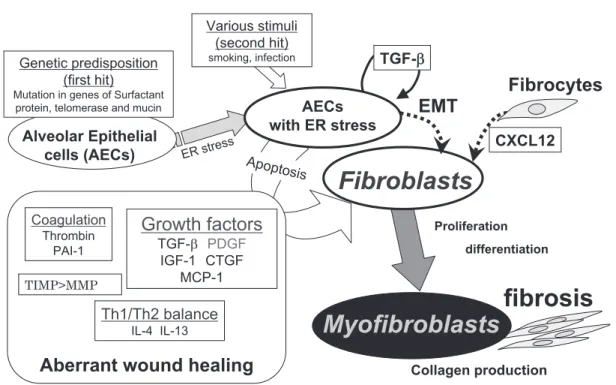
The molecular mechanisms involved in the pro-gression of IPF are still not fully understood, whereas the alveolar epithelial type II cells (AECII) and fi-broblasts are thought to be main players (Figure 1). As the first event, AECII injury is caused by endo-plasmic reticulum (ER) stress, lysosomal stress, and mitochondrial and DNA damage (7, 8). AECII are known to have genetic predisposition like gene mu-tations of surfactant protein C or A2, telomerase and MUC5B in subjects with familial pulmonary fibrosis, which lead to be susceptible for the second stimuli such as cigarette smoking or viral infection. After the second stimuli, the injured AECs have the ten-dency to be apoptotic. The link of injured AECII and fibrosis is not fully understood, but it was reported that those cells could produce the fibrotic mediators. Among profibrotic mediators, transforming growth factor (TGF)-β and PDGF are thought to play a critical role in the fibrogenesis of the lungs.
PDGF AND PDGF RECEPTORS
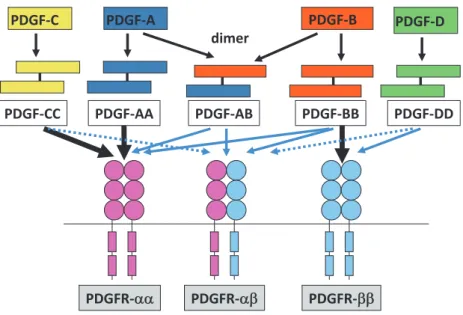
PDGF is a homo- or heterodimeric molecule with a molecular weight of 30 kDa (7). PDGF genes are consisted of four different genes including PDGF-A, -B, -C and -D, which are located on chromo-somes 7, 22, 4 and 11, respectively (9, 10). There are two types of PDGF receptors (PDGFRs),α and β, which have a molecular weight of 170-180 kDa, and composed of homo- or heterodimers. The pos-sible PDGF-PDGFR interactions are multiple and complex in in vitro study as shown in figure 2 (11). However, the in vivo study showed the binding of PDGF-AA or -CC to PDGFR-α, and PDGF-BB to PDGFR-β (11). PDGF dimers can bind their recep-tors and induce the dimerization of PDGFR, which allow their autophosphorylation of tyrosine residues in trans between two receptors (9). After the auto-phosphorylation, activated PDGFR can coupled with various signal transduction molecules such as Ras-MAPK through Grb2 and Shc adaptor proteins, and phosphatidyl inositol-3 kinase and phospholipase C-γ. PDGFR interacts with integrins and induced cell migration through activation focal adhesion kinase (FAK).
Figure 1 Molecular pathogensis of IPF
Alveolar epithelia cells (AECs) are known to have genetic predisposition like gene mutations of surfactant protein C or A2, telomerase and MUC5B in subjects with familial pulmonary fibrosis, which induce endoplasmic reticulum (ER) stress and lead to be suscepti-ble for the second stimuli such as cigarette smoking or viral infection. After the second stimuli, the injured AECs have the tendency to be apoptotic and produce the profibrotic mediators. Although the link of injured AECs and fibrosis is not fully understood, among profibrotic mediators, transforming growth factor (TGF) -β and PDGF are thought to play a critical role in the fibrogenesis of the lungs, which induce the proliferation and differentiation to myofibroblasts of fibroblasts.
Y. Nishioka, et al. PDGF in pulmonary fibrosis
EXPRESSION OF PDGFS AND PDGFRS
PDGFs are expressed in many types of cells in-cluding fibroblasts, vascular endothelial cells, macro-phages as well as platelets/megakaryocytes (9). It is known that the expression of PDGFs is up-regu-lated by various inflammatory cytokines and growth factors including TGF-β and PDGF themselves. PDGFRs are also expressed in various cells al-though the classical targets of PDGF are fibro-blasts and smooth muscle cells. The expression of PDGFRs is also induced by various stimuli. In con-trast to PDGFs, expression of PDGFR in some cells is limited to PDGFR-α or PDGFR-β, but not both.
BIOLOGICAL ACTIVITIES THROUGH PDGF/
PDGFR
PDGF is known to be a major mitogen for mesenchymal cells. PDGF is a strongest stimulus of proliferation of fibroblasts (9). In addition, binding of PDGF to their receptors induces Ca2 +influx and
rearrangement of the cytoskeleton involving changes in the arrangement of actin stress fibers. In terms of these responses, PDGF also stimulates the migration of various cells.
LUNG DEVELOPMENT AND PDGFS/
PDGFRS
The knock-out mice of the PDGF-A gene showed the homozygous lethal with two different restric-tion points, one prenatally and one postnatally (12). Postnatally surviving PDGF-A-deficient mice de-velop lung emphysema secondary due to the loss of alveolar myofibroblasts which has PDGFR-α. On the other hand, the PDGFR-α null mice showed the cranial malformations and deficiency of myotome formation (13). Mice deficient for PDGF-B revealed renal, cardiovascular and hematological abnormali-ties (14). Similarly, PDGFR-β mutant mice exhib-ited abnormal kidney development and hematologi-cal disorders, but cardiovascular abnormality was not detected (15). In summary, PDGF-A/PDGFR-α pathway plays a role in the secondary septation process, since PDGFR-α-expressing cells locate in the alveolar entry ring and have characteristics of myofibroblasts (16).
PDGF AND PULMONARY FIBROSIS
It is known that PDGF is one of the growth factors which play a role in the pathogenesis of pulmonary fibrosis (9, 11). In the animal models, bleomycin-induced pulmonary fibrosis has been used for the analysis of molecular pathogenesis in mice or rats.
Figure 2 PDGF - PDGFR system
The four PDGF proteins make a homo - or hetero - dimers and bind to PDGF receptors. The black bold arrow indicates the bindings which are confirmed in vivo. The blue arrows indicate the binding in cell culture. The hatched arrows indicate weak interactions or conflicting results.
Maeda et al. reported that expression of the PDGF-A gene increased in bleomycin-induced pulmo-nary fibrosis models in mice using semi-quantita-tive reverse transcriptase-polymerase chain reac-tion (RT-PCR)(17). Walsh et al. have examined the bronchoalveolar lavage fluid of rats treated with a bleomycin, and could find the 38-40 kDa and 29 kDa peptides, which were detected with anti-PDGF-BB and anti-PDGF-AA antibodies, respectively, showed the growth-promoting activity of lung fibro-blasts (18). The growth-promoting activity was neu-tralized 64% by anti-PDGF-BB antibody and 15% by anti-PDGF-AA antibody. In contrast, Zhuo et al. showed that PDGF-C gene, but not PDGF-A, B and D, was induced in the lungs of mice treated with bleomycin by Northern blot analysis (19). Shimizu
et al. reported that both PDGF-A and -B was
in-duced and elevated in bleomycin-treated lungs of mice at the levels of both mRNA and protein (20). Adoptive transfer of an adenovirus expressing the PDGF-B gene into the lung induced severe fibrosis in mice (21). From these reports, the expression of PDGF isoforms could be enhanced in fibrogenesis of the lungs, but the details are required to be fur-ther analyzed.
On the other hand, enhanced expression of PDGF in the epithelial cells and alveolar macrophages in lungs of patients with IPF has been reported (22, 23). However, the mechanisms involved in the en-hanced expression and action of PDGF in the fibrotic lung are poorly understood. Recently, Gochuico et
al. has examined the growth factors in alveolar
lin-ing fluids of patients with rheumatoid arthritis com-plicated with pulmonary fibrosis, and reported that PDGF-AB and -BB, but not TGF-β and PDGF-AA, was associated with the progressive stage of pul-monary fibrosis (24), indicating the importance of PDGF-B in the fibrogenesis of the lungs.
ANTIFIBROTIC EFFECTS OF TARGETING
PDGF/PDGFR SIGNALING PATHWAY IN
ANIMAL MODELS
Several evidences described above suggest the targeting PDGF/PDGFR signaling pathway might lead to show the therapeutic effects against pulmo-nary fibrosis. This hypothesis has been investigated using animal models of pulmonary fibrosis with specific inhibitors for PDGFR.
Rice et al. firstly reported that AG1296, the inhibi-tor for the tyrosine kinase of PDGFR, prevented
pulmonary fibrosis induced by vanadium pentoxide (V2O5) in rats (25). Since AG1296 is a compound
which has been used for in vitro experiments, mo-lecular targeted drugs which have been developed for treatment of patients with malignancy should be investigated their antifibrotic effects. Among them, imatinib mesylate (previously called STI571, Gleevec in the United States and Glivec in Europe) is a po-tent and specific tyrosine kinase inhibitor against c-abl, bcr-abl and c-kit. Imatinib has been demon-strated to be highly active in chronic myeloid leu-kemia (CML) and gastrointestinal stromal tumors (GIST) (26-29). The reported data regarding the specificity of imatinib for various tyrosine kinases shows that imatinib also specifically inhibits PDGFR tyrosine kinase (30). Therefore, we and others have tried to demonstrate antifibrotic effects of imatinib in various pulmonary fibrosis models. As shown in figure 3, imatinib strongly inhibited the fibrogenesis in the lungs treated with bleomycin via inhibiting the growth of mesenchymal cells in vivo in mice (31). Daniels et al. reported that imatinib could inhibit the activity of TGF-β via inhibiting c-Abl kinase in addition to the blocking of PDGFR signaling (32). They also demonstrated that imatinib prevented bleomycin-induced pulmonary fibrosis in mice. Fur-thermore, Abdollahi et al. demonstrated the antifi-brotic effects of imatinib in murine radiation-induced lung fibrosis (33). In their experiments, they used three kinds of small molecule inhibitors, imatinib, SU9518 and SU11657, which can inhibit the com-mon receptor PDGFR. Therefore antifibrotic effects of three inhibitors were strongly suggested to be mediated by blocking PDGFR. In addition, Yoshida
et al. reported that the in vivo gene transfer of an
extracellular domain of PDGFR-β reduced bleomy-cin-induced pulmonary fibrosis (34). These results suggested that PDGFR is one of therapeutic target for pulmonary fibrosis.
Imatinib has also been reported to prevent fibro-genesis in the liver and kidneys (35-38). These re-sults in addition to inhibitory effects of myelofibrosis (39, 40) suggest that imatinib might serve as an anti-fibrotic drug for various anti-fibrotic diseases in humans. Recently, the antifibrotic effects of other inhibi-tors, which could show higher activity compared to imatinib, have been reported. For example, BIBF1000 which inhibited PDGFR, VEGFR and FGFR was reported to reduce pulmonary fibrosis induced by a bleomycin in rats (41). Nilotinib was also reported to show higher antifibrotic activity as compared to imatinib (42).
Y. Nishioka, et al. PDGF in pulmonary fibrosis
ANTIFIBROTIC EFFECTS OF TARGETING
PDGF/PDGFR SIGNALING PATHWAY IN
HUMAN
Based on the preclinical studies, the application of imainib for treatment of patients with pulmonary fibrosis has been expected.
In the earlier experiences in clinical use of imatinib, several case reports showed the favorable activity of imatinib in patients with connective tissue dis-eases including systemic sclerosis (SSc) or mixed connective tissue disease (MCTD) (43-45). Chung
et al. reported two cases with SSc treated with
imatinib. Both patients showed the improvement of skin tightening after the use of 200 mg/day of imatinib for three months (43). In addition, a forced vital capacity (FVC) in one patient who has lung involvement of SSc was improved from 48% of pre-dicted to 52%. Sfikakis et al. reported the severe case of SSc who have treated with 400 mg/day imatinib for six months (44). This patient showed the im-provement of FVC from 68.0% to 88.3% predicted. Distler et al. also reported the improvement of pul-monary function and HRCT findings in patients with MCTD (45). The recent phase IIa, single-arm, open-label clinical trial with imatinib against SSc showed the efficacy in modified Rodnan skin score and FVC (46), whereas the increased adverse events were
observed, and some trials were prematurely termi-nated for safety reasons (47).
On the other hand, the clinical trial of IPF with single dose of imatinib has been conducted and performed in USA (48). Although serious adverse events were not more common in the imatinib group, treatment with imatinib did not affect lung func-tion such as FVC and the diffusing capacity of the lung (DLco) as well as survival of IPF patients. How-ever, this trial has several problems in the design and results which was pointed out in the discussion of this paper and the editorial by Thannickal VJ and Roman J (49). First, this study was conducted by the anticipation of 50% incidence of achieving the primary endpoint of disease progression or death over 96 weeks of treatment, whereas the incidence in placebo group was 31.6%, indicating the under-power of this study to detect the differences between groups. Second, theoretically, PDGFR are expressed not only in fibroblasts, but also in epithelial or other cells. To inhibit PDGFR signaling pathway can block the proliferation and migration of fibroblasts, but the blocking of PDGFR may affect the function of epithelial cells to prevent the fibrogenesis. In fact, Vuorinen et al. reported that PDGFR-β are preferen-tially expressed in lung parenchyma, but PDGFR-α are strongly expressed in epithelium in addition to lung parenchyma in the lungs of IPF patient (50).
Figure 3 Antifibrotic effects of imatinib in pulmonary fibrosis induced by bleomycin in mice. Treatment with imatinib inhibited puolmonary fibrosis induced by bleomycin in a dose - dependent manner (A). The BrdU staining showed the reduced number of proliferating cells in inter - alveolar space (B). Adapted from reference 31.
Third, the pharmacological consideration of imatinib was also pointed out. We reported the resistance mechanism of imatinib mediated byα1-acid gly-coprotein (AGP), which can bind to imatinib and block the effects of imatinib (51). AGP was elevated in serum of both bleomycin-treated mice and pati-ents with IPF. Therefore, the patipati-ents enrolled in clinical trial might be better to be selected by the level of AGP. The more extensive and fine preclini-cal study could be required to focus the molecular target for therapeutic approach of IPF.
However, the growth factors are still in central mediators to promote pulmonary fibrosis. Recently, promising clinical trials targeting the signaling of growth factors have been reported. BIBF1120, which is derivative of BIBF1000, was reported to inhibit the progression and acute exacerbation of IPF in phase II TOMORROW study (6).
FUTURE PERSPECTIVES
The international phase III clinical trial using BIBF1120 for IPF has been in progress. BIBF1120 can inhibit VEGFR and FGFR in addition to PDGFR. The role of VEGFR and FGFR in the progression of pulmonary fibrosis is still unclear. Therefore, PDGFR still play a central role as a therapeutic target in the progression of IPF. The establishment of molecular targeting therapy against growth fac-tors including PDGF would be expected in clinic.
ACKNOWLEDGEMENT
This work was supported by KAKENHI (18590855, 20390231 and 23659434), Grants-in-Aid for Scientific Researchs (C), (B) and a Challenging Exploratory Research, respectively, from the Min-istry of Education, Culture, Sports, Science and Technology (MEXT), and a grant to the Diffuse Lung Diseases Research Group from the Ministry of Health, Labour, and Welfare of Japan.
REFERENCES
1. Gross TJ, Hunninghake GW : Idiopathic pul-monary fibrosis. N Engl J Med 345 : 517-525, 2001
2. Selman M, King TE Jr, Pardo A : Idiopathic pulmonary fibrosis : prevailing and evolving
hypotheses about its pathogenesis and implica-tions for therapy. Ann Intern Med 134 : 136-151, 2001
3. American Thoracic Society : Idiopathic pulmo-nary fibrosis : Diagnosis and treatment. Inter-national consensus statement. Am J Respir Crit Care Med 161 : 646-664, 2000
4. Collard HR, King TE Jr : Demystifying idi-opathic interstitial pneumonia. Arch Intern Med 163 : 17-29, 2003
5. Raghu G, Collard HR, Egan JJ, Martinez FJ, Behr J, Brown KK, Colby TV, Cordier JF, Flaherty KR, Lasky JA, Lynch DA, Ryu JH, Swigris JJ, Wells AU, Ancochea J, Bouros D, Carvalho C, Costabel U, Ebina M, Hansell DM, Johkoh T, Kim DS, King TE Jr, Kondoh Y, Myers J, Muller NL, Nicholson AG, Richeldi L, Selman M, Dudden RF, Griss BS, Protzko SL, Schunemann HJ : An official ATS/ERS/JRS/ ALAT statement : Idiopathic pulmonary fibrosis : Evidence-based guidelines for diagnosis and management. Am J Respir Crit Care Med 183 : 788-824, 2011
6. Richeldi L, Costabel U, Selman M, Kim DS, Hansell DM, Nicholson AG, Brown KK, Flaherty KR, Noble PW, Raghu G, Brun M, Gupta A, Juhel N, Klüglich M, du Bois RM : Ef-ficacy of a tyrosine kinase inhibitor in idiopathic pulmonary fibrosis. N Engl J Med 365 : 1079-1087, 2011
7. Günther A, Korfei M, Mahavadi P, von der Beck D, Ruppert C, Markart P : Unravelling the progressive pathophysiology of idiopathic pulmonary fibrosis. Eur Respir Rev 21 : 152-160, 2012
8. Noble PW, Barkauskas CE, Jiang D : Pulmo-nary fibrosis : patterns and perpetrators. J Clin Invest 122 : 2756-2762, 2012
9. Herdin CH, Westermark B : Mechanism of ac-tion and in vivo role of platelet-derived growth factor. Physiol Rev 79 : 1283-1316, 1999 10. Li X, Eriksson U : Novel PDGF family
mem-bers : PDGF-C and PDGF-D. Cytokine Growth Factor Rev 14 : 91-98, 2003
11. Andrae J, Gallini R, Betsholtz C : Role of plate-let-derived growth factors in physiology and medicine. Genes Dev 22 : 1276-1312, 2008 12. Boström H, Willetts K, Pekny M, Levéen P,
Lindahl P, Hedstrand H, Pekna M, Hellström M, Gebre-Medhin S, Schalling M, Nilsson M, Kurland S, Törnell J, Heath JK, Betsholtz C : PDGF-A signaling is a critical event in lung
Y. Nishioka, et al. PDGF in pulmonary fibrosis
alveolar myofibroblast development and alveo-genesis. Cell 14 : 863-873, 1996
13. Soriano P : The PDGFa receptor is required for neural crest cell development and for normal patterning of the somites. Development 124 : 2691-2700, 1997
14. Levéen P, Pekny M, Gebre-Medhin S, Swolin B, Larsson E, Betsholtz C : Mice deficient for PDGF B show renal, cardiovascular, and he-matological abnormalities. Genes Dev 8 : 1875-1887, 1994
15. Soriano P : Abnormal kidney development and hematological disorders in PDGF beta-receptor mutant mice. Genes Dev 8 : 1888-1896, 1994 16. McGowan SE, Grossmann RE, Kimani PW,
Holmes AJ : Platelet-derived growth factor re-ceptor-alpha-expressing cells localize to the alveolar entry ring and have characteristics of myofibroblasts during pulmonary alveolar septal formation. Anat Rec (Hoboken) 291 : 1649-1661, 2008
17. Maeda A, Hiyama K, Yamakido H, Ishioka S, Yamakido M : Increased expression of platelet-derived growth factor A and insulin-like growth factor-I in BAL cells during the development of bleomycin-induced pulmonary fibrosis in mice. Chest 109 : 780-786, 1996
18. Walsh J, Absher M, Kelley J : Variable expres-sion of platelet-derived growth factor family proteins in acute lung injury. Am J Respir Cell Mol Biol 9 : 637-644, 1993
19. Zhou Y, Zheng J, Laboy M, Lasky JA : Modu-lation of PDGF-C and PDGF-D expression dur-ing bleomycin-induced lung fibrosis. Am J Physiol Lung Cell Mol Physiol 286 : L182-L188, 2004
20. Shimizu S, Gabazza EC, Taguchi O, Yasui H, Taguchi Y, Hayashi T, Ido M, Shimizu T, Nakagaki T, Kobayashi H, Fukudome K, Tsuneyoshi N, D’Alessandro-Gabazza CN, Izumizaki M, Iwase M, Homma I, Adachi Y, Suzuki K : Activated protein C inhibits the ex-pression of platelet-derived growth factor in the lung. Am J Respir Crit Care Med 167 : 1416-1426, 2003
21. Yoshida M, Sakuma J, Hayashi S, Abe K, Saito I, Harada S, Sakatani M, Yamamoto S, Matsumoto N, Kaneda Y : A histologically dis-tinctive interstitial pneumonia induced by over-expression of the interleukin 6, transforming growth factor beta 1, or platelet-derived growth factor B gene. Proc Natl Acad Sci USA 92 :
9570-9574, 1995
22. Antoniades HN, Bravo MA, Avila RE, Galanopoulos T, Neville-Golden J, Maxwell M, Selman M : Platelet-derived growth factor in idiopathic pulmonary fibrosis. J Clin Invest 86 : 1055-1064, 1990
23. Homma S, Nagaoka I, Abe H, Takahashi K, Seyama K, Nukiwa T, Kira S : Localization of platelet-derived growth factor and insulin-like growth factor I in the fibrotic lung. Am J Respir Crit Care Med 152 : 2084-2089, 1995
24. Gochuico BR, Avila NA, Chow CK, Novero LJ, Wu HP, Ren P, MacDonald SD, Travis WD, Stylianou MP, Rosas IO : Progressive preclini-cal interstitial lung disease in rheumatoid ar-thritis. Arch Intern Med 168 : 159-166, 2008 25. Rice AB, Moomaw CR, Morgan DL, Bonner JC :
Specific inhibitors of platelet-derived growth factor or epidermal growth factor receptor tyrosine kinase reduce pulmonary fibrosis in rats. Am J Pathol 55 : 213-221, 1999
26. Druker BJ, Talpaz M, Resta DJ, Peng B, Buchdunger E, Ford JM, Lydon NB, Kantarjian H, Capdeville R, Ohno-Jones S, Sawyers CL : Efficacy and safety of a specific inhibitor of the BCR-ABL tyrosine kinase in chronic myeloid leukemia. N Engl J Med 344 : 1031-1037, 2001 27. Druker BJ, Sawyers CL, Kantarjian H, Resta
DJ, Reese SF, Ford JM, Capdeville R, Talpaz M : Activity of a specific inhibitor of the BCR-ABL tyrosine kinase in the blast crisis of chronic myeloid leukemia and acute lymphoblastic leu-kemia with the Philadelphia chromosome. N Engl J Med 344 : 1038-1042, 2001
28. Demetri GD, von Mehren M, Blanke CD, Van den Abbeele AD, Eisenberg B, Roberts PJ, Heinrich MC, Tuveson DA, Singer S, Janicek M, Fletcher JA, Silverman SG, Silberman SL, Capdeville R, Kiese B, Peng B, Dimitrijevic S, Druker BJ, Corless C, Fletcher CD, Joensuu H : Efficacy and safety of imatinib mesylate in advanced gastrointestinal stromal tumors. N Engl J Med 347 : 472-480, 2002
29. van Oosterom AT, Judson I, Verweij J, Stroobants S, Donato di Paola E, Dimitrijevic S, Martens M, Webb A, Sciot R, Van Glabbeke M, Silberman S, Nielsen OS : European Organ-isation for Research and Treatment of Cancer Soft Tissue and Bone Sarcoma Group : Safety and efficacy of imatinib (STI571) in metastatic gastrointestinal stromal tumours : a phase I study. Lancet 358 : 1421-1423, 2001
30. Druker BJ, Tamura S, Buchdunger E, Ohno S, Segal GM, Fanning S, Zimmermann J, Lydon NB : Effects of s selective inhibitor of the abl tyrosine kinase on the growth of bcr-abl posi-tive cells. Nature Med 2 : 561-566, 1996 31. Aono Y, Nishioka Y, Inayama M, Ugai M, Kishi
J, Uehara H, Izumi K, Sone S : Imatinib as a novel antifibrotic agent in bleomycin-induced pulmonary fibrosis in mice. Am J Respir Crit Care Med 171 : 1279-1285, 2005
32. Daniels CE, Wilkes MC, Edens M, Kottom TJ, Murphy SJ, Limper AH, Leof EB : Imatinib mesylate inhibits the profibrogenic activity of TGF-β and prevents bleomycin-mediated lung fibrosis. J Clin Invest 114 : 1308-1316, 2004 33. Abdollahi A, Li M, Ping G, Plathow C, Domhan
S, Kiessling F, Lee LB, McMahon G, Gröne HJ, Lipson KE, Huber PE : Inhibition of plate-let-derived growth factor signaling attenuates pulmonary fibrosis. J Exp Med 201 : 925-935, 2005
34. Yoshida M, Sakuma-Mochizuki J, Abe K, Arai T, Mori M, Goya S, Matsuoka H, Hayashi S, Kaneda Y, Kishimoto T : In vivo gene trans-fer of an extracellular domain of platelet-de-rived growth factor beta receptor by the HVJ-liposome method ameliorates bleomycin-in-duced pulmonary fibrosis. Biochem Biophys Res Commun 265 : 503-508, 1999
35. Gilbert RE, Kelly DJ, McKay T, Chadban S, Hill PA, Cooper ME, Atkins RC, Nikolic-Paterson DJ : PDGF signal transduction inhi-bition ameliorates experimental mesangial pro-liferative glomerulonephritis. Kidney Int 59 : 1324-1332, 2001
36. Wang S, Wilkes MC, Leof EB, Hirschberg R : Imatinib mesylate blocks a non-Smad TGF-β pathway and reduces renal fibrogenesis in vivo. FASEB J 19 : 1-11, 2005
37. Yoshiji H, Noguchi R, Kuriyama S, Ikenaka Y, Yoshii J, Yanase K, Namisaki T, Kitade M, Masaki T, Fukui H : Imatinib mesylate (STI-571) attenuates liver fibrosis development in rats. Am J Physiol Gastrointest Liver Physiol 288 : G907-913, 2005
38. Neef M, Ledermann M, Saegesser H, Schneider V, Widmer N, Decosterd LA, Rochat B, Reichen J : Oral imatinib treatment reduces early fibro-genesis but does not prevent progression in the long term. J Hepatol 44 : 167-75, 2006
39. Beham-Schmid C, Apfelbeck U, Sill H, Tsybrovsky O, Hofler G, Haas OA, Linkesch
W : Treatment of chronic myelogenous leuke-mia with the tyrosine kinase inhibitor STI571 results in marked regression of bone marrow fibrosis. Blood 99 : 381-383, 2002
40. Klion AD, Robyn JA, Akin C, Noel P, Brown MR, Law MA, Metcalfe DD, Dunbar CE, Nutman TB : Molecular remission and rever-sal of myelofibrosis in response to imatinib mesylate treatment in patients with the myelo-proliferative variant of hypereosinophilic syn-drome. Blood 103 : 473-478, 2003
41. Chaudhary NI, Roth GJ, Hilberg F, Müller-Quernheim J, Prasse A, Zissel G, Schnapp A, Park JE : Inhibition of PDGF, VEGF and FGF signalling attenuates fibrosis. Eur Respir J 29 (5) : 976-985, 2007
42. Rhee CK, Lee SH, Yoon HK, Kim SC, Lee SY, Kwon SS, Kim YK, Kim KH, Kim TJ, Kim JW : Effect of nilotinib on bleomycin-induced acute lung injury and pulmonary fibrosis in mice. Res-piration 82 : 273-287, 2011
43. Chung L, Fiorentino DF, Benbarak MJ, Adler AS, Mariano MM, Paniagua RT, Milano A, Connolly MK, Ratiner BD, Wiskocil RL, Whitfield ML, Chang HY, Robinson WH : Molecular framework for response to imatinib mesylate in systemic sclerosis. Arthritis Rheum 60 : 584-591, 2009
44. Sfikakis PP, Gorgoulis VG, Katsiari CG, Evangelou K, Kostopoulos C, Black CM : Imatinib for the treatment of refractory, diffuse systemic sclerosis. Rheumatology (Oxford) 47 : 735-737, 2008
45. Distler JH, Manger B, Spriewald BM, Schett G, Distler O : Treatment of pulmonary fibrosis for twenty weeks with imatinib mesylate in a pa-tient with mixed connective tissue disease. Ar-thritis Rheum 58 : 2538-42, 2008
46. Spiera RF, Gordon JK, Mersten JN, Magro CM, Mehta M, Wildman HF, Kloiber S, Kirou KA, Lyman S, Crow MK : Imatinib mesylate (Gleevec) in the treatment of diffuse cutaneous systemic sclerosis : results of a 1-year, phase IIa, single-arm, open-label clinical trial. Ann Rheum Dis 70 : 1003-1009, 2011
47. Bournia VK, Evangelou K, Sfikakis PP : Thera-peutic inhibition of tyrosine kinases in systemic sclerosis : a review of published experience on the first 108 patients treated with imatinib. Semin Arthritis Rheum 42 : 377-390, 2013 48. Daniels CE, Lasky JA, Limper AH, Mieras K,
Gabor E, Schroeder DR : Imatinib-IPF Study
Y. Nishioka, et al. PDGF in pulmonary fibrosis
Investigators : Imatinib treatment for idiopathic pulmonary fibrosis : Randomized placebo-con-trolled trial results. Am J Respir Crit Care Med 181(6) : 604-610, 2010
49. Thannickal VJ, Roman J : Challenges in trans-lating preclinical studies to effective drug thera-pies in idiopathic pulmonary fibrosis. Am J Crit Care Med 181 : 532-533, 2010
50. Vuorinen K, Ohlmeier S, Leppäranta O, Salmenkivi K, Myllärniemi M, Kinnula VL :
Peroxiredoxin II expression and its association with oxidative stress and cell proliferation in human idiopathic pulmonary fibrosis. J Histo-chem CytoHisto-chem 56 : 951-959, 2008
51. Azuma M, Nishioka Y, Aono Y, Inayama M, Makino H, Kishi J, Shono M, Kinoshita K, Uehara H, Ogushi F, Izumi K, Sone S : Role of a1-acid glycoprotein in therapeutic antifibrotic effects of imatinib with macrolides in mice. Am J Respir Crit Care Med 176 : 1243-1250, 2007