INTRODUCTION
Histopathologic observations and the examination of bronchoalveolar lavage (BAL) fluid from patients and experimental animals with fibrotic lung disease suggest that the blood coagulation system is activated in the course of pulmonary fibrosis (1-7). Histologically, fibrin is observed in the interstitium and the alveolar surface of patients with idiopathic pulmonary fibrosis (IPF) or adult respiratory distress syndrome (ARDS) (1, 3, 4), and the sites of early fibrin deposition correlate with the location of subsequent fibrotic processes in these disorders (2). Additionally, increased procoagulant activity is observed in the BAL fluid from patients with IPF or ARDS and from animal models of bleomycin-induced lung injury (5-7). Thus, the activation of blood coagulation may have an influence on the development of pulmonary fibrosis.
Thrombin, which is involved in blood clotting, is a multifunctional enzyme generated during vascular injury. This enzyme has been shown to stimulate the growth of a variety of cell types, including fibroblasts (8-10), macrophage-like cells (11, 12), monocytes (13), and T lymphocytes (14). We previously observed an increased activity level of thrombin in the BAL fluid from rats with
bleomycin-induced lung injury, which was responsible for the development of pulmonary fibrosis and served as a growth-stimulating factor for fibroblasts (15). Ohba et al. recently reported that the level of thrombin activity in BAL fluid from patients with scleroderma was higher than in normal controls, and that thrombin was responsible for fibroblast growth in this disorder (16).
In the present study, we focused on evidence that thrombin stimulates alveolar macrophages (AM) to re-lease cytokines, and we obtained the first direct evidence that thrombin stimulates the production of platelet-derived growth factor (PDGF) by AM.
MATERIALS AND METHODS
Administration of BleomycinMale Wistar rats (Tokushima Experimental Animal Laboratories, Tokushima, Japan) weighing 170-190 g were used. They were lightly anesthetized with an intraperito-neal injection of sodium pentobarbital (10 mg) and given a single intratracheal injection of 0.6 mg of bleomycin sulfate (Nippon Kayaku Co., Tokyo, Japan) dissolved in 0.3 ml of sterile saline. Control rats received 0.3 ml of sterile saline alone by the same route.
Stimulation of AM and Preparation of AM Supernatants
The lungs were removed with other thoracic organs from the control and bleomycin-treated rats on day 4 after treatment. The trachea was cannulated with a plastic
Thrombin
stimulates
platelet-derived
growth
factor
release by alveolar macrophages in rats
-significance
in bleomycin-induced pulmonary
fibrosis-Kenji Tani, Fumitaka Ogushi, Hiroko Takahashi, Tetsuya Kawano,Takeshi Endo
and Saburo Sone
Third Department of Internal Medicine, The University of Tokushima School of Medicine, Tokushima, Japan
Abstract : Thrombin is a multifunctional enzyme generated at sites of vascular injury, and is known to be increased in the lungs in some types of fibrotic lung disease. In this study, to determine whether thrombin is associated with fibroblast growth and pulmonary fibrosis in these disorders, we examined whether a growth factor for fibroblasts (platelet-derived growth factor, PDGF) was released by thrombin-stimulated alveolar macrophages (AM). The culture supernatants of rat AM stimulated with 1 or 10 U/ml of thrombin showed a significant increase in fibroblast growth-stimulating activity (FGA). Pretreatment of the AM supernatant with anti-PDGF-AA antibody significantly decreased the FGA, but pretreatment with anti-PDGF-BB antibody did not. The supernatants of AM stimulated with thrombin also increased the growth of fibroblasts from the lungs of rats with bleomycin-induced lung injury. These results indicate that thrombin stimulates AM to release PDGF-AA, which is responsible, at least in part, for fibroblast growth and the development of pulmonary fibrosis in some types of fibrotic lung disease. J. Med. Invest. 44 : 59-65, 1997
Key Words : thrombin, fibroblast growth-stimulating factor, platelet-derived growth factor, pulmonary fibrosis
Received for publication June 30, 1997 ; accepted July 16, 1997.
1 Address correspondence and reprint requests to Kenji Tani, M.D., Ph.D., Third Department of Internal Medicine, The University of Tokushima School of Medicine, 3-18-15, Kuramoto-cho, Tokushima, Japan.
The Journal of Medical Investigation Vol.44 1997
catheter attached to a 10-ml syringe, and BAL was performed with a total volume of 25 ml of sterile saline in five 5-ml portions. The BAL cells were pelleted by centrifugation at 250 x g for 10 min and washed 3 times with Dulbecco's modified Eagle medium (DMEM ; Nissui Pharmaceutical Co., Tokyo) containing penicillin (100 U/ ml) and streptomycin (100 μg/ml), and then resuspended in DMEM. The total cell count of the suspension was determined in a hemocytometer, and differential cell counts were determined by a cytocentrifugation of the cells. AM were seeded at a density of 1 x 10⁶
cells/ml in 24-well multiwell plates (Falcon 3047 ; Falcon Plastics, Ox-nard, CA). After culturing for 1 h at 37℃ in a humidified atmosphere of 5% CO2in air, the plates were washed three times to remove non-adherent cells. The AM cell layers were cultured with (1) medium alone [DMEM containing bovine serum albumin (BSA ; Sigma Chemical Co., St. Louis, MO)], (2) medium + purified rat thrombin (Sigma,1 U/ml or 10 U/ml), and (3) medium + lipopolysaccharide (LPS,1 μg/ml). The total volume of all AM cultures was 1 ml/well, and the final concentration of BSA was 1%. After culturing for 24 h at 37℃ in a humidified atmosphere of 5% CO2in air, the AM supernatants were sterilized by micropore filtration (0.45-μm-pore filters ; Millipore Corp., Bedford, MA) and stored at -70℃. The viability of the AM, as determined by trypan blue exclusion prior to and after their incubation, was always greater than 95%.
In Vitro Effects of AM Supernatants on Fibroblast Growth
Lung fibroblasts from control and bleomycin-treated rats on day 4 after treatment were obtained by the method of Phan et al. (17). Unless otherwise stated, lung fibro-blasts from control rats were used in this study. Fibroblasts between the fifth and tenth passages were used. Fibroblasts harvested from culture dishes by trypsinization were suspended in DMEM containing 10% fetal calf serum (FCS ; GIBCO, Grand Island, NY). Fibro-blasts were seeded at a density of 1 x 10⁴
cells/200 μl/well in 96-well multiwell plates (Falcon 3072). After culturing for 24 h at 37℃ in a humidified atmosphere of 5% CO2in air, each well was washed three times with DMEM, and then fibroblasts were cultured in DMEM without serum at 37℃ in a humidified atmosphere of 5% CO2 in air. After culturing for 24 h, the medium was removed, and the AM supernatants from control or bleomycin-treated rats were added with DMEM containing BSA in a total volume of 200 μl/well. The final concentration of BSA in all fibro-blast cultures was 1%, and all experiments were done in triplicate. DMEM containing 1% BSA was used as a control of the AM supernatants (medium control). After further culture for 3 days at 37℃ in a humidified atmos-phere of 5% CO2in air, the fibroblast growth-stimulating activity (FGA) of the AM supernatants was determined by the viable cell-staining method as reported previously (15, 18). Briefly, the medium was removed, the plates were washed twice with phosphate-buffered saline, and the remaining viable adherent fibroblasts were stained with 100 μl of crystal violet solution (0.3% in 2% ethanol) for 20
min at 37℃. The crystal violet solution was then removed, and the plates were washed with distilled water. The stained cells were solubilized in 100 μl of 2% sodium dodecyl sulfate, and the absorbance at 550 nm of each well was measured with a model MTP-12 Microplate Photometer (Corona Electric Co., Tokyo). In preliminary experiments, this cell-staining method showed a close correlation with the viable cell number and3
H-thymidine incorporation, as reported previously (15).
Effects of Anti-PDGF Antibodies on the FGA of AM Supernatants
Anti-human PDGF antibodies were purchased from Wako Chemical Co., Osaka, Japan. The supernatant of control rat AM treated with 1 U/ml of rat thrombin was preincubated with an equal volume of anti-PDGF-AA or anti-PDGF-BB antibody solution (500 or 5,000 ng/ml) at 4℃ for 16 h. The solutions were then tested on fibroblasts for FGA as described above.
Effect of Argatroban on the FGA in AM Supernatants
We examined the effect of argatroban on the FGA in the supernatant of control rat AM treated with thrombin. Argatroban was a generous gift from Mitsubishi Kasei Corp., Tokyo. This synthetic arginine derivative is known to be a potent and highly specific thrombin inhibitor (19-21). The supernatant of control rat AM treated with 1 U/ ml of rat thrombin was preincubated with an equal volume of argatroban solution (100 μM) at 37℃ for 3 h. The solutions were then tested on fibroblasts for FGA as described above.
Effects of PDGF-AA and -BB on Fibroblast Growth
Fibroblasts were cultured with various concentrations of recombinant human PDGF-AA or- BB (Wako) in DMEM containing BSA or FCS in a total volume of 200 μl/well at 37℃ in a humidified atmosphere of 5% CO2 in air. After culturing for 3 days, FGA was determined as described above.
Measurement of Interleukin-1 in AM Supernatants
Enzyme immunoassays for rat interleukin (IL)-1 α and IL-1 β were performed as described previously (22, 23). The sensitivity units of the enzyme immunoassays for IL-1 α and IL-IL-1 β were 20 and 2,000 pg/ml, respectively.
Statistical Analysis
All results are expressed as mean±SD. Statistical significance was determined by Student's t test, and a p value of <0.05 was considered significant.
RESULTS
Fibroblast Growth-Stimulating Activity in AM Supernatants
The supernatants of AM from control rats were added to the cultures of fibroblasts from the lungs of control and bleomycin-treated rats at a concentration of 10%, and the FGA was then measured (Fig.1). The FGA was expressed as the percentage increase from the value in the medium control cultures. The supernatants from untreated or
LPS-K. Tani et al. Thrombin stimulates PDGF release by AM
treated AM had no effect on the growth of fibroblasts from control rats. In contrast, the supernatants of AM treated with 1 U/ml and 10 U/ml thrombin showed significant increases in FGA (52.2±7.5% and 79.3±25.9%, respec-tively). The supernatants of AM treated with 1 U/ml and 10 U/ml of thrombin also stimulated the growth of fibroblasts from bleomycin-treated rats (51.9±8.5% FGA and 53.3±14.4% FGA, respectively), similar to that of control fibroblasts .
Effects of Anti-PDGF Antibodies on the FGA in AM Supernatants
We examined the effects of anti-PDGF antibodies on the FGA detected in the supernatant of AM treated with 1 U/ ml thrombin (Fig.2). The pretreatment of the AM supernatant with anti-PDGF-AA antibody (250 U/ml and 2500 U/ml) significantly decreased the FGA (by 54.8% and 85.5%, respectively). The pretreatment with anti-PDGF-BB antibody did not decrease the FGA in the AM supernatant. The anti-PDGF-AA and -BB antibodies them-selves at the concentrations used in this experiment had no effect on fibroblast growth (data not shown).
Effect of Argatroban on the FGA in AM Supernatants
Thrombin itself is known to stimulate fibroblast growth. Thus, the effect of argatroban on the FGA in AM supernatants was examined to determine whether the FGA in the AM supernatants was due to thrombin
Fig.1. Fibroblast growth-stimulating activity (FGA) in the super-natants of AM from control rats, cultured with medium alone, medium + LPS (1 μg/ml), or medium + purified rat thrombin (1 U/ ml or 10 U/ml) for 24 h. Samples of the AM supernatants were added to cultures of fibroblasts from the lungs of control and bleomycin-treated rats at a concentration of 10%. After culturing for 3 days, their effects on fibroblast growth were assayed as described in Materials and Methods. The FGA is expressed as the percentage increases from the value of the medium control culture. Columns and bars show means and SD of values for three rats.
*Significantly different from the value cultured in medium alone by Student's t-test (p<0.01).
Fig. 3. The effect of argatroban on the FGA in AM supernatants. The supernatants from control rat AM treated with 1 U/ml of thrombin and thrombin solutions (1 U/ml) were preincubated with an equal volume of argatroban (100 μM) at 37℃ for 3 h. The solutions were then added to cultures of fibroblasts from control rats. After culturing for 3 days, their effects on fibroblast growth were assayed as described in Materials and Methods. The FGA is expressed as the percentage increase from the value of the medium control culture. Columns and bars show the means and SD of values for 3 rats.
Fig. 2. The effects of anti-PDGF-AA and -BB antibodies on the FGA in AM supernatants. The supernatants from control rat AM treated with 1 U/ml of thrombin were preincubated with an equal volume of anti-PDGF-AA or -BB antibody solution (500 or 5,000 ng/ ml) at 4℃ for 16 h. The solutions were then added to fibroblast cultures containing 10% AM supernatants. After culturing for 3 days, their effects on fibroblast growth were assayed as described in Materials and Methods. The FGA is expressed as the percentage increase from the value of the medium control culture. Columns and bars show the means and SD of values for 3 rats.
*Significantly different from the value cultured in AM supernatant not treated with PDGF antibodies by Student's t-test (p<0.01) The Journal of Medical Investigation Vol.44 1997 61
remaining in the supernatant (Fig.3). By pretreatment with argatroban, the FGA of purified rat thrombin decreased to 10.6±3.0%. In contrast, the pretreatment of the supernatant of thrombin-treated AM with argatroban decreased the FGA only to 81.9±2.5%. Argatroban itself at the concentration used in this experiment did not affect fibroblast growth (data not shown). These results indi-cated that the FGA in the AM supernatant was different from the activity of thrombin remaining in the superna-tant.
Fibroblast Growth-Stimulating Activity by Human PDGF
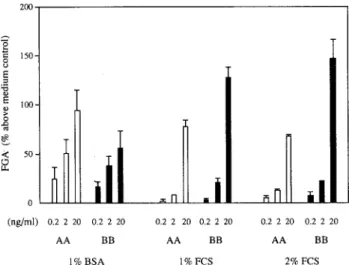
The in vitro effects of recombinant human PDGF-AA and -BB on fibroblast growth were examined in various serum conditions (Fig.4). Lung fibroblasts from control rats were observed to respond to human plasma-derived PDGF in a cell proliferation assay(24). Our study showed that human PDGF-AA and -BB stimulated rat fibroblast growth in a dose-dependent manner. Although the FGA of PDGF was found in fibroblast cultures both with and without serum, in the presence of 1% and 2% FCS, the FGA of PDGF-BB was greater than that of PDGF-AA. In serum-free medium (1% BSA alone), PDGF-AA showed a proliferative effect on fibroblasts slightly higher than that of PDGF-BB.
The Effects of the Supernatants of AM from Bleomycin-Treated Rats on Fibroblast Growth
The effects of the supernatants of AM from bleomycin-treated rats on the growth of fibroblasts from the lungs of control and bleomycin-treated rats are shown in Fig.5. The supernatant from the untreated AM of bleomycin-treated rats showed an inhibitory activity on the growth of fibroblasts from the lungs of control rats (-31.5±4.5%). LPS significantly increased the inhibitory activity(-47.7± 4.8%). The supernatants of untreated and LPS-treated AM
also showed inhibitory activity on the fibroblasts from the lungs of bleomycin-treated rats, but this inhibitory activity was higher than that seen in control fibroblasts (un-treated ; -50.8±11.7%, LPS-(un-treated ; -73.6±3.3%). In both cases, the inhibitory activity was decreased by the treatment of AM with thrombin.
IL-1 in AM Supernatants
The amount of IL-1 in the AM supernatants from control and bleomycin-treated rats was measured by enzyme immunoassays (Fig.6). Very little IL-1 α was present in the supernatants of both the untreated and
LPS-Fig. 4. Effects of PDGF-AA and -BB on fibroblast growth. Various concentrations of recombinant human PDGF-AA or -BB were added to cultures of fibroblasts from control rats with medium containing 1% BSA, 1% FCS, or 2% FCS. After culturing for 3 days, FGA was determined as described in the Materials and Methods. The FGA is expressed as the percentage increase from the value of the medium control culture. Columns and bars show the means and SD of values for 3 rats.
Fig. 5. Fibroblast growth-stimulating activity in the supernatants of AM from bleomycin-treated rats. AM were cultured with medium alone, medium + LPS (1 μg/ml), or medium + purified rat thrombin (1 U/ml or 10 U/ml) for 24 h. Samples of the AM supernatants were added to the cultures of fibroblasts from the lungs of control and bleomycin-treated rats at a concentration of 10%. After culturing for 3 days, their effects on fibroblast growth were assayed as described in Materials and Methods. The FGA is expressed as the percentage increase from the value of the medium control culture. Columns and bars show the means and SD of values for 3 rats.
*Significantly different from the value cultured in medium alone by Student's t-test (p<0.01).
**Significantly different from the values cultured in medium alone (p<0.01) and in the supernatant of untreated AM (p<0.05) by Student's t-test.
Fig.6. IL-1 α in the supernatants of AM from control and bleomycin-treated rats. The amount of IL-1 α was measured by enzyme immunoassay. Columns and bars show the means and SD of values for three rats.
*Significantly different from the value cultured in the supernatant of untreated AM by Student's t-test (p<0.01).
K. Tani et al. Thrombin stimulates PDGF release by AM
or thrombin-treated AM from control rats. Higher levels of IL-1 α were detected in the AM supernatants from bleomycin-treated rats than in those from control rats. The supernatant of AM treated with LPS showed significantly higher IL-1 α levels than the untreated AM, but thrombin did not increase the release of IL-1 α from AM. IL-1 β was not detected in the supernatants of AM from control or bleomycin-treated rats (data not shown).
DISCUSSION
The results of this study demonstrated that thrombin stimulates AM to produce fibroblast growth-stimulating factor(s), and that one of these factors is PDGF-AA. Thrombin activity has been suggested to be increased in the lungs of patients with fibrotic lung diseases, because increased levels of procoagulant activity in BAL fluid and excessive fibrin deposition have been observed in the injured lungs of patients with IPF and ARDS and in animal models(1-5, 7). In fact, increased thrombin activity has been detected in the BAL fluid from rats with bleomycin-induced lung injury and from patients with scleroderma (15, 16). Thus, thrombin may be increased and activated in the injured lungs of animal models and in patients with fibrotic lung diseases, and may play a critical role in the development of fibrosis.
Thrombin has been shown by a number of laboratories to be mitogenic to fibroblasts, epithelial and endothelial cells, T lymphocytes, monocytes, and certain macrophage-like cell lines in vitro (8-14). Thrombin has also been shown to stimulate endothelial cells, epithelial cells, and fibroblasts to produce a variety of inflammatory cytokines including PDGF (16, 25, 26), transforming growth factor-β (27), and IL-1(28). The present study observed the first evidence that thrombin can stimulate AM to produce PDGF.
PDGF is an important fibrogenic cytokine, and its primary source may be AM in the development of pulmonary fibrosis. AM from IPF patients spontaneously released PDGF at a level higher than that released by AM from normal patients(29), and a strong expression of PDGF mRNA was observed in AM from patients with IPF (30). The mechanism of PDGF production by AM in fibrotic lung diseases is not yet known, but the present findings indicate that thrombin may play a role in PDGF production by AM.
PDGF, a 30-kD protein, is a disulfide-linked homodimer or heterodimer of two peptides (AA, BB or AB). The biologic significance of the different forms is known to differ in their mitogenic potency in some culture systems. PDGF-BB is consistently mitogenic, but the mitogenicity of PDGF-AA appears to vary among species. For normal rat lung fibroblasts, BB is more potent than PDGF-AB, and PDGF-AB far exceeds the growth-promoting potential of PDGF-AA(31). Swiss 3 T 3 cells have been shown to respond mitogenically to all PDGF isoforms(31), and similar responses to the isoforms PDGF-AA, BB, and AB were observed in human fetal and adult lung fibro-blasts(32). Our present results regarding the mitogenic response of PDGF isoforms on fibroblasts showed that
their responses differed depending on the serum conditions (Fig.4). After culturing in medium with FCS, PDGF-BB was more proliferative to fibroblasts than PDGF-AA, but PDGF-AA was more proliferative under serum-free conditions.
The present results indicate that PDGF-AA is released by AM stimulated with thrombin and induces fibroblast growth in vitro. AM are capable of releasing all three PDGF isoforms(31). Nagaoka et al. reported that both PDGF-AA and -BB mRNA levels are markedly increased in AM from patients with IPF compared with control patients, and that this increase is 10-fold higher for PDGF-BB compared with PDGF-AA (30). Bonner et al. showed that rat AM stimulated with chrysotile asbestos or carbonyl iron spheres secrete all PDGF isoforms when cultured in rabbit platelet-poor plasma, but that PDGF-BB is the most predominant isoform (31). Thus, previous findings that the predominant PDGF isoform released from AM is PDGF-BB differ from our results. This discrepancy may be explained by the following two possibilities. First, PDGF isoforms produced by AM may differ depending on the kind of stimuli used ; thrombin selectively stimulates the production of PDGF-AA. Second, PDGF isoforms released from AM with or without the stimulation of thrombin may vary depending on the in vitro culture conditions. Similarly, the different proliferative effects of PDGF isoforms may also vary under differing serum conditions. In this study, AM were stimulated with thrombin in serum-free medium because various thrombin inhibitors such as α 1-protease inhibitor, antithrombin III, and α 2 macroglobulin are present in serum (33). The elucidation of the PDGF isoforms released by AM activated in the lungs of fibrotic lung models requires further study.
The supernatant of AM stimulated with thrombin showed the FGA not only to fibroblasts from control rats but also to those from bleomycin-treated rats (Fig.1). Moreover, human PDGF-AA produced the same response mitogenically for fibroblasts from both control and bleomycin-treated rats (data not shown). These results suggest that fibroblasts in lungs injured by bleomycin may respond to PDGF released from AM. However, the supernatant of AM from bleomycin-treated rats also contained an inhibitory activity for fibroblast growth and increased levels of IL-1 α. The stimulation of AM with thrombin decreased the inhibitory activity but had no effect on IL-1 α release (Figs.5 and 6). We found previ-ously that AM from bleomycin-treated rats at an early stage produced IL-1 α at both protein and mRNA levels, which corresponded to FGA in AM (34). Accordingly, we suggested that the inhibitory activity may be due to IL-1 α, and that this was partly decreased by the activity of fibroblast growth-stimulating factor(s) such as PDGF released from thrombin-stimulated AM. Although AM from rats with bleomycin-induced lung injury produced IL-1 α consistently in cultures in vitro, the continuous stimulation of AM by thrombin may be necessary for PDGF release. As reported previously(15), however, increased levels of thrombin activity were detected in the The Journal of Medical Investigation Vol.44 1997 63
lungs of bleomycin-treated rats, suggesting that AM may be stimulated with thrombin and release PDGF in the injured tissues.
Thrombin is known to induce fibroblast growth directly. This study demonstrated another mechanism, namely that thrombin induces fibroblast growth through the induction of PDGF production by AM. Further study is necessary to clarify whether this evidence applies to fibroblast growth and the development of pulmonary fibrosis in fibrotic lung diseases.
ACKNOWLEDGMENTS
We thank Dr. Ohmoto (Otsuka Pharmaceutical Co., Tokushima, Japan) for help with the IL-1 assay. This study was supported by a Grant-in-aid for Scientific Research (C) from the Ministry of Education, Science and Culture of Japan.
REFERENCES
1. Meyer EC : Acute and chronic clearance of lung fluids, proteins, and cells. In : Staub NC editor. Lung water and solute exchanges. Marcel Dekker Inc, New York, 1978, pp 277-321
2. Spencer H : Pathology of the Lung. WB Saunders, Philadelphia, 1977, pp 235-240
3. Bachofen M, Weibel ER : Structural alternations of lung in the adult respiratory distress syndrome. Clin Chest Med 3 : 35-56, 1982
4. Pratt P : The lung : Structure, function, and disease. Williams and Wilkins, Baltimore, 1978, pp 45-47 5. Idell S, Gonzalez KK, Bradford H, MaCarthur CK,
Fein AM, Maunder RJ, Garcia JGN, Griffith DE, Weiland J, Martin TR, McLarty J, Fair DS, Walsh PN, Colman RW : Procoagulant activity in bronchoalveo-lar lavage in the adult respiratory distress syndrome. Am Rev Respir Dis 136 : 1466-1474, 1987
6. Idell S., Gonzalez KK, MaCarthur CK, Gillies C, Walsh PN, McLarty J, Thrall RS : Bronchoalveolar lavage procoagulant activity in bleomycin-induced lung injury in marmosets. Am Rev Respir Dis 136 : 124-133, 1987
7. Chapman HA, Allen CL, Stone OL : Abnormalities in pathways of alveolar fibrin turnover among patients with interstitial lung disease. Am Rev Respir Dis 133 : 437-443, 1986
8. Chen LB, Buchanan JM : Mitogenic activity of blood components. I. Thrombin and prothrombin. Proc Natl Acad Sci USA 72 : 131-135, 1975
9. Carney DH, Glenn KC, Cunningham DD : Conditions which affect initiation of animal cell division by trypsin and thrombin. J Cell Physiol 95 : 13-22, 1978 10. Hendy B, Mamrack, MD : Differential response of
normal human fibroblasts to bombesin versus thrombin. J Cell Physiol 136 : 486-492, 1988
11. Bar-Shavit R, Kahn AJ, Mann KG, Wilner GD : Identification of a thrombin sequence with growth activity on macrophages. Proc Natl Acad Sci USA 83 : 976-980, 1986
12. Bar-Shavit R, Kahn A, Mann KG, Wilner GD :
Growth-promoting effects of esterolytically inactive thrombin on macrophages. J Cell Biochem 32 : 261-272, 1986
13. Bar-Shavit R, Kahn A, Fenton JW, Wilner GD : Receptor-mediated chemotactic response of a macro-phage cell line (J 774) to thrombin. Lab Invest 49 : 702-707, 1983
14. Naldini A, Carney DH, Bocci V, Klimpel KD, Asuncion M, Soares KE, Klimpel, GR : Thrombin enhances T cell proliferative responses and cytokine production. Cell Immunol 147 : 367-377, 1993
15. Tani K, Yasuoka S, Ogushi F, Asada K, Fujisawa K, Ozaki T, Sano N, Ogura T : Thrombin enhances lung fibroblast proliferation in bleomycin-induced pulmo-nary fibrosis. Am J Respir Cell Mol Biol 5 : 34-40, 1991
16. Ohba T, McDonald JK, Silver RM, Strange C, LeRoy C, Ludwicka A : Scleroderma bronchoalveolar lavage fluid contains thrombin, a mediator of human lung fibroblast proliferation via induction of platelet-derived growth factor α-receptor. Am J Respir Cell Mol Biol 10 : 405-412, 1994
17. Phan S H, Varani J, Smith D : Rat fibroblast collagen metabolism in bleomycin-induced pulmonary fibrosis. J Clin Invest 76 : 241-247,1985
18. Tani K, Yasuoka S, Ogushi F, Ozaki T, Sano N, Ogura T : Cytotoxic factor for fibroblasts in bronchoalveolar lavage fluid of bleomycin-treated rats. Exp Lung Res 16 : 293-307, 1990
19. Okamoto S, Hijikata A : Potent inhibition of thrombin by the newly synthesized arginine derivative No.805 : the importance of stereostructure of its hydrophobic carboxamide portion. Biochem Biophys Res Com-mun 101 : 440-446, 1981
20. Matsuo T, Chikahira Y, Yamada T, Nakao K, Ueshima S, Matsuo O : Effect of synthetic thrombin inhibitor (MD 805) as an alternative drug on heparin induced thrombocytopenia during hemodialysis. Tromb Res 52 : 165-171, 1988
21. Kikumoto R, Tamao Y, Tezuka T : Selective inhibition of thrombin by (2 R, 4 R)-4-methyl-1-(N 2-[(3-methyl-1, 2, 3, 4-tetrahydro-8-qunolinyl) sulfonyl]-L-arginyl) 2-piperidinecarboxylic acid. Biochemistry 23 : 85-90, 1984
22. Sone S, Yanagawa H, Nishioka Y, Orino E, Bhaskaran G, Nii A, Mizuno K, Heike Y, Ogushi F, Ogura T : Interleukin-4 as a potent down regulator for human alveolar macrophages capable of producing tumor necrosis factor-α and interleukin-1. Eur Respir J 5 : 174-181, 1992
23. Sone S, Okubo A, Ogura T : Normal human alveolar macrophages have more ability than blood mono-cytes to produce cell-associated interleukin-1 alpha. Am J Respir Cell Mol Biol 1 : 507-515, 1989
24. Bonner JC, Badgett A, Osornio-Vargas AR, Hoffman M, Brody AR : PDGF-stimulated fibroblast prolifera-tion is enhanced synergistically by receptor-recognized α 2 macrogrobulin. J Cell Physiol 145 : 1-8, 1990
K. Tani et al. Thrombin stimulates PDGF release by AM
25. Shankar R, De La Motte CA, DiCorleto PE : Throm-bin stimulates PDGF production and monocyte adhesion through distinct intracellular pathways in human endothelial cells. Am J Pathol 262 : 199-206, 1992
26. Harlan JM, Thompson PJ, Ross RR, Bowen-Pope DF :
α-thrombin induces release of platelet-derived growth
factor-like molecule(s) by cultured human endothe-lial cells. J Cell Biol 103 : 1129-1133, 1986
27. Taipale J, Koli K, Keski-Oja J : Release of transform-ing growth factor-β 1 from the pericellular matrix of cultured fibroblasts and fibrosarcoma cells by plasmin and thrombin. J Biol Chem 267 : 25378-25384, 1992
28. Stern DM, Bank I, Nawroth PP, Cassimeris J, Kisiel W, Fenton JW, Dinarello C, Chess L, Jaffe EA : Self-regulation of procoagulant events on the endothelial cell surface. J Exp Med 162 : 1223-1235, 1985
29. Martinet Y, Rom WN, Grotendorst GR, Martin GR, Crystal RG. Exaggerated spontaneous release of platelet-derived growth factor by alveolar macro-phages from patients with idiopathic pulmonary
fibrosis. N Engl J Med 317 : 202-209, 1987
30. Nagaoka I, Trapnell BC, Crystal RG : Upregulation of platelet-derived growth factor-A and-B gene expres-sion in alveolar macrophages of individuals with idiopathic pulmonary fibrosis. J Clin Invest 85 : 2023-2027, 1990
31. Bonner JC, Osornio-Vargas AR, Badgett A, Brody AR : Differential proliferation of rat lung fibroblasts induced by the platelet-derived growth factor-AA, AB, and-BB isoforms secreted by rat alveolar macro-phages. Am J Respir Cell Mol Biol 5 : 539-547, 1991 32. Clark JG, Madtes DK, Raghu G : Effects of
platelet-derived growth factor isoforms on human lung fibroblast proliferation and procollagen gene expres-sion. Exp Lung Res 19 : 327-344, 1992
33. Downing MR, Bloom JW, Mann KG : Comparison of the inhibition of thrombin by three plasma protease inhibitors. Biochemistry 17 : 2649-2653, 1978
34. Asada K, Ogushi F, Tani K, Kawaji K, Yasuoka S, Sone S, Ogura T : The role of cell-associated interleukin-1 in bleomycin-induced pulmonary fibro-sis in rats. Am Rev Respir Dis 147 : A 756, 1993 The Journal of Medical Investigation Vol.44 1997 65