RIMS-1826
Approximation Algorithms for the Minimum 2-edge Connected Spanning Subgraph Problem and the Graph-TSP in Regular
Bipartite Graphs via Restricted 2-factors
By
Kenjiro TAKAZAWA
May 2015
R ESEARCH I NSTITUTE FOR M ATHEMATICAL S CIENCES
KYOTO UNIVERSITY, Kyoto, Japan
Approximation Algorithms for the Minimum 2-edge Connected Spanning Subgraph Problem and the Graph-TSP in Regular
Bipartite Graphs via Restricted 2-factors
Kenjiro Takazawa
Research Institute for Mathematical Sciences, Kyoto University, Kyoto 606-8502, Japan.
[email protected] May 26, 2015
Abstract
In this paper, we address the minimum 2-edge connected spanning subgraph problem and the graph-TSP in regular bipartite graphs. For these problems, we present new approximation algorithms, each of which finds a restricted 2-factor close to a Hamilton cycle in the first step.
We first prove that every regular bipartite graph of degree at least three has a square-free 2-factor. This immediately leads to 4/3-approximation algorithms for the minimum 2-edge connected spanning subgraph problem and the graph-TSP in regular bipartite graphs.
We then design a 7/6-approximation algorithm for the minimum 2-edge connected spanning subgraph problem in 3-edge connected cubic bipartite graphs, which begins with a 2-factor intersecting all 3- and 4-edge cuts. This improves upon the previous best ratio due to Boyd, Iwata and Takazawa (2013), who designed a 6/5-approximation algorithm for 3-edge connected cubic graphs. Our algorithm employs the ideas in this algorithm and makes use of bipartiteness to attain a better ratio 7/6.
1 Introduction
The traveling salesman problem (TSP) is one of the most famous and important NP-hard problems.
The TSP has fascinated a lot of researchers and numerous approaches to the TSP have formed the core of the research fields of graph theory, combinatorial optimization, and operations research. A main challenge in the theoretical aspect of the TSP is to attack the famous 4/3-conjecture, saying that the integrality gap of the subtour elimination relaxation is 4/3 for the metric TSP (see [13], for example). TheBarnette conjecture [3] is another famous conjecture related to the TSP, which says that every 3-connected bipartite planar cubic graph, so-called a Barnette graph, is Hamiltonian.
In the present paper, we address approximation of NP-hard problems related to the TSP in regular bipartite graphs, which would be a conducive step to these conjectures. We mainly discuss the minimum2-edge connected spanning subgraph problem, i.e., finding a 2-edge connected spanning subgraph with minimum number of edges in a given 2-edge connected graph. This problem is widely studied in network design, and closely related to the TSP as well: if a Hamilton cycle exists, then it is an optimal solution. Hence this problem is NP-hard even in regular bipartite graphs [1], which provide a superclass of Barnette graphs.
We further deal with thegraph-TSP, which is a special class of the metric TSP. In an instance of the graph-TSP, a connected graph G = (V, E) is given and the distance between u, v ∈ V is defined by the length of the shortest path between u, v in G. Equivalently, this is a problem of finding a spanning Eulerian multi-subgraphH ofGwith minimum number of edges. That is,His a connected graph in which every vertex inV has an even degree and multiple edges with multiplicity at most two are allowed. Again, a Hamilton cycle would be an optimal solution, if exists.
The graph-TSP is a simple and important class of the metric TSP. A family of graphs con- sisting of two vertices connected by three paths of length k provides instances of the graph-TSP asymptotically attaining the integrality gap 4/3. It is also appreciated that the graph-TSP in cubic graphs retains the essential difficulty of the general graph-TSP. Moreover, in the present paper we focus on a case where G is bipartite. Unlike other combinatorial optimization problems such as the matching, covering, and coloring problems, not many results benefitting from bipartiteness has been known for the TSP, until recent results of Correa, Larr´e and Soto [8] and of Karp and Ravi [20]. In this paper, we exhibit advantages of bipartiteness by designing a simple algorithm for the minimum 2-edge connected subgraph problem and the graph-TSP, and further improving the approximation ratio for the former problem.
1.1 Related work
While the minimum 2-edge connected spanning subgraph problem is MAX SNP-hard even in cubic graphs [9], Khuller and Vishkin [21] gave a 3/2-approximation algorithm for this problem in general graphs, followed by a 17/12-approximation algorithm due to Cheriyan, Seb˝o and Szigeti [6]. A breakthrough for the graph-TSP is made by M¨omke and Svensson [25]. They presented a novel idea to obtain a substantial improvement upon the 1.5-approximation of Christofides [7], which is followed by tighter analyses [26, 27]. For the graph-TSP in subcubic graphs, the idea in [25]
yields 4/3-approximation, which proves the 4/3-conjecture for this class of the TSP. Since then, the graph-TSP and the minimum 2-edge connected subgraph problem has been studied even more actively. Seb˝o and Vygen [30] presented a 7/5-approximation algorithm for the graph-TSP and a 4/3-approximation algorithm for the minimum 2-edge connected spanning subgraph problem.
Improvements in the approximation ratio in several graph classes are made. For the minimum 2-edge connected spanning subgraph problem in 3-edge connected cubic graphs, Huh [16] gave a 5/4-approximation algorithm. A further improvement is given by Boyd, Iwata and Takazawa [5], who designed two algorithms with approximation ratio 6/5. For the graph-TSP in regular graphs, Correa, Larr´e and Soto [8] gave a (4/3−1/61236)-approximation algorithm for 2-connected cubic graphs and a 23/18-approximation algorithm for Barnette graphs. Karp and Ravi [20] designed a 9/7-approximation algorithm in cubic bipartite graphs, and a (9/7 + 1/(21(r−2))-approximation algorithm for r-regular bipartite graphs. Further related work appears in [4, 10, 12, 17, 18, 28, 33, 34].
1.2 Our contribution
Since a Hamilton cycle is a special kind of a 2-factors and the 2-factor problem is well-solved, it is quite reasonable to attack the TSP with the knowledge of 2-factors close to Hamilton cycles. Our approach is to construct a restricted 2-factor in the first step, and then converting it to a feasible solution with a bounded number of additional edges. In the present paper, we focus on two types of 2-factors close to Hamilton cycles: square-free 2-factors and 2-factors intersecting prescribed edge cuts. A square-free 2-factor is a 2-factor which does not contain cycles of length at most four. Since a Hamilton cycle is a 2-factor consisting of one cycle of length n, wheren denotes the number of
vertices, forbidding short cycles in 2-factors provides a tighter relaxation of Hamilton cycles to 2- factors. On the other hand, since a Hamilton cycle is a 2-factor intersecting all edge cuts, 2-factors intersecting prescribed edge cuts provide another tighter relaxation of Hamilton cycles.
We devise the following approximation algorithms:
• 4/3-approximation algorithms for the minimum 2-edge connected spanning subgraph problem and the graph-TSP in regular bipartite graphs, and
• a 7/6-approximation algorithm for the minimum 2-edge connected spanning subgraph problem in 3-edge connected cubic bipartite graphs.
The 4/3-approximation algorithms find a square-free 2-factor in the initial step. As is done in [20], in a cubic bipartite graph, a square-free 2-factor is constructed by replacing squares by certain gadgets and finding a 2-factor in the resulting cubic bipartite graph. This method, however, is not applied to regular bipartite graphs with degree larger than three. We prove that an arbitrary regular bipartite graph with degree at least three has a square-free 2-factor with the aid of characterizations of bipartite graphs admitting a square-free 2-factor [11, 14, 15, 22]. A square-free 2-factor is found in polynomial time by a maximum square-free 2-matching algorithm [2, 15, 29, 31], and the current best time complexity is O(n3) [2]. After a square-free 2-factor is obtained, it is not difficult to add at most n/3 edges to yields 4/3-approximation of a minimum 2-edge connected spanning subgraph. Thus, our algorithm is quite simple and runs in O(n3) time. It is also remarkable that the approximation ratio matches the current best ratio of the sophisticated algorithm due to Seb˝o and Vygen [30] for general graphs.
We further make use of square-free 2-factors to design a 4/3-approximation algorithm for the graph-TSP in regular bipartite graphs. While an algorithm with better approximation ratio ex- ists [20], again our algorithm is much simpler.
The 7/6-approximation algorithm begins with a 2-factor intersecting all 3- and 4-edge cuts.
In 2-edge connected cubic graphs, the existence of a 2-factor intersecting all 3- and 4-edge cuts is proved by Kaiser and ˇSkrekovski [19], and a combinatorial algorithm running in O(n3) time is given by Boyd, Iwata and Takazawa [5]. In [5], two 6/5-approximation algorithms for the minimum 2- edge connected spanning subgraph problem in 3-edge connected cubic graphs are designed. Even in 3-edge connected cubic bipartite graphs, this ratio 6/5 has been the best. In this paper we employ the ideas in [5] to obtain a better approximation ratio 7/6 in bipartite graphs. We remark that bipartiteness helps both in improving the approximation ratio and in proving that the algorithm does not hang up.
1.3 Organization of the paper
The rest of this paper is organized as follows. In Section 2, we exhibit basic definitions and previous work on restricted 2-factors. In Section 3, we prove that every regular bipartite graph with degree at least three has a square-free 2-factor, and obtain 4/3-approximation algorithms for the minimum 2-edge connected spanning subgraph problem and the graph-TSP in regular bipartite graphs. Section 4 is devoted to presenting a 7/6-approximation algorithm for the minimum 2-edge connected spanning subgraph problem in 3-edge connected cubic bipartite graphs.
2 Preliminaries
In this section, we give some definitions of basic notions. Previous work on restricted 2-factors used in subsequent arguments is also exhibited.
LetG= (V, E) be a simple undirected graph with vertex setV and edge setE. For a subgraphH of G, the vertex and edge sets of H are denoted by V(H) andE(H), respectively. Let δ(H) ⊆E denote the set of edges having exactly one endpoint in V(H). ForX⊆V, the complement ofX is denoted by ¯X, i.e., ¯X=V \X.
The degree of a vertex is the number of edges incident to the vertex. If every vertex in V has the same degree r, thenGis called regular, or r-regular. A 3-regular graph is often calledcubic. A subset F of E is a 2-matching if the degree of each vertex is at most two in (V, F). In particular, if (V, F) is 2-regular, then F is called a 2-factor. A cycle is a connected 2-regular subgraph ofG.
For a cycle C, the length of C is defined by the number of its edges and denoted by|C|. A path is a connected subgraph in which every vertex has degree two except for two vertices of degree one.
We remark that in the literature a 2-matching may have multiplicities on edges, and a 2- matching satisfying the above definition is often referred to as a simple 2-matching. In this paper, however, we only discuss 2-matchings which is just a subset of edges, i.e., multiplicities are never allowed, and a 2-matching always means a simple 2-matching.
Recall that a 2-matching is calledsquare-free if it does not contain a cycle of length at most four.
The maximum square-free 2-matching problem is a problem of finding a square-free 2-matching of maximum number of edges in a given graph. While the complexity of the maximum square-free 2- matching problem is unknown, in bipartite graphs this problem is well-solved. In bipartite graphs, two min-max formulas are established, one of which appears in [14, 15, 22] and the other in [11].
In [32], comparison of these two formulas is discussed and decomposition theorems based on the former formula are established. Several algorithms for finding a maximum square-free 2-matching in bipartite graphs are designed [2, 15, 29, 31], which slightly differ from each others, and the algorithm in [2] has the best time complexity O(n3). For the weighted case, dual integrality, polynomial solvability and discrete convexity are proved for edge weights with a certain property [23, 24, 31].
Another kind of 2-factors discussed in this paper is 2-factors intersecting prescribed edge cuts.
An edge cut is a minimal subset of edges whose removal makes the graph disconnected. An edge cut of sizek is called ak-edge cut. If the minimum size of an edge cut in a graph isk, the graph is called k-edge connected. In the present paper, we deal with 2-factors intersecting all 3- and 4-edge cuts. If G is 2-edge connected and cubic, a 2-factor intersecting all the 3- and 4-edge cuts always exists [19], and is found in O(n3) time [5].
3 Approximation via Square-free 2-factors
In this section, we prove that everyr-regular bipartite graphs withr ≥3 has a square-free 2-factor, which leads to 4/3-approximation algorithms for the minimum 2-edge connected subgraph problem and the graph-TSP in regular bipartite graphs.
ForG= (V, E) andX⊆V, letG[X] denote the subgraph ofGinduced byX. IfX, Y ⊆V are disjoint, then let E[X, Y] denote the set of edges in E connecting X and Y. Denote the number of components in G[X] consisting of a single vertex by q0(X). Similarly, denote the number of components in G[X] consisting of a single edge (resp., single square) by q1(X) (resp., q2(X)).
Finally, let q(X) =q0(X) +q1(X) +q2(X).
Two characterization of bipartite graphs admitting a square-free 2-factor are established. The following characterization appears in [14, 15, 22].
Theorem 1 ([14, 15, 22]). A bipartite graph G= (V, E) has a square-free2-factor if and only if
|X| ≥q( ¯X) (1)
for each X ⊆V.
The following characterization follows from a min-max theorem for the maximum square-free 2-matching problem in bipartite graphs [11].
Theorem 2 ([11]). A bipartite graph G= (V, E) has a square-free 2-factor if and only if
|X| ≥ |X| − |E[ ¯¯ X]|+q2( ¯X) (2) for each X ⊆V.
Both Theorems 1 and 2 help to prove that every r-regular bipartite graph with r ≥ 3 has a square-free 2-factor, and below we present two proofs. Note that the existence of a square-free 2-factor is trivially determined in 1- or 2-regular bipartite graphs.
Theorem 3. Let G= (V, E)be an r-regular bipartite graph with r≥3. Then, Ghas a square-free 2-factor.
Proof using Theorem 1. By Theorem 1, it suffices to prove (1) for arbitrary X ⊆V. By counting the degree of the vertices in the components contributing to q( ¯X), we have that
|E[X,X]¯ | ≥rq0( ¯X) + 2(r−1)q1( ¯X) + 4(r−2)q2( ¯X)
≥rq( ¯X). (3)
We remark that the second inequality follows from r ≥3.
On the other hand, by counting the degree of vertices inX, we have that
|E[X,X]¯ | ≤r|X|. (4)
Now the desired inequality|X| ≥q( ¯X) follows from (3) and (4).
Proof using Theorem 2. By Theorem 2, it suffices to prove (2) for arbitrary X ⊆V. It is obvious that
q2( ¯X)≤ 1
4|E[ ¯X]|. (5)
By counting the degrees of vertices in ¯X and X, we have that
|E[X,X]|¯ =r|X| −¯ 2|E[ ¯X]|,
|E[X,X]¯ | ≤r|X|, respectively. Thus,
|X| ≥ |X¯| −2 r|E[ ¯X]|
≥ |X¯| − |E[ ¯X]|+q2( ¯X).
The second inequality follows from r ≥3 and (5).
Note that a square-free 2-factor F is found by a maximum square-free 2-matching algorithm.
This implies 4/3-approximation for the minimum 2-edge connected spanning subgraph problem and the graph-TSP. Let Gbe a 2-edge connected regular bipartite graph, an instance of the minimum 2-edge connected spanning subgraph problem. We assume r ≥ 3, since r = 1 contradicts 2-edge connectivity and r = 2 implies that the entire graph is an optimal solution. Find a square-free
2-factor F in G and denote the family of cycles in (V, F) by CF. Since G is bipartite and F is square-free, |C| ≥6 for eachC ∈ CF, and hence |CF| ≤n/6. Then contract each cycleC∈ CF and denote the resulting graph by G′. We remark that G′ is 2-edge connected and has |CF| vertices.
In G′, find a 2-edge connected spanning subgraph H′ with at most 2|CF| −2 edges. This can be done, for example, by finding an ear decomposition and discarding ears consisting of a single edge.
Finally, the union of F and the edge set ofH′ provides a 2-edge connected subgraph of G, which consists of n+ 2|CF| −2≤4n/3−2 edges.
Theorem 4. For the minimum 2-edge connected spanning subgraph problem in 2-edge connected regular bipartite graphs, a solution of at most 4n/3−2 edges is computed in O(n3) time.
A 4/3-approximation algorithm for the graph-TSP also follows from a square-free 2-factor. For the graph-TSP, we only assume that Gis a connected regular bipartite graph. Again find a square- free 2-factor F in Gand contract every cycle C ∈ CF to obtainG′. Then, find a spanning tree T′ inG′, and add two copies of the edges in T′ toF to obtain a spanning Eulerian multi-subgraph of G consisting ofn+ 2|CF| −2 edges.
Theorem 5. For the graph-TSP in a connected regular bipartite graph, a solution of at most 4n/3−2 edges is computed in O(n3) time.
4 Approximation via 2-factors Intersecting the 3- and 4-edge Cuts
In this section, we describe an algorithm for finding a minimum 2-edge connected spanning subgraph of at most 7n/6−1 edges in 3-edge connected cubic bipartite graphs. For the nonbipartite case, i.e., for 3-edge connected cubic graphs, Boyd, Iwata and Takazawa [5] designed 6/5-approximation algorithms. We employ the ideas in [5] to attain an improved approximation ratio 7/6 in bipartite graphs.
4.1 A rough sketch
Let G= (V, E) be a 3-edge connected cubic bipartite graph. ThenGhas a 2-factorF intersecting all the 3- and 4-edge cuts [19], and F is found in O(n3) time [5].
Denote the family of cycles in (V, F) byCF. Let us give an elementary observation of a cycleC∈ CF. We assume thatV(C)⊊V, since otherwise (V, F) is a Hamilton cycle and we are done. Clearly δ(C) is an edge cut, and since G is 3-edge connected and F intersects all 3- and 4-edge cuts, we have that |δ(C)| ≥5. Thus,|δ(C)| ≥6 and |C| ≥6 follow sinceGis bipartite and cubic.
As stated in Section 3, we already have a 4/3-approximation algorithm beginning with F. In order to improve the approximation ratio, the following lemma plays a key role.
Lemma 6([5]). LetG= (V, E)be a2-edge-connected graph andC be a cycle inGwith at most two chords. Let V∗ ⊆V(C) be the set of vertices not incident to the chords. For any vertex v∗ ∈ V∗, there is a Hamilton path in G[V(C)] starting at v∗ and ending at some vertex u∗ ∈V∗.
Since Gis cubic, ifC hask chords, then|δ(C)|=|C| −2k. Since|δ(C)| ≥6, if|C| ≤10, then C has at most two chords and hence Lemma 6 is applied toC. We call a cycleCsmall if|C| ≤10, and large if|C| ≥12.
Roughly, we execute the ear-decomposition method described in Section 3. A key idea to improving the approximation ratio is that, for a small cycleC, we add a Hamilton path inG[V(C)]
instead of C itself, which saves one edge per one small cycle.
C2 C3
C4 C5
C1
H
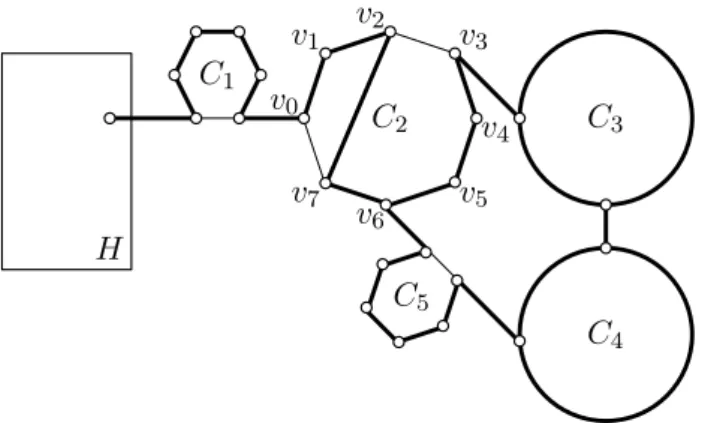
Figure 1: A lollipop consisting of thick edges within and connecting C2,C3, C4 and C5. A nontrivial difficulty in this idea is that picking a Hamilton path prescribes the next cycle to visit, and this cycle might be already contained in the current ear. A detailed argument to resolve this difficulty is described in Section 4.2.
4.2 Lollipops and tadpoles
In order to get rid of the difficulty described in Section 4.1, we employ the idea of lollipops and tadpoles in [5]. If we arrive at a large cycle C already contained in the current ear, construct a lollipopL, which is a subgraph consisting ofCand the subgraph traversed afterC. We then treatL as if it is one large cycle, and restart constructing an ear fromL. See Figure 1 for an illustration. In Figure 1, H is a 2-edge connected subgraph consisting of previously constructed ears. The current ear under construction consists of C1, . . . , C5, whereC1 and C5 are small cycles of length six, and C2, C3 and C4 are large cycles (some vertices in large cycles are omitted). We have now reached C2 again after traversing a Hamilton path in G[V(C5)], and then we construct a lollipop, which consists of thick edges within and connecting C2,C3,C4 and C5.
If we reach a small cycleC already contained in the current ear, construct a tadpoleT, which is a subgraph consisting of a picked Hamilton path P inG[V(C)] and the subgraph traversed after C. A tadpole is decomposed into two parts, thetail T+and head T−. LetsP and tP be the initial and terminal vertices ofP, respectively, and letvP be the vertex at which we have reachedCagain.
The tail P+ is a subpath of P betweensP and vP. The head T− is a subgraph consisting of the edges in E(T)\E(T+). We then traverse an edge f connecting T− and V \V(T). See Figure 2 for an illustration. In Figure 2, we have reached C2 again after traversing a Hamilton path in G[V(C5)], and then we construct a tadpole T consisting of thick edges within and connecting C2, C3,C4 and C5. The tail T+ is a path of thick edges betweenv0 andv6, and the headT− consists of path of thick edges between v3 and v6, within C3, C4, C5, and connecting C2, C3, C4, C5.
A further obstacle is that an edge f connecting T− and V \V(T), an edge traversed when leaving T, might not exist. That is, if all edges inδ(T−) have the other endvertex inT+, then we cannot move from T− and the algorithm would hang up. Indeed, in the nonbipartite case [5], this occurs when the cycle C providingT+ has length ten. Thus, a cycle in CF of length ten cannot be a small cycle, which results in the approximation ratio 6/5.
In the bipartite case, however, we can prove that this obstacle never appears. A precise argument is postponed in Lemma 7, after algorithm description.
C2 C3
C4
C5 C1
H
v0
v1
v2
v7
v6 v5 v4
v3
Figure 2: A tadpole T consisting of thick edges within and connecting C2, C3, C4, C5. The tail of T is a path betweenv0 and v6, and the other edges ofT form the head of T.
4.3 Algorithm description
We are now ready to exhibit algorithm description, followed by a proof for its validity. Note that lollipops and tadpoles do not become nested. If a lollipop or tadpole is to be contained in a newly constructed one, then it is discarded and we only possess inclusion-wise maximal ones. We refer to a cycle in the initial 2-factor F which is not contained in any lollipops or tadpoles asindependent.
Input. A 3-edge connected cubic bipartite graphG= (V, E).
Output. A 2-edge connected spanning subgraphH= (V, E(H)) ofGsuch that|E(H)| ≤7n/6−1.
Step 0. Find a 2-factor F intersecting every 3- and 4-edge cuts inG. LetC0 be an arbitrary cycle inCF, letH :=C0, and then go to Step 1.
Step 1. If V(H) = V, then return H. Otherwise, let H′ be an empty graph and e = uv be an edge in δ(H), where u∈V(H) and v∈V \V(H). Then, go to Step 2.
Step 2. Let C ∈ CF be a cycle containing v. If C is not contained in H, then go to Step 3.
Otherwise, go to Step 4.
Step 3. Apply one of the following four cases.
• If C is a large cycle not contained in H∪H′, then go to Step 3.1.
• If C is a small cycle not contained in H∪H′, then go to Step 3.2.
• If C is contained in a lollipop in H′ or is an independent large cycle in H′, then go to Step 3.3.
• If C is contained in a tadpole inH′ or is an independent small cycle in H′, then go to Step 3.4.
Step 3.1. Add eand C toH′. Let f be an edge in δ(C)\ {e} and reset e:= f and v to be the endvertex of f not inC. Then, go back to Step 2.
Step 3.2. LetPC be a Hamilton path inG[V(C)] starting fromv and ending in a vertex incident to an edge f ∈δ(C). Add eand PC toH′, reset e:= f and v to be the endvertex of f not inC. Then, go back to Step 2.
Step 3.3. Add e to H′ and construct a lollipop L. Remove all lollipops and tadpoles properly contained inL. Letf be an edge in δ(L)\E(H′) and resete:=f and vto be the endvertex of f not inL. Then, go back to Step 2.
Step 3.4. Add e to H′ and construct a tadpole T. Remove all lollipops and tadpoles properly contained in T. Letf be an edge connectingT− andV \V(T). Reset e:=f and v to be the endvertex of f not inT. Then, go back to Step 2.
Step 4. Add eand H′ toH. Then, go back to Step 1.
We now prove is that there exist an edge f connecting T− and V \V(T) in Step 3.4, which establishes the validity of the algorithm.
Lemma 7. Let T be a tadpole. Then, there exists an edge f connecting T− and V \V(T).
Proof. Suppose to the contrary that such f does not exist. Denote the cycle providing the tale of the tadpole T by CT. Clearly CT is a small cycle, i.e., |CT| ≤ 10. Since f does not exist, we have that G\V(CT) is disconnected. Since F covers every 3- and 4-edge cuts and G is 3-edge connected, there exist at least five edges betweenCT and each component inG\CT. This implies that |CT|= 10,G\CT has exactly two components, and there exist exactly five edges betweenCT
and each component in G\CT.
Denote the two components in G\CT by Q0 and Q1. The existence of the initial 2-factor F and the bipartiteness of G imply that both Q0 and Q1 have an even number of vertices. Thus
|δ(Q0)|and |δ(Q1)| are even, contradicting that there are exactly five edges between Q0 and CT, and betweenQ1 and CT.
Now the description of the algorithm is completed. It is not difficult to see that the approxi- mation ratio of the algorithm is 7/6.
Theorem 8. The above algorithm finds a 2-edge connected subgraph of at most7n/6−1 edges in O(n3) time.
Proof. It is clear that the output graphHis 2-edge connected, and the algorithm runs in O(n3) time, which is the time complexity for finding the initial 2-factorF. We now show that|E(H)| ≤7n/6−1.
Let α and β be the numbers of small and large cycles in the initial 2-factor F, respectively.
Since a small cycle is of size at least six and a large cycle at least twelve, it holds that
n≥6α+ 12β. (6)
The output graphH consists of|C| −1 edges in G[V(C)] for a small cycle C∈ CF other than the initial cycle C0,|C|edges of E[C] for a large cycleC ∈ CF, and at most two connecting edges per one cycle in CF \ {C0}. Therefore,
|E(H)| ≤
∑
C∈CF
|C| −(α−1)
+ 2(α+β−1) =n+α+ 2β−1≤ 7
6n−1. (7) The last inequality follows from (6).
References
[1] T. Akiyama, T. Nishizeki and N. Saito: NP-completeness of the Hamiltonian cycle problem for bipartite graphs, Journal of Information Processing, 3 (1980), 73–76.
[2] M.A. Babenko: Improved algorithms for even factors and square-free simple b-matchings, Algorithmica, 64 (2012), 362–383.
[3] D. Barnette: Conjecture 5, in W.T. Tutte, ed.,Proceedings of the Third Waterloo Conference on Combinatorics, 1969, 343.
[4] S. Boyd, Y. Fu and Y. Sun: A 5/4-approximation for subcubic 2EC using circulations, in J. Lee and J. Vygen, eds.,Integer Programming and Combinatorial Optimization: Proceecings of the Seventeenth International IPCO Conference, LNCS 8494, Springer International Publishing, 2014, 186–197.
[5] S. Boyd, S. Iwata and K. Takazawa: Finding 2-factors closer to TSP tours in cubic graphs, SIAM Journal on Discrete Mathematics, 27 (2013), 918–939.
[6] J. Cheriyan, A. Seb˝o and Z. Szigeti: Improving on the 1.5-approximation of a smallest 2-edge connected spanning subgraph,SIAM Journal on Discrete Mathematics, 14 (2001), 170–180.
[7] N. Christofides: Worst-case analysis of a new heuristic for the traveling salesman problem, Technical report, 388, Graduate School of Industrial Administration, Carnegie-Mellon Univer- sity, 1976.
[8] J.R. Correa, O. Larr´e and J.A. Soto: TSP tours in cubic graphs: Beyond 4/3, in L. Epstein and P. Ferragina, eds., Proceedings of the 20th Annual European Symposium on Algorithms, LNCS 7501, Springer-Verlag, 2012, 790–801.
[9] B. Csaba, M. Karpinski and P. Krysta: Approximability of dense and sparse instances of minimum 2-connectivity, TSP and path problems, in Proceedings of the Thirteenth Annual ACM-SIAM Symposium on Discrete Algorithms, ACM-SIAM, 2002, 74–83.
[10] U. Feige, R. Ravi and M. Singh: Short tours through large linear forests, in J. Lee and J. Vygen, eds., Integer Programming and Combinatorial Optimization: Proceecings of the Seventeenth International IPCO Conference, LNCS 8494, Springer International Publishing, 2014, 273–284.
[11] A. Frank: Restricted t-matchings in bipartite graphs, Discrete Applied Mathematics, 131 (2003), 337–346.
[12] D. Gamarnik, M. Lewenstein and M. Sviridenko: An improved upper bound for the TSP in cubic 3-edge connected graphs, Operetions Research Letters, 33 (2005), 467–474.
[13] M.X. Goemans: Worst-case comparison of valid inequalities for the TSP, Mathematical Pro- gramming, 69 (1995), 335–349.
[14] D. Hartvigsen: The square-free 2-factor problem in bipartite graphs, in G. Cornu´ejols, R.E.
Burkard and G.J. Woeginger, eds., Integer Programming and Combinatorial Optimization:
Proceedings of the Seventh International IPCO Conference, LNCS 1610, Springer-Verlag, 1999, 234–241.
[15] D. Hartvigsen: Finding maximum square-free 2-matchings in bipartite graphs, Journal of Combinatorial Theory,Series B, 96 (2006), 693–705.
[16] W.T. Huh: Finding 2-edge connected spanning subgraphs, Operations Research Letters, 32 (2004), 212–216.
[17] S. Iwata, A. Newman and R. Ravi: Graph-TSP from Steiner cycles, in D. Kratsch and I. Tod- inca, eds.,Graph-Theoretic Concepts in Computer Science: 40th International Workshop, WG 2014, LNCS 8747, Springer International Publishing, 2014, 312–323.
[18] R. Jothi, B. Raghavachari and S. Varadarajan: A 5/4-approximation algorithm for minimum 2- edge connectivity, inProceedings of the Fourteenth Annual ACM-SIAM Symposium on Discrete Algorithms, ACM-SIAM, 2003, 725–734.
[19] T. Kaiser and R. ˇSkrekovski: Cycles intersecting edge-cuts of prescribed sizes, SIAM Journal on Discrete Mathematics, 22 (2008), 861–874.
[20] J.A. Karp and R. Ravi: A 9/7-approximation algorithm for graphic TSP in cubic bipartite graphs, in K. Jansen, J. Rolim, N. Devanur and C. Moore, eds., Approximation, Randomiza- tion, and Combinatorial Optimization. Algorithms and Techniques, 2014, 284–296.
[21] S. Khuller and U. Vishkin: Biconnectivity approximations and graph carvings, Journal of the Association for Computing Machinery, 41 (1994), 214–235.
[22] Z. Kir´aly: C4-free 2-factors in bipartite graphs, Technical report, TR-2001-13, Egerv´ary Re- search Group, 1999.
[23] Y. Kobayashi, J. Szab´o and K. Takazawa: A proof of Cunningham’s conjecture on restricted subgraphs and jump systems,Journal of Combinatorial Theory, Series B, 102 (2012), 948–966.
[24] M. Makai: On maximum cost Kt,t-free t-matchings of bipartite graphs, SIAM Journal on Discrete Mathematics, 21 (2007), 349–360.
[25] T. M¨omke and O. Svensson: Approximating graphic TSP by matchings, inProceedings of the 52nd Annual Symposium on Foundations of Computer Science, 2011, 560–569.
[26] M. Mucha: 13/9-approximation for graphic TSP, Theory of Computing Systems, 55 (2014), 640–657.
[27] A. Newman: An improved analysis of the M¨omke-Svensson algorithm for graph-TSP on sub- quartic graphs, in A. Schulz and D. Wagner, eds., Proceedings of the 22nd Annual European Symposium on Algorithms, LNCS 8737, Springer-Verlag, 2014, 737–749.
[28] S. Oveis Gharan, A. Saberi and M. Singh: A randomized rounding approach to the traveling salesman problem, inProceedings of the 52nd Annual Symposium on Foundations of Computer Science, 2011, 550–559.
[29] G. Pap: Combinatorial algorithms for matchings, even factors and square-free 2-factors,Math- ematical Programming, 110 (2007), 57–69.
[30] A. Seb˝o and J. Vygen: Shorter tours by nicer ears: 7/5-approximation for the graph-TSP, 3/2 for the path version, and 4/3 for two-edge-connected subgraphs, Combinatorica, 34 (2014), 597–629.
[31] K. Takazawa: A weighted Kt,t-free t-factor algorithm for bipartite graphs, Mathematics of Operations Research, 34 (2009), 351–362.
[32] K. Takazawa: Decomposition theorems for square-free 2-matchings in bipartite graphs, in E.W. Mayr, ed., Proceedings of the 41st International Workshop on Graph-Theoretic Concepts in Computer Science, to appear in LNCS, 2015.
[33] S. Vempala and A. Vetta: Factor 4/3 approximations for minimum 2-connected subgraphs, in K. Jansen and S. Khuller, eds., Proceedings of the Third International Workshop on Ap- proximation Algorithms for Combinatorial Optimization, LNCS 1913, Springer-Verlag, 2000, 262–273.
[34] N.K. Vishnoi: A permanent approach to the traveling salesman problem, inProceedings of the 53rd Annual Symposium on Foundations of Computer Science, 2012, 76–80.