RIMS-1839
Finding a Maximum 2-Matching Excluding Prescribed Cycles in Bipartite Graphs
By
Kenjiro TAKAZAWA
November 2015
R ESEARCH I NSTITUTE FOR M ATHEMATICAL S CIENCES
KYOTO UNIVERSITY, Kyoto, Japan
Finding a Maximum 2-Matching Excluding Prescribed Cycles in Bipartite Graphs
Kenjiro Takazawa
Research Institute for Mathematical Sciences, Kyoto University, Kyoto 606-8502, Japan.
[email protected] November 24, 2015
Abstract
We introduce a new framework of restricted 2-matchings close to Hamilton cycles.
Given a familyU of vertex subsets, a 2-matchingFis calledU-free if, for eachU ∈ U,F contains at most|U|−1 edges in the subgraph induced byU. Our framework includes Ck-free 2-matchings, i.e., 2-matchings without cycles of at mostkedges, and 2-factors covering prescribed edge cuts, both of which are intensively studied as relaxations of Hamilton cycles.
The problem of finding a maximumU-free 2-matching is NP-hard. In this paper, we prove that the problem is tractable when the graph is bipartite and eachU ∈ Uinduces a Hamilton-laceable graph. This case generalizes the C4-free 2-matching problem in bipartite graphs. We establish a min-max theorem, a combinatorial polynomial- time algorithm, and decomposition theorems by extending the theory of C4-free 2- matchings. Our result provides the first polynomially solvable case for the maximum Ck-free 2-matching problem for k≥5.
1 Introduction
The Hamilton cycle problem is one of the most fundamental NP-hard problems in vari- ous research fields such as combinatorial optimization, graph theory, and computational complexity. One successful approach to the Hamilton cycle problem is to utilize matching theory. In a graph G = (V, E), an edge set F ⊆ E is a 2-matching (resp., 2-factor) if it has at most (resp., exactly) two edges incident to each vertex in V. Since a Hamilton cycle is a special kind of a 2-matching (or 2-factor) and a 2-matching of maximum size is found in polynomial time, it is reasonable to put restrictions on 2-matchings to provide a tight relaxation of Hamilton cycles to which matching theory can be applied. Examples include the following two kinds of restricted 2-matchings.
Ck-free 2-matchings. For a positive integer k, a 2-matching is calledCk-free if it con- tains no cycles of length at most k. The larger k becomes, the closer a Ck-free 2-factor becomes to a Hamilton cycle. Ifk≥ |V|/2, aCk-free 2-factor is a Hamilton cycle, whereas aC2-free 2-matching is nothing other than a 2-matching.
2-factors covering prescribed edge cuts. Anedge cut is a set of edges having exactly one endpoint in some vertex subsetX ⊂V. Given a familyKof edge cuts, an edge subset
is called K-covering if it intersects every edge cut in K. A Hamilton cycle is exactly a K-covering 2-factor, where K is the family of all edge cuts.
Recently, both Ck-free and K-covering 2-factors are intensively studied and applied to approximation algorithm design for NP-hard problems related to the Hamilton cycle problem, such as the graph-TSP and the minimum 2-edge connected spanning subgraph problem [4, 5, 8, 12, 20, 30].
1.1 Previous Work
In general graphs, the Ck-free 2-matching problem is much more difficult than the 2- matching problem. For the casesk≥3, no algorithm is known other than Hartvigsen’sC3- free 2-matching algorithm [14]. NP-hardness for the casek≥5 is proved by Papadimitriou (see [7]). More generally, Hell et al. [17] proved that the problem is NP-hard, unless the excluded length of a cycle is a subset of {3,4}. The case k = 4 is still open, and conjectured to be solved in polynomial time [9]. Discrete convexity shown in [22] supports this conjecture.
While only a few positive results are known for theCk-free 2-matching problem in gen- eral graphs, in bipartite graphs theC4-free 2-matching problem is efficiently solvable, and fundamental theorems in matching theory are extended. Motivated by a stimulating paper of Hartvigsen [15], Kir´aly [21] gave a min-max theorem for theC4-free 2-matching problem in bipartite graphs, followed by a different min-max theorem by Frank [11]. Comparison of these two theorems is discussed in [31], together with decomposition theorems corre- sponding to the Dulmage-Mendelsohn and Edmonds-Gallai decompositions. Polynomial combinatorial algorithms are designed by Hartvigsen [16] and Pap [25], which are again slightly different and followed by an improvement in time complexity by Babenko [1]. For the weighted version, while the NP-hardness of the weightedC4-free 2-matching problem in bipartite graphs is proved by Kir´aly (see [11]), positive results such as a linear program- ming formulation with dual integrality [23], a combinatorial algorithm [29], and discrete convexity [22] are established when the edge weight satisfies a certain property. Since the C6-free 2-matching problem is NP-hard even in bipartite graphs [13], the C4-free 2- matching problem in bipartite graphs is one of the few cases where theCk-free 2-matching problem is tractable.
For a set of integers A ⊆ Z, denote the set of edge cuts whose size belongs to A by KA. Kaiser and ˇSkrekovski [18] proved that every bridgeless planar cubic graph has a K{3,4}-covering 2-factor, which is extended to a stronger result that every bridgeless cubic graph has a K{3,4}-covering 2-factor [19]. While the proof in [19] was not algorithmic, Boyd, Iwata, and Takazawa [4] designed a combinatorial algorithm for finding a K{3,4}- covering 2-factor in bridgeless cubic graphs, together with a combinatorial algorithm for finding a minimum-weightK{3}-covering 2-factor in bridgeless cubic graphs. ˇCada et al. [6]
exhibited a family of graphs which has noK{4,5}-covering edge subset with even degree at every vertex, disproving a conjecture in [19].
1.2 Our Contribution
In the present paper, we introduce a new framework of restricted 2-matchings which commonly generalizes Ck-free 2-matchings and K-covering 2-factors. For U ⊆ V, let G[U] = (U, E[U]) denote the subgraph induced by U, i.e., E[U] = {uv ∈ E |u, v ∈ U}. ForF ⊆E, letF[U] =F∩E[U] ={uv∈F |u, v∈U}.
Definition 1 (U-free 2-matchings). Let U ⊆ 2V be a family of vertex subsets. A 2- matchingF ⊆E is called U-free if|F[U]| ≤ |U| −1 for each U ∈ U.
Equivalently, a 2-matchingF isU-free if and only if|F[U]| ̸=|U|for each U ∈ U, i.e., F excludes cycles throughU. Moreover, if F is a 2-factor, then F is U-free if and only if F ∩δ(U) ̸= ∅ for every U ∈ U, where δ(U) denotes the set of edges having exactly one endpoint in U. From these viewpoints, it is not difficult to see that U-free 2-matchings include Hamilton cycles, Ck-free 2-matchings, and K-covering 2-factors as special cases:
putU ={U ⊆V | |U| ≤ |V|/2}, U ={U ⊆V | |U| ≤ k}, andU ={U ⊆V |δ(U) ∈ K}, respectively.
TheU-free 2-matching problem is defined as a problem of finding aU-free 2-matching of maximum size for given G and U. Since the U-free 2-matching problem includes the Hamilton cycle problem, the U-free 2-matching problem is NP-hard in general. Thus, we need some assumption in order to obtain a tractable class of the U-free 2-matching problem, such as the cases where G is bipartite and U = {U ⊆ V | |U| ≤ 4}, and G is bridgeless cubic andU ={U ⊆V |δ(U)∈ K{3,4}}.
A main objective of this paper is to provide a broader well-solved class of the U-free 2-matching problem by extending the theory of C4-free 2-matchings in bipartite graphs.
For this purpose, we exploit a graph-theoretic concept ofHamilton-laceable graphs. For a bipartite graph (V, E), we denote the two color classes by V+ and V−. For X ⊆V, let X+ =X∩V+ and X−=X∩V−.
Definition 2(Hamilton-laceable graphs [26]). A bipartite graphG= (V, E) isHamilton- laceable if
(i) |V+|=|V−|and G has a Hamilton path between an arbitrary pair of u∈V+ and v ∈V−, or
(ii) |V+|=|V−| −1 and G has a Hamilton path between an arbitrary pair of distinct vertices u, v∈V−.
In what follows, we work on the U-free 2-matching problem under the assumption that G is bipartite and G[U] is Hamilton-laceable for each U ∈ U. We note that, for a 2-factorF,|F[U]|=|U|implies that|U+|=|U−|. Thus, we assume|U+|=|U−|for each U ∈ U, and hence only the case (i) in Definition 2 occurs in our argument.
The smallest nontrivial example of a Hamilton-laceable graph would be a cycle of length four, and hence our assumption includes theC4-free 2-matching problem in bipartite graphs as a special case. Further examples and previous work of Hamilton-laceable graphs are exhibited in§ 2.
In the present paper, we exhibit that the theory of C4-free 2-matching problem in bipartite graphs satisfactorily extends when G[U] is Hamilton-laceable for each U ∈ U. We first present a min-max theorem extending Kir´aly’s min-max theorem [21]. We then design a combinatorial algorithm for finding a maximumU-free 2-matching, which provides a constructive proof for our min-max theorem. In the design of our algorithm, we make use of both of Hartvigsen’s and Pap’s algorithms [16, 25]: the shrinking technique comes from Pap’s algorithm; and the construction of a minimizer of the min-max theorem derives from Hartvigsen’s method. Finally, we describe decomposition theorems extending those in [31]
and corresponding to the Dulmage-Mendelsohn and Edmonds-Gallai decompositions.
It is noteworthy that, unlike the literature of Ck-free 2-matchings and K-covering 2-factors, our assumption that each G[U] is Hamilton-laceable does not depend on the size of the forbidden structures. One benefit of this is that our result provides the first
polynomially solvable case of the Ck-free 2-matching problem for k ≥ 5, and thus has a potential to provide better approximation ratios for the graph-TSP and the minimum 2-edge connected subgraph problem.
We further remark that our framework contains both cases where multiplicities on edges are forbidden or allowed. That is, in the former case we only deal with simple 2-matchings and one edge can only contribute one to the degree of its endpoints. In the latter case, we can put multiplicity two on one edge to have degree two on the endpoints of the edges. Actually, in the literature of Ck-free 2-matching problem, these two cases have formed different streams. The aforementioned results are of the former case, and results for the latter case include [2, 7, 24]. To the best of our knowledge, not much connection between these two cases is found. In our framework, forbidding multiplicity on an edgeuv ∈E corresponds to have{u, v}inU, and it is clear thatG[{u, v}] is Hamilton- laceable if uv∈E. While in this paper we mainly keep the former case in mind, we note that our framework can represent the both cases.
1.3 Organization of the paper
The rest of the paper is organized as follows. In § 2, we show some previous work, observation, and examples of Hamilton-laceable graphs. After that, we work onU-free 2- matchings in bipartite graphs whereG[U] is Hamilton-laceable for eachU ∈ U. We present a min-max theorem in § 3. Section 4 is devoted to describing a combinatorial algorithm for finding a maximum U-free 2-matching, which provides a constructive proof for the min-max theorem. Finally, in § 5, we exhibit decomposition theorems corresponding to the Dulmage-Mendelsohn and Edmonds-Gallai decompositions.
2 Hamilton-Laceable Graphs
This section is devoted to a discussion on Hamilton-laceable graphs. We first note that the concept of Hamilton-laceable graphs is a bipartite analogue of that ofHamilton-connected graphs, which is well-known in the field of graph theory [3]. A graph isHamilton-connected if it has a Hamilton path between an arbitrary pair of distinct vertices. Thus, a Hamilton- connected graph is nonbipartite if it has at least three vertices.
In what follows, we always assume that G = (V, E) is bipartite. Trivial examples of a Hamilton-laceable graph are the case where V+ = ∅ or V− = ∅, and a graph of two vertices connected by an edge. It is also clear that a complete bipartite graph on 2t vertices, denoted byKt,t, is Hamilton-laceable. Recall that a special case K2,2, a cycle of length four, is an example of a Hamilton-laceable graph.
IfG= (V, E) is Hamilton-laceable, a graph (V,E˜) satisfying ˜E ⊇E is also Hamilton- laceable. Thus, it would be of interest to find Hamilton-laceable graphs with as few edges as possible. Indeed, the concept of Hamilton-laceable graphs was introduced as a generalized property of Hamiltonicity of d-dimensional rectangular lattices by Simmons [26], who proved that alld-rectangular lattices are Hamilton-laceable except for the two-dimensional lattices of order 2×r (r ̸= 2) and 3×2r. This result provides a class of Hamilton-laceable graphs (V, E) with|E| ≈d|V|. For instance, every hypercube is Hamilton-laceable.
Furthermore, Simmons [27] discussed the minimum numberltof the edges of Hamilton- laceable graphs with |V+| =t. It holds that 3t− ⌈t/3⌉ ≤ lt ≤3t−1 for the case (i) in Definition 2, and lt = 3t+ 1 for the case (ii) in Definition 2. Simmons [28] also showed that deleting fewer thant−1 edges fromKt,t orKt,t+1 maintains Hamilton-laceability.
The motivation of introducing Hamilton-laceable graph in this paper comes from an
analysis in [31], which reveals that cycles of length four in the C4-free 2-matching prob- lem in bipartite graphs serve as factor-critical components for the nonbipartite matching problem: if U ⊆ V induces a cycle of length four in a bipartite graph, for an arbitrary pairu∈U+ and v∈U−,G[U] contains a 2-matching of size three in which onlyu and v has degree one. Observe that the definition of Hamilton-laceable graphs generalizes this property. In the following sections we reveal that the property in Definition 2(i) plays a key role to provide a tractable class of restricted 2-matchings in bipartite graphs.
3 A Min-Max Theorem
In this section, we describe a min-max theorem for the U-free 2-matching problem in bipartite graphs where eachU ∈ U induces a Hamilton-laceable graph. Our theorem is an extension of Kir´aly’s min-max theorem [21] for theC4-free 2-matching problem in bipartite graphs. ForX⊆V, let ¯X =V \X andc′(X) denote the number of components in G[X]
consisting of a single vertex, a single edge, or a single cycle of length four.
Theorem 3 ([21]). Let G= (V, E) be a bipartite graph. Then, it holds that max{|F| |F is a C4-free 2-matching}= min{|V|+|X| −c′( ¯X)|X⊆V}.
Observe that every component contributing to c′( ¯X) is Hamilton-laceable. We now exhibit our theorem extending Theorem 3. For X ⊆ V, let c(X) denote the number of components inG[X] whose vertex set belongs toU.
Theorem 4. LetG= (V, E) be a bipartite graph andU ⊆2V be a family of vertex subsets in Gsuch that G[U] is Hamilton-laceable for each U ∈ U. Then, it holds that
max{|F| |F is a U-free 2-matching}= min{|V|+|X| −c( ¯X)|X ⊆V}. (1) Before proving Theorem 4, we first show that the inequality max≤min in (1) holds for an arbitraryG and U, i.e., G may not be bipartite and G[U] may not be Hamilton- laceable forU ∈ U. For disjoint vertex setsX, Y ⊆V, letE[X, Y] denote the set of edges connectingX andY,G[X, Y] = (X∪Y, E[X, Y]), andF[X, Y] =F ∩E[X, Y].
Lemma 5. Let G= (V, E)be a graph and U ⊆2V be a family of vertex subsets inG. For an arbitraryU-free 2-matching F andX ⊆V, it holds that |F| ≤ |V|+|X| −c( ¯X).
Proof. Since F is a 2-matching, 2|F[X]|+|F[X,X]¯ | ≤2|X|follows. Moreover, sinceF is U-free, it holds that|F[ ¯X]| ≤ |X¯| −c( ¯X).
The following lemma directly follows from the proof for Lemma 5. For F ⊆ E and u∈V, denote the number of edges in F incident to uby degF(u).
Lemma 6. If a U-free 2-matching F and X⊆V attain the equality in (1), it holds that
• F[X] =∅,
• degF[{u},X¯](u) = 2 for each u∈X, and
• for each component Q in G[ ¯X],
|F[V(Q)]|=
{|V(Q)| −1 if V(Q)∈ U,
|V(Q)| otherwise.
We complete a proof of Theorem 4 by establishing an algorithm for finding a U-free 2-matchingF and X⊆V attaining equality in (1) in §4.
4 A Combinatorial Algorithm
In this section, we describe a combinatorial polynomial-time algorithm for finding a max- imum U-free 2-matching in bipartite graphs where each U ∈ U induces a Hamilton- laceable graph. Our algorithm employs ideas both of the C4-free 2-matching algorithms of Hartvigsen [16] and Pap [25].
4.1 Algorithm Description
Roughly speaking, our algorithm resembles Edmonds’ algorithm for nonbipartite match- ings [10]. One main feature in our algorithm comes from Pap’s algorithm [25]: we shrink U ∈ Uafter we find an alternating path, whereas in Edmonds’ and Hartvigsen’s algorithms shrinking occurs in the middle of construction of alternating forests. Another feature de- rives from Hartvigsen’s algorithm [16]. A minimizer X ⊆V of the right-hand side of (1) is basically determined as the set of vertices reachable from the deficient vertices. In our algorithm, if a vertex resulting from shrinking U ∈ U satisfies certain properties, it is regarded as reachable even if it is not reachable.
Before describing the entire algorithm, we present how to shrink and expand U ∈ U. In order to provide concise notation, in the rest of this section we denote the input of the algorithm by ˆG= ( ˆV ,E) and ˆˆ U ⊆2Vˆ, and the graph obtained by repeated shrinkings by G = (V, E). In the algorithm, we maintain a U-free b-matching F in G, where U ⊆ 2V and b∈ {1,2}V, which can be extended to a ˆU-free 2-matching in ˆG. For b∈ {1,2}V, a b-matchingF isU-free ifF[U] is not ab-factor inG[U] for everyU ∈ U. Initially,G= ˆG, U = ˆU,bv = 2 for each v∈V, andF is an arbitraryU-free b-matching, e.g., F =∅.
For two edge sets F1, F2 ⊆ E, denote the symmetric difference of F1 and F2 by F1△F2, i.e., F1△F2 = (F1 \F2)∪(F2 \F1). Define the set of source vertices by S+ = {u∈V+|degF(u)< bu}and sink vertices S−={v ∈V− |degF(v) < bv}. Suppose that we have found an alternating path P from S+ to S− such that F△E(P) is not a U-free b-matching. We then apply the following shrinking procedure.
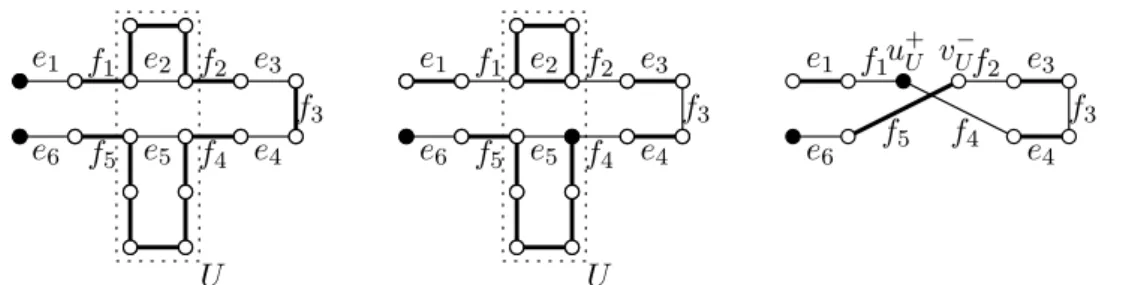
Procedure Shrink(F, P). Denote the number of edges in P by 2l+ 1. Let Pi be a path consisting of the first 2iedges inP fori∈[1, l],P0 be an empty graph, andPl+1 =P. Let i∗ be the smallest indexisuch thatF△E(Pi) contains ab-factor in G[U] for someU ∈ U, and letF′ = F△E(Pi∗−1). If more than one such U ∈ U exists, choose an arbitrary U. We then update G, b, U, and F as follows. Let u+U and v−U be new vertices, which are obtained by identifying the vertices inU+ and U−, respectively. Then, resetV,b, E,F, andU as
V := ¯U ∪ {uU, vU}, bv :=
{
1 ifv=u+U, vU−, bv otherwise,
E:=E[ ¯U]∪ {u+Uv|uv∈E, u∈U+, v∈U¯−} ∪ {uvU−|uv ∈E, u∈U¯+, v ∈U−}, F :=F′[ ¯U]∪ {u+Uv |uv∈F′, u∈U+, v∈U¯−} ∪ {uvU−|uv∈F′, u∈U¯+, v∈U−}, U :={U′ |U′ ∈ U, U′∩U =∅} ∪ {(U′\U)∪ {uU, vU} |U′ ∈ U, U ⊊U′}.
See Figure 1 for an illustration. Observe that F is still a b-matching in G after the update. We then again search an alternating path P from S+ to S−, and repeat the above procedure.
U
u+U vU− f1
e1 e2 f2 e3 e4
e5
e6 f5 f4
f3
f1
e1 e2 f2 e3 f3
e4
e6 f5 e5 f4
U
f1
e1 f2 e3 f3
e4
e6 f5 f4
Figure 1: bv = 2 for each v. The thick edges are in F, thin edges in E \F, and the vertices in black are inS+ orS−. In the figure on the left, we have found P consisting of e1, f1, e2, . . . , e5, f5, e6, and F△E(P) contains a 2-factor inG[U] for U ∈ U. In this case i∗ = 5, and the figure in the middle showsF△E(P4). The figure on the right shows the graph afterShrink(F, P).
u+U v−U e1 f1 e2 f2 e3
f3
e4
e6 f5 e5 f4
U f5 f4
u+U vU− f1
e1 f2 e3 f3
e4 e6
e1
f5 f4 f1 e3
f3
e4 e6
f2
Figure 2: The graph in the middle results from an augmentation in the graph on the left, where the augmenting pathP consists off4, e4, f3, e3, f2, f5, e6. We then expandU, where fˆU+ =f4 and ˆfU−=f2. to obtain the graph on the right.
If an alternating path P from S+ to S− such that F△E(P) is U-free b-matching is found, then we reset F := F△E(P) to augment the current solution, and expand the shrunk vertex sets to return to the original graph ˆGas follows. First note that the shrunk vertex sets in ˆU form a laminar family, and it suffices to expand the maximal shrunk vertex sets. For a maximal shrunk vertex setU ⊆Vˆ, denote the unique edge inF incident to u+U by fU+, and to vU− by fU−, if exist. Let ˆfU+,fˆU− ∈ Eˆ be the edges corresponding to fU+, fU− ∈ E, respectively. Denote the vertex in U+ incident to ˆfU+ by ˆu+U, and that in U− incident to ˆfU− by ˆvU−. If fU+ (resp., fU−) does not exist, let ˆu+U (resp., ˆv−U) be an arbitrary vertex in U+ (resp., U−). Now, since ˆG[U] is Hamilton-laceable, ˆG[U] has a Hamilton path PU between ˆu+U and ˆvU−. In expanding U, we add E(PU) to F. That is, Fˆ :=F ∪∪
U∈U∗E(PU). See Figure 2 for an illustration of augmentation and expansion.
It is not difficult to see that ˆF is aU-free 2-matching.
The entire algorithm is described as follows.
Input: A bipartite graph ˆG= ( ˆV ,E) and ˆˆ U ⊆ 2Vˆ such that ˆG[U] is Hamilton-laceable for each U ∈Uˆ.
Output: A maximum ˆU-free 2-matching ˆF in ˆG.
Step 0: PutG= ˆGandU = ˆU. LetF be an arbitraryU-free 2-matching inGand then go to Step 1.
Step 1: LetS+ ={u ∈V+|degF(u)< bu} and S− ={v ∈V− |degF(v) < bv}. Orient each edge in E\F from V+ toV− and each edge in F from V− to V+ to obtain
a directed graph D. If Dhas a directed path P from S+ to S−, then go to Step 2.
Otherwise, go to Step 5.
Step 2: Let EP ⊆ E be the set of edges corresponding to the directed edges in P. If F′ =F△EP is aU-free b-matching, then go to Step 3. Otherwise, go to Step 4.
Step 3 (Augmentation): Reset F := F′, expand all maximal shrunk vertex sets, and then go back to Step 1.
Step 4 (Shrinking): ApplyShrink(F, P), and then go back to Step 1.
Step 5 (Termination): Expand all maximal shrunk vertex sets and return ˆF. 4.2 Proof for Optimality
In the termination of the algorithm, we have a digraphD in which no directed path from S+toS− exists. LetR⊆V denote the set of vertices reachable from S+inD, and define R′ ⊆V by
R′ =R∪ {v∈R¯−|v is not a shrunk vertex, degF[R+,{v}](v) = 2}
∪ {v∈R¯−|v=v−U for someU ∈ U,uv∈F for someu∈R+}.
Finally, defineX⊆Vˆ by the set of vertices corresponding to ( ¯R′)+∪(R′)−.
Lemma 7. The output Fˆ of the algorithm and X defined above attain the equality in (1).
Proof. It is not difficult to see that ˆF[X] = ∅. Moreover, since every v ∈ X satisfies degFˆ[{v},X]¯ = 2, we have that |Fˆ[X,X]|¯ = 2|X|. Finally, in G, all edges in E[ ¯X] belong toF. Thus, each edge in ˆE[X] is in ˆF or belongs to ˆE[U] for someU ∈ U shrunk in G.
By the definition ofQ, it holds thatvU− has no adjacent edge inE[X], which implies that G[Uˆ ] forms a component in ˆG[ ¯X]. Thus, it follows that|Fˆ[ ¯X]|=|X¯| −c( ¯X). Therefore, we conclude
|Fˆ|=|F[X]|ˆ +|Fˆ[X,X]|¯ +|Fˆ[ ¯X]|= 2|X|+|X| −¯ c( ¯X) =|V|+|X| −c( ¯X).
Now Theorem 4 immediately follows from Lemmas 5 and 7. Thus, our algorithm provides a constructive proof for Theorem 4.
4.3 Complexity
In this subsection, we show that the time complexity of our algorithm is polynomial in the size of the input of the algorithm. Denoten= |Vˆ| and m =|Eˆ|. We should notice that the input size of the algorithm depends on how ˆU is given, and ˆU might have a exponential size in n, e.g., ˆU = {U ⊆ Vˆ | |U| ≤ n/2}. Nevertheless, in many cases determining if a given edge set is ˆU-free is done efficiently, such as the Ck-free 2-matching case and the K-covering 2-factor case. Therefore, we denote by γ the time for determining if an edge set is ˆU-free, and use γ in complexity analysis of the algorithm instead of|U|ˆ.
It is not difficult to see that shrinkings occur O(n) times between augmentations. Since augmentations occur O(n) times, shrinkings occur O(n2) times in total.
After each shrinking, we search an alternating path, which takes O(m) time. More- over, we determine if F△E(Pi) is U-free O(n) times for each shrinking. Thus, the time complexity between shrinkings is O(nγ+m).
Therefore, the total complexity of our algorithm is O(n3γ+n2m).
Theorem 8. Our algorithm finds an optimal solution in O(n3γ+n2m) time.
5 Decomposition Theorems
This section is devoted to decomposition theorems for the U-free 2-matching problem in bipartite graphs where each U ∈ U induces a Hamilton-laceable graph. These theorems correspond to the Dulmage-Mendelsohn and Edmonds-Gallai decompositions, and extend decomposition theorems for theC4-free 2-matchings in bipartite graphs [31].
LetX1 ⊆V be a minimizer of (1) obtained by the algorithm in§4. By exchanging the roles of V+ and V−, i.e., searching alternating paths fromS− toS+, we obtain another minimizerX2⊆V of (1). Now partitionV into three setsD, A, C⊆V, where
D= ¯X1+∪X¯2−, A=X2+∪X1−, C=V \(D∪A).
We first provide a characterization of D. Note that such characterization appears in both of the Dulmage-Mendelsohn and Edmonds-Gallai decompositions.
Theorem 9. The vertex set D is characterized as
D={v| ∃a maximum U-free 2-matchingF withdegF(v)≤1}.
Proof. It suffices to discuss V+. Letu ∈D+ = ¯X1+. By the definition of X1, at the last stage of the algorithm where no path between S+ and S− is found, u is reachable from S+ or is shrunk into a vertex reachable from S+. Denote a path from S+ to u by P. Then, it is not difficult to see thatF△EP provides a maximumU-free 2-matchingF with degF(u) = 1. Foru∈D¯+=X1+, it holds that degF(u) = 2 by Lemma 6.
The following theorem, corresponding to the Dulmage-Mendelsohn decomposition, sug- gests thatX1 and X2 are canonical minimizers of (1).
Theorem 10. For an arbitrary minimizer Y ⊆V of (1), it holds that X2+ ⊆Y+ ⊆X1+ andX1−⊆Y−⊆X2+.
Proof. It suffices to prove Y+ ⊆ X1+ and X1− ⊆ Y−. For each u ∈ Y+, by Lemma 6, degF(u) = 2 holds for every maximumU-free 2-matchingF. Thus, u∈D¯+=X1+ follows from Theorem 9.
We next prove X1− ⊆ Y−. Suppose to the contrary that there exists v ∈ X1−\Y−. Let F be an arbitrary maximum U-free 2-matching. Since v ∈ X1−, by Lemma 6 there exist two vertices u1, u2 ∈ X¯1+ ⊆ Y¯+ such that u1v, u2v ∈ F. Denote the component in G[ ¯Y] containing u1, u2, v by Q. Since u1, u2 are reachable from S+, we have that
|F[V(Q)]|<|V(Q)|, and thus |F[V(Q)]|=|V(Q)| −1 andQ∈ U by Lemma 6.
Denote QX =V(Q)∩X1 and QX¯ = V(Q)∩X¯1. We now show that there exists an edgee∈ E[Q+X¯, QX−¯]\F. By Lemma 6, every vertex in Q−X is connected to two vertices inQ+X¯ by two edges in F, implying that |QX+¯|>|Q−X|and
1≤ |F[Q+X¯, Q−X¯]| ≤2|Q+X¯| −2|Q−X| −1.
Let xy ∈ F[Q+X¯, Q−X¯], where x ∈ Q+X¯ and y ∈ Q−X¯. Since G[V(Q)] is Hamilton-laceable, G[V(Q)] has a Hamilton pathP betweenxandy. Then it follows that|E(P)[Q+X¯, Q−X¯]| ≥ 2|Q+X¯| −2|Q−X| −1, and hence
|E[Q+X¯, QX−¯]| ≥ |E(P)[Q+X¯, QX−¯]∪ {xy}| ≥2|QX+¯| −2|Q−X|.
Thus, E[Q+X¯, Q−X¯]\F ̸= ∅. Then, the endpoint ve of e in V− should be reachable from S+, contradicting thatve∈X.¯
A
D C U2
U3
U1
U4
Figure 3: The thick lines are edges in a maximumU-free 2-matchingF, and the thin lines are edges in E\F. The two vertices in black are those at which the degree of F is not two. The vertex setsU1,U2,U3, and U4 are in U. Some edges inE\F are omitted.
Finally, we establish the theorem below, which corresponds to the Edmonds-Gallai decomposition. Figure 3 would help understanding the statements.
Theorem 11. The following statements hold.
(i) For each e∈E[D, A], there exists a maximum U-free 2-matching containinge.
(ii) The vertex set of each component in G[D] and G[D, C] is a singleton or belongs to U.
(iii) Shrink the components in G[D]andG[D, C]in the manner ofShrink(F, P) to obtain a new graph G′= (V′, E′), denote the vertex subsets of V′ corresponding toD, C by D′, C′, and define b′ ∈ {1,2}D′∪C′ by
b′v =
{1 if v=u+U or v=v−U for some U ∈ U, 2 otherwise.
Then,
(a) G′[U′] has ab′-factor, and
(b) for arbitrary A′ ⊆A, it holds that b′(Γ(A′)∩D′)>2|A′|, whereΓ(A′) is the set of vertices in V \A′ adjacent to some vertex in A′.
(iv) An arbitrary maximum U-free 2-matching F is composed of the following edges.
(a) In G[D] and G[D, C], F contains |V(Q)| −1 edges in E[V(Q)] for each com- ponent Q.
(b) Foru∈A,F contains two edges connectinguand distinct components inG[D].
(c) In G[U], F[U]corresponds to a b′-factor inG′[U′].
(v) Both A∪C+ and A∪C− minimize (1).
Proof. Assertion (v). This is clear fromA∪C+=X1 and A∪C− =X2.
Assertion (i). By symmetry, it suffices to discuss e = uv ∈ E[D+, A−]. Let F be a maximum U-free 2-matching found by the algorithm and suppose e̸∈ F. Then, in the last Step 1 of the algorithm, u is reachable fromS+ oru is shrunk in some u+U reachable from S+. LetP be a path starting from S+ and reachingu. Then, from the current solution, we can obtain a new maximum U-free 2-matching containing e by taking the symmetric difference with E(P), adding e, deleting an appropriate edge in δ({v}), and expanding the shrunk vertex sets.
Assertions (ii) and (iv)(a). LetQbe a component inG[ ¯X1+,X¯1−] which is not a single- ton. Since ¯X1+ is the set of vertices reachable from S+, it follows that F[V(Q)] <
|V(Q)|. By Lemma 6, it suffices to show thatQdoes not intersect bothD−andC−. Suppose otherwise. Then, there exists one vertex inV(Q)∩D−such that degF[Q](v) = 1, and degF[Q](v′) = 2 holds for every vertexv′ ∈V(Q)∩D−. This implies v′ ∈X1−, a contradiction.
Assertions (iii)(a), (iv)(b), and(iv)(c). These assertions are now clear from Lemma 6 and Assertion (iv)(a).
Assertion (iii)(b). It suffices to discuss A′ ⊆A−=X1−. Then the assertion follows that A′ is reachable from S+ and Assertion (iv)(b).
References
[1] M.A. Babenko: Improved algorithms for even factors and square-free simple b- matchings, Algorithmica, 64 (2012), 362–383.
[2] M. Babenko, A. Gusakov and I. Razenshteyn: Triangle-free 2-matchings revisited, Discrete Mathematics, Algorithms and Applications, 2 (2010), 643–654.
[3] J.A. Bondy and U.S.R. Murty: Graph Theory, Springer-Verlag, London, 2008.
[4] S. Boyd, S. Iwata and K. Takazawa: Finding 2-factors closer to TSP tours in cubic graphs, SIAM Journal on Discrete Mathematics, 27 (2013), 918–939.
[5] S. Boyd, R. Sitters, S. van der Ster and L. Stougie: The traveling salesman problem on cubic and subcubic graphs, Mathematical Programming, 144 (2014), 227–245.
[6] R. ˇCada, S. Chiba, K. Ozeki, P. Vr´ana and K. Yoshimoto: {4,5} is not coverable: A counterexample to a conjecture of Kaiser and ˇSkrekovski,SIAM Journal on Discrete Mathematics, 27 (2013), 141–144.
[7] G. Cornu´ejols and W. Pulleyblank: A matching problem with side conditions, Dis- crete Mathematics, 29 (1980), 135–159.
[8] J. Correa, O. Larr´e and J.A. Soto: TSP tours in cubic graphs: Beyond 4/3, SIAM Journal on Discrete Mathematics, 29 (2015), 915–939.
[9] W.H. Cunningham: Matching, matroids, and extensions,Mathematical Programming, 91 (2002), 515–542.
[10] J. Edmonds: Paths, trees, and flowers,Canadian Journal of Mathematics, 17 (1965), 449–467.
[11] A. Frank: Restrictedt-matchings in bipartite graphs,Discrete Applied Mathematics, 131 (2003), 337–346.
[12] D. Gamarnik, M. Lewenstein and M. Sviridenko: An improved upper bound for the TSP in cubic 3-edge connected graphs, Operetions Research Letters, 33 (2005), 467–
474.
[13] J.F. Geelen: The C6-free 2-factor problem in bipartite graphs is NP-complete, un- published, 1999.
[14] D. Hartvigsen: Extensions of Matching Theory, Ph.D. thesis, Carnegie Mellon Uni- versity, 1984.
[15] D. Hartvigsen: The square-free 2-factor problem in bipartite graphs, in G. Cornu´ejols, R.E. Burkard and G.J. Woeginger, eds.,Integer Programming and Combinatorial Op- timization: Proceedings of the Seventh International IPCO Conference, LNCS 1610, Springer-Verlag, 1999, 234–241.
[16] D. Hartvigsen: Finding maximum square-free 2-matchings in bipartite graphs,Jour- nal of Combinatorial Theory,Series B, 96 (2006), 693–705.
[17] P. Hell, D. Kirkpatrick, J. Kratochv´ıl and I. K˘r´ı˘z: On restricted two-factors, SIAM Journal on Discrete Mathematics, 1 (1988), 472–484.
[18] T. Kaiser and R. ˇSkrekovski: Planar graph colorings without short monochromatic cycles, Journal of Graph Theory, 46 (2004), 25–38.
[19] T. Kaiser and R. ˇSkrekovski: Cycles intersecting edge-cuts of prescribed sizes,SIAM Journal on Discrete Mathematics, 22 (2008), 861–874.
[20] J.A. Karp and R. Ravi: A 9/7-approximation algorithm for graphic TSP in cubic bipartite graphs, in K. Jansen, J. Rolim, N. Devanur and C. Moore, eds.,Approxima- tion, Randomization, and Combinatorial Optimization. Algorithms and Techniques, 2014, 284–296.
[21] Z. Kir´aly: C4-free 2-factors in bipartite graphs, Technical report, TR-2001-13, Egerv´ary Research Group, 1999.
[22] Y. Kobayashi, J. Szab´o and K. Takazawa: A proof of Cunningham’s conjecture on restricted subgraphs and jump systems, Journal of Combinatorial Theory, Series B, 102 (2012), 948–966.
[23] M. Makai: On maximum costKt,t-freet-matchings of bipartite graphs,SIAM Journal on Discrete Mathematics, 21 (2007), 349–360.
[24] G. Pap: A TDI description of restricted 2-matching polytopes, in D. Bienstock and G.L. Nemhauser, eds., Integer Programming and Combinatorial Optimization: Pro- ceedings of the Tenth International IPCO Conference, LNCS 3064, Springer-Verlag, 2004, 139–151.
[25] G. Pap: Combinatorial algorithms for matchings, even factors and square-free 2- factors, Mathematical Programming, 110 (2007), 57–69.
[26] G.J. Simmons: Almost all n-dimensional rectangular lattices are Hamilton laceable, inProceedings of the 9th Southeastern Conference on Combinatorics, Graph Theory, and Computing, Congressus Numerantium 21, 1978, 649–661.
[27] G.J. Simmons: Minimal Hamilton-laceable graphs, inProceedings of the 11th South- eastern Conference on Combinatorics, Graph Theory, and Computing, Congressus Numerantium 29, 1980, 893–900.
[28] G.J. Simmons: Maximal non-Hamilton-laceable graphs, Journal of Graph Theory, 5 (1981), 407–415.
[29] K. Takazawa: A weightedKt,t-freet-factor algorithm for bipartite graphs,Mathemat- ics of Operations Research, 34 (2009), 351–362.
[30] K. Takazawa: Approximation algorithms for the minimum 2-edge con- nected spanning subgraph problem and the graph-TSP in regular bipar- tite graphs via restricted 2-factors, Technical report, RIMS-1826, Re- search Institute for Mathematics, Kyoto University, 2015, available at http://www.kurims.kyoto-u.ac.jp/preprint/index.html.
[31] K. Takazawa: Decomposition theorems for square-free 2-matchings in bipartite graphs, in E.W. Mayr, ed.,Proceedings of the 41st International Workshop on Graph- Theoretic Concepts in Computer Science, to appear in LNCS, 2015.