RIMS-1731
Covering Cuts in Bridgeless Cubic Graphs
By
Sylvia BOYD, Satoru IWATA, Kenjiro TAKAZAWA
August 2011
R ESEARCH I NSTITUTE FOR M ATHEMATICAL S CIENCES
KYOTO UNIVERSITY, Kyoto, Japan
Covering Cuts in Bridgeless Cubic Graphs
∗Sylvia Boyd† Satoru Iwata‡ Kenjiro Takazawa‡ August 8, 2011
Abstract
In this paper we are interested in algorithms for finding 2-factors that cover certain prescribed edge-cuts in bridgeless cubic graphs. We present an algorithm for finding a minimum-weight 2-factor covering all the 3-edge cuts in weighted bridgeless cubic graphs, together with a polyhedral description of such 2-factors and that of perfect matchings in- tersecting all the 3-edge cuts in exactly one edge. We further give an algorithm for finding a 2-factor covering all the 3- and 4-edge cuts in bridgeless cubic graphs. Both of these algorithms run in O(n3) time, wherenis the number of vertices.
As an application of the latter algorithm, we design a 6/5-approximation algorithm for finding a minimum 2-edge-connected subgraph in 3-edge-connected cubic graphs, which improves upon the previous best ratio of 5/4. The algorithm begins with finding a 2-factor covering all 3- and 4-edge cuts, which is the bottleneck in terms of complexity, and thus it has running time O(n3). We then improve this time complexity to O(n2log4n) by relaxing the condition of the initial 2-factor and elaborating the subsequent processes.
Keywords: bridgeless cubic graphs, minimum-weight 2-factor covering 3-edge cuts, poly- hedral description of 2-factors covering 3-edge cuts, 2-factor covering 3- and 4-edge cuts, minimum 2-edge-connected subgraphs
Mathematics subject classification (2000): 05C85, 05C70
1 Introduction
The classical theorem of Petersen [29] shows that any bridgeless cubic graph has a 2-factor. The aim of this paper is to provide algorithms for finding 2-factors that cover certain prescribed edge- cuts in bridgeless cubic graphs, and demonstrate their usefulness for developing approximation algorithms for related NP-hard problems for such graphs. In § 3 we give Algorithm W3Cut, which finds a minimum-weight 2-factor covering all 3-edge cuts in a weighted bridgeless cubic graph in O(n3) time, where n is the number of vertices, as well as a linear system describing the associated polytope for this problem. Note that this represents the first polynomial-time algorithm for this problem. We also present a polyhedral description of perfect matchings intersecting all 3-edge cuts in exactly one edge, which are a complement of those 2-factors, in bridgeless cubic graphs. In § 4 we give Algorithm 34Cut, which finds a 2-factor that covers all the 3- and 4-edge cuts in bridgeless cubic graphs. This algorithm also runs in O(n3) time, and represents the first polynomial-time algorithm for this problem. In§ 5 we demonstrate the usefulness of our results by using them to facilitate a new 6/5-approximation algorithm for the problem of finding a minimum 2-edge-connected spanning subgraph in a 3-edge-connected cubic graph, improving upon the previous best worst-case ratio of 5/4 for this problem [18, 19].
∗This research was partially supported by grants from the Natural Sciences and Engineering Research Council of Canada, and the Kayamori Foundation of Informational Science Advancement.
†School of Information Technology and Engineering (SITE), University of Ottawa, Ottawa, Ontario K1N 6N5, Canada ([email protected]).
‡Research Institute for Mathematical Sciences (RIMS), Kyoto University, Kyoto 606-8502, Japan ([email protected],[email protected]).
The problem of finding a 2-factor covering edge-cuts in a graph is closely related to the problem of finding 2-factors ofGwhich do not contain any cycles of prescribed lengths (see [17]
for an overview of what is known on this problem). We call a cycle of length three a triangle, and that of length four asquare. In a bridgeless cubic graphG, a 2-factor that covers all 3-edge cuts would form a triangle-free 2-factor, and, ifGis also 3-edge-connected, a 2-factor that covers all 3- and 4-edge cuts would form a triangle- and square-free 2-factor.
There exist polynomial-time algorithms for finding a minimum-weight triangle-free 2-factor in weighted subcubic graphs [16, 23, 32]. For general weighted graphs, the complexity of this problem is unknown, while a polynomial-time algorithm for the unweighted version of this problem is given in [15]. Polynomial-time algorithms are known for finding a triangle- and square-free 2-factor in subcubic graphs [3, 17]. For general graphs, the complexity of this problem is also unknown. Moreover, Vornberger [32] showed that the problem of finding a minimum-weight triangle- and square-free 2-factor is NP-hard, even in cubic graphs.
The algorithms for finding 2-factors which do not contain any cycles of length three and/or four have proven useful in the design of approximation algorithms for related NP-hard problems (cf. [1, 11, 28]). Surprisingly, despite being closely related and thus also potentially useful, the problem of finding a 2-factor covering 3- and 4-edge cuts has received very little attention in the literature. It can be deduced from polyhedral results of Edmonds [10] that any bridgeless cubic graph has a 2-factor that covers all 3-edge cuts (see §2), a fact which is shown in [20] and also shown and used in [6] to get the first 4/3-approximation for graph-TSP. Furthermore, Kaiser and ˇSkrekovski [21] showed that any bridgeless cubic graph has a 2-factor covering all 3- and 4-edge cuts, however their result is not algorithmic in nature (see§ 4 for more details on this).
Note that it is not always possible to find a 2-factor covering all 5-edge cuts in a bridgeless cubic graph (for example, consider the Petersen graph), nor one that covers all 2-edge cuts, and the complexity of finding a minimum-weight 2-factor covering all 3- and 4-edge cuts is currently not known.
Note that a 2-factor that covers all edge-cuts would form a Hamilton cycle. The problem of finding a Hamilton cycle in bridgeless cubic graphs is known to be NP-complete (see [25]). In the weighted case, a 2-factor found by AlgorithmW3Cutwould provide a lower bound for the TSP in a bridgeless cubic graph. This lower bound would be stronger than the one provided by a minimum-weight 2-factor, or the one provided by a minimum-weight triangle-free 2-factor.
Moreover, Algorithm34Cutis useful for designing an approximation algorithm for the TSP.
By using our algorithm as a preprocess for the algorithm in [14] for the TSP on the metric com- pletion of 3-edge-connected cubic graphs, we can improve the approximation ratio (3/2−5/389) to 7/5, which was further improved to 4/3 recently [6]. In another related paper, Aggarwal, Garg and Gupta [1] prove 4/3 specifically for 3-edge-connected cubic graphs in a more elegant way. Their algorithm begins by finding a triangle- and square-free 2-factor. However their algo- rithm and proof could easily be both simplified and shortened by using our Algorithm 34Cut to instead start with a 2-factor that covers all 3- and 4-edge cuts, as it would eliminate the necessity to deal with the cases of cycles of length five with chords.
In § 5 we further demonstrate the usefulness of Algorithm 34Cut by using it to design a polynomial-time 6/5-approximation algorithm for the 2-edge-connected spanning subgraph prob- lem for 3-edge-connected cubic graphs. Given any unweighted graph G, the 2-edge-connected spanning subgraph problem (henceforth 2EC) is the problem of finding a 2-edge-connected span- ning subgraph ofGwith as few edges as possible. This problem is known to be MAX SNP-hard even for cubic graphs (see [9]), and has been widely investigated (see [19] for an overview).
Krysta and Kumar [24] designed a 21/16-approximation algorithm for cubic graphs, and Csaba, Karpinski and Krysta [9] designed a (5/4 +ϵ)-approximation algorithm for subcubic graphs.
For 3-edge-connected cubic graphs, an algorithm achieving the approximation ratio 5/4 was given by Huh [18]. Currently, the best approximation ratio for 2EC for general graphs (and for 3-edge-connected cubic graphs) is 5/4 due to Jothi, Raghavachari and Varadarajan [19].
In [19], they build upon key concepts from the approach taken by Vempala and Vetta [31] for
their 4/3-approximation algorithm. Interestingly, in [31], they mention that in terms of possible improvements using their approach, achieving a worst-case ratio of 6/5 would seem to be a barrier, and thus our algorithm that achieves this bound has some significance.
For 2EC in 3-edge-connected cubic graphs, we present two algorithms, AlgorithmApx2EC and AlgorithmFastApx2EC, both of which have approximation ratio 6/5. AlgorithmApx2EC begins with a 2-factor covering all 3- and 4-edge cuts found by Algorithm34Cut. This prepro- cessing is the bottleneck of the complexity of the algorithm and thus Algorithm Apx2EChas running time O(n3). In AlgorithmFastApx2EC, we make use of yet a third 2-factor algorithm we provide in this paper, which finds, in a given 3-edge-connected cubic graph, a 2-factor which covers all 3-edge cuts and is square-free. Starting with this 2-factor has an advantage: the algorithm to find such a 2-factor is faster than Algorithm 34Cut, and this allows us to im- prove the time complexity of our 6/5-approximation algorithm to O(n2log4n). However, this improvement comes at a cost: The resulting 6/5-algorithm is more complicated and the proof of approximation is more difficult (see § 6). So it seems that Algorithm 34Cut has definite advantages in this regard.
A related approach for finding approximated 2EC solutions is to study the integrality gap α(2EC), which is the worst-case ratio between the optimal value for 2EC and the opti- mal value for the linear programming relaxation of its associated weighted problem, obtained by taking the metric completion. The value α(2EC) gives one measure of the quality of the lower bound provided by the linear programming relaxation. Moreover, a polynomial-time con- structive proof for the value α(2EC) would provide an α(2EC)-approximation algorithm for 2EC. For the metric completion of 3-edge-connected cubic graphs, Huh’s results [18] imply that α(2EC) is at most 5/4. In § 5 we improve upon this and show that α(2EC) for this class of graphs is at most 6/5. This is significant in that it has been conjectured thatα(2EC) = 6/5 for general weighted graphs, however what is known is only that the integrality gap lies somewhere between 6/5 and 3/2 for such graphs (see [2]).
The organization of this paper is summarized as follows. Section 2 provides basic results on 2- factors in bridgeless cubic graphs. In§3, we present an algorithm for finding a 2-factor covering all 3-edge cuts and a polyhedral description of such 2-factors in weighted bridgeless cubic graphs.
In § 4, we describe Algorithm 34Cut, an algorithm for finding a 2-factor covering all 3- and 4-edge cuts in bridgeless cubic graphs. As an example of the usefulness of Algorithm 34Cut, in§ 5 we give a 6/5-approximation algorithm for 2EC in 3-edge-connected cubic graphs which runs in O(n3) time and show that 6/5 is an upper bound for α(2EC). Finally, in § 6 we give a faster O(n2log4n)-time algorithm for the same problem with the same approximation ratio.
Definitions and notation
LetG= (V, E) be a graph with vertex setV and edge setE. In general, unless stated otherwise, we allowGto have multi-edges (i.e., parallel edges), but no loops. We denote an edge with end verticesuandvbyuv. We say thatGisweighted if each edgee∈Eis assigned a real weightce. For any vertex subsetS ⊆V, let ¯S denoteV\Sand let δ(S) denote the set of edges connecting S and ¯S. For each vertexv∈V,δ({v}) is simply denoted byδ(v). A graph in which|δ(v)|= 3 for allv∈V is calledcubic. For a subgraphH of graphG, the vertex set and edge set ofH are denoted byV(H) andE(H), respectively. For S ⊆V, we letγ(S) denote the set of edges with both ends inS and letG[S] denote the subgraph ofGinduced byS, i.e.,G[S] = (S, γ(S)). For S ⊂V, let G×S be the graph obtained by shrinking S into a single pseudo-vertex vS. Note that we keep multiple copies of edges in such a contraction, but remove loops.
A matching is a set of vertex-disjoint edges. A matchingM is called perfect if every vertex of Gis incident to an edge in M. A 2-factor F is a set of edges F ⊆E such that every vertex of Gis incident to exactly two edges inF. Note that the complement of a 2-factor is a perfect matching in cubic graphs.
An edge subset D ⊆E of the formD = δ(S) for some nonempty proper subset S ⊂V is
called a cut. A cutDof cardinality kis called ak-edge cut if it is minimal in the sense thatD does not contain any cut as a proper subset. A graph Gis said to bek-edge-connected if every cut ofGhas cardinality at leastk. A graph without any 1-edge cut is calledbridgeless. We say that a subsetF ofE covers a cut DifF ∩D̸=∅.
2 Preliminaries
A well-known theorem of Petersen [29] states that every bridgeless cubic graph contains a perfect matching. Sch¨onberger [30] proved the following strengthened form of Petersen’s Theorem:
Theorem 2.1([30]). Let G= (V, E) be a bridgeless cubic (multi-)graph with specified edgee∗ ∈ E. Then there exists a perfect matching ofG that contains e∗.
A perfect matching containing a specified edgee∗ in a bridgeless cubic graph can be found in O(nlog4n) time [4]. Taking the complement of the perfect matching in Theorem 2.1 immediately gives the following corollary.
Corollary 2.2. Let G = (V, E) be a bridgeless cubic graph with specified edge e∗ ∈ E. Then there exists a 2-factor of Gthat does not contain e∗.
For any edge setF ⊆E, theincidence vector ofF is the vectorχF ∈RE defined byχFe = 1 fore∈F and χFe = 0 for e∈E\F. For any edge setF ⊆E and x∈RE, let x(F) denote the sum∑
e∈Fxe. Given a graph G, the associated 2-factor polytope,P2F(G), is the convex hull of all incidence vectors of the 2-factors ofG. In [10], Edmonds shows thatP2F(G) is given by the following linear system:
x(δ(v)) = 2 for allv∈V, (1)
x(X)−x(δ(S)\X)≤ |X| −1 for allS ⊂V,X ⊆δ(S), X a matching,|X|odd, (2)
0≤xe≤1 for alle∈E. (3)
Using this linear description and similar methods to those found in [20] and [26], we can strengthen Corollary 2.2 as follows.
Theorem 2.3. Let G = (V, E) be a bridgeless cubic graph with specified edge e∗ ∈ E. Then there exists a 2-factor of Gthat covers all 3-edge cuts in G and does not containe∗.
Proof. Considerx∗ = 23χE. It is easily verified (see [5]) that x∗ satisfies constraints (1), (2) and (3), and hence lies in P2F(G). Thus x∗ can be expressed as a convex combination of incidence vectors of 2-factors of G, i.e., there exists 2-factors Fi (i = 1,2, ..., k) of G and positive real numbersλi (i= 1,2, ..., k) such thatx∗ =∑k
i=1λiχFi and ∑k
i=1λi = 1.
Now consider any 3-edge cut D= δ(S) ofG. (Note that any cut consisting of three edges in a bridgeless cubic graph is minimal, and hence a 3-edge cut.) We have that
2 =x∗(δ(S)) =
∑k
i=1
λi|Fi∩δ(S)|. (4) Since any 2-factor F intersects the cut δ(S) in 2 or 0 edges, (4) implies that|Fi∩δ(S)|= 2 for alli= 1,2, ..., k. Hence every 2-factorFi in the convex combination covers all 3-edge cuts inG.
Moreover,∑
i:e∈Fiλi = 2/3 for anye∈E, which implies that at least one of these 2-factors does not contain edgee∗.
Kaiser and ˇSkrekovski [21] proved a still stronger theorem, for which we will give an algo- rithmic proof in§ 4.
Theorem 2.4 (Kaiser and ˇSkrekovski [21]). Let G be a bridgeless cubic graph with specified edgee∗. Then there exists a2-factor ofGthat covers all3- and4-edge cuts and does not contain e∗.
3 Minimum-weight 2-factors covering the 3-edge cuts
In this section, let G= (V, E) be a weighted bridgeless cubic graph with edge weightsc∈RE. Recall that Gmay have multiple edges but no loops, and |V|=n. We present an O(n3)-time algorithm for finding a minimum-weight 2-factor that covers all the 3-edge cuts in G. We also give a complete linear description of the convex hull of the incidence vectors of 2-factors that cover all 3-edge cuts of G, as well as an analogous polyhedral result for perfect matchings ofG that intersect every 3-edge cut in exactly one edge.
The set of edges incident to each vertex forms a 3-edge cut, which is covered by every 2-factor in G. To exclude this kind of trivially covered 3-edge cut, we call a 3-edge cut δ(S) proper if 2 ≤ |S| ≤ n−2. Thus our goal is to find a minimum-weight 2-factor F of G that covers all proper 3-edge cuts inG.
The general approach involves choosing a proper 3-edge cut D = δ(S), finding a 2-factor F′ of G×S covering all 3-edge cuts and a 2-factor F◦ of G×S¯ covering all 3-edge cuts such thatF′ and F◦ use the same two edges of D, and then “gluing” them together (this idea is an adaptation of one used in [8] and then [16] for different problems). The fact that the resulting 2-factor covers all 3-edge cuts in Gis established by Lemma 3.1 below.
For the proof of this lemma, it is useful to note that for any graph G = (V, E), the func- tion|δ(.)|issymmetric submodular, i.e., for every two setsA, B⊆V the following two properties hold:
|δ(A)|+|δ(B)| ≥ |δ(A∪B)|+|δ(A∩B)|, (5)
|δ(A)|+|δ(B)| ≥ |δ(A\B)|+|δ(B\A)|. (6) For an edge subsetF ⊆E, we useδF(S) to denoteF∩δ(S). Note that|δF(.)|is also symmetric submodular.
Lemma 3.1. LetD=δ(S)be a proper3-edge cut of a bridgeless cubic graphG,F′ be a2-factor in G×S covering all 3-edge cuts and F◦ be a 2-factor in G×S¯ covering all 3-edge cuts such thatF′ andF◦ use the same two edges of D. Then F =F′∪F◦ is a2-factor inG covering all proper 3-edge cuts in G.
Proof. Letδ(Z) be a proper 3-edge cut such thatSandZ are crossing (i.e.,S∩Z ̸=∅,S∪Z ̸=V, S\Z ̸=∅ and Z \S ̸= ∅). Since G is cubic, the fact that |δ(S)|= 3 implies that |S| is odd, and thus either|S∩Z|or|S\Z|must be odd. Assume without loss of generality that|S∩Z|
is odd. Then |S∪Z|is also odd, and hence both|δ(S∩Z)|and |δ(S∪Z)|are odd. Since Gis bridgeless, the submodular property (5) implies that |δ(S∩Z)|= 3 and |δ(S∪Z)|= 3. Hence δ(S∩Z) is a 3-edge cut in G×S¯ and δ(S∪Z) is a 3-edge cut in G×S, and it follows by the definition ofF that|δF(S∩Z)|= 2,|δF(S∪Z)|= 2 and|δF(S)|= 2, which implies|δF(Z)| ≥2 by the submodular property (5) of|δF(.)|.
The algorithm is described as follows.
Algorithm W3Cut
Input. A bridgeless cubic graph G= (V, E) with edge weightsc∈RE.
Output. A minimum-weight 2-factorF inGcovering all the 3-edge cuts in G.
Step 1. Find a proper 3-edge cut D =δ(S) of G such that no proper subset Y of S forms a proper 3-edge cut δ(Y) of G. If Gdoes not contain any proper 3-edge cuts, then simply find a minimum-weight 2-factor F inG.
Step 2. LetD={e1, e2, e3}. For i= 1,2,3, find a minimum weight 2-factor Fi◦ inG×S¯ not containing edge ei, the existence of which follows from Corollary 2.2.
Step 3. For each 2-factor Fi◦ found in Step 2, let Li = c(γ(S)∩Fi◦). We assign an extra weightαi to each edge ei (i= 1,2,3) in G×S such thatα1+α2 =L3,α2+α3 =L1 and α3+α1 =L2. Define new edge weights c′ for the edges ofG×S by c′e=ce for e∈γ( ¯S) and c′e=cei+αi fore=ei (i= 1,2,3).
Step 4. Now consider G×S, which is also a bridgeless cubic graph of smaller size than G.
Find a minimum-weight 2-factor F′ covering all 3-edge cuts by recursively applying the algorithm toG×Swith weights c′. Letei∗ be the edge in D\F′ and returnF =F′∪Fi◦∗. The minimality of c(F) in Step 4 is verified as follows. Let ˆF be any 2-factor of G that covers all 3-edge cuts inGand ˆF′ be a 2-factor inG×S obtained from ˆF by shrinkingS. Then we have thatc( ˆF)≥c′( ˆF′)≥c′(F′) =c(F). Therefore the outputF of AlgorithmW3Cuthas minimum weight among the 2-factors covering all 3-edge cuts inG.
The time complexityT(n) of this algorithm is analyzed as follows. We have that T(n) =T(n−l+ 2) +T′(l) +f(n),
wheref(n) is the time complexity for finding a proper 3-edge cutδ(S) inGsuch that no proper subset of S provides a proper 3-edge cut and T′(l) is that for solving the 2-factor problem in G×S¯ with l vertices. We obtain f(n) = O(n2) as follows. We can assume that G is 3-edge- connected. (Otherwise, it suffices to find a 2-edge cut δ(U) ={u1v1, u2v2}, where u1, u2 ∈U, and then find a desired proper 3-edge cuts in two graphs, one is G[U] plus edge u1u2 and the other G[ ¯U] plus v1v2.) Now construct a directed graph by replacing every edge with two oppositely directed edges and find three edge-disjoint r-arborescences for a fixed vertex r∈V. We have three paths fromr tov for every vertexv∈V \ {r}, which correspond to a maximum r-v flow. Then we know all 3-edge cuts separating r and v by decomposing the residual graph into strongly connected components. Finding a 2-edge cut can be done in O(nlogn) time [13], finding three edge-disjoint r-arborescences in O(nlogn) time [13], decomposing the residual graphs for all vertices in V \ {r} in O(n2) time, and thus we obtain f(n) = O(n2). Also, we have T′(l) = O(l2logl) [12], and consequentlyT(n) = O(n3).
Theorem 3.2. AlgorithmW3Cutfinds a minimum-weight2-factor inGcovering all the3-edge cuts in O(n3) time.
Since the complement of a 2-factor inGis a perfect matching, the following is an immediate consequence of Theorem 3.2:
Corollary 3.3. Algorithm W3Cut finds a maximum-weight perfect matching in G which in- tersects every 3-edge cut in Gin exactly one edge in O(n3) time.
We complete this section by giving a polyhedral description of the convex hull of all incidence vectors of the 2-factors ofGcovering all 3-edge cuts, denoted byP2F3(G), as well as an analogous polyhedral result for perfect matchings of G.
Theorem 3.4. The polytope P2F3(G) is given by the system of constraints (1)–(3) for the 2-factor polytope P2F(G), with the addition of the following constraints:
x(δ(S)) = 2 for allS ⊂V, δ(S) a proper3-edge cut ofG. (7) Proof. Let P be the polytope defined by the system of constraints (1)–(3) and constraints (7).
Clearly P2F3(G) ⊆ P. To show P ⊆P2F3(G) is also true (and thus complete the proof), we show that anyx∗ ∈P can be expressed as a convex combination of incidence vectors of 2-factors that cover all 3-edge cuts of G.
Since x∗ ∈ P, we have that x∗ is also in P2F(G), and thus can be expressed as a convex combination of incidence vectors of 2-factors, i.e., there exist 2-factors F1, . . . , Fk of G and positive real numbersλ1, . . . , λk such that
x∗ =
∑k i=1
λiχFi and
∑k i=1
λi= 1. (8)
Now consider any proper 3-edge cut δ(S) of G. Clearly χFi(δ(S)) ≤ 2 for i = 1, . . . , k, since a 2-factor will use 0 or 2 edges of a 3-edge cut. Since we also have that x∗(δ(S)) = 2, it follows from (8) that we must have χFi(δ(S)) = 2 fori= 1, . . . , k. Consequentlyx∗ is a convex combination of incidence vectors of 2-factors that cover all 3-edge cuts of G.
Similarly, we can obtain a polyhedral description of the convex hull of the incidence vectors of perfect matchings of Gthat intersect every 3-edge cut in exactly one edge, which we denote by PP M3(G).
Given a graph G= (V, E), the associated perfect matching polytope PP M(G) is the convex hull of all incidence vectors of the perfect matchings ofG, and is given by the following linear system [10]:
x(δ(v)) = 1 for allv ∈V, (9)
x(δ(S))≥1 for allS ⊂V,|S|odd, (10)
xe≥0 for alle∈E. (11)
Using this linear system, we have the following.
Theorem 3.5. The polytope PP M3(G) is given by the system of constraints (9)–(11) for the perfect matching polytope PP M(G), with the addition of the following constraints:
x(δ(S)) = 1 for allS ⊂V, δ(S) a proper3-edge cut ofG. (12) Proof. Let P be the polytope given by the constraints (9)–(12). Clearly PP M3(G) ⊆ P. To show P ⊆PP M3(G) is also true (and thus complete the proof), we show that any x∗ ∈P can be expressed as a convex combination of incidence vectors of perfect matchings that intersect every 3-edge cut in exactly one edge.
Since x∗ ∈ P, we have that x∗ is also in PP M(G), and thus can be expressed as a convex combination of incidence vectors of perfect matchings of G, i.e., there exist perfect matchings M1, . . . , Mk of Gand positive real numbers λ1, . . . , λk such that
x∗ =
∑k i=1
λiχMi and
∑k i=1
λi= 1. (13)
Now consider any proper 3-edge cut δ(S) ofG. Clearly χMi(δ(S))≥1 for i= 1, . . . k, since a perfect matching will use 1 or 3 edges of a 3-edge cut (note that |W| is odd for such a cut).
Since we also have that x∗(δ(S)) = 1, it follows from (13) that we must have χMi(δ(S)) = 1 for i= 1, . . . k. Consequently we have that x∗ is a convex combination of incidence vectors of perfect matchings that intersect every 3-edge cut in exactly one edge.
4 Finding 2-factors covering all the 3- and 4-edge cuts
In this section, let G = (V, E) be a bridgeless cubic graph with n vertices. We present Algo- rithm 34Cut, an O(n3)-time algorithm for finding a 2-factor that covers all the 3- and 4-edge cuts and does not contain a specified edge e∗ ∈ E, which provides a constructive proof for
Theorem 2.4. We also obtain an analogous result for the perfect matching of G which is the complement of this 2-factor.
Once again, Gmay have multiple edges, but no loops. Observe that a 4-edge cutD=δ(S) with|S|= 2 is covered by every 2-factor. We call a 4-edge cutD=δ(S)properif 3≤ |S| ≤n−3.
Our goal is to find a 2-factor F that covers all the proper 3- and 4-edge cuts inG.
4.1 Covering 3-edge cuts
Our algorithm starts by finding a proper 3-edge cut δ(S). We will discuss later in § 4.2 what to do if G is free from proper 3-edge cuts. Once an appropriate S is found, the algorithm decomposes G into G×S and G×S. Note that both¯ G×S and G×S¯ are bridgeless cubic graphs. Without loss of generality, suppose thatG×Scontainse∗. We then apply the algorithm recursively to G×S to obtain a 2-factor F′ covering all the 3- and 4-edge cuts in G×S and excluding e∗. Identify the two edges f, f′ ∈ F′ incident to vS. Again apply the algorithm recursively toG×S¯to obtain a 2-factor F◦ withf, f′ ∈F◦ covering all the 3- and 4-edge cuts inG×S. Then¯ F =F◦∪F′ forms a 2-factor inG. The algorithm terminates by returning F.
Lemma 4.1. The output F of the above algorithm is a 2-factor in G covering all the 3- and 4-edge cuts in G.
Proof. By Lemma 3.1, F covers all 3-edge cuts in G. So consider a 4-edge cut in G. Let δ(Z) be a proper 4-edge cut such that S and Z are crossing. Since |δ(S)| is odd and G is cubic, it follows that |S| is odd, and thus either |S∩Z| or |S\Z| is even. Suppose without loss of generality that|S∩Z|is even and|S\Z|is odd, which implies|δ(S∩Z)|is even and|δ(S\Z)| is odd. SinceGis bridgeless, we have|δ(S∪Z)| ≥2, and thus|δ(S∩Z)| ≤5 by the submodular property (5). Thus|δ(S∩Z)|= 2 or |δ(S∩Z)|= 4 holds.
Suppose|δ(S∩Z)|= 2. Consider |δ(Z\S)|. It must be even since |Z\S|is even, and thus
|δ(Z\S)|is either 2 or 4 by the submodular property (6). Since no proper subset ofδ(Z) forms a cut, we have|δ(Z\S)|+|δ(S∩Z)|>|δ(Z)|. Thus|δ(Z\S)|= 4, which implies|δ(S\Z)|= 3 by the submodular property (6). By the definition ofF, we have|δF(Z\S)| ≥2,|δF(S\Z)| ≥2, and |δF(S)|= 2. Thus we have |δF(Z)| ≥2 by the submodular property (6) for |δF(.)|.
If|δ(S∩Z)|= 4, we have|δ(S∪Z)|= 3 by the fact that |S∪Z|is odd and the submodular property (5). By the definition ofF, we have|δF(S∩Z)| ≥2,|δF(S∪Z)|= 2, and |δF(S)|= 2, we have |δF(Z)| ≥2 by the submodular property (5) for|δF(.)|.
4.2 Covering 4-edge cuts
In this subsection, suppose thatGis free from proper 3-edge cuts. We now discuss how to find a 2-factor covering all the 4-edge cuts inGand containing two specified edgesf andf′ incident to a vertexr ∈V. IfGadmits no proper 4-edge cut, then we find an arbitrary 2-factor containing f and f′ by the algorithm in [4].
We now suppose that G has a proper 4-edge cut. Let D = δ(Y) be a proper 4-edge cut such that r /∈ Y and no proper subset Z of Y provides a proper 4-edge cut δ(Z). Suppose D = {e1, e2, e3, e4} with ej = ujvj, uj ∈ Y, and vj ∈ Y¯ for j = 1,2,3,4. Note that these end-vertices are all distinct, since D is a proper cut, no proper subset of D forms a cut, and G has no proper 3-edge cuts. Thus we cannot have bothf and f′ belong to D. Construct the graphG×Y¯. This graph is bridgeless and nearly cubic in the sense that every vertex has degree three except forvY¯, which has degree four. It follows from Corollary 2.2 that such a graph also admits a 2-factor, as will be shown in the proof for Lemma 4.2 below. LetK be the family of pairs of edges in D contained in 2-factors in G×Y¯. Then, H = (D, K) forms a graph with vertex setD and edge setK.
Lemma 4.2. The graph H = (D, K) contains a square as a subgraph.
Proof. For each pair of distinct edges e∈ D and e′ ∈ D, there exists a 2-factor that contains e and does not contain e′ in G×Y¯. To see this, split the vertex vY¯ into a pair of vertices t′ andt◦ connected by an additional edge e◦ in such a way thateand e′ are incident to t′ and the remaining two edges in D are incident to t◦. The resulting graph is a bridgeless cubic graph, which admits a 2-factor that does not contain e′ by Corollary 2.2. Contracting the new edge e◦, we obtain the desired 2-factor inG×Y¯. As a consequence, the degree of H is at least two at each e∈D. This implies that H contains a square as a subgraph.
We now suppose without loss of generality that e1e2,e2e3,e3e4 and e4e1 form a square in H. Then construct a graph G∗ = (W, E∗) as follows. ConstructG×Y, and then split vY into a pair of vertices s1 and s2 connected by an additional edge e∗ in such a way that e1 and e3 are incident to s1 and e2 and e4 are incident to s2. Thus the vertex set W and the edge set E∗ of G∗ are given byW = (V \Y)∪ {s1, s2} and E∗ = (E\γ(Y))∪ {e∗}. Note thatG∗ is a bridgeless cubic graph which possibly contains a proper 3-edge cut, and smaller in size thanG.
Apply the algorithm recursively to obtain a 2-factor F∗ covering all the 3- and 4-edge cuts in G∗ and containing the two specified edges f and f′.
We then splitvY¯ inG×Y¯ into two vertices t1 andt2 connected by an additional edgee• in such a way thate1ande3 are incident tot1 ande2ande4 are incident tot2 to obtain a bridgeless cubic graphG•. Find a 2-factorF•such that F•∩D=F∗∩Das follows: If|F∗∩D|= 4, then it suffices to find a 2-factor inG• excludinge•. If|F∗∩D|= 2, then the existence ofF• follows from the construction of G∗ and G•, and we have already obtained F• in the construction of H. ThenF =F∗∪F• forms a 2-factor in G. The following lemma establishes the correctness of our algorithm.
Lemma 4.3. The output F is a2-factor covering all the4-edge cuts in G.
Proof. Let δ(Z) be a proper 4-edge cut such that Y and Z are crossing.
Suppose |δ(Y ∩Z)|= 2, which implies that|Y ∩Z|is even. Since both|Z|and |Y ∩Z|are even,|Z\Y|is even, and so is|δ(Z\Y)|. Thus by the submodular property (6),|δ(Z\Y)|is 2, 4 or 6. Since no proper subset ofδ(Z) forms a cut, we have|δ(Z\Y)|+|δ(Y ∩Z)|>|δ(Z)|. Thus
|δ(Z\Y)| ̸= 2. If |δ(Z\Y)|= 6, then we have |δ(Y \Z)|= 2 by the submodular property (6), which is impossible since no proper subset of δ(Y) is a cut. Thus |δ(Z\Y)| = 4 holds, and there exists exactly one edge betweenY ∩Z and Z\Y. Since |δF(Z\Y)| ≥2 by the definition ofF, at least one edge inF intersectsδ(Z), which means Z is covered byF. Similarly, we may assert thatδ(Z) is covered byF if|δ(Y \Z)|= 2.
Suppose |δ(Y ∩Z)|= 3. Then Y ∩Z must be a singleton, asGhas no proper 3-edge cuts.
SinceY andZ are proper 4-edge cuts, neither Y \Z norZ\Y is a singleton. Note that|Y \Z| and|Z\Y|are odd, and so are|δ(Y \Z)|and |δ(Z\Y)|. Therefore we have|δ(Y \Z)| ≥5 and
|δ(Z\Y)| ≥5, which provide a contradiction to (6). Thus we obtain|δ(Y ∩Z)| ̸= 3. Similarly, we may assert that |δ(Y \Z)| ̸= 3.
Finally, consider the remaining case of |δ(Y ∩Z)|=|δ(Y \Z)|= 4. Since no proper subset of Y provides a proper 4-edge cut, we have |Y ∩Z|=|Y \Z|= 2. Then the induced subgraph G[Y] = (Y, γ(Y)) forms a square withγ(Y) ={u1u2, u2u3, u3u4, u4u1}. If|F∗∩D|= 2, thenF• contains three edges from γ(Y), and at least one of the three intersects δ(Z). If |F∗∩D|= 4, then e1 and e3 belongs to the same cycle in F∗, whereas u1 and u3 stay on different sides of δ(Z). Thus there must be an edge inF intersecting δ(Z).
4.3 Algorithm description and complexity analysis The algorithm is summarized as follows.
Algorithm 34Cut
Input. A bridgeless cubic graph G= (V, E) and an edgee∗ ∈E.
Output. A 2-factor inGcovering all the 3- and 4-edge cut inG and not containinge∗. Step 1. Find a proper 3-edge cut δ(S). If G has no proper 3-edge cut, then go to Step 2.
Otherwise, construct G×S and G×S, and let¯ G×S contain e∗. Apply the algorithm recursively to obtain a 2-factorF′covering all the 3- and 4-edge cuts inG×Sand excluding e∗. Let f, f′ ∈F′ be the edges incident to vS. Then, apply the algorithm recursively to G×S¯to obtain a 2-factor F◦ inG×S¯covering all the 3- and 4-edge cuts in G×S¯ and excluding the unique edge in δ(S)\ {f, f′}. Return F′∪F◦.
Step 2. Find a proper 4-edge cut D =δ(Y) such that Y does not contain both endpoints of e∗ and no proper subsetZ of Y provides a proper 4-edge cut δ(Z). Then, go to Step 3.
Step 3. For each pair of distinct edges e, e′ ∈ D, construct a graph G(e, e′) obtained from G×Y¯ by splitting vY¯ into a pair of vertices t′ and t◦ connected by an additional edge e◦ in such a way that e and e′ are incident to t′ and the remaining two edges in D are incident tot◦, and find a 2-factor in G(e, e′) excludinge◦. Then, go to Step 4.
Step 4. Construct G∗ according to the result in Step 3. Apply the algorithm recursively to obtain a 2-factorF∗ inG∗ covering all the 3- and 4-edge cuts in G∗ and excludinge∗, and then go to Step 5.
Step 5. Construct G•, find a 2-factorF• inG• such that F•∩D=F∗∩D, and then return F•∪F∗.
We analyze the time complexity T(n) of Algorithm34Cut. The decomposition intoG×S and G×S¯for a proper 3-edge cut δ(S) implies that T(n) =T(n1) +T(n2) +f(n), where f(n) is the time complexity for finding a proper 3-edge cut δ(S) in G and n1+n2 =n. Note that f(n) = O(n2), as is shown in § 3. By repeated decomposition in Step 1, we obtain that
T(n) =
∑k i=1
T′(ni) + O(n3), where ∑k
i=1ni = n and T′(ni) is the time complexity for finding a 2-factor covering all the 4-edge cuts in a bridgeless cubic graph onni vertices without proper 3-edge cuts. Furthermore, forT′(n), we have that
T′(n) =T(n−l) +g(l) +h(n),
whereg(l) is the time complexity for finding a 2-factor excluding a specified edge in a bridgeless cubic graph with l vertices, andh(n) is that for finding a proper 4-edge cut δ(Y) such that no proper subset Z of Y provides a proper 4-edge cut in a bridgeless cubic graph on n vertices without a proper 3-edge cut. We have g(l) = O(llog4l) [4], and we obtain h(n) = O(n2) as follows. We can assume that the graph has neither proper 3-edge cuts nor 2-edge cuts. Choose a vertex u and denote the edges incident to u by e1, e2 and e3. For each edgef not adjacent to e1, contract e1 and f to verticesve1 and vf, respectively, and find four edge-disjoint paths connecting ve1 and vf, which correspond to a maximum ve1-vf flow and can be found in O(n) time [22, 27]. Then we know all 4-edge cuts separating e1 and f. In order to find 4-edge cuts including e1, do the same procedures for e2 and e3. Consequently, we obtain h(n) = O(n2), T′(n) = O(n3) and T(n) = O(n3).
Theorem 4.4. Algorithm 34Cutfinds a 2-factor in Gcovering all the 3- and 4-edge cuts and not containing a specified edgee∗ ∈E in O(n3) time.
Again taking the complement of the obtained 2-factor, we have the following:
Corollary 4.5. Algorithm 34Cut finds a perfect matching inG intersecting every 3-edge cut in exactly one edge and every4-edge cut in0 or2 edges, and containing a specified edgee∗∈E in O(n3) time.
We remark that Kaiser and ˇSkrekovski’s original proof [21] for Theorem 2.4 is not a con- structive one, while they also build upon a similar argument of gluing 2-factors. In their proof, proper 4-edge cuts satisfying a specific property, not interlaced with any other proper 4-edge cut, in their terms, play a key role. Thus, in designing an algorithm based on their proof, one would need an efficient subroutine for finding a proper 4-edge cut satisfying that property.
5 Approximating a minimum 2-edge-connected subgraph
In this section, we describe AlgorithmApx2EC, an O(n3)-time algorithm for finding a 2-edge- connected spanning subgraph of a 3-edge-connected cubic graph G = (V, E) with at most 6n/5 edges, which uses Algorithm 34Cut as a preprocess. We then discuss the integrality gap α(2EC) for 2EC and prove that it is at most 6/5 for 3-edge-connected cubic graphs. For clarity, we remark here that a 3-edge-connected cubic graph has no multiple edges.
5.1 An approximation algorithm
A path is a sequence (v0, e1, v1, . . . , ek, vk), where ei = vi−1vi (i= 1, . . . , k) and v1, . . . , vk are distinct. A path in a graphG is called aHamilton pathif it contains all vertices in G. A cycle is a sequence (v0, e1, v1, . . . , ek, vk), where ei = vi−1vi (i = 1, . . . , k), v1, . . . , vk−1 are distinct and v1 =vk. For a cycle C, an edge e∈ E[C]\E(C) is a chord of C. The size of a cycle C is defined by the number of vertices in C and denoted by |C|. Where no confusion arises, we often identify a path or a cycle Qwith the subgraph consisting of the vertices and edges inQ.
For convenience, for a subgraph H of G, δ(H) denotes the set of edges connecting V(H) and V \V(H). Also, we will use G[H] to denote the subgraph induced by V(H).
The following lemma is an easy observation, but plays a key role in our algorithm.
Lemma 5.1. LetG= (V, E)be a2-edge-connected graph andCbe a cycle inGwith at most two chords. LetV∗ ⊆V(C) be the set of vertices not incident to the chords. For any vertexv∗ ∈V∗, there is a Hamilton path in G[C] starting at v∗ and ending at some vertex u∗ ∈V∗.
Proof. Denote the two vertices adjacent to v∗ on C by i and j. We assume that i ̸∈ V∗ and j̸∈V∗, since the statement is obvious if i∈V∗ orj ∈V∗.
Suppose that C has a chord ij. If ij is the unique chord of C, then the statement holds.
Assume that C has another chord kl and the vertices in V∗ appears in the order of i, k, l, j on C. If l and j are adjacent on C, thenG[C] has a Hamilton path starting at v∗, traversing j, ji, i, k, kl, lin this order and ending at a vertex betweenkand l. If there are vertices between l andj onC, then G[C] has a Hamilton path starting atv∗, traversingj, ji, i, k, lin this order and ending at a vertex betweenj and l.
Suppose the chord ij does not exist. In this case, we have two chords, ik and jl. Assume that the vertices in V∗ appears in the order of i, k, l, j onC. Then, G[C] has a Hamilton path starting atv∗, traversingi, k, l, lj, j in this order and ending at a vertex between j and l.
Assume that the vertices in V∗ appears in the order of i, l, k, j on C. If k and l are not adjacent onC, thenG[C] has a Hamilton path starting atv∗, traversingi, l, lj, j, k in this order and ending at a vertex betweenkand l. Ifkandl are adjacent onC, then there is at least one vertex between iand l or between j and k, since otherwiseG has a 1-edge cut incident to v∗, which contradicts that G is 2-edge-connected. Suppose, without loss of generality, that i and l are not adjacent. Then, G[C] has a Hamilton path starting atv∗, traversing i, ik, k, j, jl, l in this order and ending at a vertex between iand l.
Note that the proof implies how to find a desired Hamilton path inG[C].
To begin the algorithm, we apply Algorithm34CuttoGto obtain a 2-factorF which covers all the 3- and 4-edge cuts. The family of cycles inF is denoted byC. The edges inE\F, which form a perfect matching in G, are called the matching edges. Observe that |C| ≥ 5 for each
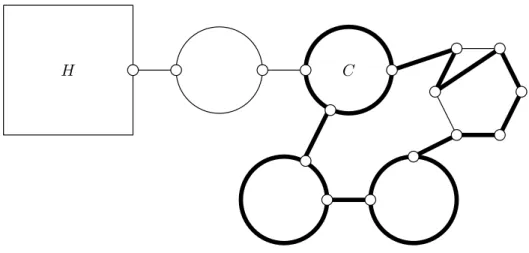
H C
Figure 1: Construction of a lollipop L. The thick edges are the edges inL. The hexagon is a small cycle of size six, and the four circles indicate large cycles. (Some vertices and edges are omitted.)
cycle C∈ C. We say that a cycle C∈ C islarge if|C| ≥10, andsmallif|C| ≤9. Note that all small cycles C have at most two chords in G[C], and thus Lemma 5.1 can be applied to such cycles.
In the algorithm, we maintain a subgraph H satisfying the following properties:
• H is 2-edge-connected;
• V(H) is the union of the vertex set of a subfamily of the cycles in C; and
• |E(H)| ≤6|V(H)|/5.
The subgraph H is initially an arbitrary cycle in C, and augmented by adding another sub- graphH′. The algorithm terminates whenV(H) =V.
In constructing H′, first we choose an edge e = uv ∈ δ(H), where u ∈ V(H) and v ∈ V \V(H), and let H′ := ({u},∅). Here, v belongs to a cycle C ∈ C which is not contained in H. If C is a large cycle, then we add e and C to H′, and continue to grow H′ from an arbitrary matching edge f ∈ δ(C)\ {e}. If C is a small cycle, by Lemma 5.1 there exists a Hamilton path P of G[C] starting at v and ending at some vertex w incident to a matching edge f ∈δ(C)\ {e}. We callv and w the initial vertexand terminal vertex of P, respectively.
Here, we addeand P toH′, and then continue to grow H′ again fromf, redefininge:=f and C as the cycle we reach at the other end of f.
The above two procedures are applied when C is not contained in H or H′. If we traverse e = uv to reach a cycle C ∈ C which is in H, then we have completed the growth of the subgraph H′, and we augment H with H′. If we traverse e=uv to reach a cycle C ∈ C with v∈C which has already been added toH′, then we addetoH′ and construct either alollipop or a tadpole.
We construct a lollipop if C is a large cycle. A lollipop L is a subgraph consisting of the large cycle C, plus the elements of H′ added after C was added to H′. See Figure 1 for an illustration. Then, we continue to grow H′ from a matching edge f ∈δ(L)\E(H′). Note that f always exists since Gis 3-edge-connected.
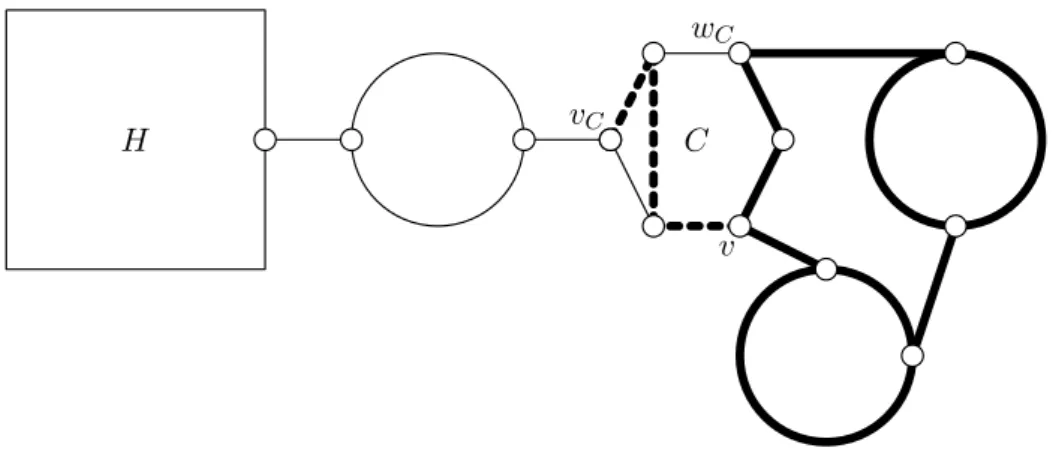
We construct a tadpole if C is a small cycle. A tadpole T is a subgraph consisting of the Hamilton path P derived fromC plus the elements of H′ added afterP was added to H′. For a tadpole T, we specify two subgraphs, the tail and the head. Let vC and wC be the initial and terminal vertices of P, respectively. The tail of T is a subgraph ofP, the path connecting vC and v. The head of T consists of the subgraph of P connecting v and wC, and elements of
H C wC
v vC
Figure 2: Construction of a tadpole T. The thick edges are the edges in T. The hexagon is a small cycle of size six, and the three circles indicate large cycles. (Some vertices and edges are omitted.) The dotted thick edges form the tail ofT, and the solid thick edges form the head of T.
T added to H′ after P was added to H′. See Figure 2 for an illustration. Then, we continue to grow H′ from a matching edge connecting the head of T to V \V(T). The fact that there always exists such a matching edge will be proved in Lemma 5.2.
We call a cycle in C which does not belong to any lollipop or tadpole as an independent cycle. If C is neither inH nor independent, then we construct a larger lollipop or tadpole. If C is contained in a lollipop L, we construct a larger lollipop ˆL, which consists of L plus the elements of H′ added after L was constructed. Then, continue to grow H′ from a matching edge inδ( ˆL)\E(H′).
If C is contained in a tadpole T, then we construct a larger tadpole ˆT, which consists of T and elements of H′ added after T was constructed. The tail and head of ˆT are defined as follows:
• If the vertexv ∈V(C) at which we come back toC is in the tail ofT, then the tail of ˆT is a subgraph of the tail ofT, a path connecting v and the initial vertex of the Hamilton path providing the tail of T. The head of ˆT is a subgraph ofH′ consisting of edges in T not in the tail of ˆT, and edges inH′ added after T was constructed.
• If v is in the head of T, then the tail of ˆT is the same as that of T, and the head of ˆT consists of the head of T and the elements of H′ added after T was constructed.
Then, continue to growH′ from a matching edge connecting the head of ˆT and V \V( ˆT).
If a lollipop or a tadpole becomes contained in a larger lollipop or tadpole, then we remove the contained lollipops and tadpoles from our list of them. That is, we only handle inclusion-wise maximal lollipops and tadpoles.
Below is a full description of the algorithm.
Algorithm Apx2EC
Input. A 3-edge-connected cubic graphG= (V, E).
Output. A 2-edge-connected subgraphH of Gwith at most 6|V|/5 edges.
Step 1. Find a 2-factorF ofGcovering all the 3- and 4-edge cuts. Choose an arbitrary cycleC0 inF, setH :=C0, and then go to Step 2.
Step 2. If V(H) = V, then return H. Otherwise, choose an arbitrary edge e = uv ∈ δ(H), whereu∈V(H) andv∈V \V(H), let H′ be the graph consisting of the single vertexu, and go to Step 3.