https://www.j-sla.org/
Japanese EFL Learners’ Null Subjects in the Control and Seem
Raising Constructions
Mineharu Nakayama The Ohio State University
Noriko Yoshimura University of Shizuoka
Kokushikan University
Abstract
This study examines whether or not Japanese speaking learners of English as a foreign language (EFL) understand referents of null subjects in infinitives, based on experimental results we obtained during the investigation of L2 acquisition of the control and seem raising constructions. In particular, it is revealed that the acquisition of PRO and A-movement is influenced by intervention and L1 transfer effects. By examining these constructions, we wish to deepen our understanding of null subjects in Japanese EFL learners’ interlanguage grammars.
1 Introduction
The interpretation of null subjects in infinitives has been a focus of several studies in the field of L1 acquisition since C. Chomsky’s (1969) pioneer work in child grammar. One main finding in her study was that subject control as in (1a), where the null subject (PRO) refers to the matrix subject John, is acquired surprisingly late (no earlier than 5 years of age), relative to object control as in (1b), where the null subject (PRO) refers to the matrix object Mary. Children tend to take Mary as the subject of the infinitive in (1a), suggesting that they follow Rosenbaum’s (1967) Minimal Distance Principle, i.e., Mary is the closer potential antecedent.
(1) a. Johnipromised Mary [PROito study hard].
b. John told Maryj[PROjto study hard].
The structure of obligatory control involves the generation of the null subject PRO in the subject position of the embedded infinitive clause (Chomsky, 1981). It is generally agreed that one syntactic factor and one semantic factor are responsible for the relationship between PRO and its controller. Syntactically, the Extended Projection Principle (EPP) (Chomsky, 1981) requires PRO to be generated in the infinitive subject position, and c-commanded by its controller; semantically, this PRO subject must be co-referential with the matrix subject or the matrix object DP depending on the requirement of the matrix verb. For instance, the matrix verb in (1a) is promised, thereby requiring the infinitive subject PRO to be compatible with the matrix subject John, i.e., subject control; on the other hand, the matrix verb in (1b) is
told, thereby requiring the PRO subject to be coreferential with the matrix object Mary, i.e.,
object control.
McDaniel, Cairns and Hsu (1990) find that children around age 4 appear to understand PRO as the infinitive subject, but its interpretation varies. Wexler (1992), following Borer and Wexler’s (1987) Maturation Hypothesis, claims that early child grammar does not have PRO. Hence, the acquisition of the subject control construction is delayed. Since the referent of PRO is the same as that of the matrix object in the object control construction, children do not show erroneous interpretations. Goodluck, Terzi, and Diaz (2001) argue that children possess the knowledge of PRO by age 4 as they found that 4-year-old children with a mother tongue other than English understood subject control sentences such as those with want and
try, but they had difficulty understanding PRO in adverbial clauses such as before drinking some water.
Another L1 acquisition study, Hirsch and Wexler (2007), investigates children’s comprehension of English raising structures. Of particular relevance to this paper, the following sentence structure types were tested in the experiment (= their (9) and (10), p. 43).
(2) a. It seems to Homer that Marge is pushing a cart. b. Homer seems to Maggie to be bowling a ball.
The results indicate that while the unraised seem construction in (2a) scored above 85% across seven different age groups of 70 monolingual children (from 3 to 9 years of age, 10 for each group), 40 children under age 7 performed poorly with accuracy ranging between 43.9% and 51.7% in the raised seem construction in (2b). The children understood the unraised seem sentences, yet they could not comprehend the raised seem sentences until around the age of 7. They concluded that the acquisition of raising with seem is a much-delayed phenomenon, and claimed that children opted to assign the raising structure a ‘think’ interpretation. That is, children’s interpretation of the sentence in (2b) is something like (3).
(3) Homer thinks Maggie is bowling a ball.
They misanalyze seem as if it were think because the two verbs share many semantic properties and because they showed almost perfect comprehension of think in the experiment. The delayed understanding of null subjects in infinitives has also been reported in L2 acquisition. In the principles and parameters theoretical framework (e.g., Chomsky, 1981; White, 1989), Finer and Broselow (1986) report that Korean speaking learners of English as a foreign language (EFL) had more difficulty identifying the correct antecedent of the reflexive
himself in infinitive clauses as in (4b) than in tensed clauses as in (4a).
(4) a. Mr. Fatithinks that Mr. Thinjwill paint himself*i/j. (92%)
b. Mr. Fatitold Mr. Thinj to paint himself*i/j. (58%)
Similarly, Hirakawa (1990) finds that Japanese speaking EFL learners had difficulty understanding infinitive clauses. They correctly identified the antecedent of the reflexive in tensed clauses 77% of the time whereas for infinitives they correctly identified the antecedent 55% of the time. Furthermore, Broselow and Finer (1991) point out that Mr. Fat was selected as the antecedent of the reflexive 8% of the time in (4a) while 20% in (4b). (4b) is an object control construction where the matrix object Mr. Thin controls PRO, which is the null subject of the infinitive verb paint and also the antecedent of himself in (5).
(5) [[Mr. Fati[told Mr. Thinj] [PROjto paint himself*i/j]]
The delayed understanding of the referents of null subjects in infinitives is reported in both L1 and L2 acquisition studies as we saw above. In this paper, we look at how well Japanese EFL learners understand referents of null infinitive subjects in control and seem raising constructions (PRO and a deleted A-movement DP or a trace of A-moved DP). We will show that the acquisition of PRO and A-movement is likely delayed due to intervention effects (Belletti & Rizzi, 2013) and L1 transfer. Throughout the paper, we assume the theoretical framework of the Minimalist Program (Chomsky, 1995) and the Full Transfer/Full Access (FT/FA) Hypothesis (e.g., Schwartz & Sprouse, 1996) with regard to Universal Grammar (UG) in L2 acquisition.
The organization of the paper is as follows: First, we will discuss L2 acquisition of control constructions, especially, the understanding of PRO. Then, we will look at our studies on L2 acquisition of the seem raising construction. Section 4 will compare the raising construction with the passive construction, another A-movement construction. Finally, we discuss Japanese EFL learners’ interlanguage grammars with respect to the control and raising (A-movement) constructions.
2 Control Constructions
Broselow and Finer (1991), Finer and Broselow (1986), and Hirakawa (1990), as we saw above, show that it takes time for L2 learners to understand sentences with infinitives compared to those with tensed clauses. The infinitive sentences contrasted with the finite clauses above are object control sentences. Yoshimura et al. (2015, 2016) and Nakayama et al. (2016) report that Japanese EFL learners seem to understand control structures from relatively early on. For instance, 30 high school learners (TOEIC average score 336.8, range 215–460) and 32 college learners (divided into two groups: Intermediate, n=18, TOEIC average score 548.6, range 470–650; Advanced, n=14, TOEIC average score 756.4, range 655–910) performed quite well on a multiple-choice questionnaire with 11 test sentence-answer pairs of subject control sentences like (6a) and object control sentences like (6b), where bold-faced words are correct answers (Nakayama et al., 2016). A summary of the experimental results is shown in Figure 1.
(6) a. Jim promised his parents to solve the problem. (Subject Control) Q: Dare-ga sono mondai-o kaiketsu-suru deshoo ka?
Who-NOM that problem-ACC solve-do would Q ‘Who would solve the problem?’
A: 1. Jim 2. his parents 3. I don’t know
b. May asked Susan to return home as soon as possible. (Object Control) Q: Dare-ga suguni ie ni kaeru koto ni naru no?
Who-NOM soon house to return fact in result Q ‘Who would return home soon?’
A: 1. May 2. Susan 3. I don’t know
Figure 1. Percentages (%) of correct answers by group and sentence type
As seen in Figure 1, the learners’ percentage of correct answers was relatively high, although the percentage of the correct answers to the object control sentences by the high school learners was relatively low. This was because the high school students did not seem to understand force, one of the verbs, included in the test sentences. Slightly lower percentages of the correct responses for the subject control sentences than the object control sentences, though statistically not significant, are likely due to intervention effects (i.e., an object DP intervenes between the matrix subject and PRO), which we will discuss below.
Yoshimura et al. (2016) conjectured that the learners’ early acquisition of control structures was attributed to L1 transfer of both syntactic and semantic properties. Japanese has control structures similar to those of English. (7) shows schematic control structures and (8) provides Japanese counterparts to English control sentences in (1).
(7) a. DPiV DPj[CPPROi/*jto VP] (Subject control)
b. DPiV DPj[CPPRO*i/jto VP] (Object control)
(8) a. Johni-ga Maryj-ni [PROi/*jisshookenmei benkyoo-suru-no]o yakusokushita.
-NOM -DAT hard study -NM-ACC promised ‘John promised Mary to study hard.’
b. Johni-ga Maryj-o [PRO*i/j isshookenmei benkyoo-suru-yooni] settokushita.
-NOM -ACC hard study to persuaded ‘John persuaded Mary to study hard.’
As a result of L1 positive transfer (i.e., L2 shares the same L1 syntactic and semantic properties), Japanese EFL learners demonstrate an understanding that the referent of the null subject is identified by the matrix verb. If so, they know the existence of the null subject that is controlled by the matrix verb. Here we assume that the null subject is PRO. Then, why did the learners have difficulty identifying the correct antecedent of the reflexive in Shirahata et al. (2015)? They report that the learners correctly understood the referent of a pronoun in (9a) better than that of a reflexive in object control sentences such as (9b).
(9) a. Mamiitold her mother to meet heriin front of the department store.
b. The father advised his sonito protect himselfifrom drunk driving.
Yoshimura et al. (2016) argue that this is due to L1 transfer of syntactic properties of zibun ‘self’. It is well-known that zibun can take the matrix subject as its antecedent (Inoue, 1976; Kuroda, 1965). Because of this, they took the matrix subject as the antecedent of the reflexive, i.e., the referent of PRO, even though it was an object control sentence. (See Yoshimura et al., 2020 below on the transfer of the properties of zibun.) In this scenario, L2 acquisition of infinitives in the control structure is not difficult for Japanese EFL learners. However, other grammatical interactions such as binding made them look as if they did not understand the control structure. See Nakayama et al. (2019) for the interaction of binding and quantification in control constructions.
3 Raising Constructions
A Minimalist analysis of raising assumes the surface subject of the sentence to start out in the infinitive subject position and get copied into [Spec, TP] of the matrix clause, checking the nominative case feature and the EPP feature (Chomsky, 1995). For example, (10b) is a structural representation of (10a), where John is copied at the matrix subject position and deleted at the infinitive subject position (A-movement). Here John moves across the experiencer argument Mary, but remains as the semantic subject of the embedded predicate to
be happy.
(10) a. John appears to Mary to be happy.
b. [TPJohni[T’appears to Mary [TPJohnito be happy]]].
Mary intervenes between John and its original, deleted John, but the sentence is grammatical
on the intended reading. Learners must adopt something like Collin’s (2005) smuggling approach in which the entire infinitive clause (YP) smuggles over an intervener (W) to a position adjacent to the matrix subject (Z), as schematically illustrated in (11).
(11) YP smuggles XP past W (Collins, 2005) a. Z [YPXP ] W <[YPXP ]>
b. Z [YPXP ] W <[YPXP ]>
With the smuggling operation, the relationship between Z and XP is local, as in (11a), whereas without it, the anaphoric relation is not local, as in (11b), thereby violating Rizzi’s (1990) Relativized Minimality, as stated in (12).
(12) Relativized Minimality (RM)
In the following configuration: X ... Z ... Y, a local relation between X and Y cannot hold if Z intervenes, and Z is a position of the same type Y.
Thus, the raised sentence (10b) becomes difficult to comprehend. (See Boeckx (1999) for the technical explanation of the experiencer c-commanding the infinitive subject position.)
Unlike the control construction we discussed above, Japanese does not have the syntactically equivalent seem construction. It has been claimed in the literature that Japanese does not have Case-triggered A-movement, as we see in the English seem construction (Kishimoto, 2005, 2009; Takezawa, 1993, 2015). Yooda and rashii, semantically equivalent to seem, are not verbs, and sentence (13a) is a translation equivalent to (10a). (13b) is a schematic representation of (13a).
(13) a. Mary-ni John-ga shiawaseni omoeru/mieru. -DAT -NOM happy seem/appear
b. [TP1Mary-ni [vP[TP2John-ga shiawaseni] omoeru/mieru TENSE]]
‘To Mary, John seems/appears to be happy.’
As seen in (13b), John can stay in the subject position of the embedded infinitive clause (TP2)
because it can receive the nominative case from the matrix clause’s (TP1) TENSE by means
of exceptional case marking (ECM). Thus, A-movement is not required in the omoeru/mieru construction in Japanese. The verbs omoeru/mieru are the semantic equivalent of seem, but syntactically different from seem. This syntactic difference is predicted to be important if L1 transfer occurs in the raising construction, as in the control construction. As we assume the FT/FA Hypothesis (Schwartz & Sprouse, 1996), we predict that Japanese EFL learners’ grammars would start with L1 syntactic properties of the verbs omoeru/mieru (e.g., argument structures) based on the meaning of seem/appear.
3.1 Unraised and Raised seem Constructions
Choe (2015) found that Korean speaking learners of English understood unraised seem constructions such as (14b) better (83%) than raised constructions such as (14a) (42%).
(14) a. John seems to be happy. (42%) b. It seems that John is happy. (83%)
Yoshimura and Nakayama (2017) found a similar tendency among Japanese EFL learners. In their experimental study with a truth-value judgment task (Crain & McKee, 1985), 67 Japanese college students (TOEIC average score 629.3, range 300–850) were asked to read the situations and judge whether the immediately following sentences correctly depicted the situations they had just read. If L2 learners behave similarly to L1 children, we would expect to find that the unraised construction is easier than the raised construction. Note that
L1 transfer (according to the FT/FA Hypothesis) does not predict that one construction would be easier than the other.
(15) a. Han Solo thinks that Luke loves Princess Leia in the movie “Star Wars”.
Luke seems to love Princess Leia. (TRUE)
b. Steve saw that it was wet everywhere after he came out of the meeting.
It appears that it rained while Steve was in the meeting. (TRUE)
The learners correctly judged the unraised construction (15b) 85% of the time while they did so on the raised construction (15a) 75% of the time. The raised construction was more difficult than the unraised construction. This is similar to the finite vs. infinitive constructions we discussed in the Introduction above, i.e., the finite construction is easier than the infinitive construction. Note that Yoshimura and Nakayama’s results were better than those of Choe’s numerically (unraised 85% vs. 83%, raised 75% vs. 42%), but the difference (particularly in the raised construction) may have come from different test materials and the proficiency of learners.
Next we will review experimental studies on raising constructions with an experiencer phrase.
3.2 Raising Sentences with Experiencer Phrases: Intervention Effects
Intervention effects in the raising construction among Japanese EFL learners were first reported in Yoshimura et al. (2016), where sentence (16b) was compared with the subject control sentence (16a). A multiple-choice questionnaire that included sentences like (16) was given to 30 Japanese high school students (TOEIC average score 368). The correct answers are bold-faced in (16).
(16) a. Hanako promised Susan to join the school tennis team. (Subject Control) Q: Who joins the school tennis team?
A: 1. Hanako 2. Susan 3. both 4. I don’t know
b. Jake appeared to Steve to have fun on his business trip. (Raising Construction) Q: Who looked to be having fun during the business trip?
A: 1. Jake 2. Steve 3. both 4. I don’t know
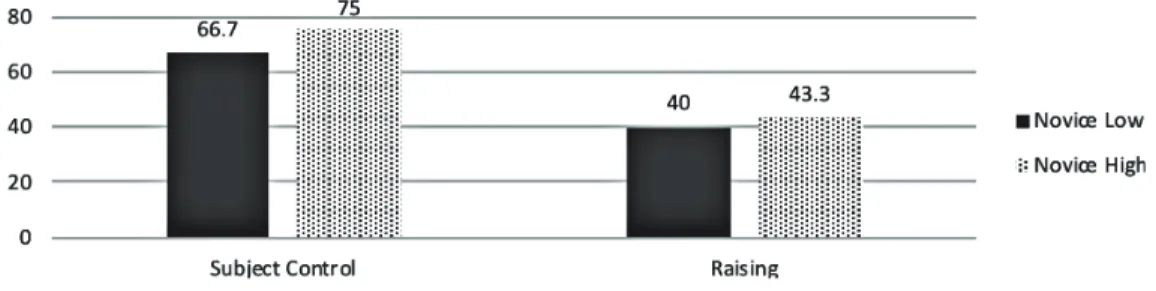
The participants were divided into two groups (15 each) based on their TOEIC scores: Novice-Low: TOEIC average score 285 (range 215–330), Novice-High: TOEIC average score 443 (range 335–625). Their English abilities were considered different as their TOEIC scores were statistically different. A summary of results is stated in Figure 2 below.
Figure 2. Correct response rate by group and sentence type (%)
Susan is an intervening phrase in the subject control sentence (16a) while Steve is the
intervening phrase in the raising construction (16b). As in Figure 2, both participant groups performed significantly better in the subject control sentence than the raising construction. The raising construction was difficult for Japanese high school students.
Yoshimura et al. (2017) examined the raising construction with an experiencer phrase as in (17). Similar to Yoshimura et al. (2016), this study employed a multiple-choice questionnaire given to 80 Japanese college students. The correct answer is bold-faced in (17).
(17) Kenji seemed to Mary to be an excellent singer for the school festival.
Q: Who would be an excellent singer at the school festival? A: Kenji Mary both I don’t know
The learners were divided into three groups based on their TOEIC scores, and the Middle group (n=27) was removed for the purpose of statistical analysis. The Low group had 28 students (TOEIC average score 443.4, range 320–500) while the High group included 25 students with a TOEIC average score of 732.9 (range 635–830). The two groups’ TOEIC scores were significantly different. Eighteen native speakers of English responded to the same material correctly 99% of the time.
The Low group had correct responses for sentences like (17) only 38% of the time while the High group evoked correct responses 67% of the time. Close to 50% of all learners selected Mary as the subject of the infinitive VP (be an excellent singer). It seems to be the case that Japanese EFL learners must reach an advanced level of English proficiency in order to acquire the raising construction though they know that infinitives take subjects (i.e., satisfying the EPP). Perhaps, it takes time because Japanese does not have A-movement to check nominative case against the subject. We will come back to this A-movement issue below.
Choe and Deen (2016) report that L1 children understood (18a) correctly only 40.9% of the time, but when the experiencer phrase is preposed as in (18b), their understanding improved and was at 87.5%. Even when the experiencer phrase contains a pronominal like (18c), their understanding improved to 81.5%. These findings indicate that the type of intervening phrase, lexical or pronominal, affects L1 children’s understanding of the raising construction.
(18) a. Donald seems to Mickey to be short. b. To Mickey, Donald seems to be short.
c. Bart seems to him to be studying.
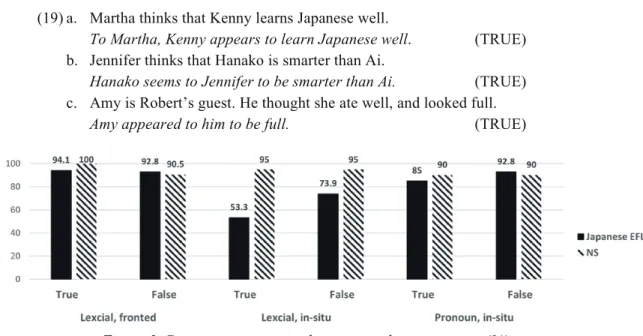
Following Choe and Deen, Yoshimura and Nakayama (2019) investigated similar constructions among 51 Japanese EFL learners (TOEIC average score 697, range 600–850, CERF = B1 equivalent). Employing a truth-value judgment task, they examined sentences like (19) among Japanese college students and seven native speakers of English (NS). In (19a), the lexical experiencer phrase appears at the sentence initial (fronted) position whereas it is in situ in (19b). In (19c), the experiencer phrase appears in situ as in (19b), but it contains a pronoun instead of a lexical noun. If L2 learners’ development is similar to that of L1 children, it is predicted that the construction without the intervening phrase (19a) is the easiest for Japanese EFL learners, and if there is a lexical difference, the construction with the pronominal experiencer (19c) is easier than that with the lexical intervening phrase (19b). A summary of results is shown in Figure 3.
(19) a. Martha thinks that Kenny learns Japanese well.
To Martha, Kenny appears to learn Japanese well. (TRUE) b. Jennifer thinks that Hanako is smarter than Ai.
Hanako seems to Jennifer to be smarter than Ai. (TRUE) c. Amy is Robert’s guest. He thought she ate well, and looked full.
Amy appeared to him to be full. (TRUE)
Figure 3. Correct response rates by group and sentence type (%)
As seen in Figure 3, Japanese EFL learners did well when the experiencer phrase appeared at the initial position, i.e., no intervention. However, they did not do well when the lexical experiencer phrase appeared in-situ, i.e., the intervening position, although they improved when the phrase included a pronoun (Lexical vs. Pronominal p < .0001; Lexical fronted vs. in-situ p < .0001). These findings are similar to what Choe and Deen found in L1 children: (i) when the experiencer phrase appears as an intervening phrase (i.e., in-situ), the sentence becomes very difficult for the learners to understand, i.e., Relativized Minimality
(RM) effect (Rizzi, 1990). (ii) The type of the intervening phrase matters, i.e., lexical nouns are more difficult than pronouns (cf. Gibson, 2000).
Yoshimura et al. (2018) examined the following sentence types among 66 Japanese college students and nine native speakers of English by employing a truth-value judgment task. (20a) is an example of the raised construction with a lexical subject and a pronominal experiencer whereas (20b) is an instance of the raised construction with a pronominal subject and a lexical experiencer. (20c) is an example of the unraised sentence with a pronominal experiencer. (20a) and (20c) simply have a raised vs. unraised difference. Thus, as we saw above, we would expect difficulty with the raised construction (20a). As for (20a) and (20b), the difference is the order of the nominal types of the matrix subject and the experiencer phrase, lexical-pronominal in (20a) vs. pronominal-lexical in (20b). Given the findings in Yoshimura and Nakayama (2019) above, (20b) is predicted to be more difficult than (20a) as the intervening phrase contains a lexical word.
(20) a. Raised construction with a lexical subject and a pronominal experiencer Joe thinks that Hanako is smarter than Ai.
Hanako seems to him to be smarter than Ai. (TRUE)
b. Raised sentence with a pronominal subject and a lexical experiencer Maria thinks that Kenny learns Japanese well.
He appears to Maria to learn Japanese well. (TRUE)
c. Unraised sentence with a pronominal experiencer Jeff is Wanda’s teacher and he thinks that she likes math.
It seems to him that Wanda likes math. (TRUE)
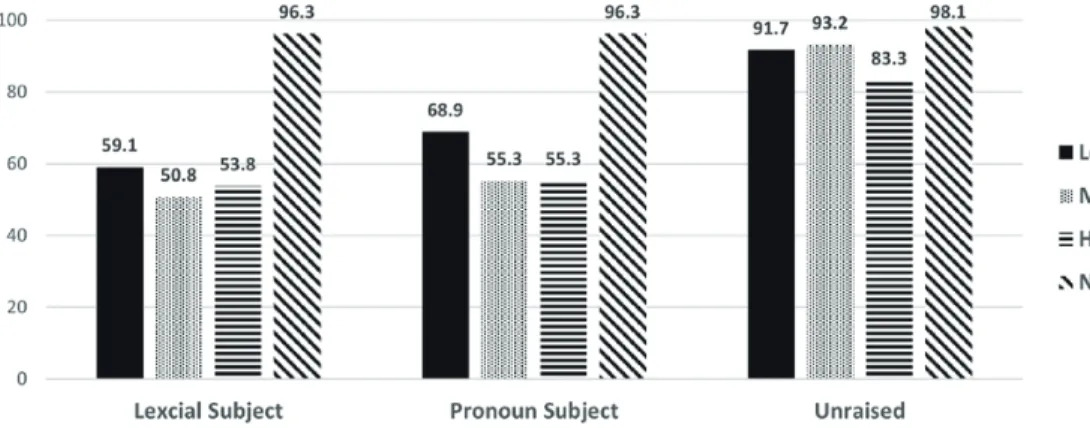
The learners were divided into three groups (22 people each) based on their TOEIC scores: Low (TOEIC average score 505, range 405–560), Middle (TOEIC average score 610, range 570–660), High (TOEIC average score 712, range 665–890). A summary of results is in Figure 4.
As seen in Figure 4, the raised construction is more difficult than the unraised construction. The unraised constructions did not differ among the four participant groups (including the control group). However, the raised construction with the experiencer phrase is difficult even when disregarding the different nominal types of experiencer phrases (lexical vs. pronominal), which suggests a strong RM effect, especially among the intermediate EFL learners (Middle and High groups). This indicates that the raised construction with the intervening phrase is more difficult than the unraised construction, regardless of the categorical nature of the experiencer. (cf. See Gibson’s (2000) processing difference in lexical nouns and pronouns.) The finding is, however, different from that of the previous experiment, where the intervening phrases were different (lexical vs. pronominal) while the raised subject was held consistently lexical. Since the sentences with the pronominal intervening phrases were easier in the previous experiment, (20a) should have been easier here. However, it was not. Since the raised subjects were either lexical or pronominal, this referential difference of the raised subjects must have nullified the referential difference of the intervening phrases. We certainly need further research on this issue, but at least one can categorically say that both lexical and pronominal subject DPs are difficult to raise over the intervening phrase, i.e., a strong RM effect.
The experiments discussed in this section indicate how difficult the raising construction is for Japanese EFL learners to acquire. The acquisition of the raising construction is delayed, compared to that of the control construction. Moreover, having an intervening phrase substantially makes the raising construction more difficult for the learners to comprehend.
3.3 Anaphoric Expressions
Yoshimura et al. (2019, 2020) investigated whether anaphoric expressions can reduce the difficulty in the comprehension of raising constructions with an experiencer phrase among Japanese EFL learners. Yoshimura et al. (2019) compared learners’ comprehension of raising constructions with and without a pronoun referring to either the raised subject or the experiencer phrase in the infinitive clause. A total of 56 Japanese EFL learners participated in the study. They were divided into two groups (28 each) based on their TOEIC scores: Low (TOEIC average scores 562.1, range 530–580) and High (TOEIC average scores 673.4, range 585–885). Ten native speakers of English served as the control group.
Their experiment employed a truth-value judgment task. Two types of raising constructions were investigated, with or without pronominal gender cues. Type I involved a raising construction without a pronoun, as in (21), and Type II involves a raising construction with a genitive pronoun within the infinitive clause, as in (22). In (22a) the gender pronoun
his in his father matches with the raised subject Mike, not the experiencer Susan, whereas in
(22b), his in his assignment matches with the experiencer DP her brother, not the raised subject Mary. That is, the contextual information given in the associated description was provided to induce a “pronoun advantage” by matching or mismatching the raised subject with the experiencer phrase, thereby leading to TRUE in (22a) and FALSE in (22b). However, such pronoun advantage is not available in both sentences in (21) because no pronoun refers
to the raised subject (Amy or the nurse) or the experiencer (Robert or Dr. Adam). That is, the pronominal existence would help Japanese EFL learners’ comprehension.
(21) Type I (Without pronouns)
a. Amy is a shoemaker. Robert, her father, thinks that she works hard making colorful shoes every day.
Amy appears to Robert to work hard daily making colorful shoes. (TRUE)
b. The nurse thinks that Dr. Adam’s shirt is white, not gray.
The nurse seems to Dr. Adam to wear a white shirt. (FALSE) (22) Type II (With pronouns)
a. Susan thinks that her brother Mike is now taller than his father.
Mike appears to Susan to be taller than his father. (TRUE) b. Mary thought that her brother worked hard on his assignment.
Mary appeared to her brother to work hard on his assignment. (FALSE)
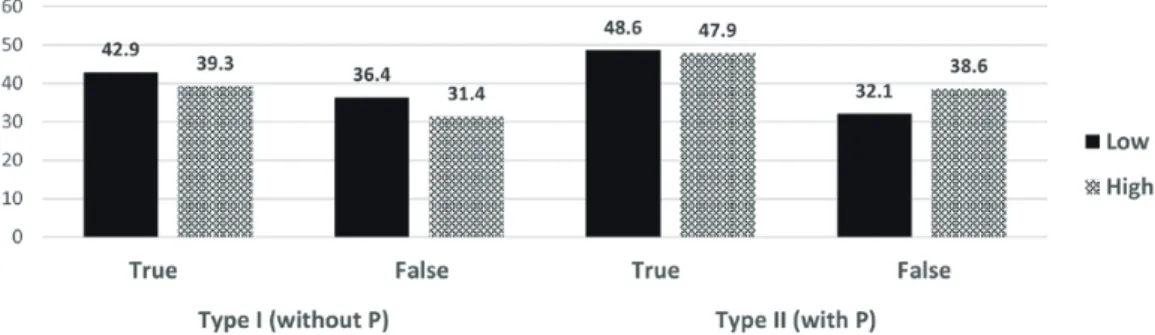
Figure 5 is a summary of results. It shows that the learners’ accuracy rates were surprisingly low regardless of their English proficiency (overall mean accuracy: Low 40% vs. High 39.3%), TRUE versus FALSE judgments (Low: 45.7% vs. 34.3%, High: 43.6% vs. 35%), and more importantly, the presence or absence of the genitive pronoun in the context and the test sentence did not help their sentence comprehension (Low: 39.6% vs. 40.4%, and High: 35.4 versus 43.2%). There was a statistically significant difference among the learner and native speaker groups, but no significant difference between the two learner groups.
Figure 5. Correct response rates by group and sentence type (%)
Upon individual examination of their responses, Yoshimura et al. (2019) found that the learners tended to become sensitive to the gender morphological distinctions as their English proficiency improved, thereby gradually utilizing the pronoun advantage in the proper way. For instance, five out of 12 participants whose TOEIC scores ranged between 700–785 (CEFR B1) answered correctly 60% of the time or above in Type II with the gender pronoun. Note that two participants with TOEIC scores of above 800 (CEFR B2) performed perfectly
in Type II. However, since it is by no means statistically proven, this tendency is not conclusive.
In sum, the learners failed to take full advantage of pronominal gender information, still suffering a strong intervention effect on A-movement from the infinitive to the matrix subject positions across the intervening experiencer.
Yoshimura et al. (2020) investigated the reflexive interpretations in raising constructions, where there is a reflexive in the infinitive clause referring to the raised subject. A total of 93 Japanese EFL learners participated in the study. They were divided into three groups based on their TOEIC scores: Low (n = 32, TOEIC average score 452.5, range 410–500, CEFR A2) Middle (n = 31, TOEIC average score 554.2, range 505–645, CEFR B1) and High (n = 30, TOEIC average score 709.8, range 650–850, CEFR B2). Eight native speakers of English served as the control group.
The experiment employed a context-based multiple-choice task. Three types of raising constructions were investigated, with a reflexive gender and number cue. The first and the second sentence types involved a raising construction with a singular reflexive, as in (23) and (24), and the third type involved a raising construction with a plural reflexive in the infinitive clause, as in (25). In (23) and (24) the masculine and feminine reflexives himself and herself match the raised subjects Tom and Yasuko, not the experiencers Linda and Mamoru, respectively, whereas in (25), themselves matches the raised subject DP Yasu and Tomo, not the experiencer Yoshi. The contextual information given in the associated description was provided to neutralize a “gender and number advantage” by providing two possible antecedents contextually while matching the raised subject and mismatching the experiencer phrase. The experiment included three practice questions and 18 test items (two for each reflexive type, masculine singular, feminine singular, and plural and 12 fillers). Each context was written in Japanese, but the associated stimulus sentences were written in English. The correct answers are bold-faced in (23)–(25).
(23) Linda: Tom, Why are you so down?
Tom: I made a simple mistake and got below 60 points on the exam. I lost confidence.
Linda: Really? To tell the truth, I got below 60 points, too. I lost confidence, too. What shall we do?
Tom seems to Linda to have lost confidence in (1. himself 2. herself
3. themselves 4. don’t know)
(24) Yasuko How was the last week’s physics exam?
Mamoru I reviewed the material thoroughly the day before the exam. So I should get a good score. I am OK. How about you?
Yasuko I also studied hard. So I can get a perfect score. I am OK, too!
Yasuko appears to Mamoru to feel satisfied with (1. himself 2. herself
(25) Yasu: How was the Chemistry exam?
Tomo: I got only 87 points. I couldn’t make 90. That was bad. What about you, Yasu?
Yasu: Oh, the same. I also got 87 points. I thought I would have made 90. I am still no good.
Yoshi: What? What are you saying, guys? Isn’t it great even if you got 87 points? Both Yasu and Tomo are aiming high.
Yasu and Tomo appear to Yoshi to set high standards for (1. himself 2. herself
3. themselves 4. don’t know).
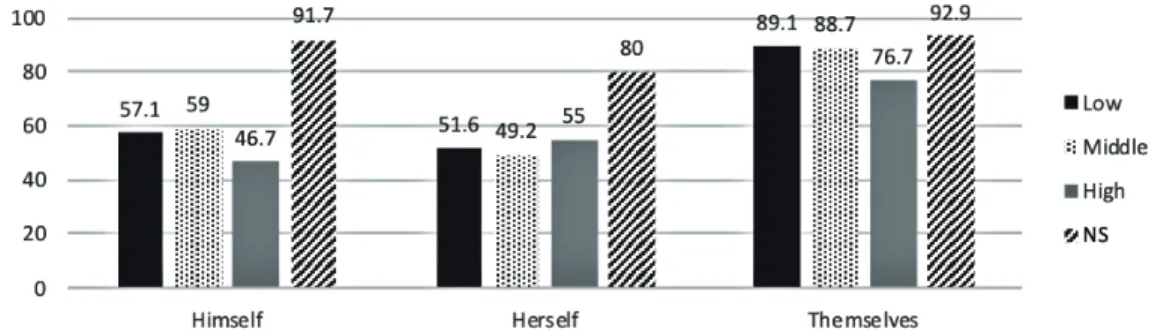
Figure 6 shows a summary of the results. The learners’ accuracy rates were low regardless of their English proficiency when the reflexive was singular (overall mean accuracy, singular vs. plural: Low: 54.3% vs. 89.1%, Middle: 54.1% vs. 88.7%, High: 50.8% vs. 76.7%). Only 22 participants (23.7%) showed a perfect performance.
Figure 6. Percentages of correct responses by group and sentence type (%)
Overall, the three learner groups (Low, Middle, and High) and the native control group were significantly different in mean accuracy rate, though there were no significant differences among the three learner groups. The three sentence types (himself, herself, and themselves) were significantly different in mean accuracy rate, but there was no significant group and type interaction. There was a significant difference between the singular (himself/herself) and plural (themselves) reflexives among the learner groups (53.1% vs. 85.1%), though the two singular reflexives did not differ (54.3% vs. 51.9%). This means that there were number effects on reflexive resolution though no gender effects were observed.1It may be the case
that morphological number information is an effective cue in facilitating Japanese EFL
1Note that the learners had difficulty with one sentence with herself that included the expression make oneself
available (Low group 25%, Middle group 29%, and High group 36.7% correct).
One of the SL reviewers raised a question why the native speakers’ correct percentage for the herself sentences was slightly low (80%). This is because three speakers gave erroneous answers for one particular test sentence, but the reasons for those errors are unknown to us.
learners’ understanding of the raising construction. This may be because number is a grammatical feature in Japanese (cf. Yusa et al., 2014). On the other hand, morphological gender information is not an effective cue, possibly because zibun, a Japanese counterpart to English reflexives, is gender-free, when L1 (syntactic and semantic) transfer is assumed.
A close look at the two sets of results from Yoshimura et al. (2019, 2020) together reveals that overall, Japanese EFL learners’ correct response rates in the “pronoun” experiment were lower than their correct response rates in the “reflexive” experiment. Suppose learners’ grammars have the structure (26).2
(26) a. [X seem to Y [PRO to V -self] ] (PRO subject hypothesis)
b. [X seem [to Y to V -self] ] (Y reanalyzed as the subject; Missing PRO hypothesis, Yoshimura et al., 2016) Here X and Y are contextually possible candidates for the antecedent of the reflexive. Contextually, Tom and Linda are possible because both lost confidence in (23), and both
Yasuko and Mamoru are also possible in (24). There are two possible scenarios when we
assume L1 transfer, i.e., the base-generation of the matrix subject. One scenario is that the learners would choose X as the antecedent of the reflexive due to L1 transfer of the properties of zibun, i.e., the subject-orientation and the long-distance antecedent. Then, they would select himself in (23) and herself in (24). Though this is the correct outcome, this choice was not made by the correct structure with A-movement. The other scenario is that locality matters more, and the learners would have to choose Y as the antecedent of the reflexive. In (26a), PRO becomes the antecedent of the reflexive and is identified by Y. Or PRO may become invisible resulting in a structure like (26b) where binding applies, e.g., Yoshimura et al (2016). This forces herself and himself to be selected in (23) and (24), respectively. Assuming even the High group learners’ interlanguage grammars still do not have a correct A-movement structure, the former scenario applies to 19 learners (20.4%) (6 Low group (18.8%), 7 Middle group (22.6%), and 6 High group participants (20%)) who chose all correct responses to both himself and herself test sentences. On the other hand, the latter scenario applies to 14 learners (15%) (3 Low group (9.4%), 5 Middle group (16.1%), and 6 High group participants (20%)) who were unable to choose any correct responses to both
himself and herself test sentences. Additionally, 20 more learners were unable to choose two
correct responses to either himself or herself test sentences. That is, 34 learners (36.6%) seem to have had a stronger locality influence. Given the individual results above, more learners had a stronger locality influence than those with L1 transfer of the properties of zibun and the PRO subject hypothesis (36.6% vs. 20.4%), but about 43% of the learner participants were unclear as to having either a locality or L1 transfer influence.
2 As in the discussion of (12), to in the experiencer phrase does not count in blocking the c-command
requirement (see Boeckx, 1999). Furthermore, the learners may consider it like Japanese ni, the dative case marker, from the L1 transfer perspective. Thus, it does not block the c-command requirement.
Now this locality issue reminds us of the finding in Yoshimura et al. (2012), where both English speaking learners of Japanese and Chinese speaking learners of Japanese behaved similarly with respect to the interpretation of zibun in an experiment with a truth-value judgment task. In context (27), the Japanese test sentence correctly depicts the situation (TRUE), where the matrix subject is the antecedent of zibun.
(27) Hanako is planning Prof. Smith’s birthday party next Saturday. She e-mailed Ken on that matter this morning, but there was no reply. So she telephoned him. Hanako: Did you read my e-mail?
Ken: Sorry, I was busy and have not checked my e-mails.
Hanako: I see. I plan to have Prof. Smith’s birthday party next Saturday, but can you come?
Ken: I think so, but what time?
Hanako: 5 pm. It’s 3000 yen. Since it’s a surprise party, please don’t tell Prof. Smith.
Hanakoi-wa Ken-ga zibuni-no meeru-o yonda ka tazunemashita. (TRUE)
-Top -Nom self-Gen email-Acc read whether asked ‘Hanakoiasked if Ken had read heriemail.’
Both English speaking learners and Chinese speaking learners with a lower proficiency level correctly accepted sentences like (27) only about half of the time. Because the Chinese reflexive ziji is like Japanese zibun allowing long-distance binding (i.e., the matrix subject antecedent), Chinese speaking learners should have responded better than English speaking learners if L1 transfer occurred (as the FT/FA Hypothesis predicts). Both learners did well on the interpretation of local (short-distance) binding (i.e., the clause-mate subject antecedent). Since locality is the core notion of human cognition as assumed in UG, this is not a strange finding, although it is still possible that L2 English influenced the local binding choice in the Chinese speaking learners’ interlanguage grammars as Japanese is their L3. Here possible antecedents were both matrix and local subjects, maintaining the subject-orientation, which is slightly different from Yoshimura et al. (2020) study in that locality forces the erroneous interpretation to make the referent of the intervening phrase as that of the local subject and the antecedent of the reflexive. In any event, the strong locality observed in L2 interlanguage grammar is not new.
To conclude this section, the data have demonstrated that Japanese EFL learners failed to take full advantage of the anaphors in overcoming the possible intervention effect. The learners are inclined to utilize their L1 knowledge when their L2 knowledge is not competent enough for the structure of a given construction or when their L2 grammar needs to cope with the syntactic complexity of a given construction. These studies, in turn, support our claim that Japanese EFL learners start out with the base-generation of the matrix subject, not A-movement from the infinitive subject position during the process of acquiring the raising
construction. Now let us further discuss the status of the matrix subject in the raising construction.
4 Raised Subjects in A-movement Constructions
Thus far, we have seen a strong intervention effect in the raising construction in the Japanese EFL learners’ interlanguage grammars. Now let us look closer at the structure of the raised construction, particularly, consider the status of the matrix subject in the raised construction. Remember that a counterpart to the seem construction is not a subject raising sentence in Japanese. For instance, Takezawa (2015) analyzes the structure of (28a) (which is a scrambled version of (13a)) is (28b), where t is a trace after DP is moved/scrambled.
(28) a. John-ga Mary-ni shiawaseni omoeru/mieru. -NOM -DAT happy seem/appear
‘John seems to Mary to be happy.’
b. [TPJohn-gai[TPMary-nij[vPtj[VPtishiawaseni] mieru]] T(ense)]
According to Takezawa, raising (A-movement) is not available in Japanese and just scrambling takes place in (28b). That is, Japanese verbs omoe/mie(ru) are lexically similar to
seem, but syntactically they do not behave like seem/appear. Given this, Japanese EFL
learners’ grammars may have the base-generated subject in the seem construction if L1 (syntactic) transfer occurs.
Nakayama et al. (2018) investigated the learners’ knowledge of the matrix subject in the raised construction. This is because Yoshimura and Nakayama (2010) found the following ungrammatical sentence accepted by Japanese EFL learners, which is similar to Kuribara’s (2003) finding.
(29) *This time seems that he followed my advice.
Yoshimura and Nakayama interpreted their experimental results as the learners did not understand that seem takes expletive it, and instead considered this time as the subject of
seem in (29). If this explanation is correct, the learners may transfer the status of Japanese
subjects to English subjects, and would accept a PP as the subject in the seem construction. This hypothesis was tested in Nakayama et al. (2018), along with passive sentences, another A-movement construction. The study examined whether Japanese EFL learners would accept the sentence with a PP subject. A questionnaire with an acceptability judgment task (1–7, 7 = acceptable) was created including two types of sentences like subject raising sentence (30) and passive sentence (31). It was given to 46 Japanese college students and 10 native speakers of English.
(30) a. John was a reporter and he thought that Virginia had a lot of money. Virginia seemed to be rich.
b. Harry is Jane’s secretary and he thought she looked sad after the business trip. *After the business trip appeared to be feeling sad for Jane.
(31) a. Ken cleaned Haruko’s room.
Haruko’s room was cleaned by Ken.
b. Tomoko flew to Paris and enjoyed drinking good wine during the flight.
*On the plane was served good wine.
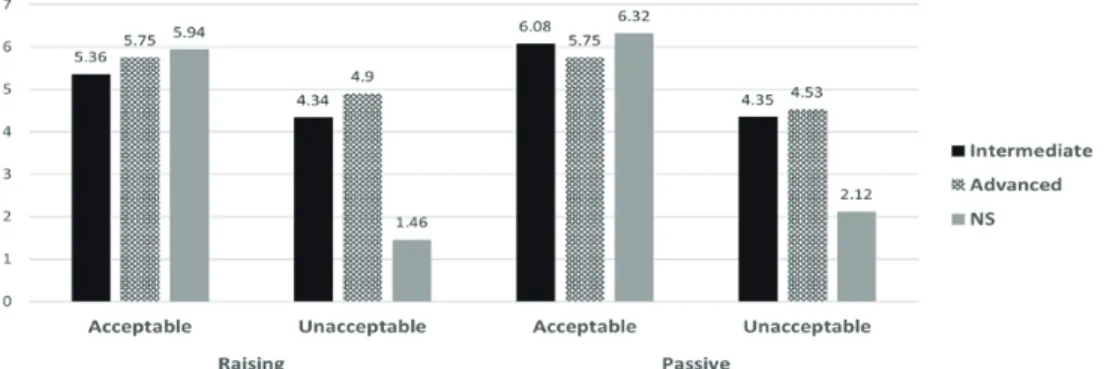
The learners were divided into two groups (23 participants each) based on their TOEIC scores, Intermediate group (TOEIC average score 558.3, range 500–595) and Advanced group (TOEIC average score 720.7, range 625–820). The two learner groups’ TOEIC scores were significantly different. A summary of results is shown in Figure 7.
Figure 7. Acceptability ratings by sentence type and group, (1–7 acceptable)
There were no statistical differences between acceptable and unacceptable sentences among the learners. In the acceptable sentences, only the Intermediate group showed a significant difference in sentence types. In the unacceptable sentences, there was a group difference, though no difference was found in sentence type nor interactions. In each sentence type, there was a significant difference between the learner groups and the native speaker group. The results suggest the following: (i) It takes time for learners to call unacceptable sentences unacceptable. This is generally so because it takes time for learners to become confident of their judgments. (ii) The learners accept PPs as the subjects of both passive and raising constructions. This must be L1 transfer (i.e., supporting the FT/FA Hypothesis), as Japanese allows PPs with –ga at the subject position (Kuroda, 1987). Having a PP subject satisfies the EPP. But it is not like English, where feature-checking takes place to satisfy the EPP. This means that there is no A-movement in these constructions. The subjects are base-generated. The following are two possible structures of the seem construction in the Japanese EFL learners’ interlanguage grammars.
(32) a. [TP1DPi[seems [TP2to DPj[to VP]]] T] (DPj= subject)
b. [TP1DPi[seems to DPj[TP2PROi/jto VP]]]
Under the base-generation hypothesis together with the EPP, we need to assume that there is a subject for the infinitive clause. In (32a), the experiencer phrase DPjserves as the subject of
the infinitive verb when a PP is allowed in a subject position like Japanese. When DPs are understood as possible subjects in English, PRO becomes the only possibility for the null subject because this is a non-tensed clause. Hence, (32b) is a possible structure. This PRO can be either DPior DPj: it can be identified as DPivia predication, and it can be compatible
with DPjdue to the locality constraint. There is no smuggling operation like Collins’ (2005)
(as in (11)) in both cases. This is different from L1 grammar where the subject the boy forms an A-chain with its (deleted) original in the infinitive after smuggling, as in (33b). The Theta assigning property of the raising verb is also different. Thus, there is no intervention effect. However, in L2 grammar here the girl and the boy in (33b) cannot be the same referents in reality, and therefore, PRO is identified by the matrix subject, although this violates the theta assigning property of the raising verb. Then, (32a) represents the structure in the learners’ interlanguage grammars allowing a PP subject (i.e., both DPiand DPjat the subject positions).
See the discussion in the previous section. (33) a. Smuggling for raising
X [YP Y ] Z <[YPY ]> (YP=to infinitive)
A-chain smuggling
b. [The boy [<the boy> to VP] to the girl <[<the boy> to VP]> ]. A-chain smuggling
When L2 learners learn that the raising construction involves A-movement, they also need to acquire an operation like smuggling so that the raising operation avoids the RM violation (see (12), i.e., intervention).
If our explanation is correct, the base-generated subject account seems to apply to passives as well, which suggests that their interlanguage grammars do not have A-movement. Notice that Japanese has two passives, direct and indirect passives, as in (34) and (35), respectively. However, here the pertinent passive is the direct passive.
(34) a. John-ga Mary ni/niyotte sonkeisareteiru. (direct passives) -NOM by respect-passive-present
‘John is respected by Mary.’
b. [TPJohni-ga [vPMary-niyotte [ tisonkeis-are-teiru]]T]
(Base-generation, Kitagawa & Kuroda, 1991) (No case-triggered movement, Kuroda, 1988) c. [TPJohn-ga [vPMary-ni [sonkeis-are-teiru]]T]
(35) Hanako-ga ame-ni fur-are-ta. (indirect passive) -NOM rain by fall-passive-past
‘Hanako had rain fallen on her.’
As in (34b) for the niyotte direct passive sentence (34a), the subjects can be A-moved or base-generated.3On the contrary, as in (34c) for the ni direct passive (34a), the subject is
based-generated. According to Kuroda (1978), Japanese has a Linear Case Marking System, which allows the subject to be ga-marked (nominative case marked) without A-movement. If L1 transfer applies to the findings of Nakayama et al. (2018), Japanese EFL learners’ English passives have base-generated subjects. English passive sentences (36a) have A-movement as in (36b) in L1 English grammar, where the experiencer phrase the boy can become an intervening phrase for the A-movement of the ball.
(36) a. The ball was pushed by the boy.
b. The ball was pushed by the boy <the ball> A-movement
(Baker et al., 1989; Jaeggli, 1986) (37) [DPi be V-en [by DPj] ]
However, if Japanese EFL learners transfer L1 properties, the subject the ball is base-generated at the subject position and there is no A-movement as in (37). Based on this assumption, the experiencer DPjis not an intervener in (37) because no movement is involved
in the structure.
There is another study that compared the raising construction and the passive sentence. Yoshimura et al. (2020) investigated how well Japanese EFL learners comprehend the seem construction in (38) and the Exceptional Case Marking (ECM) passive in (39).
(38) The boy seems to the girl to have liked their English teacher. (39) The doctor is believed by the patient to have worn a white shirt.
As we saw in (36), the experiencer phrase the boy is an intervening phrase for the ball in the passive sentence (36b)
3The niyotte passive may have movement, but not Case-forced as the English passive does because in Japanese an overt case is always available for an argument DP. It may involve scrambling to meet the EPP requirement.
(36) b. The ball was pushed by the boy <the ball>
Intervention A-movement
However, the ECM passive like (39) has the structure (40a), not (40b), which contains PRO. (40) a. The doctor is believed by the patient [<the doctor> to have worn a white shirt] A-movement
b. The doctor is believed by the patient <the doctori> [PROito have worn a white
shirt]
(41) a. The patient believes the doctor to have worn a white shirt. b. The patient believes [the doctor [to have worn a white shirt]] c. *The patient believes the doctor [PRO [to have worn a white shirt]]
Note that (41a) is an active counterpart to (40a). Since believe is an ECM verb, the subject of the infinitive is Case-marked by the matrix verb as in (41b). Thus, it does not have the structure (41c), where the doctor is the matrix object and PRO is the infinitive subject that is controlled by it. Believe is not an object control verb and does not allow a dative case-marked object in the structure. Since the passive form believed loses the accusative case-marking ability, the doctor A-moves to the matrix subject position where it is nominative case-marked in the correct ECM passive structure (40a). The erroneous structure (40b) contains PRO that is a passivized counterpart to (41c). Since Nakayama et al. (2018) showed that raising and passive sentences did not seem to have A-movement (in Japanese EFL learners’ L2 grammars), the ECM passive was contrasted against the raising sentence in this experimental study.
The experiment employed a truth-value judgement task. As shown below, a brief written context was given to 103 Japanese college students and they were asked to judge the test sentence that was immediately followed by the context description as to whether or not it correctly depicted the situation. The example test sentences are shown in (42) and (43).
(42) Raising
a. A boy and a girl went to the same school. The girl thought that the boy liked their English teacher.
The boy seemed to the girl to have liked their English teacher. (TRUE)
b. John has a daughter, Sharon, and a son, Bob. Bob thinks that Sharon bought an
iPhone.
(43) ECM Passives
a. The patient thinks that the doctor’s shirt was white, not gray.
The doctor is believed by the patient to have worn a white shirt. (TRUE)
b. The man believes that the woman would run faster than Goofy.
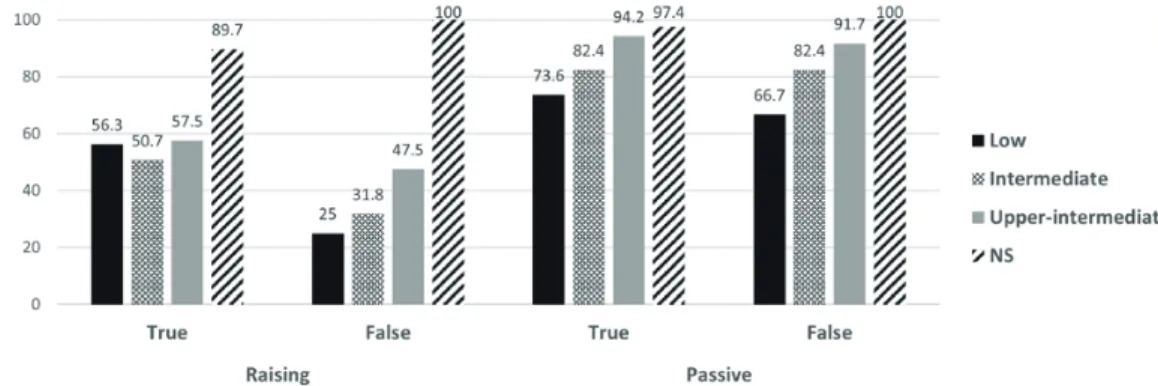
The man is believed by the woman to run faster than Goofy. (FALSE) Japanese EFL learners judged 16 test sentences (Raising and ECM Passive, 4 TRUE and 4 FALSE sentences each) and 24 fillers (40 sentences in total). The learners were divided into three groups based on their TOEIC scores: Low (n = 36, TOEIC average 474.06, range 410– 515, CEFR A2), Intermediate (n = 37, average 588.59, range 520–640, CEFR B1), and Upper-intermediate (n = 30, average 716.33, range 650–855, CEFR B2). The three groups were significantly different with respect to their English abilities. Ten native speakers of English also participated in the study as a control group. A summary of results is shown in Figure 8.
Figure 8. Correct response rates by sentence type and group (%)
Group mean accuracy rates for TRUE sentences are: Low Raising 56.3% vs. ECM Passives 73.6%, Intermediate Raising 50.7% vs. ECM Passives 82.4%, and Upper-intermediate Raising 57.5% vs. ECM Passives 94.2%. In correct responses to the TRUE sentences, all three learner groups and two sentence types were significantly different. There was also a significant difference in group and type interaction. For Passives, there was a significant difference between Low and Upper-intermediate groups (p < .000). A post hoc Bonferroni analysis reveals that the Upper-intermediate group was significantly different from the Low group (p < .014) and the Intermediate group (p < .046). Raising and passive constructions were significantly different in each learner group (Low p < .001; Intermediate p < .000; Upper-intermediate p < .000). Group and sentence type interaction was observed among the passive sentences between Low and Upper-intermediate groups (p < .000).
These results show two interesting asymmetries: (i) For Japanese EFL learners, ECM passives were much easier than raising sentences. (ii) The L2 learners were similar to L1 children on the acquisition of raising, but divergent from L1 children on the acquisition of
passives. These imply that unlike L1 children, Japanese EFL learners do not seem to suffer an intervention effect when they comprehend passives in English (i.e., it suggests subject base-generation and early acquisition of the ECM passive sentence).4
5 Discussion
We now turn to the discussion about the findings from the 11 experimental studies discussed above. First, let us summarize the findings of the studies in Table 1, where “YNFS 2015” is Yoshimura, Nakayama, Fujimori, and Shimizu (2015), “<” indicates that the left construction is more difficult than the right, and “=” means the left and the right constructions had no difference in difficulty in comprehension.
Table 1. Summary of the studies and their findings
Studies TOEIC ranges Findings YNFS 2015,16,
NYFS 2016 YN 2017 YNFS 2016
215-625 Subject Control < Object Control 215-910
300-850 Raising (without PP): Raised < Unraised seem
215-625 Intervention: Raised (with PP) < Subject Control
YNFS 2017 YN 2019 YNF 2018 YNFY 2019 YNFY 2020 NYF 2018
320-880 Intervention (with PP): Raised < Unraised seem 600-850 Intervention, Referentiality (with a lexical subject):
Lexical DP in situ < Pronominal DP in situ < Lexical DP in the fronted PP
405-890 Intervention, Referentiality: Raised lexical subject with a pronominal DP in PP = Raised pron. subject with a lexical DP < Unraised seem with a pronominal subject
530-885 Pronoun information: Raising with a pronoun = Without a pronoun
410-850 Gender and number information in reflexives: No difference on gender information, but singular < plural
500-820 A-movement: Raising < Passives
YNF 2020 410-855 A-movement: Raising < ECM Passives
As seen in the first three studies in Table 1, comprehending the object control sentences is easier than the subject control construction, and the unraised construction is easier than the raised construction for Japanese EFL learners. Unlike the subject and the object control structures, Japanese does not have a seem raising construction equivalent to the English one.
4As one of the reviewers points out the late acquisition of the raising construction could be related to the input
issue. For any construction, input data are critical for language acquisition. The seem construction is indeed taught in Japanese junior high school English classes. In a senior high school English textbook, the structure is introduced with oral and written practice, i.e., X seems to be happy together with X seems happy or X looks happy. However, example sentences in the textbook do not include the experiencer phrase “to Y”, and it is not clear if the raising construction with an experiencer phrase is actually introduced in the classroom.
This may result in negative L1 transfer (i.e., a corresponding L1 structure is different from the target L2 structure). Furthermore, the intervention effect is certainly real and seems very strong. Mitigating the intervention effect by fronting the experiencer phrase to the sentence initial position appeared to help Japanese EFL learners’ understanding of the seem construction. Moreover, the referential nature of the intervening phrase appears to matter. The inclusion of a pronoun in the raising construction did not make learners’ comprehension easier than that without it. On the other hand, the inclusion of the reflexive in the construction revealed a stronger influence in locality than L1 transfer of the property of zibun.
There seems to be no A-movement forced by case-checking in Japanese EFL learners’ interlanguage grammars. Consider (44), where (44a) is L1 grammar while (44b) is L2 interlanguage grammar. (45) shows the schematized operations that differentiate L1 and L2
seem (raised) constructions. As in (45a), the infinitive subject is copied at the matrix subject
position and the original infinitive subject is deleted in L1 English grammar. This A-movement is forced by case-checking as the infinitive subject position is not a case position. Since Japanese does not have this A-movement for case-checking, Japanese EFL learners’ grammars allow a base-generated subject, just like their L1 grammar. As a result, the interlanguage grammar allows PPs to appear in the matrix subject position of the raised construction.5 Sentences (44c) and (45c) are PRO alternative structures for (44b) and (45b),
respectively.
(44) a. [TP1[The boy [seems to the girl [TP2<the boy> [to like his English teacher]]]]]
(L1 English grammar) b. [TP1[The boy [seems [TP2to the girl [to like his English teacher]]]]]
(c.[TP1[The boy [seems to the girlj[TP2PROjto like his English teacher]]]])
(Japanese EFL learners’ interlanguage grammars) (45) a. [TP1[DPi[seems to DPj[TP2<DPi> [to VP]]]] ( ) (A-movement)
__________
([copy & deletion] case-checking) (Native speakers) b. [TP1[DPi[seems [TP2to DPj (Base-generation)
(no A-movement for case-checking) (c. [TP1[DPi[seems to DPj[TP2PROjto VP]]]] (Base-generation))
(Japanese EFL learners) The lack of A-movement does not seem to apply only to the raised construction. It applies to passives as well. As Japanese has both direct and indirect passives, Japanese EFL learners may be using the same base-generation operation for the passive subjects. If so, their
5One of the reviewers pointed out that the intervention (RM) effect would become evidence for A-movement.
However, it is an effect on the representation, not a movement operation, and thus, the RM effect itself is independent of evidence for A-movement.
interlanguage grammars may not have A-movement for case-checking as one finds in English. They need to acquire this A-movement operation for case-checking. Furthermore, they need to acquire an operation like Collins’ (2005) smuggling in (33) (=11), repeated here, for the
seem construction.
(33) a. Smuggling for raising
X [YP Y ] Z <[YPY ]> (YP = to infinitive)
A-chain smuggling
b. [The boy [<the boy> to VP] to the girl <[<the boy> to VP]> ]. A-chain smuggling
What about passives? Passives could also have both L1 transfer (Gass & Selinker, 1983; Schachter, 1983) and smuggling. As we saw above, L1 transfer seems possible because they allow PP subjects like Japanese passives without A-movement, and the smuggling operation has not been acquired. Smuggling for passives in L1 grammar seems to be like that in (46). (46) a. Smuggling for passive
DP2 [V <DP2>] by DP1 <[V DP2]>
A-chain smuggling
(based on Belletti & Rizzi, 2013; Snyder & Hyams, 2015) b. [The ball was [push <the ball>] by the boy <[push the ball]>.
A-chain smuggling
Now, how do we explain the difference between the correct response rates of the raising and the passive sentences we saw in the above experiments? In addition to L1 transfer, explicit classroom instruction may have played a role here. Raising constructions are taught, but not in detail (see footnote 4). On the other hand, passive forms are explicitly taught in the classroom, though formal teaching focuses on the literal translations of the passive form together with the by phrase:
(47) a. [be verb + the past participle of V] = rare(ru) b. by = ni yotte
Such one to one form mapping instruction starts in junior high school and is repeatedly emphasized in high school textbooks. Sentence (48a) is first introduced in a textbook for 3rd
year junior high school students (New Horizon English Course 3, Tokyo Shoseki 1998). (48) a. This painting is loved by many people.
b. Instruction [sare-masu] or [sare-te i-masu] = [be verb + pp] [by]=[ni yotte]
The passivized verbal form and the by-phrase are replaced by Japanese counterparts. This leads to L1 transfer. What about the different experimental results on regular passives and the ECM passives we saw above? For Japanese EFL learners, ECM passives were easier than raising. Syntactically, there is an absence of raising (negative L1 transfer) and there is the availability of niyotte passive (positive L1 transfer). Japanese learners learn the passives relatively early whereas L1 English speaking children experience the relatively late acquisition of the construction. L1 children do not acquire something like Collins’ (2005) smuggling until around the age of 7, thereby strictly observing a locality principle such as Rizzi’s (2004) Relativized Minimality (RM). Japanese EFL learners may also not have some prior knowledge of the smuggling approach at early stages of L2 acquisition. It is because they may not need it if their (ECM) passive structure is (49b) and the by-phrase is an adjunct phrase like ni yotte in Japanese.6Compare (49b) with the native speakers’ structure in (49a).
(49) a. [TP1DPi [be V-en (by DPj) [TP2<DPi> to VP]]]
(L1 Grammar, movement, intervention) b. [TP DPi [be V-en (by DPj) [PROito VP]]]
(L1 transfer, no movement, no intervention)
In (49b), the matrix subject DPiis base-generated and identifies the embedded subject PRO
via predication. Either the DP within the adjunct by-phrase does not c-command PRO or by assuming that predication is immune to RM or irrelevant to RM, we can maintain that the structure induces no intervention in this case. Since there is no intervention, the learners do not need to learn the smuggling operation. Thus, the ECM passive structure in Japanese learners’ L2 grammars is not like the native speakers’ structure in (49a), yet their answers in the experiment above are correct, the same as the answers generated by the grammar with (49a).
The passive form of be -en is acquired early, e.g., Form-before-meaning Hypothesis (Bardovi-Harlig, 2000), possibly due to the effect of explicit instruction. The by-phrase can be translated as niyotte, yielding the adjunct reading. This reminds us of the Competing Systems Hypothesis (Rothman, 2008; Long & Rothman, 2013), where a system of learned pedagogical rules contributes to target-deviant L2 performance. The learners’ proficiency must become high to overcome these erroneous structures.
6Note that niyotte not only appears in passives, but also in active sentences as in (i). Identifying a causee can
be ambiguous.
(i) Ooame-ni-yotte, densha-ga tomatta. big rain due to train-Nom stopped ‘Due to the heavy rain, the train stopped.’
6 Conclusion
We have discussed several experimental studies that investigated Japanese EFL learners’ interpretations of null infinitive subjects in L2 English. We found the following: (i) Japanese EFL learners understand the EPP, (ii) the control construction seems easy for them to acquire due to positive L1 transfer, (iii) the raising construction is difficult for them to acquire due to negative L1 transfer, (iv) their interlanguage grammars are vulnerable to an intervention effect, and (v) they accept a PP as a matrix subject of the raised construction. Japanese EFL learners understand finite clausal complements earlier than infinitive clausal complements, and can correctly comprehend the null infinitive subject of the control construction earlier than that of the raising construction.
In relation to the raising (A-movement) construction, moreover, we found that (vi) Japanese EFL learners also accept a PP as a matrix subject of the passive (A-movement) construction and (vii) their knowledge of passives seems unstable. Given the findings (v) and (vi), we propose that Japanese EFL learners’ interlanguage grammars do not have A-movement for case-checking. Due to negative L1 transfer, it allows matrix subjects to be base-generated in the raising construction. Positive L1 transfer allows matrix subjects to be base-generated in the passive construction. Collectively, we believe the findings of the studies discussed throughout this paper are consistent with the FT/FA Hypothesis. However, this “base-generated subject” proposal must be examined further by future research. Finally, it is also important to find out what triggers Japanese EFL learners to acquire A-movement for case-checking in their L2 English grammar (i.e., the correct grammatical status of the null infinitive subject in the raising construction).
Acknowledgements
This paper was written based on our 2019 Japan Second Language Association Fall Seminar presentation. We would like to thank the Seminar organizer Koichi Otaki, the participants of the Seminar, and two Second Language reviewers for their helpful comments on the earlier versions of this paper. All shortcomings are of course ours. We are also very grateful to Atsushi Fujimori and Tomoaki Imoto for statistical assistance and to all participants of the experiments. The studies cited here were partially supported by a small grant from The Ohio State University College of Arts and Sciences to the first author and JSPS KAKENHI Grant Numbers, 26370700, 8K00834 to the second author. Their support is gratefully acknowledged.