Pendennis and London’s Literary Bohemia :
Temporalizing the Timeless Topos
journal or
publication title
Jimbun ronkyu : humanities review
volume
70
number
4
page range
39-59
year
2021-02-10
Pendennis and London’s Literary Bohemia:
Temporalizing the Timeless Topos
Kazuo Y
OKOUCHI1. Introduction
After the epoch-making success of Vanity Fair (1847-8), William Makepeace Thackeray (1811-63) set out to engage in a typical behaviour for novelists throughout the nineteenth century—the fictitious retrospec-tion of his own life from immature boyhood up to the present status of a successful writer in the format of the autobiographical novel. Preceding the similar project by Charles Dickens—namely David Copperfield (1849-50)—by eleven months, The History of Pendennis (1848-50) became, or should have become, Thackeray’s most typical Victorian novel focused on the process of the male protagonist going out into the world and finally achieving professional success.(1)What actually came about, however, after
two years of serialization once interrupted by the author’s illness was a relatively unified but rather tedious long novel, lacking both the width and variety of Vanity Fair and the density and passion of Henry Esmond (1852); Pendennis turned out to be an odd mixture of bildungsroman and comic burlesque, the fashionable novel and middle-class domestic realism, ────────────
⑴ On comparison with Dickens’s novel, see Brian Cheadle, ‘David Copperfield and Pendennis: Answering Back’, Dickens Quarterly, 34/1 (March 2017), 14-26. 39
boorish humour and maudlin sentimentalism.(2) Critical assessment of it
has not been particularly favourable, especially during the twentieth cen-tury preoccupied with the artistic unity of literary texts, if not always so harsh as John Carey’s indictment of the author’s long decline after Vanity
Fair.(3)Yet placed in the context of the nineteenth-century British literary
culture, Pendennis justly claims a very unique position.
Nigel Cross’s seminal study in the literary culture in Victorian London brought to light the hidden presence of numerous writers or would-be writers below the surface in the age of Dickens and Thackeray and later of George Gissing. They gathered around the streets lined with publishers and taverns, aspiring to follow the example of Dickens’s huge success, while they sought pleasure in central London and often dropped out of economic independence. Cross applies the term bohemians to those ob-scure writers and publishers and bohemia to the quarters they haunted. In his mapping of the Victorian literary bohemia, its spirit was first em-bodied by William Maginn, an Irish editor and writer who ran Fraser’s
Magazine through the 1830s and died in ruin, and later followed by ‘a
group of young men, in their twenties in the 1850s, who were followers of Dickens and Thackeray’, such as George Augustus Sala, the Broughs, the Mayhews, the St Johns, Angus Reach, James Hannay, Henry Sutherland Edwards, Edmund Yates, Blanchard Jerrold, Mortimer Collins, Henry ────────────
⑵ Some finest readings of Pendennis as a bildungsroman will be found in Juliet McMaster, Thackeray: The Major Novels (Manchester: Manchester University Press, 1971), 51-86; and Cates Baldridge, ‘The Problems of Worldliness in
Pen-dennis’, Nineteenth-Century Literature, 44/4 (March 1990), 492-513. On
bildungsroman in the context through the 1820s to the 1840s, see Suzanne
Howe, Wilhelm Meister and His English Kinsmen (New York: Columbia Uni-versity Press, 1930).
⑶ John Carey, Thackeray: Prodigal Genius (London: Faber, 1977), 16. 40 Pendennis and London’s Literary Bohemia
Vizettely and William Tinsley.(4) It was Thackeray, according to Cross,
who became the first chronicler of this literary culture in Pendennis and
The Adventures of Philip (1861-2) and regarded as ‘the master of the
Bo-hemian novel—that is, novels with sub-plots set in or around Fleet Street and the Strand’.(5) In the bohemian section of Pendennis, which roughly
occupies the third fifth of the novel, he caricatured Maginn, the first genu-ine bohemian in London as well as his benefactor who published many of his early writings, with a poignant sarcasm that caused the controversy over the ‘dignity of literature’ and with an engaging humour that trapped many young men into the same occupation.(6)Edmund Yates, for example,
recollects in a chapter entitled ‘The Influence of “Pendennis”’ of his mem-oirs the irresistible charms of Pendennis on his first reading it in seriali-zation that encouraged him to pursue the literary career.(7) For those
in-terested in London’s literary culture in the mid nineteenth century, Pen-────────────
⑷ Nigel Cross, The Common Writer: Life in Nineteenth-Century Grub Street (Cambridge: Cambridge University Press, 1985), 93-4. The potential list can expand to cover more than one hundred names listed up in Robert J. Kirk-patrick’s Pennies, Profits and Poverty: A Biographical Directory of Wealth and
Want in Bohemian Fleet Street (London: Hanwell, 2016). On Maginn’s
charac-ter and role in the licharac-terary culture in the 1830s, as well as his influence on Thackeray, see also Miriam M. H. Thrall, Rebellious Fraser’s: Nol Yorke’s
Magazine in the Days of Maginn, Thackeray, and Carlyle (New York: AMS,
1966; originally published in 1934); David Latané, William Maginn and the
British Press: A Critical Biography (Farnham: Ashgate, 2013); and Kazuo
Yok-ouchi, ‘The Godfather of Victorian Realism: William Maginn and the Cultural Conflict in the 1830s’ in Hiroko Ikeda and Kazuo Yokouchi, eds., Irish
Litera-ture in the British Context and Beyond (Oxford: Peter Lang, 2020), 51-70.
⑸ Cross, The Common Writer, 110.
⑹ On Pendennis and the ‘Dignity of Literature’ controversy, see Craig Howes, ‘Pendennis and the Controversy on “Dignity of Literature”’, Nineteenth-Century
Literature, 41/3 (Dec. 1986), 269-98; and Michael Lund, Reading Thackeray
(Detroit: Wayne State University Press, 1988), 59-78.
⑺ Edmund Yates, His Recollections and Experiences, 4th edn (London: Bentley, 1885), 144-68.
41
dennis remains the first canon to be consulted.
In the current trend in Victorian studies which tends to view literary texts not as isolated or self-contented works of art but as part of the com-plex network of cultural phenomena including publishing business, the bo-hemian section of Pendennis is drawing increasing attention. Pioneered by Peter L. Shillingsburg’s 1992 work on Thackeray’s role in book production business,(8)Albert D. Pionke and Richard Salmon, both in 2013 but
sepa-rately, discussed the bohemian section of Pendennis in their book-length studies of literary profession in the Victorian era. Focusing on how Pen’s Oxbridge educational background smoothes his path towards professional writing rather than mere money making, Pionke delineates the tense rela-tionship between gentlemanship and literary profession in the class-conscious Victorian culture.(9) Salmon, on the other hand, addresses the
continuity between impoverished bohemianism and literary profession by placing Pendennis in the circle of literary apprenticeship novels that had begun to appear in the 1840s, such as Thomas Miller’s Godfrey Malvern (1843) and George Henry Lewis’s Ranthorpe (1847); what Salmon calls bo-hemians is a direct descendant of eighteenth-century hacks who haunted Grub Street.(10) These discussions illuminate the precarious position of
professional writers then emerging between gentlemen and bohemians, but both fail to take account of the temporary aspect of Thackeray’s bohe-mian section that occupies only a small portion of the novel. This tempo-ral shortness is itself closely related to the centtempo-ral theme of the novel and ────────────
⑻ Peter L. Shllingsburg, Pegasus in Harness: Victorian Publishing and W. M
Thackeray (Charlottesville: University Press of Virginia, 1992).
⑼ Albert D. Pionke, The Ritual Culture of Victorian Professionals: Competing for
Ceremonial Status, 1838-1877 (Farnham: Ashgate, 2013), 51-65.
⑽ Richard Salmon, The Formation of the Victorian Literary Profession (Cam-bridge: Cambridge University Press, 2013), 67-101.
perhaps even of Thackeray’s whole literary career. It is not until placed in the precise context of the long novel, which as a whole treats Pen’s entry into the world with many bitter results, that his bohemian experience seems to reveal its true nature and value. To explicate what it is is the aim of the following pages.
2. Scène de la vie de bohème and the timeless bohemia
Today as it did on its publication, Pendennis derives part of its interest from its vivid representation of London’s literary world in the 1830s. As John Sutherland notes, ‘ironically, many young readers of the late 1840s took these literary-world sections of Pendennis (which Thackeray intended as sordid) as a romantically attractive depiction of the literary vie
bo-hème’.(11) Indeed, the period of its serial and book-form publication
coin-cided with the growing popularity of Henri Murger’s Scène de la vie de
bo-hème (1845-9; 1851) beyond the channel, and some followers of Dickens
and Thackeray emerging in the 1850s were charmed by and imitated the life of supposedly poor and free writers and artists in Paris which was ro-mantically depicted in Murger’s fiction. In fact, Thackeray did not use the words such as bohemian and bohemia even for once in Pendennis, despite the fact that he became the first English writer to use them in the previ-ous novel. In Vanity Fair, though, he seemed to find it more appropriate to apply these terms to seedy wanderers like Becky Crawley on the Conti-nent than to her poor father who pursued art in the Soho area in Lon-don.(12) As the terms had only recently acquired the new connotations
────────────
⑾ John Sutherland, explanatory notes in William Makepeace Thackeray, The
History of Pendennis, ed. John Sutherland (Oxford: Oxford University Press),
1005-61, 1038.
⑿ On Thackeray’s use of bohemia and bohemian in Vanity Fair, I am planning↗ 43
popularized by Murger, Thackeray probably did not intend to depict
bohe-mians in particular in Pendennis. But the outcome was a unique and
per-suasive account of what soon came to be called London’s literary bohe-mia.(13)
To bring out the characteristics of Thackeray’s handling of the subject, it is useful to compare it with Murger’s approach to Paris’s bohemian life eternized in Scène de la vie de bohème which undoubtedly affected the re-ception of Pendennis, if not the writing of it. Murger’s work developed from a series of loosely related short stories or sketches that appeared separately from 1845 to 1849 before they were dramatized in 1849 and compiled into a single volume in 1851.(14) The stories evolve round four
young artists who get together in a boardinghouse with different ambi-tions—Rodolphe the poet, Schaunard the musician, Marcel the painter and Colline the philosopher—without a distinct plot; woven by romantic descriptions and lively conversations, they present in the mode of prose burlesque their destitute life, pleasure seeking and love affairs endlessly— until Rodolphe outlives his love affairs with Mimi and finally departs, with his three friends, the den of poverty and apprenticeship for good. As a whole, the series offers a record of eternal youth while it lacks any sig-nificant development or growth on the part of its characters except in the last two chapters. As its title suggests, the Scène is meant to offer a chain ────────────
↘ to write an independent essay.
⒀ On London’s literary bohemia, see Christopher Kent, ‘British Bohemia and the Victorian Journalist’, Australasian Victorian Studies Journal, 6 (2000), 25-35, as well as Cross’s The Common Writer and Kirkpatrick’s Pennies, Profits and
Poverty.
⒁ On Murger’s life and work, see Arthur Moss and Evalyn Marve, The Legend of
the Latin Quarter: Henry Mürger and the Birth of Bohemia (London: Allen, c
1946). As Murger’s name varies between Henry and Henri, Murger and Mür-ger, I follow the spellings found in the Vizetelly edition of The Bohemians of
the Latin Quarter cited below.
of static scenes rather than a coherent plot of dynamic developments or changes across time and therefore approximates a collection of sketches rather than a coherent novel.
As Amanpal Garcha argues, the 1820s and 1830s happened to see a growing popularity of fictional sketches in place of plotted novels in the English literary market. Apparently in reaction to the rapid change of so-ciety accompanying industrial revolutions and political turbulences, the reading public began to find ‘plot less appealing and fragmentation and stasis more so’, and ‘consumed sketches to enjoy, phantasmatically, the “trick of remaining stationary, unchanged, and unimproved”’.(15) While
Garcha has the trend beginning with Mary Russell Mitford’s Our Village (1819) in mind and proceeds to focus on Thackeray, Dickens and Elizabeth Gaskell who all attempted sketch-form narratives in their early careers, the writing of plotless, non-developmental narrative sequences is also found in the comic tradition including Pierce Egan’s Real Life in London (1820-1), Theodore Hook’s Sayings and Doings (1830), Dickens’s Pickwick
Papers (1836-7) and Robert Surtees’s Jorrock’s Jaunts and Jollities
(1838). One may wonder if such a masterpiece as The Pickwick Papers fits this category, but however elaborate a plot it acquired on its way, it origi-nally started as an aimless journey and was meant to stop when that journey ended. What these comic narratives have in common is the cast of characters who scarcely age. The main characters in these narratives re-main basically the same during the course of narrative, whatever events may occur to them and temporarily change their fortune. Mr Pickwick, for example, acquires a faithful servant, gets involved in a lawsuit and is put into prison during the course of narrative, but no reader would seriously ────────────
⒂ Amanpal Garcha, From Sketch to Novel: The Development of Victorian Fiction (Cambridge: Cambridge University Press, 2009), 10.
45
believe that through these experiences Mr Pickwick grows to be any better or worse man in the sense that David Copperfield or Pip does; Mr Pick-wick remains the same Mr PickPick-wick, and that is why, an old man as he is, he sometimes looks like an eternal youth.
Although distanced in time, place and language from these traditions of sketch narratives in England, Murger’s Scène roughly belongs with them in that it tells of the changeless—eventful on the surface yet fundamen-tally the same—life of young artists in a series of only loosely related, fragmentary narratives. Rodolphe, Schaunard, Marcel and Colline con-stantly change their roles and moods, their abodes and girlfriends, yet hardly outgrow the milieu of poverty and stagnation until the last chap-ter. In a different view, they hardly get old but enjoy the eternal spring of adolescence. This does not necessarily mean, though, that Murger believed in eternal youth or the infinite duration of bohemian life. In the preface to the Scène, Murger referring to the temporary state of bohemia which every artist passes through before they attain success defines the bohemia as ‘a stage in artistic life; it is the preface to the Academy, the Hôtel Dieu, or the Morgue’,(16) suggesting that the residents of this quarter are
des-tined to depart it either for professional success or for failure and death. From this long span of time, the Scène captures the passing moment of young artists and fixes it on the canvas. Therefore, the narrative is curi-ously devoid of the proper concept of time. Chapter 1, for example, sugges-tively begins with Schaunard’s vituperation at the peal of a c(l)ock: ‘By Jove! […] my feathered clock goes too fast: it cannot possibly be to-day yet!’.(17) He needs (so he recalls) to evacuate his rooms by noon since he
────────────
⒃ Henry Murger, The Bohemians of the Latin Quarter, tr. anon. (London: Vizetelly, 1888), 29.
⒄ Murger, The Bohemians, 1.
has neglected the quarterly rent, but rather chooses to go out for carous-ing in defiance of his landlord’s warncarous-ing. Schaunard, as well as his fellow bohemians, is set against the passage of time—so wasting a day in vain, drinking past midnight and into the next morning unawares; ultimately, he wastes his time of youth, saying ‘life is short, and we must enjoy our-selves whilst we can’.(18)
The timeless nature of the Scène is also found in the love affairs of Ro-dolphe and Mimi which is presented with some confusing obscurity. Un-like the romantic couple in Giacomo Puccini’s Bohème, in which the lovers first meet in Rodolphe’s room and fall in love with each other in search of a dead candle in the darkness, Murger’s couple enter their relationship without a clear beginning. Mimi is first mentioned at the beginning of Chapter 8 as a girl who is going to live with Rodolphe, but Chapter 8 is wholly devoted to Rodolphe’s flirtation with another girl named Mademoi-selle Laure. In Chapter 9, Rodolphe is in love with his cousin Angela, and there is no reference to Mimi. Chapter 10 relates how Rodolphe is assailed by one of his creditors, Monsieur Benois, and finds his room already let to ‘a girl named Mimi, with whom Rodolphe had formerly begun a love du-et’.(19)It is suggested that Mimi allows Rodolphe to stay in her room that
night. In Chapters 11 and 12, which make a sequence, Mimi is mentioned as Rodolphe’s ‘new flame’, and they surprise Rodolphe’s friends on their return from ‘honeymoon’, but at the end of Chapter 12, Mimi is courted by Viscount Paul, who is going to take her away in a later chapter. In Chap-ter 13, Rodolphe and Mimi begin to live together afChap-ter their honeymoon trip, and in Chapter 14 we find Rodolphe distressed by his loss of Mimi, who has turned out to be a flirt. The narrator then begins to recount the ────────────
⒅ Murger, The Bohemians, 24. ⒆ Murger, The Bohemians, 114.
47
history of their love in the grave tone that quite differs from the light tone in other chapters—how Rodolphe first met Mimi when she was the mis-tress of one of his friends; how he ‘made her his own’(20); how he began to
be disappoined of their marriage while Mimi began to dream of a better life with a richer patron; and how she actually achieves her aim with a new patron. In the present time of the narrative, Rodolphe is desperate and seeking a new love, but at the end of the chapter becomes reconciled with Mimi who returns to his room. From Chapter 15 to Chapter 19, the stories focus on other episodes, during which Mimi is only occasionally mentioned, and in Chapter 20 we find Mimi again, already separated from Rodolphe and patronized by Viscount Paul; Rodolphe, on the other hand, looks entirely recovered from his loss of Mimi. In Chapter 21 Rodolphe plays out the role of Romeo against his ‘new idol’ named Juliet. In Chap-ter 22, however, Rodolphe’s flirtation with Juliet has ended, and he is sud-denly visited on Christmas Eve by Mimi who confesses her separation from Viscount Paul and her fatal illness. Rodolphe receives her kindly and does his best for her, but finally learns her death at the hospital.
Rodolphe’s dragging relationship with Mimi thus summarized, con-stantly moving between separation and reconciliation, symbolizes the end-less loop of youthful energy in the literary and artistic bohemia. Their love does not start from any dramatic encounter, nor does it lead to any definite goal such as formal marriage. Their paths sometimes cross each other and at other times divide, but never lose sight of each other entirely. Through this precarious yet continuous itinerary the characters of the two lovers basically do not change, as Rodolphe’s poetic attempts in the mean-time do not bring him fame or take him anywhere without bringing him ────────────
⒇ Murger, The Bohemians, 156.
back to the same bounds of the bohemian quarter. Murger’s romantic de-piction of Paris’s bohemia thus falls into the same category with the Eng-lish trend of plotless, fragmentary and static sketch narratives in which the characters do not grow but remain where they begin. This apparently static quality of bohemia as an eternal territory of youth and freedom forms the charms of Murger’s work, despite his awareness that bohemia is really a temporary stage in life inevitably leading either to success or to failure and death.
3. Pendennis and the temporalized bohemia
To turn back to Thackeray’s Pendennis, we find quite a contrast to Mur-ger’s static approach to Paris’s bohemia. It hardly comes as a surprise that the novel focused on the protagonist’s growth across a span of years should take a different approach to one of its main stages from that of Murger’s comic narrative series. Open as it is to the debate over whether it is a bildungsroman or not, Pendennis follows the protagonist’s progress through several stages, one of which came to be recognized as Thackeray’s version of bohemia. In other words, Thackeray’s bohemia is both tempo-rarily and spatially set in the wider perspectives of English society and of Pen’s career; not monopolizing the reader’s vision, it is always surrounded and threatened by outer worlds and other values. To be precise, it does not even exist as a recognizable entity in London’s geography, unlike Mur-ger’s deceptively everlasting bohemia in Paris’s Latin Quarter. Probably, the ‘bohemian’ section in Pendennis takes place somewhere between Chapter XXVIII and Chapter XXXVI, in which Pen gets to know London’s fashionable society and comes to be involved in its publishing business, but the author never uses the word bohemia in writing it. What the later 49
generations came to call bohemian is diveded among different phases of the narrative, and it never takes the form of an integrated territory or subject. The narrative in the course of the bohemian section moves through different scenes of London society and steps through different stages of a developmental plot. Curiously, Pen’s love affairs are entirely and manifestly excluded from that perspective.
Let us take a closer look. Chapter XXVIII, to begin with, describes Pen’s arrival in London as a law student. Pen first takes his lodgings at Temple and begins his study of law while he renews old friendships and cultivates new acquaintances based in the clubland where he immediately belongs. The following few chapters record his social life among students and no-blemen, literary and theatrical talents, in a wider scale than the artists’ coterie in Scène de la vie de bohème but with the same merriment and freedom with which Paris’s bohemians pursue their pleasures.
Before long, however, Pen’s money is nearly spent and he is obliged to seek his own means of living. The narrative thus moves onto the next stage from Chapter XXXI in which Pen is persuaded by his friend and mentor George Warrington to seek literary society based in Paternoster Row, which is more or less modelled on Fleet Street. He is introduced to the editor Mr Bungay, and through his connection comes to know Captain Shandon, an Irish writer and editor who runs the conservative literary magazine The Pall Mall Gazette for Mr Bungay. Captain Shandon is loosely modelled on William Maginn, the Irish editor and writer who ran
Fraser’s Magazine and was alleged to be the first genuine bohemian in
England; Thackeray owed a great deal to Maginn for providing ample oc-casions to publish his short and long writings in Fraser’s. Reflecting Maginn’s financial ruin in his late years, Captain Shandon appears as a jailbird in Fleet Prison, and the scene of Pen and George visiting Captain 50 Pendennis and London’s Literary Bohemia
Shandon in confinement is one of the most moving scenes in the whole novel:
Pen had never seen this scene of London life, and walked with no small interest in at the grim gate of that dismal edifice. They [Pen and George] went through the ante-room, where the officers and jani-tors of the place were seated, and passing in at the wicket, entered the prison. The noise and the crowd, the life and the shouting, the shabby bustle of the place, struck and excited Pen. People moved about ceaselessly and restless, like caged animals in a menagerie. Men were playing at fives. Others pacing and trampling: this one in colloquy with his lawyer in dingy black—that one walking sadly, with his wife by his side, and a child on his arm. Some were arrayed in tattered dressing-gowns, and had a look of rakish fashion. Everybody seemed to be busy, humming, and on the move. Pen felt as if he choked in the place, and as if the door being locked upon him they never would let him out. (OT, xii, 403)(21)
Quite unusually for him, Thackeray engages here in a Dickensian descrip-tion of the poor and dark side of London with the vocabulary of vivid sen-sory impressions. The misery and sordid liveliness of the place represents —realistically and perhaps symbolically—the milieu in which the gifted writer is forced to live—the bohemia in which Pen feels ‘as if the door be-ing locked upon him they never would let him out’.
────────────
Citations from Thackeray’s works are from George Saintsbury, ed., The Oxford Thackeray with Illustrations (London: Oxford University Press, 1908), 17 vols., unless otherwise indicated. Each citation is followed by the abbreviated series title (OT) and the volume and page numbers.
51
However, once he steps into Captain Shandon’s room, he finds quite a different atmosphere—the room ‘bare’ but ‘not uncheerful’ with the sun ‘shining in at the window’ (OT, xii, 403). The narrator here abruptly be-gins a digression about Captain Shandon’s merits and Mrs Shandon’s ad-miration he deserves, concluding: ‘He was one of the wittiest, the most amiable, and the most incorrigible of Irishmen. Nobody could help liking Charley Shandon who saw him once, and those whom he ruined could scarcely be angry with him’ (OT, xii, 404); then the narrator resumes his account of Pen and George entering the room:
When Pen and George arrived, the captain […] was sitting on his bed in a torn dressing-gown, with a desk on his knees, at which he was scribbling as fast as his rapid pen could write. Slip after slip of paper fell off the desk wet on to the ground. A picture of his children was hung up over his bed, and the youngest of them was pattering about the room.
Opposite the captain sat Mr. Bungay, a portly man of stolid counte-nance, with whom the little child had been trying a conversation. (OT, xii, 404)
This scene, no doubt impressing Pen with the striking gap between Cap-tain Shandon’s enormous talent and his hardship in contrast to the rich and dignified editor Mr Bungay, becomes a sort of primal scene which re-mains in Pen’s mind and afterwards drives him to take action to help the prisoner out. Thackeray even provides for this scene a full-page illustra-tion by his own pencil (Figure 1)(22), in which Captain Shandon seems to
────────────
The composition of this illustration is apparently based on William Hogarth’s
The Distrest Poet (1736), an unmistakable icon of the proto-bohemian writer↗ 52 Pendennis and London’s Literary Bohemia
Figure 1
Figure 2 Figure 3
53
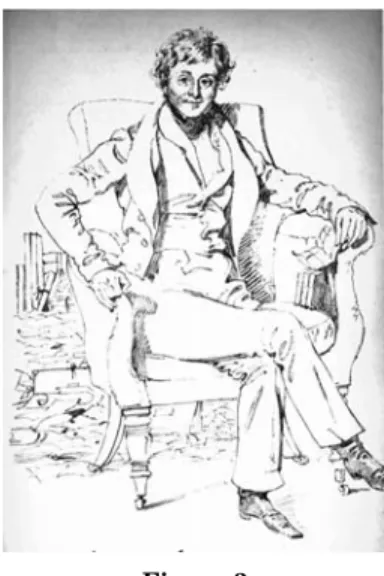
be depicted much younger than he should be if he was modelled on Maginn (Compare Figures 2 and 3)(23). While Maginn was a rather
well-built man around forty by the time Thackeray met him, playing the godfa-ther to many penniless writers including Thackeray, Captain Shandon with his slender proportion and boyish countenance, as well as his ever-flowing pen, looks rather like, say, the young Dickens. Partly due to this impressive illustration, the scene of Captain Shandon frantically devoted to writing in his imprisonment forms the core image of Thackeray’s bohe-mian myth comparable to Murger’s romantic tableau of young artists crowded in a boardinghouse.
Thackeray’s swift narrative impulse, however, does not stay its focus where it is or leave its characters where they are. After quitting Fleet Prison in the next chapter, Pen and Warrington discuss the present condi-tion of literary business that allows such a genius as Captain Shandon to suffer confinement to the prison and servitude to the bookseller. ‘It is hard to see such a man as Shandon,’ says Pen as he muses over what he saw, ‘of accomplishments so multifarious, and of such an undoubted talent and humour, an imate of a jail for half his time, and a bookseller’s hanger-on when out of prison” (OT, xii, 414). He meets George’s objection to the ef-fect that the literary profession is just one of the common occupations and that writers are not exempt from imprisonment if they fail to pay their debt as far as they cannot force capitalists to buy their works. Their dis-────────────
↘ in the Augustan age.
Figure 1: Thackeray, ‘The “Pall-Mall Gazette”’ in William Makepeace Thack-eray, The History of Pendennis (London: Smith, 1883), i, leaf between 414 and 415. Figure 2: ibid (detail). Figure 3: Daniel Maclise, ‘William Maginn’ in
Fraser’s Magazine, No. XII (Jan 1831), leaf between 716 and 717, [online
fac-simile], https://babel.hathitrust.org/cgi/pt?id=umn.31951000742899 p&view=1 up&seq=751, accessed 18 Nov. 2020.
cussion, curiously anticipating the real controversy over the ‘dignity of lit-erature’ aroused by the ‘harsh’ treatment of Captain Shandon in
Penden-nis, leads Pen’s thought to a meditation on his own future career. In
Chapter XXXIII, Mr Finucane who admires Captain Shandon and pities Mrs Shandon’s hardship sets out to rescue Captain Shandon from Fleet Prison and succeeds in bringing him to a dinner party at Mr Bungay’s, the scene elaborately described through Chapter XXXIV to the discredit of the literary figures at the time who turn out to be, in Pen’s eyes, worldly snobs. In Chapter XXXV, Captain Shandon’s new journal Pall-Mall
Ga-zette proves successful, but as Pen becomes associated with the business,
his dissatisfaction increases with literary hacks who haunt the publishing houses and readily sell their writings for money; it culminates when he finds Captain Shandon concentrated on beating his rival publisher instead of expressing honest opinions. When Pen protests him with his belief in honesty and conscience, he is met by Captain Shandon’s scorn: ‘Gad, […] you’ve a tender conscience, Mr. Pendennis. It’s the luxury of all novices, and I may have had one once myself; but that sort of bloom wears off with the rubbing of the world’ (OT, xii, 446). This remark disappoints Pen greatly as he is determined to pursue the profession without losing his conscience. Pen used to see in the eccentric genius embodied by Captain Shandon an antithesis to the worldly concerns he was expected to learn in Major Pendennis’s educational plan; but now the same Captain Shandon on his release from the prison begins to reveal worldly toughness. Captain Shandon’s ‘contamination’ in the world deprives his business of its charms. Thackeray’s bohemia thus disappears into thin air when Captain Shandon leaves the sordid den of physical restraint and mental freedom and Pen loses interest in him.
To reflect on the course of narrative so far, we will hardly find any repe-55
tition of same scenes or stagnation of plot in Thackeray’s account of London’s bohemia. On his arrival in town Pen first associates with law students in Temple and fashionable society in Mayfair, but the change of fortune forces him to get into the lower society of hacks and publishers in Paternoster Row and Fleet Prison; he does not stay in either place for more than a passing moment in his life and always outgrows his former milieu to advance onto the next stage. It is also the case with Captain Shandon, representing for Pen the ways of literary life and for the later generations the prototype of literary bohemians, who first appears as a jailbird frantically devoted to writing and then gets out of confinement to give the free rein to his talent and tactics in running business. In both cases, Thackeray does not allow his characters to enjoy a stable milieu in pursuing their art. In particular, Captain Shandon’s departure from the inconvenient yet essentially carefree domain which in a way seemed to fit his creative activity suggests the precarious state of a seemingly ever-lasting bohemia. To put it simply, Thackeray’s characters grow and age across time and his bohemia is accordingly destined to pass away.
4. Conclusion
The comparative reading exercised so far of Pendennis along with Scène
de la vie de bohème clearly shows a contrast between the two works
deal-ing with the similar subject. If Murger presented the bohemia, though for-mally defined as ‘a stage in artistic life’, as the timeless milieu in which every event or change occurs only on the surface and does not lead to sig-nificant development, Thackeray exposed its English counterpart to con-stant and irrevocable change, or perhaps simply did not describe it at all. One factor that causes this difference is of course the fictional subgenres 56 Pendennis and London’s Literary Bohemia
the two writers chose—Murger adopting the plotless series of short stories only loosely related while Thackeray intended to write a full-length novel with a coherent plot from the start. Especially the bildungsroman Thack-eray chose requires a linear development of its protagonist, in this case the socializing process of Pen who first appears as a reckless youngster in-fatuated with ill-advised passion and then gradually learns the rules of society under the mentorship of his worldly uncle, though his development brings about an ironic result. The so-called bohemian section in the novel is put in this large context of Pen’s socializing process, and inevitably im-plies a passing stage in his growth. Thackeray therefore did not allow his bohemian territory and its residents the privilege of eternal youth as is al-lowed for Murger’s bohemians—except perhaps the ageless Captain Shan-don when he was confined in prison and depicted in the static illustration. Captain Shandon, however, is a living man and grows out of the prison and the illustration to get into the world. Pen, even if he temporarily finds a home for creative genius in a corner of Fleet Prison, has to lose sight of the bohemia he once has a glimpse of. The implied theme here of the world and the bohemia as an anti-world would be fully developed in Thackeray’s next full-length novel, The Newcomes (1853-5).
Another important factor responsible for the different attitudes to the bohemian topos is probably that Thackeray simply did not have a name for it while Murger explicitly defined his subject as bohemia. Although Thackeray closely witnessed and arguably became part of the emerging culture of bohemia in Paris in the 1830s, and afterwards tried to trans-plant it in his fictional works,(24)his usage of the words bohemia and
bo-────────────
I have discussed these points in ‘Thackeray in Paris, 1829-37: The Bohemian Years’, Jinbun Ronkyu, 67/4 (Feb. 2018), 77-97; ‘Thackeray’s Early Paris Tales, 1837-40: Rogues, Gamblers, Artists’, Journal of the Society of English↗ 57
hemians in Vanity Fair, for which he is cited in The Oxford English Dic-tionary as the first author to use them in English, suggests that he at
least in the late 1840s regarded the words as indicative of suspicious vagabonds rambling across gambling halls rather than poor artists in sor-did quarters. He therefore sor-did not have a specific name for the territory and its residents depicted in the middle part of Pendennis, and the un-named perhaps remained unattended. It is unlikely that in Pendennis he intended to fix on the canvas any specific territory in London as a coun-terpart to Paris’s Latin Quarter or elevate it to a myth. That probably happened only when he launched another autobiographical project a dec-ade ahead in Philip. We may then name a third and related factor that might have affected Thackeray’s impartial treatment of his bohemia. The nostalgic tendency that became increasingly strong in his later works was not yet so evident when he was writing Pendennis around 1850. Still in his late thirties, he was not sufficiently aged to feel remote from the youth passed in the bohemian quarters of Paris and London; for the writer only recently established by the success of Vanity Fair, his formative years preceding it were too near a past to invite nostalgia but rather vivid enough in his mind to arouse shame and contempt for the custom he found and perhaps shared in the cheap publishing industry, as is evident in his 1850 essay ‘The Dignity of Literature’ written in response to attacks on Pendennis. Considering, however, that he later came to regard Lon-don’s literary bohemia in nostalgia and had the maturer Pen as narrator in Philip refer to it as ‘A pleasant land’ named ‘Bohemia’ (OT, xvi, 60), his changing attitudes to the same topos will interestingly mark different ────────────
↘ and American Literature: Kwansei Gakuin University, 63 (2019), 49-67; and ‘Thackeray’s Early London Fictions, 1837-41: Cockneys, Enterpreneurs and Merchants’, Jinbun Ronkyu, 69/3-4 (Feb. 2020), 99-121.
stages of his lifelong engagement with the grand theme of London’s liter-ary bohemia.
──文学部教授── 59