51:35 短 報
虚血性脳血管障害発症前の抗血栓薬内服状況の検討
伊藤 康幸
1)光藤
尚
1)山本 文夫
1)橋本洋一郎
1)*平野 照之
2)内野
誠
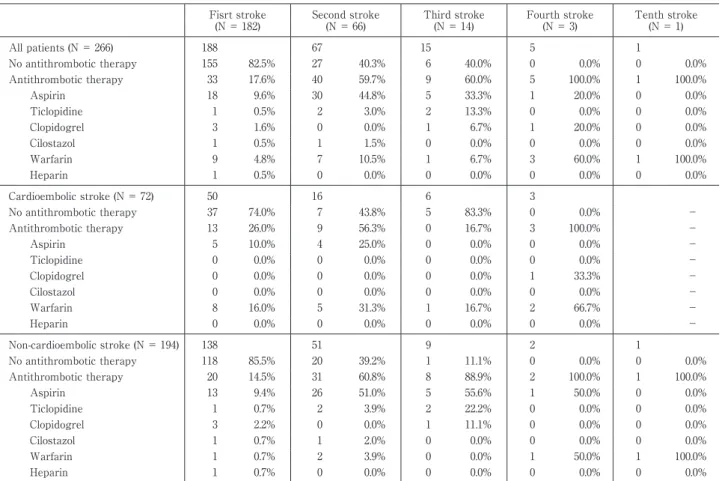
2) 要旨:当科に 2008 年 10 月から 2009 年 9 月までの 1 年間に入院した虚血性脳血管障害患者連続例を対象に,脳 卒中データバンクをもちいて,発症前の抗血栓薬内服状況を後ろ向きに検討した.脳梗塞初発時点で 17.6%(心原 性 26.0%,非心原性 14.5%)の患者がすでに何らかの抗血栓薬を内服していた一方で,2 回目再発時 40.3%(同 43.8%,39.2%),3 回目再発時 40.0%(同 83.3%,11.1%)の患者が抗血栓薬を内服していなかった.虚血性脳血 管障害の既往があっても,心原性,非心原性ともに再発直前に抗血栓薬を内服していない患者が多く存在しており, 抗血栓薬内服継続の必要性についての啓発が重要である. (臨床神経 2011;51:35-37) Key words:虚血性脳血管障害,再発予防,抗血栓薬,内服継続,啓発 はじめに 虚血性脳血管障害(ischemic stroke:IS)をひとたび発症す ると発症後 1 年で 10.0%,10 年で 49.7% が再発1)し,発症後の 抗血栓薬内服下再発率も低下しない2).そのため,一過性脳虚血発作(transient ischemic attack:TIA)または脳梗塞を一 度でも発症したばあい,危険因子対策とともに抗血栓薬(抗血 小板薬または抗凝固薬)の内服を継続すべきである.IS 発症 後の抗血栓薬継続率の検討は海外の報告3)∼6)はあるがわが国 からはなく,発症回数別の検討はこれまでない.今回われわれ は,IS 発症回数による,発症前抗血栓薬内服状況について検 討した. 対象と方法 2008 年 10 月から 2009 年 9 月までの 1 年間に熊本市民病 院神経内科(以下,当科)へ入院した IS 患者連続 266 例を対 象とし,脳卒中データバンクの記録をもちい,塞栓源心疾患, 臨床病型,IS 発症回数,発症(初発または再発)直前の抗血 栓薬内服の有無を後ろ向きに検討した.塞栓源心疾患検索で は 12 誘導心電図,経胸壁心エコー,ホルター心電図を全例に, 経食道心エコーを 40 例に施行した.臨床病型は脳卒中データ バンクの記録より,まず TIA(「血管疾患でおこる一過性黒内 障や一過性の局所脳神経脱落症候が 24 時間以内に完全に消 失するもの」という従来の定義7)を適用),ラクナ梗塞,アテ ローム血栓性脳梗塞,心原性脳塞栓症,その他の脳梗塞に分類 し,その他の脳梗塞をその他の原因による脳梗塞(その他)と 原因不明の脳梗塞(原因不明)に分類した後,塞栓源心疾患が あれば心原性,なければ非心原性に分類した.既往回数は脳卒 中データバンクの記録より抽出し,「2 回以上」は入院カルテ より回数を確認し,当科以外の治療歴も 1 回と数えた.発症前 抗血栓薬内服状況については,抗血栓薬を複数併用している ばあいはそれぞれを 1 例と数えた. 結 果 患者総数は 266 例(男性 154 例,女性 112 例),平均年齢は 73.6±11.5 歳(中央値 74.5 歳).塞栓源心疾患は 102 例(38.3%) にみられ,内訳は心房細動が 64 例(24.1%),卵円孔開存 26 例(9.8%,奇異性脳塞栓症 1 例をふくむ)などであった.臨 床病型は TIA 42 例(15.8%),ラクナ梗塞 47 例(17.7%),ア テローム血栓性脳梗塞 69 例(25.9%),心原性脳塞栓症 62 例(23.3%),その他 23 例(8.7%),原因不明 23 例(8.7%)で, TIA の内訳は心原性 10 例,非心原性 32 例,その他の内訳は 卵円孔開存単独 13 例(4.9%),動脈解離 6 例(2.3%)などで, 最終的に心原性 72 例,非心原性 194 例であった.IS 回数は初 発 182 例(68.4%),2 回目再発 66 例(24.8%),3 回目再発 14 例(5.3%),4 回目再発 3 例(1.1%)以外に,10 回目再発(脳 梗塞 3 回,TIA 6 回の既往)が 1 例あった.既往回数別の発症 前抗血栓薬の非内服率は初発群で 82.5%(心原性 74.0%,非心 原性 85.5%)であったが,2 回目再発群でも 40.3%(同 43.8%, 39.2%),3 回目再発群でも 40.0%(同 83.3%,11.1%)に上っ た(Table 1). * Corresponding author: 熊本市民病院神経内科〔〒862―8505 熊本県熊本市湖東 1 丁目 1―60〕 1) 熊本市民病院神経内科 2) 熊本大学大学院神経内科学分野 (受付日:2010 年 3 月 30 日)
臨床神経学 51巻1号(2011:1) 51:36
Table 1 Frequency of antithrombotic therapy on admission by the frequency of past stroke and the presence of cardioembolic
infarction. Fisrt stroke (N = 182) Second stroke (N = 66) Third stroke (N = 14) Fourth stroke (N = 3) Tenth stroke (N = 1) All patients (N = 266) 188 67 15 5 1 No antithrombotic therapy 155 82.5% 27 40.3% 6 40.0% 0 0.0% 0 0.0% Antithrombotic therapy 33 17.6% 40 59.7% 9 60.0% 5 100.0% 1 100.0% Aspirin 18 9.6% 30 44.8% 5 33.3% 1 20.0% 0 0.0% Ticlopidine 1 0.5% 2 3.0% 2 13.3% 0 0.0% 0 0.0% Clopidogrel 3 1.6% 0 0.0% 1 6.7% 1 20.0% 0 0.0% Cilostazol 1 0.5% 1 1.5% 0 0.0% 0 0.0% 0 0.0% Warfarin 9 4.8% 7 10.5% 1 6.7% 3 60.0% 1 100.0% Heparin 1 0.5% 0 0.0% 0 0.0% 0 0.0% 0 0.0% Cardioembolic stroke (N = 72) 50 16 6 3 No antithrombotic therapy 37 74.0% 7 43.8% 5 83.3% 0 0.0% − Antithrombotic therapy 13 26.0% 9 56.3% 0 16.7% 3 100.0% − Aspirin 5 10.0% 4 25.0% 0 0.0% 0 0.0% − Ticlopidine 0 0.0% 0 0.0% 0 0.0% 0 0.0% − Clopidogrel 0 0.0% 0 0.0% 0 0.0% 1 33.3% − Cilostazol 0 0.0% 0 0.0% 0 0.0% 0 0.0% − Warfarin 8 16.0% 5 31.3% 1 16.7% 2 66.7% − Heparin 0 0.0% 0 0.0% 0 0.0% 0 0.0% − Non-cardioembolic stroke (N = 194) 138 51 9 2 1 No antithrombotic therapy 118 85.5% 20 39.2% 1 11.1% 0 0.0% 0 0.0% Antithrombotic therapy 20 14.5% 31 60.8% 8 88.9% 2 100.0% 1 100.0% Aspirin 13 9.4% 26 51.0% 5 55.6% 1 50.0% 0 0.0% Ticlopidine 1 0.7% 2 3.9% 2 22.2% 0 0.0% 0 0.0% Clopidogrel 3 2.2% 0 0.0% 1 11.1% 0 0.0% 0 0.0% Cilostazol 1 0.7% 1 2.0% 0 0.0% 0 0.0% 0 0.0% Warfarin 1 0.7% 2 3.9% 0 0.0% 1 50.0% 1 100.0% Heparin 1 0.7% 0 0.0% 0 0.0% 0 0.0% 0 0.0% 考 察 IS を一度でも発症したばあいに抗血栓薬内服を継続すべ き理由として第一に,脳梗塞既往例ではそれ以降の脳梗塞発 症リスクが 10 倍になる1),第二に,抗血小板薬2)8),ワルファ リン9)の脳梗塞再発予防効果が確立している,第三に,抗血小 板薬内服下発症が非内服下発症より転帰良好である10),第四 に,アスピリン中止による脳梗塞再発率が中止後 1 週以降に 増加する,などが挙げられる.しかし,本研究では 2 回目再発 群の 40.3%,3 回目再発群の 40.0% が再発時に抗血栓薬を内 服しておらず,抗血栓薬非内服患者が多く存在していた. 抗血栓薬の経時的中断率についての報告は,わが国では渉 猟しえたかぎり報告はない.海外の報告では,ドイツ脳卒中 データバンクの後ろ向き検討3)において,アスピリンで 3 カ月 後 7.4%,1 年後 16%,クロピドグレル 18.4%,38.4%,抗凝 固薬 14.8%,22.6%,アメリカ一般市民を対象とした全国調査 (Medical Expenditure Panel Survey:MEPS)を も ち い た 7 年間の後ろ向き検討5)においてアスピリン 30%,抗血小板薬 全体 26%,抗血栓薬全体 19%,スウェーデン脳卒中レジスト リの前向き検討6)において,アスピリンで 1 年後 23.0%,2 年後 38.5%,クロピドグレル 46.9%,60.6%,ワルファリン 34.9%,55.0% であるが,いずれも発症回数別の検討ではな い.再発時点で抗血栓薬を内服しているかどうかが一番の問 題であり,前向き観察研究においても IS 発症回数別に非内服 理由を検討し,はじめから非内服か,何らかの理由で中断した かを検討すべきと考える. 本検討の限界として,第一に,症例数が 266 例と少なく一地 方一病院における単年の検討であり,本検討の結果がそのま まわが国全体の結果を反映しない点,第二に,本検討が脳卒中 データバンクや入院カルテの記録による後ろ向き検討で,再 発時抗血栓薬非内服の理由を検討できなかった点,第三に,内 服コンプライアンスが悪く抗血栓薬を内服していない患者が 再発をくりかえしているというバイアスの可能性を検討して いない点が挙げられる.抗血栓薬非内服理由については,大規 模臨床 試 験 の 検 討4)で 4.2∼7.8% が 患 者 の 自 己 中 断,3.0∼ 20.9% が薬剤の副作用,全体で 11.8∼52.0% が抗血栓薬を中 止しているという報告もあり,今後,IS 発症患者全例を対象 に多施設共同前向き研究をおこない,抗血栓薬非内服患者の 発症回数,過去の治療内容,中断理由など検討し,IS 患者に 抗血栓薬を内服継続してもらうための努力,啓発を続けてい くべきである.
虚血性脳血管障害発症前の抗血栓薬内服状況の検討 51:37
文 献
1)Hata J, Tanizaki Y, Kiyohara Y, et al. Ten year recur-rence after first ever stroke in a Japanese community : the Hisayama study. J Neurol Neurosurg Psychiatry 2005;76:368-372.
2)Gotoh F, Tohgi H, Hirai S, et al. Cilostazol stroke preven-tion study: a placebo-controlled double-blind trial for sec-ondary prevention of cerebral infarction. J Stroke Cere-brovasc Dis 2000;9:147-157.
3)Hamann GF, Weimar G, Glahn J, et al. Adherence to sec-ondary stroke prevention strategies ― results from the German Stroke Data Bank. Cerebrovasc Dis 2003;15:282-288.
4)Gencheva E, Sloan M, Leurgans S, et al. Attrition and non-compliance in secondary stroke prevention trials. Neuroepidemiology 2004;23:61-66.
5)Cheng EM, Cohen SN, Lee ML, et al. Use of antithrom-botic agents among U.S. stroke survivors, 2000-2006. Am J Prev Med 2010;38:47-53.
6)Glader EL, Sjölander M, Eriksson M, et al. Persistent use of secondary preventive drugs declines rapidly during the first 2 years after stroke. Stroke 2010;41:397-401. 7)Feinberg WM, Albers GW, Barnett HJM, et al. Guidelines
for the management of transient ischemic attacks. From the Ad Hoc Committee on guidelines for the manage-ment of transient ischemic attacks of the Stroke Council of the American Heart Association. Stroke 1994;25:1320-1335.
8)Antithrombotic Trialists Collaboration. Collaborative meta-analysis of randomised trials of antiplatelet therapy for prevention of death, myocardial infarction, and stroke in high risk patients. BMJ 2002;324:71-86.
9)EAFT (European Atrial Fibrillation Trial) Study Group. Secondary prevention in non-rheumatic atrial fibrillation after transient ischaemic attack or minor stroke. Lancet 1993;342:1255-1262.
10)Kalra L, Perez I, Smithard DG, et al. Does prior use of as-pirin affect outcome in ischemic stroke? Am J Med 2000; 108:205-209.
Abstract
Non-taking oral antithrombotic agents in patients with ischemic stroke
Yasuyuki Ito, M.D.1) , Takashi Mitsufuji, M.D.1) , Fumio Yamamoto, M.D.1) , Yoichiro Hashimoto, M.D.1) , Teruyuki Hirano, M.D.2)
and Makoto Uchino, M.D.2) 1)
Department of Neurology, Kumamoto City Hospital
2)
Department of Neurology, Faculty of Life Sciences, Kumamoto University
Background: In clinical practice, secondary prevention in patients with ischemic stroke (IS) needs to be con-tinued permanently; however, antithrombotic agents are sometimes stopped by clinicians or the patients them-selves. The rate of non-taking oral antithrombotic agents was evaluated in IS patients. Methods: 266 consecutive patients (154 men and 112 women; age, 73.6±11.5 years) with first-ever acute IS were studied. Patients with trsient ischemic attack (TIA) were also included. Emboligenic heart diseases, frequency of past stroke, oral an-tithrombotic agent use just before IS, and secondary prevention were evaluated. Results: The number of past strokes was 0 in 182 cases (68.4%), 1 in 66 cases (24.8%), 2 in 14 cases (5.3%), 3 in 3 cases (1.1%), and 9 in 1 case (0.4%; 3 times with stroke, and 6 times with TIA). There were 42 cases (15.8%) with TIA, 47 (17.7%) with lacunar infarction, 69 (25.9%) with atherothrombotic infarction, 62 (23.3%) with cardioembolic infarction, 23 (8.7%) with other types of infarction, and 23 (8.7%) with stroke of unknown etiology. Although 15-26% of patients with their first IS had taken antithrombotic agents just before IS, about 40% of the patients with a previous IS history were not taking antithrombotic agents just before their recurrent IS. Conclusion: About 40% of the patients with recur-rent IS were not taking antithrombotic agents at the time of their recurrecur-rent IS; had they been taking antithrom-botic agents at the time, the recurrent IS might have been prevented. Clinicians must recognize the importance of antithrombotic agents in patients with IS, and patients must continue to take antithrombotic agents permanently.
(Clin Neurol 2011;51:35-37)