修 士 論 文 概 要 書
Summary of Master’s Thesis
Date of submission: 01/31/2012 (MM/DD/YYYY) 専攻名(専門分野)
Department 情報理工学専攻 氏 名Name 吉井章人
指 導 教 員 Advisor
中島 達夫 印 研究指導名 Seal
Research guidance 分散システム
学籍番号 Student ID
number
CD
5110B133-1
研究題目
Title Study of a Conversational Agent System Encouraging “Real” Answers of Individuals in a Group of Acquaintances
Introduction
Persuasion is an attempt of changing behavior or attitude of an individual [1]. After the emergence of computers and the internet, research on applying computers for the persuasion has accelerated and a realm related to analyzing and designing persuasive computer system has been named as
“Captology”[1].
As computers become available anywhere and anytime, they can encourage its user as a persuader using modalities such as graphics or audio, calculation abilities and network connections. In addition, an individual can treat a computer as if it was a living being and such phenomena is stated in work such as the “media equation” [2]. Thus, computers can behave and construct relationship with its user as a social actor.
A virtual agent can play a role of such social actor and a user interface which implements an agent can establish more intimate relationship with an individual [3]. In our previous work [4], we developed a persuasive game application which a virtual agent is implemented as a persuader and used conversation including questions as a mean of persuasion and sensing of individuals' current behavior.
However, as for the results of the user study, we found the existence of those who did not answer to the questions according to their actual situation. That is, such individuals can choose an option just by curiosity. In a conversation crucial for precision of the persuasion, answering without an individual's actual situation can be trouble.
In this research, we focused on the existence of other individuals so as to handle this “curiosity” problem. That is, an individual has a notion of what is “correct” or what is acceptable by society and this can be a bias which called
“social desirability”. In addition, being a member of a group and anonymity can affect behaviors of an individual (e.g. [5]) and these situations are common in computer systems which intermediate social communication between individuals.
Based on these theories, we proposed a hypothesis that an individual may answer to a question according to his/her actual opinion or state in the situation the answer can be known by other members in a group consists of his/her acquaintances.
With this hypothesis, we developed a web-based application on which an individual can have conversations with a conversational agent and conducted a user study in order to evaluate effectiveness of our hypothesis. We also conducted a user study in order to examine an effect of existence of other individuals on an individual's answering behavior on a conversation with agent.
In this paper, we will use a term “conversational agent” as an agent with which an individual can converse and which has a specific appearance and character.
Previous work
In our previous work [4], we developed a location-based application which runs on iOS devices and persuades an individual to walk for their health.
In this research, we proposed the unconscious persuasion where the application persuades an individual without being noticed by him/her. We intended to persuade those who are not aware of their problematic behavior such as the lack of exercise using the unconscious persuasion because such individuals can be resistant to the change of their behavior [6]. We also implemented a sensing feature which obtains current behavior stage based on the transtheoretical model [6]
without being noticed by the individual.
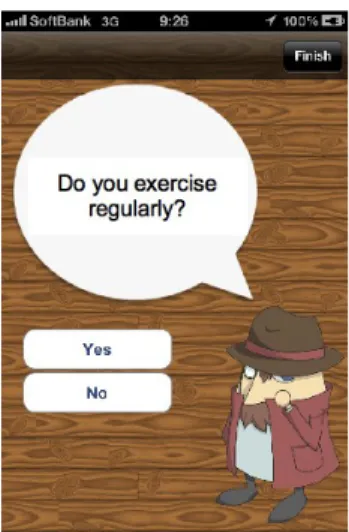
In order to implement the unconscious persuasion, we used a conversational agent and weave a persuasive features and a sensing feature into the casual conversation. Fig. 1 shows a screenshot of a conversation with the agent.
In order to evaluate the effectiveness of the unconscious persuasion, we conducted a user study. In the user study, we recruited 5 participants and asked them to use this application for a month. From the results of the questionnaire, 3 participants said that they have chosen an option which does not correspond to their actual mind.
Fig. 1 : A screenshot of the conversation with the agent in the iDetective
Design of the system
We developed a web-based application where an individual can converse with a virtual agent. Fig. 2 shows an overview of the application. The design of the agent and most of conversations are migrated from the iDetective.
Conversations can be separated into two types. One is a conversation which simply conveys a message from the agent and the other is one which an individual can choose from options and answer to a question given by the agent.
Fig. 2 : An overview of the web-based application This application can present a disclosure conversation, a conversation which shows one individual's answer to other individuals. This conversation is introduce in order to examine the reaction based on the social desirability under the observation by others.
Evaluation
We conducted a user study and recruited 20 participants.
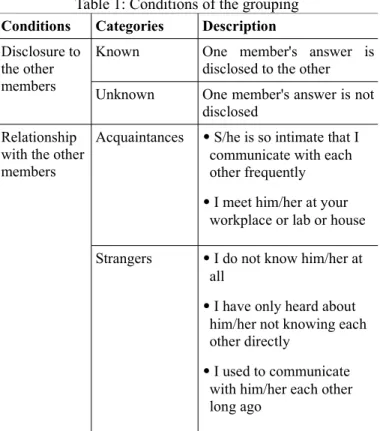
They were divided into one of four groups according to two conditions listed in Table 1 and asked to use the application and have conversation freely for 10 days.
Their behavior on the application was logged and saved to the database. We also asked fill a questionnaire at the end of the user study.
Table 1: Conditions of the grouping Conditions Categories Description Disclosure to
the other members
Known One member's answer is disclosed to the other Unknown One member's answer is not
disclosed Relationship
with the other members
Acquaintances S/he is so intimate that I communicate with each other frequently
I meet him/her at your workplace or lab or house Strangers I do not know him/her at
all
I have only heard about him/her not knowing each other directly
I used to communicate with him/her each other long ago
Results and Discussions
We will show the result of the questionnaire especially a
question related to an effect of existence of other members on answering to the questions from the agent. We asked same questions as for each of two types of conversations, one is related to exercise and the other is not such as topics of wide variety of fields.
“How did you think when you answered the question from the agent? Please choose from the list.”
This question asked participants to choose from a list of attitudes when they answered a question given by the agent.
As a result, few differences exist between both types of conversations. 17 participants for the former case and 16 participants as for the latter case have said that “I answered according to my actual opinion or situation no matter whether my answer will be disclosed to others” whereas 1 participant for the both case has chosen “I answered according to my actual opinion or situation because my answer will be disclosed to others”.
“The number of the conversations was limited.
Did you change your attitude toward answering the questions if you are bored?”
The numbers of participants for each option were same in both cases. The result of this question shows that 11 participants have chosen the “I answered according to my actual opinion or situation until I get bored but after that I get to answer just by curiosity”.
Discussion and Future Work
From these results, boredom in conversations can more affected the individuals' behavior than the existence of other members. Therefore, an evaluation under the condition where the boredom is decreased is needed.
We also asked the participants how they feel about that an individual's answer is disclosed to others. 1 participant said that “I cannot accept the disclosure no matter kinds of questions” and 6 participants said that they cannot accept the disclosure as for either querying their knowledge or their opinion or situation. Although 13 participants do not mid the disclosure, a designer of the system still have to choose target behavior or contents of disclosure carefully.
References
[1] B. J. Fogg, Persuasive Technology, Morgan Kaufmann Publishers (2003) [2] B. Reeves and C. Nass, The media equation : how people treat computers, television, and new media like real people and places, Stanford, Calif. : CSLI Publications (1996)
[3] T. Bickmore and J. Cassell, Relational agents: a model and implementation of building user trust. Proceedings of the SIGCHI conference on Human factors in computing systems, (2001), pp. 396–403.
[4] A. Yoshii, Y. Funabashi, H. Kimura, and T. Nakajima. idetective: A location based game to persuade users unconsciously. IEEE 17th International Conference on Embedded and Real-Time Computing Systems and Applications (RTCSA), volume 1 (2011) , pp. 115 –120.
[5] M. Deutsch and H. B. Gerard, A study of normative and informational social influences upon individual judgment. The Journal of Abnormal and Social Psychology, 51(3) (1955) pp. 629 – 636.
[6] J. O. Prochaska, C. C. DiClemente and J. C. Norcross. In search of how people change: Applications to addictive behaviors. Journal of Addictions Nursing: A Journal for the Prevention and Management of Addictions, 5(1) (1993), pp. 2–16.