GS-Supported Collaborative Learning for Primary School Students’
Reading Comprehension
Chiu-Pin Lin* Su-Jian Yang**
*Graduate Institute of e-Learning Technology, National Hsinchu University of Education, Taiwan,
[email protected]
**Graduate Institute of Library and Information Studies, National Chengchi University, Taiwan
[email protected]
Abstract
In primary education, fostering students’ reading and comprehension skills has long been pursued by language learning researchers and practitioners. Reading materials recently have been expanded from paper-based books to digital books and even the multimedia books. In this research we explored a synchronous collaborative learning using Group scribbles (GS) software and self-adopted e-picture book based on our traditional local paper-based reading books. Experimental group and control group were established to investigate the effectiveness of using GS–based e-picture book in developing students’ reading and comprehension skills. The results indicated that great improvement in using GS–based e-picture book in reading as well as great enhancement of motivation and interest of learning by collaborative learning with GS.
1. Introduction
The development of electronic picture books enables multimedia representations to assist reading, which receive great popularity among primary school students. Reading the texts of electronic picture books, animation and audio explanations help students appreciate the reading beyond the texts and comprehend the beauty of meaning between lines. A boost of advanced information technology provides different new ways of reading and more sufficient electronic picture books than traditional collection of books on library shelves. This study attempts to combine localized learning materials and teaching strategies with Group Scribbles [1] software to investigate students’ learning outcomes in reading comprehension. The research tries to examine the following aspects: First, is to explore the effectiveness of GS-based electronic picture book for reading comprehension. Second, is to explore real-time sharing and group brainstorming discussions with GS to strengthen mutual learning among peers. Third, is to explore the new method of cooperative reading activities
with GS software to stimulate students’ interest and motivation in reading.
2. Literature Review
Computer supported collaborative learning encourages flexible interactions among students to carry out learning online but not to replace teachers and learning materials with technology. Learning should be designed well to leverage the curriculum, pedagogy, technology mediation and the students’ activities [2]. Sharples [3] pointed out that learning is not only a process of knowledge given through curriculum but a process of mutual agreement by negotiation. CSCL can increase student motivation and interest to make progress, to enhance positive interaction between students and teachers and to fulfill learning goals.
2.1. Reading comprehension
Caver [4] defined techniques for improving students' success in extracting useful knowledge from texts. Comprehension is a "construction process" as a text is read to create a representation of the text in the reader's mind. Reading comprehension can be divided into four levels: decoding, literal comprehension, inferential comprehension and comprehension monitoring [5][6]. Ko
[7] suggested the reading comprehension can be divided
into: looking for clear information, direct inference, synthesis and interpretation of discourse and the evaluation of chapter content and language patterns. Reading comprehension involves two parts: "direct understanding" and "understanding through interpretation". "Direct understanding" contains direct and immediate consequence of extraction while “understanding through interpretation" consist of interpretation, integrating Ideas and information and assessing the content, language elements of an article. It is easier for readers to comprehend from "direct extraction" and "direct inference".
2.2. Collaborative story-structuring
Collaborative Structure analysis is an approach to understand the story by discussion and experience sharing with peers to understand the text [8]. A story includes the contexts, theme, plot, and ending. We borrowed a reading comprehension model for our electronic picture storybook as following:
Figure1: Reading comprehension model for storybook [9] With the "Collaborative Integrated Reading and Writing Model"(CIRC) in this study we carried out group reading comprehension with GS and face-to-face discussion about the story analysis in two classes of students.
2.3. Group Scribbles
We are investigating how to improve students’ reading comprehension skills through collaborative learning supported by a network technology named Group Scribbles (GS) (firstly designed by SIR International and co-developed by Learning Science Lab in Singapore) (SRI International, 2006). Based on a metaphor of whiteboard and sticky notes for collective construction of knowledge [10], GS is conceived as a flexible platform for designing and enacting different forms of collaborative work via synchronous communication and interaction in classroom settings [11].
Previous studies have proved the effectiveness of GS enhanced group work in improving learning, attitudes, and epistemology in various learning contexts, including higher education [12][13], science and math education [14][15], and second language learning [16] in primary schooling. The importance of integrating pedagogical designs and technological affordances to realize classroom culture transformation, where teacher-centered instruction gradually gives way to student-initiated interaction and exploration, is highlighted in previous school-based practices. Looi, Chen and Ng [17] proposed 10 principles of Rapid Collaborative Knowledge Building. These principles were further refined into 9 principles for Rapid Collaborative Knowledge Improvement [18]. Incorporating these learning principles into lesson design and implementation greatly contributed to student progress in science learning. In this study, we would like to explore the possibility of translating these nutrients of GS-supported collaborative learning into the culture of language learning.
3. Methodology
Two classes of fourth-grade students in primary school participated in this study. 23 students in control class and the experimental class consisted of 24 students and based on their results in the pre-test, we performed a test of homogeneity of two groups of students by classifying them into the heterogeneous groups of high, medium and low ability groups. Both classes conducted the reading pre-test of “Kinmen localized reading book” with the follow-up experiments.
Table 1 Comparison of experimental and control class
Class Experimental class (N=24) Control class (N=23) Environment Traditional classroom with
projector and wireless network
Computer room
Tools One Tablet PC per group Per PC Per student Approach Collaborative learning in
groups
Learning individually Strategy Reading comprehension with hypothesis, connection
and extraction Coursework Coursework sheets
In this reading practice, four reading strategies were applied: detecting the cause and the consequence, discerning the connections including connections between sentences, paragraphs and chapters, and summarizing. With GS, students can propose their own comments, share them in the public space and achieve real-time interaction with the electronic picture book as well as other peers. Students were asked to have discussions at different points in the book and post their comments to the public space in GS. Experimental group tutorials lasted for around five weeks in which we gave GS training in the first week. In the following four weeks we implemented collaborative reading with GS in class for 90 minutes each week. Figure 2 below shows an example of their reading practice.
Figure 2: students share comments for story reading on GS In GS public space a pictured story was shown to the students and the teacher posted a task to ask the students to modify their hypothesis on what would happen in the story. Six groups’ responses were shown and shared at the public space.
In this study, the reading comprehension tests were designed by the researcher, including multiple choices and essay questions and constitute two sections of "direct
understanding" and "understanding through interpretation". We also analyzed the performance of children on the reading comprehension skills about “understanding through interpretation”, i.e., interpretation, integrating Ideas and information and assessing the content, language elements of an article.
The intervention cycle involved 8 lessons (90 minutes per lesson, 2 lessons per week, one unit per week). The topics and passages covered were from a local textbook and in accordance with the standard curriculum. The learning materials were presented in the electronic picture book incorporated in the GS platform.
In Class, three reading strategies, including prediction, connection, and summarization were adopted to guide students to comprehend the passages. In prediction, students were instructed to formulate hypothesis about the content of the following paragraphs or the following developments of the story. In connection, students were required to form associations among phrases, sentences, and paragraphs, and associate the reading material with past experiences. In summarization students were requested to sum up the main idea of a paragraph, or write an abstract for a passage. Same learning tasks were carried out in the experiment class and control class. When necessary, teacher would give demonstrations, explanations, elaborations and clarifications in class. To ensure the consistency in instruction, lessons in both experiment class and control class were delivered by the researcher.
When designing GS collaborative learning activities, we refer to RCKI principles [18] for guidance. In reading comprehension lessons, following 5 items were stressed: 1) Distributed cognition: designing for thinking to be distributed across people, tools and artifacts;
2) Higher-order thinking: encouraging skills like analysis, synthesis, evaluation, sorting, and categorizing;
3) Improvable ideas: providing a conductive environment where ideas can be critiqued and made better;
4) Idea diversity: exploring ideas and related¥contrasting ideas, encouraging different ideas;
5) Democratized knowledge: everybody participates and is a legitimate contributor to knowledge.
4. Findings
Before the experimental treatment, the experimental group and control group received the Reading Comprehension Test as the pre-test, including multiple choice and two essay questions. Two essay questions were marked by two raters with a Pearson correlation coefficient at 0.933, and a significant correlation (p<0.01). The average scores marked by two raters were regarded as the final scores for the essay questions. Then analysis to the differences of two classes of students in their pre-test were carried out by Levene test with the F value of 1.250 (p =. 270> .05), less than .05 level of
significance. This indicates the two groups were homogeneous.
ANCOVA analysis was employed to determine the significance of the difference between two regression coefficients estimated within the experimental class and the control class separately. Statistical value (F =. 004, p =. 952> .05) shows without significant. This indicates the regression coefficient of homogeneity within each class is acceptable. The follow-up covariance analysis to these two classes on pre and post tests have a statistic value that F = 11.468, p =. 002 <.05, which indicates the experimental class had make a great improvement in post test. The learning outcome is more significant than the control class excluding the effects of pre-test.
Table 2 Comparison between the Experimental class and the Control Class
Class Tests N Mean SD t-value p-value Experimental Control Pre-test 24 23 44.02 43.24 10.95 8.89 .268 .790 Experimental Control Post-test 24 23 81.58 73.32 13.20 11.71 11.468 .002* *:p-value<0.05
Table 2 illustrates that the mean score of experimental group (44.02) in pre-test is slightly higher than the control group (43.24). T-test on pre-tests for these two classes shows no significant differences between the experimental class and the control group (t =. 268, p =. 790> .05). This implies that the two classes of students have similar reading comprehension skills before the experiment.
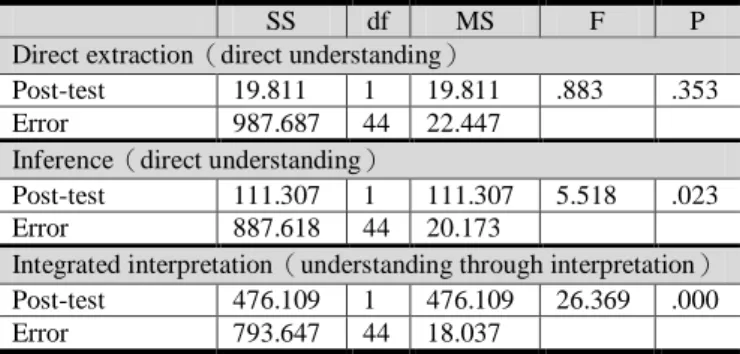
Statistic analysis was executed to investigate the changes of scores according to different question type. Regression coefficient of homogeneity of each question type, i.e., “direct extraction”, ”inference” and “integrated interpretation” were conducted. Accordingly the statistic values were F=1.058, F= 0.268, F=1.169, and the p values were 0.310, 0.607, 0.286, which were all less than significant level (p> .05). ANCOVA tests therefore were executed and results were shown in Table 3.
Table 3 ANCOVA results to different Question types (Post-test)
Excluding the effects of pre-test by ANCOVA test, there are not statistically significant differences on the Direct extraction (direct understanding) between the
SS df MS F P
Direct extraction(direct understanding)
Post-test 19.811 1 19.811 .883 .353 Error 987.687 44 22.447
Inference(direct understanding)
Post-test 111.307 1 111.307 5.518 .023 Error 887.618 44 20.173
Integrated interpretation(understanding through interpretation) Post-test 476.109 1 476.109 26.369 .000 Error 793.647 44 18.037
experimental class and the control class but fairly significant difference on the outcomes of “Inference” and “integrated interpretation” questions in the post-test. This indicates utilizing GS and Notebook to read e-picture book can promote students’ skills of inference and integrated interpretation in reading. Particularly students had a dramatic improvement of “understanding through interpretation” in using GS and Notebook according to the results of the tests.
5. Conclusions
In this study we explored the synchronous collaborative learning and learning effectiveness with electronic picture book. The results showed that much greater achievement was gained by the experimental class with GS and Notebook. In terms of effectiveness, students gained better improvement with GS and Notebook than those independent learning students. The GS-based collaborative learning significantly improved students reading skills especially the inference and integrated interpretation.
In this study we also explored the perceptions and views to the curriculum implementation. Statistic results from the questionnaire also indicated that most students held positive attitude and views to synchronous computer supported collaborative learning activities with GS. Their reading skills were greatly promoted and their motivation and interest was also improved through this study.
6. References
[1] DiGiano, C., Tatar, D., & Kireyev, K. (2006). Learning from the Post-It: Building collective intelligence through lightweight, flexible technology. Conference on Computer Supported Cooperative Work, 2006, 65-66.
[2] Stahl, G., Koschmann, T., & Suthers, D. (2005). “CSCL: An Historical Perspec- tive”, Cambridge, UK: Cambridge University, Proceedings of the 13th Euromicro Conference on Parallel, Distributed and Network-Based Processing.
[3] Sharples, M. (2005). Learning as conversation: Transforming education in the mobile age. Proceedings of Conference on Seeing, Understanding, Learning in the Mobile Age, Budapest, Hungary, 147-152.
[4] Carver, R. P. (1973). Reading as reasoning: Implications for measurement. In W. H. MacGinitie (Ed.), Assessment problems in reading. Newark, DE: International Reading Association. [5] Benton, S. L., & Kiewra, K. A. (1987). The assessment of cognitive factors in academic abilities. In R. R. Ronning, J. A. Glover, J. C. Conoley, & J. C. Witt (Eds.), The influence of cognitive psychology on testing,145–189. Hillsdale, NJ: Lawrence Erlbaum.
[6] Gagne' E.D. (1985). The Cognitive Psychology of Schllo Learning. Boston: Little, Brown and Company.
[7] Ko, H. W. et al. (2006). The Reading Literacy of Fourth Grade Students in Taiwan, PIRLS 2006. http://lrn.ncu.edu.tw/pirls/
[8] Mathes, P.G., Fuchs, D., & Fuchs, L.S. (1997). Cooperative story mapping. Remedial & Special Education, 18(1), 20-27. [9] Thorndyke, P. (1977). Cognitive structures in comprehension and memory. Cogni- tive Psychology, 9, 1-13. [10]Roschelle, J., Tatar, D., Chaudhury, S. R., Dimitriadis, Y., Patton, C., & DiGiano, C. (2007). Ink, improvisation, and interactive engagement: Learning with tablets. Computer, 40 (9), 42-48.
[11]Looi, C. K., So, H. J., Toh, Y., & Chen, W. (2011). The Singapore experience: Synergy of national policy, classroom practice and design research. International Journal of Computer-Supported Collaborative Learning, 6(1), 9-37. [12]Dimitriadis, Y., Asensio, J.I., Hernandez, D., Roschelle, J., Brecht, J., Tatar, D., Chaudhury, S., DiGiano, C., & Patton, C. (2007, July). From socially-mediated to technology-mediated coordination: A study of design tensions using Group Scribbles. Computer Supported Collaborative Learning 2007 Conference (CSCL 2007), New Jersey, USA.
[13]Looi, C. K., Lin, C. P., & Liu, K. P. (2008). Group Scribbles to Support Knowledge Building in Jigsaw Method. IEEE Transactions on Learning Technologies, 1(3), 157-164. [14]Chen, W., Looi, C. K., & Tan, S. (2010). What do students do in a F2F CSCL classroom? The optimization of multiple communications modes. Computers & Education, 55(3), 1159-1170.
[15]Chen, W., & Looi, C. K. (2011). Active classroom participation in a GroupScribbles primary science classroom. British Journal of Educational Technology, 42(4), 676-686. [16]Chen, W., Wen, Y., Looi, C. K. (In Press). Technology enhanced pedagogical innovation in second language learning. Paper accepted by Global Chinese Journal for Computers in Education.
[17]Looi, C. K., Chen, W., & Ng, F. K. (2010). Collaborative activities enabled by GroupScribbles (GS): An exploratory study of learning effectiveness. Computers & Education, 54(1), 14-26.
[18] Looi,C. K., Chen, W., & Patton, C. M. (2010). Principles and enactment of rapid collaborative knowledge building in classrooms. Educational Technology, 50(5), September-October, 26-32.