The Types of Grammatical Feedback
Students Prefer from Teachers
Julia Mika Kawamoto
松 山 大 学
言語文化研究 第 巻第 号(抜刷) 年 月
Matsuyama University Studies in Language and Literature
The Types of Grammatical Feedback
Students Prefer from Teachers
Julia Mika Kawamoto
INTRODUCTION
There has been considerable evidence indicating the benefits of form-focused instruction(FFI)in second language acquisition(e. g., Norris & Ortega, ; Mackey & Goo, ). The question researchers are now asking is how teachers can effectively teach grammar instruction in a content-based language course(Pica, ; Zyzik & Polio, ) and in a context of meaningful communication (Tocalli-Beller & Swain, ; Sato & Lyster, ). Iwai and Kawamoto ( )and Kawamoto( ; )tackled the feasibility issue of teachers using form-focused instruction through grammatical feedback, in other words, if FFI is a useful teaching method for every language teacher. In addition, they examined whether teachers were able to draw students’ attention intentionally and efficiently to their errors by providing linguistic feedback where students can focus on certain linguistic features and at the same time still engage in meaningful language use. In their study, they investigated how teachers differ in their ways of teaching and providing form- and meaning-focused feedback. They found that when teachers did not provide form feedback effectively, students seemed confused as to what their errors were, or why the teachers were providing feedback. Despite the evidence of the type of teachers’ feedback(Ammar & Spada, ), there is a problem that teachers are not fully aware of their students’ expectations regarding feedback. In
this pilot study, I investigated students’ preferences with regard to teachers’ feedback by focusing on the two main types of form-feedback used by teachers : recasts and prompts. The study reveals how students vary in their expectation on the type of form-feedback by the teacher.
STUDENTS EXPECTATIONS ON GRAMMAR FEEDBACK
FROM TEACHERS
Although classroom studies have shown how indispensable error correction is in the everyday classroom where students have the desire and/or expect to receive corrective feedback from the teachers, many EFL/ESL educators and researchers’ studies(Oladejo, ; Brown, )have shown that there is a gap between teachers and students over whether teachers should draw attention to grammatical forms in communicative language classes. They found that students have certain beliefs and expectations from their teachers about the important role of grammar in language learning. Research into differences between teachers’ and students’ educational beliefs about formal instruction was conducted by Kern( ). The study compared beliefs about language learning among teachers and students in an American university. The study revealed first that teachers believed pronunciation was not important to speak in a foreign language, whereas the students thought it was important. Second, teachers strongly disagreed that learning many grammar rules played a large part in learning a foreign language, but for the students, there were mixed results. Those who agreed that grammar rules were important were students who had taken a foreign language for two years or more. Students who disagreed were older students who had less experience learning a foreign language. Third, teachers also strongly disagreed with the statement that speaking a foreign language was easier than listening, while students gave assorted
responses.
One of the few studies that examined students’ belief on grammar instruction is from Schulz( )where she conducted an exploratory study of students’ beliefs in error correction from various language classes in her study. Drawing on the results from a questionnaire administered to students, % of the students thought it was essential for their spoken errors to be corrected. Replicating the study in , Schulz found that % of the Columbian foreign language students had a strong preference for teachers to correct their spoken errors. In addition, % of the students liked being corrected in class.
Studies on the role of students favoring corrective feedback by the teacher have overall covered positive effects. Chenoweth, Day, Chun, and Luppescue( ; see also Oladejo, ), for example, found that the students’ attitudes towards grammatical feedback were more positive than the teachers realized. Another example is seen in Katayama’s( ; a) studies, where students strongly favored their teachers providing feedback. According to Katayama( b), successful learning initially comes from matching beliefs and expectations between teachers and students. She suggested that teachers need to find out which type of errors should be corrected. She also found that % of the students preferred that teachers provide prompts(explained in the next section)in order for them to notice and self-repair their errors. The second most favored type of grammar feedback was explicit corrections, in which teachers point out the error and provide the correct form. The least favored was recasts(which will be mentioned in the next section). The next section will discuss two types of form-feedback that teachers provide as a necessary tool in second language acquisition(SLA)classrooms.
RECASTS AND PROMPTS
Several empirical studies focused on two types of form feedback, recasts and prompts(Lyster & Ranta, ; Lyster, ; )in order that students notice their errors and improve their L(second language)development. This study uses the definition of recasts as “the reformation of all or part of a student’s utterance, minus the error”(Lyster & Ranta, , p. ). An example below illustrates this :
Example of a recast :
Teachers ( ): How did you feel during this time ? Student ( ): I feel happy.[Error : grammatical-tense] Teachers ( ): Oh you felt, felt happy.[Feedback : recast]
(Kawamoto, )
Here in line , the teacher signaled the student the correct form by repeating the student’s ill-formed utterance from line . Much research had found recasts to appear the most common interactional feedback technique in second language(L ) classrooms(Braidi, ).
However, Lyster( ; ) questioned the effectiveness on whether students would notice their errors. He argued that recasts would go unnoticed because they are vague in nature. In addition, he found that a more explicit type of feedback would increase students’ awareness and understanding of their errors thus facilitating their L acquisition. Therefore, he claimed that prompts withhold the correct forms by pushing the output(in this case, the students’ oral communication) to accurately modify their repair(self-correction). The examples below show instances of these four kinds of prompts from the researcher’s data(Kawamoto,
):
Clarification requests
Student ( ): We ate barbecue and talk and drank, drink. Teacher ( ): Sorry, you talked and.
Student ( ): Talked and drank ?
In this example, the teacher located and assisted(line )that the student’s utterance (line )was incorrect.
Repetitions
Student ( ): I don’t other. Teacher ( ): You don’t other ?
Student ( ): Know, know I don’t know.
For this example, repetition was operationalized as repeating the student’s utterance with rising intonation(line ).
Metalinguistic clues Student ( ): She will.
Teacher ( ): How did ? So it’s past tense. Student ( ): She used the bus.
In line , the teacher gave a comment on how the student needed to repair her error.
Elicitation
Teacher ( ): One more time, she ~ Student ( ): She left ?
Teacher ( ): Ah-huh.
Student ( ): She left from her office ?
The teacher located and provided a hint in line . The student repaired her error, and then the teacher encouraged(line )her to continue her talk.
Based on the theoretical review, recasts and prompts have two functions for the present study. The first is to identify and determine the type of feedback that teachers typically use to indicate grammatical errors. The second will allow the researcher will be able label teachers’ form feedback with the aid of the model and examples above. The next section will present the methodology of this study.
THE CURRENT STUDY
Based on the following literature, it appears that students expect teachers to provide oral grammatical feedback. The question now is what type of grammatical feedback students think is effective for them to notice and repair their errors. The aim of this study is to investigate students’ preferences of grammatical feedback given by the teacher. The research questions are as follows :
) What type of grammatical feedback(recasts or prompts)do students prefer in order to notice their errors ?
) When do students think is the appropriate timing for teachers to provide feedback ?
Group A Recasts to Prompts 9 students Group B Prompts to Recasts 9 students Student Teacher 3 students 3 students 3 students 3 students 3 students 3 students Student Student Figure : Grouping
METHODOLOGY
ParticipantsEighteen ESL adult students participated in this study. The students were put into two groups, Group A(nine students)and Group B(nine students). Within these groups, there were sub-groups in order for the students to have equal amount of time interacting with the teacher. Figure below describes how the students were grouped. The teacher is the researcher of this study.
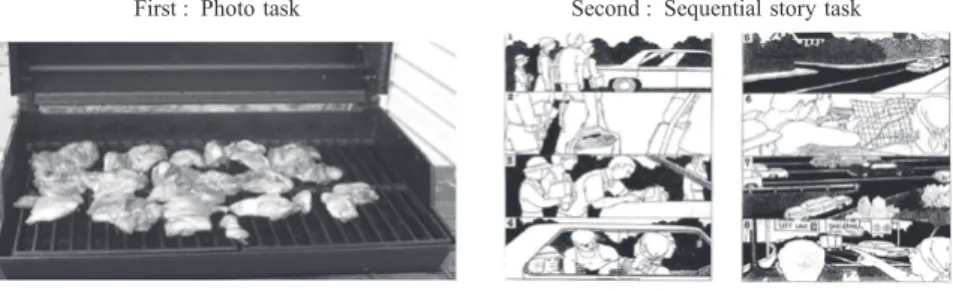
First : Photo task Second : Sequential story task
Figure : Task activity Materials and procedure
Figure illustrates the two tasks that were used in this study : Task - the photo task and Task - the sequential story task(Dumicichi, ). Both tasks were chosen for their effectiveness in facilitating teacher-student interaction, as well as students would make errors frequently for the teacher to correct. For the photo task, each student brought a photograph. As for the sequential story task, there were pictures of natural sequences of events. There were six sets with eight pictures on each page. During the teacher-student interaction, each student worked on a different set.
In the photo task, each student described their picture for one to two minutes. Then there was a question and answer session where the teacher asked questions. The sequential story task was conducted in a similar fashion.
In order for the teacher to provide recasts and prompts for both groups, the order of these two types of form feedback was counterbalanced. For the students in Group A(recasts to prompts), the teacher provided recasts in Task and prompts in Task . Regarding Group B(prompts to recasts), prompts were given in Task and then recasts in Task .
The researcher later showed the videotape of the lessons to each of the students in a retrospective interview session later, to find out what they were thinking each time the teacher provided form feedback and how they felt overall during the sessions. The interviews were audio-recorded. In the next section, the researcher will present the results and discussion.
After the quasi-classroom interactions, the recorded data were transcribed verbatim. Dots( . . . ) are used for silent (or unfilled) pauses, and each dot represents approximately one second.
RESULTS AND DISCUSSION
This section explores the answers of the three research questions that were presented. First, how much the students noticed the feedback that their teacher provided will be shown. Second, whether or not the timing of giving the feedback was an important factor for students will be shown. Finally, the analysis will be presented of what the students were thinking after they received the form-feedback from the teacher. The results of the qualitative analysis will be presented in this section.
Noticing the feedback
Overall, the students were able to notice their errors when the teacher used recasts and prompts. The first example shows how recasts were used in order to draw the students’ attention to their error during a meaningful interaction between them and their teacher.
In order to clarify which group the excerpts have been extracted from, the students in Group A will be referred to as S through S . S ’ through S ’ are students in Group B.
Excerpt
S ’( ): First, her put on apron.
T( ): She put on her apron.[Error : grammatical - subject] S ’( ): She she put on apron.[Feedback : recast]
In line , the teacher pointed out to the student the correct form of the subject with a recast. The S ’ understood the teacher’s feedback by repeating what the teacher had said. As mentioned earlier, recasts are the most frequent interactional moves in L communication, since one of the advantages that recasts provide is that they do not interrupt the flow of the interaction(Long ).
In general, prompts are considered to be effective in stopping students temporarily and drawing their attention to specific errors they have made(Lyster, ). The following presents how the prompts can be an effective tool for teachers in order to provide hints or “cues to draw on their[the students’]own linguistic resource”(Lyster, , p. ).
Excerpt
S ( ): Number pictures, he . . uh .shavers . shavers.[Error : grammatical -tense]
T ( ): OK, so what are you, are you talking about it now or yesterday ? Or.[Feedback : prompt - metalinguistic]
S ( ): He. T ( ): OK.
S ( ): Shaved, he shaved. T ( ): OK.
S ( ): He . . brush, brush teeth.[Error : grammatical - tense] T ( ): OK.
S ( ): His teeth.
T ( ): OK, you said, here, “he shaved”. I’m I’m confused, then you said, “he put on his after shave.” So what s this ? He . . . [Feedback : grammatical - elicitation]
S ( ): He . . brush.[Error : grammatical - tense]
T ( ): OK, is this yesterday ? Today ?[Feedback : prompt - metalinguistic] S ( ): Brushed.
In line , the teacher provided a metalinguistic feedback in order for the student to use the past tense. The student corrected her feedback in line and continued the activity. Then in line and , the teacher once more reminded the student to remain in the past tense. Eventually in line , the student gave the correct answer. As this excerpt shows, the teacher was methodical about how she gave the student time in order for the student to notice, think, and self-repair the errors.
As mentioned earlier, the students noticed both types of form-feedback ; however, in their interviews students preferred prompts, because of their explicitness in nature which in turn promoted acquisition(Carroll & Swain, ; R. Ellis, Loewen, & Erlam, ). Those who preferred recasts(three students) felt they were actually talking with the teacher rather than having a formal lesson. Five of the students preferred both types corrective feedback.
Investigating on timing
Although providing feedback is necessary and effective(Lyster, Lightbown, & Spada, ), there are some crucial problems where providing feedback would interfere with students’ noticing and repairing their errors. Timing is one factor that the researcher has found can occur. Excerpts and illustrate this :
Excerpt
S ’ ( ): She . she . is bed making. T ( ): Making her bed. S ’ ( ): She is making her bed.
Excerpt
S ’ ( ): First, I was wearing, I uh. T ( ): Put, put.
S ’ ( ): I wa, I put on my apron, apron.
In Excerpts and , the teacher provided the students a typical recast ; however, in the interview, the students mentioned that they felt the teacher interrupted them. They said that they had already realized they had made an error and wanted to repair it themselves.
In addition, S ’ felt that the teacher was too hasty in providing the feedback. Yet, in the next excerpt, she insisted that the teacher was too late.
Excerpt
S ’ ( ): Haven t get married. T ( ): I am . .
S ’ ( ): I am not getting. T ( ): No, I am not married. S ’ ( ): I am not married.
In this task, the teacher focused on providing prompts ; however, S ’ pointed out that throughout Excerpt , she wanted the teacher to provide a recast.
form-feedback or when are appropriate for the student. However, this does not mean that teachers should not provide any feedback, since recasting and prompting do provide effective ways of either revisiting or focusing on students’ errors. This in turn assists students to gradually develop accuracy in their utterances(Lyster, Lightbown, & Spada, ; Mackey, ).
Thinking after the feedback
Researchers have found problems with using recasts where students may perceive them as confirmation by the teacher and fail to recognize that the feedback is corrective when the teacher provides the recasts haphazardly. To investigate these problems more closely, Excerpts and from the collected interactive data are shown below.
Egi( a)found demerits of recasts where students did not consider them as feedback, but were more inclined to regard them as confirmation. There may be some confusion for students about the teachers’ intentions and expectations when using recasts. Excerpt demonstrates this :
Excerpt
S ( ): It is called henna tattoo. T ( ): Uh huh.
S ( ): And . . we can take off in two weeks. Two weeks it will go on. T ( ): Oh I see. So it comes off.
S ( ): Yes.
In line , the student indicated that she interpreted the teacher’s feedback as a confirmation by saying “Yes”. The student thought that the teacher’s recast was for the teacher’s benefit to understand what she was trying to say. Another problem
that students in the study found was that when teachers provide recasts, it simply often means that the teacher solves the problem for the students. In other words, there is no compulsion for the students to repair their errors themselves ; thus there is no effort by the students to push their output(Egi, b). In addition, students constantly hear teachers repeating what the students say which in turn leads the students to assume the feedback is a confirmation. Therefore, teachers need to understand the conditions under which recasts can be used effectively.
Another problem with recasts is that students fail to understand precisely the correct grammar form. Although the teacher attempted to draw students’ attention to the target language, the student did not recognize the feedback. In Excerpt , the teacher may have rushed in providing a recast in line .
Excerpt
S ( ): So . I . . want to . see . it . So . . T ( ): So you wanted to see this bassoon. S ( ): Yes, yes.
This section showed that the teacher attempted to fully make use of recasts and prompts. However, as indicated in Excerpts through , there were some problems. Although, recasts reduce the cognitive load for students while the intended meaning is maintained(Long, )and prompts draw students’ attention to specific errors(Lyster, ), the students were either confused as to what their errors were and/or whether the teacher was providing feedback. In addition, they were annoyed that the teacher was either too slow or too quick to provide the feedback.
PEDOGOGICAL IMPLICATIONS
The findings reported in this study suggest that students had their preference in the type of form-feedback used. However, overall the students were able to notice their errors when the teacher provided both recasts and prompts to each student. In this section, the research will make some recommendations about when to provide recasts and prompts.
Using recasts
Empirical studies have shown evidence of situations where recasts could be used effectively as feedback. As mentioned earlier, it may be difficult for students to recognize recasts as feedback(e. g., Lyster & Ranta, )since the level of readiness is important when using recasts. If students have prior knowledge of the grammatical form from earlier instruction or have metalinguistic awareness(e. g., Long, Inagaki, & Ortega, ; Schmidt & Frota, ), they are more likely to recognize the corrective element of recasts. Mackey and Philp( )studied the effectiveness of recasts on students at beginner and intermediate levels using interrogative forms. Their analysis suggested that students at a higher proficiency level or at the right stage to receive newly acquired grammatical forms were more likely to respond to recasts than those who were at lower levels. Philp( ) reported similar results when lower level students did not improve their accuracy and did not notice the recast when they were not familiar with the target language or not at the appropriate developmental stage to understand this type of feedback. Therefore, students at lower and beginning levels most likely would not benefit from recasts since these students have to struggle with processing the disparity between recasts and their readiness to deal with unfamiliar input.
Philp’s study( ), she found that the length of recast is another factor that teachers must consider. She discussed that the shorter the recasts are, the easier it is for students to recognize and recall a particular feedback. Carpenter, Jeon, MacGregor, and Mackey( )obtained significant results similar to Philp’s study. They concluded that the shorter the recasts, the more salient the feedback is. They also argued that phonological and lexical errors have more of a tendency to trigger communication breakdown than morphosyntatic ones.
Another point to consider regarding recasts is finding methods to draw students’ awareness to the corrective content of this feedback. Loewen and Philp( ) conducted a study that examined how teachers’ use of intonation patterns could draw students’ attention to their recasts. They found that the most effective type of signals used by teachers was the use of the declarative rather than the interrogative intonation, which teachers mostly used for phonological errors.
In summary, the factors of how to make recasts a more noticeable corrective function may enable teachers to assist students to notice their errors in their utterances and provide feedback effectively. Although there are desirable results for recasts(Mackey & Philip, ; Muranoi, ; Ellis, Basturkmen, & Loewen, ), there are those(e. g., Boivert, ; Lyster, , ; Lyster & Ranta, )who feel that recasts may not be enough for the students to notice their errors and to narrow their interlanguage gap. The next section will present the recommendation of using prompts.
Using prompts
An important aspect of prompts is that they are effective when the students already have prior knowledge of the form, so teachers only need to provide hints on their errors(e. g., Ellis, ; Saxton, Houston-Price, & Dawson, ). For example, Ellis, Loewen, & Erlam( )used the regular past tense -ed as a target
item in their study. Although the intermediate students in their study had already studied this grammatical form, they found that the students had extreme difficulty in controlling their tense errors, particularly in oral communication. From their results, they noticed that the group who received metalinguistic feedback had more control over their knowledge of the past tense compared to a recast group and a control group.
However, there are some drawbacks to the use of prompts. Kawamoto( ) argued that one of the teachers in her study had the tendency to over-prompt by not giving students enough time to finish or engage in self-repair. As a result, the students did not specifically understand what their errors were. In addition, the teacher used prompts as a tool to introduce new vocabulary, which proved to be ineffective since prompts assume that the students already have the knowledge to perform self-repair : this also supports Ellis( )and Saxton et al.( ).
CONCLUSION
It is important to consider the limitations of this study. First is the relatively small in number of participants. Having a larger number of participants would make it possible to examine other variables, such as gender, age, and educational background. The other limitation was the recruitment and not placing students in different proficiency levels which was based on convenience. The method in which the students were grouped was not based on any proficiency exam but arranged on the days that were convenient for students and teacher.
To conclude, this study investigated : )Students’ preference regarding recasts and prompts ; )the appropriate timing of providing these types of form-feedback ; and )students’ reaction after receiving feedback. The results indicate students had their preference in the type of form-feedback ; yet they were able to notice both
recasts and prompts when the teacher appropriately provided them. This study also revealed that is it rather difficult for teachers to determine exactly when to give feedback. This does not mean that teachers should stop giving any form-feedback to the students and the generalization of the results should be made with caution. In spite of the limitations, this study provided some evidence regarding to teachers providing effective corrective feedback and the impact they have on their students’ second language development.
REFERENCES
Ammar, A., & Spada, N.( ). One size fits all ? Recasts, prompts, and L learning. Studies of Second Language Acquisition, , − .
Boisvert, B. B.( ). The role of prompts as focus on form uptake.(Unpublished doctoral dissertation). University of Massachusetts-Amherst : Massachusetts.
Braidi, S.( ). Reexamining the role of recasts in native-speaker/nonnative-speaker interactions. Language Learning, , − .
Brown, A. V.( ). Students’ and Teachers’ Perceptions of Effective Foreign Language Teaching : A Comparison of Ideals. The Modern Language Journal, , − .
Carpenter, H., Jeon, K. S., MacGregor, D., & Mackey, A.( ). Learners’ interpretations of recasts. Studies in Second Language Acquisition, , − .
Carroll, S., & Swain, M.( ). Explicit and implicit negative feedback : an empirical study of the learning of linguistic generalization. Studies in Second Language Acquisition, , − . Chenoweth, N., Day, R., Chun, A., & Luppescu, S.( ). Attitudes and preferences of
nonnative speakers to corrective feedback. Studies in Second Language Acquisition, , − . Dumicichi, J.( ). Picture It ! . Englewood Cliffs, N. J. : Prentice-Hall.
Egi, T.( a). Recasts, learners’ interpretations, and L development. In A. Mackey(Ed.), Conversational interaction in second language acquisition : A collection of empirical studies (pp. − ). Oxford : Oxford University Press.
Egi, T.( b). Interpreting recasts as linguistic evidence : The roles of linguistic target, length, and degree of change. Studies of Second Language Acquisition, , − .
Ellis, R.( ). The differential effects of corrective feedback on two grammatical structures. In A. Mackey(Ed.), Conversational interaction in second language acquisition : A collection of empirical studies(pp. − ). Oxford : Oxford University Press.
Ellis, R., Basturkmen, H., & Loewen, S.( ). Learning uptake in communicative ESL lessons. Language Learning, , − .
Ellis, R., Loewen, S., & Erlam, R.( ). Implicit and explicit corrective feedback and the acquisition of L grammar. Studies of Second Language Acquisition, , − .
Iwai, C., & Kawamoto, J.( ). Factors affecting teachers’ feedback. In A. Stewart(Ed.), JALT Conference Proceedings, − .
Katayama, A.( ). Perceptions of JFL students toward correction of oral errors. In Bradford-Watts, K., Ikeguchi, C., & Swanson, M.(Eds.)JALT Conference Proceedings, Tokyo :
JALT, − .
Katayama, A.( a). Students’ perceptions toward oral error correction, Japanese Language and Literature, , pp. − .
Katayama, A.( b). Japanese EFL students’ preferences toward correction of classroom oral errors. The Asian EFL Journal Quarterly, ( ), − .
Kawamoto, J.( ). Exploring successful and unsuccessful feedback in teacher-student interaction. JACET Chugoku-Shikoku Chapter Research Bulletin, , − .
Kawamoto, J. M.( ). The feasibility for teachers to merge, form-focused and meaning-focused feedback.(Unpublished doctoral dissertation). Hiroshima City University, Hiroshima, Japan.
Kawamoto, J. M.( ). Feasibility issue of form-focused instruction. The Asian Conference on Education Official Conference Proceedings, − .
Kern, R. G.( ). Students’ and Teachers’ beliefs about language learning. Foreign Language Annals, ( ), − .
Lyster, R.( ). Recasts, repetition, and ambiguity in L classroom discourse. Studies of Second Language Acquisition, , − .
Lyster, R.( ). Differential effects of prompts and recasts in form-focused instruction. Studies of Second Language Acquisition, , − .
Lyster, R.( ). Learning and teaching languages through content. Amsterdam : John Benjamins Publishing.
Lyster, R., Lightbown, P., & Spada, N.( ). A response to Truscott’s ‘What’s wrong with oral grammar correction.’ Canadian Modern Language Review, , − .
Lyster, R., & Ranta, L.( ). Corrective feedback and learner uptake : Negotiation of form in communicative classrooms. Studies in Second Language Acquisition, , − .
Loewen, S., & Philp, J.( ). Recasts in the adult English L classroom : Characteristics, explicitness, and effectiveness. Modern Language Journal, , − .
Long, M. H.( ). Focus on form : A design feature in language teaching methodology. In K. DeBot, R. Ginsberg, and C. Kramsch(Eds.), Foreign language research in crosscultural
perspective(pp. − ). Amsterdam : John Benjamins.
Long, M. H.( ). The role of the linguistic environment in second language acquisition. In W. Ritchie & T. Bhatia(Eds.), Handbook of second language acquisition(pp. − ). San Diego : Academic Press.
Long, M. H., Inagaki, S., & Ortega, L.( ). The role of implicit negative feedback in SLA : Models and recasts in Japanese and Spanish. The Modern Language Journal, , − . Mackey, A.( ). The role of conversational interaction in second language acquisition. In A.
Mackey(Ed.), Conversational interaction in second language acquisition(pp. − ). Oxford : Oxford University Press.
Mackey, A., & Goo, J.( ). Interaction research in SLA : A meta-analysis and research synthesis. In A. Mackey(Ed.), Conversational interaction in second language acquisition : A collection of empirical studies(pp. − ). Oxford : Oxford University Press.
Mackey, A., & Philp, J.( ). Conversational interaction and second language development : Recasts, responses, and red herrings. The Modern Language Journal, ( ), − . Muranoi, H.( ). Focus on form through interaction enhancement : Integrating formal
instruction into a communicative task in EFL classrooms. Language Learning, , − . Norris, J., & Ortega, L.( ). Effectiveness of L instruction : A research synthesis and
quantitative meta-analysis. Language Learning, , − .
Oladejo, J. A.( ). Error correction in ESL : Learners’ preferences. TESL Canada Journal, , − .
Pica, T.( ). Subject-matter content : How does it assist the interactional and linguistic needs of classroom language learners ? Modern Language Journal, , − .
Philp, J.( ). Constraints on “noticing the gap” : Non-native speakers’ noticing of recasts in NS-NNS interaction. Studies in Second Language Acquisition, , − .
Sato, M., & Lyster, R.( ). Peer interaction and corrective feedback for accuracy and fluency development : Monitoring, practice, and proceduralization. Studies in Second Language Acquisition, ( ), − .
Saxton, M., Houston-Price, C., & Dawson, N.( ). The prompt hypothesis : Clarification requests as a corrective input for grammatical errors. Applied Psycholinguistics, , − . Schmidt, R. W., & Frota, S.( ). Developing basic conversational ability in a second
language : A case study of an adult learner of Portuguese. In R. Day(Ed.), Talking to learn : Conversation in second language acquisition(pp. − ). Rowley : Newbury House. Schulz, R. A.( ). Focus on form in the foreign language classroom : Students’ and teachers’
views on error correction and the role of grammar. Foreign Language Annals, , − . Schulz, R. A.( ). Cultural differences in student and teacher perceptions concerning the role
Journal, , − .
Tocalli-Beller, A. & Swain. M.,( ). Reformulation : The cognitive conflict and L learning it generates. International Journal of Applied Linguistics, ( ), − .
Zyzik, E., & Polio, C.( ). Incidental focus on form in university Spanish literature courses. Modern Language Journal, , − .