153
日米女子大生の会話比較(5):快・不快の度合い
滝沢 カ レンA Comparative Study of Speech Acts of Japanese and
American College Students (5):Degree of Pleasantness or
Unpleasantness
Karen Ann Takizawa
長野市の清泉女学院短期大学 と米国マサチューセ ッツ州 アマース ト大学で実施 したコ ミュニケーシ ョン ・ス タイル調査の分析結果か ら、快 ・不快 の度合いについて論 じる。
1Introduction
Thisispart5inaseriesofarticlescomparingthecommunicationstylesofyoung womenatcollegesinJapanandtheUnitedStates.Previousarticlesdiscussedthe resultsofaDiscourseCompletionTestthatcoveredavarietyofspeechacts,suchas greetings,requests,responsestocomplimentsandcriticism,apologies,thanks,and classroominteraction.ThisarticlecoversanewSuⅣeyonCommunicationStylesthat attemptstomeasurethedegreeofpleasantnessorunpleasantnessstudentsfeelin theseconversationalsituations.
2SurveyonCommunicationStyles
TheDiscourseCompletionTestexaminedoutput,thatis,whatthestudentswould sayinagivenconversationalsituation.Thestudentshadtoreadeachitemonthetest andwritetheverbaland/ornonverbalresponsetheywouldmostlikelymake.Thenew
SuⅣeyonCommunicationStylesexaminesinput,specifically,how thestudentsfeel aboutwhatissaidbyothers.ForthesuⅣey,tenidenticalorcloselyrelatedsituations werechosenfrom theDiscourseCompletionTest.Oneormoreofthemostcommon responsesfrom theJapaneseandAmericandatawerelistedundereachone,foratotal oftwenty-sixitems.TheJapanese-languageresponsesweretranslatedintoEnglishfor theEnglish-languageversionofthesuⅣey,andtheEnglishresponsesweretranslated intoJapanesefortheJapanese-languageversion.Therewasnoindicationoftheorigin oftheitem.Thestudentshadtoreadthesituationsandratethedegreeofpleasantness orunpleasantnesstheyfeltabouteachitemonthefollowingfive-pointscale:
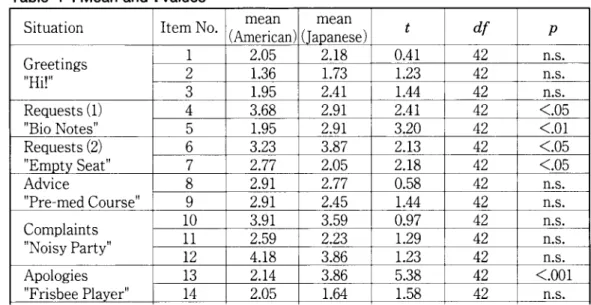
Therewasalsoaspaceforstudentstowritecommentsabouteachsituation,ifthey wished.The‡-testwasappliedtotheresultsforeachitem.AccordingtoHatchand Lazaraton,thistestwasespeciallydesignedtocomparethestatisticaldifferences betweengroupsforsmallsamplesizes.Theresultsofthei-testareshowninthe followlngChart.
Table1:Meanandfvalues
situation ⅠtemNo. me(Ameraicnan) me(Japaneanse) i dF P Greetings "Hi!■ー 21 2.1.0536 2.1.7138 0.1.4123 4242 n.n.SS.. 3 1.95 2.41 1.44 42 n.S. Requests(1) 一一BioNotesH 45 3.1.9685 2.2.9191 2.3.4120 4242 <.<.0015 Requests(2) ●ーEmptySeattt 76 2.3.7237 3.2.8705 2.2.1183 4422 <.<.0055 Advice HPre-medCourse'ー 89 2.2.9191 2.2.4577 0.1.4548 4422 n.n.SS.. Complaints
"NoisyPartyー' 1l120l 4.2.3.915189 3.3.2.285963 0.11..292973 424242 n.n.n.SSS... Apologies
滝沢 :AComparatlVeStudyofSpeechActsoりapaneseandAmericanCollegeStudents(5):DegreeofPleasantnessorUnpleasantness 155 Disagreelng I-ⅠnClassH 1165 2.2.8686 2.3.9514 11..0283 4242 n.n.SS.. 17 2.32 2.18 0.40 42 n.S. Requests(3) "TheWindowH 1189 4.1.8322 2.3.2273 4.1.4638 4242 <.n.0S01. 20 3.27 3.59 1.33 42 n.S. Requests(4)
"EXtraMoney■' 2122 2.3.7413 2.2.6886 4.1.3064 4242 <.n.0S01.
Co一一RemplcruiimetSuintts" 23 3.64 3.27 1.32 42 n.S. 24 2.77 2.59 0.55 42 n.S. 25 3.00 2.36 2.00 42 <.10 26 1.73 1.73 0.00 42 n.S. Thefollowinggraphshowsthemostfrequentresponseforeachitem.
Chart1:Mode (MostFrequentResponseforeachitem)
Ⅰnthefollowingsection,thesituationswillbediscussedintheorderinwhichthey appearedinthesuⅣey.
3StudentRatingsotPleasantness/UnpleasantnessfortheItemsinEach Situation
3.1 Greetings-■■Hi■■
situation:Ⅰnthemorningonyourwaytothelibra叩,youpassthreefriends(A,B,and C)goingtheotherway.Theygreetyou.(Ⅰmaginethatyouknowthethreestudents equallywellandseethemoftenandthatnoneofyouareespeciallybusy.)
状況 :朝、あなたは、図書館 に行 く途中、反対方向か らきた3人の友達A,B,Cと行 き 合い ま した○彼等 は下記の ような挨拶 をしま した○(彼等 は、あなたが よく顔 を合わせ
ⅠNo.tem Mode
1 Asays,"Hi.‖ 2
Aは、「おは よう」 3
2 Bsays,ttHi,(yourfirstname).How■sitgoing?■■ 1 Bは 「おは よう○<あなたの名前 >、調子 どう?」 1 3 Csays,"Hi,(yourlastname).Howーsitgoing?‖ 1
TherewasnosignificantdifferencebetweentheratingsoftheJapaneseand Americanstudentsforanyoftheitemsinthissituation.Accordingtotheresultsofthis suⅣey,bothprefertobegreetedbyname.
InTakizawa (1996),theJapanesestudentsshowedaverymarkedpreferencefor usingonlyaformulaicexpression,suchas「お は よ う」or「こん に ち は」ingreeting theirfriends.TheAmerican studentsused greetingsthatincluded a formulaic expression,aname,andsomesortofconversationalexpression.
BothJapaneseandAmericanstudentscommentedthattheylikethefeelingof friendlinessandintimacythatcomeswiththeuseoftheirfirstname(No.2).Some AmericanstudentssaidthatitwouldbeoddforsomeonetousealastnameintheUSA, unlessitwasasanickname,whenthefriendknewthefirstname.Otherssimplysaid thattheydidnotlikebeingcalledbytheirlastnamesunlessitwasaspecialsituation,
滝沢 :AComparatlVeStudyofSpeechActsoりapaneseandAmerlCanCollegeStudents(5):DegreeofPleasantnessorUnpleasantness 157
suchasaJapaneselanguageclass.Itwasalsomentionedthatuseoflastnamesin greetingswouldbemorecommonamongmalesthanfemalesintheUSA.
3.2 Requests(1) -I.BioNotes.I
situation:Therewillbeatesttomorrowinyourbiologyclass.Yourfriends(AandB) wereabsentfromclasslastweek,Sotheywouldliketomakeacopyofyoum otes. 状況 :明 日、生物学のテス トがあ ります○先週欠席 した友達
A,
B
があなたのノー トをⅠNo.tem Mode
4 Asayscasually,"Hey,1etmecopyyourbionotes.■' 4 Aは、 くだけた表現で 「ねえ、生物のノー ト、コピーさせて」 と頼み 3
ました○
5 Bscopiaeyspodyournolitely,‖tesⅠmi?一一ssedtheclasslastweek.WouldyoumindifⅠ 1 Bは、丁寧 な表現で 「先週休んで しまったので、先週のノー トコピー 2
TherewasasignificantdifferencebetweentheJapaneseandAmericanresponses forbothitemsinthissection.TheAmericanstudentsfeltthatthepoliterequest(No.
5) wasmorepleasantandlikelytobegrantedbecauseitshowedrespect.The Japanesestudentsfeltcomfortablewiththemorecasualrequest(No.4),andinfact thoughtthatthepoliterequestsoundedoddcomingfrom afriend.Bothgroups, however,wantedtoknowthereasontheirfriendmissedclassbeforeagreeingtolend thenotes.
3.3 Requests (2) -■■EmptySeat■■
situation:Ⅰnthecafeteria,youputyourbagontheemptyseatneXttoyoutosaVeit forafriend.Twostudentsyoudonotknow(AandB)speaktoyouabouttheseat. 状況 :カフェテ リアであなたは、友人の座席 を確保 しようとして、空いている横 の席
ⅠNo.tem Mode
6 Assowecaysianafnsirtheiendrelya?"nddirectway,ttwouldyoumindmoVingyourbag 4 Aは、親 しげに、そ して直接的に、「バ ッグどけていただけませ んか、 4 座 りたいんで」 と言い ま した○
7 B ssittlanyghesinasre?一一eriousandroundaboutway,"EXcuseme?Ⅰsanyone 2 Bは、神妙そ うに、そ して遠回 しに、「すみ ません、この座席空いてい 1
Theresultslooksimilar,butactuallytherewasasignificantdifferencebetweenthe twogroupsforbothitemsinthissituation.Bothgroupsdislikedtherequesttomove thebag (No.6),buttheJapanesestudentsweremorestronglyirritatedbyitthanthe Americanswere.OneJapanesestudentcommentedthatitsoundedinappropriatefor theiragegroup,almostmiddle-aged.Bothgroupsfeltmorecomfortablewiththe questionabouttheemptyseat(No.7)becauseitwaspoliteandshowedrespect,butthe Japanesestudentsweremorestronglypositiveaboutitbecauseitcontainedthe expression「すみ ません」.
3.4 Advice-■■Pre-modCourse"
situation:Yourroommate,influencedbyapopularTVprogram,hasrecentlybeen thinkingaboutchangingtothepre一medcourseatyouruniVersity.Youhearyour roommatetalkingtotwofriends(AandB)aboutit.(Ⅰmaginethatyouandthetwo friendsknowthatyourroommatedoesnーtliketostudyandisnーtreallysuitedtobeing adoctor.)
状況 :あなたのルームメー トは、最近、人気 テ レビ番組の影響で医者 になることを目 指そ うと思 うようにな りま した○あなたは、そのルームメー トが二人の友人 (A、B) とその ことをについて話 しているの を耳 に しました○ (あなた も、その友人A、Bも、 あなたのルームメー トが勉 強嫌いで、実際 に医者 に向いていない ことが分 つている と
滝沢 :AComparatlVeStudyofSpeechActsofJapaneseandAmencanCollegeStudents(5):DegreeofPleasantnessorUnpleasantness 159
ⅠNo.tem Mode
8 A tHanrgliestntoaherVoe!一一idhurtingyourroommateーsfeelingsandsays,HCool! 3 Aは、ルームメー トの気持 ちを傷つけない ように、「す ごい、がんばつ 3 て」 と言 って ます○
9 B afrankskstlysaheryswhaeastheonwh/shetyyhiourrnksoooftmmaheitdeewaa.ntstobeadoctorand 4 Bは、ルームメー トが なぜ医者 にな りたいのか理 由を尋 ね、それか ら 3
Therewasnosignificantdifferencebetweenthetwogroupsforeitheritem inthis situation.
AmericanstudentshadawiderangeofreactionstoNo.8.Some,whoratedit
"somewhatpleasant■■,consideredA tobeasupportivefriend.Others,whoratedit Hsomewhatunpleasant",Wereannoyedbecauseshewassimplylyingtotheroommate. Japanesestudentshadmoreneutralreactions.MostthoughtthatAwasrightnotto discouragetheroommatefrom studyingmedicinebecauseshewasinnopositionto knowhowAmightchangeinthefuture.
BothJapaneseandAmericanstudentscommentedthatB (No.9)wasbeingan honest,butnecessary,friend.Theynotedthatcandorandtrutharesometimesneither politenorpleasant,andnoonewantedtohurtafriend■sfeelings.Inanycase,they wantedtogivetheirfriendmoralsupportandencouragehertofollowherdream.
3.5 Complaints-.lNoisyPartyl.
situation:Ⅰtismidnight.YouarehaVingapartyinyourapartment,anditseemsthat yourneighbors(A,B,andC,alsostudents)arebotheredbytheloudmusic.(Ⅰmagine thatyouhaVenotbeenliVinginthisapartmentVerylong,andyouhavehadseVeral noisyparties.)
状況 :今、真夜 中で、あなたは、 自分の アパ ー トでパ ーテ ィーを開いてい ます○隣人 (学生A、B、C)が、騒が しい音楽 に迷惑が ってい る ようです○ (あなたは、 このア パ ー トに引 っ越 して来てか ら、 まだあ ま り日がたっていず、 また、すで に数回騒が し
ⅠNotem. Mode
10 Addayaoendasnttsskshiayamtnythiodosngtooymeotu.Hehinga/sbohegouttheprestotoblhelem.andlordtheneXt 5
Aは、あなたに何 も言 わず、次 の 日、管理人 に何 とか して もらえるよ 3 うにたのみ ましたo
ll Bkofninghtockso."nyourdoorandmildlysays,"It'sprettyloudforthistime 2
Bは、あなたの部屋 をノ ック し
、
「この時間ですか ら、かな り聞 こえ 2 て くるんです」 と穏やかに言い ました○12 CkTurnonictdksoown!nyo"urdoorandsaysstrongly,‖Ⅰttstoonoisy.ⅠCanttsleep. 4 Cは、あなたの部屋 をノック し、「うるさ くて眠れない、ボ リュームを 4
TherewasnosignificantstatisticaldifferencebetweentheJapaneseandAm erican studentsinthissituation.AmericanstudentsreactedmorenegativelytoNo.10than Japanesestudents,whoaremoreaccustomedtotheideaofsolvingproblemsthrougha thirdparty.However,SeveralJapanesestudentscommentedthattheywouldfeel annoyedifsomeonedidthistothem.Notsurprisingly,bothgroupspreferredB's approach(No.ll),thepolitehinttoturndownthemusic.BothgroupsfoundC-sangry complaintunpleasanteventhoughitwasjustified.
3.6 ApologleSI.IFrisbeePlayer"
situation:Youaresittingonthegrassreadingabook.Nearby,somestudentsare playingFrisbee.Twoofthem (AandB)accidentallybumpintoyou.
状況 :キャンパスの芝生で座 って本 を読 んでい ます○近 くで、何人かの学生が フリス ビーを してい ますo学生 (A,B)が、 もののはずみで、あなたの足 をふみ ました○
ⅠNo.tem Mode
滝沢 :AComparativeStudyofSpeechActsofJapaneseandAmerlCanCollegeStudents(5川egreeofPleasantnessorUnpleasantness 161
14 Blooksseriousandsays,一一Sorry.Areyouhurt?" 1&2
Inthissituation,therewasaveryslgnificantdifferencebetweenthegroupsin No.13,butnodifferenceinNo.14.TheAmericansratedbothitemsalmostequally I-pleasant"or Hsomewhatpleasant",Commenting thatthey found both sincerely apologetic.Itwas,afterall,anaccident,theycommented.TheJapanesestudents showedastrongpreferenceforNo.14.TheyratedNo.13''unpleasant"becauseit showednoconcernforthewelfareoftheinjuredparty.Thissameresultwasseenin Takizawa(1998),whereJapanesestudentstendedtoexpressresponsibilityfortheir actionsafterthesetphraseofapology.TheAmericanstudents,ontheotherhand, tendedtoofferanexplanationfortheiraction.Inthiscase,noexplanationwasneeded becausethesituationwasobviousfromthecontext.
3.7 Disagreeingl.lJnClass"
situation:Youaretakingnotesduringalectureinaclassofabout30students.Some femalestudentssittingnearyou(A,ち,andC)seemtodisagreewithsomethingthe teachersays.
状況 :あなたは約30人の学生 と心理学 の講義 を受 け、 ノー トを取 ってい ますoあなた の周 りに座 っている女子学生 (A,B,C)が教授が言 ったことに対 して、何 か異議があ
ⅠNotem. Mode
15 Ahashecsapuzontinuezstledeakixnprgnoesstieonos.nherface.Shedoesn.tsayanything,and 3 Aさんは、教授 に賛同で きない といった表情 を して、何 も言わず ノー 3
トを取 り続 けました○
16 BwhisperstothestudentneXttoher,一一ButⅠthinkit■S□□□ …‖ 3 Bさんは、ひそひそ と隣の学生 に話 してい ます○「私 は、□□口だ と忠 3
17 Cransaweiserashelsoporhasndisiblmmee?■ーdiatelyandsays,■■Ⅰthinkit'Sロ□□ ….Ⅰsthis 2 Cさんは、直ちに挙手 し、「私は□□ロ と思いますが、この考えもあ り 1
Therewasnosignificantdifferencebetweenthegroupsinthissituation.Bothgave neutralratlngStONo.15.TheyalsogaveneutralratlngStONo.16,thoughthequestion ofshigo (whispering)producedverydifferentresultsbetweenthegroupsonthe DiscourseCompletionTest(Takizawa,1999).Bothgroupsgave"pleasantHor"somewhat pleasantHratingstoNo.17.Americanstudentscommentedthataskingquestionsin classwasnotonlybetterforthestudent■sownunderstandingofthesubject,butalso beneficialtotheclassasawhole.TheJapanesestudentsidentifiedmostcloselywith StudentsAandB.TheyadmiredStudentC,whohadtheconfidencetoraisehis/her handtoaskaquestioninclass,butmanycommentedthattheypersonallywould probablybetooshytodoso.Otherscommentedthatitwasnotappropriatetointerrupt theteacherduringthelessoninthisway.
3.8 Requests (3) -■■TheWindow■■
situation:Theroom wherethetennisclubmeetsishot.Threethird-yearmale students,(A,B,andC)askfirst-yearstudentswhoaresittingnearthewindowsto openthem.
状況 :テニス部の3年生 (A、B、C君)は、部室が暑いので、窓の近 くにいる 1年生
ⅠNo.tem Mode
18 Alooksatonestudentandsays,1'openthewindow:' 5
A君は、「窓開けて」 と言いました○ 3
19 B lwindoooksaw?■ーtanotherstudentandsays,"Couldyoupleaseopenthe 1 B君は、 もう一人の学生 を見て
,
「窓開けて ください」 と言 ました○ 2&3 20 Cfanshimselfandsays,'TIt'Shotinhere." 3滝沢 :AComparatlVeStudyofSpeechActsoりapaneseandAmerlCanCollegeStudents(5):DegreeofPleasantnessorUnpleasantness 163
TherewasaverysignificantdifferencebetweentheratingsforNo.18,butnonefor Nos.19and20.InTakizawa (1996),theexpressionsusedwhenmakingrequestswere rankedfrom mosttoleastpolite.Inbothlanguages,theexpressionusedinNo.18was atthebottomofthelist.OntheJapanese-languageversionoftheDiscourseCompletion Test,however,thiswasfoundtobethemostcommonform chosenforrequeststo familymembers(73.5%)andthesecondmostcommonform chosenforrequeststo friends(28.6%).Inotherwords,itisastandardwaytomakearequesttomembersof one-sin-group.Thethird-yearstudentinthissituationwasasempai(anoldermember ofthesamegroup),sotheJapanesestudents,whoareveryconsciousoftheirplacein anyhierarchy,wereneutralaboutthisitem.TheresultsoftheDiscourseCompletion TestshowedthatAmericansdonotmakesuchacleardistinctionbetweenrequeststo in-group and out-group members.Polite language is always considered more appropriate when making a request,so the American students rated No.18 ''unpleasant一一.Infact,somecalledit■■JuStrude".
No.19,wor°edinstandardmid-levelpoliteness,wasthemostpleasant-soundingto bothgroups."Beingpolitemakesiteasiertocomplywith"wasoneAmericanstudent-s commentonthis.
BothgroupsgavenegativeratingstoNo.20,whereStudentC wasindirectly makingtherequest.Japanesestudentscommentedthattheyfeltannoyedthatthe
sempaididnotmaketherequestclearly.
3.9 Requests(4)-■tExtraMoney"
situation:Thesetwofemalestudents(AandB)receiVeamonthlyallowancefrom theirparents.ThismonththeyhaVesomeuneXpectedexpenses.Youhearthem askingtheirparentsforaneXtra$3000Verthephone.
状況 :友人の女子学生
(
A、B
さん)は、両親か ら毎月定額の仕送 りを受けてい ます○ 今月は特別なお金が必要なようで、電話で両親 に3万円の臨時仕送 りをお願い しているINo.tem Mode
21 Asmealaysi,"ttlMoebim,Ⅰtofe■m sXtroramory,Ⅰnetm aly,aboitut$tles30ho0,rbetocncausae.sht…●hiーsmonth.Send 4 Aさんは、「お母 さん、ごめん、お金た りな くなつちやった○ ち ょっ と 3 余分 に送 って、… なので (理由)3万円ばか り」 と言 って ます○
22 Bsmontaysh.Ⅰ,"'Mollnem,edaⅠwaboswondeut$300beringicausf
Ⅰc
e….
o
u
‖
l
dhaVesomeeXtramoneythis 2 Bさんは、「お母 さん,今 月余分 にお金送 っていただけないで しょう 4TherewasaverysignificantdifferencebetweentheratingsforNo.21,butno differenceforNo.22.American studentsrated A■srequestmorenegatively and commentedthatitsoundedtoodemandingandrude.Japanesestudentscommented thattheywouldmostlikelymaketherequestinthiswaytoafamilymember.American studentsfeltthatB■srequestsoundedmorepleasantandappropriateandlikelytobring them theresulttheydesired.JapanesestudentsthoughtBsoundedunnaturallypolite andsuspectedthatsomethingwaswrongwiththerelationshipbetweenthemotherand daughter.AfewJapanesestudents,however,commentedthatitmightbebettertobe morepolitewhenaskingforsuchalargeamountofmoney.
3.10 RespondingtoCompliments-■■RecruitSuitH
situation:Fourmalestudents(A,B,C,andD)havecometoschooltodaywearing suitsbecausetheywillbehavingemploymentinteⅣiewsafterclass.Theirteacher says,"Youlooknicetoday.You'VegotajobinteⅣiew,havenーtyou?■ー(Ⅰmaginethatall fourstudentsliketheirsuits.)
状況 :その 日の午後 は、就職面接がある日なので、A、B、C、D君が、朝、スーツで 登校 しました○彼等の教授が、スーツ姿の学生 に、「スマー トに決 まってるよ○就職試 験 の面接があるんだね○」 と言い ま した○ (学生 は、それぞれ 自分で もスー ツ姿が気 に
滝沢 :AComparativeStudyofSpeechActsoりapaneseandAmericanCollegeStudents(5):DegreeofPleasantnessorUnpleasantness 165
ⅠNotem. Mode
23 Ashakeshisheadandsayshumbly,一一Ⅰdonttlookgoodinasuityet." 4 A君 は、謙遜 して、首 を横 に振 り 「僕 にはスーツはまだ似合い ませ ん 3
よ」 と言いま した○
24 Bsstraanyges,H?■■Really?Ⅰ一m notusedtowearlngaSuit.Don'tⅠ10okalittle 3 B君 は、「本当ですか ?慣 れない格好 なので変 じやないですか?」と言 3 い ました○
25 Clooksalittleembarrassedandsays,■ーⅠー11domybestattheinteⅣiew.一一 3 C君 は、 ち ょっ と恥ずか しそ うに、「(就職試験 の面接)頑張 って きま 2 す」 とだけ言い ました○
26 Dlookspleasedandsays,ー1Thankyou." 1
TherewasasignificantdifferencebetweenthegroupsforNo.25,butnoneforNos. 23,24,and26.AswasseeninTakizawa(1997),bothJapaneseandAmericanstudents feltthatthesimpleappreciationtoken■thankyou'wasthemostpoliteandpleasant responsewhenreceivingacompliment.DifferencesbetweenJapaneseandAmericans appearedintheiruseofotherstrategies,suchastheexpressionsofembarrassmentor humilityinNos.23and25.TotheAmericanstudents,theseshowalackofconfidence andarenotgraciouswaystoreceiveacompliment.InNo.25,forexample,the complimentaboutthenewsuitisnotevenacknowledged,andattentionisdrawntothe jobinteⅣiew.Bothgroupswereneutralabouttheexpressionofsurpriseanddenialof thecomplimentinN0.24.Infact,thestudent,whoprobablyusuallydressedcasuallyfor class,wasonlytellingthetruth,andboththestudentandteachermayhaveshareda laughoverthis.
4 Conclusion
Ofthetwenty-sixitemsontheSuⅣeyofCommunicationStyles,therewasa significantdifferencebetweentheJapaneseandAmerican studentson eight:six requests,Oneapology,andonecomplimentresponse.Wehadexpectedthestudentsto
ratetheitemsthatwererepresentativeoftheirownlanguageandcultureonthe DiscourseCompletionTestmorepositively,andsoconfirm thoseresults.Asitis,We founddifferencesinonlythreecategories:
1)Thebiggestdi#erencewasseeninthewordingandlevelofpolitenessofrequests. Japanesestudentsmadeacleardistinctionbetweenin-group(familyandclosefriends) andouLgroupwhentheymakerequests.Infact,itwasfoundthatin一grouprequests thatarecomfortableandfamiliarinJapaneselookedquiterudewhentranslatedinto English.Americans,whodonotmakeasmuchofadistinctioninthiscase,feelthat speakingpolitelytofamilymembersisasimportantasspeakingpolitelytostrangers. ThismadeAmerican-stylerequeststofamilymemberssoundstrangeandunnatural whentranslatedintoJapanese.
2)Inthecaseoftheapologies,theAmericanstudentsweresatisfiedwithasetphrase. TheJapanesestudents,however,feltthattheapologywasincompleteandinsincere withouttheadditionalexpressionofconcern.
3)Whenreceivingacompliment,Americansconsiderasimple,directappreciation tokentobethemostappropriateresponse,whileJapanesevalueexpressionsofhumility incomplimentresponses.
Wecanconcludefrom thissuⅣeythatinputandoutputarenotalwaysquitethe sameandfeelingsofpleasantnessandunpleasantnessaboutlanguageusearedifficult tomeasure.
Note:Twenty-two female students (ages18-21)atAmherstCollege in Amherst,
Massachusetts,USA,filledouttheEnglish-languageversionofthesuⅣeyinDecember, 2000.Twenty-twoJapanese-languageversionsofthesuⅣeywerechosenatrandom fromthesixty-sixthatwerefilledoutatSeisenJogakuinCollegeinJanuary,2001.
滝沢 :AComparativeStudyofSpeechActsoりapaneseand血encanCollegeStudents(5川egreeofPleasantnessorUnpleasantness 167
Acknowledgement:IwouldliketothankProfessorWakoTawaofAmherstCollegefor hercooperationincollectingdataforthissuⅣey.
References:
Hatch,EvelynandAnneLazaraton.(1991)TheResearchManual.DesignandStatisticsfor
AppliedLinguistics.Boston,Massachusetts:Heinle&Heinle.
Takizawa,Karen.(1996)AComparativeStudyofSpeechActsofJapaneseandAmerican CollegeStudents (1):GreetingsandRequests.BulletinofSeisenJogakuin
Couege14.73191,
-一一一一一日一一.(1997)A ComparativeStudyofSpeechActsofJapaneseandAmericanCollege Students (2):ResponsestoComplimentsand Criticism.Bulletin of Seisen
Jogakum College15:1011126
---I.(1998)A ComparatlVeStudyofSpeechActsofJapaneseandAmericanCollege Students(3):ApologiesandThanks.BulletinofSeisenJogakuinCollege16:9
3-110
---日-.(1999)A ComparativeStudyofSpeechActsofJapaneseandAmericanCollege Students (4):Classroomlnteraction.BulletinofSeisenJogakuinCollege18 99