Original
Auxological and Biochemical Continuum of Short Children Born Small for
Gestational Age (SGA) during Growth Hormone (GH) Treatment
Hisafumi MATSUOKA, Yuki YASUDA and Shigetaka SUGIHARA Department of Pediatrics, Tokyo Women s Medical University Medical Center East
(Accepted December 1, 2016)
Introduction: The role of growth hormone (GH) on body composition in Japanese children born small for ges-tational age (SGA) has not been fully elucidated.
Methods: Every six months, the total GH dose was adjusted: SGA, 33-66μg/kg/day, or GHD, 25-30 μg/kg/ day. Changes in metabolic parameters (HbA1c, leptin, total cholesterol, low-density lipoprotein cholesterol and high-density lipoprotein cholesterol) were recorded. Changes in the body mass index standard deviation score (BMI SDS), BMI percentile, and percent overweight were also evaluated.
Results: Over a 3-year period of GH treatment, significant increases in Δ height SDS and Δ insulin-like growth factor-I ( IGF-I ) were observed. The HbA 1 c and leptin levels were generally unaffected. Favorable changes in the lipid profiles were recorded, and these changes were maintained for the study duration. No ad-verse changes in BMI SDS, BMI percentile, or percent overweight were noted.
Conclusion: GH treatment had a positive impact on height, and any changes observed in safety parameters, such as lipid profiles, HbA1c and BMI SD, were considered to be related to the natural course of growth in chil-dren and to be clinically insignificant.
Key Words: small for gestational age (SGA), growth hormone deficiency (GHD), body mass index (BMI)
Introduction
Small for gestational age (SGA) at birth is a rela-tively common condition, with approximately 5 % of all newborns being below − 2 standard deviation scores (SDS) for weight and/or length. While the majority of these children will demonstrate sponta-neous catch-up growth in early life, approximately 10 % of children born with SGA will fail to do this by 3 years of age, and this height deficit is likely to continue into adulthood, with a final adult height re-maining below −2 SDS of the mean height1)
. Al-though the mechanism responsible for the stunted postnatal growth in short children born with SGA is poorly understood, studies have shown that con-tinuous or disconcon-tinuous treatment with
recombi-nant human growth hormone (GH) at varying dos-ages accelerates growth significantly in short chil-dren born with SGA, resulting in catch-up growth to values within the normal range followed by growth within their target height percentile2)3)
. Restricted fetal growth, which is often studied us-ing SGA at birth as a proxy, has been robustly asso-ciated with high blood pressure, type 2 diabetes, and coronary artery disease in later life. Several re-cent epidemiologic studies have reported that SGA at birth is also associated with greater adiposity (percentage body fat and fat mass), and obesity, par-ticularly truncal obesity, during later childhood and adulthood, suggesting that increased adiposity may be a step on the causal pathway between restricted
:Hisafumi MATSUOKA Department of Pediatrics, Tokyo Women s Medical University Medical Center East, 2―1―10 Nishiogu, Arakawa-ku, Tokyo, 116―8567 Japan
Email: [email protected]
! # $
J Tokyo Wom Med Univ
87 (Extra 1) E73∼E79 (2017)
" # %
fetal growth and long-term adult chronic disease outcomes4)
. The mechanisms underlying these risks are unknown, although it has been postulated that increased insulin resistance and/or intra-abdominal fat could be responsible5)
. Indeed, insulin resistance and subsequent hyperinsulinemia are common fea-tures in children born with SGA who experience a rapid weight gain.
The aim of this study is to examine body compo-sition and growth at the start and during 3 years of GH treatment of short children with SGA and GHD. We hypothesized that the effect of GH on height gain, adiposity and lipid profiles would be similar in both groups.
Patients and Methods
The study population was composed of 16 short children born with SGA and 30 short children with growth hormone deficiency (GHD) aged 3-8 years. The short children born SGA were included after meeting the following criteria: 1) birth weight and birth length <10th percentile for gestational age; 2) birth weight SDS or birth length SDS <−2 SDS for gestational age; 3) chronological age ≧3 years; 4) height SDS for chronological age < − 2.5 SDS ; 5 ) peak GH level of > 6 ng / mL on at least one GH provocation test conducted within 1 year, and 6 ) prepubertal children (Tanner stage 1 for both boys and girls). GH-deficiency ( GHD ) was defined as a peak GH secretion ≦ 6 ng / mL during two GH provocation tests. None of the patients had diabetes insipidus, chromosomal abnormalities, Silver-Russell syndrome, or dysmorphic syndromes, as estab-lished by a careful clinical evaluation. All the sub-jects had normal thyroid function (normal TSH and FT 4 circulating levels ) . Children who had previ-ously received systemic thyroid hormone or ana-bolic steroid, adrenocortical steroid and analogue of gonadotropin-releasing hormone were not eligible in both groups.
Biosynthetic GH was given subcutaneously once daily at bedtime using a pen injection system. Every six months, the total GH dose was adjusted: SGA, 33-66 μg/kg/day or GHD, 25-30 μg/kg/day. All the children were seen at our hospital for a physical examination, including measurements of
standing height and weight at baseline and every 3 months thereafter, by trained observers. Height was expressed as SDS. Body mass index ( BMI : weight [in kilograms]/height squared [in meters]) was expressed as the SD-score and percentile for sex and chronological age. Percent overweight was calculated as follows : ( actual weight ) − ( ideal weight)/(ideal weight)6)7)
. The pubertal stages were assessed by the same two investigators according to the Tanner stage using an orchidometer in boys. Changes in height, IGF-I, BMI SDS, BMI percentile, and percent overweight were reported at 1, 3, and 6 months and at 1, 2, and 3 years. This report also presents data on the effect of long-term GH therapy on the following metabolic parameters : glucose, HbA1c (glycosylated hemoglobin A1c, NGSP), total cholesterol (TC), low-density lipoprotein cholesterol (LDL-C), high-density lipoprotein cholesterol (HDL-C) and leptin in Japanese children born with SGA and GHD.
All the analyses were performed using the full analysis set consisting of all the randomized pa-tients. The summary statistics (mean with SD) were calculated for treatment differences (SGA vs GHD, baseline vs 3 years) in Ht-SDS, IGF-1, leptin, BMI-SDS, BMI percentile, percent overweight, lipid pa-rameters and HbA1c for patients who had baseline and 3-year data (last observation carried forward). Data were analyzed using 2-sided, 2-sample t-tests performed at a significance level of p<0.05.
This study was approved by the institutional eth-ics review board of the Tokyo Women s Medical University (No. 3859).
Results Clinical data
Table 1 lists the baseline clinical data of the 45 children. Both the SGA and the GHD groups had similar initial characteristics. No significant differ-ences in baseline data between the SGA and the GHD groups were found. After three years of GH treatment, all the children were still getting height gain and receiving GH treatment.
Height, IGF-I, and leptin
During 3 years of GH treatment, catch-up growth was accompanied by changes in height SDS (SGA:
Table 1 Patient demographics SGA GHD N, gender (male/female) 14 (7/7) 31 (18/13) CA, years 7.61 (3.23) 8.62 (3.62) Height SDS −2.92 (0.41) −2.66 (0.46) IGF-I, ng/mL 121.5 (50.1) 118.6 (52.2) Leptin, ng/mL 2.7 (1.5) 3.3 (2.3) HbA1c, % 4.9 (0.3) 4.9 (0.3) TC, mg/dl 180 (33) 172 (41) LDL-C, mg/dl 108 (33) 100 (39) HDL-C, mg/dl 69 (17) 63 (17) TSH, μIU/ml 2.27 (1.01) 2.58 (0.96) f T4, ng/dl 1.39 (0.18) 1.32 (0.16) BMI SDS −0.87 (1.08) −0.31 (1.13) BMI percentile 28.8 (26.0) 42.8 (31.6) percent overweight 0.3 (9.2) 7.4 (15.4) Results are expressed as means with standard deviations in parentheses.
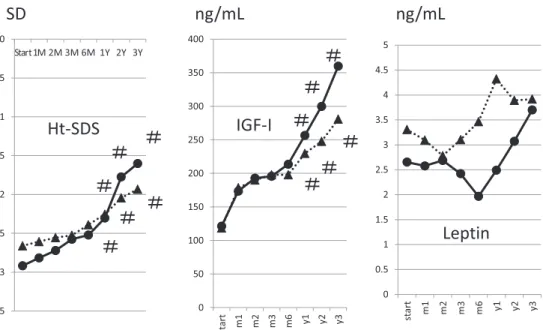
Fig. 1 Time sequence of changes in height (Ht) SDS, IGF-I, and leptin before the start
of GH treatment and for the first 3 years of treatment in the SGA (circle symbol) and GHD (triangle symbol) groups. Note the significant increase in Ht SDS and IGF-I during the first year of treatment, with ongoing (although more gradual) increases thereafter in both groups. Significant changes from baseline to each year of GH treatment (#p<0.05) are indicated.
Start
I
−2.92 to −1.60, p<0.01; GHD: −2.66 to −1.93, p< 0.01; SGA vs GHD at 3 years, p=0.21) and IGF-I level (SGA: 121.5 to 359.9, p<0.01; GHD: 118.6 to 280.8, p< 0.01; SGA vs GHD at 3 years, p=0.12). No significant differences in the changes in height SDS or IGF-I measurements after three years of GH treatment were seen between the two groups. During the first 6 months, the leptin levels decreased by 25 % in
SGA children, indicating a body fat reduction. Thereafter, these levels increased to a value that was not significantly different from the pretreat-ment values (Fig. 1).
BMI SD, BMI percentile, and percent over-weight
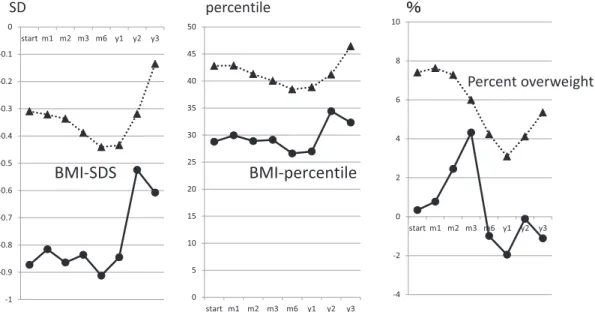
At the start of GH treatment, the mean SD for BMI was −0.87, which was lower than zero, indicat-ing that untreated children born with SGA had a lean and fragile body mass and reflecting a subopti-mal nutritional status. After 3 years of GH treat-ment, it had increased, but not significantly, com-pared to the baseline value, with values that were closer to zero. The increment in the BMI SD-score was not significantly different between these two groups during GH treatment. The changes in BMI percentile and percent overweight were not signifi-cantly different between the GHD group and the SGA group during the 3-year study period (Fig. 2).
Lipids & HbA1c
The mean pretreatment lipid profiles and HbA1c levels were normal in both groups. Four children had a TC level of more than 200 mg/dL, one child had an LDL cholesterol level of more than 140 mg/
Fig. 2 Body mass index (BMI) SD-score, BMI percentile and percent overweight using
reference values for healthy Japanese children according to sex, chronological age, height and weight at baseline and during 3 years of GH treatment in the SGA (circle symbol) and GHD (triangle symbol) groups.
Fig. 3 Time sequence for changes in total cholesterol, LDL cholesterol, HDL cholesterol
and HbA1c at baseline and during 3 years of GH treatment in the SGA (circle symbol) and GHD (triangle symbol) groups.
dL, and none of the children had an HDL cholesterol level of less than 40 mg/dL in the SGA group. De-spite the observed decreases during the 3-year GH treatment period in the SGA group, the mean TC, LDL, and HDL measurements did not exceed the normal limits for healthy children, and the subjects in this study were considered normotensive. After
3 years of GH treatment for SGA, one of the dren had an abnormal TC, whereas none of the chil-dren had an LDL cholesterol level of more than 140 mg/dL and one child had an HDL cholesterol level of less than 40 mg/dL. The mean HbA1c values had marginally increased in both groups after 3 years of GH treatment (0.08 % and 0.17 % in the SGA and
GHD groups, respectively ) , although none of the subjects exceeded the upper limit of the HbA1c ref-erence range (4.3 %-5.8 %) (Fig. 3).
Discussion
We decided to compare SGA children with al-ready well-described GHD children. It would have been useful to have two measurements at different times after the start of GH treatment so as to quan-tify the effect of GH more precisely in each group8)
. A lack of treatment might provide a psychological advantage (no injection stress ) or a disadvantage (thoughts that no one is doing anything about my short stature ), while the use of placebo injections is not acceptable to many parents whose SGA chil-dren have often had varying degrees of traumatic hospital experiences in the past. Both the SGA and the GHD children showed similar increases in height SDS after three years of GH treatment. An indicator of GH sensitivity, the IGF-I level, was measured throughout this study; these levels were low at the start of treatment but increased in a simi-lar manner in both groups. GH is a crucial regulator of substrate metabolism during fasting, and its ana-bolic actions are tightly coupled with energy bal-ance. A low adiposity in SGA children may reflect a suboptimal energy balance and may alter their sen-sitivity to GH.
BMI expressed as the SDS for age, which is a bet-ter paramebet-ter for assessing the degree of over-weightness since it takes into account age as well as height, has not been studied extensively in SGA children. Correction for age is important because the BMI changes substantially with age, decreasing during preschool years and then increasing into adulthood9)10)
. Unfortunately, no reference values are available for the BMI SD score in untreated short children born with SGA. Therefore, the natu-ral development of the BMI SD score in these chil-dren remains unknown ; consequently, we cannot prove whether the changes in the BMI SD score during treatment are caused by GH. In the present study, however, during the 3 years of treatment, the height SD score and the IGF-I improved signifi-cantly, while the BMI SD score, BMI percentile, and percent overweight did not change. Therefore, it is
likely that the changes in the BMI SD score during the GH treatment are more a result of the natural childhood growth of subjects with a short stature who were born with SGA or that the changes in the BMI SD score reflect catch-up growth in these chil-dren, rather than a direct effect of the GH treat-ment. GH causes the body to utilize fat mass stores for energy to aid in the production of muscle, which is proportionally increased in patients receiving GH. It is possible that GH may have affected body com-position, as GH promotes the development of mus-cle over fat, but specific tests such as dual-energy X-ray absorptiometry would be needed to show such a change11)
.
Leptin, the first adipocyte hormone identified, in-fluences food intake through a direct effect on the hypothalamus. In humans and rodents, plasma leptin concentrations are strongly correlated with the BMI12)
. Far from hormonally inert, adipose tis-sue has, in recent years, been recognized as a major endocrine organ, as it produces hormones such as leptin, PAI-1, resistin, and the cytokine TNFα. Moreover, adipose tissue can affect other organ sys-tems of the body and may lead to disease. Our leptin data in SGA is comparable with the results of fat and muscle measurements made using magnetic resonance imaging and described by Leger et al.13)
. They reported an increase in the cross-sectional area of muscle tissue in 14 prepubertal short chil-dren born with SGA but without GH deficiency dur-ing 3 years of GH treatment with 0.2 IU/kg per day (!6 IU/m2
per day). In addition, the adipose tissue cross-sectional area showed an initial decrease dur-ing the first year of treatment, followed by an in-crease during the second and third years to values similar to those in a control group of GHD children. GH increases basal lipolysis and increases the activ-ity of hormone-sensitive lipase, resulting in a rapid decrease in the adipose area and an increase in muscle tissue. It seems likely that the reduction in leptin levels is attributable to the reduction in adi-pose tissue mass that occurs during GH treatment.
GH deficiency is associated with dyslipidemia. Barker et al demonstrated a negative correlation between birth weight and syndrome X
(hyperten-sion, diabetes mellitus type 2, and hyperlipidemia) in adult men14)
. Being born with SGA has been asso-ciated with the onset of hyperlipidemia at a rela-tively young age later in life15)
hence, we were inter-ested in the effect of GH therapy on the lipid pro-files in these patients. The pretreatment levels of TC and LDL-C in the SGA group were normal, com-pared with those in the GHD group which were slightly low. An analysis of the change from the baseline TC and LDL-C values in a model that in-cluded the baseline values as covariates showed treatment differences for TC and LDL, and a clear trend towards a reduction in both lipid parameters was evident in the SGA group. In a previous study, no change in the HDL-C levels was seen during GH treatment16)
. Further investigations are warranted to evaluate the impact of GH treatment on lipid pa-rameters in children born with SGA in greater de-tail. Long-term monitoring is needed to assess whether the effects of GH on the lipid profiles of children with SGA or GHD has long-term benefits (or risks) for their metabolic health.
GH therapy is known to affect glucose homeosta-sis and insulin action. Despite slight increases in HbA1c during the initial 3 years of this study, no clinically relevant HbA1c changes were observed, and none of the patients were classified as diabetic type . SGA children with spontaneous catch-up growth are at an increased risk of developing type 2 diabetes17)
, in addition to other chronic conditions that are risk factors for cardiovascular disease. Therefore, it is encouraging that these data suggest that in Japanese children born with SGA, prolonged GH treatment is not associated with the develop-ment of diabetes. These data are in accordance with recent studies demonstrating that long-term GH treatment did not increase the risk of type 2 dia-betes and metabolic syndrome in young adults born with SGA18)
. Nevertheless, our data is limited to the first 3 years of GH therapy, and further studies with an extended follow-up period lasting until the final stature has been reached are needed to confirm that the non-diabetic type persists after 3 years of GH treatment and that the treatment affects the fi-nal height of children with SGA or GHD.
Conclusion
GH treatment had a positive impact on height, and any changes observed in safety parameters, such as lipid profiles, HbA1c and BMI SD, were con-sidered to be correlated with the natural course of childhood growth and to be clinically insignificant.
Acknowledgements
We thank the staff members of the Department of Pediatrics, Tokyo Women s Medical University Medical Center East, for their efforts and collaboration.
The authors declare that there are no conflicts of in-terest.
References
1)Breukhoven PE, Kerkhof GF, van Dijk M et al: Long-term impact of GH treatment during child-hood on body composition and fat distribution in young adults born SGA. J Clin Endocrinol Metab
96: 3710―3716, 2011
2)Tanaka T, Yokoya S, Seino Y et al: Long-term ef-ficacy and safety of two doses of growth hormone in short Japanese children born small for gesta-tional age. Horm Res Paediatr 76: 411―418, 2011 3)Berndt C, Schweizer R, Ranke MB et al: Height,
muscle, fat and bone response to growth hormone in short children with very low birth weight born appropriate for gestational age and small for gesta-tional age. Horm Res Paediatr 82: 81―88, 2014 4)Sas T, Mulder P, Aanstoot HJ et al: Carbohydrate
metabolism during long-term growth hormone treatment in children with short stature born small for gestational age. Clin Endocrinol 54 (2): 243―251, 2001
5)Mericq V, Ong KK, Bazaes R et al: Longitudinal changes in insulin sensitivity and secretion from birth to age three years in small- and appropriate-for-gestational-age children. Diabetologia 48: 2609― 2614, 2005
6)Kato N, Takimota H, Sudo N: The cubic functions for spline smoothed L, S and M values for BMI ref-erences of Japanese children. Clin Pediatr Endocri-nol 20: 47―49, 2011
7)Tanaka T, Yokoya S, Kato N et al: The basic idea for the evaluation of physique of Japanese children (transl). J Jpn Assoc Hum Auxol 17: 84―99, 2011 8)Meazza C, Pagani S, Pietra B et al: Different
long-term response to growth hormone therapy in small-versus appropriate-for-gestational-age chil-dren with growth hormone deficiency. Horm Res Paediatr 79: 214―219, 2013
9)Kramer MS, Martin RM, Bogdanovich N et al: Is restricted fetal growth associated with later adipos-ity? Observational analysis of a randomized trial. Am J Clin Nutr 100: 176―181, 2014
Adiposity in children born small for gestational age is associated with β-cell function, genetic variants for insulin resistance and response to growth hor-mone treatment. J Clin Endocrinol Metab 101: 131― 142, 2016
11)Gunn KC, Cutfield WS, Hofman PL et al: Consti-tutional delay influences the auxological response to growth hormone treatment in children with short stature and growth hormone sufficiency. Sci Rep 4: 6061, 2014
12)Maffei M, Halaas J, Ravussin E et al: Leptin lev-els in human and rodent: measurement of plasma leptin and ob RNA in obese and weight-reduced subjects. Nat Med 1: 1155―1161, 1995
13)Leger J, Carel C, Fjellestad-Paulsen A et al: Hu-man growth hormone treatment of short-stature children born small for gestational age : effect on muscle and adipose tissue mass during a 3-year treatment period and after 1 year s withdrawal. J Clin Endocrinol Metab 83: 3512―3516, 1998
14)Barker DJ, Hales CN, Fall CH et al: Type 2 (non-insulin-dependent) diabetes mellitus, hypertension and hyperlipidaemia (syndrome X): relation to
re-duced fetal growth. Diabetologia 36: 62―67, 1993 15)Sas T, Mulder P, Hokken-Koelega A: Body
com-position, blood pressure, and lipid metabolism be-fore and during long-term growth hormone (GH) treatment in children with short stature born small for gestational age either with or without GH defi-ciency. J Clin Endocrinol Metab 85: 3786―3792, 2000 16)Kappelgaard AM, Kiyomi F, Horikawa R et al:
The impact of long-term growth hormone treat-ment on metabolic parameters in Japanese patients with short stature born small for gestational age. Horm Res Paediatr 81: 272―279, 2014
17)Dulloo AG: Thrifty energy metabolism in catch-up growth trajectories to insulin and leptin resistance. Best Pract Res Clin Endocrinol Metab 22: 155―171, 2008
18)van Dijk M, Bannink EM, van Pareren YK et al: Risk factors for diabetes mellitus type 2 and meta-bolic syndrome are comparable for previously growth hormone-treated young adults born small for gestational age (SGA) and untreated short SGA controls. J Clin Endocrinol Metab 92: 160―165, 2007
SGA 性低身長症における成長ホルモンの体格および脂質代謝に及ぼす影響 東京女子医科大学東医療センター小児科 マツオカ ヒサフミ ヤ ス ダ ユ ウ キ スギハラ シゲタカ 松岡 尚史・安田 祐希・杉原 茂孝 〔緒言〕SGA 性低身長症小児の体組成に及ぼす成長ホルモン(GH)の影響については,本邦での報告がない. 成長ホルモン分泌不全性低身長(GHD)小児との GH 治療期間中の体格の経時的な比較をすることで検討した. 〔対象と方法〕SGA 群 16 名,GHD 群 30 名を対象として,GH 治療期間中に 6 月ごとに外来受診時に身体計測と 成長関連および糖脂質代謝パラメーターの血液検査を施行して,治療開始前後および両群間で比較検討した. 〔結果〕3 年間にわたる GH 治療期間中,SGA 群では GHD 群と同様に身長 SD スコアおよび IGF-1 は両群ともに 治療開始後,有意に増加したが,糖脂質代謝および血中レプチン値に変化はなかった.BMI SD スコア,BMI パー センタイル,肥満度の各体格指数は治療前後および両群間で有意な変化を認めなかった. 〔結論〕SGA 性低身長症における GH 治療は有意な身長増加をもたらすが,体格に及ぼす影響はなく自然な成長 パターンでの身長増加効果がある.この間,糖尿病や脂質異常などの副作用出現はみられなかった.