平成 26 年度電気関係学会四国支部連合大会 講演論文集 (2014 徳島大学)
2014 SHIKOKU-SECTION JOINT CONVENTION RECORD OF THE INSTITUTES OF ELECTRICAL AND RELATED ENGINEERS (TOKUSHIMA)
Relationship between Structure and Phenomena of CNN Using Three Kinds of Cloning Templates
Mana Tanaka1, Yasuteru Hosokawa1, Yoshifumi Nishio2 (1Shikoku University,2Tokushima University)
1. Introduction
Cellular neural network [1] using three cells can gen- erate double scroll type attractors [2]. In our previous studies, cellular neural networks using three kinds of cloning templates was proposed as one of chaotic os- cillatory system [3]. Some interesting phenomena was observed. However, these phenomena was not investi- gated in detail.
In this study, relationship between structures and phenomena observed in cellular neural networks using three kinds of cloning templates are investigated.
2. Cellular Neural Networks Using Three Kinds of Cloning Templates
Figure1shows a structure of CNN using three kinds of cloning templates. Cells are coupled as triangle lat- tice. The system consists of three kinds of cells which names are Cellα, Cellβ or Cell γ. The difference of three kinds of cells is only values of cloning templates.
The boundary condition is set as a periodic condition.
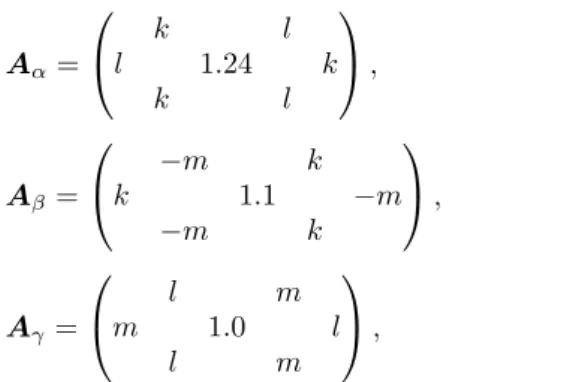
Namely, this system has a torus structure. In order to keep a symmetric property, symmetric cloning tem- plate parameters are set as follows.
Aα=
k l
l 1.24 k
k l
,
Aβ=
−m k
k 1.1 −m
−m k
,
Aγ =
l m
m 1.0 l
l m
,
(1)
where k, l, mshow the coupling strengths between Cellαand Cell β, Cellαand Cell γ, Cell β and Cell γ, respectively.
3. Simulations
The cases that the number of cells is three, six, nine, twelve, eighteen, twenty-four and thirty-six are inves- tigated in this study. By increasing the number of cells, some interested phenomena are observed. Fig- ure2shows one of observed phenomena. In some area, synchronization of switching is observed. Additionally, in the nine cells case, synchronization phenomena can be observed and waveforms of same kinds of cells be- come same, respectively.
:α :β :γ
i
j
c(1,1) c(1,2) c(1,3) c(1,N)
c(2,1) c(2,2) c(2,3) c(2,N)
c(3,1) c(3,2) c(3,3) c(3,N)
c(i,1) c(i,2) c(i,j) c(i,N)
c(M,1) c(M,2) c(M,j) c(M,N)
Fig. 1: Structure of cellular neural networks using three kinds of cloning templates.
Fig. 2: Waveforms in the case of twelve cells. k=
−1.03, l=−1.07 and m= 1.47.
4. Conclusions
In this study, relationship between structures and phenomena of CNN using three kinds of cloning tem- plates has been investiated. As results, some interest- ing phenomena were observed. Additionally,, we con- firmed that increasing the number of cells expands the parameter region of oscillations.
References
[1] L. O. Chua and L. Yang, “Cellular Neural Networks: The- ory,”IEEE Trans. Circuits Syst., vol. 35, no. 10, pp. 1257–
1272, 1988.
[2] F. Zou, and J. A. Nossek, “Bifurcation and chaos in cel- lular neural networks,” IEEE Trans. Circuits Syst. I, vol. 40, no. 3, pp. 166–173, 1993.
[3] M. Tanaka, Y. Hosokawa and Y. Nishio, “Relationship be- tween a Number of Cells and Phenomena in Cellular Neu- ral Networks Using Three Kinds of Cloning Templates,”
RISP Proc. NCSP’14533–536, 2014.
1-19
19