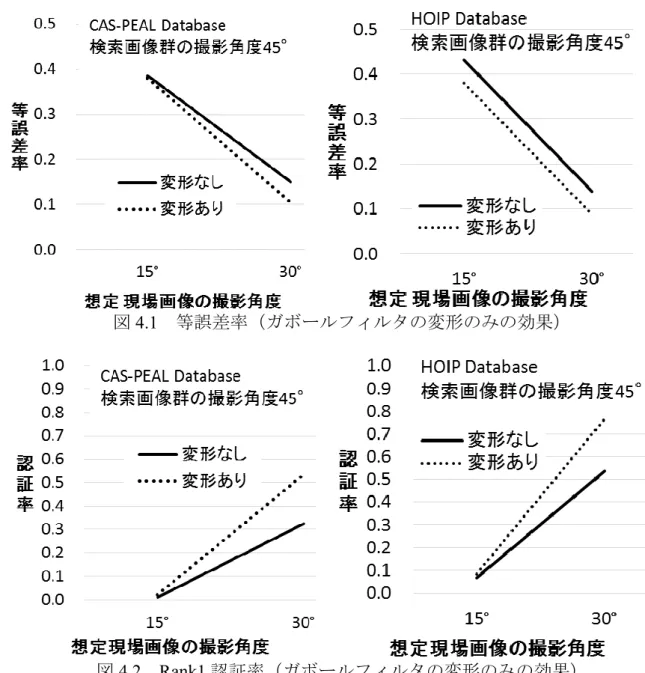
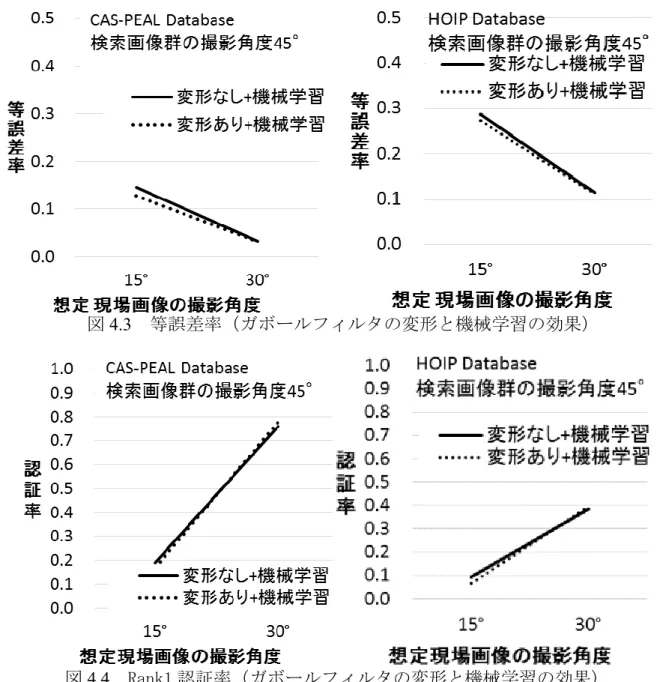
目次
第1 章 はじめに ... 1 1.1 背景 ... 1 1.2 概要 ... 2 第2 章 1 枚の画像を基にした耳介認証の平面外回転に対するロバスト化 ... 3 2.1 耳介特徴点の検出 ... 3 2.1.1 検出に関する先行研究 ... 3 2.1.2 耳介特徴点とガボール特徴量 ... 3 2.1.3 Jet 空間類似度に基づく耳介特徴点の検出 ... 4 2.1.4 回転方向の定義 ... 5 2.1.5 実験に使用するデータベース ... 6 2.1.6 正解座標の作成 ... 6 2.1.7 検出実験条件 ... 7 2.1.8 検出精度の評価方法(等誤差率) ... 8 2.1.9 検出実験結果 ... 8 2.1.10 耳介特徴点検出のまとめ ... 11 2.2 撮影角度の差に対するロバスト化(LJT) ... 11 2.2.1 耳介認証に関する先行研究 ... 112.2.2 Linear Jet Transform ... 11
1.2 概要
第2 章 1 節では,耳介特徴点の検出について述べる.捜査支援システムの実用化 にあたっては,運用コストの観点から検索対象画像群および現場画像に対して,自 動的に耳介特徴点が検出できることが望まれる.特に現場画像の被写体の撮影角度 の固定は不可能であることから,撮影角度にばらつきがあってもロバストに検出が できるかどうかということを論じる.𝐚 =|𝑦×𝐧|𝑦×𝐧 = (−cosφ 0 sinφ) (2.3)
𝐛 = 𝐧×𝐚
|𝐧×𝐚|= (sinθsinφ cosθ sinθcosφ) (2.4)
となる.(2.3),(2.4)式から 3 次元上の点(𝑥,𝑦,𝑧)を,カメラ平面上の座標(𝑢,𝑣) に投影する投影式
(𝑢 𝑣) = (
−cosφ 𝟎 sinφ sinθsinφ cosθ sinθcosφ) (
に含めない状態で5 通りの実験を行い検出精度の平均を求め評価を行う.
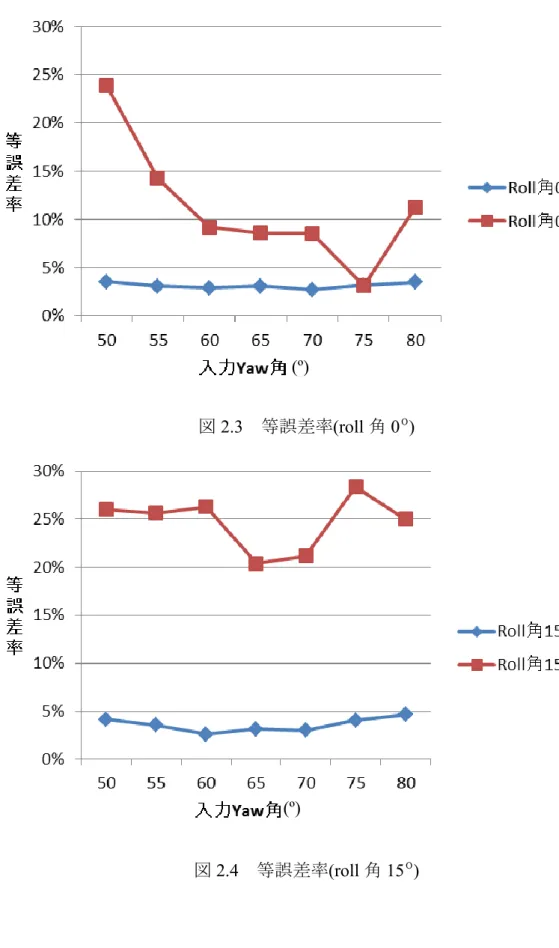
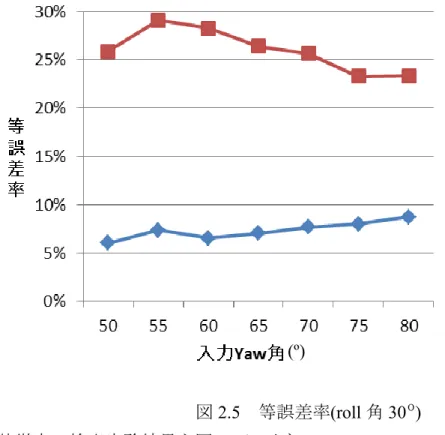
2.1.8 検出精度の評価方法(等誤差率)
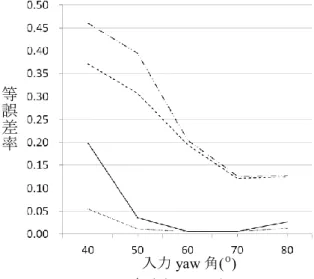
図2.3 等誤差率(roll 角 0º)
図2.4 等誤差率(roll 角 15º) (º)
上しており,特に対耳輪後脚で約40%の改善がみられる.
2.1.10 耳介特徴点検出のまとめ
耳介特徴点を検出するアルゴリズムの提案を行った.このアルゴリズムの特徴は, 第一にガボール特徴量の主成分復元との相関であるjet 空間類似度を用いて耳介形 状の探索を試みたことである.これは,撮影角度の変化に対応するためである.第 二に,平均耳グラフを変形する際に,主成分方向に変形を限定したことである.こ れは探索方向の限定により誤検出を減らすためである. 実験結果からyaw 角 50ºから 80ºまで,roll 角 0ºから 30ºまでの実験範囲におい て耳介特徴点をロバストに検出できることを示した.2.2 撮影角度の差に対するロバスト化(LJT)
2.2.1 耳介認証に関する先行研究
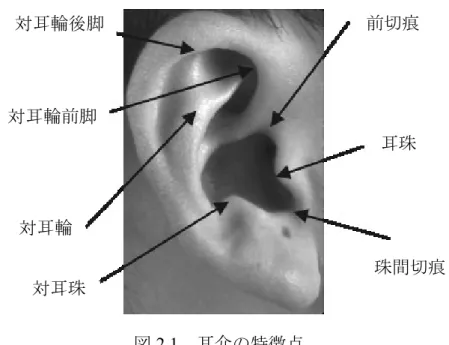
これまで,パターンスペクトル[15],主成分分析[16],force field[17],GA[18]など を利用した手法をはじめ,多数の手法[19][20][21][22]が提案されているものの,撮 影角度の違いの問題への対応を試みた研究は数少ない.高精度な3 次元の入力デー タを利用したもの[23][24],あるいは連続的なビデオ画像を利用したもの[25]がある のみである.ところが防犯カメラから得られる画像は,通常3D ではなく 2D であ る.また認証に利用できる解像度を持つ防犯カメラは,フレームレートが高くなく 連続的なビデオ画像とはいえない. 法医学分野においては,上方向への撮影角度の変化は,例えば耳たぶの分類を変 化させると報告された[5].また防犯カメラ画像の解像度の低さから,耳の分類に際 し注意深い精査が推奨される.例えば珠間溝の出現は画質に強く依存し,舟状窩は 途切れないものが連続するように写っているように見える[6].このことから,低解 像度の問題とともに撮影角度の違いの問題は,耳介を用いた捜査支援システムを法 医学コミュニティに受け入れてもらうためには解決しなければならない.2.2.2 Linear Jet Transform
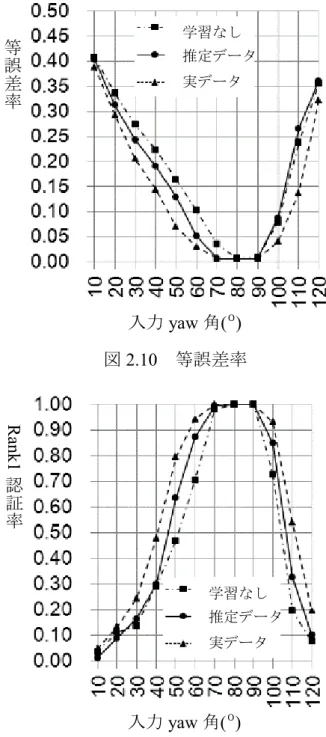
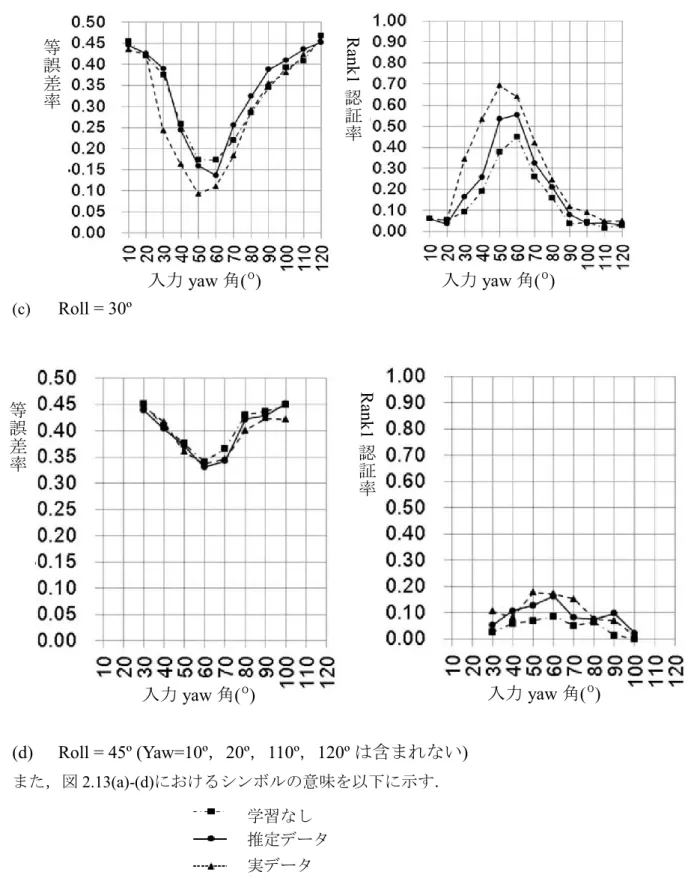
2.3.3 撮影角度の差に関する実験結果
2.3.4 解像度に関する実験結果
様々な解像度における,3 つの手法の EER および Rank1 認証率と入力画像の yaw 角の関係を示す.まず登録画像の撮影角度が yaw 角 45ºの実験結果を図 2.15 に示 す. (a) 解像度 100%,Roll = 0º (b) 解像度 50%,Roll = 0º 等 誤 差 率 等 誤 差 率
入力入力yaw 角(º) yaw 角(º) 入力入力yaw 角(º) yaw 角(º)
調査する.
3.2 超解像処理の影響
3.2.1 超解像処理の影響への対策
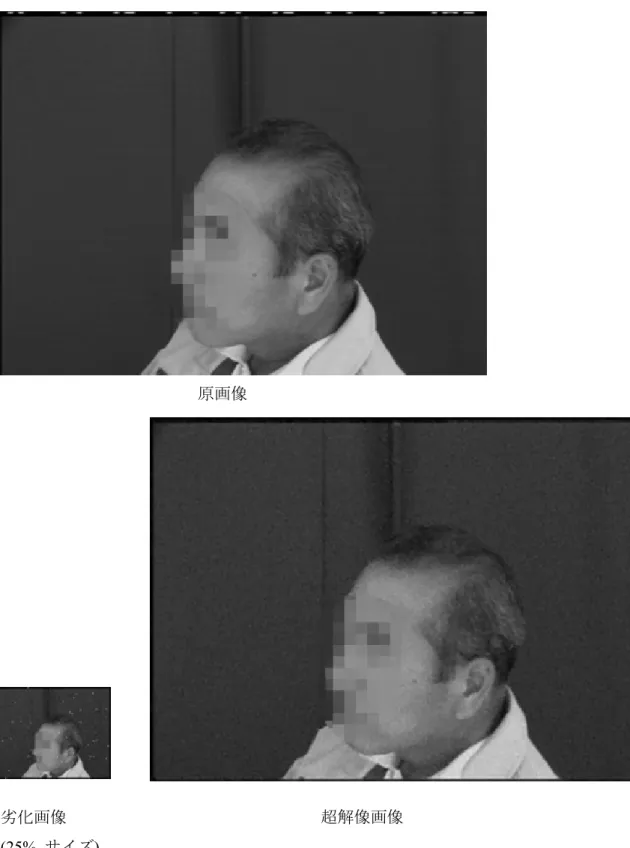
2 章 2 節では,法線ベクトルモデルを作成するとき,劣化やゆがみのない画像を 用いた.次に超解像処理による影響への対策として,高精度な登録画像から低解像 度およびノイズのある劣化画像を作成し,その劣化画像から超解像画像を作成し, 法線ベクトルモデルを構築する.この法線ベクトルモデルを用いて,異なる撮影角 度のガボール特徴量を推定し判別分析で学習する.3.2.2 実験データセットおよび評価方法
図3.1 劣化画像と超解像処理で解像度をあげた画像の例 原画像
超解像画像 劣化画像
図3.5 イヤリングをつけた人の耳介画像(*r は反転画像) 影響の評価のために,まず類似度を求め,そこから rank を求める.そしてイヤ リングをつけた人を含むグループとイヤリングをつけた人を含まないグループに 分け,それぞれのrank[14]の平均を求め検定を行って評価する.
3.4.2 イヤリングの影響の実験結果
まず表3.1 に,イヤリングを含む集団における rank を示す.見出し行に入力画像 の撮影角度を示し,見出し列には耳介画像名を示している.最後の 2 行は rank の 各角度における平均と標準偏差を示している.登録画像の撮影角度65ºから離れる につれて認証精度が低下する傾向があることがわかる. 表3.1 イヤリングを含む集団の各角度における rank謝辞
この研究テーマを指導してくださった渡部大志教授,協力してくださった崔英泰 氏,相馬貢士氏をはじめとした渡部研究室のOB 諸氏に深く感謝します.本研究は JSPS 科研費 JP15K00191,JP24500260,JP22700219 の助成を受けたものです.HOIP データベースを利用許諾くださったソフトピアジャパンに感謝します.参考文献
[1] “http://jpn.nec.com/press/201603/20160307_01.html(最終閲覧日2016/10/18).” [Online].Available: http://jpn.nec.com/press/201603/20160307_01.html. [2] “https://www.nttdocomo.co.jp/service/suguden/about/(最終閲覧日2016/10/18).” [Online].Available: https://www.nttdocomo.co.jp/service/suguden/about/. [3] A.Bertillon, Signaletic Instructions: Including the Theory and Practice of Anthropometrical Identification (1896).Kessenger Legacy Reprints, 1896. [4] A.V.Iannarelli, Iannarelli system of ear identification.Foundation Press,Brooklyn, NY, 1989. [5] 森好 浩行, 三好 美紀, 日野 大樹, 中山 英樹, 森川 俊雄, 中木 真一糸原 幸次, “撮影角度の異なる画像間における耳介の個人識別,” 日本法科学技術 学会誌, vol.12, no.1, pp.27–34, 2007. [6] 森好 浩行, 三好 美紀, 日野 大樹, 中山 英樹, 森川 俊雄, 中木 真一糸原 幸次, “耳介各部の形態分類と各部における形態特徴間の関連性に関する研 究,” 日本法科学技術学会誌, vol.14, no.2, pp.61–70, 2009.
[7] S.Prakash, U.Jayaraman, and P.Gupta, “Ear Localization from Side Face Images using Distance Transform and Template Matching,” in Proc.of the First Workshops on Image Processing Theory, Tools and Applications, 2008, vol.1, pp.1–8.
[8] L.Yuan and F.Zhang, “Ear detection based on improved adaboost algorithm,” in Proc.of the 2nd International Conference on Biometrics ICB.nternational
Conference on Machine Learning and Cybernetics, 2009, 2009, vol.4, no.July, pp.2414–2417.
real-time surveillance,” in Proc.of the Fourth IEEE International Conference on Biometrics: Theory Applications and Systems (BTAS), 2010, 2010, pp.1–6. [10] P.Yan and K.W.Bowyer, “Biometric recognition using 3D ear shape.” IEEE
Trans.Pattern Anal.Mach.Intell. vol.29, no.8, pp.1297–1308, Aug. 2007.
[11] L.Wiskott, J.-M.Fellous, N.Kuiger, and C.von der Malsburg, “Face
recognition by elastic bunch graph matching,” IEEE Trans.Pattern Anal.Mach. Intell. vol.19, no.7, pp.775–779, Jul.1997.
[12] D.Watabe, H.Sai, K.Sakai, and O.Nakamura, “Improving the Robustness of Single-View Ear-Based Recognition under a Rotated in Depth Perspective,” 2011 Int.Conf.Biometrics Kansei Eng. pp.179–184, Sep.2011.
[13] K.Yamamoto and Y.Niwa, “Human and Object Interaction Processing (HOIP) project.” in Joho Shori Gakkai Shinpojiumu Ronbunshu (in Japanese), 2002, p. 379–384.
[14] ISO/IEC, “Information technology — Biometric performance testing and reporting — Part 1: Principles and framework,” in ISO/IEC 19795-1, 2006.
[15] 篠原克幸, 南敏, and 結城義徳, “モルフォロジー演算を用いた耳介画像によ る個人識別,” 画像電子学会誌, vol.21, no.5, pp.528–534, 1992.
[16] K.Chang, K.W.Bowyer, S.Sarkar, and B.Victor, “Comparison and
combination of ear and face images in appearance-based biometrics,” IEEE Trans. Pattern Anal.Mach.Intell. vol.25, no.9, pp.1160–1165, 2003.
[17] D.J.Hurley and M.S.Nixon, “Force field energy functionals for image feature extraction,” Image Vis.Comput. vol.20, no.5–6, pp.311–317, 2002.
[18] Y.Wang, H.Tsurusawa, T.Yuizono, K.Sato, and S.Nakayama, “Study on Human Recognition by Ear Image Based on Genetic Local Search,” IEEJ Trans. Electron.Inf.Syst. vol.124, no.6, pp.1267–1273, 2004.
[19] S.Barra, M.D.Marsico, N.M. and D.Riccio, “Unconstrained Ear Processing: What is Possible and What Must Be Done,” in Signal and Image Processing for Biometrics, 2014, pp.129–190.
[20] A.Abaza, A.Ross, C.Hebert, M.A.F.Harrison, and M.Nixon, “A Survey on Ear Biometrics,” ACM Trans.Embed.Comput.Syst. vol.9, no.4, p. 39:1-39:31, 2010.
[22] L.Yuan, Z.C.Mu, and F.Yang, “A Review of Recent Advances in Ear Recognition,” Proc.6th Chinese Conf.Biometric Recognit.CCBR, pp.252– 259, 2011.
[23] H.Chen and B.Bhanu, “Human ear recognition in 3D,” IEEE Trans.Pattern Anal.Mach.Intell. vol.29, no.4, pp.718–737, 2007.
[24] P.Yan and K.Bowyer, “An automatic 3D ear recognition system,” in Proc of the Third Int’l Symp.3D Data Processing, VisualizationVisualization, and
Transmission, 2006, pp.213–218.
[25] S.Cadavid and M.Abdel-mottaleb, “3D Ear Modeling and Recognition from Video Sequences using Shape from Shading,” in Proc.of the 19th International Conference on Pattern Recognition, 2008.ICPR 2008. 2008, pp.1–4. [26] D.Watabe, Z.Huang, K.Souma, H.Sai, K.Sakai, and O.Nakamura,
“Improving Robustness of Single-view-based Recognition of Ears Rotated in Depth,” J.Inst.Image Inf.Telev.Eng.japanese), vol.65, no.7, pp.1016– 1023, 2011.
[27] K.Fukunaga, Introduction to Statistical Pattern Recognition.Academic Press, San Diego, CA, 1990.
[28] D.Watabe, H.Sai, K.Sakai, and O.Nakamura, “Ear biometrics using jet space similarity,” in Proc.of the IEEE Canadian Conference on Electrical and Computer Engineering, 2008.CCECE 2008. 2008, no.1, pp.1259–1264.
[29] H.Biwasaka et al. “Assessment of Computerized Method for Correction of Optical Distortion of Facial Images,” Japanese J.Forensic Sci.Technol. vol. 13, no.1, pp.7–16, 2008.
[30] S.Farsiu, M.D.Robinson, M.Elad, and P.Milanfar, “Fast and robust multiframe super resolution.” IEEE Trans.Image Process. vol.13, no.10, pp.1327–44, Oct.2004.
[31] S.Z.Li and A.K.Jain, Eds. Handbook of Face Recognition.London: Springer London, 2011.
[32] W.Zhao, R.Chellappa, P.J.Phillips, and A.Rosenfeld, “Face Recognition : A Literature Survey,” ACM Comput.Surv. vol.35, no.4, pp.399–458, 2003. [33] S.Prince, “Computer Vision (Models, Learning, and Inference) Algorithms,” pp.
1–75, 2013.
[1]–[3][3]–[10][11]–[31]
南谷崇成 研究業績一覧 2017.2.6 学術論文
[1] 南谷崇成, 崔英泰, 渡部大志, “Gabor フィルタの変形による耳介認証の撮影角度差への
対策,” 日本感性工学会論文誌, vol. 15, no. 6, pp. 659–669, 2016.
[2] D. Watabe, T. Minamidani, W. Zhao, H. Sai, and J. Cao, “Examining Barrel
Distortion , Super-resolution on Single-view-based Ear Biometrics Rotated in Depth,”
Int. J. Affect. Eng., vol. 14, no. 2, pp. 103–110, 2015.
[3] D. Watabe, Y. Wang, T. Minamidani, H. Sai, K. Sakai, and O. Nakamura, “Empirical Evaluations of a Single-view-based Ear Recognition when Rotated in Depth,” Kansei Eng. Int. J., vol. 11, no. 4, pp. 247–257, 2012.
国際会議
[4] D. Watabe, T. Minamidani, and H. Sai, “Another attempt at estimating the shooting angle in ear recognition,” in International Symposium on Affective Science and Engineering 2017, 2017, p. Accepted for presentation.
[5] D. Watabe, T. Minamidani, H. Sai, T. Maeda, T. Yamazaki, and J. Cao, “Estimating a Shooting Angle in Ear Recognition,” in Lecture Notes in Computer Science, K. Saeed and W. Homenda, Eds. Warsaw, Poland: Springer International Publishing, 2015, pp. 559–568.
[6] D. Watabe, T. Minamidani, H. Sai, and J. Cao, “Comparison of Ear Recognition Robustness of Single-View-Based Images Rotated in Depth,” in 2014 Fifth
International Conference on Emerging Security Technologies (EST), 2014, pp. 19–23. [7] D. Watabe, T. Minamidani, and H. Sai, “Single-view-based ear biometrics rotated in
depth: effects of variations in angle of ear overhang,” in 2013 International Workshop on Smart Info-Media Systems in Asia (SISA2013) SS-BioX-1, pp.87-92, 2013.
[8] D. Watabe, T. Minamidani, W. Zhao, H. Sai, and J. Cao, “Effect of barrel distortion and super-resolution for single-view-based ear biometrics rotated in depth,” in 2013 International Conference on Biometrics and Kansei Engineering, 2013, pp. 183–188. [9] D. Watabe, T. Minamidani, H. Sai, K. Sakai, and O. Nakamura, “Improving the
Robustness of Single-View-Based Ear Recognition When Rotated in Depth,” in
International Conference on Neural Information Processing, Lecture Notes in Computer Science, 2012, vol. 7667, no. V, pp. 177–187.
![図 3.5 イヤリングをつけた人の耳介画像(*r は反転画像) 影響の評価のために,まず類似度を求め,そこから rank を求める.そしてイヤ リングをつけた人を含むグループとイヤリングをつけた人を含まないグループに 分け,それぞれの rank[14] の平均を求め検定を行って評価する. 3.4.2 イヤリングの影響の実験結果 まず表 3.1 に,イヤリングを含む集団における rank を示す.見出し行に入力画像 の撮影角度を示し,見出し列には耳介画像名を示している.最後の 2 行は rank](https://thumb-ap.123doks.com/thumbv2/123deta/10124490.1958460/44.892.128.782.139.293/イヤリンググループイヤリンググループイヤリングイヤリング.webp)