INTRODUCTION OF A CASE OF HIGH
SCHOOL-UNIVERSITY COLLABORATIVE PROGRAM SUPPORTED BY JAPANESE GOVERNMENTS: PROMOTION
OF EARTH SCIENCE EDUCATION IN HIGH SCHOOL
Akihiko NAIKI*
Abstract The author conducted earth science course as a part of high school earth science education in collaboration with universities and research institutes. These sessions consisted of lectures, field excursions, laboratory experiments and a summary presentation. During the fiscal periods between 2003 and 2014, the author carried out 15 Science Partnership Programs (SPP) with the support of the Ministry of Education, Culture, Sports, Science and Technology of Japan (MEXT) or Japan Science and Technology Agency (JST). These programs were of great significance for the development and promotion of earth science education and beneficial to many students, schools, teachers, universities and research institutes that participated.
Key words:Science Partnership Programs (SPP), earth science education, high school-university collaboration, competitive funding
1. Introduction
Japan is located in a humid and tectonically active region of Far East Asia. Natural disasters, for example, earthquakes and tsunamis, volcanic eruptions, river floods and landslides, occur frequently in Japan. Earth science education in school is important for disaster prevention and mitigation. However, little emphasis has been placed on earth science education in high school (e.g.
Tamura 2008).
The Course of Study in high school introduced by Ministry of Education, Culture, Sports, Science and Technology of Japan (MEXT) (2009) states that curriculum should 1) provide opportunities for students to have hands-on experience in performing observations and experiments with target objectives in mind, in analyzing observation/experiment results, in drawing his/her own conclusions, and in presenting findings. And 2) actively seek guidance and cooperation from universities, research institutes, and museums. It is important to incorporate field observations as part of the research process. In response to the Course of Study, the MEXT designed and implemented the Science Partnership Program (SPP) as a competitive funding opportunity in the 2002 fiscal year.
The author recognizes the importance of scientific observation and experimental (hands-on) ______________________________________________________________________________
* Tokyo Metropolitan Hakuo Senior High School-Junior High School.
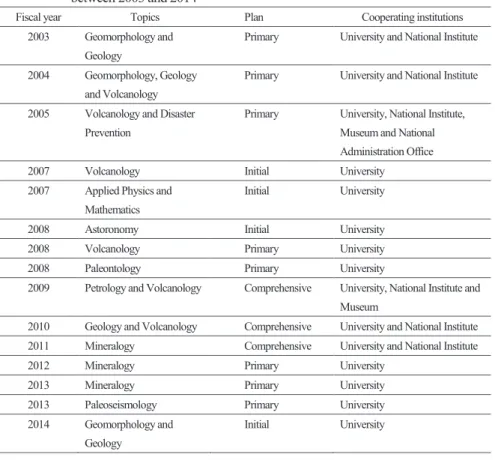
activities that contribute significantly to earth science education. Then, the author conducted field excursions many times in and around the Tokyo Metropolitan area. In the end of fiscal year 2002, the author responded immediately to the call of the SPP. The author fully conducted 15 case studies/programs with SPP for 12 years between fiscal years 2003 and 2014, at three Tokyo Metropolitan high schools (Table 1). These studies/programs included contexts of geomorphology, geology, volcanology, petrology, mineralogy, paleontology, and paleoseismology. This note introduces an outline of SPP and an example of SPP Case Study/Project, and describes the effectiveness and future perspectives of the high school-university collaboration.
Table 1 SPP Case Study/Project list conducted by the author during the fiscal periods between 2003 and 2014
Fiscal year Topics Plan Cooperating institutions
2003 Geomorphology and Geology
Primary University and National Institute
2004 Geomorphology, Geology and Volcanology
Primary University and National Institute
2005 Volcanology and Disaster Prevention
Primary University, National Institute, Museum and National Administration Office
2007 Volcanology Initial University
2007 Applied Physics and Mathematics
Initial University
2008 Astoronomy Initial University
2008 Volcanology Primary University
2008 Paleontology Primary University
2009 Petrology and Volcanology Comprehensive University, National Institute and Museum
2010 Geology and Volcanology Comprehensive University and National Institute
2011 Mineralogy Comprehensive University and National Institute
2012 Mineralogy Primary University
2013 Mineralogy Primary University
2013 Paleoseismology Primary University
2014 Geomorphology and Geology
Initial University
2. Outline of the SPP
The SPP which began in fiscal year 2002 and finished in 2014, was established to encourage science, technology and mathematics education. The background of SPP was PISA2000 and TIMSS-R 1999 international surveys conducted by the Organization for Economic Cooperation and Development (OECD) and the International Association for the Evaluation of Educational Achievement (IEA), respectively. The findings of these surveys were rather alarming due to the fact that the number of Japanese students who “like” or “enjoy” learning science was
proportionally lower than the number of students in comparative foreign countries. The MEXT stated that this would be a major issue for the society caused by a “Science Phobia” among school students (MEXT 2002).
The SPP was supported and funded by the MEXT during fiscal periods between 2002 and 2006, and was continued on through fiscal year 2014 by the Japan Science and Technology Agency (JST). The SPP was designed and implemented to create collaborative environments where educational institutions (e.g. junior high school and high school), research institutions (e.g.
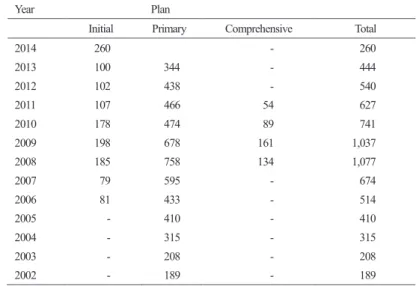
university, museum of natural history and national institute) and commercial businesses, collaboratively offer opportunities to practice progressive scientific technology, science and mathematics education alternatives. It was composed mainly of comprehensive activities performed by a researcher, and managed by a school teacher. Funding category, maximum funding and the number of adoption changed year by year during each fiscal periods between its beginning and completion (Table 2). The SPP offered opportunities for ambitious teachers to acquire additional funding to teach specializations in certain preponderant scientific subject matters in a competitive setting. This type of funding decision/selection was the first of its kind to encourage individual schools and educators to compete for additional funding in fulfillment of more meaningful educational opportunities.
Table 2 Number of adopted SPP case study/project
Maximum funding of initial, primary and comprehensive plans were 200,000, 500,000 and 2,000,000 yen, respectively. In fiscal years 2006 and 2007, comprehensive plan adopted for only research institutions (http://www.jst.go.jp/cpse/spp/about/data.html).
Year Plan
Initial Primary Comprehensive Total
2014 260 - 260
2013 100 344 - 444
2012 102 438 - 540
2011 107 466 54 627
2010 178 474 89 741
2009 198 678 161 1,037
2008 185 758 134 1,077
2007 79 595 - 674
2006 81 433 - 514
2005 - 410 - 410
2004 - 315 - 315
2003 - 208 - 208
2002 - 189 - 189
3. Case Study/Project Example
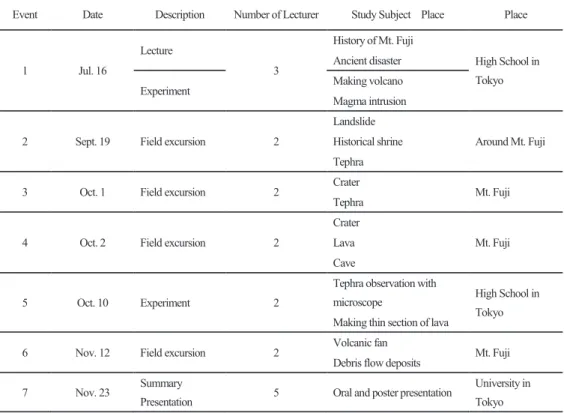
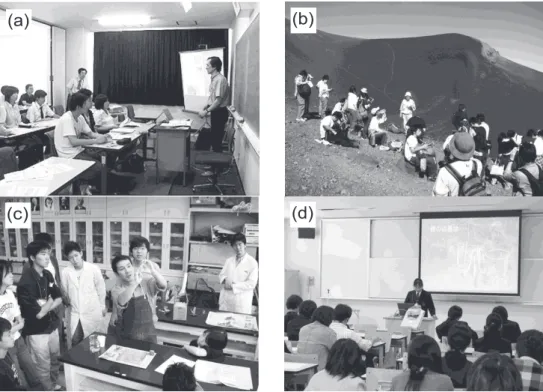
Table 3 provides a specific SPP case study/project by which the author conducted in fiscal year 2005 in detail. The study/project began with a lecture series (Fig. 1a) and progressed to field excursions (Fig. 1b), laboratory experiments (Fig. 1c), and a summary presentation (Fig. 1d).
Thirty-four high school students participated. Six lecturers, consisting of university faculty,
museum staff and researchers from national research institutes, lead the case study/project. Also, teaching assistants (TA) from universities and graduate schools helped with field excursions and the conference. The summary presentation was open to the general public.
The author conducted questionnaire surveys for student participants and the results are shown in Fig. 2. Responses were all positive in these categories: 91% responded as “Understood objectives (Fig. 2a),” 100% responded as “Understood commentary (Fig. 2b),” and 94%
responded as “interested in subject matter (Fig. 2c).” Some students provided individual commentary and typical commentaries are shown in Table 4.
Table 3 SPP Case Study/Project detail conducted by the author in fiscal year 2005.
Study/Project theme is “Mount Fuji – Volcanic Activities and Disaster Prevention”
Event Date Description Number of Lecturer Study Subject Place Place
1 Jul. 16
Lecture
3
History of Mt. Fuji
High School in Tokyo Ancient disaster
Experiment Making volcano
Magma intrusion
2 Sept. 19 Field excursion 2
Landslide
Around Mt. Fuji Historical shrine
Tephra
3 Oct. 1 Field excursion 2 Crater
Mt. Fuji Tephra
4 Oct. 2 Field excursion 2
Crater
Mt. Fuji Lava
Cave
5 Oct. 10 Experiment 2
Tephra observation with
microscope High School in
Tokyo Making thin section of lava
6 Nov. 12 Field excursion 2 Volcanic fan
Mt. Fuji Debris flow deposits
7 Nov. 23 Summary
Presentation 5 Oral and poster presentation University in Tokyo
Table 4 Typical commentaries provided by student participants
・I enjoyed attending lectures and field observations where I learned many new ideas and observed things I have never seen before.
・I learned even more by preparing presentation materials that required re-learning and re-investigating subject matter which lead to new issues and that stimulated positive energy for learning. I want to be part of this project next year.
・I have experienced ‘shock and awe’ every time I attended these project events. I gained valuable experience beyond regular class-room learning.
・Although I had some difficulty comprehending in-depth subject matter from time to time, I had many valuable experiences which I would never have learned in a regular class room setting.
・I enjoyed (this program) very much, since it is out of the ordinary class room learning.
Fig. 1 Typical photograph of Case Study/Project Example in fiscal year 2005.
(a) Lecture in high school classroom. (b) Field excursion at Mt. Fuji. (c) Experiment of making thin section in high school laboratory. (d) Summary presentation in university lecture room.
Fig. 2 Results of questionnaire surveys for student participants (N=34).
4. Effectiveness and Future Perspectives of the SPP
The SPP session provided favorable influence to participants as seen in the questionnaire survey results. Student participants gained the opportunity to work with researchers, learn their
profession and learn leading-edge research subjects. This also provided university and graduate school students with the opportunity to teach and coach younger students as teaching assistants (TA), providing valuable on-the-job experience for their careers. Many student participants pursued science and education fields in college upon graduation from high school.
However, fhe SPP projects need some future improvements. Managing the balance of time and effort for several months was fairly difficult for both students and teachers. Summer session setting could be a good alternative which allows everyone to focus on the concentrated session in a shorter period of time.
5. Conclusion
The author concludes that the SPP contributed tremendously to the promotion and progress of science education in high school. This also provided valuable opportunities for schools and teachers to develop professionally and for universities and research institutes to contribute to society through outreach activities.
The SPP ended in fiscal year 2014 and a new format was implemented in fiscal year 2015, replacing the SPP. The new JST program, unlike the SPP, focuses on motivated and advanced students and their learning and improvement. Research and education communities would collaboratively conduct new programs to promote earth science.
Acknowledgements
The author wishes to extend special appreciation to those who contributed to the success of these case studies/programs. Professor Haruo Yamazaki and Professor Takehiko Suzuki of Tokyo Metropolitan University, Professor Satoru Harayama of Shinshu University, Professor Takeyuki Ueki of Chiba Institute of Science and many other researchers and graduate students who contributed tremendously.Special thanks to Sayuri Criss, Anita Mackay and Associate professor Hisashi Otsuji of Ibaraki University for a fruitful contribution to improve an early version of English manuscript.
References
Ministry of Education, Culture, Sports, Science and Technology. 2002. Japanese Government Policies in Education, Culture, Sports, Science and Technology.
http://www.mext.go.jp/b_menu/hakusho/html/hpac200201/ (January 5th, 2016).
Ministry of Education, Culture, Sports, Science and Technology. 2009. Koutougakkou Gakusyu Shido Youryo Kaisetsu Rika-hen (Commentary of the high school course of study Science). * http://www.mext.go.jp/component/a_menu/education/micro_detail/__icsFiles/afieldfile/2010/0 1/29/1282000_6.pdf (January 5th, 2016).
Tamura, I. 2008. A situation and problems on the Earth Science education in high school of Japan.
The Journal of the Geological Society of Japan 114: 157–162. **
(*: in Japanese, **: in Japanese with English abstract)