
魚類の生殖に及ぼす環境要因の影響 : IV. 低温下におけるメダカ,Oryzias latipes の卵巣発達に及ぼす長日光周期の影響
8
0
0
全文
(2) Vol. 21, No. 1 Journal of Hokkaido University of Education (Section II B) September 1970. On the Effects of Environmental Factors upon the Reproduction of Fishes IV. Effects of Long Photoperiod on the Development of Ovaries of Adult Medaka, Oryzias latipes, at Low Temperatures"'2>. Hiroshi YOSHIOKA Biological Labaratory, Hakodate College, Hokkaido University of Education, Hakodate, Hokkaido. ^W X : ^S®^%^®.^"t^M^B®l IV. f£®T'r^H%^ ^"A, Or^as to^es O^P^^jSrS.^'-tXS&^^ffl®^1. If females of fish, Oryzias latipes, were kept at room temperature (ranging from 17°C to 22°C), the inducement of spawning could be controlled by artificial long day-length throughout all seasons of the year (Yoshioka, 1963; 1966). On the contrary, it has been also experimeted that the abortion of the females was artificially caused by artificial short daylength even if water temperatures were high enough to maintain the spawning of Oryzias during the breeding season (Yoshioka, 1962). In order to clarify the critical low temperature during which Medaka can react to stimlus of long day-length, the writer has studied the effects of long day-length on Oryzias kept at various low temperatures, ranging from 4° to 14°C. Before proceeding further, the writer wishes to express his hearty thanks to Professor K. Yamamoto, Hokkaido University, for his kind guidance and valuable criticisms during the course of the present study.. Material and Methods The experiment was carried out with adult individuals of wild type of Oryzias latipes, during the out-of-breeding seasons. The fish used in this study were obtained from a pond at Yunokawa Hot Springs in the suburbs of Hakodate City. After being collected from their natural habitat, they were cultured in an aquarium in the laboratory untill needed. The fish were fed with living freshwater oligochaetes twice a day. Six groups, consisting of 20 males and 20 females, were kept in each aquarium containing about 40 litres of water. Each group was subjected to the long day-length of 15.0 hours of light per day at different degree of water temperatures of 4°C, 6°C, 8°C, 10°C, 12°C and 14°C respectively. For the long day-length artificial illumination was supplied by a 20-Watt firefly lamp. 1) Contribution No. 30 from Kikonai Marine Biological Station, Hokkaido University of Education. 2) This study was supported by a grant from the Scientific Research Fund of the Ministry of Education.. ( .24).
(3) •21. (^ 2 g|5 B). ;1^-. R3%45^&jl. At the beginning of the experiment and in intervals of two weeks during the experiment three fish were sacrificed to examine the changes in their ovaries. For measuring the diameter of oocytes, the ovaries were fixed in Allen-Bouin's solution, and stained with Delafield's haematoxylin followed by eosin. The size composition of oocytes in the ovaries was determined by counting the largest 50 oocytes in the sections of each ovary.. Results 1. Changes in ovary weight The experiment was performed from December 21, 1967 until February 1, 1968. After the fish had been kept at each separate temperature for 4 weeks, three females were picked up at random from each group and killed. The body weight and ovary weight of the fish were recorded.. 70 60. 50 U). •S 40 s: >. ^ 30 20. 01234 Weeks. Figure 1, Graph showing the changes in ovary weight of Medaka kept at various water temperatures.. The change in ovary weight is shown in Figure 1. The mean ovary weight was 11.6 mg to begin with. All the fish kept below 10°C showed little increase in ovary weight 4 weeks later, i.e., 13.5 mg for the 4°C fish, 15.2 mg for the 6°C fish and 18.0 mg for the 8°C fish. Therefore, no distinguishable changes were found in ovary weight for the fish between initial control and throughout 4°-8°C temperatue duration. All the fish kept above 10°C had markedly enlarged their ovaries 4 weeks after. The mean ovary weight was 42,0 mg for the 10°C fish, 48.4 mg for the 12°C fish and 55.0 mg for the 14°C fish. The enlarged ovaries of these fish seemed to correspond to those of the fish immediately before the beginning of the spawning season. Moreover, the gross appearance of the ovaries in the fish kept at 14°C was well in accord with those of the spawning period.. 2. Size composition of oocytes in the ovary In two weeks intervals three females from each group were sacrificed for the examination of the size composition of oocytes in their ovaries. The histograms of the oocytes diameter. (25).
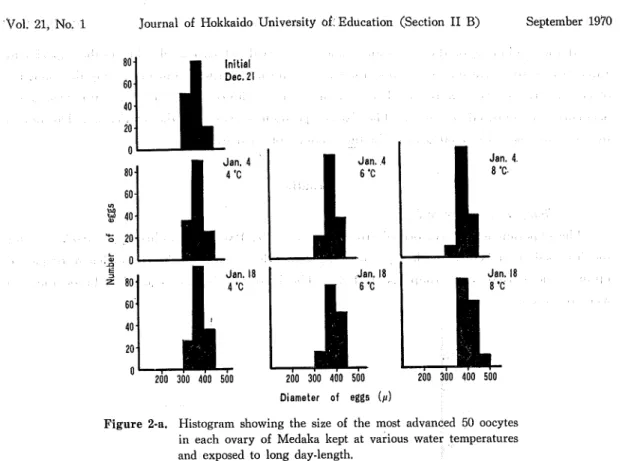
(4) Vol. 21, No. 1. Journal of Hokkaido University of; Education (Section II B). September 1970. Initial. Dec.21. Jan. 4. Jan. 4.. Jan,18. Jan.18. Jan. 4. Jan.18. 200 300 400. 200 300 400 500. 200 300 100 500. Diameter of eggs (/i) Figure 2-a. Histogram showing the size of the most advanced 50 oocytes in each ovary of Medaka kept at various water temperatures and exposed to long day-length.. Initial. Dec.21. 40. Jan. 4 10-C. Jan. 4 12'C. Jan. 4 14'C. Jan.18 ID'C. Jan. 18 12'C. Jan. 18. 3 20 0 60!. wi. 14-C !. Mi 0'. m 30B 400 500 600 700 800. 300 400 500 600 700 800 900 1(00. 300 400 500 600 700 800 Diametar of' eggs (/<). Figure 2-b. Histogram showing the size of the most advanced 50 oocytes in each ovary of Medaka kept at various water temperatures and exposed to long daylength.. ,. .. .. .. ,. ,. ,. ,.,.,:. in each group is shown . in Figure 2. Investigations on the ovaries obtaied from the initial controls revealed the presence of numerous small oocytes varying from 300 micra to 450 micra in diameter. Their mean diameter was 370 micra. (.16).
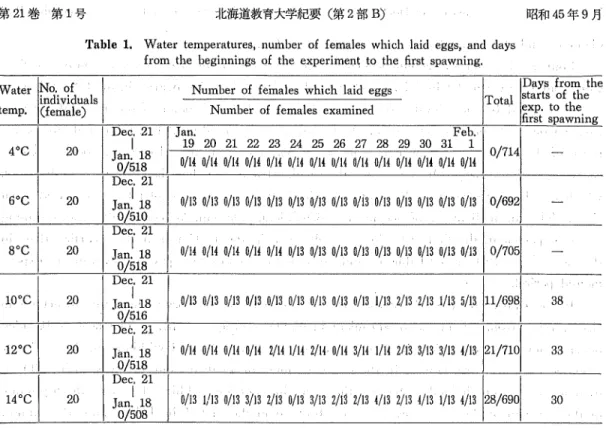
(5) (H¥ 2 S|5 B). ^21^ ^1^. IIg^B45^9^. Table 1. Water temperatures,. number of females which laid eggs, and days from. the beginnings of the experiment to the first spawning, Water. No. of. temp.. Cfemale). Number of females which laid eggs. individuals. Number of females examined Dec, 21. 4°C. 20. 6°C. 20. 8°C. 20. 10 °C. 20. L_ .. Jan, 18. 0/518. Jan.. .. Days from the Total. starts of the exp. to the first spawning. Feb.. 19 20 21 22 23 24 25 26 27 28 29 30 31 1. 0/11 0/14 0/14 0/14 (1/11 0/14 9/lt 0/U O/H «/14 0/11 0/H 0/14 0/H. 0/714. Dec. 21 Jan. 18. 0/510. 0/13 0/13 0/13 0/13 0/13 0/13 0/13 0/13 0/13 0/13 0/13 0/13 0/13 0/13. 0/692. 0/14 0/U 0/U 0/H 0/K 0/13 »/13 0/13 8/13 0/13 0/13 C/13 0/13 0/13. 0/705. Dec. 21 Jan, 18. 0/518. Dec. 21. Jan: 18. 0/516. 0/13 0/13 0/13 0/13 0/13.0/13 0/13 0/13 0/13 1/13 2/13 2/13 .1/13 5/1,3 11/698. 38. • 0/14 C/U 0/U O/U 2/14 1/14 2/» 0/H 3/H 1/H 2/13 3/13 3/13 4/13 21/710. 33. (1/13 1/13 0/13 3/13 2/13 0/13 3/13 2/13 2/13 4/13 2/13 Vl3 1/13 4/13 28/690. 30. Dec. 21. 12°C. 20. 14°C. 20. Jan: 18. 0/518. Dec, 21 Jan. 18. 0/508. Of the fish kept at'4°C no females exhibited spawnings at all during the experimental. period (Tabel 1). The ovaries obtained from the 4°C fish on Jan. 18 showed no distinguishable increase in the size of oocytes (Figure 2-a). The size composition of oocytes in the fish kept at 6°C was similar to that of the fish kept 4°C. No marked increase in the size of oocytes was found in them 4 weeks later although the mean diameter slightly increased. The mean diameter'of oocyfes was 392 micra. No spawning was'observed in. the females of the 8°C fish throughout the experimental period (Table 1). • The ovaries of females in the 8°C fish remained undeveloped as late as Jan. 4, 2 weekes after the start of the experiment and showd about the same size composition of oocytes as that in the initial controls, except for a slight increase of the mean diameter of oocytes (Figure 2-a). Observations on the ovaries from the 8°C fish, preserved until Jan. 18, revealed the presence of a lot of small oocytes showing 351) micra to 500 micra in diameter. These oocytes in the range' of 350-500 micra in diameter just corresponded to those in the' yolk vesicle, and the primary yolk stage at' which yolk formation had not been accomplished yet. (Y&Blambto & Yoshioka, 1964). No females exhibited any'spawning in the 8°C fish by the close of the experiment. On the other hand, a great increase in oocyte size was discerned in the ovariesofall the fish kept at temperatures above 10°C for 4 weeks and most of them began to lay eggs at a;regular"interval of 2 or 3 days until the end of the experiment. In the ovaries of the fish kept at 10°C for 4 weeks many large oocytes of more than 450 rhicra in diameter were detected. On Jan. 28, 36 days after the start of the experiment, one female out of 14 fish started the first spawning and thereafter the number of the spawning females increased day by day, up to 5, by the close of the experiment (Table 1), The largest oocytes attaind 700 micra in (.17).
(6) Vol. 21, No, 1 Journal of Hokkaido University of Education (Section II B) September 1970 diameter and the mean diameter of oocytes was 595 micra. Four weeks after the commencement of the experiment, marked differences in oocyte sizes were found between the initial controls and the 12°C fish. The ovaries in the 12°C fish were well developed by the stimulus of long day-length and the diameter of oocytes in the ovaries; varied from 450 micra to 800 micra. In the ovaries preserved until Jan. 18 not only the occurrence of the oocytes at the primary yolk stage was common, but also a few oocytes corresponding to the tertiary yolk stage were discerned. The oocytes less than 450 micra in diameter, which had been observed in the ovaries of the initial controls, completely disappeared from sight. The mean diameter of oocytes was 650 micra. On Jan. 23, 33 days after the beginning of the experiment, the first spawning was observed in the 12°C fish, 5 days earlier than in the case of the 10°C fish (Table 1) and most of them exhibited spawnings within the experimental period. In the ovaries obtained from the 14°C fish on Jan. 18 the oocytes increased to maximurta. size, varying from 450 micra to 900 micra in diameter (Figure 2-b). The large yolk-laden oocytes more than 800 micra in diameter were expected to be laid within a few days. A few ovulated eggs were recognized in the ovarian lumen of an oyary out of three fish. These ovulated eggs were judged to be laid the following morning. Thirty days after the beginning of the experiment the first spawning was observed in the 14°C fish (Table 1) and then almost all females showed spawning within the experimental period, This result coincides with one obtained previously from Oryzias kept at 16°C and exposed to the same long photoperiod conditions (Yoshioka, 1966). From the above facts it becomes clear that when the fish are kept below 10°C the gonads of this species are not stimulated to develop at all by long photoperiod. When the gonads were well stimulated to develop by long photoperiod and most of the fish began to lay eggs within 6 weeks, the fish had been kept at temperature above 10°C. Moreover the yolk formation in the fish kept at higher levels of temperatures may be accelerated earlier than that of the fish kept at lower levels.. Discussion It is evident that various environmental factors affect the maturation of the fish. Egami (1954) has already demonstrated that the small winter ovaries of Oryzias in the sexually inactive seasons were caused to develop rapidly if the fish were kept at 22°-26°C. Undpubtedly the water temperature is at least one of the most important environmental factors in the development of the ovaries of the fish (Matthews, 1939 ; Burger, 1939; etc.) The present writer demonstrated in a previous paper that the treatment with artificial long day-length affected the gonadal development of Oryzias and the females came to lay eggs within a month, even if the fish were kept at temperture below 22°C (15°-19°C) in out-of-breeding seasons. (Yoshioka,. 1966).. i. In the present experiment, the development of the ovaries in adult females was definitely stimulated by long day-length when the fish were kept at low temperature of 10°-14°C.. C^s).
(7) ^-21^ ^1^ ;lbi®;aat:^?^ (^2gf!B) »B%45^9^ However, the stimulative effects of long day-length on the ovarian growth ' were hardly observable at temperatures below 10°C (4°-80C). From this fact, it may be clearly concluded that long day-length plays an important role on the development of the ovaries if the fish were kept below 20°C and the critical water temperature for the fish to react to the stimulus of long photoperiod may be about 10°C. . , It has already been demonstrated that the stimulus of environmental factors do not directly affect the gonadal development, but the pituitary hormone does in fishes (Yamazald, 1961; etc.). Egami (1954) reported that the implantation of a piece of a frog's pituitary into the fish kept at 22°-26°C affected a further acceleration of the growth of the ovary, but pituitary implants failed to stimulate the ovarian growth at temperature below 13°C. From the results of the present experiment, it is reasonable to assume that the stimulus of long day-length could excite the activity of the pituitary gland resulting in the inducement of spawning.. Summary The effect of log day-length on sexual development of Medaka, Oryzias latipes, kept at low water temperature (4°-14°C) has been investigated during the sexually inactive seasons. A unit of fifteen hours of light per day was chosen as a long day-length. The results obtained are as follows. 1. The ovaries of Oryzias are caused to develop by the stimulus of long day-length when the fish are kept at low temperature of 10°-14°C. 2. However, in the fish kept below 10°C (4°-8°C), the treatment with long day-length fails to stimulate the acceleration of the gonadal development. 3. Therefore, long day-length seems to be the most important environmental factor in regard to the gonadal development at low temperature conditions. 4. The critical water temperature at which the fish can react to the stimulus of long day-length may be about 10°C.. References Burger, J. W. 1939. Some experiments on the relation of the external environment to the spermatogenetic. cycle of Fundulus heteroclitus (L.). Biol. Bull. 77, 96-103. Egami, N. 1954. Effects of pituitary substance and estrogen on the development of ovaries of adult females of Oryzias latipes in sexually inactive seasons. Annot, Zool, Japon. 27, 13-18. Matthews, S. A, 1939. The effects of light and temperature on the male sexual cycle in Fundulus. Biol. Bull. 77, 92-95. Yamamoto, K, & H. Yoshioka. 1964. Rhythm of development in the oocytes of the Medaka, Oryzias latipes, Bull. Fac, Fish. Hokkaido Univ. 15, 5-19. Yamazaki, F. 1961. The effects of hypophysectmy on the ovary of the goldfish, Carassius auratus, Bull. Fac. Fish. Hokkaido Univ. 12, 167-180. Yoshioka, H. 1962. On the effects of environmental factors upon the reproduction of fishes. 1. The effects. of day length on the reproduction of the Japanese Killifish, Oryzias latipes. Bull. Fac. Fish. Hokkaido Univ. 13, 123-136.. (.19).
(8) Vol. 21, No. 1 Journal of Hokkaido University of Education (Section II B) September 1970 Yoshioka, H. 1963. On the effects of en viromental factors upon the reproduction of fishes, 2. Effects of short and long day-lengths on Oryzias latipes during spawning season. Bull. Fac, Fish, Hokkaido Unlv. 14, 137-151. 1966. On the effects of environmental factors upon the reproducton of fishes. 3. The occurrence •and regulation of the refractoi-y period in the photoperiodic response of Medaka, Oryzias latlpes. Jour. Hokkaido Univ. of Education, Sec. 2 (B), 17, 23-33. - ;. 1970, Medaka, Oryzias latipes lives in Hakodate. ,Seibutu Kyozai. 7, 72-76. (in Japanese).. (.20).
(9)
図
関連したドキュメント
[r]
どにより異なる値をとると思われる.ところで,かっ
[r]
選定した理由
敷地と火山の 距離から,溶 岩流が発電所 に影響を及ぼ す可能性はな
敷地と火山の 距離から,溶 岩流が発電所 に影響を及ぼ す可能性はな
敷地と火山の 距離から,溶 岩流が発電所 に影響を及ぼ す可能性はな
(Yc) 、有楽町層砂質土層(Ys) 、埋没段丘堆積層(Bts)、東京層第一粘土層上部層(Tcu) 、東京
