抗菌薬の耐性化を防止することは重要な課題である。特に 他薬剤で代用できない抗methicillin-resistantStaphylococcus
aureus(以下,MRSA)薬1)や広域な抗菌スペクトラムを有す
るcarbapenem系抗菌薬2)については適正使用を推進し,耐性
菌を増加させない工夫が求められている。近年,抗菌薬の使用 制限は耐性菌の発生を抑制することが報告されている2〜4)。 また細菌の耐性化率に変化がみられない場合でも,抗菌薬の 使用制限は医療費削減の面から有益5)とする報告もある。これ らのことから最近では,多くの施設で抗菌薬の適正使用に向 けた啓蒙6),使用報告書の提出義務化4,5,7,8),使用許可制度の
導 入9〜15)お よ び 抗MRSA薬 投 与 患 者 へ のtherapeutic drug
monitoring(以下,TDM)の施行9,16,17)等が試みられている。
飯塚病院(以下,当院)においても抗MRSA薬とcarbap- enem系抗菌薬について,使用量を制限するための方策を実 施してきた。すなわち2001年9月から抗MRSA薬を処方す る際には,事前に使用理由書を感染対策チームに提出するよ うに義務づけ,2003年11月にはcarbapenem系抗菌薬も対 象とした。また2003年10月には血液培養陽性例の主治医に 対して, 感染管理医師(以下,ICD)による指導的介入(以下,
血培ラウンド)を開始した。さらに2004年1月より,すべて
の抗MRSA薬投与患者を対象にTDMに基づいて,薬剤師が 推奨投与計画を立案し,主治医に情報提供している。そこで本 研究では,これらの方策の抗菌薬使用制限効果を検証した。
I. 対象および方法
1.調査対象
当院採用の抗
MRSA
薬vancomycin(以下,VCM),
arbekacin
(以下,ABK),teicoplanin(以下,TEIC)お よびcarbapenem
系抗菌薬meropenem
(以下,MEPM),
panipenem! betamipron
(以下,PAPM! BP), imipenem!
cilastatin(以下,IPM
!CS)を調査対象とした。
2.調査方法
抗
MRSA
薬については2002
年1
月〜2004年12
月お よ びcarbapenem
系 抗 菌 薬 で は2003
年1
月〜2004年12
月を調査期間として,調査対象薬の使用症例数,全使 用量,1
症例あたりの使用期間,平均1
日処方量および平 均投与間隔,使用患者の年齢,性別,入院診療科名を処 方オーダーシステムから抽出した。さらに各月の延べ入院患者数を用いて抗菌薬使用密度
(以下,AUD)を求めた。なお
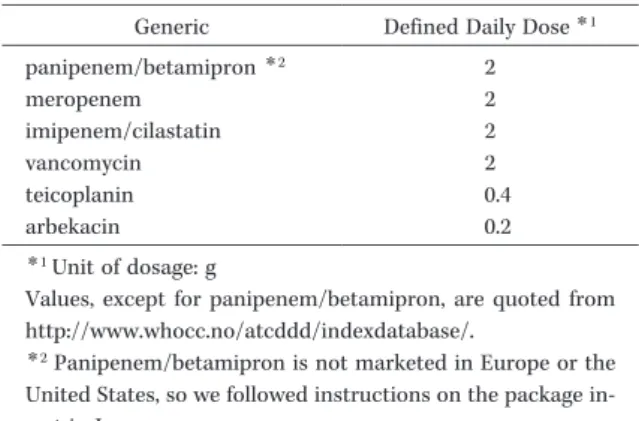
PAPM
!BP
以外の対象薬 のDefined Daily Dose(以 下,DDD)は 世 界 保 健 機 関
抗 MRSA 薬および carbapenem 系抗菌薬適正使用化の試み
室 高広1)・秀島 里沙1)・中村 権一2)・神村 英利3)
1)飯塚病院薬剤部*
2)飯塚病院総合診療科
3)福岡大学筑紫病院薬剤部
(平成18年6月19日受付・平成18年8月23日受理)
抗菌薬の濫用は耐性菌の増加を招く。このため抗
methicillin-resistant
Staphylococcus aureus(以下,MRSA)薬および carbapenem
系抗菌薬の使用制限を行う試みがなされている。飯塚病院(以下,当院)では,これらの抗菌薬に対する使用理由書の提出を義務づけるとともに,血液培養陽性患者の主治医に 対して感染管理医師による指導的介入(以下,血培ラウンド)を行っている。さらには抗
MRSA
薬投与 患者の主治医に対して,therapeutic drug monitoring(以下,TDM)に基づき至適投与量の提案を行っ ている。そこで,これらの取り組みに対する抗菌薬使用制限効果を検証した。その結果,血培ラウンド 開始後に抗MRSA
薬の使用患者数は減少した。また使用理由書に血培ラウンドとTDM
を加えること で,使用理由書のみの期間に比べ,vancomycin
の1
日処方量は有意に減少し,teicoplanin
も減少傾向で あった。一方,carbapenem
系抗菌薬に関しては使用理由書の提出と血培ラウンドの併用で,これらの対 策前に比べて,panipenem!betamipron(0.5 g
!V)の 1
日処方量は,むしろ増加した。以上のことから,
TDM
と血培ラウンドは抗MRSA
薬の使用抑制効果があり,抗MRSA
薬の適正使用 を推進し,耐性菌の出現を抑えるために有効な手段と考えられる。またcarbapenem
系抗菌薬の使用量 の抑制は,使用理由書の提出と血培ラウンドのみでは不十分であり,薬物動態!薬力学(以下,PK!PD)
理論に基づく明確な投与基準を確立することが望まれる。
Key words: anti MRSA agent,carbapenem,therapeutic drug monitoring(TDM)
*福岡県飯塚市芳雄町3―83
Table 2. Patientprofilesin anti-MRSA drugprescription
total III
II I
period
1,687 682
107 898
cases
46.9 56.9
35.7 99.8
mean case(pes rmonth)
61.8/38.2 60.6/39.4
59.8/40.2 62.9/37.1
gende(mar le/female)[%]
68.(06-100) 67.(00-95)
65.8(8-93) 70.2(0-100)
age(range)
17.0 cardiacsurgery
17.9 hematology
16.8 cardiacsurgery
18.2 cardiacsurgery
departmentofprescription [%]
16.1 hematology
15.4 cardiacsurgery
13.1 hematology
15.0 hematology
10.8 cardiorogy
11.6 cardiorogy
12.1 generalmedicine
10.6 cardiorogy
8.1 surgery
10.1 surgery
9.3 pulmonology
8.1 generalmedicine
7.9 generalmedicine
6.9 generalmedicine
8.4 surgery
7.9 neurosurgery
7.1 neurosurgery
6.3 neurosurgery
8.4 cardiorogy
7.1 pulmonology
6.9 pulmonology
6.2 pulmonology
8.4 neurology
6.5 surgery
5.7 nephrology
5.9 nephrology
4.7 orthopedicsurgery 6.2
nephrology
4.3 neurology
4.1 neurology
4.7 neurosurgery
3.9 neurology
3.1 orthopedicsurgery
2.5 orthopedicsurgery 3.7
hepatology 3.3
orthopedicsurgery
2.5 hepatology
2.3 pediatrics
2.8 dermatology
2.7 hepatology
1.7 gastroenterologicalmedicine 2.1
hepatology 1.9
otolaryngology 1.9
gastroenterologicalmedicine
1.6 dermatology
1.8 dermatology
1.9 gastroenterologicalmedicine 1.7
endocrinology
1.1 endocrinology
1.5 gastroenterologicalmedicine 0.9
Chinesemedicine 1.3
Chinesemedicine
1.1 urology
1.2 urology
0.9 emergencydepartment 1.3
dermatology
1.0 pediatrics
0.9 otolaryngology
0.9 dentalsurgery
1.1 urology
0.9 Chinesemedicine
0.7 ophthalmology
0.9 nephrology
1.0 ophthalmology
0.9 otolaryngology
0.6 psychiatry
0.8 otolaryngology
0.8 ophthalmology
0.6 endocrinology
0.3 emergencydepartment
0.4 emergencydepartment 0.4
Chinesemedicine 0.3
psychiatry
0.4 psychiatry
0.4 emergencydepartment 0.2
radiology
0.2 dentalsurgery
0.4 gynecology
0.2 dentalsurgery
0.2 gynecology
0.3 psychosomaticmedicine 0.1
obstetrics
0.1 radiology
0.1 pediatrics
0.1 psychosomaticmedicine
0.1 obstetrics
period (2I002.1-2003.9):required to reportreason ofchoiceofantibiotics
period I(2I003.10-2003.12):“reason report”plussupportbyinfection controlphysician forbacteremia period II(2I004.1-2004.12):“reason report”plus“ICD support”plusTDM
Table 1. Defined Daily Dosage
Defined Daily Dose*1 Generic
2 panipenem/betamipron *2
2 meropenem
2 imipenem/cilastatin
2 vancomycin
0.4 teicoplanin
0.2 arbekacin
*1 Unitofdosage:g
Values, except for panipenem/betamipron, are quoted from http://www.whocc.no/atcddd/indexdatabase/.
*2 Panipenem/betamipron is notmarketedin Europe or the United States,so we followed instructions on the package in- sertin Japan.
(以下,WHO)によって定められた値を使用した。海外 で販売されていない
PAPM! BP
のDDD
は添付文書に 記載された値を用いた(Table 1)。AUDの算出には同じ くWHO
の指針に従い,AUD=(抗菌薬月間使用量(g)!(DDD×月間入院患者延べ日数))×1,000(単位:1,000 患者日)の式によって求めた。
各試みの効果を検証するために,抗
MRSA
薬では使用理由書の提出のみの対策を行っていた
2002
年1
月〜2003
年9
月(以下,I期),血培ラウンドが開始となった2003
年10
月〜12月(以下,II期),そしてTDM
の全例 施行が加わった2004
年1
月〜12月(以下,III期)の3
群で,一方,carbapenem系抗菌薬では具体的対策のな かった2003
年1
月〜9月(以下,A
期),血培ラウンドを 始めた2003
年10
月(以下,B期),使用理由書の提出義 務が加わった2003
年11
月〜2004年12
月(以下,C期)の
3
群で,上記各項目を比較した。なお1
年を4
期に分 けて,対象薬の使用量を比較し,季節による変動がない ことを確認したうえで,各試みの効果を検証した。なお,データの一部が欠落している症例があったため,解析対 象症例数は検討項目ごとに異なることとなった。
抗
MRSA
薬のTDM
はVCM
では点滴静注用塩酸バ ンコマイシンTDM
データ薬物速度論的解析支援用ソフ ト ウ ェ アVCM-TDM on Excel ver2.0(塩 野 義 製 薬),
TEIC
ではテイコプラニンTDM
解析支援ソフトウェア(Ver. 1)(藤沢製薬),ABKではハベカシン
TDM
解析ソ フト(Ver1.0)(明治製菓)を用いて行った。MRSA
検出検体数の年次推移および臨床分離株に対 するMEPM
およびIPM! CS
の感受性を調査した。感受Table 3. Patientprofilesin carbapenem prescription
total C
B A
period
2,348 1,388
84 876
cases
65.2 106.8
84.0 97.3
mean case(pes rmonth)
62.2/37.8 62.2/37.8
71.4/28.6 61.2/38.8
gende(mar le/female)[%]
65.5(0-98) 65.1(0-98)
63.(31-91) 66.2(0-97)
mean ofage(range)
16.8 pulmonology
17.4 pulmonology
20.2 pulmonology
15.5 pulmonology
departmentofprescription[%]
12.9 hematology
14.2 hematology
17.9 hematology
12.1 surgery
12.7 surgery
13.3 surgery
10.7 surgery
11.9 generalmedicine
11.7 generalmedicine
11.7 generalmedicine
9.5 generalmedicine
10.4 hematology
7.0 hepatology
8.3 hepatology
8.3 gastroenterologicalmedicine 6.5
neurology
4.2 pediatrics
4.1 pediatrics
6.0 neurology
5.5 hepatology
4.2 gastroenterologicalmedicine 4.1
nephrology 4.8
cardiorogy 4.5
pediatrics
4.0 cardiorogy
4.0 gastroenterologicalmedicine 3.6
ophthalmology 4.1
cardiorogy
3.8 neurology
3.9 cardiorogy
3.6 orthopedicsurgery 4.1
gastroenterologicalmedicine
3.5 nephrology
3.0 neurosurgery
2.4 emergencydepartment 3.8
gynecology
2.9 neurosurgery
2.4 gynecology
2.4 pediatrics
3.2 orthopedicsurgery
2.9 gynecology
2.3 cardiacsurgery
2.4 endocrinology
2.9 nephrology
2.2 cardiacsurgery
1.9 neurology
2.4 neurosurgery
2.9 neurosurgery
2.2 orthopedicsurgery
1.4 orthopedicsurgery 1.2
hepatology 2.1
cardiacsurgery
1.6 endocrinology
1.4 endocrinology
1.2 otolaryngology
1.8 ophthalmology
1.5 ophthalmology
1.2 ophthalmology
1.2 cardiacsurgery
1.8 endocrinology
1.2 urology
1.2 urology
1.2 nephrology
1.5 urology
1.1 dermatology
1.0 emergencydepartment 1.2
gynecology 1.5
dermatology
1.0 emergencydepartment 0.9
dermatology 1.4
psychiatry
0.9 psychiatry
0.7 psychiatry
1.1 Chinesemedicine
0.6 Chinesemedicine
0.4 pediatricsurgery
0.9 emergencydepartment
0.4 pediatricsurgery
0.4 Chinesemedicine
0.3 pediatricsurgery
0.3 otolaryngology
0.4 otolaryngology
0.2 otolaryngology
0.1 psychosomaticmedicine 0.2
psychosomaticmedicine 0.1
obstetrics
0.1 obstetrics
0.1 dentalsurgery
0.1 dentalsurgery
0.1 obstetrics
period A(2003.1-2003.9):no intervention
period B(2003.10):supportbyinfection controlphysician forbacteremia
period C(2003.11-2004.12)“I:CD support”plusrequired to reportreason ofchoiceofantibiotics
性検査は日本ビオメリュー社製
VITEK 2
自動測定器を 用いて行い,臨床分離株の感受性をS
(感受性),I(中等 度感受性)およびR(耐性)に分け,全検体に対する S
株数の割合を算出した。3.統計処理
AUD,1
症例あたりの使用期間,1症例の平均1
日処方量,平均投与間隔のそれぞれに対して
Kruskal Wallis
H-test
を用いて各期間の3
群間で両側の有意差検定を行った。これで有意差が認められたものに対 し て は
Mann-Whitney U-test
を用いた両側の有意差検定を行っ た。いずれの場合も危険率が5% 未満の場合を有意と判
定した。II. 結 果
1.患者背景
抗
MRSA
薬使用患者およびcarbapenem
系抗菌薬使 用患者の背景を,それぞれTables 2,3
に示す。調査期間 における抗MRSA
薬使用患者の総数は1,687
名で,その 男女比は6:4,平均年齢は約 69
歳(0〜100歳)であっ た。carbapenem
系抗菌薬の使用患者数は2,348
名,男女 比は6:4,平均年齢は約 66
歳(0〜98歳)であった。抗MRSA
薬使用患者の受診科目は心臓血管外科や循環器科が上位を占めたのに対して,carbapenem系抗菌薬使 用患者では呼吸器内科や総合診療科の比率が高かった。
また血液内科は,いずれの抗菌薬についても処方頻度が 高かった。
2.抗 MRSA
薬の使用状況II
期ならびにIII
期の月間使用症例数は,I
期に比べて 減少した(Table 2)。またAUD
はIII
期が6.1
であり,II 期(8.4)と比較して低下傾向がみられた(Fig. 1)。平均 使 用 期 間 は 約8
日!症 例 で,有 意 な 変 化 は な か っ た(Fig. 2)。なお
I
期の期間内にAUD
の経時的な変化はみ られなかった。TEIC
の1
日平均処方量は,II期が2.3
本!症例で,I 期(1.8本!症例)に比べて有意に増加したが,III期では1.74
本!症例となり,II
期に比べて有意に減少した。VCM
ではI
期の2.6
本!症例に比べ,III期では2.4
本!症例と 有意に減少した。ABK
では3
群間で有意差は認められな かった(Fig. 3)。投与間隔は
ABK
とTEIC
に関しては有意差が認めら れなかったが,VCMではI
期の17.0
時間に対して,II 期およびIII
期ではそれぞれ18.5
時間および18.3
時間と なり,有意に延長した(Fig. 4)。Fig. 1.AUD ofanti-MRSA drugsatIizukaHospital. 0
5 10 15 20 25
AUD[1,000 patient day]
5.36±1.93
period I(2002.1-2003.9): required to report reason of choice of antibiotics
period II(2003.10-2003.12): “reason report” plus support by infection control physician for bacteremia
period III(2004.1-2004.12): “reason report” plus “ICD support” plus TDM
AUD(antimicrobial use density)is calculated per each month in period below.
AUD=DDD(Defined Daily Dose) / 1,000 patients
*1 Result of Kruskal Wallis H-test period
n 21 3 12
p=0.14*1
8.38±1.64
6.06±1.66
I II III
Fig. 2.Administration term ofanti-MRSA drugs atIizuka Hospital. 0
5 10 15 20 25 30 35 40 45 50
administration[day]
period I(2002.1-2003.9): required to report reason of choice of antibiotics period II(2003.10-2003.12): “reason report” plus support by infection control physician for bacteremia
period III(2004.1-2004.12): “reason report” plus “ICD support” plus TDM
*1 Result of Kruskal Wallis H-test period
8.14±9.80 8.31±10.80 8.11±11.00
I II III
n 565 122 489
p=1.94*1
3.carbapenem
系抗菌薬の使用状況C
期の使用症例数はA
期に比べて増加した(Table 3)が,AUDは低下傾向を示した(Fig. 5)。平均使用期間は
A
期の6.9
日に対し,B期5.7
日と有意に短縮したもの の,C
期では7.6
日とB
期と比べ有意に延長し,A
期と比 べても延長傾向が認められた(Fig. 6)。1
日平均処方量はMEPM
とPAPM! BP
の0.25 g
入りバイアルには有意な 変化が認められなかった。PAPM!BP
の0.5 g
入りバイ アルの処方量は,B
およびC
期ではA
期に比べて有意に 増加した(Fig. 7)。投与間隔はPAPM! BP
の0.25 g
入り バイアルのC
期において,A
期ならびにB
期のいずれと 比較しても有意な短縮が認められたが,MEPMおよびPAPM! BP
の0.5 g
入りバイアルでは有意な変化は認め られなかった(Fig. 8)。なおIPM! CS
は2003
年3
月で採 用取消しとなったため,処方量と投与間隔の比較は行わ なかった。4.MRSA
検出検体数MRSA
の 検 出 検 体 数 は2002
年 が803
件,2003年 が706
件および2004
年が1,872
件であった。調査期間中にアウトブレイクは発生しなかった。
5.臨床分離株の carbapenem
系抗菌薬に対する感受性の変化
MEPM
およびIPM! CS
に対する成人と小児の感受性 株検出率をTable 4
に示す。当院のコンピュータシステ ム上,各検体の検出部位に関して詳細な調査は行えな かったが,MEPMおよびIPM! CS
の感受性が大きく変 化した菌種はなかった。III. 考 察
1.使用理由書の提出義務化
抗菌薬の濫用防止のため,何らかの制限を設けること で使用量を減少させた施設は多い11,12,14,15)
。一方,使用制 限を行わず,処方医からの報告のみで使用量を減少させ
Fig. 3.Daily dose ofanti-MRSA drugs atIizuka Hospital. 0.00
1.00 2.00 3.00 4.00 5.00 6.00 7.00 8.00 9.00 10.00
daily dose[vial or ampule]
n 473 100 391 45 6 48 73 28 78
I II III
period I(2002.1-2003.9): required to report reason of choice of antibiotics
period II(2003.10-2003.12): “reason report” plus support by infection control physician for bacteremia period III(2004.1-2004.12): “reason report” plus “ICD support” plus TDM
*1 Result of Kruskal Wallis H-test
*2 Result of Mann-Whitney U-test p=0.37 *2
p=0.14 *2
p=0.25 *1
p=0.82 *2
p=9.61×10−4*2
p=1.94×10−3*2
1.74±0.62 p=2.09×10−4*2
2.61±1.08 2.53±1.00 2.35±1.03
1.15±0.42 1.65±0.53
1.74±0.64 1.83±0.61
2.30±0.73
VCM ABK TEIC
period
Fig. 4.Intervalofanti-MRSA drugs atIizuka Hospital. 0.00
10.00 20.00 30.00 40.00 50.00 60.00
VCM ABK TEIC
interval[hours]
II III
period I(2002.1-2003.9): required to report reason of choice of antibiotics
period II(2003.10-2003.12): “reason report” plus support by infection control physician for bacteremia period III(2004.1-2004.12): “reason report” plus “ICD support” plus TDM
*1 Result of Kruskal Wallis H-test
*2 Result of Mann-Whitney U-test p=6.86×10−3 *2
period
n 391 95 332 43 6 39 52 23 53
I 3.28×10−2 *2
p=0.49*1 p=0.72*2
p=0.98*1
17.03±6.0418.46±6.02 18.26±5.96 21.05±2.75
16.30±5.42 19.66±5.20
18.07±5.50 21.08±3.3920.38±3.49
Fig. 5.AUD ofcarbapenems atIizuka Hospital. 14.24±3.50
17.05±4.10 18.57
0 5 10 15 20 25 30 35 40
A B C
AUD[1,000 patient day]
p=0.76 *1
period A(2003.1-2003.9): no intervention
period B(2003.10): support by infection control physician for bacteremia
period C(2003.11-2004.12): “ICD support” plus required to report reason of choice of antibiotics
AUD(antimicrobial use density)is calculated per each month in period below.
AUD=DDD(Defined Daily Dose) / 1,000 patients
*1 Result of Kruskal Wallis H-test n
period
1 14
9
Fig. 6.Administration ofcarbapenems atIizuka Hospital. 7.58±5.70 6.90±5.27
5.70±4.61
0.00 5.00 10.00 15.00 20.00 25.00 30.00 35.00
A B C
administration[day]
period A(2003.1-2003.9): no intervention
period B(2003.10): support by infection control physician for bacteremia
period C(2003.11-2004.12): “ICD support” plus required to report reason of choice of antibiotics
*1 Result of Mann-Whitney U-test period
n 729 98 946
p=5.78×10−2 *1
p=3.92×10−4 *1 p=1.10×10−3 *1
Fig. 7.Daily dose ofcarbapenems atIizuka Hospital. 0
1 2 3 4 5 6 7 8 9 10
MEPM 0.5 g/V PAPM/BP 0.25 g/V PAPM/BP 0.5 g/V
daily dose[vial]
A B C
period A(2003.1-2003.9): no intervention
period B(2003.10): support by infection control physician for bacteremia
period C(2003.11-2004.12): “ICD support”plus required to report reason of choice of antibiotics
*1 Result of Kruskal Wallis H-test
*2 Result of Mann-Whitney U-test
3.00±1.04
period 2.93±1.12
2.68±1.25 2.75±1.22
2.08±0.73 2.30±0.42
2.28±0.94 2.54±1.08 3.53±1.28
p=0.31 *1 p=0.88 *1 p=2.21×10−3*2
p=0.11 *2 p=6.60×10−5*2
532 75 727
n 30 2 27 150 21 195
Table 4. Detection rateofsensitiveorganismsformeropenem orimipenem/cilastatin isolated from IizukaHospitalin 2003and 2004 IPM/CS
MEPM drug
organism
2004 2003
2004 2003
year Gram-positivecoccus
96(241)/85(17) 99(339)/96(25)
Enterococcusfaecalis
(samplefrom adult/from child)
19(63)/0(6) 6
(82)/25(4) Enterococcusfaecium
100(702)/100(128) 100(1,179)/100(104)
Staphylococcusaureus
0
(631)/0(75) 0
(1,794)/0(78) MRSA
36(271)/14(22) 26(311)/25(12)
Staphylococcusepidermidis
100(216)/100(8) 100(276)/100(11)
Streptococcusagalactiae
100(37)/100(115) 100(77)/100(84)
Streptococcuspneumoniae
100(117)/100(216) 100(86)/99(151)
PISP
87(23)/100(108) 81(42)/90(94)
PRSP
10(305)/100(10) 100(28)/100(21)
Streptococcuspyogenes Gram-negativerod
99(76)/100(3) 98(108)/100(4)
99(76)/100(3) 99(108)/10(40)
Acinetobacterbaumannii
(samplefrom adult/from child)
97(36)/100(2) 100(55)/100(1)
100(36)/100(2) 100(55)/10(10)
Citrobacterfreundii
100(52)/100(2) 98(60)/―
100(52)/100(2) 98(60)/―
Enterobacteraerogenes
100(127)/100(6) 99(164)/―
100(127)/100(6) 99(164)/―
Enterobactercloacae
100(622)/100(42) 100(792)/100(63)
100(621)/100(42) 100(792)/10(603)
Escherichiacoli
100(60)/100(4) 100(68)/100(4)
100(60)/100(4) 100(68)/10(40)
Klebsiellaoxytoca
100(190)/100(5) 100(286)/100(9)
100(190)/100(5) 100(286)/10(90)
Klebsiellapneumoniae
100(31)/100(2) 97(35)/100(4)
100(31)/100(2) 100(35)/10(40)
Morganellamorganii
95(63)/100(1) 86(105)/100(1)
100(63)/100(1) 100(105)/10(10)
Proteusmirabilis
95(20)/100(3) 95(22)/100(2)
100(20)/100(3) 100(22)/10(20)
Proteusvulgaris
80(389)/96(25) 79(788)/90(20)
90(387)/100(25) 87(787)/10(200)
Pseudomonasaeruginosa
100(70)/100(3) 99(155)/100(4)
100(70)/100(3) 100(155)/10(40)
Serratiamarcescens
*Thefirstnumberisthesensitivityratefortheorganism(%)and thesecond isthetotalnumberofspecimensdetected each year. Valuesareshown beforeslash aresamplesfrom adultand valuesareshown afterslash aresamplesfrom children.
Fig. 8.Intervalofcarbapenems atIizuka Hospital. 13.56±4.95
12.71±3.57 13.12±4.51
10.56±4.95 12.03±3.34 10.62±1.96
8.29±2.57
12.98±3.99 11.51±2.07 p=1.42*1
20 143
21 2
29
n 429 69 608 127
A B C
period A(2003.1-2003.9): no intervention
period B(2003.10): support by infection control physician for bacteremia
period C(2003.11-2004.12): “ICD support” plus required to report reason of choice of antibiotics
*1 Result of Kruskal Wallis H-test
*2 Result of Mann-Whitney U-test 0
5 10 15 20 25 30 35 40
interval[hours]
p=3.28×10−3*2
p=6.94×10−2*2
p=0.29 *2 p=0.59 *1
MEPM 0.5 g/V PAPM/BP 0.25 g/V PAPM/BP 0.5 g/V
た施設4)は少ない。当院は抗
MRSA
薬の使用理由書の提 出を2001
年9
月から義務づけているが,この取り組みが 定着したI
期においてもAUD
には有意な変化がみられ なかった。carbapenem系抗菌薬については2003
年11
月に使用理由書の提出を義務づけたが,その後のAUD
の減少は有意ではなかった。すなわち当院の場合も使用 理 由 書 の 提 出 義 務 化 の み で は,抗MRSA
薬 お よ びcarbapenem
系抗菌薬の使用制限には至らないと考えられ,使用許可制の導入7)を検討するべきと思われる。
2.血培ラウンドによる指導的介入
ある医療機関において,菌血症の確定後,広域スペク トルの抗菌薬から狭域スペクトル薬に変更された症例は
14% 程度との報告がある
18)。またICD
や感染対策チー ムの積極的な介入は,抗菌スペクトルが広く,経験的投 与の際に選択されやすい薬剤の適正使用を促し,結果的 に投与症例数の減少効果や抗菌薬使用量の抑制効果があ ると考えられている。当院においても,血培ラウンドの 開始後,抗MRSA
薬の使用症例数は減少した。これは血 培ラウンドにより,偽陽性例と感染例の鑑別が行われ,治療対象患者が限定された結果であると考えられる。ま た,2003年
10
月以降にcarbapenem
系抗菌薬の使用期 間が一時的に短縮したことも,適正薬剤への変更指導な どの血培ラウンドの成果であると推測される。3.TDM
TDM
は抗菌薬の使用量減少に寄与すると報告されて いる5,8)。当院においても抗MRSA
薬のTDM
を完全実 施した2004
年からは前年までに比べて,使用期間とAUD
が低下傾向を示し,TEIC
に関しては平均1
日処方 量が有意に減少した。またTDM
開始後は,適正使用の対 策が使用理由書の提出のみであった期間と比較して,VCM
の平均1
日処方量も有意に減少し,投与間隔は延 長傾向を示した。これらの結果は,2004
年以前は主治医 の依頼のあった患者に対してのみ行っていたTDM
を,抗
MRSA
薬が処方された時点で全患者に対して初期投 与設定から介入するようにかえたことで,適切な投与設 計による治療がなされた症例が増加したことによると考 えられる。今後は,PK!PD
理論に基づく処方設計が抗MRSA
薬の適正使用を推進し,結果的に使用量の制限を もたらすか否かについて検討する必要があると考えられ る。4.carbapenem
系抗菌薬の投与基準の必要性carbapenem
系抗菌薬では,使用期間の延長および平均
1
日処方量の増加傾向がみられた。また投与間隔の有 意な短縮は,血培ラウンド開始後,使用理由書を義務づ けた後のPAPM! BP 0.25 g
入り製剤で認められたのみ であった。これらの結果は,抗MRSA
薬に対するTDM
のような理論的な投与法決定指針がcarbapenem
系抗 菌薬で確立されていないことに起因すると考えられる。現在,carbapenem系抗菌薬についても
PK! PD
理論を応用した投与法での臨床効果が確認されつつあるが,ま だ報告が少なく19,20),さらに多くの研究成果が集積され る必要がある。
IV. 結 論
①使用理由書の提出義務のみでは抗菌薬の使用量抑制に 対する効果は十分とはいえない。
②ICDによる指導的介入は抗
MRSA
薬の使用症例数を 減少させる効果がある。③TDMは抗
MRSA
薬の適正使用をもたらし,結果とし て使用量の減少に寄与する。④carbapenem系抗菌薬の
PK! PD
理論に基づく投与基 準を確立する必要がある。謝 辞
本論文を執筆するにあたり,有用な細菌感受性データ を提供していただいた飯塚病院中央検査部,真名子順一 部長他,細菌検査室スタッフの方々に心よりお礼申し上 げます。
文 献
1) 蔵園瑞代,山田恵子,平井洋子,井田孝志,井上松久:
MRSAの疫学動向と各種抗菌薬の抗菌活性につい て。日化療会誌2002; 50: 494-9
2) 竹末芳生,松浦雄一郎,横山 隆,板羽秀之:緑膿菌 における治療薬の選択理由とその実際。日本外科感染 症研究1999; 11: 219-22
3) 武内 一:抗生物質を使用しなければ,小児医療にお ける耐性菌は確実に減少する。外来小児科1999; 2: 51- 6
4) 橋本 治:抗菌薬体制化防止のための薬剤師の役割。
Infection Control 2005; 14: 1017-23
5) 小笠原康雄,八島加八,近藤里美,播野俊江,小滝照子,
長崎信浩,他:抗MRSA用抗生物質の適正使用のた めのTDM活用システムの有用性。環境感染2003; 18:
323-8
6) 新宮行雄,青山平一,狩野京子,漆谷義徳:松江赤十 字病院における抗菌薬適正使用の取り組みと評価。日 病薬誌2005; 41: 1519-22
7) 阿南節子,芝イク子,藤本卓司:抗菌薬の使用制限に 関する医師アンケート調査。環境感染2001; 16: 225-9 8) 高瀬尚武,湊 幸一,中田日早枝,他:塩酸バンコマ
イシン適正使用における薬剤師の役割〜TDM施行 症例から見た有用性の評価について〜。全自病協雑誌 2002; 42: 1058-61
9) 草地信也,炭山嘉伸,川井邦彦,他:抗菌剤の臓器別 指定と監視。日本外科感染症研究1994; 6: 59-64 10) 藤本卓司:抗菌薬の使用制限とICD。Infection Con-
trol 2002; 11: 456-8
11) 藤田芳正,山崎芳郎:特定抗菌薬使用許可制の導入に 関する臨床的検討。環境感染2005; 20: 31-6
12) 古川恵一:抗菌薬の適正使用と病院感染対策。臨床と 微生物2003; 30: 479-86
13) Gould I M, Jappy B: Trends in hospital antibiotics prescribing after introduction of an antibiotic policy.
J Antimicrob Chemother 1996; 38: 895-904
14) Quale J, Landman D, Saurina G, et al: Manipulation of a Hospital Antimicrobial Formulary to Control an Outbreak of Vancomycin-ResistantEnterococci. Clin
Infect Dis 1996; 23: 1020-5
15) Toltzis P, Yamashita T, Vilt L, et al: Antibiotic re- striction does not alter endemic colonization with re- sistant Gram-negative rods in a pediatric intensive care unit. Crit Care Med 1998; 26: 1893-9
16) 鈴木仁志,貴田岡節子:抗MRSA薬の適正使用シス
テムの構築とバンコマイシンにおける初期投与設定 の有用性。環境感染2004; 19: 365-72
17) 石坂敏彦,向井淳治,福嶋 誠,他:血中濃度からみ た抗MRSA薬の適正使用。日病薬誌2004; 40: 1125-8 18) 小阪直史,志馬伸朗:京都府立医科大学附属病院にお
ける抗菌薬適正使用のためのコントロール。Infection Control 2005; 14: 998-1002
19) 三鴨廣繁,二宮望祥,玉舎輝彦:カルバペネム系抗菌 薬の投与方法に関する検討。The Japanese Journal of Antibiotics 2002; 55: 875-81
20) 三鴨廣繁:重症感染症におけるPK!PDに基づいた
メロペネムの最適投与方法。化学療法の領域2005; 21:
105-13
21) 真下啓二:抗菌薬の使用制限はなぜ必要か。Infection
Control 2000; 9: 152-4
Effort to promote proper use of anti methicillin-resistant Staphylococcus aureus agents and carbapenems
Takahiro Muro
1), Risa Hideshima
1), Kenichi Nakamura
2)and Hidetoshi Kamimura
3)1)Department of Pharmacy, Iizuka Hospital, 3―83 Yoshiomachi, Iizuka, Fukuoka, Japan
2)Department of General Medicine, Iizuka Hospital
3)Department of Pharmacy, Fukuoka University Chikushi Hospital