【原著・臨床】
血液内科病棟薬剤師による抗菌薬適正使用への介入効果
田沼 道也・田中 昌代・折井 孝男 NTT東日本関東病院薬剤部*
(平成27年11月24日受付・平成28年1月14日受理)
抗菌薬の適正使用は,院内感染対策の重要な課題であり,耐性菌の出現等を防止するためにも重要で ある。そこで,抗菌薬使用量の多い血液内科病棟において抗菌薬使用密度(antimicrobial use density:
AUD)を用いて抗菌薬使用量を把握し,院内検出菌の薬剤感受性からアンチバイオグラム作成を行い,
AUD
の推移と使用抗菌薬の変化について比較検討した。血液内科病棟の
AUD
は,全診療科のAUD
に比較し高値であったが,薬剤師の介入により623.2
から354.2
と減少が認められた。系統別AUD
では,第4
世代セフェム系やカルバペネム系の使用量が高値であったが病棟薬剤師配置後,カルバペネム系は
233.7
から96.5
へ有意に減少した。血液内科病棟のアンチバイオグラムは,全診療科に比較し耐性率が高く,特に
Pseudomonas aeruginosa
の薬剤感受性は,全診療科でのimipenem(IPM)の耐性率 11%,meropenem(MEPM)の耐性率 7%
に比較し血液内科病棟での耐性率は
IPM
耐性34%, MEPM
耐性31% と高値であり,アンチバイオグラ
ムに基づいた慎重な薬剤選択の必要性が示唆された。Key words: antimicrobial use density,antibiogram,hematology,clinical pharmacist
抗菌薬の適正使用は,感染症の治療効果を高めるだけでな く,耐性菌の出現を抑制する。近年,抗菌薬の適正使用を推進 し,耐性菌の出現防止や治療効果を高めることを目標とする 手法としてantimicrobial stewardship(AMS)という言葉が 提唱されており,2007年の米国感染症学会(Infection Disease Society of America)よりAMSガイドラインが公表されてい る1)。
NTT東日本関東病院(以下,当院)は病床数606床であり,
35の診療科を有する急性期の総合病院である。血液内科病棟 は48床(医師7名,薬剤師1名)となっている。当院では,
薬剤師が中心となり特定の抗菌薬を指定し,使用期間や使用 患者の把握,長期使用例の状況確認を行い抗菌薬の適正使用 に向けた介入を行っている。また,使用量に関しては世界保健 機関(World Health Organization)が推奨する抗菌薬の評価 方 法 で あ る 抗 菌 薬 使 用 密 度(antimicrobial use density:
AUD)を用いて把握し2),院内検出菌の薬剤感受性からアンチ
バイオグラム作成を行い耐性菌減少のために対応を行ってい る。しかし,診療科ごとの抗菌薬使用量の偏りの問題について は未介入であった。
そこで今回,抗菌薬の使用量の多い血液内科病棟を対象と して抗菌薬使用量の調査とアンチバイオグラム作成を行っ た。さらに,病棟薬剤師を配置しinfection control team(ICT)
と連携をとり,現状把握と病棟薬剤師の介入による抗菌薬使
用状況の変化の検討を行ったので報告する。
I. 材 料 と 方 法
1.血液内科病棟での抗菌薬使用状況の把握 1) 抗菌薬使用量の算出
2011
年4
月から2014
年3
月までの抗菌薬(注射剤)使 用状況を薬剤部門システムから抽出し,第I
期:2011 年4
月から2012
年3
月,第II
期:2012年4
月から2013
年3
月,第III
期:2013年4
月から2014
年3
月とし,全 診療科のAUD
と血液内科病棟のAUD
とを算出し比較 した。AUD
の算出は抗菌薬に規定された1
日投与量(de-fined daily dose:DDD)を定数とし,AUD=[特定期間
の抗菌薬使用量(g)/
(DDD×特定期間の入院患者延べ入 院日数)]×1,000で求めた。2) アンチバイオグラムの作成
2008
年1
月から2014
年12
月の期間で検出された菌 株を対象とし,血液内科病棟のアンチバイオグラムを作 成し,全診療科と比較した。また,AUD
とアンチバイオ グラムとの関連性を調査した。アンチバイオグラムはClinical and Laboratory Standards Institute
の薬剤感受 性に基づき耐性,中度耐性,感受性とした3)。各対象薬剤 については感受性率を数値で示した。*東京都品川区東五反田5―9―22
Table 1. Comparison of the antimicrobial use density (AUD) between all sections of the hospital and the hematology ward
I (2011.4―2012.3)
II (2012.4―2013.3)
III (2013.4―2014.3)
All sections 16.4 16.5 18.3
Hematology 623.2 559.3 354.2
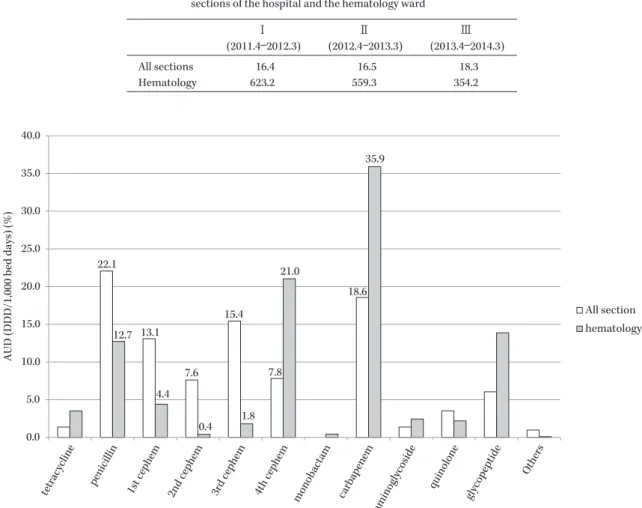
Fig. 1. Comparison of the ratio of the AUD between the hematology ward and all sections of the hospital (2011.4―2014.3).
AUD (DDD/1,000 bed days) (%)
22.1
13.1
7.6 15.4
7.8
18.6
12.7
4.4
0.4 1.8
21.0
35.9
0.0 5.0 10.0 15.0 20.0 25.0 30.0 35.0 40.0
tetracycline penicillin
1st cephem 2nd cephem 3rd cephem 4th cephem
monobactam carbapenem aminoglycoside
quinolone glycopeptide
Others
All section hematology
2.病棟薬剤師介入とその効果 1) 薬剤師による介入
血液内科病棟での抗菌薬処方時には,病棟薬剤師によ る処方内容の確認を実施し,病態や検体の状況について 確認を行い抗菌薬処方についての確認を行った。また,
TDM
実施薬剤については血中濃度測定の依頼を行い,結果による処方提案を実施した。
抗菌薬の処方内容に疑問がある症例や変更の必要が考 えられる症例に対しては,ICT薬剤師へ相談し,病棟薬 剤師と
ICT
薬剤師が相互に連携して処方内容を確認し,随時担当医師へ確認や提案を行った。
抗菌薬の使用期間については主に
ICT
薬剤師が中心 となり調査を行い,長期使用患者を病棟薬剤師へ報告し,長期使用の必要性や妥当性について病棟薬剤師と連携し て判断を行い,必要性が認められない場合には担当医へ 変更や中止の依頼を行った。
2) 介入による効果
当院では,
2012
年5
月から血液内科病棟で薬剤師の配 置を開始した。そこで,本研究では第I
期を薬剤師配置開 始前,第II
期を移行期,第III
期を薬剤師配置後とし,AUD
の推移と使用抗菌薬の変化について比較検討し た。また,2015年8
月から2015
年10
月の3
カ月間にお ける介入内容について調査した。3.統計学的解析
薬剤師介入が抗菌薬使用量へ及ぼす効果として,
AUD
の系統別使用量の変化についてχ
2検定を行い,p<0.05 を統計学的に有意差ありとした。II. 結 果
1.血液内科病棟での抗菌薬使用状況の把握
1) 全診療科 AUD
と血液内科病棟AUD
との比較抗菌薬の使用データから,全診療科と血液内科病棟と の
AUD
を比較した(Table 1)。年度別AUD
は全診療科 で2011
年が16.4,2012
年が16.5,2013
年が18.3
であっ たのに対し,血液内科病棟のAUD
は2011
年が623.2,
2012
年が559.3, 2013
年が354.2
であった。血液内科病棟 のAUD
は全診療科のAUD
に比較して高値であること が明らかになった。系統別
AUD
を比較した結果,全診療科ではペニシリ ン系の使用割合22.1%,カルバペネム系が 18.6%,第 3
世代セフェム系15.4%,第 1
世代セ フ ェ ム 系13.1%
でFig. 2. Comparison of the antibiograms between the hematology ward and all sections of the hospital (2008.1―2014.12).
ABK LVFX CLDM VCM
S.aureus (MRSA) 1 84 0
S.aureus (MSSA) 0 15 0
S.epidermidis 1 41 0
E.faecalis 0
E.faecium
PCG 100 59 92 1
79 0
E.coli K.pneumoniae E.cloacae
ABPC 100 59 92 0 78 39 80 83
CEZ 100 0 80
15 4 97
CMZ
1 1 85
CTM 100 0 79
12 4 90
FMOX 100 0 80
1 1 64
CTRX
16 3 23
SBT/ABPC
100 0 79
21 5 45 P.aeruginosa
PIPC
35 13 23 5
IPM 100 0 80 0 0 0 0.5 11
SBT/CPZ
2 1 14 7 S.maltophilia
Isolates 1,183 1,434 1,777 2,205 572 3,568 1,240 586 1,568
561
CAZ
11 4 26 7 48
CFPM
14 3 4 6 77
AZT
11 3 21
9 92
MEPM
0 0 2 7 96
GM 67 21 55
10 1 6 6 74
AMK
0 0 0.5
3 76
MINO 43
0 3 39 37 7 6 13 48 0
83 6 60 18 76 23 2 8 9 4
Isolates ABK CLDM VCM
S.aureus (MRSA) 50 0 0
S.aureus (MSSA) 25 0 0
S.epidermidis 213 0
87 7 47 0
E.faecalis 256 0
E.faecium 246
PCG 100 70 98 6
86 0
E.coli 188
CTRX
33
SBT/ABPC
100 0 94
37 K.pneumoniae 68
E.cloacae 51
ABPC 100 70 98 0 85 59 78 86
CEZ 100 0 94
30 13 98
CMZ
1 3 94
CTM 100 0 94
24 12 96
FMOX 100
0 94
1 3 70 P.aeruginosa 71
PIPC
58 22 33 23
AZT
22 10 24 24
IPM 100 0 94 0 0 1 4 34
MEPM
0
31
SBT/CPZ
9 6 20 30
GM 66 14 76
21 7 0 24
AMK
0 0 0 17 S.maltophilia 61
CAZ
22 12 29 30 43
CFPM
29
30 73
MINO 32
0 15 23 49 22 15 29 0
LVFX 90
5 92 56 85 47 12 33 34 11 a) Hospital antibiogram
b) Hematology antibiogram
あった。血液内科病棟ではカルバペネム系が
35.9%,第 4
世代セフェム系が21.0%
と高い傾向が認められた(Fig.1)。
2) 血液内科病棟独自のアンチバイオグラムの作成
血液内科病棟では抗菌薬の使用量が多く,院内全体で のアンチバイオグラムと異なることが懸念された。その ため,本研究では,血液内科病棟患者由来の検出菌の薬 剤感受性データから血液内科病棟独自のアンチバイオグ ラムを作成した(Fig. 2)。Pseudomonas aeruginosaの薬剤 感受性は院内全体に比較すると低く,全診療 科 で のimipenem
(IPM)の耐性率11%meropenem
(MEPM)の耐性率
7% に比較し血液内科病棟での耐性率は IPM
耐性
34%,MEPM
耐 性31% と 高 値 で あ っ た。さ ら に levofloxacin
(LVFX)に対しても全診療科の耐性率は9%
であったのに比較し,血液内科病棟では
34%
と高値で あった。Escherichia coli
についてはampicillin
(ABPC)やpiper- acillin
(PIPC)の耐性率が全診療科では39%, 35%
であっ たのに対し血液内科病棟では59%,58%
と高かった。ま たLVFX
に対する耐性率は,全診療科では23% であっ
たのに対し血液内科病棟では47% と高かった。 Klebsiella
pneumoniae
についてはABPC
以外の薬剤に対する耐性率は血液内科病棟で高い傾向が認められた。
2.病棟薬剤師介入による効果
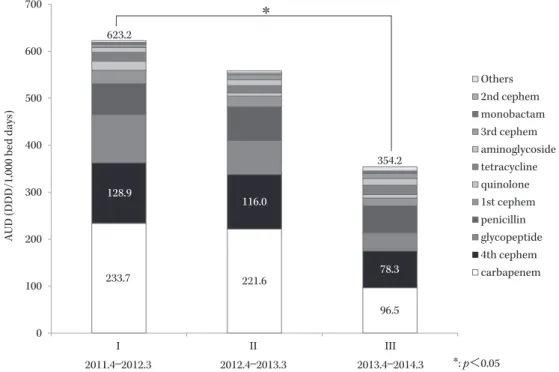
薬剤師配置前後での血液内科病棟における
AUD
を比 較した結果では, 薬剤師の病棟配置前のAUD
は623.2,
配置後の
AUD
は354.2
と低下が認められた(Fig. 3)。血液内科病棟での系統別使用量の推移を比較した結果 では,使用量の多かったカルバペネム系は薬剤師配置前
が
233.7,配置後が 96.5
と有意な低下が認められた(p<0.05)。第
4
世代セフェム系では薬剤師配置前が128.9,
配置後が
78.3
とAUD
の低下は示したが有意な差は認 めなかった。3.薬剤師介入内容
3
カ月間における主な介入例としては,投与量や投与 方法の変更や提案の介入が16
件であり,そのうち腎機能 や肝機能に応じた減量の提案が8
件,増量提案が1
件,抗菌薬開始前の相談により投与量を提案した事例が
7
件 であった。感受性結果に基づいて薬剤変更を提案したの が3
件であった。TDM
介入は33
件であり,vancomycin
(VCM)が
31
件,amikacin
が2
件であった。長期使用や 病態の改善のため,抗菌薬使用の期間への介入が8
件,薬剤変更(de-escalation含む)が
3
件,抗菌薬処方薬剤 の提案が2
件であった(Table 2)。その他の介入例として は,ニューモシスチス肺炎予防のsulfamethoxazole
処方 依頼やbortezomib
使用時のvalaciclovir
依頼や提案等 であった。<症例
1>
91
歳,男性,左下葉肺炎にてceftriaxone 2 g q24h
で開 始となったが38
度の発熱継続しday5
にVCM
処方が オーダーされたが,喀痰からP. aeruginosa
の検出があっ たため抗菌薬変更について担当医に相談。MEPM
へ薬剤Table 2. Intervention analysis of antimicrobial prescription by the pharmacists in the past three months Intervention analysis n Dosage and administration 16 Duration of administration 8
Medication change 3
Drug selection 2
Therapeutic drug monitoring 33
Others 4
Total 66
Fig. 3. The effect of pharmacist involvement on the AUD.
233.7 221.6
96.5 0
100 200 300 400 500 600 700
I II III
Others 2nd cephem monobactam 3rd cephem aminoglycoside tetracycline quinolone 1st cephem penicillin glycopeptide 4th cephem carbapenem
2013.4―2014.3
*
*: p<0.05 2011.4―2012.3 2012.4―2013.3
623.2
354.2 128.9
116.0
78.3
AUD (DDD/1,000 bed days)
変更となった。
<症例
2>
23
歳,男性,急性骨髄性白血病の寛解導入時に39
度の 発熱あり,発熱性好中球減少症(febrile neutropenia:FN)として MEPM 1 g q8hr
で治療開始するも解熱なくday5
にてtazobactam/piperacillin 4.5 g q8hr,micafun- gin 150 mg q24hr
へ変更するが解熱効果が乏しくday10
でVCM
追加予定となり,1 g q12hr
投与を推奨。その後,血中濃度はトラフ値が
2.58( μ g/mL)と低く,1 g q6hr
へ の 増 量 を 提 案 し 投 与 す る も ト ラ フ 値 は8.36( μ g/
mL)と上昇が乏しく発熱症状は継続であった。担当医師
より
linezolid(LZD)への変更の相談があったが血球も
低く
LZD
が静菌的な作用であることからICT
薬剤師と 相談し,VCM
を1.25 g q6h
へ増量を提案。その後,血中 濃度は20.3( μ g/mL)と上昇し以降 TDM
実施にてフォ ロー実施。day13でVCM
終了となった。III. 考 察
抗菌薬の適正使用の推進は感染治療を行う観点からき わめて重要である。感染治療では適切な抗菌薬の選択や 投与量,投与期間等に配慮した使用が求められている。
一方で抗菌薬の不適切な使用は耐性菌の増加を引き起こ すため医療経済的にも早急,かつ継続的に取り組まなけ ればならない課題である。本研究では,抗菌薬使用量が 多い血液内科病棟における抗菌薬の使用量と薬剤感受性 について調査を行い,病棟薬剤師による介入効果につい て検討を行った。今回,調査を行った
2011
年から2014
年の当院血液内科の入院実績を比較したところ,主な疾 患である急性骨髄性白血病,急性リンパ性白血病,骨髄 異形成症候群,悪性リンパ腫,ホジキンリンパ腫,多発 性骨髄腫,再生不良性貧血,造血幹細胞移植の対象件数 は大きな変化がなく,各年度において患者背景には大き な違いは認められなかった。抗菌薬の使用データから,血液内科病棟と全診療科と の
AUD
を比較し,血液内科病棟のAUD
は,全診療科のAUD
に比較して高値であった。その理由として,血液内 科病棟でのFN
に対する抗菌薬使用,化学療法,移植に伴 う感染症治療および感染症予防のため,他科に比較し使 用量が多いと推測された。系統別抗菌薬使用量においては,第
4
世代セフェム系 やカルバペネム系が多く使用されており,FNの治療と して第4
世代セフェム系やカルバペネム系が選択される ことが原因と考えられた。その他の系統別抗菌薬使用量 では,グリコペプチド系のAUD
が高かった。これは血球 減少時の発熱に対してFN
として治療が開始されるものの解熱が得られない際に追加薬剤として使用されること が原因と考えられた4,5)。
VCM
の投与に関しては,病棟薬剤師が
100% の症例で TDM
介入を行っており適正使用へ向けて取り組んでいる。VCMの
TDM
介入での提案 受け入れは,別途実施した3
カ月間での調査でも,100%
であった。
抗菌薬処方に対して病棟薬剤師が常に確認し,処方内 容について疑問がある場合には担当医に確認を行ってお り,病棟薬剤師は常に
ICT
薬剤師と相談しながら処方内 容がより適切になるように努めている。過去3
カ月間に おける薬剤師による抗菌薬処方への介入としては,腎機 能や肝機能に応じた減量の提案が8
件あり,提案は全例 で受け入れられた。増量提案は1
件であり,これは透析 患者の投与量についての提案であった。また,担当医か らの抗菌薬開始前の投与量の相談により投与量を提案し た例が7
件あり,疾患や腎機能・肝機能,PK/PD
理論に 基づいて提案を行った。アンチバイオグラムでは病院環境で耐性化を生じやす く,院内耐性菌の一つの指標とされる
P. aeruginosa
につ いて6〜8),血液内科病棟での第4
世代セフェム系やカルバ ペネム系の耐性率が高くAUD
を反映している結果と なった。このことから,血液内科病棟にてP. aeruginosa
の感染を視野に入れて治療を行う場合は,一般的なスペ クトラムを考慮することに加え当院独自の血液内科病棟 におけるアンチバイオグラムを活用することが重要であ ると考えられる。さらに血液内科病棟では,他科に比較 し耐性率が高いことを考慮して治療行う必要があること が示唆された。E. coli
に対するLVFX
耐性率が高かった 理由として,血液疾患患者での予防内服としてLVFX
の経口投与を行っていることが要因であると考えられ た。当院における薬剤師の病棟配置後の
AUD
は,配置前 のAUD
に比較し低下が認められた。さらに,血液内科病 棟での系統別使用量の推移の比較では使用量の多かった カルバペネム系で有意な低下が認められた。これは,病 棟薬剤師の常駐により抗菌薬使用状況をカルテで確認し 必要時に医師と相談していること,さらに,抗菌薬長期 使用症例に対するICT
介入の成果と考えられた。病棟薬剤師配置後,病棟薬剤師と
ICT
との連携によ り,抗菌薬使用量は適正化が図られている。血液内科病棟では血球低下がみられる症例も多く,血球回復前の安 易な抗菌薬変更,安易な
de-escalation
や中止は感染症発 症のリスクからも避けることが重要である。また,化学 療法施行中の場合は,血球減少の可能性を考慮し抗菌薬 を継続使用する場合がある。このような局面に対して,血液内科病棟のカンファレンス参加や診療科医師とのコ ミュニケーションを図れる病棟薬剤師と
ICT
薬剤師と が密に連携することでAMS
の質がさらに向上すると考 える。今後,知識の共有や治療方針,患者状態の把握など病 棟薬剤師と
ICT
薬剤師との連携を強め積極的な介入を 行い,抗菌薬使用の適正化を図りたい。利益相反自己申告:申告すべきものなし。
文 献
1) Dellit T H, Owens R C, McGowan J E Jr, Gerding D N, Weinstein R A, Burke J P, et al: Infectious Dis- eases Society of America and the Society for Health- care Epidemiology of America guidelines for devel- oping an institutional program to enhance antimicro- bial stewardship. Clin Infect Dis 2007; 44: 159-77 2) Merlo J, Wessling A, Melander A : Comparison of
dose standard units for drug utilisation studies. Eur J Clin Pharmacol 1996; 50: 27-30
3) Institute CaLS: Performance Standards for Antimi- crobial Susceptibility Testing, CLSI, Wayne, Penn- sylvania, 2008
4) JAID/JSC感染症治療ガイド2014,日本感染症学会・
日本化学療法学会,2014
5) Freifeld A G, Bow E J, Sepkowitz K A, Boeckh M J, Ito J I, Mullen C A, et al: Clinical practice guideline for the use of antimicrobial agents in neutropenic pa- tients with cancer: 2010 update by the infectious dis- eases society of america. Clin Infect Dis 2011; 52: e56- 93
6) Buising K L, Thursky K A, Robertson M B, Black J F, Street A C, Richards M J, et al: Electronic antibi- otic stewardship- -reduced consumption of broad- spectrum antibiotics using a computerized antimi- crobial approval system in a hospital setting. J An- timicrob Chemother 2008; 62: 608-16
7) 田中 大,深澤鈴子,喜古康博,木下かおり,坂口み きよ,藤江俊秀:抗菌薬の幅広い使用届出制が処方動 向及び薬剤感受性に及ぼす効果。環境感染誌 2008;
82: 365
8) 宮崎博章:抗菌薬制限下における緑膿菌の感受性の 推移。環境感染誌 2008; 82: 6-13
Contribution of ward pharmacists to appropriate antimicrobial use in the hematology ward
Michiya Tanuma, Masayo Tanaka and Takao Orii
Department of Pharmacy, NTT Medical Center Tokyo, 5―9―22 Higashi-Gotanda, Shinagawa-ku, Tokyo, Japan