薬剤師主導の抗菌薬適正使用支援活動
―抗菌薬適正使用支援の有用性と病棟専従薬剤師を中心 とした活動体制の構築―
佐村 優
横浜総合病院薬剤科*
受付日:2018 年 9 月 19 日 受理日:2019 年 3 月 4 日
本邦で 2017 年 8 月に 8 学会合同抗微生物薬適正使用推進検討委員会より発表された「抗菌薬適正使 用支援プログラム実践のためのガイダンス」では,薬剤師を主要構成メンバーに加えた antimicrobial stewardship team(AST)の発足とともに専門資格を有している薬剤師が中心となる活動を推奨してい る。横浜総合病院は 300 床,7 病棟の中規模病院で,感染症専門医は常勤しておらず,非常勤の感染症 専門医が 1 名勤務しているのみであるが,2012 年度より薬剤師主導の抗菌薬適正使用支援を開始した。
主な活動内容としては,血液培養陽性例および重症感染症例を中心とした抗菌薬適正使用支援,一部の 感染症における治療プロトコールの作成,プロトコールに基づく薬物治療管理による抗菌薬の薬物治療 モニタリングの導入,感染対策チームとの連携による血液培養採取の推進などの取り組みを通じた抗菌 薬適正使用支援を行っている。また,継続的に抗菌化学療法認定薬剤師の養成を行い,各病棟に配置す ることで,AST の活動と病棟における抗菌薬 time outs(抗菌薬開始後 72 時間程度で感染症の種類,抗 菌薬選択,用法・用量,投与経路,de-escalation の可否,治療期間などを評価)の充実を図ってきた。
一般的に AST 活動は人数,活動時間の制限があるため,主治医と良好な関係を構築している病棟専 従薬剤師は抗菌薬適正使用支援におけるキーパーソンとなり得ると考えられる。また,各病棟に抗菌化 学療法認定薬剤師を配置することによって,抗菌薬適正使用支援活動の充実を図ることが可能となり,
プロセス指標,アウトカム指標の向上に寄与できる可能性がある。特に,感染症専門医が不在の施設に おける抗菌薬適正使用支援活動では,病棟専従薬剤師の果たすべき役割は大きいと考える。
Key words: antimicrobial stewardship,infectious disease chemotherapy pharmacist,bacteremia
● ● ● ● ● ● ● ● ● ● ● ● ● ● ● ● ● ● ● ● ● ● ● ● ● ● ● ● ● ● ● ● ● ● ● ● ●
はじめに
抗菌薬の適正使用を推進する方法として,2007 年に米国感染症学会と米国医療疫学学会から
an- timicrobial stewardship program(ASP)のガイド
ラインが公表された1)。本ガイドラインは「抗菌薬 の使用制限」と「前向きな介入(早期モニタリング)とフィードバック」を主要な戦略としており,後者 では感染症専門医または感染症のトレーニングを受 けた薬剤師による抗菌薬の適正使用支援を推奨して
いる1)。また,「教育の実践」,「ガイドラインの利用」,
「抗菌薬のサイクリング」,「抗菌薬オーダシートの 利用」,「de-escalationやターゲットを絞った抗菌薬 の合理化」,「PK/PD理論に基づいた抗菌薬投与量 の適正化」,「注射薬から経口薬への変更」などの活 動を主要なストラテジーとしており1),2016年には
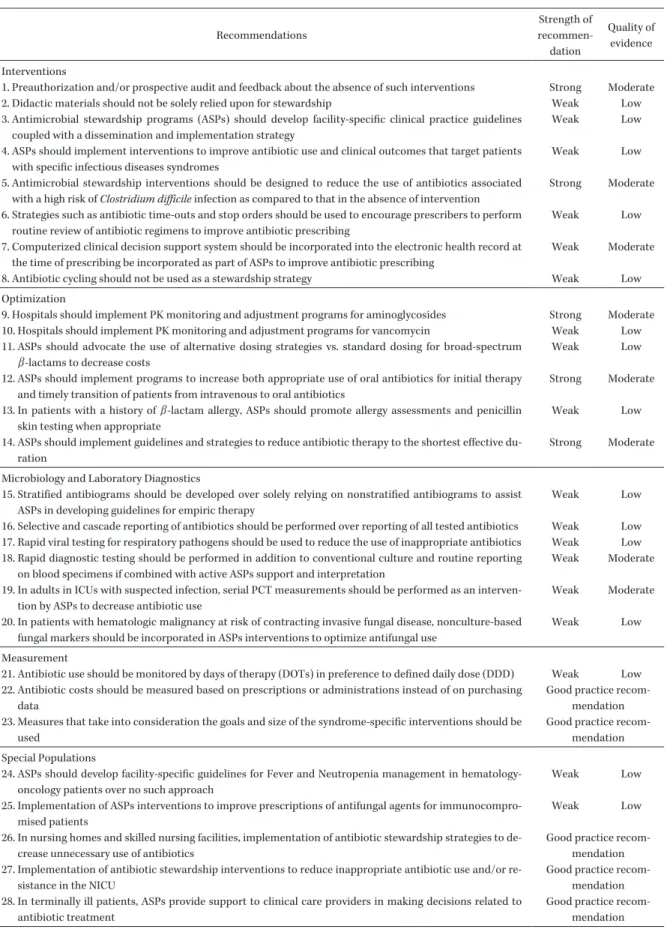
Table 1
に示す28
項目の具体的な内容も示されて いる2)。他方で,米国疾病管理予防センター(centers for
disease control and prevention:CDC)は,抗菌薬
*神奈川県横浜市青葉区鉄町 2201―5
Table 1. Recommendations for implementing an antimicrobial stewardship program
Recommendations
Strength of recommen-
dation
Quality of evidence Interventions
1. Preauthorization and/or prospective audit and feedback about the absence of such interventions Strong Moderate
2. Didactic materials should not be solely relied upon for stewardship Weak Low
3. Antimicrobial stewardship programs (ASPs) should develop facility-specific clinical practice guidelines coupled with a dissemination and implementation strategy
Weak Low
4. ASPs should implement interventions to improve antibiotic use and clinical outcomes that target patients with specific infectious diseases syndromes
Weak Low
5. Antimicrobial stewardship interventions should be designed to reduce the use of antibiotics associated with a high risk of Clostridium difficile infection as compared to that in the absence of intervention
Strong Moderate 6. Strategies such as antibiotic time-outs and stop orders should be used to encourage prescribers to perform
routine review of antibiotic regimens to improve antibiotic prescribing
Weak Low
7. Computerized clinical decision support system should be incorporated into the electronic health record at the time of prescribing be incorporated as part of ASPs to improve antibiotic prescribing
Weak Moderate
8. Antibiotic cycling should not be used as a stewardship strategy Weak Low
Optimization
9. Hospitals should implement PK monitoring and adjustment programs for aminoglycosides Strong Moderate 10. Hospitals should implement PK monitoring and adjustment programs for vancomycin Weak Low 11. ASPs should advocate the use of alternative dosing strategies vs. standard dosing for broad-spectrum
β -lactams to decrease costs
Weak Low
12. ASPs should implement programs to increase both appropriate use of oral antibiotics for initial therapy and timely transition of patients from intravenous to oral antibiotics
Strong Moderate 13. In patients with a history of β -lactam allergy, ASPs should promote allergy assessments and penicillin
skin testing when appropriate
Weak Low
14. ASPs should implement guidelines and strategies to reduce antibiotic therapy to the shortest effective du- ration
Strong Moderate Microbiology and Laboratory Diagnostics
15. Stratified antibiograms should be developed over solely relying on nonstratified antibiograms to assist ASPs in developing guidelines for empiric therapy
Weak Low
16. Selective and cascade reporting of antibiotics should be performed over reporting of all tested antibiotics Weak Low 17. Rapid viral testing for respiratory pathogens should be used to reduce the use of inappropriate antibiotics Weak Low 18. Rapid diagnostic testing should be performed in addition to conventional culture and routine reporting
on blood specimens if combined with active ASPs support and interpretation
Weak Moderate
19. In adults in ICUs with suspected infection, serial PCT measurements should be performed as an interven- tion by ASPs to decrease antibiotic use
Weak Moderate
20. In patients with hematologic malignancy at risk of contracting invasive fungal disease, nonculture-based fungal markers should be incorporated in ASPs interventions to optimize antifungal use
Weak Low
Measurement
21. Antibiotic use should be monitored by days of therapy (DOTs) in preference to defined daily dose (DDD) Weak Low 22. Antibiotic costs should be measured based on prescriptions or administrations instead of on purchasing
data
Good practice recom- mendation 23. Measures that take into consideration the goals and size of the syndrome-specific interventions should be
used
Good practice recom- mendation Special Populations
24. ASPs should develop facility-specific guidelines for Fever and Neutropenia management in hematology- oncology patients over no such approach
Weak Low
25. Implementation of ASPs interventions to improve prescriptions of antifungal agents for immunocompro- mised patients
Weak Low
26. In nursing homes and skilled nursing facilities, implementation of antibiotic stewardship strategies to de- crease unnecessary use of antibiotics
Good practice recom- mendation 27. Implementation of antibiotic stewardship interventions to reduce inappropriate antibiotic use and/or re-
sistance in the NICU
Good practice recom- mendation 28. In terminally ill patients, ASPs provide support to clinical care providers in making decisions related to
antibiotic treatment
Good practice recom-
mendation
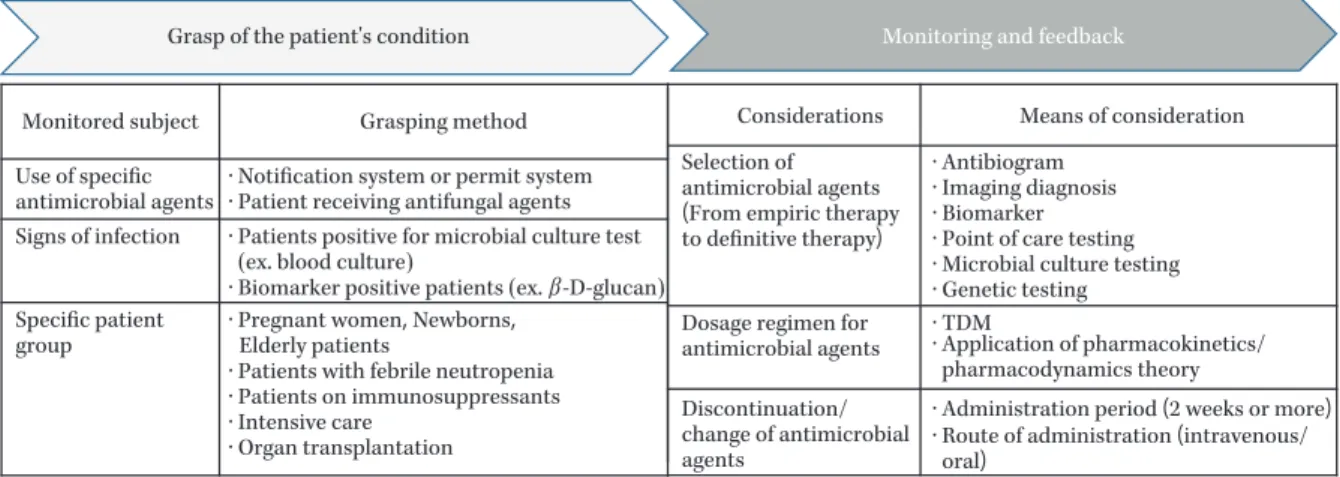
Fig. 1. Example of an antimicrobial stewardship intervention process in Japan
For conducting the intervention, each institution must first determine how to monitor the patient as the target of antimicrobial stewardship and how to monitor the proper use of antimicrobial agents. In general, use of specific antimicrobial agents and posi- tive blood cultures are as the trigger to start monitoring. However, it is also effective to target specific infectious diseases or groups of diseases. It is possible to select the indications according to the situation at each facility.
Monitored subject Grasping method
Use of specific antimicrobial agents
· Notification system or permit system
· Biomarker positive patients (ex. β -D-glucan)
· Patient receiving antifungal agents Signs of infection · Patients positive for microbial culture test
(ex. blood culture) Specific patient
group
· Pregnant women, Newborns, Elderly patients
· Patients with febrile neutropenia
· Patients on immunosuppressants
· Intensive care
· Organ transplantation
Considerations Means of consideration Selection of
antimicrobial agents (From empiric therapy to definitive therapy)
Dosage regimen for antimicrobial agents Discontinuation/
change of antimicrobial agents
Grasp of the patient's condition Monitoring and feedback
(Modified from the reference 4) Utilization of various guidelines, introduction of electronic medical records and infection control software,
education and enlightenment activities for staff
· Antibiogram
· Imaging diagnosis
· Biomarker
· Point of care testing
· Microbial culture testing
· Genetic testing
· TDM
· Application of pharmacokinetics/
pharmacodynamics theory
· Administration period (2 weeks or more)
· Route of administration (intravenous/
oral)
適正使用支援の介入手法として「事前許可制」,「前 向きな介入(早期モニタリング)とフィードバック」,
「抗菌薬
time outs(抗菌薬開始後 48
時間で感染症 の種類,抗菌薬選択,用法・用量,投与経路,de-escalation
の可否,治療期間などを確認すること)」を推奨している3)。
本邦では,2017年
8
月に8
学会合同抗微生物薬 適正使用推進検討委員会より「抗菌薬適正使用支援 プログラム実践のためのガイダンス」が発表され,2018
年度の診療報酬改定では「抗菌薬適正使用支 援加算」が新設されている。本ガイダンスでは,米 国と同様に薬剤師を主要構成メンバーに加えたan- timicrobial stewardship team(AST)の発足とと
もに専門資格を有している薬剤師の中心的な活動を 推奨している4)。また,ここではFig. 1
に示す国内 向けの介入プロセスを示しているが4),各施設でAST
の活動状況は異なるため,それぞれの施設に 応じた対応が必要となる。特に,感染症専門医が不 在である多くの中小病院では薬剤師の主体的な活動 が重要となる。現在,本邦の診療報酬上で規定されている薬剤師 の病棟活動には,薬剤管理指導(薬剤師による処方 薬の服薬支援と薬学的管理)と病棟薬剤業務(薬剤 師が医療従事者の負担軽減および薬物療法の有効性,
安全性の向上に資する業務)がある。後者は医師の 負担軽減を目的に
2010
年4
月30
日に発出された「医療スタッフの協働・連携によるチーム医療の推 進について」に関する厚生労働省医政局長通知(医 政発
0430
第1
号)を基本としており,薬剤師を積 極的に活用することが可能な業務として,「薬剤選 択,投与量,投与方法,投与期間等について,医師 に対し,積極的に処方を提案すること」,「薬物の血 中濃度や副作用のモニタリング等に基づき,副作用 の発現状況や有効性の確認を行うとともに,医師に 対し,必要に応じて薬剤の変更等を提案すること」5)などを挙げ,2012年に新設された病棟薬剤業務実 施加算にも反映されている。したがって,感染症領 域で病棟専従薬剤師が積極的に病棟薬剤業務を実践 することは,抗菌薬
time outs
を通じた抗菌薬適正 使用支援に繋がる可能性がある。横浜総合病院(以下,当院)は常勤の感染症専門 医が不在の
300
床の中規模病院である。当院では細 菌検査は外部業者に委託しているため,対応の遅れ によって菌血症などの重症感染症例で,治療に難渋 することがあった。そのため,病院長の指示の下に2012
年度から感染症担当薬剤師を配置し,病棟専 従薬剤師とともに薬剤師主導による早期からの抗菌 薬適正使用支援活動を行っている。今回,その支援活動の内容と活動を通じて得られた結果のプロセス 指標およびアウトカム指標を用いた評価について概 説する。
I. 薬剤師による初期治療および培養結果に基づ く抗菌薬適正使用支援
当院は
300
床,7病棟,外来28
診療科の中規模 病院であり,地域の基幹病院として感染防止対策加算
1,感染防止対策地域連携加算,抗菌薬適正使用
支援加算を取得している。また,2018年度
8
月現 在ではインフェクションコントロールド ク タ ー(ICD)5名,抗菌化学療法認定薬剤師
9
名(うち 感染制御専門薬剤師2
名),感染管理認定看護師2
名が在籍している。一方で,感染症専門医は常勤し ておらず,非常勤の感染症専門医が1
名勤務してい るのみであり,微生物検査および薬物血中濃度測定 を含む一部の血液検査項目は外部業者に委託してい る。当院では,1990年
2
月から脳神経外科病棟で病 棟専従薬剤師(主に病棟業務を行う薬剤師)による 薬剤管理指導と薬剤選択,投与量,投与方法,投与 期間に関する処方提案による医師の診療支援(現行 の病棟薬剤業務)を開始し,その後全病棟に展開し て2012
年度からは病棟薬剤業務実施加算も取得し た。また,2005年に病棟専従薬剤師の業務の一環 としてバンコマイシン(VCM),テイコプラニンな どの抗MRSA
薬の薬物治療モニタリング(thera-peutic drug monitoring:TDM)を開始し,同時に
一部の病棟専従薬剤師による感染症診療支援も開始 した。しかし2011
年度に,感染症治療に遅れを生 じたと考えられた症例や治療に難渋した重症感染症 を数例経験した。当時の当院では,「感染症患者の 感染臓器,起炎菌を熟慮せずに安易に広域抗菌薬を 使用する」,「抗菌薬投与前に血液培養などの適切な 検査の実施が不十分である」,「検査室からの培養報 告が迅速に主治医に連絡されない」,「細菌検査結果 に基づく使用抗菌薬の再評価体制が不十分である」などの問題点があり,その結果として血流感染症な どの重症感染症の対応が遅れたと考えられた。その ため,病院長から薬剤師の感染症治療に対する積極 的な支援を院内全体に展開するように指示があり,
2012
年度から抗菌化学療法認定薬剤師1
名を感染 症担当薬剤師(血液培養陽性例の対応,医師および 病棟専従薬剤師から感染症の相談応需を行う薬剤師)として専任で薬剤科内に配置し,主治医および 病棟専従薬剤師と連携して,薬剤師による初期治療 および培養結果に基づく抗菌薬適正使用活動を開始 した。まず
1)〜3)の支援活動を中心とした支援
を試みた6)。1)初期治療に対する薬剤師の支援内容
抗菌薬適正使用支援活動開始前は主に主治医の判 断または一部の病棟専従薬剤師による自主的な支援 によって初期治療を開始していたが,全例にはかか われていなかった。抗菌薬適正使用支援活動後は抗 菌薬の開始時に病棟専従薬剤師と主治医との協議に より非感染性疾患を除外したうえで,抗菌薬投与前 の血液培養
2
セット採取を含む各種培養採取,患者 背景,感染臓器,推定起炎菌に応じた初期の抗菌薬 選択に関する支援を開始した。休日や時間外,他の 業務などで初期の抗菌薬選択に関与できない場合は,その翌日または休日明けの朝に病棟専従薬剤師が担 当病棟の使用抗菌薬を確認してその妥当性を検証す ることで支援を行っている。また,病棟専従薬剤師 がこれらの活動を通じて重症例と判断した場合や全 身性炎症反応症候群の基準を満たす場合には,感染 症担当薬剤師も含めた感染症診療の支援を実施して いる。さらに,病院長の指示の下で必要に応じて主 治医から感染症担当薬剤師に相談する体制も設ける とともに,感染症担当薬剤師が専用の
PHS
を携帯 し,院内に不在時でも状態に応じて血液培養陽性例 や重症例の相談を受けることで感染症診療を支援し ている。2)血液培養の中間報告に基づく薬剤師の支援内容 当院では,抗菌薬適正使用支援活動前は血液培養 の中間報告書が検査室から該当病棟に運搬されるの みで,主治医への連絡が遅れて治療に影響すること があった。そのため,2012年度からの薬剤師主導 の抗菌薬適正使用支援活動開始後は感染症担当薬剤 師が検査科からの血液培養陽性の中間報告書を受け,
必要に応じて菌種にかかわる情報を外部委託先の検 査室に直接確認したうえで,ただちに主治医と病棟 専従薬剤師とともにその結果および対象患者の臨床 所見,検査所見から,現行の抗菌薬の選択と用法・
用量の妥当性を評価する支援を開始した。その際,
抗菌薬選択や用法・用量の適正化に加え,適宜血液 培養の再検査や陰性化確認を含む各種培養検査およ び治療上で必要となる検査項目なども提案すること
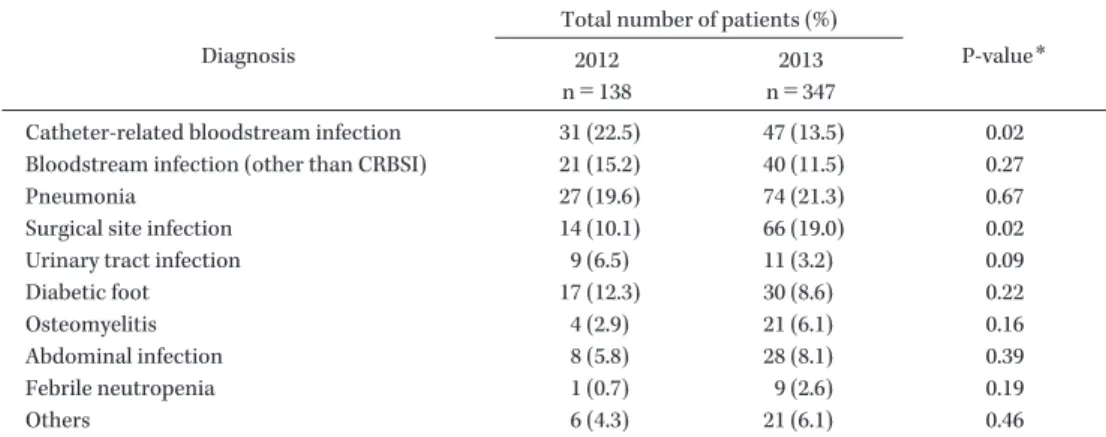
Table 2. Rates of infectious diseases in pharmacist-driven antimicrobial stewardship between 2012 and 2013
Diagnosis
Total number of patients (%)
P-value
*2012
n=138
2013 n=347
Catheter-related bloodstream infection 31 (22.5) 47 (13.5) 0.02
Bloodstream infection (other than CRBSI) 21 (15.2) 40 (11.5) 0.27
Pneumonia 27 (19.6) 74 (21.3) 0.67
Surgical site infection 14 (10.1) 66 (19.0) 0.02
Urinary tract infection 9 (6.5) 11 (3.2) 0.09
Diabetic foot 17 (12.3) 30 (8.6) 0.22
Osteomyelitis 4 (2.9) 21 (6.1) 0.16
Abdominal infection 8 (5.8) 28 (8.1) 0.39
Febrile neutropenia 1 (0.7) 9 (2.6) 0.19
Others 6 (4.3) 21 (6.1) 0.46
*
Data were compared using the chi-squared test with the statistical significance level set at p<0.05.
で,適正な感染症診療に繋がる支援を実施している。
3)最終報告に基づく薬剤師の支援内容
抗菌薬適正使用支援活動前における最終報告に基 づくさまざまな支援は一部の医師または病棟で行わ れていた。そのため,薬剤師主導の抗菌薬適正使用 支援活動後は感染症担当薬剤師と病棟専従薬剤師が 中心となって全病棟における細菌検査の最終報告書 を確認し,起炎菌,感受性結果,臨床経過とともに 現行の抗菌薬治療を評価する体制とした。また,感 染症担当薬剤師は評価した情報をもとに,
escalation,
de-escalation,経口薬へのスイッチ,適切な治療期
間の設定,各種必要な検査の実施について病棟専従 薬剤師を通じて主治医に提案することで,薬剤師主 導による適正な感染症診療支援を院内全体で実施し ている。なお,1)〜3)における
2012
年度以降の病棟専 従薬剤師の活動は,病棟薬剤業務の一環として実施 している。II. 薬剤師による抗菌薬適正使用支援内容の分析 とそれに基づく院内プロトコールの作成
1.2012 年度,2013 年度の感染症診療支援内容に 関する評価
2012
年度,2013年度の感染症診療支援患者数は それぞれ85
名,169名,延べ支援件数は138
件お よび347
件と2013
年度で増加していた。2012年度 に支援した延べ疾患の割合はカテーテル関連血流感 染症が最も多く,次いで肺炎であった。また,2013 年度では肺炎が最も多く,次いで手術部位感染症で あった。両年度の割合を比較すると2013
年度にカ テーテル関連血流感染症の割合が有意に減少し,手術部位感染症の割合が有意に上昇していた(Table
2)。感染症診療の支援内容について「抗菌薬選択」,
「用法・用量」,「TDM」,「感染源」,「細菌培養・血 液検査」,「抗菌薬の副作用」,「抗菌薬の相互作用」
の項目に分類のうえで各項目における延べ件数とそ の割合を比較したところ,両年度の延べ件数は
313
項目および653
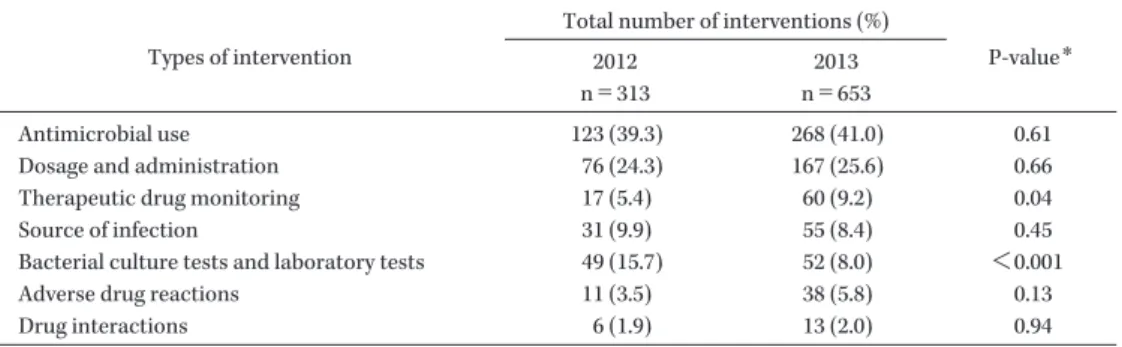
項目であり,2013年度で増加して いた。両年度とも抗菌薬選択が最も多く,次いで用 法・用量に関する支援であった。両年度の割合を比 較すると2013
年度にTDM
が有意に上昇し,細菌 培養・血液検査が有意に減少していた(Table 3)。2.支援内容の結果に基づく効率的な抗菌薬支援体 制の構築
支援率の高かった抗菌薬の選択については,各種 ガイドラインをもとに肺炎における抗菌薬使用前の 適切な検査,重症度に応じた抗菌薬選択に関するプ ロトコールの作成,MRSA感染症における疾患,重 症度,腎機能に応じた抗菌薬選択と投与量に関する プロトコールの作成を行い,感染症の診療支援を 行った。また,抗菌薬の選択に次いで支援率の高かっ た抗菌薬の用法・用量については,腎機能に応じた 標準投与量表を作成して適切な用法・用量の支援を 図った。さらに,TDM対象薬ではガイドラインを もとにした血中濃度測定のタイミングおよび重症例 などにおける早期での血中濃度測定に関するタイミ ングも記載し,TDMの適正化と外部委託による結 果報告の遅れを防ぐ支援も行った(Fig. 2)。
Table 3. Rates of types of intervention in pharmacist-driven antimicrobial stewardship between 2012 and 2013
Types of intervention
Total number of interventions (%)
P-value
*2012
n=313
2013 n=653
Antimicrobial use 123 (39.3) 268 (41.0) 0.61
Dosage and administration 76 (24.3) 167 (25.6) 0.66
Therapeutic drug monitoring 17 (5.4) 60 (9.2) 0.04
Source of infection 31 (9.9) 55 (8.4) 0.45
Bacterial culture tests and laboratory tests 49 (15.7) 52 (8.0) <0.001
Adverse drug reactions 11 (3.5) 38 (5.8) 0.13
Drug interactions 6 (1.9) 13 (2.0) 0.94
*
Data were compared using the chi-squared test with the statistical significance level set at p<0.05.
Fig. 2. Example of measurement of the serum concentration of vancomycin
We modified the TDM guideline
7)to a method that is consistent with the practice at our hospital to avoid outsourcing the serum concentration measurement. In addition, we also introduced PBPM by ward pharmacists.
【Target serum concentration】
Trough concentration of vancomycin: 10-15 μ g/mL (severe cases: 10-20 μ g/mL) Caution;
When the trough concentration of VCM is more than 15 μ g/mL, the rate of development of renal function impairment increases. Therefore, if the target trough concentration exceeds 15 μ g/mL in the early stages, it is necessary to pay close attention to the kidney function.
If VCM is administered concomitantly with aminoglycosides, the trough concentration of VCM should be less than 15 μ g/mL.
【Timing of measurement of the serum concentration】
Principle;
Immediately prior to administration on the third day of administration (it is nearly steady-state at this time when a loading dose is given on the first day or the injection is administered twice a day).
When the administration is continued for 7 days or more, the serum concentration is measured again after day 7.
Exception1;
Depending on the blood collection schedule, it is also possible to measure the serum concentration just before administration on the fourth day (e.g., severe case, acute kidney injury, chronic kidney disease).
Exception2;
In case of weekends or cases where it is difficult to estimate the serum concentration, measurement on day 2 of administration may also be considered.
III. プロトコールに基づく薬物治療管理(protocol- based pharmacotherapy management:PBPM)に よる抗菌薬適正使用支援体制の構築
2010
年4
月30
日に発出された「医療スタッフの 協働・連携によるチーム医療の推進について」に関 する厚生労働省医政局長通知(医政発0430
第1
号)では,薬剤師を積極的に活用することが可能な業務 の一つとして「薬剤の種類,投与量,投与方法,投 与期間等の変更や検査のオーダについて,医師・薬 剤師等により事前に作成・合意されたプロトコール
に基づき,専門的知見の活用を通じて,医師等と協 働して実施すること」を奨励している5)。それを受 けて日本病院薬剤師会では,医師・薬剤師等が事前 に作成・合意したプロトコールに基づき,薬剤師が 薬学的知識・技能の活用により,医師等と協働して 薬物治療を遂行する
PBPM
による薬剤師の専門性 の発揮を推奨している8)。当院では,2014年
5
月から病棟専従薬剤師によ るPBPM
を導入した。感染症領域におけるPBPM
では,医師との事前合意の下「TDM対象薬の血中Fig. 3. Pharmacist-driven antimicrobial stewardship system for bacteremia and severe infections
① The IDCPs receive the interim and final results of bacteriological examination. ② The IDCPs consult the clinical laboratory about the pathogenic bacteria in the reports (For example, the IDCPs consult the laboratory about the shape of the bacteria in the interim report, the MIC for the identified microorganism, the setting breakpoint, etc.). ③ The pharmacist and doctors in the AST confirm and support the activities of the ward pharmacist including IDCPs. ④ For patients with severe or refractory infec- tious diseases, the IDCP in the AST consult with doctors or pharmacists in the ward. ⑤ The IDCP in the AST report cases of bac- teremia and cases with refractory infections at the weekly AST meetings and receive advice from the infectious disease physician or doctors in the AST, as needed. In addition, for patients suffering from severe and/or refractory infectious diseases despite AST support, the IDCPs consult the infectious disease physician along with the ward pharmacists or attending doctors.
Wards Doctors Pharmacists
*4(IDCPs and non-IDCPs) Nurses AST
Doctors (ICD
*1) Pharmacist (IDCP
*2)
Nurse (ICN
*3) Clinical laboratory technician
Clinical laboratory (outside)
③
①
Infectious disease physician (Part time)
④
①
*1
ICD: infection control doctor
*2
IDCP: infectious disease chemotherapy pharmacist
*3
ICN: infection control nurse
*4
We have allocated IDCPs to each ward since 2016.
②
②
⑤
Fig. 4. Outline of pharmacist-driven antimicrobial stewardship for patients with bacteremia and severe infections Pharmacist-driven antimicrobial stewardship system, support attending doctors from the initial therapy to definitive therapy for patients with bacteremia and severe infections. In addition, IDCP and doctors in the AST support the ward pharmacists.
Examination of blood cultures and selection of the initial therapy of bacteremia and severe infections
Positive report on interim results of blood culture to pharmacists and doctors
Report on final results of blood culture to pharmacists and doctors
Pharmacist-driven antimicrobial stewardship
• Confirmation of collection of 2 sets for blood cultures
• Support of the initial therapy by ward pharmacists
• Evaluation of the initial therapy and recommendation for appropriate antimicrobial therapy by ward pharmacists
• The IDCP
*1and doctors in the AST support ward pharmacists
• Evaluation of the current therapy and recommendation of a definitive therapy by ward pharmacists
• Recommendation for re-examination of blood cultures and search for sources of infection if these inspections have not been done yet, the patient’s clinical symptoms do not improve, and/or bacteremia persists
• Recommendation for the appropriate duration of treatment
• Recommendation for another therapy if the current therapy has failed, for example, when the patient’s clinical symptoms do not improve and/or the bacteremia persists
• The ICDP and doctors in the AST support ward pharmacists Pharmacist-driven antimicrobial stewardship
• Evaluation of the initial therapy and recommendation for appropriate antimicrobial therapy by ward pharmacists if the initial therapy has failed, for example, when the patient’s clinical symptoms do not improve
• Recommendation for re-examination of blood cultures and search for sources of infection if the initial therapy has failed
• The IDCP and doctors in the AST support ward pharmacists
Pharmacist-driven antimicrobial stewardship
*1
IDCP: infectious disease chemotherapy pharmacist
Fig. 5. Trends in the number and two-set sample collection rate for blood cultures per year
(A) Annual number of blood culture collections between 2011 and 2017. Data on blood cultures were collected yearly between April 1 and March 31 of the following year. (B) Two-set sample collection rate for blood culture between 2011 and 2017. Data on the two-set sample collection rate for blood culture were collected yearly between April 1 and March 31 of the following year.
(A) Number of annual blood culture collections (B) Two-sets collection rate for blood culture
268 322 536
941 2,147
2,332 2,974
0 500 1,000 1,500 2,000 2,500 3,000 3,500
2011 2012 2013 2014 2015 2016 2017 2011 2012 2013 2014 2015 2016 2017
25.7%
42.6%
71.8%
92.8% 93.0% 94.1% 91.8%
0%
20%
40%
60%
80%
100%
Number of blood culture collections Two-sets collection rate
Years Years
濃度」,「市中肺炎における尿中肺炎球菌抗原,レジ オネラ抗原」,「敗血症例(疑い例を含む)における プロカルシトニン」,「真菌感染症例(疑い例を含む)
における
β
―D―グルカン」,「daptomycin投与患者 におけるクレアチンホスホキナーゼ」,「liposomalamphotericin B
投与患者におけるK
値,Mg値」な どに関する検査項目の院内プロトコールを作成し,薬剤師も代行入力できる体制とした。また,感染対 策チーム(infection control team:ICT)と協働で 各診療科の指示書に「38℃ 以上の場合に血液培養
2
セット採取」を加え,夜間でも看護師が血液培養を 採取できる体制も構築した。IV. 病棟専従薬剤師を中心とした抗菌薬適正使用 支援体制の構築
当院薬剤科では,可能な限り病棟で感染症診療支 援を行える薬剤師を育成する目的で,前述の抗菌薬 適正使用支援を感染症担当薬剤師と病棟専従薬剤師 で行うことで業務を通じた育成を図るとともに,日 本化学療法学会の認定制度である抗菌化学療法認定 薬剤師の取得を推進して感染症診療支援に貢献でき る薬剤師の育成を行った。その結果,抗菌化学療法 認定薬剤師数は
2011
年に1
名であったが,2015年 に2
名,2016年に6
名,2017年に7
名,2018年に9
名となった。また,2016年からは各病棟に抗菌化 学療法認定薬剤師を配置して可能な限り病棟専従薬剤師が抗菌薬適正使用支援の中心的な役割として,
AST
と連携した主治医による感染症治療の支援と 病棟活動を通じた抗菌薬time outs(当院では抗菌
薬開始後72
時間程度で感染症の種類,抗菌薬選択,用法・用量,投与経路,de-escalationの可否,治療 期間などを評価することとしている)を行い,感染 症担当薬剤師はその活動を後方支援する役割へと体 制をシフトした(Figs. 3,4)。
V. 抗菌薬適正使用支援体制の成果(プロセス指 標,アウトカム指標に関する検証)
1.血液培養採取件数,2 セット率の推移
2011
年度から2017
年度における血液培養採取件 数,2セット遵守率をFig. 5
に示す。活動前の2011
年度は年間採取件数268
件,2
セット遵守率は25.7%
であったが,前述の取り組みによって年間採取件数 は
2015
年度以降に2,000
件以上となり,2セット遵 守率は2014
年度以降に90%
以上となった。2.血液培養陽性例における支援内容
2012,2013
年度における血液培養陽性例に対する薬剤師の早期支援効果の検証結果を
Fig. 6, Table 4
に示す。初期治療から薬剤師が支援した群(初期 治療支援群)と初期治療は薬剤師が支援せず血液培 養の中間報告以降に支援した群(初期治療非支援群)に分類して検証した結果,累積適正抗菌薬使用率と
de-escalation
実施率は初期治療支援群で有意に高く,Table 4. Rates of 30-day survival, change of antimicrobial agents at interim and final reports and de-escalation in patients with intervention and non-intervention for the initial therapy
Number of patients (%)
P-value
*Intervention group for the
initial therapy (n=35)
Non-intervention group for the initial therapy (n=44)
30-day survival rate 33 (94.3) 35 (79.5) 0.10
At the interim and final reporting 8 (22.9) 24 (54.5) <0.01
De-escalation after the final reporting 9 (25.7) 3 (6.8) 0.03
*
Data were compared using the Fisherʼs exact test with the statistical significance level set at p<0.05.
Fig. 6. Cumulative rate of achievement of appropriate antimicrobial therapy in patients with intervention or non-intervention in relation to the initial therapy
We set the day on which the sample for blood culture was collected as Day 1. The cumulative rate of achievement of appro- priate antimicrobial use for the initial therapy as assessed by the Kaplan-Meier method was 82.9% on day 1, 88.6% on day 3, and 97.1% on day 4 in the intervention group, and 43.2% on day 1, 50.0% on day 2, 77.3% on day 3, and 84.1% on day 4 in the non-intervention group; the rate was significantly higher in the intervention group than that in the non-intervention group (p<0.01). The intervention for the initial therapy was supported by the IDCP. Data were collected between April 1, 2012 and March 31, 2014, analyzed by the Kaplan-Meier method and compared by the log-rank test. The statistical significance level was set at p<0.05.
0 0.2 0.4 0.6 0.8 1
0 1 2 3 4 5 6 7 8 9 10 11
Days
P<0.01 Intervention group for the initial therapy (n=35) Non-intervention group for the initial therapy (n=44)
Cumulative achievement
No. of patients
Intervention 35 6 5 4 1 1 1 0 0 0 0 0
Non -intervention 44 25 22 10 7 6 4 3 3 3 1 0
感受性のない不適正な抗菌薬の使用によって中間・
最終報告後に抗菌薬を変更した割合は初期治療支援 群で有意に低かった。一方,30日生存率は初期治 療支援群で高い傾向を認めたが,統計学的に有意な 差は認めなかった。
3.市中肺炎に対する支援内容9)
抗菌薬適正使用支援前の
2011
年度,支援1
年目 である2012
年度,支援2
年目である2013
年度にお ける尿中肺炎球菌抗原・尿中レジオネラ抗原の同時 採取件数をFig. 7
に示す。各年度の中央値は2011
年度が7.0
件(6.8〜11.3),2012年度が11.5
件(9.0〜12.3),2013
年度が14.0
件(12.8〜17.5)であり,2013年度(支援
2
年目)で有意に増加した。また,尿中 肺炎球菌抗原陽性例のうち,適正抗菌薬が使用され ていた割合は2011
年度が33.3%(2/6
例),2012年 度が37.5%
(3/8例),2013年度が92.3%
(12/13例)であり,2013年度(支援
2
年目)では2011
年度(支 援前)と2012
年度(支援1
年目)に比べて有意に 上昇した。4.PBPM 導入前後における TDM 実施率の推移
PBPM
導 入 の 効 果 を 導 入 前(2014年1〜4
月),導入後(2014年
6〜9
月)におけるVCM
とamikacin
(AMK)の
TDM
実施率,VCMにおけるトラフ値 の推移で検証したところ,VCMのTDM
実施率はFig. 7. Number of urinary antigen tests for Legionella and S. pneumoniae and rate of antimicrobial use for urinary pneumo- coccal antigen-positive cases
(A) Number of urinary antigen tests for Legionella and S. pneumoniae between 2011 and 2013. Data on urinary antigen tests for Legionella and S. pneumoniae were collected yearly between April 1 and March 31 of the following year and estab- lished monthly. (B) The rate of antimicrobial use in urinary pneumococcal antigen-positive cases between 2011 and 2013.
Data on antimicrobial use for urinary pneumococcal antigen-positive cases were collected yearly between April 1 and March 31 of the following year and compared using the Kruskal-Wallis test (A) and chi-squared test (B). The statistical significance level was set at p<0.05.
1 (16.7) 1 (16.7) 0 (0) 4 (66.7) 2 (33.3)
3 (37.5) 0 (0) 0 (0) 5 (62.5) 3 (37.5)
p<0.01 p = 0.03
(A) Number of urinary antigen tests for Legionella and S. pneumoniae
p = 0.10
2011 (n = 6)
2012 (n = 8)
2013 (n = 13) The appropriate
antimicrobial agents
*2(%) 12 (92.3)
SBT/ABPC (%) 11 (84.6)
1 (7.7) 1 (7.7) 0 (0) CTRX (%)
LVFX (%) TAZ/PIPC (%)
<P-value>
2011 vs. 2012 : p = 1.00, 2011 vs. 2013 : p = 0.04 2012 vs. 2013 : p = 0.04
*1
We conducted the evaluation after excluding patients with pulmonary diseases such as chronic obstructive pulmonary disease, nursing and healthcare-associated pneumonia and severe pneumonia, for which selection of carbapenem should be considered.
*2
We defined SBT/ABPC, CTRX and LVFX, which are recommended in guidelines as appropriate antimicrobial agents.
2013
(B) Rates of antimicrobial use in urinary pneumococcal antigen-positive cases
*12012 2011
Number of urinary antigen tests
導入前:87.5%(21/24),導入後:97.1%(34/35)と 有意ではないものの上昇を認めており(p = 0.29,
fisherʼs exact test),AMK
では導入前:22.2%(4/18),導入後:64.7%(11/17)と有意な上昇を認め
た(p = 0.02,fisherʼs exact test)。一方で,VCM にお け る ト ラ フ 値 の 推 移 は,PBPM導 入 前 で10 μ g/mL
以下:14.3%(3/21),10〜20 μ g/mL:61.9%
(13/21),20
μ g/mL
以 上:23.8%(5/21),導 入 後 は10 μ g/mL
以下:11.8%(4/34),10〜20 μ g/mL:
79.4%(27/34),20 μ g/mL
以 上:8.8%(3/34)で あり,両群で有意な差は認めなかった(p = 0.27,chi- squared test)。
5.Staphylococcus aureus菌血症(SAB)におけ る支援10)
SAB
を対象に薬剤師による抗菌薬適正使用支援 の有用性を,支援前(2008〜2011年度:pre-ASP),支援後(2012〜2015年度:post-ASP)に分類して
30
日生存率,早期の適正抗菌薬使用,同定後のde- escalation,血液培養の再検査,経胸壁心エコーの
実施,14日以上の抗菌薬投与について検証した。その結果,アウトカム指標である
30
日生存率では両 群で有意な差を認めなかったが,MRSA菌血症に お け る 早 期 の 適 正 抗 菌 薬 使 用,同 定 後 のde- escalation,14
日以上の抗菌薬投与は支援後で有意 な上昇を認めた(Fig. 8,Table 5)。● ● ● ● ● ● ● ● ● ● ● ● ● ● ● ● ● ● ● ● ● ● ● ● ● ● ● ● ● ● ● ● ● ● ● ● ●
おわりに
抗菌薬適正使用支援を実践していくうえで,病床 規模,感染症専門医,ICD,抗菌化学療法認定薬剤 師などの人数,ASTのマンパワーなどの影響は大 きい。したがって,各施設に応じた体制を構築する ことが重要であるが,担当者の兼務などで人数と活 動時間に制限のある
AST
活動には限界もある。そ のような施設では,主治医と信頼関係を構築してい る病棟専従薬剤師は抗菌薬適正使用支援における キーパーソンとなり得ると考えられる。また各病棟 に抗菌化学療法認定薬剤師を配置して病棟薬剤業務 を通じた抗菌薬適正使用支援活動を行うことにより,その効果としてプロセス指標およびアウトカム指標
Table 5. Rates of adverse drug reactions, de-escalation and adherence with care bundle in patients with SAB in pre-and post-ASP
Pre-ASP (n=25) Post-ASP (n=48) P-value
*3Rate of adverse drug reactions 4 (16.0%) 4 (8.3%) 0.43
Rate of de-escalation
*12 (8.0%) 17 (35.4%) 0.01
Administration for 14 days or more 12 (48.0%) 38 (79.2%) <0.01
Re-examination of blood culture
*29 (36.0%) 27 (56.3%) 0.13
Implementation of TTE
*29 (36.0%) 23 (47.9%) 0.46
*1
We evaluated the rate of de-escalation during antimicrobial agent administration after antimicrobial susceptibility testing reports pre-and post-ASP.
*2
We evaluated these events with or without implementation before treatment completion.
*3
Data were compared using the chi-squared test with the statistical significance level set at p<0.05.
Fig. 8. 30-day survival rate and cumulative use with adherence rate appropriate antimicrobial therapy in SAB patients pre- ASP and post-ASP
(A) 30-day survival rate in SAB patients pre-ASP and post-ASP. (B) Cumulative use with adherence rate to appropriate antimicrobial therapy in patients pre-ASP and post-ASP for SAB. (C) Cumulative use with adherence rate appropriate an- timicrobial therapy in MSSA infection patients pre-ASP and post-ASP. (D) Cumulative use with adherence rate to appro- priate antimicrobial therapy in MRSA infection patients pre-ASP and post-ASP. We set the day on which the sample for blood culture was collected as Day 1. The pre-ASP group data were collected from April 1, 2008 to March 31, 2012 and the post-ASP group data were collected from April 1, 2012 to March 31, 2016. Data were analyzed by the Kaplan-Meier meth- od and compared by the log-rank test, with the statistical significance level set at p<0.05.
No. of patients
Pre-ASP 25 25 24 21 21 21 20 Post-ASP 48 47 44 42 41 39 39
0.0 0.2 0.4 0.6 0.8 1.0
0 2 4 6 8 10
Days
Pre-ASP (n=13) Post-ASP (n=21)
0.0 0.2 0.4 0.6 0.8 1.0
0 2 4 6 8 10
Days
Pre-ASP (n=12) Post-ASP (n=27) p = 0.44
p = 0.02
Cumulative achievement The cumulative achievement
(C) Cumulative use with adherence to appropriate antimicrobial therapy in patients with MSSA pre-ASP and post-ASP
(D) Cumulative use with adherence to appropriate antimicrobial therapy in patients with MRSA pre-ASP and post-ASP (B) Cumulative use with adherence to appropriate antimicrobial
therapy in patients with SAB pre-ASP and post-ASP
The cumulative achievement 0.0 0.2 0.4 0.6 0.8 1.0
0 2 4 6 8 10
Days
Pre-ASP (n=25) Post-ASP (n=48) p = 0.07
No. of patients
Pre-ASP 25 6 4 1
Post-ASP 48 13 22
8
10 3 2 0
No. of patients
Pre-ASP 13 3 1 0 0 0
0
Post-ASP 21 4 0 0 0
No. of patients
Pre-ASP 12 10 7 6 4 1
Post-ASP 27 18 10 3 2 0
0.0 0.2 0.4 0.6 0.8 1.0
0 5 10 15 20 25 30
Days
Pre-ASP (n=25) Post-ASP (n=48) p = 0.80
Survival rate
(A) 30-day survival rate in patients with SAB pre-ASP and post-ASP
のいずれの向上にも寄与できる可能性があり,特に,
感染症専門医不在施設における抗菌薬適正使用支援 活動では,病棟専従薬剤師の果たすべき役割は大き いと考える。
利益相反自己申告:申告すべきものなし。
文献
1) Dellit T H, Owens R C, McGowan J E Jr, Gerd- ing D N, Weinstein R A, Burke J P, et al; Infec- tious Diseases Society of America; Society for Healthcare Epidemiology of America: Infectious Diseases Society of America and the Society for Healthcare Epidemiology of America guide- lines for developing an institutional program to enhance antimicrobial stewardship. Clin Infect Dis 2007; 44: 159-77
2) Barlam T F, Cosgrove S E, Abbo L M, Mac- Dougall C, Schuetz A N, Septimus E J, et al:
Implementing an Antibiotic Stewardship Pro- gram: Guidelines by the Infectious Diseases So- ciety of America and the Society for Health- care Epidemiology of America. Clin Infect Dis 2016; 62: e51-77
3) Centers for Disease Control and Prevention:
Core Elements of Hospital Antibiotic Steward- ship Programs
https://www.cdc.gov/antibiotic-use/healthcare/
implementation/core-elements.html(2018/8/28
アクセス)4) 8
学会合同抗微生物薬適正使 用 推 進 検 討 委 員 会:抗菌薬適正使用支援プログラム実践のため のガイダンス。日化療会誌2017; 65: 650-87 5)
厚生労働省医政局長:医療スタッフの協働・連携によるチーム医療の推進について(医政発
0430
第1
号)。2010年4
月30
日https://www.mhlw.go.jp/shingi/2010/05/dl/s 0512-6h.pdf(2018/8/28
アクセス)6)
佐村 優,國島広之,倉田武徳,廣瀬直樹,石 井淳一,腰岡 桜,他:血液培養陽性例に対す る薬剤師の早期介入体制の構築とその効果。日 化療会誌2015; 63: 544-52
7)
日本化学療法学会抗菌薬TDM
ガイドライン作 成委員会,日本TDM
学会TDM
ガイドライン 策定委員会―抗菌薬領域―:抗菌薬TDM
ガイ ドライン。日化療会誌2012; 60: 393-445 8)
日本病院薬剤師会:プロトコールに基づく薬物治療管理(PBPM)の円滑な進め方と具体的実 践事例(Ver.1.0)
http://www.jshp.or.jp/cont/16/0331-1.pdf
(2018/8/28
アクセス)9)
佐村 優,倉田武徳,廣瀬直樹,石井淳一,南 雲史雄,鯉淵寛之,他:感染症担当薬剤師配置 を通じた病棟薬剤業務による感染症治療支援の 有用性に関する検討。日病薬誌2016; 52: 518-22 10)
佐村 優,廣瀬直樹,倉田武徳,石井淳一,南 雲史雄,高田啓介,他:薬剤師主導の抗菌薬適 正使用支援活動を通じたStaphylococcus aureus
菌血症に対する診療支援の有用性に関する検討。日化療会誌