九州大学学術情報リポジトリ
Kyushu University Institutional Repository
高温高圧下における低含水率デンプンの熱溶融特性 に関する研究
井倉, 則之
https://doi.org/10.11501/3135195
出版情報:Kyushu University, 1997, 博士(農学), 論文博士 バージョン:
権利関係:
V-1
CHAPTER V
Effect of shearing force on physicochemical change of starch melts at an elevated temperature
Introduction
Many investigations have been done on starch properties heated under dry condition, and reviewed by Greenwood (1967) and Tomasik (1989). Several researches have been done on moist starch heating under wet-condition and usually heated treatment of starch under moist condition have been carried out at a temperature range from 50 to 120 OC by using an autoclave (Fukui & Nikuni, 1964; Kubota et al., 1979; Bakshi & Singh, 1980). In the heated treatments of moist starches (moisture content, ca. 0.20"-'0.25 g-H20/g-solid), it is known that
the physicochemical properties of the starches may be altered, such as, the raise of gelatinization temperature (Kubota et al., 1979), the change of X-ray diffraction profile (Fukui & Nikuni, 1964). Such the heated treatment has not been in use for industrial starch processing itself, however the above event may be taken place for actual processing of starchy foods. In the novel development of starchy material processing by extrusion-cooking (Dolan et al., 1989; Mackey
& Ofoli, 1990a, b), moist starchy material is assumed to be fused at a high
temperature and is processed under powerful kneading in an air-tight barrel of
65
the extrusion cooker. In this case , the shearing-force on starch melt must be given b y the kneading. While the effect of shearing-force on starch melt has not been revealed because it is so complicated phenomenon that the kneading behaviour cannot analyze to date .
I consider that the shearing-force is simplified b y use of a capillar y tube viscometer, in other words the shearing-force occur when the starch melts flow through a capillar y tube only. In this chapter I investigate the effect of shearing-force on various starch melts at an elevated temperature using a capillary tube viscometer.
66
V-2 Materials and Methods
V -2-1 Starches
Potato, sweet potato, corn and wheat starches used in this study were the same as described in Chapter II-2-1. The moisture content of these starches were adjusted to 0.20, 0.25 g-H20/g-solid by same method as Chapter III -2-1.
V-2-2 Flow tester
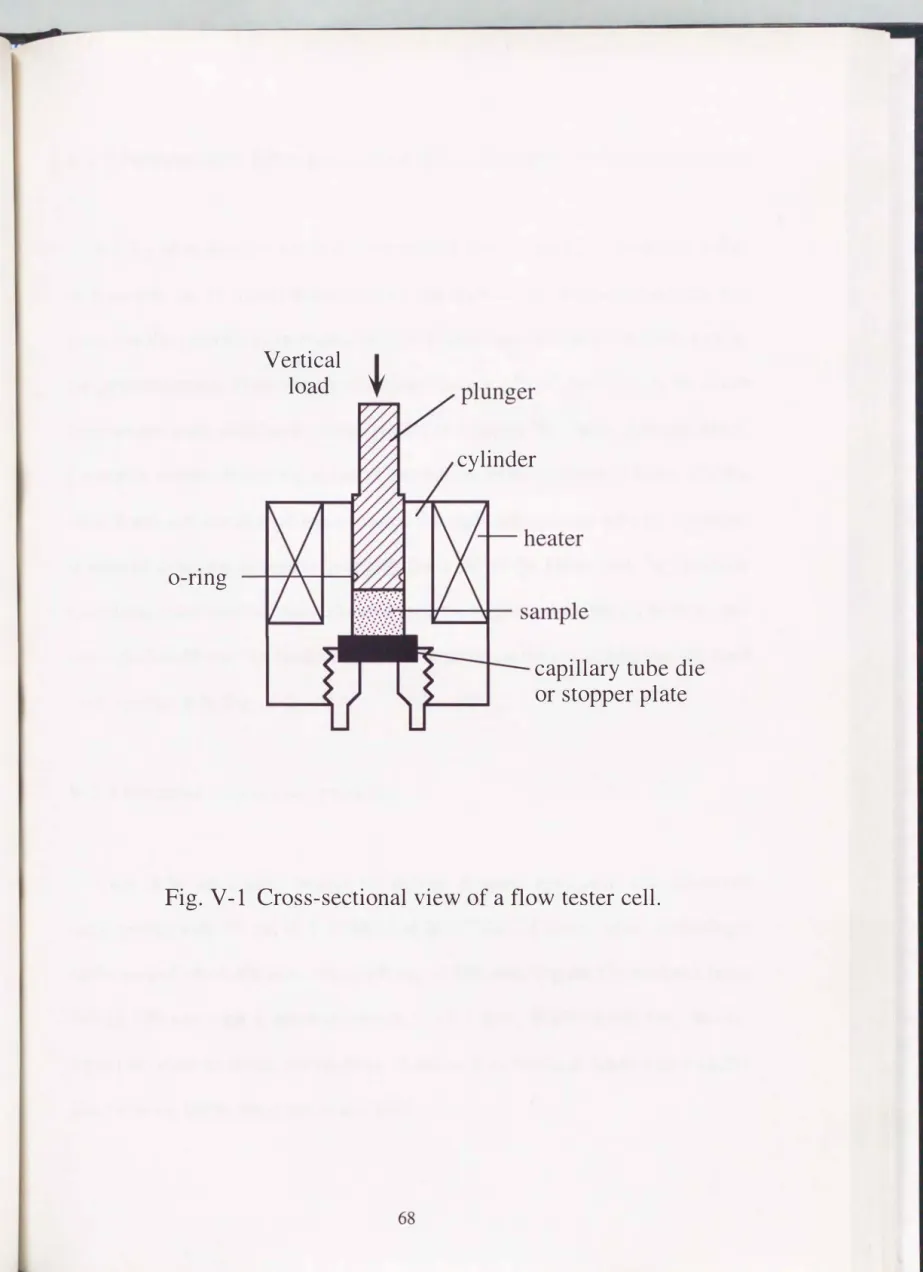
A flow tester (CFT-500C, SI-llMADZU Co., Kyoto, Japan) equipped with a capillary tube (1.0 mm in inside diameter, 15.0 mm in length) or a stopper plate was used to prepare heated and heated sheared starch specimens. A crass
sectional view of the flow tester cell was shown in Fig. V -1. An o-r ing was attached to the bottom of the plunger for pre venting steam from leakage. The flow tester can regulate the heating temperature and pressure by a plunger on starch specimen mounted in a reservoir (the cell block was composed of a reservoir and a plunger).
67
o-r1ng
Vertical load
cylinder
capillary tube die or stopper plate
Fig. V -1 Cross-sectional view of a flow tester cell.
V-2-3 Measurement of flow properties and heated sheared specimen preparation
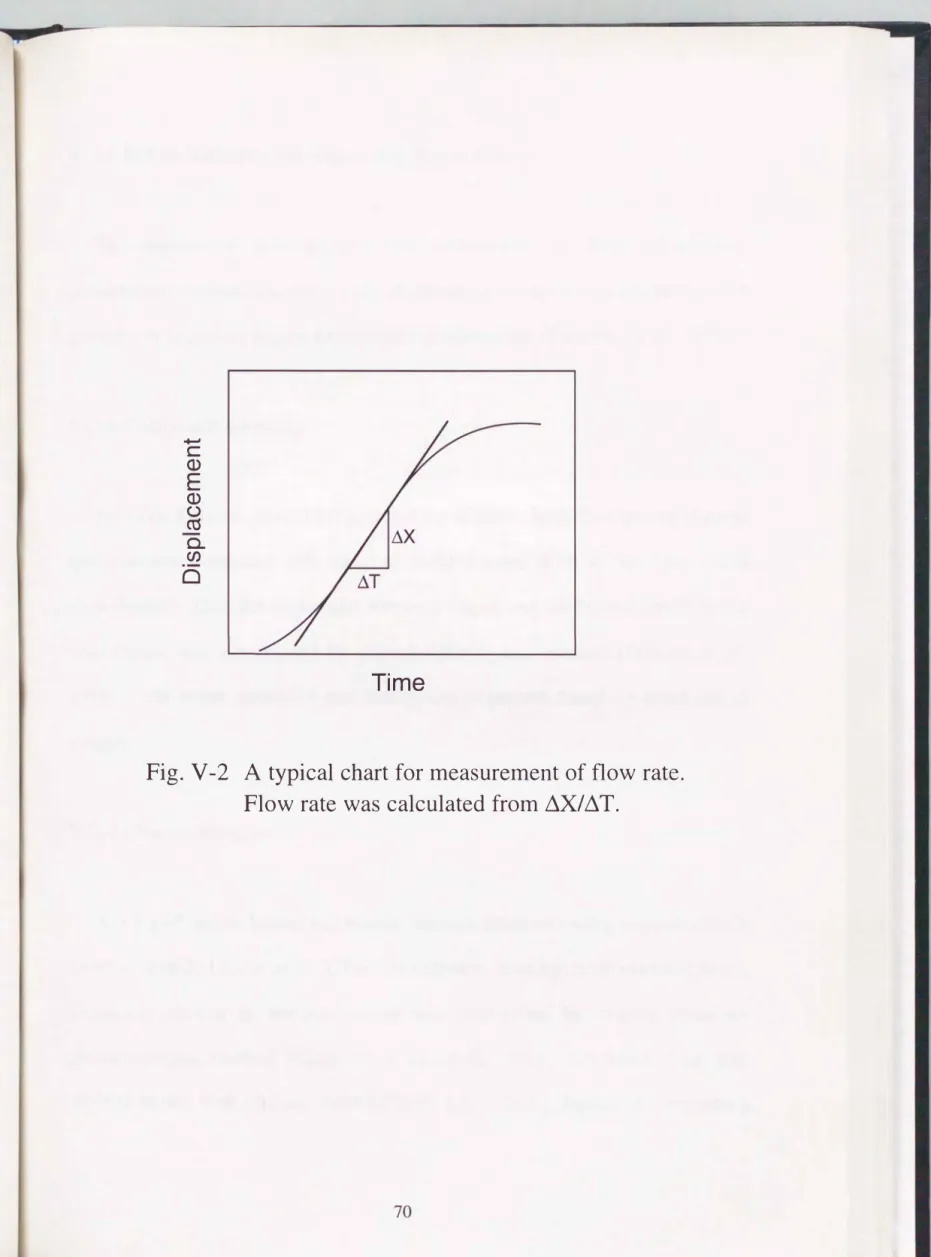
A 1. 7 g of moisturized starch was moulded int o a cylindrical shape ( 10.8 mm in diameter, ca. 15 mm in length) with a hand press. The moulded specimen was placed in the reservoir pre-heated at 150 OC and then mounted with the plunger for pressurization. Then starch was maintained at 150 OC for 15 min, at which the starches melt sufficiently fr om results of Chapter III. After co oling down, the starch specimen was taken out as heated specimen (gr ound to fine). On the other hand, the starch melt was extruded through the capillary tube by a plunger at desired constant pressures (ranging from 20 to 50 MPa) and the resultant extrudates were used as heated sheared specimens (ground to fine). The flow rate was calculated form the displacement of extrusi on stroke divided by the required time, as sh own in Fig. V -2.
V -2-4 Detection of pyrolysis products
Each 0.5g of intact, heated or heated sheared specimen was dissolved respectively with 50 ml of 1 N KOH at 30 OC for 24 hour. After centrifugal separation of insoluble fine, the spectrum of the centrifugate was scanned fr om 230 to 600 nm with a spectr ophotometer (UV-160, SHIMADZU Co., Ky oto, Japan) in order to detect pyrolysis products such as furfural (absorbance at 277 nm) (Jencks, 1959; Kainuma et al., 1973).
69
...,
c Q)
E
Q) (.) ct:S c.. en 0Time
Fig. V-2 A typical chart for measurement of flow rate.
Flow rate was calculated from 11X/11T.
V -2-5 Determination of the degree of gelatinization
The degr ee of gelatinization was determined by BAP (�-amylase
pulluranase) method. The degree of gelatinization was given in percent based on the ratio of digestion degree to complete gelatinization (Kainuma et al., 1981 ).
V-2-6 Cold water solubility
Based on Kainuma et al.(1967), each 0.5 g of intact, heated and heated sheared specimen was suspended with 15 ml of distilled water at 30 OC for 3 hour with slow shaking. Then the suspension was centrifuged and solubilized star ch in the centr ifugate was deter mined by phenol-sulfur ic acid method (Dubois et al., 1956). Cold water solubility was then given in per cent based on dr ied star ch weight.
V-2-7 Glucose detection
A 0.5 g of intact, heated and heated shear ed specimens wer e suspended with 15 ml of distilled water at 30 OC for 3 h with slow shaking. After centrifugation,
D-glucose amount in the super natant was deter mined by slightly modified glucose-oxidase method (Kingsley & Getchell, 1960) (Glucose-B Test Kit, WAKO PURE CHEMICAL INDUSTRIES Ltd., Osaka, Japan). To estimate a
71
small amount of glucose, amounts of specimen solution were scaled up to 1 ml instead of specified amount of 0.1 ml of the Kit and simultaneously amount of other reagent was also scaled up to corresponding volume of the specimen solution. Glucose content was given in percent based on dried starch weight.
V -2-8 Gel filtration
Based on Chinnaswam y & Bhattacharya (1986), each 80 mg of intact, heated and heated sheared specimen was suspended with 8 ml of distilled water and gelatinized with 10 N NaOH solution, and then neutralized with 1N HCl. In this experiment the extrudates b y pressure of 50 MPa (20 MPa on sweet potato starch at 0.25 g-H20/g-solid, because it was impossible to measure the flow rate for its high fluidity) wer e used as the heated shear ed specimens. After the starch solution was diluted to five times with distilled water and was centrifuged (15,000xG, 10 min), a 5 ml of the supernatant was charged on a Sephacryl S-500 gel column (16 mm in inside diameter , 98 em in packing height, Pharmacia Biotech Co., Uppsala, Sweden) and eluted with distilled water at a flow rate of 20 ml/h and collected each fraction of 5 ml. Dextran T2000 and T500 (2000 and 500 kDa, Pharmacia Biotech Co., Uppsala, Sweden) and dextran
(17
.9 kDa, SIGMA CHEMICAL Co., St. Louis, USA) and sucrose (0.342 kDa, WAKO PURE CHEMICAL INDUSTRIES Ltd., Osaka, Japan) were used as the standard-72
molecular-weight markers. Eluted starch in each fraction was determined by phenol-sulphuric acid method.
V
-2-9
ViscometryIn order to determine viscometric molecular weight of intact, heated and heated sheared specimen, viscometry with an Ubbel ohde viscometer was done at
20
OC for specimen solution (dissolved with1
NKOH)
at concentration rangingfrom
0.05
to0.25
% (w/v) in accordance with Leach (1963). In this experiment the extrudates by pressure of50
MPa(20
MPa on sweet potato starch at0.25
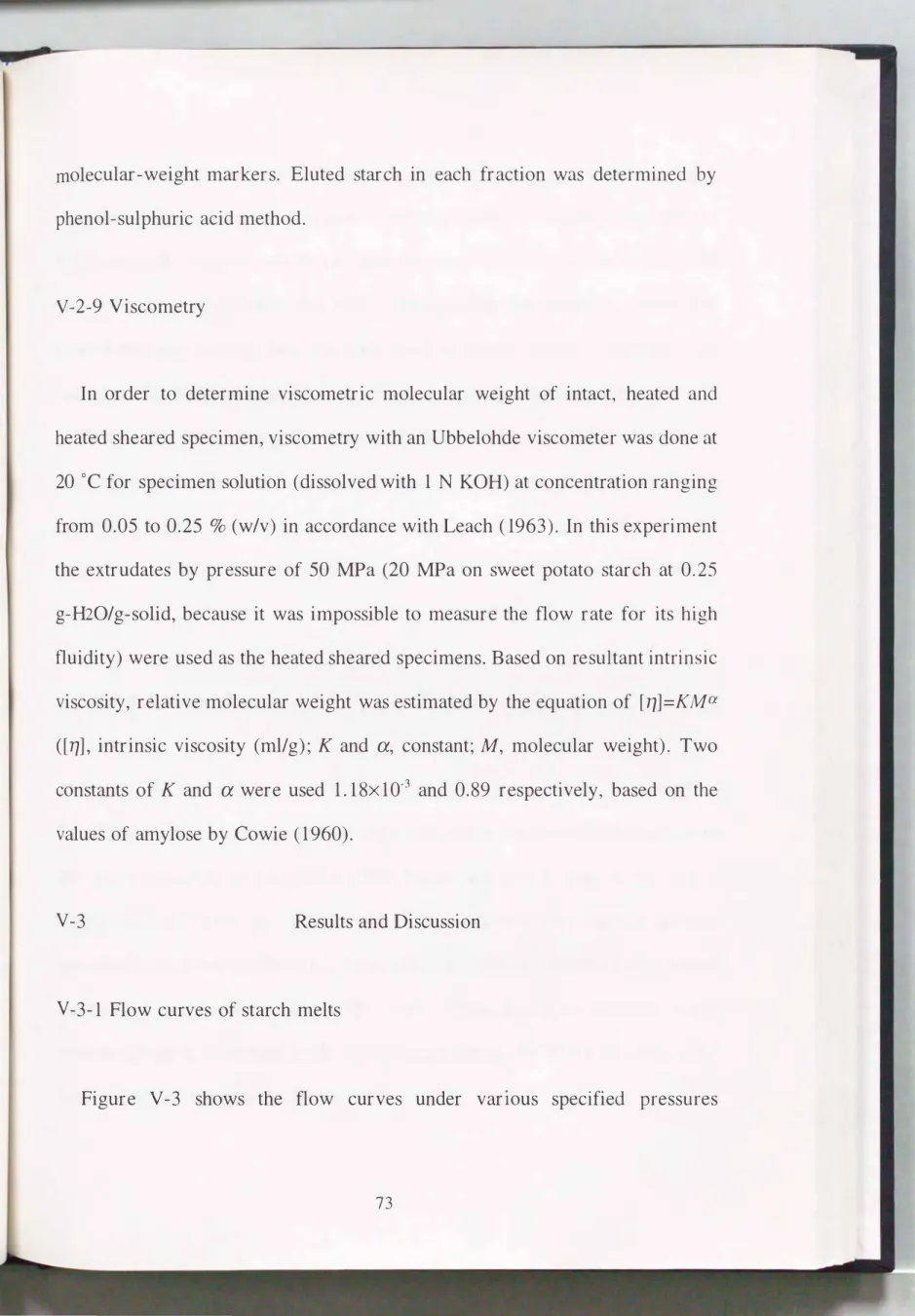
g-H20/g-solid, because it was impossible to measure the flow rate for its high fluidity) were used as the heated sheared specimens. Based on resultant intrinsic viscosity, relative molecular weight was estimated by the equation of [7J]=KMa ([7]], intrinsic viscosity (mllg); K and a, constant; M, molecular weight). Two constants of K and a were used
1.18x10⁻³
and0.89
respectively, based on the values of amylose by Cowie(1960).
V-3 Results and Discussion
V -3-1 Flow curves of starch melts
Figure V-3 shows the flow curves under various specified pressures
73
(expressed as the pr essure difference) applied on the plunger. The fluidity of 4 varieties of star ch melts was in or der of low viscosity of sweet-potato melt to high viscosity of potato starch melt and the same order was given in the both cases of 0.20 g-H20/g-solid and 0.25 g-H20/g-solid. The starch specimen that flowed thr ough the capillary tube was used as heated sheared specimens. A shown in Fig. V -3, both flow curves of corn and sweet-potato starches with 0.25 g-H20/g-solid were changed suddenly to sharp slopes at a flow rate of ca.
1.8x10⁻⁶ m3/sec. This may be explained that the flow tester used reaches to the
maximum flow rate (the limit of the flow tester used) at the neighborhood of the indicated flow rate, and proper phenomena considered as the dotted lines on Fig.
V-3.
V-3-2 Pyrolysis products
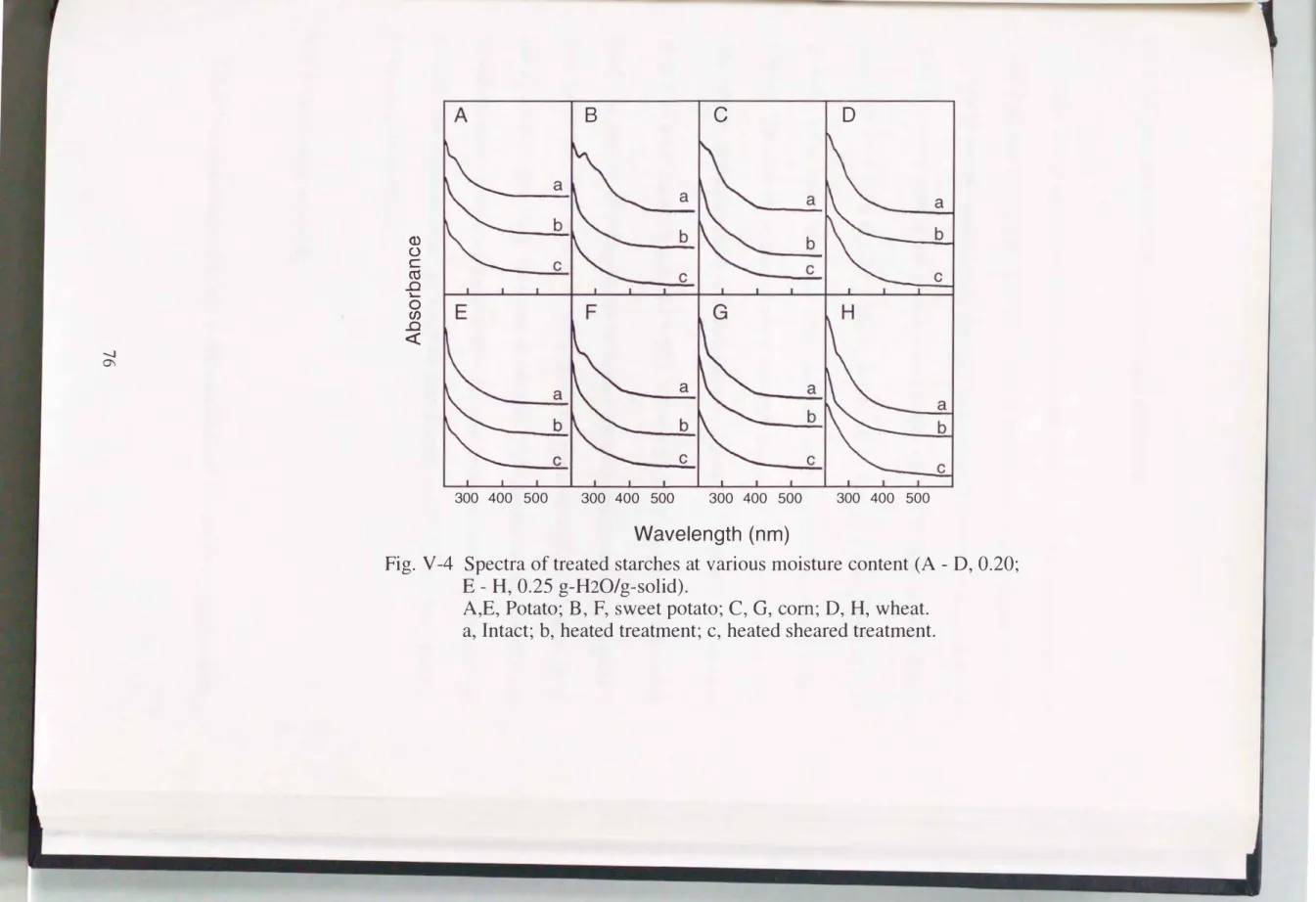
Figure V -4 shows the results of spectral analysis scanned from 230 to 600 nm for all heated and heated sheared specimens, based on intact starches. Comparing the spectra profiles of respective intact star ch (curve-a in Fig. V-4), only a negligible small peak at ca. 270 nm in B-e (sweet-potato, heated sheared specimen) was detected. However, the profiles of intact (a), heated (b) and heated sheared (c) star ch were almost the same. Thus, pyrolysis products were considered not to be formed by the heated treatment at 150 OC for 15 min and the heated sheared treatment at 150 °C.
74
102 �---�
A
Flow rate (m3/sec)
102
�---�8
1 0 � 0
-9Flow rate (m3/sec)
Fig. V -3 Flow properties of various starch melts through capillary tube at 150°C.
1
o-5
(A),
0.20 g-H20/g-solid ;(B),
0.25 g-H20/g-solid.0,
Potato ;•,
sweet Potato ;6.,
com ; T, wheat.75
-...) 0\
Q) 0 c m .0 l-
0 CJ) .0
�
A
300 400 500
B c D
300 400 500 300 400 500 300 400 500
Wavelength (nm)
Fig. V -4 Spectra of treated starches at various moisture content (A -D, 0.20;
E- H, 0.25 g-H20/g-solid).
A,E, Potato; B, F, sweet potato; C, G, com; D, H, wheat.
a, Intact; b, heated treatment; c, heated sheared treatment.
V -3-3 Determination of the degree of gelatinization
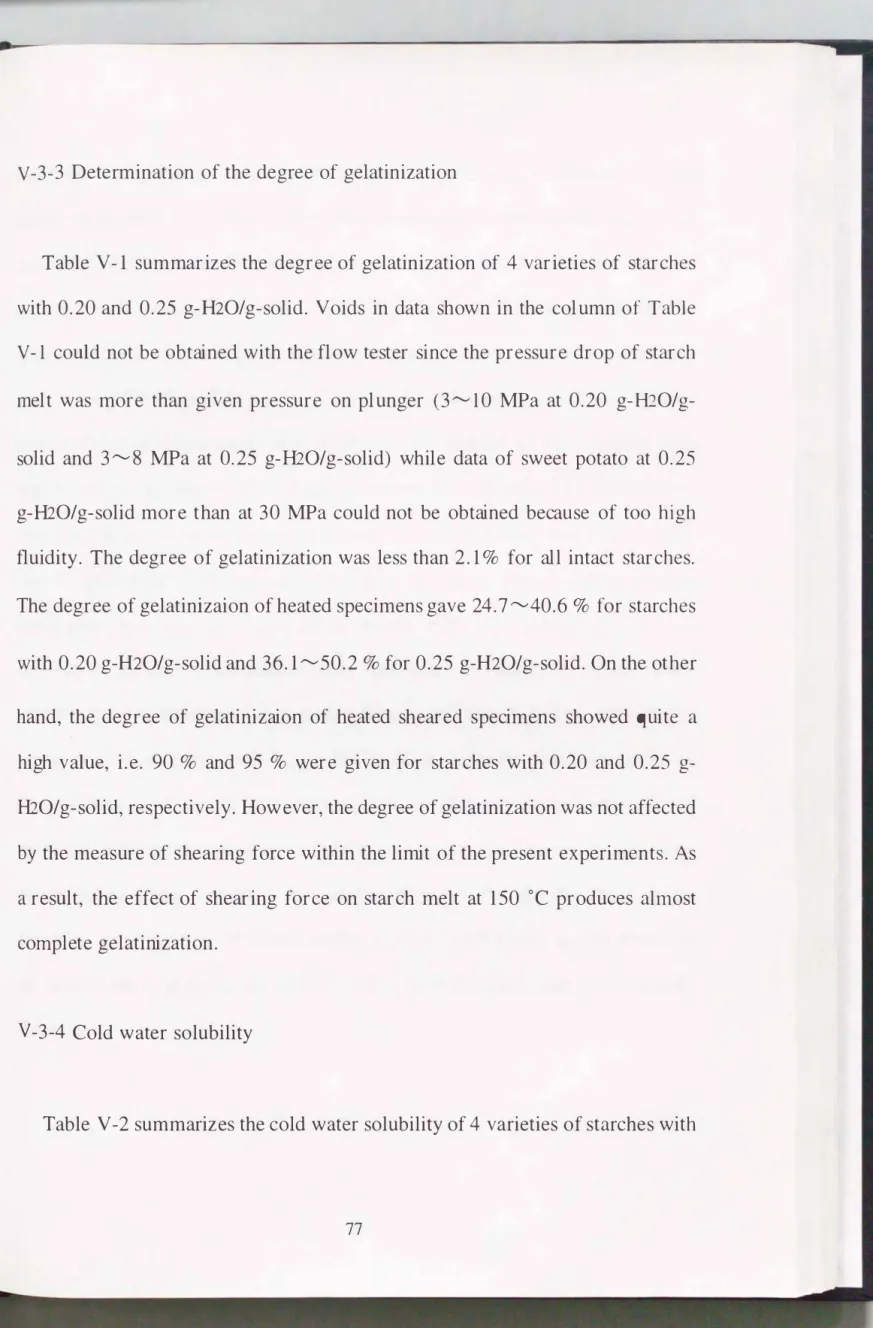
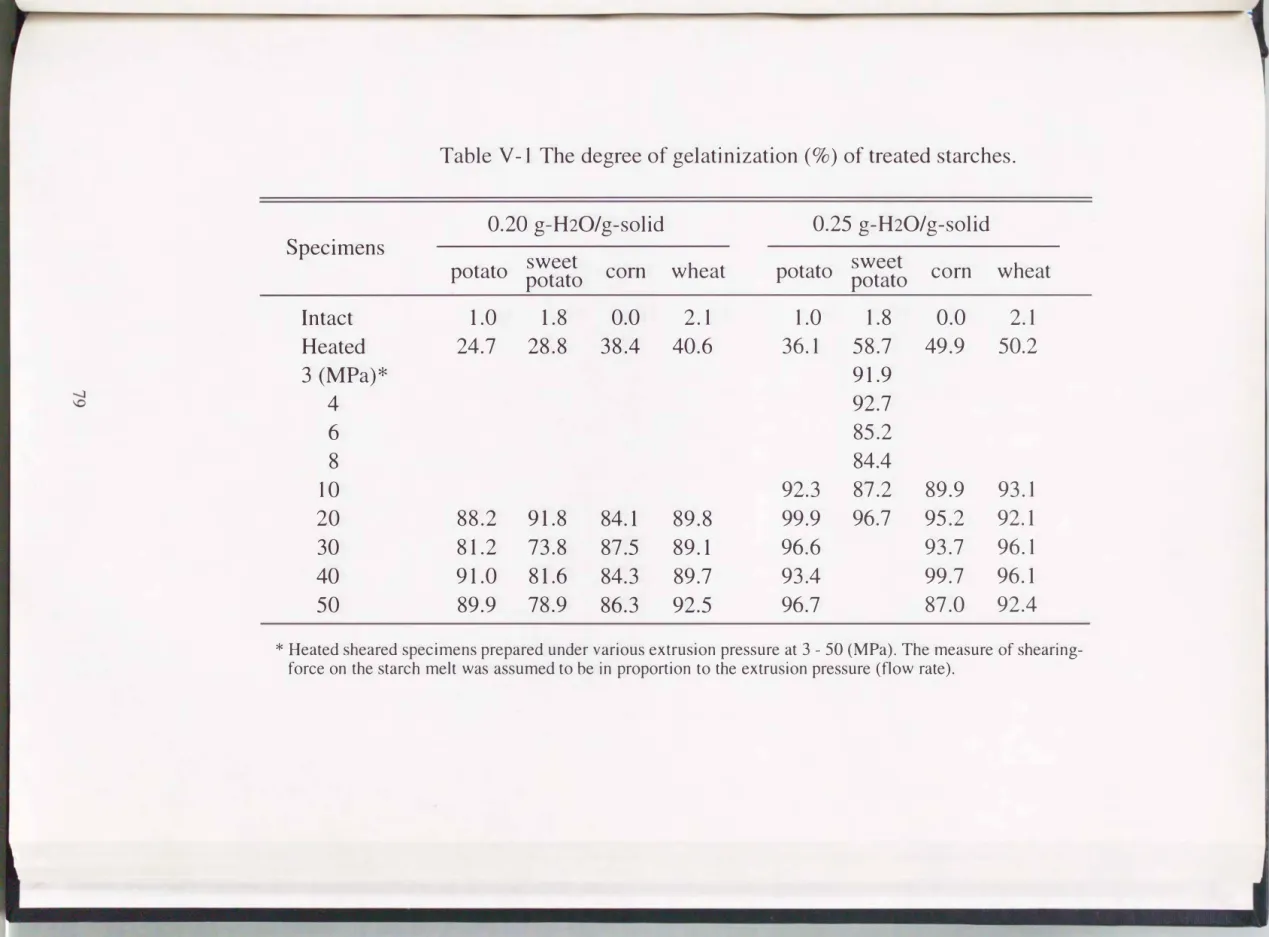
Table V -1 summarizes the degree of gelatin ization of 4 varieties of starches with 0.20 and 0.25 g-H20/g-solid. Vo ids in data shown in the column of Table V -1 could not be obtained with the flow tester since the pressure drop of starch melt was more than given pressure on plunger (3'"'-'10 MPa at 0.20 g-H20/g-
solid and 3'"'-'8 MPa at 0.25 g-H20/g-solid) while data of sweet potato at 0.25
g-H20/g-solid more than at 30 MPa could not be obtained because of too high fluidity. The degree of gelatinization was less than 2.1% for all intact starches.
The degree of gelatiniza ion of heated specimens gave 24.7 '"'-'40.6 % for starches with 0.20 g-H20/g-solid and 36.1 '"'-'50.2 %for 0.25 g-H20/g-solid. On the other
hand, the degree of gelatinizaion of heated sheared specimens showed quite a high value, i.e. 90 % and 95 % were given for starches with 0.20 and 0.25 g
H20/g-solid, respectively. However, the degree of gelatinization was not affected by the measure of s he aring force within the limit of the present experiments. As
a result, the effect of shearing force on starch melt at 150 OC produces almost complete gelatinization.
V -3-4 Cold water solubility
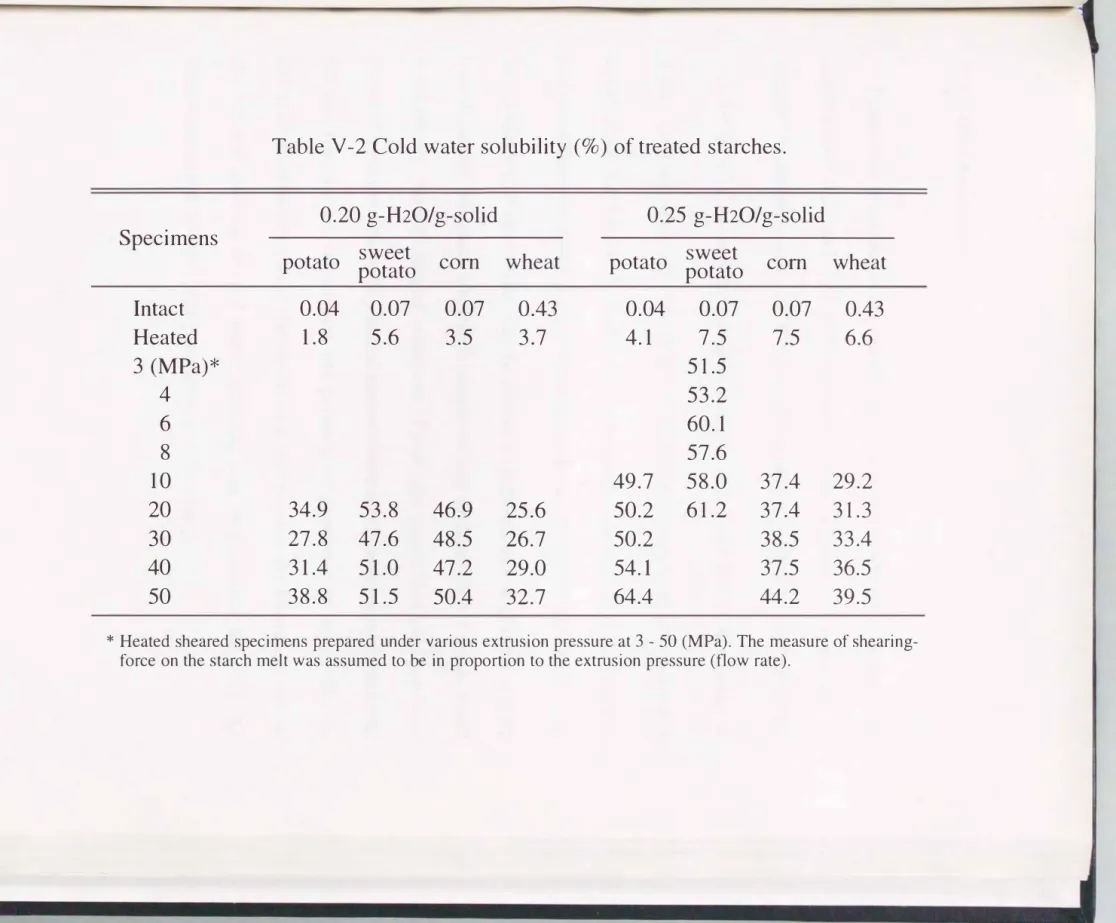
Table V -2 summarizes the cold water solubility of 4 varieties of starches with
77
0.20 and 0.25 g-H20/g-solid. Voids in Table V-2 could not be obtained by the same reason as V-3-3 on the degree of gelatinization. Intact starches with 0.20 and 0.25 g-H20/g-solid showed a little solubility of 1.8 to 5.6 % while those of heated starch specimens gave 4.1 to 7.5 %. For heated starch specimens, the specimens of 0.25 g-H20/g-solid seems to give a higher cold water solubility than those of 0.20 g-H20/g-solid. Based on heated specimens, heated sheared specimens gave considerably high solubility, i.e. around 10 times higher than that of heated specimens. Wheat starch specimens of 0.20 and 0.25 g-H20/g-solid which done heated sheared treatment shows a lower solubility than that of other starch specimens. However, the solubility of almost every heated sheared specimens, except potato and wheat starch with 0.25 g-H20/g-solid, was considered to be independent from the rate of shearing force which corresponded to the extrusion pressure donated in Table V-2. The solubility of potato and wheat starch with 0.25 g-H20/g-solid increased with increase in the rate of shearing force. It was revealed that the shearing force under 150 OC markedly affected the cold water solubility as a result. The increase in cold water solubility ordinary results from gelatinization of the starch. Because the complete gelatinization of these starches, as mentioned above, are produced by the heated sheared treatment, the solubility of these specimens can markedly Increase.
78
Specimens
Intact Heated 3 (MPa)*
4 6 8 10 20 30 40 50
Table V -1 The degree of gelatinization (%) of treated starches.
0.20 g-H20/g-solid sweet
potato potato com wheat
1.0 1.8 0.0 2.1
24.7 28.8 38.4 40.6
88.2 91.8 84.1 89.8 81.2 73.8 87.5 89.1 91.0 81.6 84.3 89.7 89.9 78.9 86.3 92.5
0.25 g-H20/g-solid sweet
potato potato 1.0 1.8 36.1 58.7 91.9 92.7 85.2 84.4 92.3 87.2 99.9 96.7 96.6
93.4 96.7
corn
0.0 49.9
89.9 95.2 93.7 99.7 87.0
wheat
2.1 50.2
93.1 92.1 96.1 96.1 92.4
*Heated sheared specimens prepared under various extrusion pressure at 3- 50 (MPa). The measure of shearing- force on the starch melt was assumed to be in proportion to the extrusion pressure (flow rate).
Table V -2 Cold water solubility(%) of treated starches.
0.20 g-H20/g-solid 0.25 g-H20/g-solid Specimens
sweet sweet
potato potato com wheat potato potato com wheat
Intact 0.04 0.07 0.07 0.43 0.04 0.07 0.07 0.43
Heated 1.8 5.6 3.5 3.7 4.1 7.5 7.5 6.6
3 (MPa)* 51.5
4 53.2
6 60.1
8 57.6
10 49.7 58.0 37.4 29.2
20 34.9 53.8 46.9 25.6 50.2 61.2 37.4 31.3
30 27.8 47.6 48.5 26.7 50.2 38.5 33.4
40 31.4 51.0 47.2 29.0 54.1 37.5 36.5
50 38.8 51.5 50.4 32.7 64.4 44.2 39.5
*Heated sheared specimens prepared under various extrusion pressure at 3- 50 (MPa). The measure of shearing- force on the starch melt was assumed to be in proportion to the extrusion pressure (flow rate).
V -3-5 Glucose detection
Table V-3 summarizes the results of glucose for mation of 4 varieties of starches with 0.20 and 0.25 g-H20/g-solid. Voids in Table V-3 could not be obtained by the same reason as V-3-3 on the degree of gelatinization. Only 0.001
""'-'0.005 % of glucose wer e detected in intact starch. In heated specimens of
potato, corn and wheat starches, 0.007 "'-'0.020 % of glucose were detected and in sweet potato starch 0.042 % of glucose was detected. In heated sheared specimens, glucose content increased to 2 � 5 times that of intact and heated specimens. The
fact conducts that starch melt may be release a slight amount of glucose only by heated sheared treatment and starch molecules may be depolymerized into small molecule by heated shear ed treatment. From the r esult that the pyrolysis
products were not detected by heated sheared treatment, the depolymerization of the starches did not accompany the produce of pyr olysis products, like as furfur als. Furthermore from the r esults of the increase in the liber ation rate of glucose, the incr ease in cold water solubility can be promoted not only the gelatinization but also the depolymerization of the starch.
81
V -3-6 Gel filtration
Figure V-5 and V-6 show gel-filtration profiles for 0.20 and 0.25 g-H20/g
solid starches (intact, heated and heated sheared specimens for four kinds of starches), respectively. In the case of 0.20 g-H20/g-solid starches, molecular weight distributions of heated specimens of potato and wheat starch were little difference from intact starches, while those of sweet potato and corn starches were slightly shifted to low molecular weight. Molecular weight distribution of heated sheared specimens, however, were obviously shifted to low molecular weight, especially that of sweet potato starch had no void volume. The fact in Fig.
V -5 seems that huge-molecule of intact starches may depolymerize into small
molecules by heated sheared treatment. In the case of 0.25 g-H20/g-solid starches, similar distribution patterns with 0.20 g-H20/g-solid were obtained.
From this result, there were no great differences between 0.20 and 0.25 g
H20/g-solid on molecular weight distribution by gel filtration.
V-3-7 Viscometry
Table V -4 summarizes the viscometry results on molecular weight of intact, heated and heated sheared specimens. Intrinsic viscosity of heated specimens of potato and wheat starches were decreased slightly, while those of sweet potato and corn starches were markedly decreased from those of intact starches. In
heated specimens molecular weight was more decreased as moisture content increased. Intrinsic viscosity of heated sheared specimens of each star ches were more markedly decreased as compared with heated specimens. Parti cularly in sweet potato and corn star ches, molecular weight of heated sheared specimen were 0.86xl05 and 1.69xl05 at 0.20 g-H20/g-solid and 1.16xl05 and 0.89xl05 at 0.25 g-H20/g-solid, respectively based on 5.27xl05 of inta ct specimen. The fact
seems that starch molecule containing low moisture may be depolymerized by heated treatment at 150 OC for 15 min and given shear force may arise markedly the depolymerization of starch molecule.
Specimens
Intact Heated 3 (MPa)*
4 6 8 10 20 30 40 50
Table V-3 Glucose content(%) of treated starches.
0.20 g-H20/g-solid sweet
potato potato 0.000 0.001 0.007 0.042
0.009 0.200 0.011 0.203 0.014 0.212 0.013 0.213
com
0.001 0.020
0.043 0.042 0.046 0.060
wheat
0.005 0.016
0.027 0.029 0.028 0.028
0.25 g-H20/g-solid sweet
potato potato 0.000 0.001 0.015 0.040 0.179 0.222 0.197 0.197 0.025 0.217 0.031 0.219 0.031
0.042 0.035
com
0.001 0.025
0.043 0.044 0.043 0.054 0.068
wheat
0.005 0.016
0.043 0.035 0.062 0.041 0.040
*Heated sheared specimens prepared under various extrusion pressure at 3- 50 (MPa). The measure of shearing- force on the starch melt was assumed to be in proportion to the extrusion pressure (flow rate).
00 Vl
Mw 2000K 17.9K Mw 2000K 17.9K Mw 2000K 17.9K Mw 2000K 17.9K
0.5 �---��--�---��--�---��--�---��--�
�
Q) 0.4"'0
>.
..c 0
..0
�
0.3+-' co
t: 0
�
0.2lo...
"'0
>.
..c 0
�
0.1 ()A B c D
o.o
I
.1 S;- I
.g�)t I I
.l4 � I
0 1 0 20 30 40 0 1 0 20 30 40 0 1 0 20 30 40 50
Fraction number
Fig. V-5 Gel filtration profiles of intact
(0),
heated(6.)
and heated sheared(•)
starchesat 0.20 g-H20/g-solid on Sephacryl S-500 column.
A, potato; B, sweet potato; C, corn; D, wheat.
00 0\
... Q) co lo....
"'0
>.
...c ..c 0 lo....
co (.) ... co
t: 0 ... Q) co lo....
"'0
>.
...c ..c 0 lo....
co ()
Mw2000K 17.9K Mw 2000K 17.9K Mw 2000K 17.9K Mw 2000K 17.9K
0.5 .---
��
-�---r---,--,---r----r-T---r---,--,----"1
A B c 0
0.4
0.3
0.2
0.1
0.0
I
I1 �
.I
IN �'* I
I1� I I
0 1 0 20 30 40 0 1 0 20 30 40 0 1 0 20 30 40 0 50
Fraction number
Fig. V -6 Gel filtration profiles of intact
( 0 )
, heated( 6.)
and heated sheared( •)
starchesat 0.25 g-H20/g-solid on Sephacryl S-500 column.
A, potato; B, sweet potato; C, com; D, wheat.
00 ...)
Table
V-4 Intrinsic viscosity and viscosimetric average molecular weight of various starches.
Molecular weight
X105
*([17] (mllg))
0.20 g-H20/g-solid 0.25 g-H20/g-solid Specimens
Intact Heated Heated sheared Heated
potato 10.47 (269) 9.86 (255) 5.39 (149) 7.42 (198) sweet potato 5.27 (146) 2.57 (77) 0.86 (29) 1.90 (59) com 5.27 (146) 3.41 (99) 1.69 (53) 1.72 (54) wheat 6.05 (165) 5.11 (142) 2.79 (83) 4.19 (119)
* Calculated from Mark-Houwinck-Sakurada equation [T]]=KMa (K= 1.18x1 0-3, a=0.89)
Heated sheared
5.19 (144)
1.16 (38)
0.89 (29)
2.64 (79)
V-4 Summary
Potato, sweet potato, corn and wheat starch with 0.20 and 0.25 g-H20/g-solid were treated with a flow tester under heated and heated sheared condition at 150 OC for 15 min. Comparing with heated specimens, the degrees of gelatinization
were markedly increased by heated sheared treatment. Cold water solubility of low moisturized starches increased by heated sheared treatment based on heated treatment. Small amount of glucose was detected in water-soluble fractions of heated and heated sheared specimens in spite of almost no detection in intact starches, while pyrolysis products did not detected. The increase in cold water solubility by heated sheared treatment can be due to not only gelatinization but also depolymerization, molecular cleavage, of the starches. The fact of depolymerization of starch was also supported from gel filtration profiles. By viscometry, the viscometric molecular weights of intact potato, sweet potato, corn and wheat starch were more decreased by heated sheared treatment than heated treatment. The considerable depolymerization of starch molecules 1s
yielded by the physical shearing force on starch melt despite starch varieties.
88
VI-1
CHAPTER VI
Effect of longer heating time on depolymeriza tion of low moisturized starch melts
Introduction
In Chapter V, the cold water solubility increased by heated and heated sheared treatments at 150 °C, and these starch melts are depolymerized, while pyrolysis products don't detected at these conditions. Comparing heated treatment with heated sheared treatment, the effects of shearing force on cold water solubility and depolymerization of starch melts are considerably greater than that of heating only. Many factors, however, can act on the properties of food polymer melts except for temperatures and pressures in extrusion cooking. Time
temperature history and strain history are each of them. Morgan et al. ( 1989) established a theoretical model for soy protein dough viscosity, with time
temperature history and strain history as parameters. Mackey & Ofoli (1990) investigated the dough rheology of importance of time-temperature history and strain history in viscosity analysis. However, there are few research about the effect of these histories on the cold water solubility and the depolymerization of starch melts.
89
In this chapter noti cing the time-temperature history, I investigate the effect of heating time on the cold water solubility and the depolymer ization of low moisturized star ches melting at 150 °C. Furthermore, I attempt to compare the effect of heating time with shearing force to the starches.
90
VI-2 Materials and Methods
VI-2-1 Starches
Potato, sweet potato, corn and wheat starches used in this study were the same as descr ibed in Chapter II-2-1. The moistur e content of these starches were adjusted to 0.20 and 0.25 g-H20/g-solid by same method as Chapter III-2-1.
VI-2-2 Heated and heated sheared treatment
A flow tester (CFT-500C, SHIMADZU Co., Kyoto, Japan) equipped w ith a capillary tube (1.0 mm in inside diameter, 15.0 mm in length) or a stopper plate was used to prepare heated and heated sheared starch specimens, as described in Chapter V -2-2. A 1.7 g of starch which molded to a cylindrical shape (10.8 mm in diameter, ca. 15 mm in length) was placed in the cylinder pre-heated at 150 OC and then mounted with the plunger for pr essur ization. Then starch was maintained at 150 OC for 15, 30, 60, 90 and 120 min with keeping the cylinder airtight. After cooling down, the star ch specimen was taken out as heated specimen (ground to fine). On the other hand, the starch melt was extruded through the capillary tube at 50 MPa by a plunger and the resultant extrudates were used as heated sheared specimens (ground to fine).
91
VI-
2-3
Cold water solubilityThe cold water solubility was measured and given in per cent based on dried starch weight by the same method as described in Chapter
V-2-5.
VI-
2-4
Gel FiltrationThe pr ocedur e of the gel filtr ation was same as described in Chapter
V-2-8.
Eluted starch in each fraction was determined by phenol-sulphuric acid method, and the absorption maxima
(Amax)
of the iodine-polysaccharide complexes were scanned by spectrophotometer (UV-160, SlllMADZU Co., Kyoto, Japan) (Chinnaswamy & Bhattacharya, 1986).VI-3 Results and Discussion
VI-3-1 Cold water solubility
Figure VI-1 shows cold water solubility of heated and heated shear ed specimens of four varieties of starches with
0.20
and0.25
g-H20/g-solid. Intact, zer o minute heating, starches were little soluble in cold water (0.04"'-'0.4% ).
By means of heating for 15 min, these starches became some soluble in cold water (
2
""'20 %)
. As the heating time was long, the solubility of heated specimens was increased. The inclinations of solubilities by heated treatments92
100 80 60
40
.-.
-;:!2. 0
20
..._..
."t: �
..c
0
:::::l
(/') 0
80
60 40 20
0 0
0.20 g-H20/g-solid
0.25 g-H20/g-solid
• 0
�
30 60 90 120 Heated sheared Heating time (min)
Fig.
VI -1Comparison of heated sheared and heated treatment of cold water solubility.
0, potato; •, sweet potato; L, corn; T, wheat
were different from origin of starches, sweet potato starch was highest (the solubility was about 55'"'-'63 % after 120 min heated) and potato starch wa lowest (the solubility was about 10'"'-'15% after 120 min heated). The less water
in specimens also affected to the solubilities. The solubilities at 0.25 g-H20/g
solid over these heating times was higher than that at 0.20 g-H20/g-solid.
Further more heated sheared specimens showed higher cold water solubility (35
"'-'65 % ). To obtain similar degree of solubility to heated sheared specimens,
more 120 min heated treatment was required. Considering that the heating time was 15 min at heated sheared treatment, the shearing force through the capillary tube might greatly influence the increases in cold water solubility.
VI-3-2 Gel filtration
Figures VI-2 and VI-3 show gel-filtration profiles of starches at 0.20 and 0.25 g-H20/g-solid (intact and heated specimens), respectively. In intact
specimens, almost carbohydrates was eluted as a void volume. Except sweet potato starch, there is no significant change between 15 min heated specimens and intact specimens. In respect to 15 min heated sweet potato starches, a peak of void volume decreased and carbohydrates of lower molecular weight was eluted after the void volume. After 60 min heating, the peak of void volume in all starches decreased and/or disappeared. Heating the starches for 120 min, the
94
peak of void volume of sweet potato and corn starches disappeared and the peak of void volume of potato and wheat starches decreased. It is obvious that high molecular weight of intact starch was shifted to low-molecular weight with an increase in heating time. The fact in Fig. VI-2 and VI-3 seems that huge
molecule of intact starches breakdown to small molecules by longer heating time.
Figures VI-4 and VI-5 show comparisons of molecular distributions between the specimens with longer heating time and heated sheared specimens. In Chapter V, I clarified that the starches were depolymerized by heated sheared treatment.
Gel filtration profiles of heated specimens with longer heating time were similar to the profiles of heated sheared specimens. In result, to obtain similar elution patterns of the heated sheared specimens, 60 min heated treatment need except potato starch with 0.25 g-H20/g-solid (120 min heated treatment needed). As mentioned in cold water solubility, in spite of only 15 min heating, the starch molecule of heated sheared specimens depolymerized into same degree of 60""'-'
120 min heated specimens. From this fact, the shearing force through the capillary tube might greatly influence the increases in degree of depolymerization.
VI-3-3
Amaxof iodine-polysaccharide complex
Figure VI-4 and VI-5 simultaneously show
Amaxprofiles of iodine
polysaccharide complex of intact specimens, specimens with longer heating time
95
and heated sheared specimens. Similar Amax patterns were observed between the specimens with longer heating time and the heated sheared specimen with similar elution patterns. In result, the specimens with similar degrees of depolymerization had similar molecular state regardless of the treatments of only heated for longer time and heated sheared. With respect to intact specimens, the Amax rose to more than 645 nm, which was generally absorbance of amylose with long chain length (Bailey & Whelan, 1961), around 20 fraction (potato starch) and 25 fraction (another starches). So that, the void volumes which appeared before 20""25 fractions were estimated as almost amylopectin, and the fractions after the void volume (around 25""35) were estimated as almost
amylose. On heated and heated sheared specimens, the Amax reached to 645 nm around 25 fraction (potato starch) and 30 fraction (corn and wheat starches).
Furthermore Amax of sweet potato starch didn't reach 645 nm in all fractions, barely reached to 600 nm around 40 fraction. It was suggested that the shifts of Amax peak were due to depolymerization of amylose and amylopectin. In other
words, as amylopectin which occupied the void volume in intact starch would depolymerize into lower molecule and then elute after 25 fraction, Amax of depolymerized amylopectin might be higher absorption than one of amylose.
Furthermore, as amylose also would depolymerize into lower molecule, Amax of amylose might be decreased.
... (1) co �
-a >.
..c 0 .c � co (.)
... co
t::
0... (1) co �
\0 -a
-....) >.
..c 0 .c � co
()
17.9K 17.9K 17.9K 17.9K
Mw 2000K 0.342K Mw 2000K 0.342K Mw 2000K 0.342K Mw 2000K 0.342K 0.5
I
AI
BIC
D0.4
0.3
0.2
0.1
0.0
0 10 20 30 40 0 10 20 30 40 0 10 20 30 40 0 10 20 30 40 50 Fraction number
Fig. VI-2 Gel filtration profiles of heated starches at 0.20 g-H20/g-solid on Sephacryl S-500 column.
A, potato; B, sweet potato; C, corn; D, wheat
0, intact; e, 15 min; 6., 60 min; .._, 120 min
+-' Q) co ,._
"0
>.
..c 0 ..Q ,._
co (.)
+-' co
t::
0+-' Q)
\0 co ,._
00 "0
>.
..c 0 ..Q ,._
co
()
17.9K 17.9K 17.9K 17.9K
Mw 2000K 0.342K Mw 2000K 0.342K Mw 2000K 0.342K Mw 2000K 0.342K 0.5
lA IB IC ID
0.4 0.3 0.2 0.1
0.0
0 10 20 30 40 0 10 20 30 40 0 10 20 30 40 0 10 20 30 40 50 Fraction number
Fig. VI-3 Gel filtration profiles of heated starches at 0.25 g-H20/g-solid on Sephacryl S-500 column.
A, potato; B, sweet potato; C, corn; D, wheat
0, intact; e, 15 min; 6., 60 min; •, 120 min
0·5 [ A � 18lj �c�lod' j:��
�
Ct1
Q)�
� 0.4
..c 0 ..0 �
ctS ()
0
ctS0.3
r-
0.2
-- o+-J Q)
�
� 0.1
..c 0 ..0 �
ctS
0.0
,_... : � I I -rr "")Q)q"l If" I �m I # I I zzL500 �
0
10 20 30 10 20 30 10 20 30 10 20 30 40 Fraction number
Fig. VI-4 Gel filtration profiles and
Amax
of treated starches at 0.20 g-H20/gsolid on Sephacryl S-500 column.
A, potato; B, sweet potato; C, com; D, wheat
0,-, intact; 6.,-, 60 min heated; •, -,heated sheared
...
0 0
+-' Q)
� !...
"'0 ..c � ...0 0 !...
� ()
+-' � 1-0
-- +-' Q)
� !...
"'0 ..c � ...0 0
!...
0 �
A�,-"
I --
_, 1
BE
�
-- ---� \,,.-:
~ D� ?oo 600 '";' E
c ct:S500 � 0.5
0.4 0.3 0.2 0.1
0·�o 20 30 10 20 30
1 0 20 30 1 0 20 30 40
Fraction number
Fig. VI-5 Gel filtration profiles and
Amax
of treated starches at 0.25 g-H20/gsolid on Sephacryl S-500 column.
A, potato; B, sweet potato; C, com; D, wheat
0,-, intact; 6.,
---· ,60 min heated; •,
---, 120 min heated;
•, -,heated sheared
Vl-4 Summary
Low moisturized potato, sweet potato, corn and wheat starches were treated with a flow tester under heated and heated sheared conditions. The starches depolymerized into lower molecule by longer heating time at 150 °C. With an increase in heating time, the cold water solubility of starches increased and the degree of depolymerization progressed. Comparing heated treatment with longer heating time and heated sheared treatment, 60"'-' 120 min heating was
necessary for heated specimens to obtain similar cold water solubility and degree of depolymerization of heated sheared specimens. These results conducted that heated sheared treatment strongly promoted the depolymerization of low moist starches under high temperature as compared with heated treatment only. From the results of Amax of iodine-polysaccharide complex, there was almost same molecular state between heated for longer time and heated sheared treatment.
Both amylose and amylopectin depolymerized into lower molecule by both treatments.
101
VII -1
CHAPTER VII
Effect of time-temperature and strain history on flow property and depolymerization of starch melts
Introduction
As described in Chapter VI, it is necessary to consider the effect of time
temperature history and strain history on extrusion cooking. Some resear ches have been performed the effect of time-temperature history and strain history on the effect of dough rheology. Hayashi et al. (1992) measured the influence of time-temperature history and strain history on low moisturized soy protein isolate using capillary tube viscometer. They revealed the strain history was more influential on the change of dough rheology at lower moisture content (below 0.30 g-H20/g-solid) while the time-temperature histor y was more influential at higher moisture content (above 0.41 g-H20/g-solid). In Chapter V and VI, the effect of shearing force and time-temperature history on cold water solubility and depolymerizaion of starch melts at 150 OC were investigated. Then the cold water solubility increased and the huge starch molecules were depolymerized by shearing force and longer heating treatment at high temperature. H owever the effects of time-temperature history and strain history were different from the varieties of starches. Potato starch was the most less
102
effect by longer heating treatments of four varieties of the starches. Then, in thi chapter I investigate the effect of time-temperature history and strain history on pressur e dr ops thr ough capillary tube and on the cold water solubility and the depolymerization of potato starch melts.
103
VII-2 Materials and Methods
VII-2-1 Starches
Potato starch used in this study was the same as described in Chapter II-2-1.
The moisture content was adjusted to 0.16, 0.20 and 0.25 g-H20/g-solid by same method as Chapter III-2-1.
VII-2-2 Extrusion experiment
The capillary tube viscometer used for the measurements of flow properties and heated sheared treatments was the same as described in Chapter III-2-2. A rec iprocating extrus ion experiment was performed in order to observe the effect of strain h istory on the measured pressure drop and alteration of starch (approximate procedure was shown in Fig. VII-1). The viscometer can use the reciprocating extrusion experiment for its symmetr ical and highly air-tight structure. A capillary tube which has 0.75 mm in radius and 20 mm in length was equipped in the viscometer. A 4.0 g of the moisturied starch was moulded into a cylindrical shape (1.08 em in d iameter and about 3.0 em in length) using a hand press and placed into the upper specimen reservoir. The reservoir was heated to 150 OC in advance and the measurements of flow properties were performed at 150 °C, at which the starches melt sufficiently from results of Chapter III. A pressure of 15 MPa was applied to the specimen by both the upper and lower
104
plunges (Fig. VIl-la). After the specimen was kept for
15
min in the reser voir for melt them, the lower plunger was pulled down to prepare a dead volume for the extruded specimen (Fig. VII-lb). Then the specimen was extruded through the capillary tube at0.2
cm3s-1 under a constant plunger speed of0.2
em s-' at thehigher plunger drive pressure
( 100
MPa) (Fig. VIl-le). The string-like extruded specimen in the lower reservoir was pressurized again plunger at15
MPa for1
min in order to pack extrudate. By this procedure, the exturdate in the lower reservoir was exposed to almost the same conditions as that just before the first extrusion (Fig. VII-ld). The same procedure was repeated
37
times, taking atotal time of
60
min including15
min of initial-heating time.Single extrusion was also carried on in order to observe the effect of time
temperature history on measured pressure drop and alteration of starch. A 4.0 g of the specimen moulded into cylindrical shape was placed into the upper reservoir. After the various initial heating times at
15
MPa pressure, the specimen extruded to the bottom reservoir at the same flow rate as in the reciprocating extrusion experiment. The initial-heating times in the reservoir were15, 20, 30, 40, 50
and60
min, which were equivalent to the time required for1, 5, 13, 2 1, 29
and37
extrusion strokes, respectivel y.105
1---'
0 0\
15 MPa
�
15 MPa
[B � @]
100 MPa 15 MPa
open space for extudate
15 MPa
Fig. VII-1 Procedure of reciprocating extrusion.
VII-2-3 Cold water solubility
The cold water solubility was measured and given in percent based on dried starch weight by the same method as described in Chapter V-2-5.
VII-2-4 Gel filtration
The procedure of the gel filtration was same as described in Chapter V-2-8.
Eluted starch in each fraction was determined by phenol-sulphuric acid method.
VII-3 Results and Discussion
VII-3-1 Measured pressure drop of starch melts
Figure VII-2 shows measured pressure drop profiles for reciprocating and single extrusion of potato starch with various moisture content. The measured pressure drop decreased by first 5 times strokes in the reciprocating extrusion at each moisture content. Then the measured pressure drops maintained constant values after 15 or 20 times strokes. It is considered that the strain history and time-temperature history would be affected these decrease in pressure drop when reciprocating extrusion was carried on. Then the single extrusion was performed in order to observe the effect of time-temperature history on the
107
measured pressure drop of starch melts. The measured pressure drop decreased also as increased in initial-heating times. In this case the slopes of the decrease were gentle compared with the reciprocating extrusion at each moisture content.
The differ ences between them of 0.16 and 0.20 g-H20/g-solid wer e larger than of 0.25 g-H20/g-solid. This reason why these differ ences occur red was that so the water in the starch acted as a lubricant at 0.25 g-H20/g-solid, the effect of the strain history could be small, but the effect of the time-temperature history could be large as described in Chapter VI. On the other hand at 0. 16 and 0. 20 g
H20/g-solid, so the water was less to act as a lubricant that the starch granules could be more injured by reciprocating extrusion and then the effect of the strain history could be large.
VII-3-2 Cold water solubility
Figure VII-3 shows cold water solubility profiles for reciprocating and single extrusion of potato starch with various moisture content. The cold water solubility of r eciprocating extrudate at 0.16 and 0.20 g-H20/g-solid increased rapidly to about 70 % by 5 times strokes, then after 13 times strokes those maintained constant values. That at 0.25 g-H20/g-solid increased to 55 % by 5 times strokes, however, after 13 times str okes that decreased slightly. It was same reason as described in above section why the strain histor y could be more effective to the starches at lower moisture content on a breakage of the starch
granules. From this result, the strain history could affected to the cold water solubility of the extrudates of the starch melts. On the specimens at 0.25 g
H20/g-solid after 13 times strokes, the reason of the cold water solubility decreased slightly could be a retrogradation of the specimens when the incubating procedure. The cold water solubilities of single extrudate decreased from about 30 % at first 15 min as increased in initial-heating time at each moisture content. This was reason why both the decrease of the shearing force and the retrogradation of specimens as mentioned above.
VII-3-3 Gel filtration
Figure VII-4 and VII-5 show gel filtration profiles for reciprocating and single extrusion of potato starch with various moisture content, respectively. The specimens of single extrusion after 15 min was used as a control at each moisture content. The molecular weight distributions of the reciprocating extrusion shifted to lower molecular weight as the extrusion strokes increased at each moisture content (Fig. VII-4). Especially the specimens at 0.16 g-H20/g-solid showed great decrease of the molecular weight by the reciprocating extrusion.
Then the strain history could affect to the depolymerization of starch melts. The molecular weight distributions of single extrusion at 0.16 g-H20/g-solid showed nearly same patterns in spite of initial-heating time. On the other hand, those at 0.20 and 0.25 g-H20/g-solid shifted to lower molecular weight. Then the time-
109
temperature histor y could affect to the depolymerization of starch melts in higher moisture content. Comparing reciprocating extrusion with single extrusion at 0.25 g-H20/g-solid, so there were few different, that the time
temperature histor y can be more effective on the depolymerization of starch melts than the strain history at higher moisture content in this limited condition.
However at low moisture content, the strain history can be more effective on the depolymerization of starch melts.
110
,...--,
a_ en
�
c. 0
"--
"0 Q) "--
:::::l en en Q) "--
a_
100 �---�
80
60
40
20
B
�
0 � 0 u [] uo �--�--�----�--�--�----�--�--�
0
15 20
10 20
Extrusion strokes
30 40
Retention time
[
min ]30 40
50 60
Fig. VII- 2 Measured pressure drop profiles for reciprocating (open symbol) and single (closed symbol) extrusion of potato starch with various moisture content at 150°C.
0, e, 0.16; 6.,
_.,0.20;
D, ., 0.25 g-H20/g-solid.
� 0
>.
-+-J
.0 ::::J (/) 0
80
60
40
20
0 �--�--�----�--�--�----�--�--�
0 10
15 20
20
Extrusion strokes
30 40
30
50 Retention time
[
min ]40
60
Fig. VII-3 Relationship between cold water solubility and
reciprocating (open symbol) or single (closed symbol) extrusion of potato starch with various moisture
content at 150°C.
0, e,
0.16; 6, _., 0.20; D, ., 0.25g-H20/g-solid.
...
...
(j..)
Q) 0.2
+-' co
,_
lA IB y I
c"'0
>.
...c .0 0 ,_
co ()
+-' co
0 0.1
I--
+-' Q) co ,_
"'0
>.
...c .0 0 ,_
co 0.0
() 0 10 20 30 40 0 10 20 30 40 0 10 20 30 40 50
Fraction number
Fig. VII-4 Gel filtration profiles of reciprocating extrusion at 150°C at various moisture content on Sephacryl S-500 column. A, 0.16; B, 0.20; C, 0.25 g-H20/g-solid.
0,
one time extrusion; • , 5 times extrusion; L, 21 times extrusion;e,
37 timesextrusion.
Q)
+-' co
"0 �
>.
..c 0 ..c �
co u
+-' co r-0 -Q)
+-' co
� �
"0
� >.
-+:>. ..c
..c 0
� co ()
0.2 �---�---.---,
A B c
0.1
��-
t:fl!0.0 I . I I • I .,., I . , I • I I 7 7 I I ff I • I = 50 I
30 40
0 10 20 30 40 0 10 20 30 40 0 10 20
Fraction number
Fig. VII-5 Gel filtration profiles of single extrusion at 150°C at various moisture content on Sephacryl S-500 column. A, 0.16; B, 0.20; C, 0.25 g-H20/g-solid.
0,
extrusion after 15min; •, extrusion after 20min; 6., extrusion after 40min;e'
extrusion after 60min.VII-4 Summary
The effects of time-temperature and strain history on the potato starch melts at 150 OC were investigated by use of the capillary tube viscometer. The reciprocating extrusion after 15 min heating and single extrusion after various initial-heating time were performed for investigating them effects. The measured pressure drop of single extrusion decreased gently as the initial
heating time increased, while the measured pressure drop of reciprocating extrusion decreased rapidly as the extrusion strokes increased. At 0.25 g
H20/g-solid, however, there was small difference between reciprocating extrusion and single extrusion. The reason why water in the potato starch could act as a lubricant. The cold water solubility of the reciprocating extrudate at 0.16 and 0.20 g-H20/g-solid increased to about 80% by 5 times strokes, while that at 0.25 g-H20/g-solid increased 55 %. The molecular weight distribution of the
reciprocating extrudate shifted to low-molecular weight at lower moisture content (0.16 g-H20/g-solid). On the other hand the cold water solubility of the single extrudate decreased as initial-heating time increased. The molecular weight distribution of the single extrudate shifted to low-molecular weight at higher moisture content (0.25 g-H20/g-solid), but the degree of depolymerization of starch melts were nearly same between the reciprocating extrusion and the single extrusion in this moisture content. From these results, the time-temperature history could be more effective on the cold water solubility
115
and the degree of depolymerization of starch melts at higher moisture content, while the strain history could be more effective to these at lower moisture content.
116
CHAPTER VIII
Conclusion
Importance of thermal processing using starchy materials tends to increase in food industr y from year to year , with increase in var iation of foods. However relatively many operating procedure of the thermal processing, such as extrusion cooking, can depend on experience, because physical properties of the materials processing at high temperatures and pressures are difficult to measure. Then the thermal properties of starches with low moisture content are studied in order to obtain one of basic information on food production using starchy materials. The starches used in this study are potato, sweet potato, corn and wheat starches, which are widely used in food industr y, since they can easily obtain in large quantities at a low cost.
These starches with low moisture are commonly solid state under room temperature and atmospheric pressure. It is, however, believe that the low moistur ized starch can fuse by heating without evaporation. This melting phenomenon, which is considered that crystallite regions of starch granules melt, greatly relates to the moisture content of the starch. Ther efor e, the effect of water state in star ch on the thermal phase transition of star ch was investigated using differential scanning calorimeter.
117
There are only one phase transition peak, which can be considered gelatinization of starches, or two phase transition peaks, which of lower temperature can be considered gelatinization, and which of higher temperature can be considered melting of starch crystallites, were observed in each starches.
As the moisture content decreased, the area of the gelatinization peak decreased, but the peak temperature kept constant. The gelatinization peak disappeared between 0.25 and 0.50 g-H20/g-solid. The peak temperature of melting of starch crystallites increased with the decrease in the moisture content. The moistur e contents at which the freezable water appeared first by DSC measurement were 0.47, 0.43, 0.39 and 0.39 g-H20/g-solid in potato, sweet potato, corn and wheat
starches, respectively. The ranges of the moisture content at which the gelatinization peak disappeared corresponded to that at which the freezable water appeared in these starches. It is concluded that gelatinization of the star ches required the freezable water. Namely under low moisture content, the star ches could not gelatinize but melt.
It is clarified that the moisture content of starch affected to melting of starch crystallites at high temperature. The starch melts, however,could be also affected by an applied pressure which can be often necessary to a food processing, such as
in extrusion cooking. Some information about the thermo-mechanical properties include flow-starting temperature
(Ts),
which is measured when the specimens start to extrude through a capillary tube by raising temperature at applying some pressure with a flow tester. ThenTs
of low moisturized starches were measured118
using a capillary tube viscometer under varying moistur e content
( W)
and applied pressure(P).
Ts was increased with decreasing moisture content and applied pressure.
There was no significant difference between starch varieties. Ts converged into a temperature
(
Tc; 270.9 OC)
at a pressur e(Pc; 0.32
MPa). BecauseTs
was in inverse proportion to the moisture content and logarithm of the applied pressure, Ts was expressed as,Ts =
Tc- (a+
bW)
log(PI Pc)
where coefficients,
a
and b were36.8
and1.68x 102•
The lines calculated from the equation were in a good agreement with experimental data.Next, in order to further fundamental studies on the properties of starch melts, the flow properties of potato and corn starch melts (melting through
150 ° C, 15
min) with low moisture were characterized using a capillary tube viscometer. By use of measured flow rates
(Q,
m3s-1), and pressure drops of capillary tube(!J.Pc,
MPa) and orifice
(!J.Po,
MPa), the relationships between the flow rate and the pressur e dr op in the capillary tube(!J.Pd,
MPa) wer e obtained. The flow curves of both star ch melts showed good linearly on logarithmic scales. These star ch melts, however, gave a yield stress, especially at low moisture content. Then both flow curves satisfied an equation by Her schel-Bulkley power -law model after exchanging the flow rate and the pressure drop to apparent shear rate( i,
s-1) and119
shear stress
(
rw, MPa), respectively. The flow properties were good representative by Herschel-Bulkley power-law model and these curves varied with the moisture content. The flow properties between potato and corn starch melts were different even though they were same moisture content, especially that was reflected in the consistency index.In extrusion cooking, food polymers are subjected to not only heat, but also shearing-force by kneading in an extrusion barrel. It must be considered how the shearing-force also affect the food polymers to obtain optimal products. Then low moisturized starches were treated with a flow tester under heated and heated sheared condition at 150 OC for 15 min. Cold water solubility of low moisturized starches increased by heated sheared treatment based on heated treatment, while pyrolysis products did not detected. Small amount of glucose was detected in water-soluble fractions of heated and heated sheared specimens in spite of almost no detection in intact starches. Comparing with heated specimens, the degrees of gelatinization were markedly increased by heated sheared treatment. By viscometry, the viscometric molecular weights of intact potato, sweet potato, corn and wheat starch were more depolymerized by heated sheared treatment than heated treatment. These facts were also supported from gel filtration profiles. As the results from glucose formation, viscometric molecular-weight depolymerization and gel-filtration profiles, the considerable depolymerization in starch molecules is yielded by the physical shearing force on starch melt despite starch varieties.
120