CULTURAL DIFFERENCES IN THE SITUATIONS OF
EXPRESSING GRATITUDE BETWEEN JAPANESE AND
INDONESIAN COLLEGE STUDENTS
著者
Hanami Yuliana
学位授与機関
Tohoku University
CULTURAL DIFFERENCES IN THE SITUATIONS OF EXPRESSING GRATITUDE BETWEEN JAPANESE AND INDONESIAN COLLEGE
STUDENTS
ABSTRACT
Graduate School of International Cultural Studies International Graduate Program of Language Sciences B2KM2001 Yuliana Hanami
1. INTRODUCTION
The present study is an exploratory cross-cultural study of pragmatic development of expressions of gratitude in different situations. Expressing gratitude is a speech act that may have different functions and meanings in different societies. It is applied in variety of ways in every society with different norms and values, the kinds of contexts it should be used, and when, how, why and to whom it should be said. The expressions of gratitude in a certain culture can vary and those may be said differently according to what kind of situations one faces. The present study investigates how Japanese and Indonesians express their feeling of gratitude according to the situations of thanks specified by Coulmas’s taxonomy of thanks (1981). According to his taxonomy, gratitude expressions may be expressed depending on how the person perceives those situations as gratitude situations. By focusing on these two cultures, Japanese
and Indonesian, which have different cultural backgrounds, these two nations have different cultural way of expressing gratitude in their societies. The objectives of this study are: (1) to examine the perception of native speakers of Japanese and Indonesians on different gratitude situations; (2) to find out the expressions used by both cultures in different kinds of gratitude situations; and (3) to examine whether there is gender differentiation in using gratitude expressions among both cultures.
2. LITERATURE REVIEWS
Initially proposed by Austin in 1962, the concept of speech acts have become one of the most important concept in pragmatics. Searle (1969) developed his ideas on speech acts in more detail where thanking is categorized as expressive, which is one of the types of speech act. Speech acts are the actions we do through speaking, and they may cause a change in the existing state of affairs or cause an effect on the interlocutor (Cheng, 2005). By saying thank you, one is not only stating something, but is also performing an act of thanking. Eisenstein and Bodman (1986) have described thanking as an illocutionary act under Searle’s classification of speech act. Their study indicated that an expression of gratitude is an illocutionary act performed by a speaker based on a past act performed by the hearer. The speaker feels grateful or appreciative, and makes a statement that counts as an expression of gratitude. Coulmas (1981) stated that every sincere verbalization of gratitude was related to some action (or actions) of a benefactor or to a result of the action. He proposed the taxonomy of thanks containing eight situations classifying
criteria of situations where a person may verbalize his or her gratitude to others.
3. METHODOLOGY
286 people including 103 Japanese students and 183 Indonesian students volunteered to take part in the study. The data collection was conducted during the period of December 2013-April 2014 at Tohoku University, Japan and at Padjadjaran University, Indonesia. The data were collected through a discourse completion task (DCT) questionnaire that was designed based upon Coulmas’s taxonomy of thanks (1981). Descriptive and t-test analysis were conducted to identify the gratitude expression differences that distinguished the behavior of the Japanese and Indonesians native speakers toward various gratitude situations.
4. RESULTS
The results show that Japanese and Indonesians have various preferences for gratitude expressions. The Japanese have given eleven expressions of gratitude, namely (1) arigatou, (2) arigatougozaimasu, (3) arigatougozaimashita, (4) sumimasen, (5) sumanai, (6) doumo, (7) gomen, (8) sankyuu, (9) azzasu, (10) which are a combination of gratitude and apology expressions, and (11) other expressions that are not frequently used as gratitude expressions. On the other hand, there are eight gratitude expressions used by Indonesians, namely (1) terima kasih, (2) makasih, (3) thanks, (4) thank you, (5) maaf, (6) nuhun, (7) which are a combination of gratitude and apology expressions, and (8) other expressions, the expressions that are not frequently used as gratitude
expressions. Overall, the native speakers of Japanese tend to respond significantly more than Indonesians toward gratitude situations. Both Japanese and Indonesians frequently express gratitude in the Coulmas’s situations of thanks for immaterial goods. Moreover, there are no particular gender differences between Japan and Indonesia in terms of their gratitude responses in several situations of gratitude. Males and females respond gratitude situations more frequently with the use of informal gratitude expressions, such as Japanese arigatou and makasih for Indonesian.
5. DISCUSSIONS
The Japanese tend to respond significantly more than Indonesians toward gratitude situations. However, the study has found similarity in showing preferences in their selection of gratitude expressions. The similarity includes the use of informal forms in gratitude expressions, the usage of English words as gratitude expressions, and the appearance of a category of combined of gratitude and apology expressions and other expressions that are not frequently used as gratitude expressions. Regarding gender, the results show that with both Japanese and Indonesian students, males and females tend to use informal or casual expressions of gratitude in delivering their grateful feelings among their peers. Moreover, it is also found that there are several informal and slang expressions used only by male students in both cultures.
CULTURAL DIFFERENCES IN THE SITUATIONS OF EXPRESSING GRATITUDE BETWEEN JAPANESE AND INDONESIAN COLLEGE STUDENTS
A Thesis
submitted to the Faculty of the
Graduate School of International Cultural Studies of Tohoku University
in partial fulfillment of the requirements for the degree of
Master of International Cultural Studies
in International Graduate Program of Language Sciences
By
Yuliana Hanami
Sendai, Japan June 2014
ii
Copyright 2014 by Yuliana Hanami All Rights Reserved
iii
CULTURAL DIFFERENCES IN THE SITUATIONS OF EXPRESSING GRATITUDE BETWEEN JAPANESE AND INDONESIAN COLLEGE STUDENTS
A Thesis
submitted to the Faculty of the
Graduate School of International Cultural Studies of Tohoku University
in partial fulfillment of the requirements for the degree of
Master of International Cultural Studies
in International Graduate Program of Language Sciences
By
Yuliana Hanami
I certify that I have read this dissertation and that, in my opinion, it is fully adequate in scope and quality as a thesis for the degree of Master of International Cultural Studies.
Hiroyuki Eto
I certify that I have read this dissertation and that, in my opinion, it is fully adequate in scope and quality as a thesis for the degree of Master of International Cultural Studies.
Naoyuki Ono
I certify that I have read this dissertation and that, in my opinion, it is fully adequate in scope and quality as a thesis for the degree of Master of International Cultural Studies.
Takeshi Nakamoto
iv
The research and writing of this thesis
is dedicated to everyone who helped along the way.
Many thanks, Yuliana Hanami
v
TABLE OF CONTENTS
CHAPTER I INTRODUCTION ... 1
1.1 Background ... 1
1.2 Brief Overview of Gratitude Culture in Japan ... 3
1.3 Brief Overview of Gratitude Culture in Indonesia ... 4
1.4 General Comparison between Japanese and Indonesian in Terms of Gratitude Expressions ... 6
1.5 Purpose of Study and its Contents ... 7
CHAPTER II SPEECH ACTS OF THANKING ... 9
2.1 Speech Acts of Thanking ... 9
2.2 Coulmas’s Frameworks of Thanking and Previous Studies ... 12
2.3 Usage of Discourse Completion Task ... 17
CHAPTER III RESEARCH METHODOLOGY ... 20
3.1 Participants ... 20
3.2 Instrument ... 21
3.3 Data Analysis ... 27
CHAPTER IV RESULT ... 29
4.1 General Overview of Gratitude Expressions in Japanese and in Indonesians ... 30
4.2 Gratitude Expressions in Japanese ... 32
4.2.1 Iie ... 33
4.2.2 Arigatou, arigatougozaimasu, and arigatougozaimashita ... 34
vi
4.2.4 Doumo ... 39
4.2.5 Gomen... 40
4.2.6 Sankyuu ... 42
4.2.7 Azzasu ... 43
4.2.8 Combination of Apology and Gratitude Expressions ... 44
4.2.9 Other expressions... 45
4.3 Gratitude Expressions in Indonesian ... 46
4.3.1 Tidak ... 47
4.3.2 Terimakasih and makasih ... 48
4.3.3 Thank you and thanks ... 50
4.3.4 Maaf ... 52
4.3.5 Nuhun ... 52
4.3.6 Combination of Apology and Gratitude Expressions ... 53
4.3.7 Other expressions... 54
4.4 Gender Differentiation between Japanese and Indonesians ... 56
CHAPTER VDISCUSSIONS AND CONCLUSIONS ... 61
5.1 Discussions ... 61 5.2 Conclusions ... 65 APPENDIX 1: QUESTIONNAIRE ... 68 A. English Version ... 68 B. Japanese Version ... 76 C.Indonesian Version... 84 APPENDIX 2 ... 94
vii
B. t-test Gender Analysis between Japanese and Indonesian ... 94
B.1 Japanese sample t-test ... 94
B.1 Indonesian sample t-test... 95
viii
LIST OF TABLES
TABLE 3.1DESCRIPTION OF DERIVATION CONCEPTS OF COULMAS’S TAXONOMY OF THANKS .... 22
LIST OF FIGURES
FIGURE 4.1FREQUENCY OF ALL GRATITUDE EXPRESSIONS IN EACH DIMENSION ... 31FIGURE 4.2FREQUENCY OF RESPONSES OF NO IN EACH SITUATION DIMENSION OF GRATITUDE . 31 FIGURE 4.3FREQUENCY OF OVERALL GRATITUDE EXPRESSIONS FOR NATIVE SPEAKER OF JAPANESE ... 33
FIGURE 4.4FREQUENCY OF IIE ... 34
FIGURE 4.5FREQUENCY OF ARIGATOU AS GRATITUDE EXPRESSION ... 37
FIGURE 4.6FREQUENCY OF ARIGATOUGOZAIMASU AS GRATITUDE EXPRESSION ... 37
FIGURE 4.7FREQUENCY OF ARIGATOUGOZAIMASHITA AS GRATITUDE EXPRESSION ... 37
FIGURE 4.8FREQUENCY OF SUMIMASEN AS GRATITUDE EXPRESSION... 39
FIGURE 4.9FREQUENCY OF SUMANAI AS GRATITUDE EXPRESSION ... 39
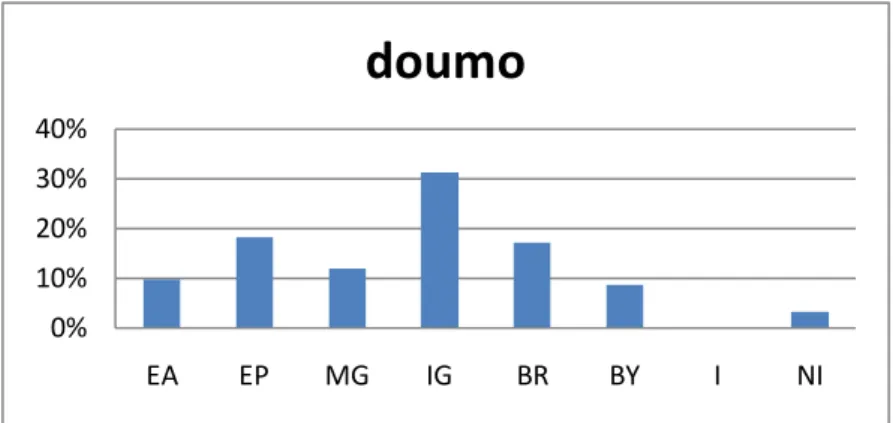
FIGURE 4.10FREQUENCY OF DOUMO AS GRATITUDE EXPRESSION ... 40
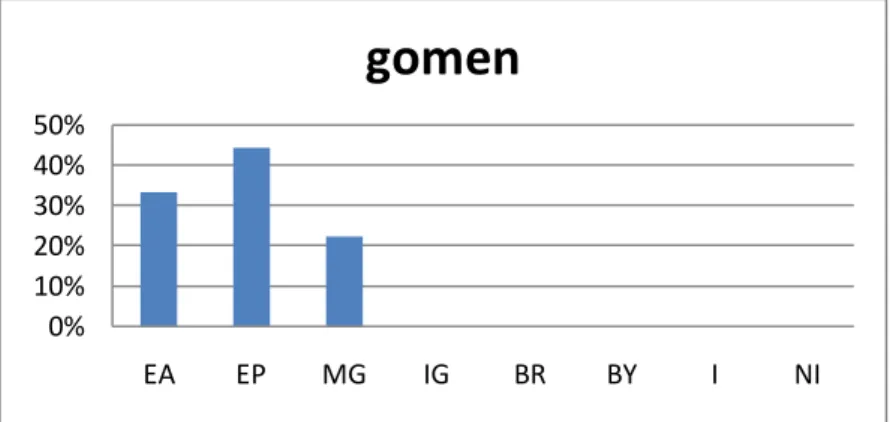
FIGURE 4.11FREQUENCY OF GOMEN AS GRATITUDE EXPRESSION ... 41
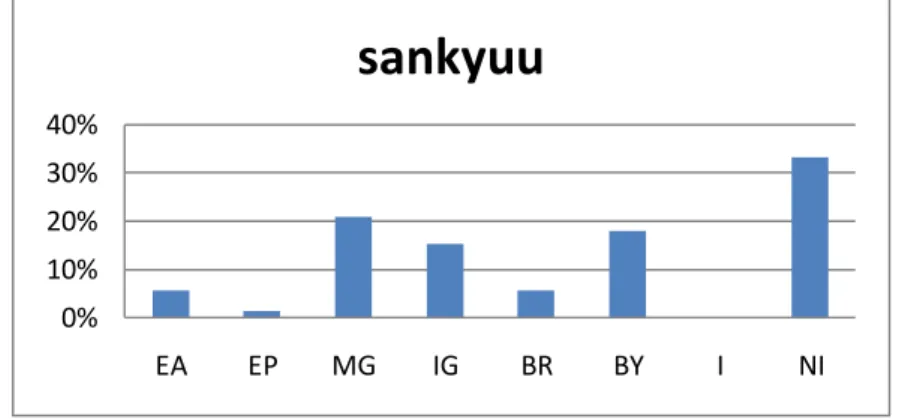
FIGURE 4.12FREQUENCY OF SANKYUU AS GRATITUDE EXPRESSION ... 42
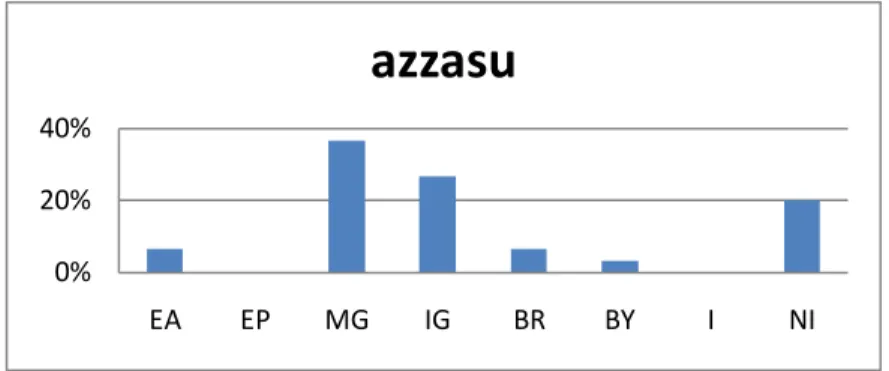
FIGURE 4.13FREQUENCY OF AZZASU AS GRATITUDE EXPRESSION ... 44
FIGURE 4.14FREQUENCY OF COMBINATION EXPRESSIONSAS GRATITUDE EXPRESSION ... 45
FIGURE 4.15FREQUENCY OF OTHER EXPRESSIONSAS GRATITUDE EXPRESSION ... 46
FIGURE 4.16FREQUENCY OF OVERALL GRATITUDE EXPRESSIONS FOR NATIVE SPEAKER OF INDONESIAN ... 47
ix
FIGURE 4.18FREQUENCY OF TERIMA KASIH AS GRATITUDE EXPRESSION ... 49
FIGURE 4.19FREQUENCY OF MAKASIH AS GRATITUDE EXPRESSION ... 50
FIGURE 4.20FREQUENCY OF THANKS AS GRATITUDE EXPRESSION ... 51
FIGURE 4.21FREQUENCY OF THANK YOU AS GRATITUDE EXPRESSION ... 51
FIGURE 4.22FREQUENCY OF MAAF AS GRATITUDE EXPRESSION ... 52
FIGURE 4.23FREQUENCY OF NUHUN AS GRATITUDE EXPRESSION ... 53
FIGURE 4.24FREQUENCY OF COMBINATION EXPRESSIONSAS GRATITUDE EXPRESSION ... 54
FIGURE 4.25FREQUENCY OF OTHER EXPRESSIONSAS GRATITUDE EXPRESSION ... 56
FIGURE 4.26FREQUENCY OF GRATITUDE EXPRESSIONS FOR MALES AND FEMALES JAPANESE ... …57
FIGURE 4.27FREQUENCY OF GRATITUDE EXPRESSIONS FOR MALES AND FEMALES INDONESIAN… ... 57
FIGURE 4.28FREQUENCY OF GRATITUDE EXPRESSIONS FOR MALE AND FEMALE JAPANESE…. . 58
1
CHAPTER I
INTRODUCTION
1.1 Background
Thank you is a linguistic form to express gratitude when people receive help or
kindness from others. It refers to the gratitude of a person toward something that has been accepted. This expression is a kind of routinized speech act (Coulmas, 1981). Even though it is defined in an identical manner across cultures, its expression is applied in a variety of ways in every society with different norms and values, the kind of contexts it should be used, and when, how, why and to whom it should be said. The expression of thanks may have different functions and meanings in different societies. For instance, gratitude expressions in British English and in American English are slightly different in function as well as in meaning. According to Hymes (1971, in Coulmas, 1981), the British thank you generally indicates a formality marker in certain interactions. Whereas, the American thank you is mainly regarded as a formula for the expression of gratitude whose functions strengthen social relationship (Cheng, 2005). Every culture has its norms and values with regard to what kind of acts or situations require thanks and the people of each society understand the use of that expression in an appropriate way.
Children are always taught by parents or care-givers that the expression of thanks is a matter of politeness (Cheng, 2005). Coulmas (1981) stated that thanks is a strategic device which has an function to balance politeness relation between interlocutors. The usage of
2
thanks is closely related to cultural norms which are a part of polite behavior in society. In a certain culture, for example, one may judge others as impolite or rude if they do not say thanks appropriately when it should be said in a certain occasion. In other words, there are some possibilities that without saying thanks after receiving some acts, it may cause negative social consequences and threaten a relationships.
According to Hee et al. (2012), although the use of a gratitude could be universal in many different languages, cultures vary with regard to the types of behaviors and situational characteristics that elicit gratitude and also the functions that the gratitude expression provides (p.138). In other words, the role of culture, especially in terms of expressing gratitude, cannot be separated from the use of language. Previous studies have shown that expressions of gratitude present interesting cultural differences across languages. Hinkel (1994) and Cheng (2005), for example, investigated cultural differences in different target cultures in the
attitudes toward the speech act of giving thanks. The results indicated that differences existed for the expression of thanks in every culture. Social and cultural influences that hold each of them have an important role in this expression. It is plausible that the use of gratitude
expressions are tightly dependent on the cultural context.
Jautz (2013) claimed that there have been only a limited number of studies that (1) examined the use of expressions of gratitude in one language, compared it in different languages, or (2) investigated non-native speakers‟ use against native speakers‟. Only a few researches have carried this out to explore the usage of thanks in different varieties of one language. The present study investigates gratitude culture in Japan and in Indonesia. As a society professing eastern culture, the people of Indonesia and Japan equally view moral values in social interaction as valuable. However, there are fundamental differences in
3
gratitude culture in these societies. In Japan, research on the gratitude expression has been investigated extensively, with and without a contrastive focus (Jautz, 2013). On the contrary, until now, comprehensive research regarding gratitude in Indonesia has hardly been looked at. By focusing on Japanese and Indonesian culture, which have numerous differences, the two nations‟ different cultural ways of expressing gratitude in their societies can be seen.
1.2 Brief Overview of Gratitude Culture in Japan
Japan as a modern and developed country is known as a nation that upholds its ancestral cultures, including cultures in gratitude. Japanese people respectfully say thank you to others. It is also a fact that in this globalized and modern era, Japanese people, from
children to elderly people, are accustomed to expressing gratitude without hesitation, even for something small. Young children in Japan are taught, particularly by their parents and
teachers, to have awareness toward gratitude. Furthermore, the curriculum guidance for defining basic standards of education in Japan, issued in 1998 by the Ministry of Education, Culture, Sports, Science and Technology (Naito et al., 2005), includes the following
statements concerning gratitude in a section on moral education for fifth and sixth grades of elementary school: “Be thankful that daily life depends on the support and help of other people, and respond to their help” (p.247).
For Japanese, manners and customs are important parts in their daily life. For example, bowing is one of the unique customs in Japan. Everyone usually bows when they say hello, goodbye, thanks, or sorry. This typical gesture is a term of respect, remorse, and greeting. Bows are also commonly used as gestures to show gratitude or apology. Regardless of bowing, in expressing their gratitude, Japanese say arigatou. In addition, sumimasen is also
4
used for the same purpose, although in literal term the meaning of the word is sorry. Naito et al. (2005) also emphasized that Japanese people usually express their gratitude by saying sumimasen, or “I am sorry”, as well as arigatou, or “thank you” (p.249). In saying sumimasen,
it reflects the strong feeling of indebtedness associated with receiving favor in Japanese society (Naito, 2005). Furthermore, he argued that in Japanese society, the concept of
gratitude involved both positive feelings and feelings of indebtedness. The research regarding the expression of sumimasen has been a study of interest in Japanese pragmatic fields, mainly in the 80s and 90s. Ide (1998) argued that there are even several functions of the expression of sumimasen, one of which is to exhibit one‟s mixed feelings of regret and thankfulness. This is
in accordance with some previous studies stating that when a gratitude statement such as “thank you” is expected in one culture, apologies can be used in place of or in addition to the gratitude statement in another culture (Coulmas, 1981; Ide, 1998; Kumatoridani, 1999).
Additionally, in a casual conversation, Japanese say just doumo, an intensifier just like “much” in English (Sugimoto, 1998). The expression of doumo commonly functions as a greeting and means “very much”. It is also often used as an expression of gratitude, even though Long (2010) stated that expression did not clearly express gratitude or apology.
1.3 Brief Overview of Gratitude Culture in Indonesia
As is stated above, every culture has its own way in conveying gratitude. The custom of Indonesians expressing their gratitude may not be as obvious as that of Japanese. In Indonesia, regardless of age, sometimes an expression of thanks is not delivered well when they receives something from others. Even among persons who have close relations, such as family members, Indonesians often have difficulty in expressing gratitude adequately.
5
Therefore, there is no wonder that even Indonesian children have difficulty in expressing their gratitude. Sometimes, it is the parents who usually say thanks on behalf of their children if the children get help or receive something from someone else. This means the children are not accustomed to expressing their gratitude to other people.
The Indonesian population consists of several different religious groups, each having several subgroups, and hundreds of ethnic groups with their respective languages (Mulyana, 2012). Indonesia is known as a multi-language nation with 726 languages spread around the country (Riza, 2008). However, the Indonesian language is the official language used as a means to unite various tribes with different cultural backgrounds and languages across Indonesia. As the national language, Indonesian serves as an emblem of national pride, the symbol of national identity, and the unifying tool as well as the tool of interregional and intercultural communication (Setyawati, 2013).
In Indonesia, common gratitude expressions include terima kasih or informally, makasih. According to Kamus Besar Bahasa Indonesia or The Great Dictionary of
Indonesian (Pusat Bahasa, 2008), it is a noun meaning rasa syukur (thankfulness). Terima
kasih is the expression of gratefulness or thankfulness, or returning the favor after receiving
kindness. It is used in every situation of thanks. It is very unusual that Indonesians say apologetic expression toward certain gratitude situation (Wouk, 2006). Though sometimes, when apology is expressed in certain gratitude situations that result in an uneasy feeling or indebtedness, the expression used is terima kasih or makasih followed by maaf (sorry), or vice versa, maaf, followed by the gratitude, terima kasih or makasih. In other words, there is no expression of thanks that has a double function, as in sumimasen in Japanese.
6
1.4 General Comparison between Japanese and Indonesian in terms of Gratitude Expressions
The role of culture in each society contributes to the differences in the custom of expressing gratitude. In Japanese, people use various expressions of thanks for different situations that demand thanks expressions, such as arigatou, sumimasen, and doumo. Arigatou is used as the general and the least marked expression of gratitude (Ide, 1998).
Meanwhile, several gratitude expressions can be replaced by apology expression. Sumimasen can be used when thanks are expected in certain situations (Kumatoridani, 1999). Doumo can be used as a formality marker in situations of thanks that do not demand expression such as arigatou. On the other hand, Indonesians commonly have a limited number of expressions in
conveying thanks in every thanks situation, namely terima kasih or makasih. There is no use of thanks for an apologetic situation as in sumimasen in Japanese. Indonesians use expression such as maaf or sorry for that kind of situation. In every situation of thanks, the only
expression of gratitude commonly used is terima kasih. The different picture of cultures between Japanese and Indonesia is quite noticeable. It is in accordance with the fact that different languages affect its users in their physical and social environment and make them think of it in a different way, therefore leading them to behave differently (Mulyana, 2012).
The present study investigates how Japanese and Indonesians express their feeling of gratitude according to the situations of thanks specified by Coulmas‟s taxonomy of thanks (1981).His taxonomy consists of several thanks situations where a person may feel grateful, so he or she expresses gratitude. Gratitude expressions may be expressed depending on how the person perceives those situations as gratitude situations. The perception can be viewed
7
differently by each person. The use of thanking in every culture may be different according to how its culture perceives a certain situation as one that stimulates the thanks expression.
1.5 Purpose of Study and its Contents
There may be a few aspects of expressing gratitude in many situations of thanks that trigger people to convey their gratitude in the way they do in Japan and Indonesia. It is of interest to investigate the cultural differences of expressing thanks of Japanese and Indonesian people. This study focuses on perception and interpretation made by both natives, particularly the younger generations, in how they express gratitude in various thanks situations. Young adults have mature ability in conversational and literacy aspects of language, so college students are suitable participants in this study. In young adults, those aspects of language become more elaborate with age(Owens Jr., 2008). Since this study is mainly aimed at observing expressions used by younger generations of two different cultures in conveying thanks, this thesis specifically focused on what kind of thanking expressions are used by college students. This will then be representative of the younger generationsin of both cultures in different types of gratitude situations and why they use the word they do.
To achieve the purpose of this study, the following questions must be answered to guide the research:
1. How do Japanese and Indonesians perceive different gratitude situations?
2. What expressions are used by both cultures when different kinds of thanks situations are faced?
8
This thesis consists of five chapters. Chapter 1, the introduction chapter, shows the background of this study, which describes the usage and the function of gratitude expression across cultures, including the gratitude culture of Japan and Indonesia. Chapter 2 introduces the relevant theoretical frameworks for this study. It reviews literature on pragmatics, particularly speech acts. Chapter 3 presents the methodology used in this study that includes the characterization of the participants, the construction of the questionnaire, and data analysis methods. Chapter 4 shows the results of the present study, and Chapter 5 discusses the
interpretations of the findings. It consists of the limitations and suggestions for further research and the implications of this study.
9
CHAPTER II
SPEECH ACTS OF THANKING
Dealing with cross-cultural researches, the present study aims to investigate engaging issues in pragmatic fields of speech acts. According to Moalla (2013), people in different countries speak differently, and their different ways of speaking can be accounted for in terms of independently different cultural norms, which can be called the ideas of the field of cross-cultural pragmatics. The way people from different cultures produce and perceive speech acts are determined by the underlying cultural norms and values.
2.1 Speech Acts of Thanking
Speech acts are a concept that was initially proposed by Austin in 1962. With words, people can express anything they want to say or communicate to others. For example, people can make statements, questions, exclamations, promises, and so on. Austin underlined that a statement, which is formed by words, not only describes a situation or states information about the facts, but it also performs a certain action. The notion of speech acts, according to Searle (1969), is the basic unit of language used to express meaning or an utterance that expresses intention. Speech acts are the actions we do through speaking, and they may cause a change in the existing state of affairs or cause an effect on the interlocutor (Cheng, 2005). For instance, in saying thank you, one is not only stating something, but is also performing an act of thanking.
10
Searle developed the idea of speech acts in more details. There are five types of speech acts in Searle‟s classification (pp.12-20):
(i) Representatives (or assertives), which commit the speaker to the truth of something (i.e., asserting, claiming, reporting);
(ii) Directives, which are attempts of the speaker to get the hearer to do something (i.e., ordering, commanding, requesting, begging);
(iii) Commissives, which commit the speaker to do some future action (i.e., promising, offering, threatening);
(iv) Expressives, which express a psychological state (i.e., thanking, apologizing, complimenting); and
(v) Declarations, which bring out the correspondence between the propositional content and reality (i.e., appointing a chairman, nominating a candidate, marrying a person, christening).
Based on Searle‟s classifications of speech acts, the present study explores native speakers‟ behavior toward one of the expressive speech acts, namely thanking. It is classified by Searle as an expressive illocutionary act, which expresses a psychological state.
Psychologically, there are components that may be conveyed when expressing gratitude. Fitzgerald (1998) identified three important components of gratitude conveyed that include not only a warm sense of appreciation for something or somebody but also a sense of
goodwill toward that thing or that person and a resultant disposition to act positively because of appreciation and goodwill. When saying thanks, the speaker expresses gratitude for the hearer‟s involvement in a prior action that was beneficial to the speaker.
11
Thanking as a routinized speech act is chosen because it seems that thanks is one of the most important expressions involving multiple aspects that are easily found in daily routine conversation in society. Since the expression of thanks is socially valuable, Leech (1983) discusses thanking from a social perspective that defines thanking as a friendly function, and its goal of stating appreciation is to establish and maintain a polite and friendly social atmosphere. Further, Leech describes thanking as an expressive act because it makes known the speaker‟s psychological attitude.
Eisenstein and Bodman (1986) have described thanking as an illocutionary act under Searle‟s classification of speech acts. Their study indicated that an expression of gratitude is an illocutionary act performed by a speaker based on a past act performed by the hearer. This past act benefits the speaker, and the speaker believes it to have benefited him or her. The speaker feels grateful or appreciative, and makes a statement that counts as an expression of gratitude (p. 167). However, not all expressions using the word thank you refer to gratitude (Eisenstein and Bodman, 1993). Rubin‟s (1983) ethnographic study on the use of the words thank you found that thank you can also refer to other language functions such as
compliments and closings in a conversations (i.e., That’s all, thank you), or rejecting an offer (i.e., No, thank you or [Thanks,] I’m fine). Further, Rubin also identified a quick and almost automatic expression thanks, and the bald thank you, which is typical in service encounters.
The use of thanking might differ from culture to culture (Cheng, 2005). For example, in most English-speaking cultures, thanks can be given regardless of whether the offer or promise is accepted or rejected and can be utilized as an acknowledgement (Hymes, 1971, cited in Cheng, 2005). Furthermore, Hymes noted that in British English, giving thanks was different from that in American English, with thank you frequently serving as a discourse
12
marker or conversation sequencer, rather than an expression of gratitude. According to Coulmas (1981), “the social relation of the participants and the inherent properties of the object of gratitude work together to determine the degree of gratefulness that should be expressed in a given situation. Differences in this respect are obviously subject to cultural variation” (p.75). In other words, the quality of social relationships among certain people plays an important role in defining certain situations.
2.2 Coulmas’s Frameworks of Thanking and Previous Studies
Coulmas‟s idea of thanking is used as the main foundation for this study. According to Coulmas (1981), the pioneer of the research on gratitude expressions, thanking is a kind of routinized speech act whose occurrence is tied to more or less standardized communication situations and social norms that belong to certain community. Coulmas stated that every sincere verbalization of gratitude was related to some action (or actions) of a benefactor or to a result of this action. Coulmas called this “the object of gratitude” (p. 74), which was
described in terms of different properties: real vs. potential, material vs. immaterial, requested vs. not requested, and indebting vs. not indebting. Coulmas‟s taxonomy of thanks is presented as follows:
(i) real vs. potential
- thanks ex ante (for a promise, offer, invitation) - thanks ex post (for a favor, invitation afterwards) (ii) material vs. immaterial
- thanks for material goods (gifts, services)
13 (iii) requested vs. not requested
- thanks for some action initiated by the benefactor
- thanks for some action resulting from a request/wish/order by the beneficiary (iv) indebting vs. not indebting
- thanks that imply indebtedness
- thanks that do not imply indebtedness (p. 74)
Coulmas carefully cautioned that this taxonomy was not definitive, that other criteria were conceivable (e.g., the scale of weightiness), and that the criteria in the taxonomy were not mutually exclusive. In addition, Coulmas argued that “the nature of the object of gratitude is not the only factor that determines the choice of a gratitude expression that the quality of the interpersonal relation between the participants is equally important” (p. 75). Furthermore, Coulmas also focused on the similarity condition of thanking and apologizing in certain situations, which described as apologetic thanks. The connection between thanks and apologies is the concept of indebtedness. Expressions of thanks convey a speaker‟s
indebtedness as a recipient of a benefit whereas apologies express the speaker‟s indebtedness to his or her interlocutor for having performed an action to the hearer. This close relationship between apologies and thanks has especially been observed in Japanese where the expression sumimasen is used in both thanking and apology contexts (e.g., Coulmas, 1981; Ide, 1998;
Kimura, 1994; Kumatoridani, 1999). According to Ide (1998), the primary „„metapragmatic‟‟ function of the use of apology expressions is to mark „„public discourse‟‟ in Japanese. In other words, apology–gratitude can be viewed as „„a kind of ritualized formula that allows
interlocutors to signal that they are engaging in proper public discourse‟‟ (p. 527). In this context, sumimasen may function both as an apology and as an expression of gratitude. This is not only applied to Japanese culture, but also in Chinese, where gratitude can also be
14
indicated by expressing one‟s embarrassment for causing the interlocutor extra effort or for taking up his or her time with an apology (Cheng, 2005).
Jautz (2013) claimed that there have been only a limited number of studies that have investigated the use of expressions of gratitude in one language, compared it with different languages, and investigated non-native speakers‟ use against native speakers‟. Few researches have been carried out to explore the usage of thanks in different varieties of one language. Besides, most of the researches on the speech act of thanking have focused on linguistic issues more than on perceptions and interpretations made by both native and non native speakers of a language (Pablos-Ortega, 2010). Therefore, the study is focused on the use of conventional expression of thanking by native speakers of a language (L1) in various given thanks situations. In order to enrich the description of L1 perception and interpretation of the usage of thanks expressions across cultures, a comparison between two different cultures is conducted in this study.
Until now, many studies have mainly been concerned with understanding the use of gratitude expressions of non-native speakers or second language learners (L2) rather than native speakers (L1) of a certain language. For examples, Hinkel (1994) examined cultural differences in attitudes toward the speech act of giving thanks to several non-native speakers of English learners: Chinese, Indonesians, Koreans, Japanese, Spanish, and Arabs. There are differences between speakers of those native languages and native speakers of English in perception of the appropriateness of certain expressions of thanks. Cheng (2005) studied that the longer non-native speakers (L1 Chinese) stayed in the United States, the more appropriate strategies were used to express gratitude. In other words, the length of residence in the target community has positive effects on the L2 pragmatic development. Furthermore in the same study, Cheng also examined native speakers (L1) of Chinese and English with different
15
preferences for thanking strategies in certain situations. Johansen (2008) investigated how native speakers of Norwegian and learners of English as a foreign language expressed gratitude in certain situations where the Norwegian participants relied heavily on their L1 pragmatic competence when expressing gratitude in English. Farnia (2009) argued that when Iranian English learners expressed gratitude, the strategies used reflected the influence of Farsi, their first language. Moreover, Iranian native speakers of Farsi are significantly different from native speakers of English with regard to their use of thanking strategies.
Those studies lead to the understanding of what Bodman and Eisenstein (1988) and Eisenstein and Bodman (1986, 1993) stated that saying thank you is a problem not only for native speakers, but also for second language learners who need to know when and how to thank in the target culture. Therefore, the problem of expressing thanks for native speaker cannot be neglected. Giving more attention to comprehensive research focusing on the use of thanking expressions among native speakers is equally important for research development in the field of the speech act of thanking. This condition has triggered this cross-cultural study investigating L1 speakers of Japanese and Indonesian in the area of gratitude acts.
Although there have been many studies on Japanese gratitude expressions, literature on Indonesian gratitude expression is still difficult to find.In Japan, research on gratitude expression has been investigated extensively, with or without a contrastive focus (Jautz, 2013). Otherwise, studies regarding gratitude focusing on Indonesians have rarely been conducted, especially the gratitude of native speakers (L1). It should be mentioned that previous research on gratitude culture in Indonesia has a number of limitations. Of the studies that are rarely found in terms of gratitude studies in Indonesia, Tedjaatmaja and Putri (2011) investigated the strategy used by Americans and Indonesians in expressing gratitude.
16
Americans used explicit strategies less frequently than the Chinese-Indonesians. This research signifies that ethnicity is not the only factor affecting gratitude expression, as other potential factors, namely language exposure and attitudes toward both cultures, also play important roles.
Most studies on Japanese gratitude expressions are heavily concerned with the usage of gratitude expression in regard to the thanking-apology context. Findings suggest that Japanese allow apology expressions (e.g., sumimasen) to be used in place of or alongside gratitude expressions (e.g., arigatougozaimasu) in gratitude situations (Coulmas, 1981; Ide, 1998; Kumatoridani, 1999; Long, 2010). Coulmas (1981) also focused on the similarity condition of thanking and apologizing in certain situations, which he described as „apologetic thanks‟. Thanking, as well as apologizing, he described, entails indebtedness to the addressee in Japanese culture whereas it did not in European culture. In accordance with Coulmas, Ohashi (2008) examined that expressing o-rei (expression of manner or respect) in thanking in Japanese cannot be separated from the symbolization of indication of debt.
Thanks and apologies are not as distinctly different as widely believed according to Kumatoridani (1999). Describing further, Kumatoridani stated that in Japanese, the co-occurrence between the gratitude expression and the apology expression occured due to the different discourse functions the two expressions assumed: sumimasen for local management and arigatou for closing the gratitude exchange. The use of gratitude-apology expressions is also the main point of interest for Long (2010) in his study. Long argued that awareness of the use of apology–gratitude began as early as first grade and approximates to that of adults between seventh and ninth grade. It is acquired gradually as a part of the process of language socialization. Investigating gratitude feeling toward Japanese and Thai students, Naito et al. (2005) illustrated that positive feelings correlated with facial and verbal expressions of
17
gratitude and increased prosocial motivation. Feelings of indebtedness were reported more strongly by Japanese students compared with Thai students, and these feelings were somewhat related to the enhancement of prosocial motivation.
Considering several ideas and previous studies related to the present study, Coulmas‟s ideas on the speech act of thanking becomes the main base of this study. In his work,
Coulmas outlined eight dimensions in which thanks could differ from one to another. The dimensions distinct classes of various thanks situations and those were adapted in the present study. The taxonomy of thanks is used as the primary basis in figuring out perception and assessment people in two different cultures toward certain situations that create a grateful feeling to a result of particular action that others have done. Then, this study is directed to how people, Japanese and Indonesians, respond to the situations, particularly in their response in terms of gratitude statements that may emerge. It focuses on the perception of L1 of
Japanese and Indonesians toward gratitude situations in expressing gratitude statements. Those expressions of gratitude are then listed and classified as various expressions that exist in Japanese and Indonesian according to the given situations of Coulmas‟s taxonomy.
2.3 Usage of Discourse Completion Task
The choice of the instrument will determine the reliability and accuracy of the data that represents the authentic performance of the language related behavior (Rasekh, 2012). It is known that the Discourse Completion Task (DCT) has been widely used as a popular speech act instrument in cross-cultural pragmatics study (Beebe & Cummings, 1996; Kasper & Dahl, 1991). DCT has been widely used in speech act studies because it enables the
18
and it is also possible to control situational variables such as social status, age, gender, and language proficiency (Kasper, 2000). Beebe and Cummings (1996) explained that DCTs are a “highly effective means of instrumentation” (p. 80). They found that DCTs enable researchers to (a) gather large amounts of data quickly; (b) create an initial classification of semantic formulas and strategies that will likely occur in a natural speech; (c) study the stereotypical, perceived requirements for socially appropriate responses; (d) gain insight into social and psychological factors that are likely to affect speech act performance; (e) ascertain the canonical shape of speech acts in the minds of speakers of the language; and (f) vary the situational control variables that may affect speech behavior. By using DCT, the participants have the opportunity to respond freely, that is they are not asked to produce a certain speech act, but to state what they would say in a certain situation (Johansen, 2008).
Although it is commonly used and advantageous, the use of DCTs in the collection of speech act data has also been criticized. Beebe and Cummings (1996) stated that the data obtained from DCTs may (a) differ from actual wording used in real interaction; (b) differ in the range of strategies used (e.g., avoidance strategy tends to be left out); (c) differ in length of responses or the number of turns it takes to fulfill the function; and (d) lack depth of emotion that in turn qualitatively affects the tone, content, and form of linguistic performance (p.80). In the use of DCTs, participants do not face real life situations, thus, the data
represents what people think they would say, not what they actually say (Aston, 2004 cited in Rasekh, 2012).
In spite of its advantages and disadvantages, the present study uses DCT as the instrument of research. DCT is one of the most common questionnaire types used to elicit speech acts. Questionnaires are a frequently used method to obtain a written version of speech data. A questionnaire generally consists of a list of questions that the participants read,
19
interpret, and give answers to (Johansen, 2008). In questionnaires, the respondents record the answers themselves, as opposed to in an interview where the interviewer records the answers (Kumar, 2005, cited in Johansen, 2008). According to Kumar, DCT is easy to distribute in gathering data from different geographical areas and have limited resources. In order to elicit written data by asking the participants to respond in writing, the participants will have more time to complete the questionnaire which would not have been the case in oral
communication (Cohen, 1996). Expressing utterances in a written form, as in the questionnaire, one may produce responses as reflected in natural language use.
20
CHAPTER III
RESEARCH METHODOLOGY
3.1 Participants
Participants in this study are divided into two groups of native speakers of Japanese and native speakers of Indonesian. The groups are Japanese and Indonesian undergraduate students who are enrolled at Tohoku University and Padjadjaran University. These college students were selected based on the consideration of the following specific criteria:
1. The participants are young adults who are in the age range between 18 and 22 years old. According to Owens Jr. (2008), in that age range, young adults are versatile speakers who are expected that their conversational and literacy abilities continue to diversify and become more elaborate with age.
2. The participants, undergraduate students, are almost always available and willing to participate in the research conducted in the campus area.
Sampling was conducted by using quota sampling technique. This technique
determines the sample of the population that has certain characteristics to fulfill the desired amount or quota (Black, 1999). The participants were selected as they come to fill a quota of the characteristics mentioned above. In this study, the undergraduate college students were taken as a sample study in accordance with the characteristics of the study. In conducting research involving the participation of human beings, it implicates a variety of ethical concerns such values as dignity, bodily integrity, autonomy, and privacy (Kapp, 2006). Therefore, the participants cannot be forced into taking part in the research. The participants
21
must be in a condition where they consciously agree to participate. The students participated in this study voluntarily. A number of the voluntary participants used as a sample amount to a total of 286 people: 103 Japanese students and 183 Indonesian students.
The data collection was conducted during the period of December 2013-April 2014 at Tohoku University, Japan and at Padjadjaran University, Indonesia. The data retrieved by distributing questionnaires to each student in the classroom with the instruction of
administration procedures for filling in the questionnaires beforehand. Completion of the questionnaire was not done in the classroom at the time but it was taken back home and the the questionnaire was returned in the classroom a week later.
3.2 Instrument
The measuring instrument used in this research is a Discourse Completion Test (DCT). DCT is one of the most common questionnaire types used to collect data in language research. DCT usually consists of a short description of a particular situation, specifying the setting, the social distance, and the social status between the participants (Blum-Kulka, House & Kasper, 1989; Kasper & Dahl, 1991). Beebe and Cummings (1996) stated that DCT allowed
researchers to collect a large amount of data in a relatively short time. Furthermore, they stated that DCT created model responses that were likely to occur in spontaneous speeches. DCT also provides stereotypical responses for a socially appropriate response. By using a DCT, it allows to investigate speech act production in a variety of settings and thus perhaps illustrates some general strategies used when expressing gratitude (Johansen, 2008).
The DCT questionnaire in the present study is designed based upon Coulmas‟s taxonomy of thanks (1981). Coulmas (1981) stated that every sincere verbalization of
22
gratitude was related to some action (or actions) of a benefactor or to a result of this action. Regarding Coulmas‟s taxonomy of thanks, see the detail in Chapter 2.
Based upon Coulmas‟s taxonomy of thanks, the questionnaire was developed for measuring gratitude expressions in various given situations. The situations presented to the participants dealing with everyday events that are familiar and natural in both Japanese and Indonesian cultures. Therefore, the participants were expected to be able to know how to respond in these situations. There were two versions of the questionnaire: one in Japanese and the other in Indonesian. Initially, the questionnaire was constructed in English. Then, both versions of the questionnaire were translated by a bilingual student of Japanese and Indonesian, and then relevancy of the translations was checked by native speakers of both languages. Each question in the two versions of the questionnaire was adjusted to the original English construction to obtain the same situation context for both translations. It was
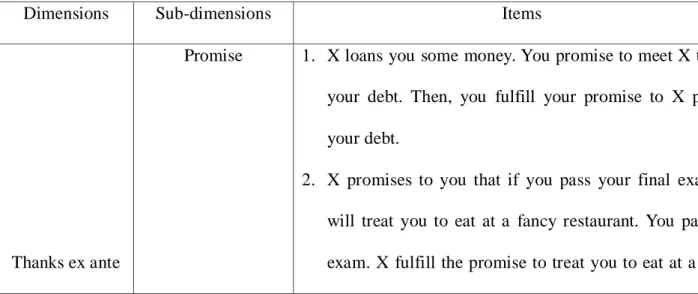
designated to make sure that every situation was cross-culturally comparable and authentic for both native students. Derivation of theoretical concepts of Coulmas‟s taxonomy of thanks into question items in the questionnaire is described in Table 3.1.
Table 3.1 Description of derivation concepts of Coulmas‟s taxonomy of thanks
Dimensions Sub-dimensions Items
Thanks ex ante
Promise 1. X loans you some money. You promise to meet X to pay your debt. Then, you fulfill your promise to X paying your debt.
2. X promises to you that if you pass your final exam, X will treat you to eat at a fancy restaurant. You pass the exam. X fulfill the promise to treat you to eat at a fancy
23 restaurant.
Offer 3. Usually, you walk home. Today the rain is pouring down and you do not bring your umbrella. X offers to drive you home.
4. X offers to go with you to the department office to help you with some of the procedures for registration.
Invitation 5. X will hold a birthday party. X invites you. You accept it.
Thanks ex post
Favor 6. You need to book a hotel room immediately for tomorrow via internet but you are away from internet connection at this time. X helps you to book it for you. 7. You ask X to give you a ride when you in a hurry to meet
your advisor in a one place after having a group meeting with another friends in another place. X helps you to give you a ride.
Invitation (afterwards)
8. You came to a birthday party held by X last night. You meet X in cafeteria today.
9. You went to a musical concert together with X. You got the ticket from X. The next days, you have the same class with X and meet X in the class.
Thanks for
Services 10. You are typing a paper in the computer lab, and you are having a hard time getting your printer to work. X gets it to work.
24
material goods making a bowl of porridge for you to eat.
Gifts 12. You are having a birthday. X remembers your birthday and gives you a present.
13. X just came back from a trip. X gives you souvenir.
Thanks for immaterial
goods
Wishes 14. You are going home for the break between quarters. X wishes you a safe trip and a nice break.
15. Today is your birthday. X sends you a text, wishing you a happy birthday.
Congratulations 16. You have just got a job offering from a company. X knows about it and X congratulates you.
17. You have just received a letter of acceptance to a prestigious university. X congratulates you.
Compliments 18. You wear new shoes you bought last week. X compliments you saying that you have nice shoes.
19. X appreciates your opinions in a group work in making a project for a class.
Information 20. X shows you how to get to the city by city bus, giving you a number of bus and the bus stop you should get off. 21. You are planning on taking a course which X has already taken. You want to know more about that course. X tells you about it.
Thanks for
22. You are bringing many books that you cannot push the lift button. Seeing that, X pushes it for you.
25 some action
initiated by the benefactor
23. You dropped your notes in the middle of a busy sidewalk. X is walking by. X stops and helps you pick up your notes. Thanks for some action resulting from a request/wish/ order by the beneficiary
24. X is picking up your bag which fell to the wet floor after you asking him to do it, since you are far a way to reach it.
25. You are requesting to X to play the music that you want to hear in X‟s laptop. X plays it for you.
Thanks that imply indebtedness
26. You are sick. Your family is away and you do not have anybody to rely on. X knows you are in a very bad condition that you are in difficulty taking care of yourself.
27. You have to pay your rent and the due date is tomorrow. The allowance from your parents will not come until next week, but you really need the money. Then, X helps giving you a loan.
Thanks that do not imply indebtedness
28. X lends you a pencil when you forget to bring your pencil case.
29. You and X are walking to the class. You drop your glove. X picks it up and gives it to you.
A pilot study was conducted in order to develop the final version of the questionnaire. In the pilot study, the questionnaire had 36 questions that were distributed to 8 Japanese
26
students at Tohoku University and 10 Indonesian students at Padjadjaran University. Results and suggestions from the pilot study were analyzed and taken into consideration for
developing the final questionnaire. The instruction of the questionnaire and some contextual variables were adjusted for easier understanding. Some situations considered unfamiliar and unsuitable according to the pilot study were also omitted. As a result, 29 out of 36 questions were selected for the final questionnaire.
Each question in the questionnaire followed the same format where a thanks situation was briefly described and then succeeded with two choices of answer and fill-the-blank space. These two choices of answer were grouped into two parts regarding gender matters. Therefore, generally each question consisted of four choices of answer. This questionnaire used in the present study contained yes and no simple-open questions. In this format, participants were free to respond depending on every given situation described in the questions. When
participants chose no as their response, they marked their answer and left as it is. On the other side, when participants answered yes as their response, they were required to provide a verbal response in the given space. According to Grove et al. (2013), using a sequential approach, the method used in the present study is categorized as a mixed method approach. Quantitative data was collected first, and then followed by qualitative data. The quantitative data was obtained in the yes-no data from the questionnaire. After that, the data from the simple open questions in the questionnaire were elicited in order to support the quantitative data that was obtained first. The quantitative data was also main data source for this study.
3.3 Data Analysis
Statistical analysis was conducted to determine the significance of the data sets. The analyses were used for following purposes: (a) to investigate how native speakers of Japanese
27
and native speakers of Indonesian express gratitude as defined by classified situations of thanks and (b) to examine whether there is any influence with regard to gender in gratitude culture among Japanese and Indonesians.
After collecting the data, several thanking responses were coded for expression of gratitude in response to certain given thanks situations described in the Coulmas‟s taxonomy of thanks. The data was coded for entry into a database. The coded responses were then entered into the SPSS software program and statistical analyses were performed. The number of responses was converted in the form of a percentage and those were presented in the graphs. To calculate the significance of the usage of gratitude expressions between Japanese and Indonesians data, a t-test was performed to determine how the levels of Japanese and
Indonesians differed in response to the given gratitude situations. Aspects of the data analysis examined in this study are as follows:
1. Thanking expressions
The thanking expressions that were examined are divided into two groups, expressions of thanks used by Japanese and those used by Indonesians. Each group consists of different categories of gratitude expressions which come out as the data in the questionnaire.
According to those expressions written on it, the responses between two data sets of Japanese and Indonesian were classified to obtain classification of various thanks expressions toward different situations of thanks in both cultures.
2. Gender
In each question, there are two groups of answer choices where participants were asked to fill in the both of them. Those answer choices were made regarding to the gender matters. Example of the answer choices is given below:
28
X offers to go with you to the department office to help you with some of the procedures for registration.
If you are facing on that situation, will you say thank you? (1) X is a female.
A. no
B. yes. If yes, what kind of expression will you convey?
……… (2) X is a male.
A. no
B. yes. If yes, what kind of expression will you convey?
……….
In the present study, it is important to discuss in order to find out the expressions used in different thanks situations among male and female students. It may also demonstrate evidence as to whether there is a relationship between gender and the choice of thanks expression toward every described situation of thanks.
29
CHAPTER IV
RESULTS
This chapter presents the results of the study in accordance with the research questions described in Chapter 1:
(a) how native speakers of Japanese and native speakers of Indonesian express gratitude as defined by classified situations of thanks,
(b) the expressions used by both people when facing different kinds of thanks situations, and
(c) whether there is any evidence of gender toward gratitude culture among Japanese and Indonesians.
The result descriptions from the Japanese native speakers are analyzed and presented first, followed by the data from those of the Indonesians native speakers. Then, the Japanese data is compared with native speaker data of Indonesian to find out the similarity and the differences of expressing gratitude in various situations of thanks. All expressions given according to the data are examined based on the eight situations of thanks by Coulmas‟s taxonomy. The situations are as follows:
- thanks ex ante (for a promise, offer, invitation) - thanks ex post (for a favor, invitation afterwards) - thanks for material goods (gifts, services)
- thanks for immaterial goods (wishes, compliments, congratulations, information) - thanks for some action initiated by the benefactor
30 - thanks that imply indebtedness
- thanks that do not imply indebtedness.
In the analysis of the data result, the term referent and addressee are used as a reference to the one who gives gratitude responses and to the one who receive gratitude expressions, respectively. It should be noted that the „Japanese‟ and „Indonesians‟ terms used in this chapter refer to the Japanese and Indonesian students, respectively, who participated in the present study.
4.1 General Overview of Gratitude Expressions in Japanese and in Indonesian
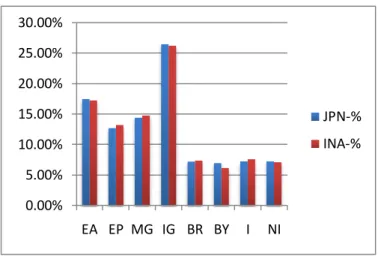
It is plausible that various expressions of gratitude appear toward different kinds of thanks situations. According to the Japanese and Indonesian data, both display various gratitude expressions as responses to the different situations of thanks. From the data, Japanese and Indonesians use several expressions that they thought were appropriate in response to various thanks situations they met in the questionnaire. Above all the other expressions, arigatou for Japanese and makasih for Indonesians were the most used gratitude expressions. Figure 4.1 and Figure 4.2 present the overall description of responses in gratitude situations. In Figure 4.1, it is shown that in all dimensions of gratitude situations, Japanese and Indonesians mostly express their gratitude using various expressions. The highest dimension in which gratitude expressions were particularly used was situations of thanks for immaterial goods. In this dimension, situations where the addressee gave the referent wishes, congratulations, compliments, and information, most students from Japan and Indonesia responded more frequently to those situations with gratitude expressions.
Results of a t-test analysis show that the native speaker of Japanese tend to respond significantly more than Indonesians toward gratitude situations. The mean percentage of
31
Japanese responses (95.71%) is higher than Indonesian (89,24%), and the difference between the two groups is significant (see Appendix 1). However, generally there is not much
difference between Japanese and Indonesians when choosing not to respond with gratitude expressions to the situation in all dimensions (see Figure 4.2). Interestingly, the data show that they mainly do not express thanks to the dimensions thanks for immaterial goods. This is the same dimension that appears when the most gratitude expressions are used. In this case, for some other Japanese and Indonesians, it is unnecessary to express any expressions of gratitude, since those situations do not produce gratitude feelings.
Figure 4.1 Frequency of all gratitude expressions in each dimension
Figure 4.2 Frequency of responses of no in each situation dimension of gratitude 0.00% 5.00% 10.00% 15.00% 20.00% 25.00% 30.00% EA EP MG IG BR BY I NI JPN-% INA-% 0.00% 10.00% 20.00% 30.00% 40.00% 50.00% EA EP MG IG BR BY I NI JPN-% INA-%
32
Note: EA = thanks ex ante; EP = thanks ex post; MG = thanks for material goods; IG = thanks for immaterial goods; BR = thanks initiated by benefactor; BY= thanks initiated by
beneficiary; I = thanks implying indebtedness; NI = thanks do not implying indebtedness; JPN = Japan; INA = Indonesia
4.2 Gratitude expressions in Japanese
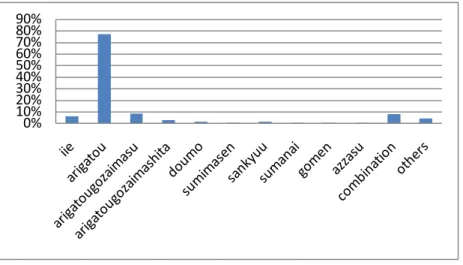
A number of expressions used in conveying gratitude in Japanese were used, as seen in Figure 4.3. According to the Japanese data, native speakers of Japanese gave a few expressions as their responses in conveying gratitude that categorized into twelve types of expressions, namely: (1) iie, responses given when participants think that certain situations do not need expressions of gratitude, (2) arigatou, (3) arigatougozaimasu, (4)
arigatougozaimashita, (5) sumimasen, (6) sumanai, (7) doumo, (8) gomen, (9) sankyuu, (10)
azzasu, (11) combination of gratitude and apology expressions, and (12) other expressions
that are not frequently used as gratitude expressions.
Figure 4.3 shows the frequency of gratitude expressions used in the various situations of thanks by Japanese. Overall, the most used gratitude expression by Japanese is arigatou (69%), especially for the material and immaterial of thanks situations where arigatou appears as the most frequent expression. Other expressions frequently used are arigatougozaimasu (8%), the combined expression of gratitude and apology, such as gomen-arigatou or sumimasen-arigatou (7%), and expressions that belong to other categories, such as
tasukarimashita (4%). The use of arigatou and arigatougozaimasu as well as
arigatougozaimashita is examined individually because of honorific and politeness matters.
This also applies to the use of sumimasen and its impolite form, sumanai. However,
33
any expressions of gratitude as they think that in some certain situations, it is unnecessary to express gratitude. Further explanation of each expression category is presented in detail in the following sub-sections.
Figure 4.3 Frequency of overall gratitude expressions for native speaker of Japanese
4.2.1 Iie
There were 343 responses of iie (6%) as Japanese‟s response to some certain gratitude situations. Japanese do not give any expressions of gratitude mostly when they meet the situations of thanks for immaterial goods and thanks ex post. In the situations of thanks for immaterial goods that consist of four sub-dimensions, iie mostly appears in the sub-dimension of compliment. In the questionnaire, the situation is as follows: when participant is
complimented in using new shoes and is appreciated when conveying a good opinion in a group discussion. Most of the Japanese responded in these situations with iie, which means they have no urgency to express gratitude in the compliment-situations. In another situation, iie is expressed when Japanese face thanks ex post situations. Iie was highly used in the
sub-dimension of invitation (afterward). These situations mean that thanks was given to the addressee when an invitation has been fulfilled by the one who is invited (the referent). In the
0% 10% 20% 30% 40% 50% 60% 70% 80% 90%
34
example of case where a certain participant was invited to a birthday party, Japanese
participants mostly did not say thanks after the party. In other words, Japanese tend to not say thanks or any other expressions of gratitude to the past invitation situation.
On the other hand, Japanese contrastively avoided expressing iie in the situation involving feeling of indebtedness. It is shown as in the situations thanks of imply
indebtedness and thanks that do not imply indebtedness. The case situations contain some kind of efforts from the benefactor (referent) of doing something for the beneficiary
(addressee). As long as the referent does something with any effort, even if it involves fewer effort (do not imply indebtedness) or more effort (implying indebtedness), Japanese did not say iie in those contexts of situations of thanks.
Figure 4.4 Frequency of iie
4.2.2 Arigatou, arigatougozaimasu, and arigatougozaimashita
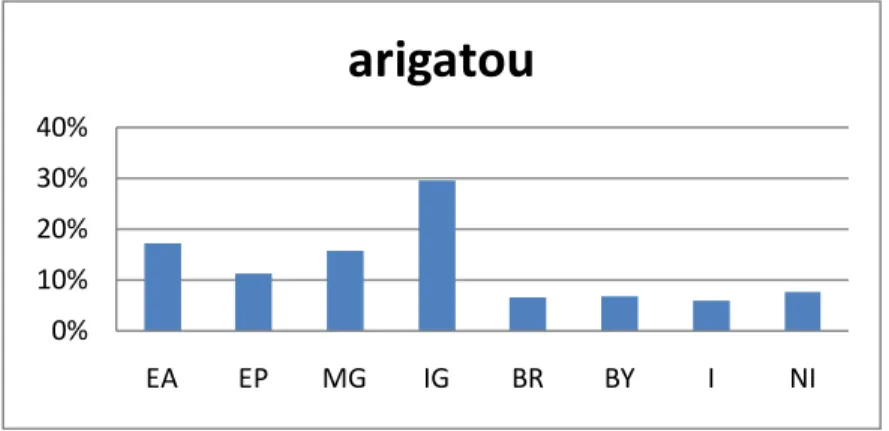
Expressions of arigatou and its variant, arigatougozaimasu and arigatougozaimashita are combined and presented into one section. Those three expressions have the same meaning and are derived from one basic word, arigatou. Its linguistic and pragmatic forms distinguish the function of those expressions. Arigatou is examined as the most used expression of gratitude among Japanese in this study. Overall, there were 4121 responses (69%) choosing
0% 10% 20% 30% 40% 50% EA EP MG IG BR BY I NI
iie
35
arigatou as the common expression for thanking in most of gratitude situations. Since the
participants of this study were college students who in the same average age range, the use of arigatou was predictable. Arigatou is a casual gratitude expression used mostly among
persons who have intimate relationships and are in the same age. Linguistically, arigatou is categorized as a plain form expression. According to Larsson (2011), the plain-form is usually referred to as informal not marked for politeness, but used between peers. As one kind of plain form, arigatou can be expressed between peers to convey a casual mood and informality among them. Specifically, according to the data, the expression was used in the situations of thanks that do not imply indebtedness. The case in the questionnaire is the situation involving fewer efforts in fulfilling the favor asked by a benefactor. For example, a referent lent a pencil to an addressee since she or he forgets to bring her or his pencil. The situation perceived by most participants may arise a feeling of indebtedness. The addressee is also regarded as a person who has a close relationship with the referent, so that the casual form of the gratitude expression is enough to be conveyed.
Honorifics in Japanese are regarded as an essential function in their society that is one of the most important means of expressing politeness in Japanese (Okamoto, 1999). It is definable that there is different function of using arigatou, arigatougozaimasu, and
arigatogozaimashita. The suffix -masu includes the present (-masu) and past (-mashita) tense
forms (Okamoto, 1999). Both forms are representatives of the honorific form in Japanese. Larson (2011) stated that the -masu form conveys respect towards the addressee and „linguistically marked for politeness,‟ and when it is expressed, it has a more formal tone (p.22). He further stated that to maintain speech level harmony, an honorific expression directed towards the addressee should also be followed by the -masu form. When –masu form is attached, it is marked politeness and conveys respect to the addressee. In other words,