
Cultivating Intercultural Sensitivity for
Local and Global Business Contexts
journal or
publication title
International review of business
number
14
page range
99-121
year
2014-03
1. Introduction
1.1 Background
English as the lingua franca is being used on a global scale in workplaces and societies but with mixed results. It is clear that English language skills alone are not enough for “global and peaceful dialogues” and for solving issues involving different cultures in business environments (Nakamura, 2011, p. 68). Organizations, which lack culturally sensitive corporate messages, may find it difficult to maintain or expand their businesses (Fatima Oliveira, 2013). This means that students’ future ability to communicate their macro and micro views effectively in business situations does not result from just talking or exchanging ideas with people from different cultural backgrounds (Martínez & Gutiérrez, 2013). The ability to create a common meaning when communicating with people from different cultural backgrounds in business contexts requires an individual to develop respect for differences and the capability to shift their worldview temporarily (Bennett, 2004). In today’s local and global markets, there is a need for university graduates who are not only proficient in foreign or second languages but also have developed intercultural sensitivity
for Local and Global Business Contexts
Joan GILBERT*
Abstract
The purpose of this study is twofold. First, based on two developmental theories, I posit that intercultural-sensitivity development is a process which could help university students develop life-long capabilities to recognize and cope effectively and appropriately with cultural differences upon entering business situations after graduation. Second, in a pilot study, I explore how different intervention activities of awareness of English prosodic features or a nonverbal cue would affect the perception and outcomes of the participants’ speeches. The suggestions from this study could be used to inform future studies on university students’ intercultural sensitivity development and related contributions in macro and micro business contexts.
Keywords: Intercultural Sensitivity, Development Theories, University Students, Business Contexts, Speeches
(Martínez & Gutiérrez, 2013; Tsuruta, 2013). While it is clear that university graduates need to develop life-long learning capabilities, which include intercultural sensitivity, to succeed in local and global organizations and meet societal demands, it is unclear how educators in institutions of higher education can facilitate this process. Intercultural sensitivity in this paper is defined as a person’s capability to be able to discover cultural differences, critically reflect on those differences, and employ interpersonal skills to express his ideas and opinions and participate actively in exchanges with people from diverse cultural backgrounds effectively and appropriately. The purpose of this study is to explore how university students, especially language learners, can develop intercultural sensitivity and related communication skills through theoretical perspectives and a pilot study. First, based on William C. Perry’s nine-Position Scheme of intellectual and ethical development and Milton J. Bennett’s six-stage development model of intercultural sensitivity, I posit that intercultural-sensitivity development is a process which could help university students develop life-long capabilities to recognize and cope effectively and appropriately with cultural differences upon entering business situations after graduation. Second, in a pilot study, I explore how intervention activities of (1) awareness of English prosodic features and (2) a nonverbal cue would affect the perception and outcomes of the participants’ speeches in their foreign language, English.
2. Literature Review
2.1 Business Demands and Educational Reforms
Developing human resources that can meet the demands of local and global organizations and societal needs has led to university reforms in curricula and policies (Hashimoto, 2013). Stakeholders at institutions of higher education often debate how to implement educational reforms that will prepare business graduates for evolving and demanding business contexts (e.g., Azevedo, Apfelthaler, & Hurst, 2012; Robles, 2012; Tuleja & Greenhalgh, 2008). In America, for example, the Association of American Colleges and Universities and the Council for Higher Education Accreditation advocated educational reforms aimed at providing university learners with an education, which would deepen their knowledge of democratic issues and prepare them to work in society (Cleary & Raimon, 2009). In another example, in Australia, national stakeholders at educational institutions, under the Australian Vice-Chancellors’ Committee (AV-CC 2005) policy, required educational institutions to value international students’ knowledge while providing a mutually-beneficial learning environment that is sensitive to those students’ needs (Ryan & Viete, 2009). However, research and professional development programs have not supported this reform movement, which has created barriers to implementing and sustaining this goal (Ryan & Viete, 2009). The Common European Framework of Reference for Languages, on the other hand, called for
students to develop skills and strategies for future jobs (Amiri, Moghimi & Kazemi, 2010). In Japan, several policies and plans have also been proposed, and some of them have been implemented to enhance internationalization and global human resource development (Tsuruta, 2013, p. 140). According to the Japan Business Federation (Keidanren) (2013), there is a need in Japan to increase the number of university graduates who are able to compete in business activities, in the global market, and create innovations. In order to meet this need, Keidanren proposed the internationalization of universities which would promote learning opportunities for Japanese and international students and help Japanese graduates gain access to global markets. As a result, the Japanese Ministry of Education Culture, Sports, Science and Technology’s (MEXT) set a goal of admitting 300,000 international students, mostly from Asian countries, to universities in Japan by 2020 under the Global 30 plan (Morita, 2012). In addition, MEXT has claimed that:
In order to develop human resources that are able to work in global society, it is important to cultivate not only language skills but also the creativity that can create new values, as well as the ability to actively communicate one’s own ideas in the international community. However, the recent “inward-looking” trend of young people demonstrated by the recent decline in interest in going abroad to work or study has become a social problem (White Paper 2011, Chapter 8).
Recent literature has highlighted the complexity and dynamic process of internationalization efforts in Japan and other countries and revealed that there is a “gap between policy and practice” (Tsuruta, 2013, p. 140).
2.2 Globalization Efforts and Study Abroad Programs
Many governments and institutions promote study abroad programs as a way to help students gain overseas experience and become active members in global societies (Hashimoto, 2013). Several studies on university students’ perceptions of their study abroad experiences have been carried out (e.g., Rose-Redwood, 2010; Brown, 2009; Ramburuth & Tani, 2009; Sato & Hodge, 2009). Most international students, according to Sherry, Thomas, and Chui (2010), have made a conscious decision to study abroad. While their reasons vary, most of them claim that they wanted to experience a new culture and increase their cross-cultural knowledge and skills. This was also noted by Taylor and Rivera’s (2011) study that found study abroad programs can help students learn how to communicate effectively with people who belong to other cultures (p. 57).
However, Rose-Redwood (2010) discovered that diversity efforts at higher education institutes in the United States were not fulfilling their goals. The author claimed that there was a need to establish more opportunities for international and American students to mix not just inside the classroom but also outside the classroom in order to encourage
cross-cultural interactions. In a study by Sato and Hodge (2009) that explored Asian students, who were studying in graduate programs in the United States, the authors found that those international students felt that their host peers had negative or discriminatory attitudes toward them due to their language and cultural differences. Prior research also suggests that common issues that international students have cited are language and cultural barriers, financial difficulties, racial discrimination, and lack of support. Many international students felt exploited or forced to change in order to adapt to the host culture (Sherry, Thomas, & Chui, 2010). The present research did not investigate whether the students in the studies, who were in study abroad programs or were interacting with foreign exchange students, had developed any degree of intercultural sensitivity or not. It is tempting to hypothesize that fewer problems related to racial discrimination and cultural differences could have been prevented if students had developed the ability discover cultural differences, critically reflect on those differences, and employ interpersonal skills to express those differences.
2.3 Foreign Language and Intercultural Understandings
The connection between language learners and intercultural understandings has also been explored in several studies. Naiditch (2011) examined English language learners’ (ELL), who were Brazilian Portuguese and studied at a university in the United States, pragmatic transfer and awareness of sociolinguistic norms by analyzing the number of politeness markers used by each group and the justifications for using the markers. The author found that native speakers of American English used more politeness markers and justifications than the Brazilian Portuguese ELLs, and there was limited L1 pragmatic transfer to L2 (p. 92). The author claimed that this study highlighted the need for second language learners to gain an understanding of how language and culture interact. This study supports the concept that culture strongly influences how people view the world and express their views through language (Naiditch, 2011, p. 85).
Moriizumi and Takai (2010) also found that increasing students’ knowledge of different cultural frameworks, such as how people in individualistic cultures and collective cultures, like Japan, use different conflict styles and language expressions when talking with others, could improve relations and open communication between people with different cultural backgrounds. In addition, Su (2011) examined how English as a foreign language (EFL) learners, who were studying at a university in Taiwan, could develop intercultural understandings of English-speaking cultures through increased knowledge and awareness. Su claimed that a cultural portfolio project aided the students’ cultural understanding of an English-speaking culture and made them more aware of cultural misconceptions that could lead to misunderstandings. Su (2011) emphasized the impact of discovering and negotiating meaning to adapt or create a new way of thinking. While Su’s (2011) study provides a
method for enhancing language learners’ knowledge and awareness of cultural differences, cultural interactions could encourage them to actively analyze, discuss, discover, and negotiate content in meaningful ways (Kennedy, 2009).
2.4 Intercultural Skills in Business Contexts
In a qualitative study employing focus groups of business people, Yoshida, Yashiro, and Suzuki (2013) explored what kinds of real-life intercultural skills are needed in Japanese companies and if those skills differed from the ones needed in multinational companies. Yoshida et al.’s purpose for doing this research was (a) to discover how university faculty could reform curricula and teaching approaches to help students acquire meaningful, intercultural experiences and (b) to gain a deeper understanding of what kinds of intercultural skills are required by Japanese companies. Yoshida, Yashiro, and Suzuki’s (2013) main finding was that most of the business people in their sample felt that university students need to gain both intercommunication skills and intracommunication skills, which included “attitudes” or the ability to have an open mind, to enjoy differences, to not have prejudices, and to be introspective (p. 79).
In business contexts, cultural differences in verbal and nonverbal communication styles could have an impact on an exchange (Trompenaars & Hampden-Turner, 2012). In Western societies, according to Trompenaars and Hampden-Turner (2012), people tend to take turns when talking and feel nervous if there is a pause, while people in Asian cultures add in moments of silence to reflect on the information or message received during the exchange (p. 94). This implies that in order to communicate effectively with people from different cultural backgrounds, awareness and critical reflection of assumptions and beliefs are necessary (Mezirow & Associates, 2000). However, Li, Mobley, and Kelly (2013) warned that explicit knowledge of a culture may not apply to the present reality of a culture, and business executives need to develop life-long learning capabilities of observing, reflecting, and developing interpersonal skills in order to deal with cultural challenges. This could imply that university students need to develop life-long learning capabilities, which include intercultural sensitivity, through a process before entering business contexts.
3. Theoretical Perspectives
Based on William C. Perry’s nine-Position Scheme of intellectual and ethical development and Milton J. Bennett’s six-stage development model of intercultural sensitivity (DMIS), I posit that university students’ development of intercultural sensitivity is linked to their intellectual and ethical development, and successful integration of intellectual, ethical, and intercultural-sensitivity development might help them develop life-long learning capabilities, which would help them recognize and cope effectively with cultural differences upon
Figure 1. Bennett’s (2004): ethnocentric stages !understandings of common concepts or emotions !empathy Minimization Denial !isolation!physical and Defense
social barriers
!negative stereotyping !superior to
others
entering business situations after graduation.
Perry (1999), through a phenomenological study of college students’ advancements and deflections, created a valuable theoretical and prescriptive framework, which synthesized how students could construct meaningful interpretations of experiences through a process of assimilating or accommodating novel information into past knowledge. In the first two of the nine Positions in Perry’s (1999) Scheme, college students perceive their learning community as an outside force. However, if the learning environment cultivates students’ awareness that dilemmas and unanswerable questions exist in society, then they can develop critical thinking skills and reflect on others’ beliefs or opinions. Through this process, students can progress to Perry’s Position 3, multiplicity subordinate, which is when students perceive authority as non-threatening and needed for support in helping them evaluate new information. While some students may acknowledge the importance of employing various perspectives to interpret events, those same students may not view cultural differences as an important tool for reconciling opposing values and norms.
In Perry’s (1999) Position 4, relativism subordinate, students are able to express their thoughts, beliefs, or concepts, which help them gain acceptance in their learning community, but it is not until Position 5 that students explore Relativism − or questioning of their assumptions in order to develop a surface understanding of how Multiplicity − or novel ways of thinking would affect their personal and social lives (Perry, 1999, p. 128). Like in the first five Positions of Perry’s (1999) Scheme, students in Bennett’s (1986) first three ethnocentric stages (see Figure 1) would have only a vague awareness of their changes in self-perceptions in relation to others.
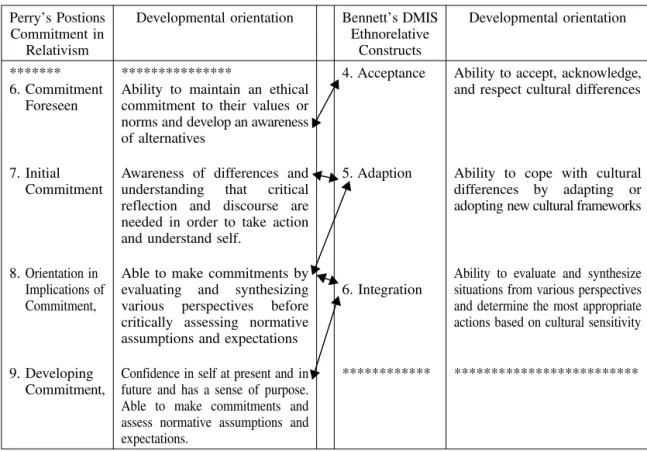
It could be assumed that students, who are still in Perry’s (1999) first five Positions, have yet to acquire the competency to be critically reflective of their own assumptions and are still in Bennett’s (2004) ethnocentric stages. This could imply that students might not gain meaningful interpretations of experiences, like studying abroad, and would be ill-prepared for business contexts until they have reached Perry’s Position 6 and Bennett’s stage of ethnorelativism. Development in both Perry’s final Positions of Commitment in
Table 1. Development in Perry’s Commitment Positions and Bennett’s Ethnorelative Stages
Perry’s Postions Commitment in
Relativism
Developmental orientation Bennett’s DMIS Ethnorelative Constructs Developmental orientation ******* 6. Commitment Foreseen ***************
Ability to maintain an ethical commitment to their values or norms and develop an awareness of alternatives
4. Acceptance Ability to accept, acknowledge, and respect cultural differences
7. Initial Commitment
Awareness of differences and understanding that critical reflection and discourse are needed in order to take action and understand self.
5. Adaption Ability to cope with cultural differences by adapting or adopting new cultural frameworks
8. Orientation in Implications of Commitment,
Able to make commitments by evaluating and synthesizing various perspectives before critically assessing normative assumptions and expectations
6. Integration
Ability to evaluate and synthesize situations from various perspectives and determine the most appropriate actions based on cultural sensitivity
9. Developing Commitment,
Confidence in self at present and in future and has a sense of purpose. Able to make commitments and assess normative assumptions and expectations.
************ *************************
Relativism and Bennett’s DMIS Ethnorelative Constructs could be linked (see Table 1).
In Perry’s Position 6, students are able to alter their assumptions or frameworks, through effective discourse and critical reflection. Likewise, in Bennett’s stages of ethnorelativism, students have developed the ability to accept, acknowledge, and respect cultural differences. Bennett warned, however, that if students have not developed effective discourse and critical reflection skills, then they will not be able to maintain an ethical commitment to their values or norms and, at the same time, an awareness of alternatives. Without an awareness of alternatives, students might retreat and develop a feeling of superiority or inferiority toward people who come from diverse cultural backgrounds. This means that students need to develop empathy to engage proactively in intercultural exchanges. However, development of empathy in relation to intercultural contexts may take “some time (perhaps years)”, according to Bennett (2004), and empathy is necessary for “shifting” or creating common meaning when communicating with people who have different cultural frames of reference
(p. 52). This implies that students who do not face dilemmas that require reflective insights and new learning experiences in their college years might have narrow frames of reference before entering business situations. This could cause students to be ill-equipped for the demands of globalizing societies, which require effective communication and action in multicultural situations.
In micro or macro business contexts, people need the capability to assess why other people from different cultural backgrounds behave in dissimilar ways to the same or similar experiences by developing understandings in communicative learning, instrumental learning, and emancipatory learning. This means that it is important for students to develop understandings in communicative learning, instrumental learning, and emancipatory learning, which are vital to the transformation process, according to Mezirow and Associates (2000). Communicative learning is defined as learning how to listen actively to others and respond in a clear, objective manner by employing learning strategies and approaches to support opinions. Communicative competence requires instrumental learning, or knowledge and skills. In order for students to apply their communicative competence and instrumental competence, they need emancipatory learning, which refers to being able to “enhance (their) impression on others” (Mezirow & Associates, 2000, p. 10).
Discourse amongst students could facilitate understandings of common concepts when students have contradictory viewpoints if reasons, evidence, and various perspectives are given (Mezirow & Associates, 2000, p. 11). In addition, as students develop communicative competence, instrumental competence, and emancipatory competence, their ability to become critically reflective of their own assumptions and other people’s assumptions could facilitate shared meanings of “words, concepts, or emotions”, which are necessary for effective communication (Mezirow & Associates, 2000; Trompenaars & Hampden-Turner, 2012, p. 93).
Bennett (2004) posited that intercultural communication was not simply knowledge about or the ability to use a foreign verbal and nonverbal language but also the capability to “shift” or have empathy to consciously adapt “one’s cultural frame of reference” (p. 52). Thus, intercultural communication involves a transformation in a person’s frame of reference, which means awareness and critical reflection of assumptions and beliefs, to develop cultural empathy in order to communicate critically and develop reflective insights (Mezirow & Associates, 2000). This implies that students who experience successful integration of intellectual, ethical, and intercultural-sensitivity development could handle cultural differences in an effective and sustainable way upon entering business situations after graduation.
4. Pilot Study
4.1 Purpose of pilot study
Developing life-long learning capabilities, which include intercultural sensitivity, is a process, which according to Perry (1999), could be achieved by some students during their college years, if those students have meaningful learning environments. As an educator, I want to explore ways to help language learners develop intercultural sensitivity and intercultural communication skills simultaneously through meaningful learning environments. For language learners, development of both prosody features and nonverbal communicators are necessary to ensure the intent of their speech in a foreign language is clear. Thus, in order to provide a meaningful learning environment, in a pilot study, I explore how the intervention activities of (1) awareness of English prosodic features and (2) a nonverbal cue, gestures, would affect the perception and outcomes of the participants’ speeches in English. The following research questions guided my study:
1. William C. Perry (1999) posited that college students developed through a process of assimilating or accommodating novel information into past knowledge. Thus, would the order of developing a shared knowledge of prosody features before novel nonverbal cues aid or deter from the participants’ progress in making effective speeches?
2. Would the participants perceive the intervention activities of awareness of English prosodic features (stress and intonation) and a nonverbal cue (gestures) as valuable for making effective speeches now and in the future?
4.2 Background of Prosody Features
Educators at institutes of higher education could help language learners develop intercultural sensitivity and intercultural communication skills simultaneously through meaningful learning environments. For intercultural communication skills, the prosody features of intonation and stress are important, because they indicate whether a speaker’s message is declarative, emphatic, or questioning. A flat intonation or misplaced stress could cause miscommunications or lack of intelligibility (Hahn, 2004; Scollon & Scollon, 2001). According to Yonesaka and Tanaka (2014), unlike some Asian languages that use pitch to change the meaning of a word, English uses pitch throughout the sentence, which is called intonation, to convey the speaker’s intention, and intonation is linked to stress (p. 62). Sentence stress is important because the content words, which are stressed in sentences, signal new or contrastive information (Hahn, 2004). Thus, it could be inferred that a speaker’s intention or real meaning would be unclear or misunderstood if he used a flat intonation or stressed function words when saying a sentence or sentences in English (Yonesaka & Tanaka, 2014).
4.3 Background of Gestures
In discourse acts that involve people of different cultural backgrounds, it is, according to Martin and Chaney (2006), helpful to use nonverbal communicators, like gestures to facilitate understandings of a message. Several studies have shown that native speakers of English align gestures with intonation (e.g, Esteve-Gibert, Priet, Kreiman, & Baum, 2013; Loehr, 2012; Shattuck-Hufnagel, Yasinnik, Veilleux, & Renwick, 2007). In addition, hand gestures and words are linked in speech acts, and speakers of most languages gesture spontaneously (Cassell, Pelachaud, Badler, Steedman, Achor, Becket, et al., 1994). However, Martin and Chaney warned that gestures can have different meanings in different cultures, and if a speaker’s gestures do not correspond to their spoken message, the audience will focus on the gestures and not the message (Morgan, 2008). Thus, not only knowledge of when and how to use gestures effectively but also that of their meanings across cultures is important to ensure the intent of the speech is clear.
5. Method
5.1 Sample Population
The participants in this pilot study consisted of 9 female university students, who were 18 or 19 years old. All of them were in their first year of university and volunteered to participate in this study. The sample was a small, gender and culture-sharing group, which allowed me to manage multiple data sources. All of the participants signed a consent form before the start of the study and produced identity codes of made-up initials, which were used to ensure that their identities would be kept confidential. One of the participants was excluded from the study results because she was unable to make her final speeches due to a cold, which caused her to lose her voice.
5.2 Sampling Procedures
There were two groups: one group, which was labeled P, received intervention activities on prosodic features (stress and intonation) and the other group, which was labeled G, received intervention activities on a nonverbal cue (gestures) for the first four sessions. After four sessions, the groups switched intervention activities. Both groups of participants participated in a total of eight sessions, lasting one hour each, during the summer break in 2013. In order to collect data on the differences between the two groups, a pre-/post set speech was employed and rated by outside raters after four sessions. However, the rest of the data collected was based on the eight sessions.
The participants in the P group received intervention activities on the prosodic features of stress and intonation by listening to model speeches from the first section of a TED 2004 lecture (Virgina Postrel: On glamour) and a CD-ROM on Presentation Skills (Harvard
Business School Publishing, 2009), which was purchased for use in this study. Those audio materials were used to help the participants identify which words were stressed and why, in addition to whether the speakers’ pitch rose, fell, or stayed high at the end of each sentence in the speeches. The participants in the G group, on the other hand, received intervention activities on how nonverbal cues are not only related to speech acts but also to facilitating understandings. The differences in gestures across cultures were discussed and photos from the Internet of the International Olympic Committee (IOC) speeches (Google images of IOC Olympic 2020, retrieved 2013, September), including Prime Minister Abe’s gestures and other business leaders were viewed and reflected on. The same TED 2004 lecture (Virginal Postrel: On glamour) and the CD-ROM on Presentation Skills (Harvard Business School Publishing, 2009) were used for materials to show effective use and timing of gestures.
Both groups had three interview sessions. While the interview questions were determined before each interview, extra questions or slight changes in a couple of them during the interviews were added to elicit information that had not been anticipated, which was suggested by Patton (2002). In addition, the participants in both groups prepared 5 to 7 minute speeches, which were used for discussions on logical order of speeches and practice sessions.
5.3 Instruments
The instruments consisted of pre-/post-questionnaires (see Appendix A) and pre-/post set one-minute speech retrieved from TED X East (Nancy Duarte: The secret structure of great talks, 2011, Nov.; see Appendix B) recordings, in-depth group interviews, written samples of speeches, video recordings, and recordings of pre-/post-impromptu speeches, and prepared speeches. All speeches and interviews were filmed using a tripod-mounted JVC Kenwood digital video camera and recorded with an Olympus V-801 IC recorder to ensure the images and recordings were of high-quality.
Prior to the start of the study, a pre-questionnaire was administered to obtain information on the participants’ English background and knowledge of cultural differences in speech patterns. The questions included the following: (a) what their native language is, (b) experiences (or lack of experiences) living abroad (c) whether or not they had friends from other countries, and (d) learning experiences of making speeches.
The post-questionnaire was administered at the end of the study to gather data on the participants’ reflections. The participants were told to indicate their reply to each question by marking a point on the rating scale for the Likert-type questions and answering the open-ended questions as best as they could.
6. Results
6.1 Raters
Two native-English-speaking university instructors (one female from Canada and one male from America) and two near-native, Japanese, English-speaking instructors (both female) rated the pre-/post set speeches for prosody markers of word stress and sentence-ending intonation, using audio alone. They were paid 5,000 yen each for their services. The raters were blind to the differences in the two groups of participants.
6.2 Rating Procedures
The raters were asked to listen to each participant’s pre and post set one-minute speeches and identify which words the participant stressed or identify whether the participant’s pitch rose, fell, or stayed high at the end of each sentence for sentence-ending intonation. Each correct response was termed a hit. The following procedure was used for scoring the number of stress hits and sentence-ending intonation hits:
1. One point was given for each word a participant stressed accurately. There were 30 possible stress hits based on a scoring rubric designed after which words Nancy Duarte, the original speaker of the one-minute speech, which was retrieved from TED X East (Nancy Duarte: The secret structure of great talks, 2011), stressed.
2. One point was given for each sentence-ending intonation, which was correctly uttered, using a rising, falling, or staying high pattern. There were 14 possible sentence-ending intonation hits based on a scoring rubric designed after Nancy Duarte’s, the original speaker of the one-minute speech, which was retrieved from TED X East (Nancy Duarte: The secret structure of great talks, 2011), sentence-ending intonation.
3. One Japanese rater and one Canadian rater used a red pen to mark each participant’s sentence-ending intonation with an arrow that slanted up for rising intonation, slanted down for falling intonation, or across for staying-high intonation. Another Japanese rater and an American rater used a highlight pen to mark the words that each participant stressed. The order of the participants was shuffled to prevent any possibility of biased rating. The inter-rater agreement for the number of stress hits was .79 and for sentence-ending intonation hits was .77.
6.3 Results from Prosody Marker Rating
Table 2 shows the results averaged across the two raters for the two factors, word stress hits and final intonation hits. The P group showed slight improvement in sentence-ending intonation hits but no improvement in word stress hits. In contrast, the G group demonstrated improvement in both factors. Although the data are limited, it can be concluded that the G group showed more improvement in both word stress hits and
Table 2. Group
word stress sentence final intonation pre post progress
(pre-post) pre post
progress (pre-post)
P (n=4) .80 .74 -.06 .30 .37 .07
G (n=4) .81 .83 .03 .26 .42 .16
Prosody Assessment of the Participants’ Word Stress and Sentence Intonation
Note. The number of hits was counted for each factor in each group’s pre- and post-recordings and was averaged across the participants and the two raters. The highest scores in the progress row are in boldface.
Table 3. Post-questionnaire: Likert-type questions [0 (not at all) − 100 (very much)]
Question P
(n=4)
G (n=4) Overall improvement in speech skills 100 99
Improved intonation 78 80
Understanding of intonation and speech intent 90 94
Stress key words or phrases 91 94
Use nonverbal communication 95 95
Awareness of effective use of gestures 84 96
Peers’ feedback 73 78
Importance for future 100 83
Enjoyment of sessions 98 95
sentence-final intonation hits.
6.4 Results from Post-questionnaire
A post-questionnaire was given to the participants at the end of the study to gather data on the participants’ reflections. The questionnaire consisted of two sections: Likert-type questions and open-ended questions. The Likert-type questions included inquiries on the participants’ perceptions of their overall improvement in speech production skills, intonation, stress, usage of nonverbal communication, and level of enjoyment of the sessions. The open-end questions included reflections on speech styles and nonverbal communication. The questions are in Appendix A.
Almost all participants reported that they felt that they had improved and had gained an awareness of the usage of intonation and stress, but a slight difference in the participants’ understanding of intonation and speech intent was observed between the groups. The G group which first received intervention activities on how nonverbal cues are not only related to speech acts but also to facilitating understandings, reported more confidence in their ability to use gestures at an average of 96% and to use stress and intonation effectively (94%). However, the P group which received intervention activities on prosody features of stress and intonation first felt that learning how to make a speech was important for their futures (100%) compared to the G group (83%). Almost all participants reported that they enjoyed the sessions (96.5%).
The open-ended questions provided valuable insights into the participants’ depth of understandings of verbal communication usage and cultural differences related to speech styles. The following are two examples of what participants wrote:
1. Speakers use nonverbal communication to emphasize the important words. When they use it effectively, they can make audiences pay attention to what they want to (say) the most (MF, 2013, Sept).
2. When a speaker gesture(s), some people regard the gesture as good and other people regard it as bad according to their culture. Views differ between cultures. The ways of making speeches are different from culture to culture (GB, 2013, Sept).
7. Discussion
7.1 Discussion
In addressing the first research question of whether the order of shared knowledge of prosody features before novel nonverbal cues aid or deter from the participants’ progress in making effective speeches, the outcomes were unexpected. I had expected the P group, which received intervention activities on prosodic features of stress and intonation to make more progress than the G group because the intervention activities, which included collaborate practice on identifying which words were stressed and why, in addition to whether the speakers’ pitch rose, fell, or stayed high at the end of each sentence in the model speeches, were explicit. However, it should be noted that out of the four participants, only one participant was rated as not making progress and the other three demonstrated slight progress. It is also possible that the number of sessions was not enough for the participants to internalize the information and produce it.
In contrast, the data from the group interviews, which were analyzed qualitatively according to themes, indicate that the G group was motivated by the novel information about gestures and could relate to it because the images of the International Olympic Committee (IOC) speeches (Google images of IOC Olympic 2020, retrieved 2013,
September), included known leaders, such as Prime Minister Abe. This could suggest that the participants were motivated by real-life examples. However, since the raters did not see the participants in the gesture group gesture during their post speech and only listened to audio recordings, there seems to be more to the effect of gestures on perception and outcomes of the participants’ speeches. One possible explanation for the outcomes could be found in the research. According to Kelly, Manning, and Rodak (2008), there are four main co-speech gestures. While iconic gesture, deictic or pointing gesture, metaphoric, and beat gesture are used to accompany speech and clarify the meaning, only the beat gestures “keep the rhythm of speech” (p. 2). Since the photos of world leaders and business leaders, the speaker in the TED lecture, and the speakers in the CD-ROM on Presentation Skills (Harvard Business School Publishing, 2009) used beat gestures in their speeches, the participants in the G group also used them when making their post speech. Thus, it could be inferred that the use of beat gestures aided the participants’ outcomes of intonation patterns and affected the perception and outcomes of the participants’ speeches.
In addressing the second question of whether the participants perceived the intervention activities as valuable for making effective speeches now and in the future, the results from the post-questionnaire show that all of the participants in the P group (100%) and most of the participants in the G group (83%) did. The participants’ comments on the post-questionnaire and during the interview sessions also indicated that they viewed them as valuable. In view of their thoughts about developing life-long capabilities for future business contexts, all of them claimed that making effective speeches was important for them now and in the future in the group interviews. However, three of them claimed that they did not know what they wanted to do in the future, so they did not know if they would be using the knowledge and skills gained from the intervention activities. According to Perry (1999), some students, like those in this study, who are still in the beginning stages of development, might not gain meaningful interpretations of experiences. This implies that a meaningful learning environment needs to include varying amounts of support for students to encourage them to take risks and gain experiences in their learning community before entering society.
8. Conclusion
8.1 Conclusion
The results provide some insights into how educators at universities can cultivate students’ intercultural sensitivity and communication skills so that they can express their ideas and opinions and participate actively in exchanges with people from diverse cultural backgrounds effectively and appropriately. Based on theoretical perspectives, university students’ development of intercultural sensitivity is connected to their intellectual and ethical development, and the results from the pilot study suggest that facilitating the participants’
discovery of not just how to express their messages effectively but also how their nonverbal cues could add or take away from those messages was effective. This could imply that educators at institutes of higher education could help students develop intercultural communication skills and intercultural sensitivity by providing meaningful learning environments, which encourage students to discover cultural differences, critically reflect on those differences, and use interpersonal skills to express those differences. Meaningful classroom experiences could include learning how to make business presentations that are effective and appropriate for local and global business situations.
8.2 Limitations
The data were analyzed to infer multiple perspectives, but the sample size was too small to allow analysis by statistical methods. In addition, the participants were a gender and culture-sharing group, so future studies should include males and participants from other cultures. Finally, the number of sessions might not have been enough to discover the students’ real progress. A longitudinal study of university students’ development over their years at university and in local or global business environments after graduation might provide invaluable insights on how educators at institutions of higher education could facilitate students’ development of life-long learning capabilities, which include intercultural sensitivity, to succeed in local and global organizations and meet societal demands.
References
Amiri, A. N., S. M. Moghimi, and M. Kazemi. 2010. “Studying the relationship between cultural intelligence and employees’ performance,” European Journal of Scientific Research 42 (3): 418-427. Azevedo, A., G. Apfelthaler, and D. Hurst. 2012. “Competency development in business graduates: An
industry-driven approach for examining the alignment of undergraduate business education with industry requirements,” The International Journal of Management Education, 10: 12-28. doi: 10.1016/j. ijme.2012.02.002
Bennett, M. J. 1986. “Towards ethnorelativism: A developmental model of intercultural sensitivity,” In Cross-cultural orientation: New conceptualizations and application. Edited by R. M. Paige. Lanham, MD: University Press of America: 27-69.
Bennett, M. J. 2004. “Becoming interculturally competent”, In Towards multiculturalism: A reader in multicultural education, 2nd
ed. Edited by J. Wurzel. Newton, MA: Intercultural Resource Corporation: 62-77.
Brown, L. 2009. “International students in England: Finding belonging through Islam,” Journal of Muslim Minority Affairs, 29 (1): 57-65. doi: 10.1080/13602000902726772
Cassell, J., C. Pelachaud, N. Badler, M. Steedman, B. Achorn, T. Becket, B. Douville, S. Prevost, and M. Stone. 1994. “Animated conversation: Rule-based generation of facial expression, gesture & spoken intonation for multiple conversational agents,” In Proceedings of SIGGRAPH ’94. Retrieved from: ScholarlyCommons, http://repository.upenn.edu/cis reports/340
Cleary, R. J., and E. A. Raimon. 2009. “Whose “greater expectations” are they, anyway? Exposing the tensions within the rhetoric of educational reform,” Teaching in Higher Education, 95 (1). Retrieved from; http://www.aacu.org/liberaleducation
Duarte, N. 2011. “The secret structure of great talks,” TED x East. Lecture. Retrieved from: http://www. ted.com/talks/nancy_duarte_the_secret_structure_of_great_talks.html
Esteve-Gibert, N., P. Priet, J. Kreiman, and S. Baum. 2013. “Prosodic structure shapes the temporal realization of intonation and manual gesture movements,” Journal of Speech, Language and Hearing Research, 56 (3): 850-864. doi: 10.1044/1092-4388
Fatima Oliveira, M. 2013. “Multicultural environments and their challenges to crisis communication,” Journal of Business Communication, 50 (3): 253-277. doi: 10.1177/0021943613487070
Hahn, L. D. 2004. “Primary stress and intelligibility: Research to motivate the teaching of suprasegmentals,” TESOL QUARTERLY, 38 (2): 201-222.
Hashimoto, K. 2013. “‘English-only’, but not a medium-of-instruction policy: the Japanese way of internationalising education for both domestic and overseas students,” Current Issues in Language Planning, 14 (1): 16-33. doi: 10.1080/14664208.2013.789956
Japan Business Federation [Keidanren]. 2013. “Fostering people who can excel in global arena − A follow-up proposal for the development of global talents,” Retrieved from: www.keidanren.or.jp/en/policy/2013 /059.html
Kelly, S. D., S. M. Manning, and S. Rodak. 2008. “Gesture gives a hand to language and learning: Perspectives from cognitive neuroscience, developmental psychology and education,” Language and Linguistics Compass, 2: 569-588. doi: 10.1111/j.1749-818X.2008.00067.x
Kennedy, R. 2009. “The power of in-class debates,” Active Learning in Higher Education, 10 (3): 225-236. doi: 10.1177/1469787409343186
Li, M., W. H. Mobley, and A. Kelly. 2013. “When do global leaders learn best to develop cultural intelligence? An investigation of the moderating role of experiential learning style,” Academy of Management Learning & Education, 12 (1): 32-50. doi: 10.5465/amle.2011.0014
Loehr, D. P. 2012. “Temporal, structural, and pragmatic synchrony between intonation and gesture,” LaHitboratory Phonlogy, 3 (1): 71-89. doi: 10.1515/lp-2012-0006
Martin, J. S., and L. H. Chaney. 2006. Global Business Etiquette. Westport: Praeger.
Martínez, R. M., and A. C. Gutiérrez. 2013. “Developing communicative competence in English as a second language by integrating business competencies,” Business Education & Accreditation, 5 (2): 65-77.
Ministry of Education, Culture, Sports, Science and Technology. 2011. “White paper on education, culture, sports, science and technology: Chapter 8: Expanding international cultural exchange and cooperation,” Retrieved from: www. mext.go.jp
Morgan, N. 2008. “How to become an authentic speaker,” Harvard Business Review, 86 (11): 115-119. Moriizumi, S., and J. Takai. 2010. “The relationships between Japanese interpersonal conflict styles and
their language expressions,” Journal of Social Psychology, 150 (5): 520-539. doi: 10.1080/ 00224540903365349
Morita, L. 2012. “English and intercultural interaction in the internationalization of a Japanese university,” Journal Of Intercultural Communication, 305.
Naiditch, F. 2011. “Friends or foes? Communicating feelings through language in cross-cultural interactions,” International Journal of the Sociology of Language, 208: 71-94. doi: 10.1515/IJSL. 2011.013
Nakamura, S. 2011. “Characteristics of contrast between the stressed and the unstressed in rhythm units observed in duration structure in English speech by Japanese learners,” Journal of Pan-Pacific Association of Applied Linguistics, 15 (1): 177-189.
Park, Y. S., and B. K. Kim. 2008. “Asian and European American cultural values and communication styles among Asian American and European American college students,” Cultural Diversity and Ethnic Minority Psychology, 14 (1): 47-56.
Patton, M. Q. 2002. Qualitative research and evaluation methods (3rd Ed.). Thousand Oaks, CA: Sage
Publications, Inc.
Perry, W. G. 1999. Forms of Intellectual and Ethical Development in the College Years: A Scheme. San Francisco: Jossey-Bass
Postrel, V. 2004. “On glamour,” TED 2004. Lecture. Retrieved from: www.ted.com/talks/virginia_postrel_ on_glamour.html
“Presentation Skills”. 2009. Harvard ManageMentor. CD-ROM. Harvard Business Publishing Corporation. Ramburuth, P., and M. Tani. 2009. “The impact of culture on learning: Exploring student perceptions,”
Multicultural Education & Technology Journal, 3 (3): 182-195. doi: 10.1108/17504970910984862 Robles, M. M. 2012. “Executive perceptions of the top 10 soft skills needed in today’s workplace,”
Business Communication Quarterly, 75 (4): 453-465. doi: 10.1177/1080569912460400
Rose-Redwood, C., R. 2010. “The challenge of fostering cross-culture interactions: A case study of international graduate students’ perceptions of diversity initiatives,” College Student Journal, 44 (2), 389-399. doi: 10.1037/1099-9809.14.1.47
Ryan, J. and R. Viete. 2009. “Respectful interactions: learning with international students in the English-speaking academy,” Teaching In Higher Education, 14 (3): 303-314. doi: 10.1080/13562510902898866 Sato, T., and S. R. Hodge. 2009. “Asian international doctoral students’ experiences at two American
universities: Assimilation, accommodation, and resistance,” Journal Of Diversity In Higher Education, 2 (3): 136-148. doi: 10.1037/a0015912
Scollon, R. and S. W. Scollon. 2001. Intercultural Communication (2nd
edition). Oxford: Blackwell Publishers Inc.
Shattuck-Hufnagel, S., Y. Yasinnik, N. Veilleux, and M. Renwick. 2007. “A method for studying the time alignment of gestures and prosody in American English: ‘Hits’ and pitch accents in academic-lecture-style speech,” Fundamentals Of Verbal & Nonverbal Communication & The Biometric Issue, 18 (1): 34 -44.
Sherry, M., P. Thomas, and W. Chui. 2010. “International students: A vulnerable student population,” Higher Education: The International Journal of Higher Education And Educational Planning, 60 (1): 33-46. doi: 10.1007/s10734-009-9284-z
Su, Y. 2011. “The effects of the cultural portfolio project on cultural and EFL learning in Taiwan’s EFL college classes,” Language Teaching Research, 15 (2): 230-252. doi: 10.1177/1362168810388721 Taylor, M., and D. Rivera. 2011. “Understanding student interest and barriers to study abroad: An
exploratory study,” Consortium Journal of Hospitality & Tourism, 15 (2): 56-72.
Trompennars, F., and C. Hampden-Turner. 2012. Riding the Waves of Culture: Understanding Diversity in Global Business, New York: McGraw-Hill.
Tsuruta, Y. 2013. “The knowledge society and the internationalization of Japanese higher education,” Asia Pacific Journal of Education, 33 (2):140-155. doi: 10.1080/02188791.2013.78067
Tuleja, E. A., and A. M. Greenhalgh. 2008. “Communicating across the curriculum in an undergraduate business program: Management 100 − Leadership and communication in groups,” Business Communication Quarterly, 71 (1): 27-43. doi: 10.1177/1080569907312934
Yonesaka, S. M., and H. Tanaka. 2014. Discovering English Sounds: Phonetics Made Easy, Tokyo: Cengage Learning K.K.
Yoshida, T., K. Yashiro, and Y. Suzuki. 2013. “Intercultural communication skills: What Japanese businesses today need,” International Journal of Intercultural Relations, 37: 72-85. http://dx.doi.org/ 10.1016/j.ijintrel.2012.04.013
Appendix A
Post-questionnaire
Code initials: Date: Group:
Section A
Instructions: Please write your responses to the following questions.
1. Write three differences in speech styles between native English-speaking people and Japanese.
1. 2. 3.
2. Why do you think it is important to understand cultural differences related to speech styles?
3. How, when, and why is nonverbal communication (i.e., gestures, eye contact, and posture) used in speeches?
Section B
Instructions: Please reply to each question by marking a point on the rating scale
1. Overall, do you think the sessions helped you improve your ability to make a speech in English?
not at all somewhat very much ... ...
2. Do you think the sessions helped you improve your intonation? not at all somewhat very much
... ...
3. Did you gain an understanding of how your intonation could change the meaning? not at all somewhat very much
... ...
4. Do you think the sessions helped you improve your ability to stress key words or phrases?
not at all somewhat very much ... ...
5. Do you think the sessions helped you improve your ability to use nonverbal communication (gestures, eye contact, posture)?
not at all somewhat very much ... ...
6. Do you think the sessions helped you become aware of when to use gestures effectively? not at all somewhat very much
... ...
7. Did your peers’ feedback help you improve your ability to make an effective speech? not at all somewhat very much
... ... 8. Did you enjoying doing the sessions?
not at all somewhat very much ... ...
9. Would you like to do something like this again?
Yes ... O.K ... No
(Yes, I would love to!) (Either way is O.K.) (No, I would not like to do it again!) 10. What aspect of the sessions had the greatest influence on you?
Appendix B
Pre-/Post-One-minute set speech Nancy Duarte: The secret structure of great talks
FILMED NOV 2011 − POSTED FEB 2012 −TEDxEast
Retrieved from:
http://www.ted.com/talks/nancy_duarte_the_secret_structure_of_great_talks.html
You have the power to change the world. I’m not saying that to be cliché. You really have the power to change the world. Deep inside of you, every single one of you has the most powerful device known to man, and that’s an idea. So, a single idea from the human mind could start a groundswell; it could be a flashpoint for a movement, and it can actually rewrite our future, but an idea is powerless if it stays inside of you. If you never put that idea out for others to contend with, it will die with you. Now maybe some of you guys have tried to convey your idea, and it wasn’t adopted; it was rejected, and some other mediocre or average idea was,when the only difference between those two is in the way it was communicated.

![Table 3. Post-questionnaire: Likert-type questions [0 (not at all) − 100 (very much)]](https://thumb-ap.123doks.com/thumbv2/123deta/8171424.1273659/14.800.115.706.712.978/table-post-questionnaire-likert-type-questions.webp)
