ATEM’19, JSME-MMD, October 7-11, 2019, Niigata, Japan
High stability of Existence of Ultra-Fine Bubble in a Range of Relatively
High Temperature
Takaki Kobayashi
1*, Akiomi Ushida
2, Itaru Kourakata
2, Kouichi Seto
3, Tadashi Hiwatashi
4, Taisuke Sato
5,
and Takatsune Narumi
21 Graduate School of Science and Technology, Niigata University, 8050-2 Ikarashi, Nishi-ku, Niigata-shi, Japan 2 Institute of Science and Technology (Faculty of Engineering), Niigata University, 8050-2 Ikarashi, Nishi-ku, Niigata-shi, Japan
3 Iwase Limited, 1965-2, Yoshida Hokkedou, Tsubame-shi, Japan 4 Futech-Niigata Limited, 16-6, Ikarashi Nishi, Nishi-ku, Niigata-shi, Japan
5 Center for Transdisciplinary Research, Institute for Research Promotion, Niigata University, 8050-2 Ikarashi, Nishi-ku, Niigata-shi, Japan
*E-mail: [email protected]
Introduction. Washing effect by fine-bubble (FB) is widely paid attention as an environmental load-reducing technology. The FB is defined as tiny bubble with less than 100 μm in diameter. Also, FBs are used as a generic term for microbubble (MB) and ultra-fine bubble (UFB). The characteristic properties were reported; high-existence, large specific area, and charge negatively(1). Furthermore, highly stability of UFBs
was reported(2). However, many studies were
conducted under temperature-controlled conditions (T = 10~30 °C), and a study under practical temperature conditions (T = 10~100 °C) was rare case. On the other hand, UFB could not be existed after boiling over 100 °C. In this situation, we measured the particle diameter of the UFB mixtures under relatively high-temperature conditions (T = 25~50 °C). Moreover, we discussed the stability under practical conditions and advantages.
Test Fluids. In this study, deionized water (DW; electric conductivity = 0.055 μS/cm, ADVANTEC Co Ltd) and a mixed UFB water via a commercial generator (Microattak-V, Iwase Limited). Also, we used a generator via pressurized dissolution method. Experiments. The particle diameter was measured by particle-counter-system (SALD-7500x10, Shimadzu Ltd). The particle diameter and number density could be observed instantly by using the diffraction and scattering of laser light. After a 5.0 mL of a mixed UFB water after temperature-controlled in hot water was poured into a glass cell, it was placed and measured automatically.
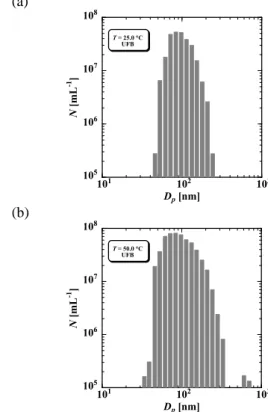
Experimental Results. The experimental results at T = 25 °C and T = 50 °C are shown in Fig. 1. The vertical axis is number density N and the horizontal axis is the particle diameter Dp. Firstly, the highest number
density is N = 5.3 × 10⁷ mL-1 at 25 °C and N = 8.1 ×
107 mL-1 at 50℃, respectively. Also, peak diameter
Dpeak (= 80 nm) is independence of the temperature.
Secondly, distribution of particle diameter was focused. Because we set on threshold as N > 107 mL-1, the
distribution at T = 25 °C was from 50 nm to 200 nm and 50 nm to 240 nm at T = 50℃. The difference between two conditions was not appeared. Therefore, it was confirmed that high stability of UFB in a range of relatively high temperature.
Discussions. In this study, the possibility of the highly stable existence of UFB in relatively high temperature environment was suggested. Thus, the UFB existed stably under relatively warm conditions, which MB and tiny bubble disappeared. We discussed a useful finding in terms of application.
Concluding Remarks. We investigated the particle diameter of a mixed ultra-fine bubble water in a range of relatively high temperature. Even though UFB mixture set at 50 °C, UFB in water was highly stable. Acknowledgment. We thank to Mr. Ryuichi Kayaba in carrying out many experiments.
(1) Takahashi, M., Chiba, K., and Li, P, The Journal of Physical Chemistry B, 111, (2007), 1343-1347. (2) Aktas, Z., Cilliers, J. J., and Banford, A. W.,
International Journal of Mineral Processing, 87, (2008), 65-71.
(a)
(b)
Fig. 1 Experimental results for plotting number density N against particle diameter Dp at (a) 25 °C