【原著・臨床】
ムコイド型,非ムコイド型肺炎球菌性市中肺炎の比較
川崎 聡1)・青木 信樹1)・田端 篤2)・本間 康夫2)
1)社会福祉法人 新潟市社会事業協会信楽園病院呼吸器内科*
2)同 臨床検査科
(平成27年8月27日受付・平成27年10月29日受理)
肺炎球菌は,コロニー形態の違いにより,ムコイド型と非ムコイド型に分類することができるが,そ の臨床的意義についての検討はほとんどなされていない。そこで今回われわれは,2013年5月〜2014 年11月までに当院で入院診療した成人肺炎球菌性市中肺炎をムコイド型と非ムコイド型に分類し,患者 背景,臨床経過,薬剤感受性,莢膜血清型を比較検討した。
17例中6例がムコイド型,11例が非ムコイド型に分類された。ムコイド群の莢膜血清型は全例3型で,
ペニシリン感受性であった。患者背景および使用抗菌薬は両群に差異を認めなかった。入院時検査では,
ムコイド群でCRP値が有意に高く(ムコイド群28.4±12.4 mg!dL vs非ムコイド群13.7±7.0 mg!dL,
p=0.006),胸部単純X線の浸潤影も広範囲に広がっていた。死亡例は両群とも認められなかったが,ム
コイド群で初期治療失敗例が有意に多く(p=0.041),治療期間も長期間に及んだ(ムコイド群16.7±9.8 日vs非ムコイド群8.1±2.0日,p=0.012)。
以上の所見より,成人市中肺炎において,肺炎球菌がムコイド型であることは,非ムコイド型と比較 して,重症化の一因になりうることが強く示唆された。好中球による貪食殺菌作用の阻害因子となる莢 膜ポリサッカライド産生量の多い株がムコイド形態をとることから,整合性のとれた結果と思われた。
Key words:Streptococcus pneumoniae,mucoid strain,community-acquired pneumonia,capsular serotype,drug susceptibility
肺炎球菌は,成人市中肺炎1)や医療・介護関連肺炎2)の原因 微生物として最も頻度が高く重要であるが,これらの診療を 行ううえで,いくつかの分類が活用されている。その一つがペ ニシリンGに対する薬剤感受性によるペニシリン感受性肺 炎球菌(penicillin sensitiveStreptococcus pneumoniae;PSSP)
とペニシリン耐性肺炎球菌(penicillin resistantStreptococcus pneumoniae;PRSP)への分類であるが,抗菌薬選択の根拠と して広く活用されている。また,細胞壁の外側にある莢膜抗原 の血清型分類も,昨今肺炎球菌ワクチンの普及もあり,その流 行疫学情報に関する重要性が広く認識されつつある3)。
一方肺炎球菌には,これらとは別にコロニー形態の違いに よる,ムコイド型と非ムコイド型への分類も古くから知られ ている4〜6)。本邦では,耳鼻咽喉科領域で少数報告されている が7,8),成人肺炎に対する臨床的意義についての検討は,内外を 問わず皆無である。
そこで今回われわれは,自施設にて入院診療を行った成人 肺炎球菌性市中肺炎を対象とし,ムコイド型が分離された症 例と非ムコイド型が分離された症例で,患者背景,臨床経過,
薬剤感受性,莢膜血清型を比較検討した。
I. 材 料 と 方 法 1.対象
2013年5月〜2014年11月に当院で入院診療した成人 市中肺炎のうち,治療開始前の喀痰から肺炎球菌が分離 された全例を対象とした。病院外で日常生活をおくり,
咳嗽,喀痰,発熱等の臨床症状を呈し,胸部単純X線ま たは胸部CT検査で,急性に新たに出現したと考えられ る浸潤影が認められたものを市中肺炎症例とした。医 療・介護関連肺炎9)に該当する症例は除外した。
2.ムコイド型と非ムコイド型の判定10)
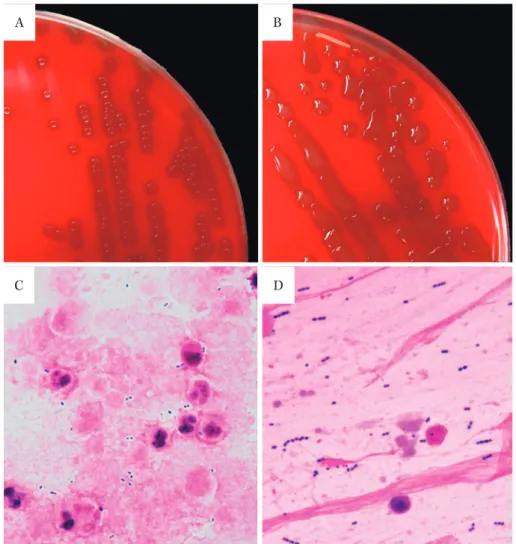
血液寒天培地上,中心窩を伴う円形のコロニーを形成 し(Fig. 1A),グラム染色で莢膜に相当する部分が白く抜 ける株を非ムコイド型(Fig. 1C),中心窩を欠き,粘性の 大きなコロニーを形成し(Fig. 1B),莢膜部分が赤く染色 される株をムコイド型と定義し(Fig. 1D),2名の微生物 検査技師が判定した。
3.臨床所見の比較
年齢,性別,基礎疾患などの患者背景,入院時所見,
治療経過などをレトロスペクティブに比較した。胸部 単純X線における浸潤影の広がりについては,日本化学
*新潟県新潟市西区新通南3―3―11
Fig. 1. Distinction between non-mucoid type S. pneumoniae and mucoid type S. pneumoniae.
A) colony of non-mucoid type, B) colony of mucoid type, C) gram stain findings of non-mucoid type, D) gram stain findings of mucoid type
B
C D
A
療法学会の「呼吸器感染症における新規抗微生物薬の 臨床評価法」11)に基づいて評価した。重 症 度 分 類 は,
PORT(Pneumonia Patient Outcome Research Team)ス タディ12)のPSI(Pneumonia Severity Index)を使用した。
セプシスの基準は,日本集中治療学会の定義13)により判 定した。臨床経過が思わしくなく,初期抗菌薬の変更を 余儀なくされた症例を初期治療失敗例と判定した。連続 変数はStudentʼs t test,名義変数はχ2検定により統計学 的比較検討を行った。
4.薬剤感受性検査
薬剤感受 性 の 測 定 は,Clinical and Laboratory Stan- dards Institute(CLSI)の方法14)に準じ,微量液体希釈法 により最小発育阻止濃度(MIC)を測定した。McFarland
No. 1.0に調整した菌液をドライプレート(英研化学)に
接種し,35℃ 24時間静置培養後,2名の微生物検査技師 が目視で判定した。
5.莢膜血清型の解析
デンカ生研の肺炎球菌莢膜型別用免疫血清「生研」を 使用し,凝集法で判定した。試薬の特性上,typingのみ
の判定とした(groupingは未実施)。
II. 結 果
1.臨床所見の比較(Table 1)
1) 入院時臨床所見の比較
ムコイド型による市中肺炎6例(以下,ムコイド群),
非ムコイド型による市中肺炎11例(以下,非ムコイド群)
が対象となった。判定に苦慮するコロニーは1例もな かった。両群で,年齢,性別に差異を認めなかった。糖 尿 病 を 基 礎 疾 患 に 有 す る 症 例 が ム コ イ ド 群 で3例
(50%),非ムコイド群で1例(9.1%)と,ムコイド群で 多い傾向を示した(p=0.055)。
入院時検査所見では,白血球数の異常値をとる症例が ムコイド群6例(100%),非ムコイド群4例(36.4%)(p=
0.011),CRP値もムコイド群28.4±12.4 mg!dL,非ムコイ ド群13.7±7.0 mg!dL(p=0.006)と有意にムコイド群で 強い炎症が惹起されている結果を示した。胸部単純X 線浸潤影は,ムコイド群6.3±1.8点,非ムコイド群2.5±
1.4点(p<0.001)と,ムコイド群で広範囲に広がってい た。
Table 1. Comparison of non-mucoid type pneumococcal pneumonia and mucoid type pneumococcal pneumonia
Non-mucoid type (n=11)
Mucoid type
(n=6) p-value
Age, years 68.8±19.3 67.7±8.6 0.892
Sex, male/female 8/3 5/1 0.622
Underlying disease
Diabetes mellitus (%) 1 (9.1) 3 (50.0) 0.055
Chronic respiratory illness (%) 4 (36.4) 1 (16.7) 0.394 Laboratory findings on admission
WBC >9,800/μL or <3,900/μL (%) 4 (36.4) 6 (100.0) 0.011
CRP titer, mg/dL 13.7±7.0 28.4±12.4 0.006
Infiltration score of chest X ray 2.5±1.4 6.3±1.8 <0.001 Respiratory failure on admission (%) 4 (36.4) 3 (50.0) 0.585 Pneumonia severity index IV+V (%) 4 (36.4) 3 (50.0) 0.585
Sepsis (%) 1 (9.1) 5 (83.3) 0.002
Initial antibiotics
Penicillin (%) 4 (36.4) 2 (33.3) 0.901
Cephalosporin (%) 2 (18.2) 1 (16.7) 0.938
Carbapenem (%) 0 (0.0) 1 (16.7) 0.163
Quinolone (%) 4 (36.4) 0 (0.0) 0.091
Cephalosporin+macrolide (%) 1 (9.1) 2 (33.3) 0.210
Initial therapeutic failure (%) 0 (0.0) 2 (33.3) 0.041
Duration of antibiotics use, days 8.1±2.0 16.7±9.8 0.012
Duration of hospitalization, days 7.0±3.3 17.5±15.6 0.043
In-hospital mortality (%) 0 (0.0) 0 (0.0) NS
Table 2. MICs of typical antibiotics against Streptococcus pneumoniae isolated from adult patients with community-acquired pneumonia
Antibacterial agent
Non-mucoid (n=11) Mucoid (n=6)
Cases※ MIC50
(μg/mL)
MIC90
(μg/mL)
MIC range
(μg/mL) Cases※ MIC50
(μg/mL)
MIC90
(μg/mL)
MIC range (μg/mL)
PCG 11 <_0.06 0.25 <_0.06―0.5 6 <_0.06 <_0.06 <_0.06
ABPC 11 0.12 0.5 <_0.12―0.5 6 <_0.12 0.12 <_0.12―0.12
CEZ 8 0.25 2 0.25―2 5 0.25 0.5 0.25―0.5
CTM 6 0.25 1 0.12―1 4 <_0.12 0.25 <_0.12―0.25
CTRX 3 0.5 0.5 <_0.06―0.5 3 0.12 0.25 0.12―0.25
MEPM 11 <_0.06 0.12 <_0.06―0.12 6 <_0.06 <_0.06 <_0.06
EM 8 4 >4 <_0.12―>4 4 >4 >4 <_0.12―>4
AZM 3 >4 >4 0.25―>4 3 >4 >4 >4
LVFX 11 1 2 <_1―2 6 1 4 <_1―4
VCM 11 <_0.25 0.5 <_0.25―0.5 6 <_0.25 0.5 <_0.25―0.5
PCG, penicillin G; ABPC, ampicillin; CEZ, cefazolin; CTM, cefotiam; CTRX, ceftriaxone; MEPM, meropenem; EM, erythromycin;
AZM, azithromycin; LVFX, levofloxacin; VCM, vancomycin
※Number of cases in which the antimicrobial susceptibility test was performed
セプシスの定義を満たした症例は,ムコイド群5例
(83.3%),非ムコイド群1例(9.1%)(p=0.002)とムコイ ド群で有意に多かった。しかし,血液培養実施例中(ム コイド群5例,非ムコイド群1例),侵襲性肺炎球菌感染 症(invasive pneumococcal disease;IPD)に該当する症 例は1例も認められなかった。
2) 治療および予後の比較
入院時の呼吸不全の頻度および重症度には有意な差異 を認めず,抗菌薬の選択にも偏りがなかったが,抗菌薬 治療期間(ムコイド群16.7±9.8日vs非ムコイド群8.1±
2.0日,p=0.012)および入院期間(ムコイド群17.5±15.6 日vs非ムコイド群7.0±3.3日,p=0.043)とも,ムコイ ド群で有意に長い結果を示した。初期治療失敗例もムコ イド群のみで2例認められた。この2例から分離された 肺炎球菌の使用抗菌薬に対する薬剤感受性は良好であっ た。
2.薬剤感受性の比較(Table 2)
両群とも全例PSSPであったが,ムコイド群でより感 受性が保持されている結果であった。この傾向はβ―ラク タム薬全体に共通していた。Erythromycin(EM)およ
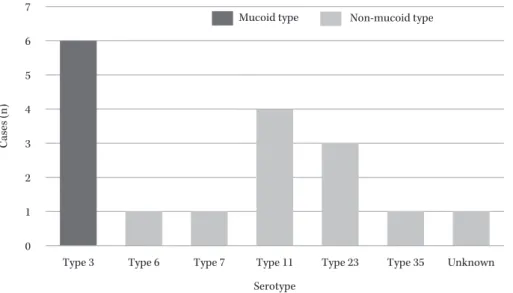
Fig. 2. Differences in serotype distribution of mucoid type and non-mucoid type.
0 1 2 3 4 5 6 7
Type 3 Type 6 Type 7 Type 11 Type 23 Type 35 Unknown Serotype
Cases (n)
Mucoid type Non-mucoid type
びazithromycin(AZM)に対しては,両群の大多数が耐 性であった。Vancomycin(VCM)に対しては両群とも 良好な感受性を示していた。
3.莢膜血清型の比較(Fig. 2)
非ムコイド型では,11型4例,23型3例,6型1例,
7型1例,35型1例とさまざまな血清型に分布していた のに対し,ムコイド型は全例3型であった。非ムコイド の1例は,検体の未保存で検査不能だった。
III. 考 察
肺炎球菌のコロニー形態によるムコイド型と非ムコイ ド 型 へ の 分 類 は,前 者 をOpaque phenotype,後 者 を Transparent phenotypeもしくはスムース型などとも言 い換えられ,古くから報告されているものの15),その意義 についてほとんど検討されていなかった。1990年代には いり,その形態の違いは莢膜ポリサッカライドの厚さと 関連すること,すなわち莢膜ポリサッカライドの産生量 の多い株がムコイド形態をとることが判明した16)。
今回われわれの成人市中肺炎を対象とした検討では,
17例中6例(35%)がムコイド型であったが,その頻度 に関して,副鼻腔炎など耳鼻咽喉科領域由来 検 体 の 10%17),小規模施設の呼吸器患者由来検体(小児科含む)
で26%18),市中病院外来患者由来検体で5%19)などさまざ まな報告がある。頻度の違いは,対象疾患や年齢の違い,
地域差,経年的変化などさまざまな要因が推察されるが,
継続した多施設研究がない現状において詳細は不明であ る。
ムコイド型の薬剤感受性に関しては,ペニシリンG をはじめとするβ―ラクタム薬に対し,非ムコイド型と比 較して感受性がより保持される傾向にあることが報告さ れている7,19)。ムコイド型の本質である厚い莢膜が,形質 転換を起こしにくくしているためと推察されている20)。 一方マクロライド系薬に対しては,ムコイド型,非ムコ
イド型にかかわらずほとんどが耐性を示すとされ19),い ずれもわれわれのデータと一致しており興味深い。
肺炎球菌の莢膜は93血清型に分類されるが,感染症を 引き起こす血清型は約20種類といわれている21)。 また,
血清型により起こしやすい感染症や年齢分布が異なるこ とも知られている22)。成人市中肺炎においては19F,23,
6B,3,14型などの頻度が高いとされる23)。ムコイド型と 血清型の関係で見ると,その大多数(73%21)〜92.3%19))が 3型である一方で,3型の29% のみがムコイド型であっ たとも報告されており24),決して一対一の関係ではない ことに注意が必要である。われわれの結果でも,ムコイ ド全例が3型であり,これらの報告を裏付ける形となっ た。そもそも3型は莢膜産生量が多い傾向にあることが 知られており25),ムコイド傾向になりやすいことと矛盾 しない。
ムコイド型と肺炎の重症度の関係が,今回の最も重要 な問題提起であったが,われわれの結果は,ムコイド型 でより強い炎症反応が惹起され,治療がより難治化する ことが示された。マウスに対する腹腔内投与の検討16)で は,ムコイド型で有意に生存期間が短いことが報告され ている。また,莢膜産生量の多い血清型ほど肺炎の死亡 率が高いとする報告もあり25),それぞれ間接的ではある が,われわれの結果と併せ,ムコイド型が重症化もしく は難治化傾向の要因となるとする仮説を支持するものと 考える。
強い炎症を反映して,ムコイド群でセプシス例が有意 に多かった結果も注目される。しかし,ここで注意すべ きは,肺炎の重症化が必ずしも菌血症,IPDへの進展を 介するものでないことである。当院のデータでも,IPD は1例も認められなかった。莢膜血清型により起こしや すい病態への志向性が異なる22)ことと関係しているもの と思われる。
肺炎球菌の病原因子にはPneumococcal surface pro- tein A(PspA)26),ニューモリシン27)などさまざまなもの が知られているが,ポリサッカライドからなる莢膜もそ の一つである。細胞壁の外側の莢膜が厚いことは,細胞 壁成分への抗体や補体C3bが直接結合しにくくなり,好 中球やマクロファージによる貪食に抵抗性を示す要因と なりうる28,29)。ムコイド型がより重症化しやすいことを示 したわれわれの結果も,これらの報告から推察されるよ うに,莢膜産生量の多さによる,宿主免疫への抵抗性に 起因するものと考えられる。
今回われわれは,成人の肺炎球菌性市中肺炎において,
ムコイド型であるという細菌側要因が重症化の予測因子 になることを証明した。昨今の肺炎球菌ワクチンの普及 もあり,莢膜血清型への関心が深まりつつあるが,その 判定は一部の施設でしか実施できない。一方莢膜血清型 とも一定の関連性をもつムコイド型の判定は,細菌検査 室があればどこでも実施可能であり,今後これらの検討 が多施設に及ぶことが期待される。重症化しやすいムコ イド型に対し,特別な治療戦略が必要かどうかは今後の 検討が必要であるが,少なくともムコイド型で最も多い 3型は,23価肺炎球菌多糖体ワクチンおよび13価肺炎球 菌結合型ワクチンいずれにも含有されており,重症化し やすい血清型の制御という観点からも,両者の普及が望 まれる。
利益相反自己申告:共著者 青木信樹は,第一三共株式 会社,杏林製薬株式会社,大正富山医薬品株式会社から 講演料を受けている。筆頭著者を含むその他の著者は申 告すべきものなし。
文 献
1) Saito A, Kohno S, Matsushima T, Watanabe A, Oizumi K, Yamaguchi K, et al; Study Group: Prospec- tive multicenter study of the causative organisms of community-acquired pneumonia in adults in Japan. J Infect Chemother 2006; 12: 63-9
2) Ishida T, Tachibana H, Ito A, Yoshioka H, Arita M, Hashimoto T: Clinical characteristics of nursing and healthcare-associated pneumonia: a Japanese variant of healthcare-associated pneumonia. Intern Med 2012; 51: 2537-44
3) Weinberger D M, Malley R, Lipsitch M: Serotype re- placement in disease after pneumococcal vaccina- tion. Lancet 2011; 378: 1962-73
4) Griffith F: The Significance of Pneumococcal Types.
J Hyg (Lond) 1928; 27: 113-59
5) Dawson M H: Variation in the pneumococcus. J Pa- thol Bacteriol 1934; 34: 323-44
6) Austrian R: Morphologic variation in pneumococcus.
J Exp Med 1953; 98: 21-40
7) 末武光子,入間田美保子,高橋 辰,沖津尚弘,大山 健二:ムコーズス中耳炎の現況と問題点。Otol Jpn 2000; 10: 89-94
8) 桑内麻也子,奥野妙子,畑 裕子,松本 有,小嶋康 隆:ムコイド型肺炎球菌を起因菌とした耳性頭蓋内
合併症の2例。Otol Jpn 2012; 22: 141-7
9) 日本呼吸器学会医療・介護関連肺炎(NHCAP)診療 ガイドライン作成委員会 編:医療・介護関連肺炎
(NHCAP)診療ガイドライン,日本呼吸器学会,東京,
2011
10) 川崎 聡,青木信樹:ムコイド型肺炎球菌による重症 市中肺炎の1例。日呼吸誌 2015; 4: 303-8
11) 日本化学療法学会抗菌薬臨床評価法制定委員会呼吸 器系委員会報告―呼吸器感染症における新規抗微生 物薬の臨床評価法(案)―1997年6月。日化療会誌 1997; 45: 762-78
12) Fine M J, Auble T E, Yearly D M, Hanusa B H, Weissfeld L A, Singer D E, et al: A prediction rule to identify low-risk patients with community-acquired pneumonia. N Engl J Med 1997; 336: 243-50
13) 日本集中治療医学会Sepsis Registry 編:日本版敗 血症診療ガイドライン。日集中医誌 2013; 20: 124-73 14) Clinical and Laboratory Standards Institute : Per-
formance standards for antimicrobial susceptibility testing. Twenty-Second Informational Supplement.
M100-S22, CLSI, Wayne, Pa, 2012
15) Weiser J N, Austrian R, Sreenivasan P K, Masure H R: Phase variation in pneumococcal opacity: relation- ship between colonial morphology and nasopharyn- geal colonization. Infect Immun 1994; 62: 2582-9 16) Kim J O, Weiser J N: Association of intrastrain phase
variation in quantity of capsular polysaccharide and teichoic acid with the virulence ofStreptococcus pneu- moniae. J Infect Dis 1998; 177: 368-77
17) 小関晶嗣,鈴木賢二,宮本直哉,馬場駿吉,田中久夫,
金子陽子,他:肺炎球菌の検出率とbacterial biofilm に関する検討。日耳鼻感染症研会誌 1998; 17: 92-6 18) 明石 敏,河野 緑,保科定頼,金田佳枝,河内弘行:
小規模医療施設から分離された肺炎球菌の疫学的研 究。慈恵医大誌 2005; 120: 19-33
19) Ogihara S, Saito R, Akikura T, Iwama A, Adachi Y, Kaji D, et al: Characterization of Mucoid and Non- MucoidStreptococcus pneumoniaeIsolated From Out- patients. Ann Lab Med 2015; 35: 410-5
20) 紺野昌俊,生方公子:V.肺炎球菌の血清型と病原性。
ペニシリン耐性肺炎球菌,協和企画通信,東京,1997;
55-68
21) Musher D M: Infections caused byStreptococcus pneu- moniae: clinical spectrum, pathogenesis, immunity, and treatment. Clin Infect Dis 1992; 14: 801-7
22) 千葉菜穂子:わが国における侵襲性肺炎球菌感染症 の実態とその予防としての肺炎球菌ワクチン。日化療 会誌 2011; 59: 561-72
23) 大石和徳:肺炎球菌性肺炎とその対策。臨床と研究 2005; 82: 93-6
24) Dunne E M, Montgomery J, Lupiwa T, Michael A, Lehmann D:Streptococcus pneumoniaeserogroups and colony morphology: a look back. P N G Med J 2010;
53: 166-8
25) Weinberger D M, Harboe Z B, Sanders E A, Ndiritu M, Klugman K P, Rückinger S, et al: Association of serotype with risk of death due to pneumococcal pneumonia: a meta-analysis. Clin Infect Dis 2010; 51:
692-9
26) Briles D E, Tart R C, Swiato E, Dillard J P, Smith P,
Benton K A, et al: Pneumococcal diversity: consid- erations for new vaccine strategies with emphasis on pneumococcal surface protein A (PspA). Clin Mi- crobiol Rev 1998; 11: 645-57
27) Fukuda Y, Yanagihara K, Higashiyama Y, Miyazaki Y, Hirakata Y, Mukae H, et al: Effects of macrolides on pneumolysin of macrolide-resistantStreptococcus
pneumoniae. Eur Respir J 2006; 27: 1020-5
28) 西順一郎:侵襲性肺炎球菌感染症とワクチンによる 予防。モダンメディア 2013; 59: 273-83
29) Weinberger D M, Trzci!ski K, Lu Y G, Bogaert D, Brandes A, Galagan J, et al: Pneumococcal capsular polysaccharide structure predicts serotype preva- lence. PLoS Pathog 2009; 5: e1000476
Comparison of the clinical characteristics of community-acquired pneumonia in adults due to the mucoid and non-mucoid phenotype of Streptococcus pneumoniae
Satoshi Kawasaki1), Nobuki Aoki1), Atsushi Tabata2)and Yasuo Honma2)
1)Department of Respirology, Shinrakuen Hospital, 3―3―11 Shindori-minami, Nishi-ku, Niigata, Japan
2)Department of Clinical Laboratory, Shinrakuen Hospital
Two phenotypes ofStreptococcus pneumoniaeexist, mucoid and non-mucoid, which are classified based on colony morphology. However, the differences in their clinical characteristics have not yet been investigated.
In this study, at the Shinrakuen Hospital from May 2013 to November 2014, we classified cases of adult pneu- mococcal pneumonia into two groups according to the aforementioned causative phenotypes. We also com- pared patientsʼ backgrounds, clinical courses, antimicrobial susceptibility, and capsular polysaccharide sero- types.
Of the 17 patients with pneumococcal pneumonia, 6 (35.3%) were classified into the mucoid group, and 11 (64.7%) were classified into the non-mucoid group. All mucoid phenotypes were of the capsular serotype 3 and were more susceptible to penicillin G than were the non-mucoid phenotypes. On admission, the C- reactive protein titer was significantly higher in the mucoid group (28.4±12.4 mg!dL) than in the non- mucoid group (13.7±7.0 mg!dL, p=0.006). The mucoid group also showed a wider spread of infiltrates on chest radiography. There were no fatal cases in either group, but the mucoid group had a significantly higher number of cases with initial treatment failure (p=0.041) and longer periods of antimicrobial use (16.7±9.8 days in the mucoid group and 8.1±2.0 days in the non-mucoid group, p=0.012).
Our findings indicate that colony morphology (mucoid or non-mucoid phenotype) could be a prognostic factor in cases of pneumococcal pneumonia in adults. It is known that S. pneumoniaestrains that produce greater amounts of capsular polysaccharide show the mucoid phenotype and that capsular polysaccharide confers resistance against complement-mediated opsonophagocytosis. Considering these two facts makes our results easy to understand.