厚生労働科学研究費補助金 労働安全衛生総合研究事業
平成28-30年度 総合研究報告
資料 5:累積振動ばく露量に基づく振動工具取扱い者の Laser Speckle
Flowgraphy を用いた手指末梢循環の評価結果
参加者
福岡県内の振動工具取り扱い業務がある 複数の製造事業所で本研究被験者の募集を 行い,業務で振動工具を使用したことのあ る42名の男性(振動工具取扱い群)およ び業務においてこれまで一度も振動工具を 取り扱ったことのない 29名の男性(振動 工具非取扱い群)、合計72名の男性から参 加の申し込みが得られた。本研究において は,振動障害の既往歴がない者と設定し た。研究開始前に質問紙による手指の自覚 症状の調査、医師によるインタビュー調査 を実施し、振動障害の国際的な振動障害症 度分類であるストックホルムスケールにお いて循環障害の stage0(レイノー現象が存 在しない)に該当する 71名の参加者をコ ホートに登録した。
LSFGを用いた末梢血流評価
手指皮膚血流の測定にはLSFGを用い,
示指,中指,環指全体を含む手掌全体を撮 像した。血流測定後は LSFG Analyzer ver.3
(ソフトケア社製, 日本)を用いて,各指 のMP 関節から手指先端の各指全体の皮膚 面を選択し,選択範囲内の各測定点の値を 平均した血流パラメータを算出した。
LSFGで得られた血流値は,Mean Blur Rate (MBR)という相対値で示される。
MBR は,平均ブレ率を数値化したもの で、血球の移動速度に比例する。各参加者 の基準値を算出するために、人工気候室内 で安静後に3回の連続測定を行った。その 後は冷水浸漬検査開始のタイミングを0分 とし,冷水浸漬中の 5 分間と冷水から室 温に戻した10 分間の計15分間に亘り,1 分ごとに4秒間の撮像時間で計 15回測定 した(図5a)。
安静時に3回測定した値の平均 MBR値 を基準値(100)とし,各測定点の実測 MBR 値をMBR相対値に変換した(式 2)。
グループ化
過去累積振動ばく露量によるグループ化 振動工具取扱い群の振動ばく露による 末梢血流障害の長期的影響を評価するた め,初回調査で得られた過去の振動工具取 扱いによる累積振動ばく露量(過去累積振 動ばく露量)を用いて,グループ化を行っ た。過去累積振動ばく露量の中央値で振動 工具取扱い群を 2群に分け、Past high exposure groupと Past low exposure group に分類した。振動工具取扱い歴がないもの を Non–exposure group_1とした。
現累積振動ばく露量によるグループ化 振動工具取扱い群の振動ばく露による
末梢血流障害の短期的影響を評価するた め,研究期間(2.5年間)中の振動工具取 扱いによる累積振動ばく露量(現累積振動 ばく露量)を用いて,グループ化を行っ た。振動工具取扱い群において3回以上調 査に参加したもののうち、調査期間内で累 積振動ばく露量が 6.25以上増加したもの をCurrent high–exposure groupとした。な お、6.25は、日振動ばく露量の対策値であ
る2.5m/s2に相当する振動工具を調査期間
の2.5年間にわたり毎日使用した場合に得 られる累積振動ばく露量である。振動工具 取扱い歴がなく,本調査に3回以上参加し たものをNon–exposure group_2とした。
倫理的配慮
本調査は,産業医科大学倫理委員会での 承認を得て実施した。調査参加者には本調 査の概要を説明し調査協力への承諾ならび に同意書を取得した上で実施した。本調査 へ不参加を希望する場合には自由意志に基 づき中止可能であることや、被験者自身が 検査中に体調不良を認めた時は,即時検査 を中止することを説明した。
統計学的分析
はじめに,カイ二乗検定または一元配置 分散分析を用い,振動工具取扱いによる 3 群あるいは2群の分類で個人要因と職業性 要因の比較を行った。続いて,末梢血流に 影響を与える要因を評価するため,Linear mixed model (LMM)による分析を行った。
LMMは,目的変数として LSFGの各指標
(冷水浸漬中 MBR相対値(5分平均),
回復 5分 MBR相対値,回復 10 分MBR相 対値)とした。従属変数について,参加者 は random effectとして処理し,振動工具 取扱い状況(3群または2群),調査点,
年代(30歳未満、30歳代、40歳代、50歳 以上),肥満(Body mass index≥ 25)の有 無,糖尿病の有無,現在の喫煙の有無は fixed effectsとして処理した。その後の多 重比較検定は,Bonferroni法を用いた。
統計解析には,IBM SPSS 24.0J(IBM corp., New York)を使用した。有意水準は p<0.05 とした。
( (8)[unit: m/s ])×(Coefficient of use frequency) n=vibration tool handling years
…式1
MBR相対値= 各測定点における実測MBR値
冷水浸漬前3回連続測定の平均MBR値×100 …式 2
図5a. LSFGによる冷水浸漬検査の手順
A. 結果
参加者の基本属性
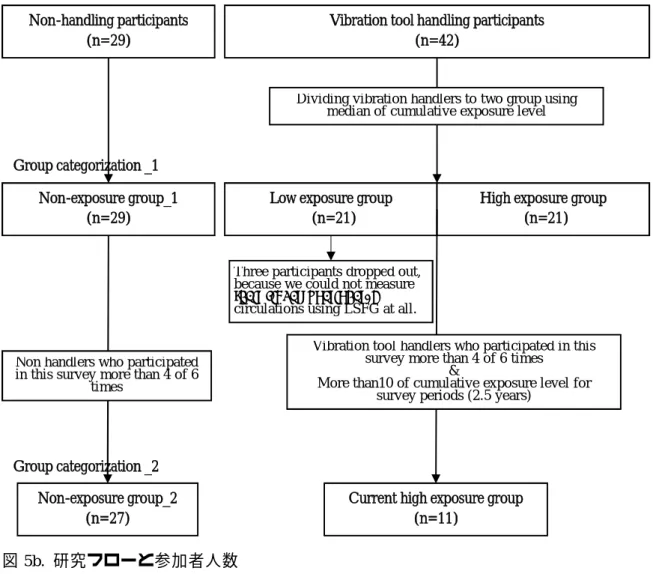
初回調査の参加者数は,全71 名であっ た。Non–exposure group_1が29 名、過去 累積振動曝露量の中央値である27.2以上 となったPast high exposure groupが21 名、27.2未満であった Past low exposure groupが21名に分類された。Past low exposure groupの3名が2回目以降の調査 に不参加であったため,最終的な参加者 は,Non–exposure group _1 が29名、Past high exposure groupが21名、Past low exposure group が18 名となった。現累積 振動ばく露量による分類における各群の参 加者数は,Current high–exposure groupが 11名、Non–exposure group_2が27名であ
った(図5b)。参加者の基本属性の3群間
において,年齢について一元配置分散分析 を用いて比較したところ,有意差を認めた
(p=0.007)。その後の検定で,Past low exposure group は,Non–exposure group_1 と比較して,有意に若かった。また,喫煙
者数についてもカイ二乗検定で比較したと ころ,有意差を認めた(p=0.017)。その後 の検定で Non–exposure group_1の喫煙者 数が有意に少なかった。参加者の基本属性 の 2群間において,年齢について一元配置 分散分析を用いて比較したところ有意差を 認めた(p=0.015)(表5a)。
振動工具取扱い状況
振動工具取扱い群の振動工具作業歴につ いて,参加者 39 名中,1種類のみの振動 工具を取り扱った者は 4名(10.3%),2種 類の振動工具を使用した者は 8名
(20.5%), 3種類以上の工具を取り扱って いる者が27 名(69.2%)であった。また 取り扱った工具の種類の中で頻出のものは グラインダー34名(87.2%)とインパクトレ ンチ 32名(82.1%)であった(表 5b,5c)。
振動工具使用時の手袋の使用にについて,
参加者 39名中38名(97.6%)が使用して いた。38名の主に使用する手袋の種類の 内訳は,軍手 27 名,防振用手袋7名,皮 手袋 2名,ビニール手袋が 2名であった。
Baseline (3min)
Cold water Immersion (5min, 15℃)
Recovery
(10min, room temperature;
20℃) Acclimation
(20min, room temperature; 20℃)
LSFG measurement
Recovery 5min Recovery 10min 1min interval
振動工具の定期的なメンテナンスの実施に ついては,26名(66.7%)が実施してい た。過去に,振動業務健康診断を1回以上 受診したことがある作業者は9名
(23.1%)であり,毎年受診している作業 者は1名(2.6%)であった。過去に,振 動障害に関する教育を受けたことがある参 加者は20名(51.3%)であった。
過去累積振動ばく露量
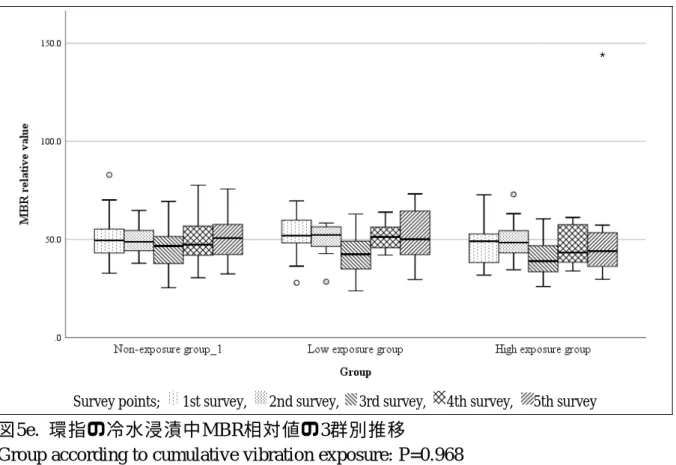
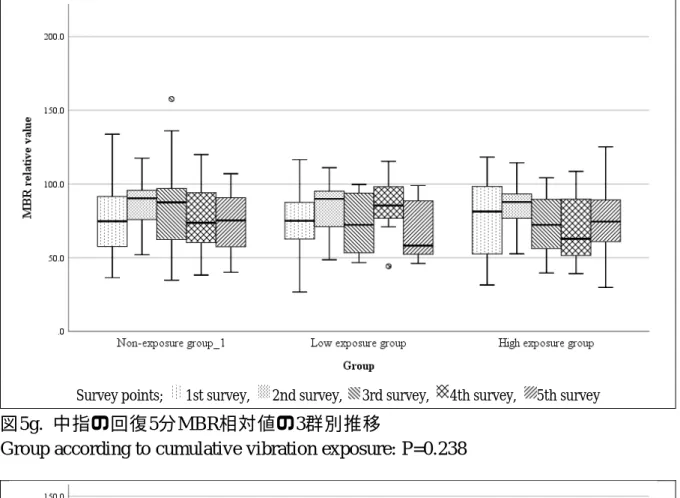
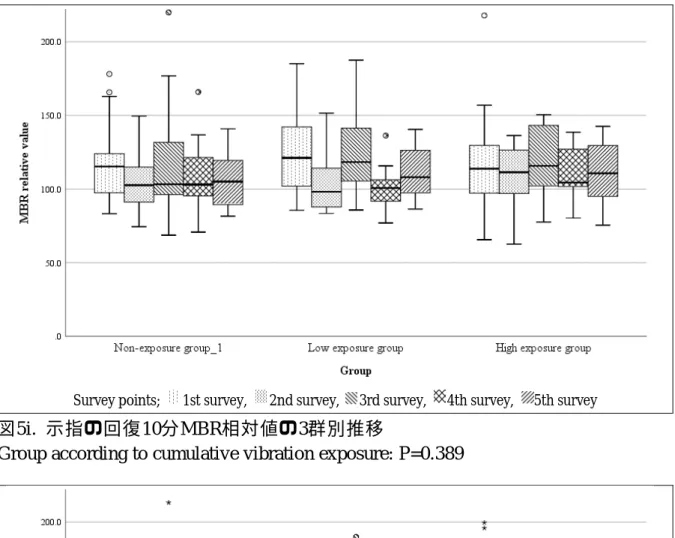
過去累積振動ばく露量分類による分析 Past high exposure group , Past low exposure group ,Non–exposure group _1 の 3群間で,各手指のMBR 相対値を比較し た。全測定手指の冷水浸漬中MBR相対 値,回復5分MBR相対値および回復 10 分MBR相対値において,群間の主効果お よび群間と測定点の交互作用が認められな かった。図5c–5jに,各3指の3群別の MBR相対値の調査点毎の推移を示す。
現累積振動ばく露量分類による分析
Current high exposure groupとNon–
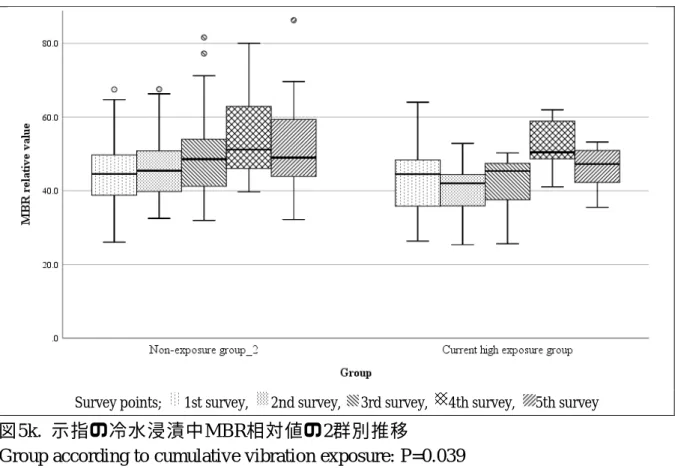
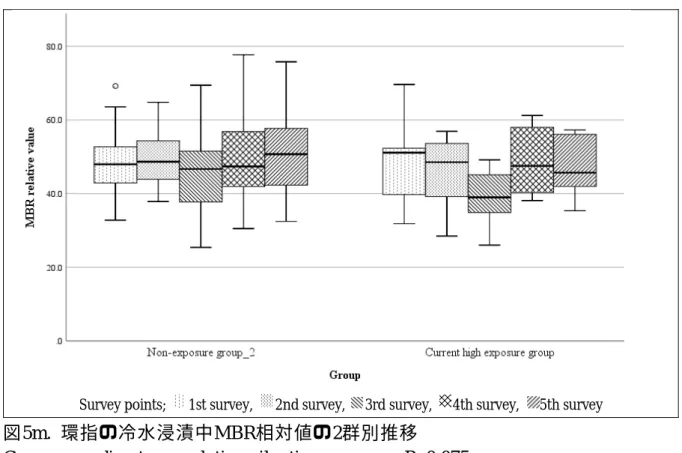
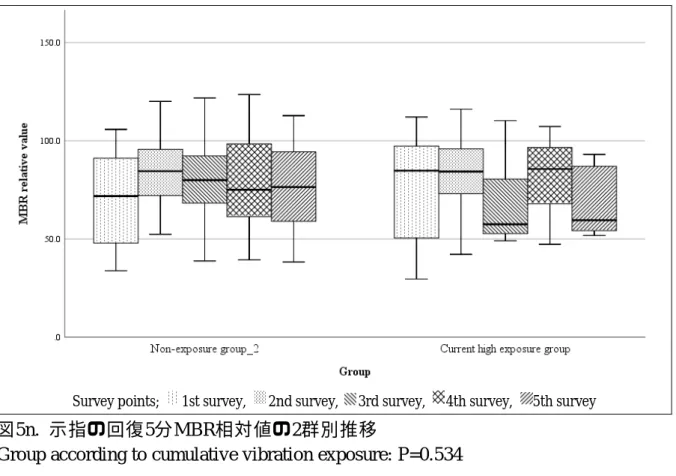
exposure group _2 の2群間の各手指の MBR 相対値を比較した。全ての測定手指 の冷水浸漬中 MBR相対値において,群間 の主効果を認めた(示指;P=0.015,中 指;P=0.013,環指;P=0.029)。いずれの 手指においても,Current high exposure groupは Non–exposure group _2よりも,冷 水浸漬中のMBR相対値が有意に低かっ た。冷水浸漬中 MBR相対値において,群 間と測定点の交互作用は認められなかっ た。回復5分MBR相対値および回復 10 分 MBR相対値において,群間による主効 果は認められなかった。図 5k-5sに,示指 の 2群別の LSFGの MBR相対値の調査点 毎の推移を示す。また,示指の 2群別の MBR 相対値の全体推移を図5t-5uに示 す。
図5b. 研究フローと参加者人数
表5a. Participants characteristics in baseline survey
Vibration tool exposure status Non–exposure group _1
(n=29)
Past low exposure group (n=18)
Past high exposure group (n=21)
mean (SD) / % mean (SD) / % mean (SD) / %)
Age 41.9 (11.2) 31.9 (10.7) 37.8 (8.0)
Obesity (BMI≥ 25) 10 (34.5) 9 (38.1) 9 (42.9)
Diabetes 2 (6.9) 2 (11.1) 2 (9.5)
Cigarette Smoking 6 (20.7) 9 (50.0) 12 (57.1)
Left handler 2 (6.9) 1 (5.6) 1 (4.8)
Vibration tool exposure status Non–exposure group _2
(n=27)
Current high exposure group (n=11) mean (SD) / n(%) mean (SD) / n(%)
Age 42.1 (10.8) 33.1 (6.3)
Obesity (BMI≥ 25) 9 (33.3) 5 (45.5)
Diabetes 2 (7.4) 0 (0.0)
Cigarette Smoking 4 (14.8) 4 (36.3)
Left handler 2 (7.4) 0 (0.0)
Non-handling participants (n=29)
Vibration tool handling participants (n=42)
Non-exposure group̲1 (n=29)
Low exposure group (n=21)
Current high exposure group (n=11)
Non-exposure group̲2 (n=27)
High exposure group (n=21) Group categorization ̲1
Group categorization ̲2
Vibration tool handlers who participated in this survey more than 4 of 6 times
&
More than10 of cumulative exposure level for survey periods (2.5 years)
Non handlers who participated in this survey more than 4 of 6
times
Dividing vibration handlers to two group using median of cumulative exposure level
Three participants dropped out, because we could not measure their fingers’ peripheral circulations using LSFG at all.
表 5b.使用した振動工具の種類
周波数補正振動加速度実効値 の 3軸合成値の換算値
[m/s2]
N=39
削岩機 18.3 5
コンクリートブレーカー 13.6 13
ピックハンマー 8.0 21
チェーンソー 4.7 7
エンジンカッター 7.9 7
刈払機 4.4 8
コンクリートバイブレータ 2.5 11
インパクトレンチ 6.0 32
エアドライバー 2.5 5
グラインダー 4.0 34
ディスクサンダー 3.0 12
バイブレーションシャー 10.8 1
ジグソー 7.0 6
スーパーケレン 50.0 11
その他 – 5
表5c. 参加者が使用し た工具の種類数
種類数 N=39
1種類 4
2種類 8
3種類 7
4種類 3
5種類 1
6種類 3
7種類 7
8種類 1
9種類 5
Survey points; 1st survey, 2nd survey, 3rd survey, 4th survey, 5th survey
図 5c. 示指の冷水浸漬中 MBR 相対値の 3 群別推移
Group according to cumulative vibration exposure: P=0.341
Survey points; 1st survey, 2nd survey, 3rd survey, 4th survey, 5th survey
図 5d. 中指の冷水浸漬中 MBR 相対値の 3 群別推移
Group according to cumulative vibration exposure: P=0.523
Survey points; 1st survey, 2nd survey, 3rd survey, 4th survey, 5th survey
図 5e. 環指の冷水浸漬中 MBR 相対値の 3 群別推移
Group according to cumulative vibration exposure: P=0.968
Survey points; 1st survey, 2nd survey, 3rd survey, 4th survey, 5th survey
図 5f. 示指の回復 5 分 MBR 相対値の 3 群別推移
Group according to cumulative vibration exposure: P=0.219
Survey points; 1st survey, 2nd survey, 3rd survey, 4th survey, 5th survey
図 5g. 中指の回復 5 分 MBR 相対値の 3 群別推移
Group according to cumulative vibration exposure: P=0.238
Survey points; 1st survey, 2nd survey, 3rd survey, 4th survey, 5th survey
図 5h. 環指の回復 5 分 MBR 相対値の 3 群別推移
Group according to cumulative vibration exposure: P=0.236
Survey points; 1st survey, 2nd survey, 3rd survey, 4th survey, 5th survey
図 5i. 示指の回復 10 分 MBR 相対値の 3 群別推移
Group according to cumulative vibration exposure: P=0.389
Survey points; 1st survey, 2nd survey, 3rd survey, 4th survey, 5th survey
図 5j. 中指の回復 10 分 MBR 相対値の 3 群別推移
Group according to cumulative vibration exposure: P=0.621
Survey points; 1st survey, 2nd survey, 3rd survey, 4th survey, 5th survey
図 5j. 環指の回復 10 分 MBR 相対値の 3 群別推移
Group according to cumulative vibration exposure: P=0.839
Survey points; 1st survey, 2nd survey, 3rd survey, 4th survey, 5th survey
図 5k. 示指の冷水浸漬中 MBR 相対値の 2 群別推移
Group according to cumulative vibration exposure: P=0.039
Survey points; 1st survey, 2nd survey, 3rd survey, 4th survey, 5th survey
図 5l. 中指の冷水浸漬中 MBR 相対値の 2 群別推移
Group according to cumulative vibration exposure: P=0.017
Survey points; 1st survey, 2nd survey, 3rd survey, 4th survey, 5th survey
図 5m. 環指の冷水浸漬中 MBR 相対値の 2 群別推移
Group according to cumulative vibration exposure: P=0.075
Survey points; 1st survey, 2nd survey, 3rd survey, 4th survey, 5th survey
図 5n. 示指の回復 5 分 MBR 相対値の 2 群別推移
Group according to cumulative vibration exposure: P=0.534
Survey points; 1st survey, 2nd survey, 3rd survey, 4th survey, 5th survey
図 5o. 中指の回復 5 分 MBR 相対値の 2 群別推移
Group according to cumulative vibration exposure: P=0.629
Survey points; 1st survey, 2nd survey, 3rd survey, 4th survey, 5th survey
図 5p. 環指の回復 5 分 MBR 相対値の 2 群別推移
Group according to cumulative vibration exposure: P=0.663
Survey points; 1st survey, 2nd survey, 3rd survey, 4th survey, 5th survey
図 5q. 示指の回復 10 分 MBR 相対値の 2 群別推移
Group according to cumulative vibration exposure: P=0.172
Survey points; 1st survey, 2nd survey, 3rd survey, 4th survey, 5th survey
図 5r. 中指の回復 10 分 MBR 相対値の 2 群別推移
Group according to cumulative vibration exposure: P=0.171
Survey points; 1st survey, 2nd survey, 3rd survey, 4th survey, 5th survey
図 5s. 環指の回復 10 分 MBR 相対値の 2 群別推移
Group according to cumulative vibration exposure: P=0.092
図5t.
示指における冷水浸漬中,回復5分,回復10分の相対MBR値の推移図 5u.
中指における冷水浸漬中,回復5分,回復 10分の相対MBR値の推移 20.060.0 100.0 140.0
Baseline Cold water
immersion
5min. after cold water immersion
10min. after cold water immersion
MBR rerative values of middle finger
Non-exposure group Current high exposure group 20.0
60.0 100.0 140.0
Baseline Cold water immersion
Recovery 5-min Recovery 10-min
MBR rerative values of index finger
Non-exposure group Current high exposure group
*
図 5v.
環指における冷水浸漬中,回復5分,回復10分の相対MBR値の推移 20.060.0 100.0 140.0
Baseline Cold water immersion
5min. after cold water immersion
10min. after cold water immersion
MBR rerative values of ring finger
Non-exposure group Current high exposure group