
JAIST Repository: 化学修飾によるエステル系高分子の高性能化
8
0
0
全文
(2) Rheological properties and processability of Chemically Modified Poly (ethylene terephthalate - co - ethylene isophthalate) Takashi Wakabayashi (Yamaguchi Lab). 1. INTRODUCTION It has been of great interest in recycle system with the rapid growth of the attention to environment in the plastic industry these days [1][2]. As well known poly (ethylene terephthalate) (PET) is one of the most advanced polymers from the view point of the recycle, because large amounts of PET bottles are recovered, more than 60% in Japan in 2005. Further, extensive efforts have been carried out in both academia and industries to widen the application of recycled PET because of the poor processability due to the lack of melt elasticity with low viscosity as well as the brittle nature in the solid state. In this study, a polymeric material having epoxy functionality is used as a chain extender to improve the processability at extrusion of polyester. It would be preferred to employ a polymeric reagent because of easy handling in both solid state (pellet form) and molten state (high viscosity). Although numerous studies [2][3-8] have been carried out for blends of PET and polymeric modifiers, such as ethylene-vinyl acetate copolymer, ethylene-propylene. copolymer,. ethylene-glycidyl. methacrylate,. and. ethylene-ethyl. acrylate-glycidyl methacrylate, most of them are focused on the improvement of toughness and the relation with the morphology. Since the interest of this study is to control the rheological properties and processability, the amount of the modifier is quite less as compared to the impact modifier.. 1.
(3) 2. EXPERIMENTAL 2-1 Materials Poly(ethylene terephthalate-co-ethylene isophthalate) P(ET-EI) was employed in this study instead of PET. P(ET-EI) can be evaluated at lower temperature which avoid thermal degradation because of less crystallinity, rheological properties and extrusion processability. The modifier employed in this study was styrene-acrylate-based copolymer with glycidyl functionality. The epoxy equivalent is 1.8 [meq/g].. 2-2 Processing Mixing of P(ET-EI) and 10 wt% of the modifier was performed firstly by a co-rotating twin-screw extruder with L/D=22 at 100 rpm. The temperature profile of the extruder was as follows; C1 190 ºC, C2 220ºC, C3 230ºC, and Die 230 ºC. The extruded strand was cut into the pellet form. Then, P(ET-EI) and 10 - 40 wt% of the obtained pellet, i.e., 1 - 4 wt% of the modifier, were put into a single-screw extruder with a full-flight screw (L/D=20, CR=2.1) having the following temperature profile; C1 200 ºC, C2 210ºC, C3 210ºC, and Die 210 ºC. The screw rotation was 30 rpm, and the Garvey-type die was employed.. 2-3 Measurements The oscillatory shear moduli, such as shear storage modulus G’ and loss modulus G”, were measured by a cone-and-plate type rheometer (UBM, MR500) at 210ºC. The molecular weight and its distribution of the extrudates were investigated by a gel permeation chromatograph, G.P.C., (Tosoh, HLC-8020) with TSK-GELTR GMHXL as a polystyrene standard. In G.P.C. measurements, the sample was firstly dissolved into. 2.
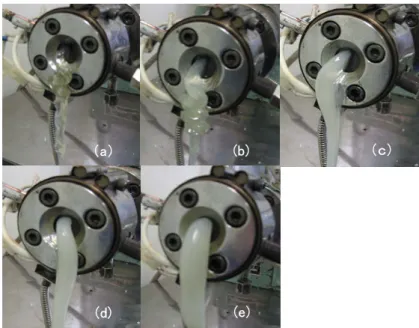
(4) hexafluoroisopropanol at the concentration of 10 mg/ml and then the solution was diluted by chloroform at the concentration of 1 mg/ml. The measurements were carried out by injection of the diluted solution at 40 ºC at a flow rate of 1.0 ml/min.. 3. RESULT and DISCUSSION Figure 1 shows the extrudates from the die. It demonstrates that the modified materials show extrudate swell, which is pronounced with increasing the amount of the modifier. Further, heat sagging, i.e., downward-deformation of a molten polymer by gravitational force, is quite improved by the modifier, implying that the modified material will be applied to various processings, such as extrusion, blow-molding, thermoforming, and foaming.. (a). (b). (d). (e). (c). Figure 1 Appearance of extrudates from Garvey-die controlled at 210 ºC for (a) P(ET-EI), (b) 1 wt%, (c) 2 wt%, (d) 3 wt%, and (e) 4 wt%.. 3.
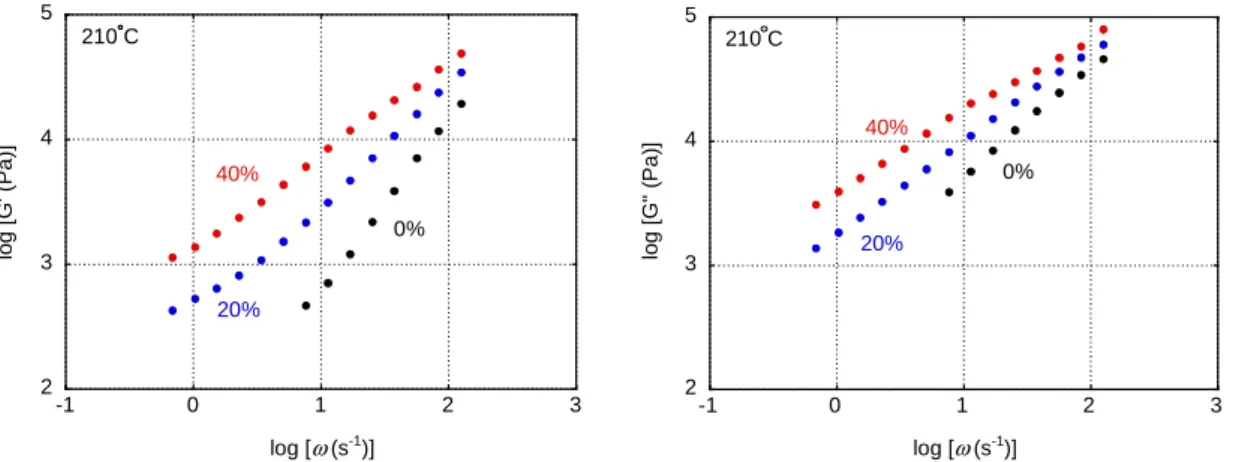
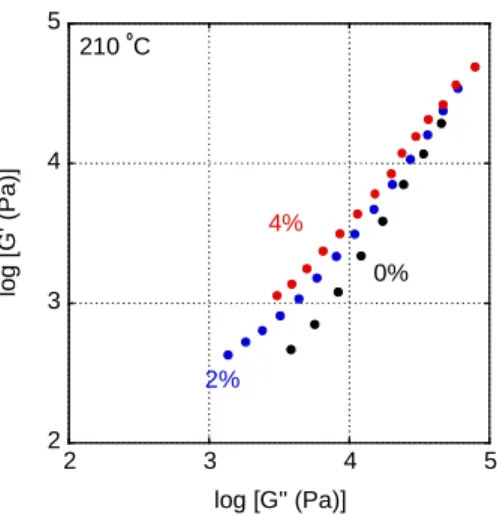
(5) The. rheological. properties. of. the. extrudates are. measured. by a. cone-and-plate rheometer. Figure 2 exemplifies the oscillatory shear moduli of P(ET-EI) and the modified P(ET-EI) with 2 and 4 wt% of the modifier. Both G’ and G” increase with the amount of the modifier, suggesting that average relaxation time increases. Further, the slope of G’ for the modified P(ET-EI) becomes small especially in the low frequency region. The result indicates the existence of prolonged long-time relaxation mechanism. Consequently, the storage modulus is more sensitive than the loss modulus by the modifier as demonstrated in Figure 3.. 5. 5 210 C. 4. log [G" (Pa)]. log [G' (Pa)]. 210 C. 40% 0% 3. 40%. 4. 0% 20%. 3. 20%. 2. -1. 0. 1. 2. 2. 3. log [ω (s-1)]. -1. 0. 1. 2. 3. log [ω (s-1)]. Figure 2 Frequency dependence of oscillatory shear moduli for extrudates of P(ET-EI) and the modified P(ET-EI) at 210 ºC.. 4.
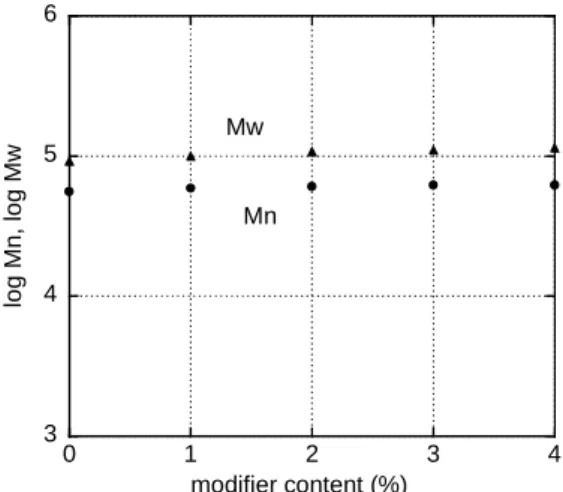
(6) 5. log [G' (Pa)]. 210 C. 4 4% 0% 3 2% 2. 2. 3. 4. 5. log [G" (Pa)]. Figure 3 Modified Cole-Cole plot for extrudates of P(ET-EI) and the modified P(ET-EI) at 210 ºC.. In order to check the mechanism of the enhancement of melt elasticity, G.P.C. measurements are carried out employing extruded samples. As shown in Figure 4, blending the modifier has little effect on the molecular weight and distribution. Further, it is confirmed, but not presented here, the G.P.C. curves of the modified P(ET-EI) are almost same as that of the pure P(ET-EI). The experimental results of the molecular weight measurements indicate that the enhancement of melt elasticity by the modifier is mainly ascribed to generation of long-chain branches [9].. 5.
(7) 6. log Mn, log Mw. Mw 5 Mn 4. 3. Figure 4. 0. 1 2 3 modifier content (%). 4. Effect of modifier content on number-average molecular weight Mn and weight-average molecular weight Mw for extrudates.. 4. CONCLUSION The improvement of processability at extrusion of polyester has been carried out by means of reactive extrusion with styrene-acrylate-based copolymer. Adding the reactive modifier enhances melt elasticity to a great extent, which is attribute to formation of branched structure.. 6.
(8) REFERENCES [1] Yoshihara, N. Plastics (in Japan), 2007, 58, 77. [2] Scheurs, J. Additives for the modification of poly(ethylene terephthalate) to produce engineering-grade polymers, in Modern Polyesters, Eds. Scheirs, J. and Long, T. E., Wiley, 2003. [3] Pegoretti A.; Kolarik, J.; Gottardi, G.; Penati, A. Polym Int 2004, 53, 984. [4] Ma P. L.; Favis, B. D.; Champagne, M. F.; Huneault, M. A.; Tofan, F. Polym Eng Sci 2002, 42, 1976. [5] Loyens, W.; Groeninckx, G. Polym 2002, 43, 5679. [6] Loyens, W.; Groeninckx, G. Polym 2003, 44, 123. [7] Chapleau, N.; Ajji, A. Polym Eng Sci 2003, 43, 1197. [8] Pegoretti, A.; Kolarik, J.; Gottardi, G.; Penati, A. Polym Int 2004, 53, 984. [9] Ferry, J. D. Viscoelastic Properties of Polymers; Wiley: New York, 1980.. 7.
(9)
図
関連したドキュメント
このうち糸球体上皮細胞は高度に分化した終末 分化細胞であり,糸球体基底膜を外側から覆い かぶさるように存在する.
Trichoderma reesei cellobiohydrolase I (TrCel7A) molecules were observed to slide unidirectionally along the crystalline cellulose surface, and the catalytic domain without
心臓核医学に心機能に関する標準はすべての機能検査の基礎となる重要な観
少子高齢化,地球温暖化,医療技術の進歩,AI
All (4 × 4) rank one solutions of the Yang equation with rational vacuum curve with ordinary double point are gauge equivalent to the Cherednik solution.. The Cherednik and the
はじめに 中小造船所では、少子高齢化や熟練技術者・技能者の退職の影響等により、人材不足が
Amount of Remuneration, etc. The Company does not pay to Directors who concurrently serve as Executive Officer the remuneration paid to Directors. Therefore, “Number of Persons”
海に携わる事業者の高齢化と一般家庭の核家族化の進行により、子育て世代との
