journal or
publication title
International review of business
number
21
page range
27-56
year
2021-03
1. Introduction
In this study, we investigate the effect of active learning on the change in undergraduate business and accounting students’ perceptions of accounting in order to empower their deep learning approach. Our primary motivation is the recent call from academia to change the approaches to learning in accounting among students, particularly because of the effect of artificial intelligence (AI) and robotics within this field. That is, the skills needed for future accounting professions would gradually change from memorization and reproduction into judgement and decision-making. In relation to this, a recent study reports that accountants have a 95 percent chance of losing their jobs in the near future as a combination of machines and AI take over data computing, processing, and analysis (Griffin 2016). AI is expected to reduce the rigorous and tedious nature of the accounting profession; instead, this profession would demand higher-value specialties that involve more professional judgement
Playing the LEGO Simulation Game: Positive Relationship between Active Learning,
Students’ Perceptions of Accounting, and Learning Approaches
Satoshi SUGAHARA* and Andrea CILLONI†
Abstract
This action research investigates the effect of a self-developed business simulation game ― as active learning―on the change in undergraduate business and accounting students’ perceptions of accounting in order to empower their deep learning approach. The student participants resided in Italy and were enrolled in an intensive class called “Introductory Accounting” incorporating an active learning approach using the LEGO simulation game. The researchers provided attendees 15-hour learning activities over a week. Pre- and post-test questionnaire-based surveys were administered for data collection before and after the intervention. Data from the control group were collected to compare the differences in the results with the experimental student group. This study clarifies the effect of a short-term active learning course on the types of students’ perception profiles about accounting, which ultimately allows the students to alter their learning approach into deep learning. The study provides practical guidelines on how educators and program coordinators can arrange active learning in programs or curriculums to enhance deep learning approaches.
* Professor, School of Business Administration, Kwansei Gakuin University † Professor, Dipartimento di Scienze Economiche e Aziendali, Università di Parma
(Greenman 2017; Odoh, Echefu, Boniface, and Victoria 2018). Studies such as Griffin’s alert accounting students to be ready to re-skill immediately after graduation (Griffin 2016). More specifically, students will need to concentrate on generic skills that are difficult to automate, such as skills requiring human judgment or a deep understanding of the business environment, tasks depending on the knowledge and application of highly complex rules, and skills to explain and communicate holistic pictures with analyses and interpretations (ICAEW 2018; ACCA 2016; Griffin 2016; ICAEW 2015).
At the same time, the accounting literature has long advocated educators to prepare accounting students for changes in the radical economic environment, which continually brings drastic shifts in the role of accounting professionals (De Lange, Jackling, and Gut 2006; Howieson 2003; Albrecht and Sack 2000; AICPA 1999). There is now a consensus that professional candidates should acquire generic skills that are beyond technical skills and knowledge (e.g., De Lange et al. 2006; Howieson 2003). However, a substantial body of studies reports that the perceived nature of duties performed by accountants or of tasks required in accounting courses among students are all negative, and such skewed images prevent them from acquiring new skills (Wells 2019; 2018; Ma, Chen, and Ampountolas 2016; Ferreira and Santoso 2008; Jackling 2005; Lucas and Myer 2005). In fact, there is evidence that students perceive memory of technical knowledge and calculation as being important in the context of learning in accounting. They tend to believe that adopting a surface approach such as the rote learning method is effective for their successful learning (Ma et al. 2016; Jackling 2005).
Similarly, the literature has attempted to change students’ learning approaches using nontraditional and innovative teaching pedagogies, including case studies (Wynn-Williams, Beatson, and Anderson 2016), team learning activities (Hall, Ramsay, and Raven 2004), and in-class simulation (Levant, Coulmont, and Sandu 2016; Phillips and Graeff 2014) because the key to the successful change in students’ contextual approach of learning (such as deep or surface learning) is to reduce the perceived negative view of accounting by using new pedagogy. However, extant studies simply hypothesize that certain changes in teaching methods and curricula allow students to increase and better their perception of accounting. These studies fail to empirically and comprehensively address the relationship between teaching pedagogy and perceptions of accounting and learning approaches. Further, stereotypes of accounting (or accountants) have become more diversified than those found in prior studies (Caglio et al. 2019; Carnegie and Napier 2010). Such recent perceptions or stereotypes of accounting include both positive and negative aspects. Thus, based on the new trends of perceptions, the current study needs to refine the role of one’s perceptions of accounting with regard to their choice of particular learning approach.
game ― as active learning ― in an attempt to change perceptions of accounting for the purpose of enhancing the deep learning approach. This deep learning approach strives continuously to improve understanding by applying and comparing ideas, while the surface learning approach is described as a reproductive strategy that scarcely attempts to integrate information (Marton and Saljo 1976; Biggs 1987). Regarding the effective learning approach, Bonner (1999) illustrates several interventions that allow students to move from a surface approach to a deep approach and also states that teaching complex skills requires active learning methods, while simpler skills can be mastered with more passive teaching methods. We adopt a game-based learning (GBL) technique using a self-developed LEGO simulation game as the active learning material. GBL is thought to be an effective teaching and learning material in building students’ confidence and creating a more positive attitude toward accounting and sustaining a deeper understanding of accounting principles (Phillips and Graeff 2014).
This study contributes to the literature by providing several new insights. First, we present statistical evidence of a positive association between perceptions and learning approach, although the course offers a short time activity, which also ensures that deep learning is strongly adopted by students only when their participation in the active learning course changes their perceptions of accounting.
Second, our study reveals that students’ perceptions of accounting as a modern profession become more unstructured with people orientation. This perception also becomes more discretional; their interest increases as well owing to their attendance in active learning courses.
Third, we confirm that such changes in students’ perception also urge them to redevelop the skills they need to use for their future work. We also find that students’ strong image of conformity in accounting is associated with a deep approach to learning. Thus, we admit that students perceive the surface approach and strategies as necessary for them to progress to higher levels of deep understanding in the accounting context. Students hold more favorable images of conformity, which can foster them to engage more with deep approach processes when they adopt the appropriate facilitation of active learning.
The remainder of this paper is structured as follows. In the following section, we review the related literature and discuss the theoretical rationale applied in this study. Then, we discuss the research design. Thereafter, we demonstrate the results of the analyses and discussions. In the last section, we offer the conclusion and limitations of the present study, together with an orientation of future research.
2. Literature Review
2.1 Associations between Perception of Accounting and the Learning Approach
A number of prior studies address the importance of students’ perceptions of accounting in their learning approach (Ma et al. 2016; Duffs and Mladenovic 2015; Ferreira and Santoso 2008; Jackling 2005; Lucas and Meyer 2005; Lucas 2001; Lucas 2000; Mladenovic 2000). Among them, some studies find that negative stereotypes of accounting professions are often a powerful predictor of negative expectations of learning accounting. For example, Lucas (2001, 2000) conducted a qualitative interview research among accounting students and discovered that a deep approach to learning accounting is subject to a desire to engage with concepts and ideas that seek personal meaning, while a surface approach is characterized as learning by rote, memorization, and academic anxiety. Jackling (2005) also uses qualitative data to investigate the relationship between the context of learning and learning approaches among second-year accounting students in Australia. This author discovers that students with negative perceptions of accounting tend to learn using the surface approach with lower-level strategies such as role learning, paraphrasing, and describing.
Further studies using quantitative data empirically endorse this analysis between perceptions of accounting and the learning approach (Ma et al. 2016; Ferreira and Santoso 2008; Lucas and Meyer 2005). Ferreira and Santoso (2008) conducted a survey among undergraduate accounting students in Australia and found that negative perceptions can cause a decline in motivation and cognitive processing that results in lower accounting performance. On the other hand, positive perceptions of accounting among students have a positive effect on their performance. Ma et al. (2016) extend this investigation using samples collected from hospitality students. They examined whether students have a negative perception of accounting courses. Using quantitative data from those who attended financial management courses in the US, the findings show that the students tended to have negative perceptions of the accounting course, and this perception caused them to be less likely to adopt a deep approach to learning.
Against such unfavorable trends in the findings, the challenges to positively alter perceptions of accounting have also been discussed in the literature. Several studies have found that non-traditional teaching methods in accounting, such as active-type blended learning methods, are more effective than traditional lecture-based methods in terms of altering negative perceptions of accounting (Duffs and Mladenovic 2015; Anderson and Lawton 2009; Mladenovic 2000). For instance, Duffs and Mladenovic (2015) attempted to explore how students’ expectations of learning influence their approaches to learning accounting. With quantitative research methodologies, this research reveals that students with negative expectations of studying accounting are more likely to adopt ineffective learning
strategies and have poor learning outcomes. Given this result, the authors suggest accounting educators to expend more effort toward developing positive expectations of learning accounting through innovative and comprehensive educational interventions.
2.2 Challenges to Alter Perceptions of Accounting
In the same vein as above, scholars have further examined the role of active learning in students’ learning perceptions and attitudes. For example, Metrejean, Pittman, and Zarzeski (2002); Butler and Wielligh (2011); and Jackson (2014) use guest lecturers to explore the impact of altering students’ views toward accounting. Here, lectures by invited guests are thought to be a form of active learning (Jackson 2014). The results reveal that guest speakers positively change students’ awareness of accounting, motivate them to learn accounting, and strengthen the appeal of a career in accounting. Further, Wells (2019) conducted an empirical study to explore the effect of contact with accountants on people’s perceptions of accounting. The data of this study were collected from both questionnaires and interviews among people in public who received accounting services either with or without contact with accountants. A comparison of perceptions between these two groups shows that contact with accountants creates little awareness of a diverse range of work types. This result contradicts Metrejean et al. (2002), Bulter and Wielligh (2011), and Jackson (2014). Wells (2019) implies that, while contact might assist in changing perceptions, the change will not necessarily have the effect of creating positive views.
In addition to the effect of contact with accountants, we find several studies that have explored the effect of various active learning approaches to change students’ perception of subjects. For example, Riedinger, Marbach-Ad, McGinnis, Hestness, and Pease (2011) incorporated several active learning components such as virtual field trips in a course titled “Science Method” in order to explore the effectiveness of an active learning approach on students’ perceptions. The authors found that attitudes toward this course among the experimental group were notably improved. This evidence indicates that a comprehensive active learning setting is effective for changing learners attitudes. However, this is a non-accounting research; and to date, no study has empirically addressed the effect of active learning and ones’ perceptions of learning, especially in accounting.
Recent studies on accounting perceptions further complicate the discourse (e.g., Carnegie and Napier 2010; Caglio et al. 2019). Some studies indicate that the perception of accounting is neither fixed nor simply categorized into a dichotomous (positive/negative) stereotype. For instance, Carnegie and Napier (2010) investigated a variety of publications related to the topics of the Enron scandal to explore the image of accounting and accountants after this incident. They concluded that the stereotype of the accountant in public has changed from the “traditional accountant” or “bean counter” with the dull, but honest traits, to that of a
business professional who is an educated and attractive expert. More recently, Caglio et al. (2019) attempted to identify images of accountants held by several different groups of people; the authors uncovered new images, including nuances, which are neither favorable nor unfavorable. This prior study concludes that perceptions of accountants are not static, but may change over time. With this new and multi-dimensional image of accounting, it is not clear how the perceptions of accounting are associated with the learning approach.
2.3 Effect of Game-Based Learning on Learning Approach
One innovative intervention that has become an effective teaching and learning intervention is GBL. GBL employs games to promote learning, skill acquisition, and training (Boyle, Connolly, Hainey 2011; Randel, Morris, Wetzel, and Whitehill 1992). Prior studies report evidence that GBL can produce cognitive (e.g., perceptual skills), behavioral (e.g., social skills), and affective (e.g., motivation, engagement, and satisfaction) learning outcomes (Carenys and Moya 2016; Vlachopoulos and Makri 2017).
In the literature, GBL is defined from two different theoretical perspectives. On the one hand, it is thought to be an active learning method, where the student ― and not the instructor ― is treated as the main agent engaging activities in the learning process. This type of learning method is believed to encourage deeper learning than the passive learning methods (Riley and Ward 2017; Prince 2004). On the other hand, GBL can also be defined as experiential learning, which is the process of creating knowledge through experience as opposed to merely receiving or transmitting information (Kolb 1984; Kolb and Kolb 2005). In this experiential learning, GBL is thought to involve deep learning that develops a new perspective by integrating new material with existing knowledge. This type of learning contradicts traditional instruction, which emphasizes surface learning, including task completions, memorization, and clear-cut answers (Turner and Baskerville 2013).
Given these two theories, Butler et al. (2019) explain that experiential learning is a broader concept than active learning is. However, both theories contend that GBL empowers deep learning. The literature on GBL most often includes empirical investigations that seek to ensure the role of GBL on learning approaches. For example, Sivan, Leung, Woon, and Kember (2000) measured business students’ approach to learning (surface or deep) and examined the effects of several active learning approaches, including games and simulations. Their findings show that students change their approach to learning immediately after experiencing these active learning materials. Phillips and Graeff (2014) also empirically investigated this theoretical framework by adopting in-class simulation exercises incorporated into the accounting course. They concluded that the simulation exercise is a strong and effective active learning tool that helps students move from a surface to a deeper level of understanding of accounting (Phillips and Graeff 2014). However, these extant studies
hypothesize that the adoption of GBL would increase deep learning, and simply used adopted interventions as proxies for effective GBL.
GBL is not likely to be free from constraints. The major weakness that has often been reported in the literature is its reality and validity (Ampountolas, Shaw, and James 2019; Edelheim and Ueda 2007; Wolfe 1976). For instance, when the simulated environment of the game does not duplicate a real business situation, the game could lack validity. Also, GBL can mislead participants, causing them to misunderstand incorrect habits as reality, which increases the complexity of GBL (Hely and Jarvis 1999). The complexity itself becomes a constraint because it makes conceptualizing the relationship between causes and effects more challenging for learners (Fripp 1993).
Thus, GBL does not always seem to be an effective active learning tool to provide deep learning opportunities. Some extant studies in the accounting education literature have found it difficult to support accounting students to change their approach from surface to deep learning by implementing certain active learning-type interventions (e.g., Carenys and Moya 2016; Turner and Baskerville 2013; Fox, Stevenson, and Connolly 2010). Thus, the effectiveness of GBL as an active learning tool must be measured to confidently analyze its empirical association with learning approaches.
3. Theoretical Framework and Hypothesis
In this study, we use the Biggs’ Presage−Process−Product (3P) model (2001, 1993a, 1993b, 1987) as the theoretical framework. This model explains the mutual interactions between student factors, teaching context, on-task approaches to learning, and learning outcomes as a dynamic system (Biggs, Kember, and Leung 2001).
According to the 3P model, there are three components to students’ learning. The first component is the presage. This includes student-based factors and the teaching context. The second component is the process. This component describes how the student executes the task. The third component is product, which is the learning outcome. With this model, the active learning approach is thought to be part of the teaching context of the presage stage, which intends to play an important role in determining the students’ perceptions, and then approach, to learning as a consequence (Phillips and Graeff 2014; Anderson and Lawton 2009; Hall et al. 2004; Sivan et al. 2000).
For an in-depth exploration, we divided our research purpose into two research questions (Appendix 1, Panel A). The first research question (RQ1) is “Do students participating in an active learning course positively change their perceptions of accounting?” Our literature review demonstrates that there is little direct research on the relationship between students’ participation in active learning and perceptions of accounting. Thus, hypothesis H1 is formed to address this research question (Appendix 1, Panel B):
Appendix 1. Research Questions and Hypotheses
Panel A: Research Questions
Panel B: Hypotheses
H1: Participating in an active learning course of accounting significantly changes students’ perceptions of accounting.
Moreover, H1 can be broken down into the following two sub-hypotheses. To test H1, we applied pre- and post-test and control groups.
H1-1: There are significant differences in students’ perceptions of accounting before and after their participation in the active learning course of accounting (pre- and post-test).
H1-2: There are significant differences in perceptions of accounting between students who participate in the active learning course of accounting and those who do not (control group).
The second research question (RQ2) is “How do changes in students’ perceptions of accounting by an active learning course predict their adoption of a particular learning approach (deep or surface learning)?” (See Appendix 1, Panel A). According to our literature review, students’ positive perceptions of accounting are correlated with their adoption of a deep learning approach, while their negative perception is associated with their adoption of surface learning. However, no empirical study has been conducted to address the effect of change in perceptions on students’ approach to learning. To address this RQ2, we develop the following hypothesis (H2-1) (Appendix 1, Panel B):
H2: Students’ positive (or negative) perceptions of accounting are significantly associated with the deep (or surface) learning approach after participating in an active learning course of accounting.
To address H2, we also formulate the following two sub-hypotheses (H2-1 and H2-2) to support H2 by using pre- and post-test and control groups.
H2-1: There are significant differences in the learning approach adopted by students before and after their participation in the active learning course of accounting (pre- and post-test).
H2-2: There are significant differences in the learning approach adopted between students who participate in the active learning course of accounting and those who do not (control group).
4. Research Design
4.1 Active Learning Course Using the LEGO Simulation Game (ALC)
We designed an intensive course for introductory accounting based on an active learning approach using the LEGO simulation game (ALC). The ALC provides opportunities for participants to enhance the intrinsic interest of accounting, comprehend the importance of
accounting in a real business setting, and learn how to apply technical knowledge, generic skills, and professional judgment in practical accounting and business. To achieve these learning aims, LEGO is used as part of the learning materials, which participants use in order to play a simulation game. This type of game-based learning pedagogy is called GBL (Boyle et al., 2011). GBL has been characterized as a form of experiential learning (Kolb, 1984), and is often thought to be a type of active learning that relies on the senses to build or construct learning by experiencing problems and reflecting on the experience to clarify understanding (Stainton, Johnson, and Borodzicz 2010).
There are a variety of active learning teaching methods in accounting. Traditionally, accounting educators have long adopted case-based materials as one of the active learning approaches in classrooms (e.g., Wynn-Williams et al. 2016). However, GBL is thought to have stronger realism than the case-based approach. Adobor and Daneshfar (2006) define realism as the extent to which game users perceive the simulation to be reflective of life situations. These authors found a positive relationship between realism and the degree of learning from the simulation game.
Another recent trend of the active learning approach in accounting is Work Integrated Learning (WIL). WIL is a teaching practice of combining formal learning with student exposure to the world-of-work in their chosen profession (Jackson 2015). The WIL, which includes business internship, industry-based learning placement, and community-based volunteering, provides participants with higher realism that allows them to learn comprehensive employability skills needed in real business practices, such as team working, problem-solving, communication, information literacy, and professionalism (Jackson 2015). These skills are almost compatible with those needed for future professions in recent digital society. However, effective WIL design requires careful consideration of many factors and is widely acknowledged as both difficult and costly to implement (Abeysekera 2006). This is because the accounting curriculum needs to be more involved in coordinating with industries. To overcome the limitations of existing teaching materials, we developed the ALC with the LEGO simulation game for this research.
Using LEGO as active learning material for the game was inspired by Everaert and Swenson (2014). The authors adopted LEGO in order to include unstructured problems and uncertainties when understanding the knowledge and skills students needed for management accounting. Structured problems require well-defined methodologies for finding a solution; they also require particular data to reach a decision. On the other hand, unstructured problems rely on expertise and/or intuition. In principle, accounting education is intended to provide students with opportunities to develop the ability to identify and solve unstructured problems in unfamiliar settings (AECC, 1990). Constructivist theories also state the importance of deep learning using unstructured problem contexts, because deep learning is
encouraged by unfamiliar settings, where learning starts by defining a problem that is always unstructured (Bevinakoppa, Ray, and Sabrina 2016; Hodges 2011). To address this, many tasks assigned by the ALC focus more on judgement and decision-making ― than memorization and rote learning ― in order to confront unstructured problems.
Further, Phillips and Graeff (2014) articulate that GBL is an effective tool in building student confidence and creating a more positive attitude toward accounting as well as sustaining a deeper understanding of accounting principles. In addition, GBL enhances students’ deep learning through the use of individualized and authentic assessed learning tasks. To simplify, it helps students apply concepts to their individual or real firm, thus helping develop a personal meaning and understanding of those concepts (Turner and Baskerville 2013). These authors point that deep learning enables students to develop personal capabilities in their university studies.
At the end of this course, students were required to complete an essay-writing assignment that questions their understanding of the concepts and knowledge covered by the course. Further, we assigned our participants an open-end type oral examination to examine whether they learned thinking and judgement skills from the ALC. We incorporated this assessment step into the course because prior studies indicate that an appropriate assessment is inevitable for the successful construction of deep learning (Ma et al. 2016; Mladenovic 2000; Biggs 1987).
The GBL herein is team-based, with each team comprising five persons. Each team is an executive group of the company, who competes in the game to maximize profit. Note that Faria, Hutchinson, Wellington, and Gold (2009) show that the reasons for using GBL have rarely changed over the past 40 years; further, developing teamwork and providing interactive occasions constantly listed higher together with forming learners’ thinking and problem-solving skills.
While playing the game, the teams use LEGO to design an automobile, mass-produce it as their company products, and sell them to the market. The more LEGO pieces the team uses to make a product, the more cost they need to cover. They must also make decisions on the number and price of products manufactured in accordance with cost−volume−profit analysis. The number of units ordered from the market is influenced by the ranking of each team’s product that is mutually evaluated during the motor show, where each team prepares and delivers a promotional presentation in front of other teams. To be evaluated better than other companies, students need to consider which and how many LEGO pieces they use to assemble a well-designed and popular automobile model, together with a consideration of production cost. All figures as the result of the game are presented in the financial statements. Thus, participants learn both fundamental principles of accounting and basic skills of how to use them for their decision-making. An overview of the ALC with 15
Appendix 2. Overview of the ALC
Contents Contents Contents
1
Introduction of the course, purpose of the simulation game, team building
6
Group presentation session:
Motor show 11
Professional judgement in business accounting setting
2
Preparation and use of financial report and manufacturing cost report
7
Cost leadership strategy and branding strategy 12
Preparing financial statement 3
3
Cost-Volume-Profit analysis and break-even point 8
Preparing financial statements
1 13
Capitalizing and Costing: Depreciation or advertising cost?
4
Productivity and innovation of manufacturing process 9
Business marketing strategy and its relationship with accounting
14
Role of auditing impact of culture and language upon accounting
5
Dilemmas between designing products and production cost 10
Preparing financial statement
2 15
Course summary: Results and implications of LEGO simulation game
learning hours is described in Appendix 2.
Recent research in GBL is shifting to test the effect of digital GBL as well (DGBL)1. Faria et al. (2009) have also noted the benefit that this change in technology. For example, educators and users can now avoid hand scoring, which is time-consuming, prone to error, and limits the games in terms of the complexity of decisions and amount of feedback. Given this aspect, we incorporated ALC as an Internet-based cloud scoring system, where participants of the LEGO game can transmit scores from their decisions via their own cellular phones. This enables immediate and automatic calculation of activity outcomes without hand-scored-type errors. This innovative technology successfully allows the ALC to reduce nuisances than traditional paper-and-pen type GBL. Further, this ALC can facilitate more face-to-face interactions among participants than the full-fledged DGBL using a video game platform.
4.2 Data Collection
The participants of this study comprised undergraduate business and accounting students enrolled in an intensive class ― “Introductory Accounting” ― at a large northern university in
1 GBL is often confused with a “serious game” because both aim to employ game-based activities for
learning. The key difference between the two is that GBL may employ a wider variety of game platforms, such as traditional table-top board and card games as well as video games (Plass, Homer, and Kinzer 2015), while serious games employ primarily video game technology platforms (Tsekleves, Cosmas, and Aggoun 2016).
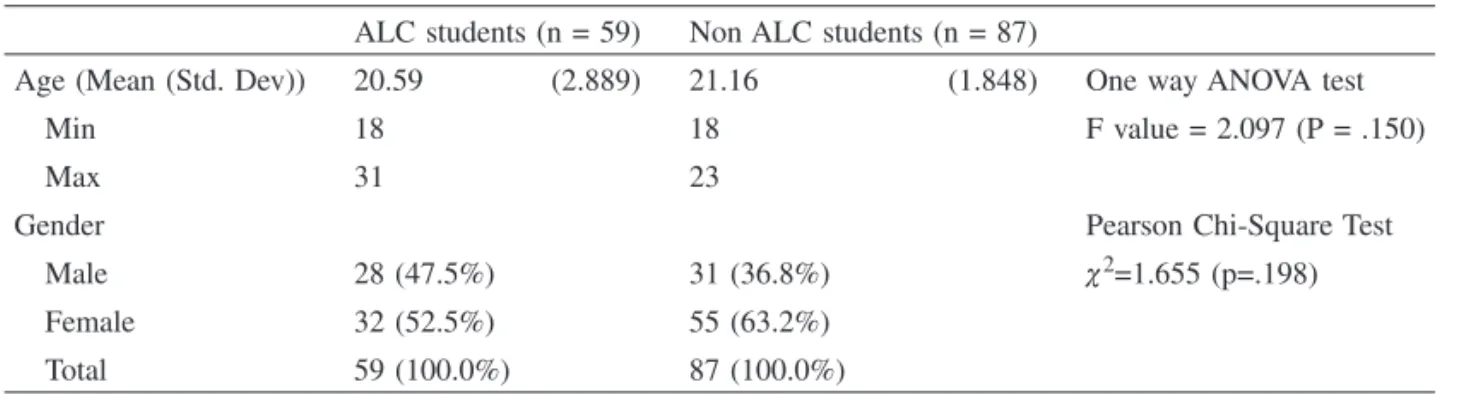
Table 1. Demographics
ALC students (n = 59) Non ALC students (n = 87)
Age (Mean (Std. Dev)) 20.59 (2.889) 21.16 (1.848) One way ANOVA test
Min 18 18 F value = 2.097 (P = .150)
Max 31 23
Gender Pearson Chi-Square Test
Male 28 (47.5%) 31 (36.8%) χ2=1.655 (p=.198) Female 32 (52.5%) 55 (63.2%)
Total 59 (100.0%) 87 (100.0%)
Italy. This intensive class is a selective course open for any undergraduates who attend three-year international business programs. Participants have sufficient fluency in English language skills, so this course is taught in English. The researchers of this study give attendees 15-hour learning activities as educational intervention within a week. Then, a final assignment and an oral examination are conducted as an assessment process. Pre-test and post-test questionnaire-based surveys were administered for data collection before and after the intervention. Further, we collected data from students who did not appear in the ALC at the same time as the post-test. These data were used as the control group (non-ALC students).
Table 1 shows the demographics of our sample. We collected our research data from four intensive courses over four semesters from autumn 2018 to spring in 2020. Participants who attended each semester were not the same students. With regard to the experimental group (students who attended ALC, i.e., ALC students), we initially collected data from 88 students, but 29 were discarded due to incomplete surveys, giving us 59 samples for analysis (67.05% effective response rate).
For the control group, we collected data from other accounting classes that ALC students attended. As a result, 87 effective responses were collected as the non-ALC students’ group (87.45% effective response rate). The chi-square test and one-way analysis of variance do not report significant differences in both gender and age between ALC and non-ALC student groups (see Table 1).
4.3 Questionnaire Development and Analyses
We designed a self-developed survey instrument to address the research questions, RQ1 and RQ2. The data collection consists of the following two components: perceptions of accounting and approach to learning in accounting.
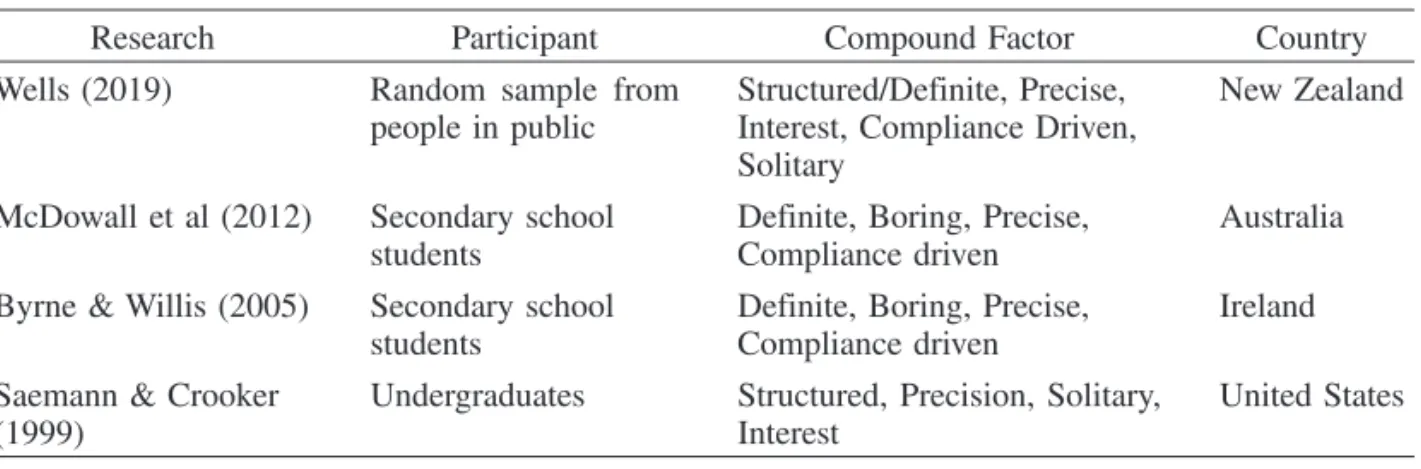
Table 2. Prior Studies Using PAPI
Research Participant Compound Factor Country
Wells (2019) Random sample from people in public
Structured/Definite, Precise, Interest, Compliance Driven, Solitary
New Zealand
McDowall et al (2012) Secondary school students
Definite, Boring, Precise, Compliance driven
Australia Byrne & Willis (2005) Secondary school
students
Definite, Boring, Precise, Compliance driven
Ireland Saemann & Crooker
(1999)
Undergraduates Structured, Precision, Solitary, Interest
United States
4.3.1 Perceptions of Accounting
In this part, the participants were asked to complete 36 five-point scales of opposing adjectives based on their perceptions of accounting (see Appendix 3). These scales are measured on a semantic differential scale, with “1” indicating agreement with the left-hand word and “5” indicating agreement with the right-hand word. Several pairs of words are reverse-coded in the instrument, but adjusted such that the score of the right-hand word would be better than that of the left-hand word when the analysis is conducted. This instrument was originally developed by Saemann and Crooker (1999) to assess respondents’ perceptions of the accounting profession. It is called the Perception of Accounting Profession Index (PAPI) and finds wide application in prevailing research.
Table 2 lists the studies adopting the PAPI, their participants, compound factors loaded by principal component analysis, and the country of each study. The data from this questionnaire item is used to address RQ1: the effect of ALC on perceptions of accounting. In this investigation, the responses for students’ perceptions is initially compiled using principle component analysis in order to decrease the number of perceived factors. We perform the principal component analysis with the data for the post-test. The results reveal the compiled factor/s that would effectively change subjects’ learning approaches. Then, the elements of the compound factors are individually compared by t-tests between the pre-test and post-test and between the ALC students and non-ALC students to ensure the framework of the hypotheses.
4.3.2 Approach to Learning in Accounting
The learning approaches are measured using the 20-item questionnaire invented by Biggs et al. (2001), known as the Revised Two-factor Study Process Questionnaire (R-SPQ-2F). Ten items are used to assess deep or surface learning approaches. Each student establishes a
Appendix 3. Paired Samples T-Tests for ALC students Between Pre-test and Post-test Paired Sample T-Test
between pre-ALC and post-ALC students
Independent Sample T-Tests Between Non ALC and ALC students Means (Std. Dev) Means (Std. Dev)
Perception Items ALC Pre-test (n = 59) ALC Post-test (n = 59) t-value (p-value) Non ALC (n = 87) ALC Post-test (n = 59) t-value (p-value)
P1 Cut & Dry vs Creative Solutiona 3.28 (1.017) 4.03 (1.016) -5.031 (.000)*** 3.26 (1.061) 4.03 (1.016) -4.372 (.000)*** P2 Repetition vs Variety 3.03 (1.033) 3.81 (1.042) -4.094 (.000)*** 3.11 (1.195) 3.81 (1.042) -3.744 (.000)*** P3 Established Rules vs New Ideasa 2.49 (1.135) 3.84 (1.047) -8.478 (.000)*** 2.80 (1.237) 3.84 (1.047) -5.482 (.000)***
P4 Boring vs Interesting 4.10 ( .959) 4.39 ( .788) -2.250 (.028)** 4.09 (1.007) 4.39 ( .788) -1.909 (.058)* P5 Easy vs Challenginga 3.62 ( .945) 3.89 ( .977) -1.777 (.081)* 3.87 (1.076) 3.89 ( .977) -.141 (.888)
P6 Dull vs Exciting 3.68 ( .955) 4.14 ( .798) -4.099 (.000)*** 3.82 ( .909) 4.14 ( .798) -2.188 (.030)** P7 Structured vs Flexiblea 2.40 (1.131) 3.50 (1.179) -5.420 (.000)*** 2.73 (1.135) 3.50 (1.179) -3.972 (.000)*** P8 Solitary vs Interaction with Others 3.59 (1.116) 4.47 ( .796) -5.491 (.000)*** 3.64 (1.110) 4.47 ( .796) -5.267 (.000)*** P9 Conformity vs Originality 2.78 (1.018) 3.69 (1.071) -5.448 (.000)*** 2.87 (1.246) 3.69 (1.071) -4.131 (.000)*** P10 Stable vs Dynamica 3.05 (1.278) 3.91 (1.021) -4.230 (.000)*** 3.36 (1.132) 3.91 (1.021) -3.040 (.003)*** P11 Standard Operating Procedures vs New Solutions 2.76 (1.222) 3.93 ( .998) -6.831 (.000)*** 3.01 (1.234) 3.93 ( .998) -4.966 (.000)*** P12 Introvert vs Extroverta 3.20 (1.156) 3.93 (1.127) -3.803 (.000)*** 3.39 ( .992) 3.93 (1.127) -3.060 (.003)*** P13 Conceptual vs Analytical 3.39 (1.083) 3.24 (1.023) .922 (.360) 3.52 (1.088) 3.24 (1.023) 1.563 (.120) P14 Compliance vs Innovationa 3.08 (1.235) 3.93 (1.014) -4.779 (.000)*** 3.26 (1.083) 3.93 (1.014) -3.749 (.000)*** P15 Facts vs Intuitiona 2.33 (1.010) 3.23 (1.179) -4.584 (.000)*** 2.93 (1.118) 3.23 (1.179) -1.588 (.114) P16 Certainty vs Ambiguitya 2.13 ( .990) 2.47 ( .988) -2.317 (.024)** 2.52 (1.032) 2.47 ( .988) .316 (.752) P17 Planned vs Spontaneous 1.81 ( .819) 2.34 (1.092) -3.380 (.001)*** 1.93 ( .873) 2.34 (1.092) -2.396 (.018)** P18 Number Crunching vs People-Orienteda 2.76 (1.193) 3.47 (1.072) -4.596 (.000)*** 3.08 (1.069) 3.47 (1.072) -2.182 (.031)** P19 Theoretical vs Practicala 3.49 (1.150) 3.76 (1.056) -1.639 .(107) 3.75 ( .976) 3.76 (1.056) -.024 (.981) P20 Tedious vs Absorbing 3.66 ( .757) 3.71 ( .832) -.402 (.689) 3.26 ( .855) 3.71 ( .832) -3.137 (.002)*** P21 Monotonous vs Fascinatinga 3.47 (1.072) 4.10 ( .824) -4.107 (.000)*** 3.78 ( .920) 4.10 ( .824) -2.150 (.033)** P22 Concrete vs Abstracta 2.06 (1.127) 2.05 ( .898) .131 (.896) 2.14 ( .908) 2.05 ( .898) .646 (.519) P23 Efficiency vs Effectivenessa 2.61 (1.083) 2.84 (1.095) -1.285 (.204) 2.55 ( .899) 2.84 (1.095) -1.784 (.077)* P24 Logic vs Imaginationa 1.64 ( .482) 2.27 ( .979) -4.667 (.000)*** 1.89 ( .682) 2.27 ( .979) -2.548 (.012)** P25 Superficial vs Thorougha 3.94 ( .818) 3.98 ( .880) -.299 (.766) 4.18 ( .707) 3.98 ( .880) 1.523 (.130) P26 Routine vs Unpredictablea 2.54 (1.039) 3.45 (1.039) -5.448 (.000)*** 2.97 (1.022) 3.45 (1.039) -2.768 (.006)*** P27 Details vs Overview 2.47 (1.088) 1.88 (1.176) 2.870 (.006)*** 2.38 (1.154) 1.88 (1.176) 2.540 (.012)** P28 Accurate vs Imprecise .95 (1.252) 1.71 ( .789) -4.538 (.000)*** 1.18 ( .896) 1.71 ( .789) -3.663 (.000)*** P29 Uniform Standards vs Alternative Viewsa 2.44 (1.118) 3.67 (1.195) -6.146 (.000)*** 3.16 (1.150) 3.67 (1.195) -2.624 (.010)*** P30 Fixed vs Changinga 2.89 (1.213) 3.55 (1.118) -3.922 (.000)*** 3.17 (1.193) 3.55 (1.118) -1.972 (.051)** P31 Methodical vs Novelty 2.10 ( .865) 2.97 (1.159) -4.845 (.000)*** 2.29 ( .999) 2.97 (1.159) -3.774 (.000)*** P32 Record Keeping vs Decision Making 3.44 (1.277) 4.08 ( .794) -3.633 (.001)*** 3.46 (1.108) 4.08 ( .794) -3.968 (.000)*** P33 Profit Driven vs Benefit Societya 2.94 ( .818) 2.86 (1.106) .438 (.089)* 2.94 (1.092) 2.86 (1.106) 1.718 (.089)*
P34 Ordinary vs Prestigiousa 3.01 (1.065) 3.79 (1.149) -4.076 (.000)*** 3.34 (1.087) 3.79 (1.149) -3.410 (.001)***
P35 Adaptable vs Inflexible 2.61 (1.051) 2.31 (1.004) 1.763 (.083)* 2.54 (1.149) 2.31 (1.004) 1.309 (.193) P36 Mathematical vs Verbal 2.27 ( .944) 2.71 (1.099) -3.027 (.004)*** 2.02 ( .976) 2.71 (1.099) -3.885 (.000)***
***, **, * indicate two-tailed statistical significance at the 1 percent, 5 percept and 10 percent levels, respectively.
score for their inclination toward both deep and surface learning at the same time. The R-SPQ-2F instrument also finds wide application in the accounting education literature (e.g., Wynn-Williams et al. 2016; Bobe and Cooper 2020).
Multiple regression analyses were performed to examine the associations between the approach to learning in accounting and perceptions of accounting. The data collected from R-SPQ-2F are regressed with the compound factors obtained from principal component analysis for perceptions of accounting. Two main scales of the deep learning approach (DA) and the surface learning approach (SA) are used as the dependent variables, and a set of compound factors for the post-test are used as the independent variables for regression analyses. These regressions were separately performed for both ALC students and non-ALC students in order to compare the differences in the association with their perception of accounting. Further, t-tests for R-SPQ-2F scores will be applied to assure RQ2.
5. Results
5.1 Effect of Active Learning on Students’ Perceptions of Accounting (RQ1)
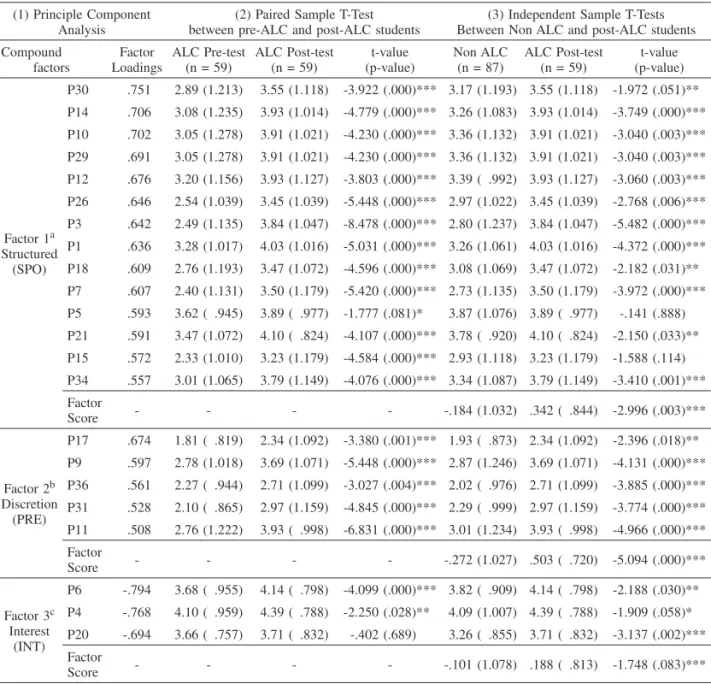
Principal component analysis was performed to reduce the 36 perception scales for the data collected from the post-test. This analysis uses the Oblimin rotation technique to assist with the interpretation of potential influential factors. Table 3 (1) shows the extracted components, Cronbach’s α, eigenvalues, and percentage of variance from the analysis outcome. Applying Cattell’s scree test, three factor scores were derived from the 36 original variables. We comprehensively interpret the results to provide appropriate labels of the extracted factors as per similar prior studies, such as Wells (2019), McDowall et al. (2012), Byrne and Willis (2005), and Saemann and Crooker (1999).
With regard to this analysis (see Table 3 [1]), 14 adjectives were loaded as the first component from the original 36 adjectives. Of the 14 attributes, nine aggregated variables of P1, P3, P7, P10, P14, P15, P26, P29, and P30 are assigned interchangeably with the “Structured” label by Saemann and Crooker (1999) or “Structured/Compliance-driven” label by Byrne and Willis (2005) and Dowall et al. (2012).
For the other two attributes of P12 (Extrovert/Introvert) and P18 (Number oriented/ People-oriented), Saemann and Crooker (1999) and Wells (2019) label them as “Solitary.” In this study, these two variables are not compiled as an individual factor but incorporated as a part of the major compound factor. “Solitary” is eventually the factor related to the people-involved aspect; hence, P12 and P18 may react with other variables compiled in the same factor, such as creative thinking (P1) or alternatively judging (P23), which are similarly regarded as people-involved aspects. Further, participating students may think whether an image of accounting would be structured or not is also dependent on the degree of people involved in the accounting judgment and decision processes. With this preliminary interpretation, we
consider the “Structured/People-orientation” (SPO) label as the largest component factor. Second, regarding the second factor, the five variables of P9, P11, P17, P31, and P36 are compounded. In a prior study, these factors are coincidentally attributed to the factor label “Precision” (PRE) by Saemann and Crooker (1999). All factors compiled in this factor are related to discretions at the point of decisions regarding whether the individuals would simply comply with conventional rules or could possibly create new solutions. By following the prior study, we label this second largest component factor as the PRE.
Finally, the third factor’s label is set as the “Interest” (INT), since Saemann and Crooker (1999), Wells (2019), and Dowall et al. (2012) include the same three variables of P4, P6, and P20, and label the factor as the INT.
Notably, all the scores of the variables in SPO for the pre-test are closer to neutral (between 2.50 and 3.50), except for P5 (Easy/Challenging). Regarding the PRE, P17 (Planned/Spontaneous), P36 (Mathematical/Verbal), and P31 (Methodical/Novelty) for the pre-test were closer to the left-hand words (less than 2.50). That is, the subject’s image is more compliance-oriented than discretional. As for the INT, the scores of all three attributes were over 3.50 for the pre-test. That is, the subjects’ interest in accounting was higher from the beginning.
Our study also conducted paired samples t-tests to observe changes in perceptions of accounting between the pre-test and postest (Table 3 [2]). We extract the results of the t-tests only for the variables loaded by the principal component analysis in Table 3 (2). The results report significant differences in 19 items (P1, P3, P6, P7, P9, P10, P11, P12, P14, P 15, P17, P18, P21, P26, P29, P30, P31, P34, and P36), P4, and P5 at the 1%, 5%, and 10% levels, respectively. No significant differences were found in P20. Compared with the mean scores for the pre-test, all variables containing SPO and PRE significantly changed their post-test scores in more positive ways. Moreover, the scores of two attributes, including in the INT, also changed significantly from those of the pre-test, except for a non-significant variable of P20. Thus, the ALC significantly changes students’ perceptions that accounting is more unstructured with people-orientation (SPO), more discretional (PRE), and more interesting (INT). Given this result, H1-1 is supported by this analysis.
Table 3 (3) demonstrates the results of the t-tests for the subjects’ perceptions of accounting between ALC (experimental) and non-ALC (control) student groups. Regarding the scores of non-ALC students, the trends of the results are similar to those of the pre-test in Table 3 (2). Almost all attributes from SPO were closer to neutral, except for P5 (Easy/ Challenging) and P21 (Monotonous/Fascinating). Regarding PRE, the three attributes of P 17, P36, and P31 for the non-ALC group were closer to the left-hand words. That is, the image is more compliance-oriented than discretional. Regarding the INT, the scores of two attributes for P6 (Dull/Exciting) and P4 (Boring/Interesting) were over 3.50, indicating that
Table 3. The Results of Principle Component Analysis and T-tests
(1) Principle Component Analysis
(2) Paired Sample T-Test between pre-ALC and post-ALC students
(3) Independent Sample T-Tests Between Non ALC and post-ALC students Compound factors Factor Loadings ALC Pre-test (n = 59) ALC Post-test (n = 59) t-value (p-value) Non ALC (n = 87) ALC Post-test (n = 59) t-value (p-value) Factor 1a Structured (SPO) P30 .751 2.89 (1.213) 3.55 (1.118) -3.922 (.000)*** 3.17 (1.193) 3.55 (1.118) -1.972 (.051)** P14 .706 3.08 (1.235) 3.93 (1.014) -4.779 (.000)*** 3.26 (1.083) 3.93 (1.014) -3.749 (.000)*** P10 .702 3.05 (1.278) 3.91 (1.021) -4.230 (.000)*** 3.36 (1.132) 3.91 (1.021) -3.040 (.003)*** P29 .691 3.05 (1.278) 3.91 (1.021) -4.230 (.000)*** 3.36 (1.132) 3.91 (1.021) -3.040 (.003)*** P12 .676 3.20 (1.156) 3.93 (1.127) -3.803 (.000)*** 3.39 ( .992) 3.93 (1.127) -3.060 (.003)*** P26 .646 2.54 (1.039) 3.45 (1.039) -5.448 (.000)*** 2.97 (1.022) 3.45 (1.039) -2.768 (.006)*** P3 .642 2.49 (1.135) 3.84 (1.047) -8.478 (.000)*** 2.80 (1.237) 3.84 (1.047) -5.482 (.000)*** P1 .636 3.28 (1.017) 4.03 (1.016) -5.031 (.000)*** 3.26 (1.061) 4.03 (1.016) -4.372 (.000)*** P18 .609 2.76 (1.193) 3.47 (1.072) -4.596 (.000)*** 3.08 (1.069) 3.47 (1.072) -2.182 (.031)** P7 .607 2.40 (1.131) 3.50 (1.179) -5.420 (.000)*** 2.73 (1.135) 3.50 (1.179) -3.972 (.000)*** P5 .593 3.62 ( .945) 3.89 ( .977) -1.777 (.081)* 3.87 (1.076) 3.89 ( .977) -.141 (.888) P21 .591 3.47 (1.072) 4.10 ( .824) -4.107 (.000)*** 3.78 ( .920) 4.10 ( .824) -2.150 (.033)** P15 .572 2.33 (1.010) 3.23 (1.179) -4.584 (.000)*** 2.93 (1.118) 3.23 (1.179) -1.588 (.114) P34 .557 3.01 (1.065) 3.79 (1.149) -4.076 (.000)*** 3.34 (1.087) 3.79 (1.149) -3.410 (.001)*** Factor Score - - - - -.184 (1.032) .342 ( .844) -2.996 (.003)*** Factor 2b Discretion (PRE) P17 .674 1.81 ( .819) 2.34 (1.092) -3.380 (.001)*** 1.93 ( .873) 2.34 (1.092) -2.396 (.018)** P9 .597 2.78 (1.018) 3.69 (1.071) -5.448 (.000)*** 2.87 (1.246) 3.69 (1.071) -4.131 (.000)*** P36 .561 2.27 ( .944) 2.71 (1.099) -3.027 (.004)*** 2.02 ( .976) 2.71 (1.099) -3.885 (.000)*** P31 .528 2.10 ( .865) 2.97 (1.159) -4.845 (.000)*** 2.29 ( .999) 2.97 (1.159) -3.774 (.000)*** P11 .508 2.76 (1.222) 3.93 ( .998) -6.831 (.000)*** 3.01 (1.234) 3.93 ( .998) -4.966 (.000)*** Factor Score - - - - -.272 (1.027) .503 ( .720) -5.094 (.000)*** Factor 3c Interest (INT) P6 -.794 3.68 ( .955) 4.14 ( .798) -4.099 (.000)*** 3.82 ( .909) 4.14 ( .798) -2.188 (.030)** P4 -.768 4.10 ( .959) 4.39 ( .788) -2.250 (.028)** 4.09 (1.007) 4.39 ( .788) -1.909 (.058)* P20 -.694 3.66 ( .757) 3.71 ( .832) -.402 (.689) 3.26 ( .855) 3.71 ( .832) -3.137 (.002)*** Factor Score - - - - -.101 (1.078) .188 ( .813) -1.748 (.083)***
Extraction Method: Principal Component Analysis.
Rotation Method: Oblimin with Kaiser Normalization; Rotation converged in 14 iterations. Factor loadings > .5 reported
Kaiser-Myer-Olkin (KMO) Measure of Sample Adequacy value is .834 Bartlett’s Test of Sphericity value is significant (Approxχ2=1787.416, p < .000)
***, **, * indicate two-tailed statistical significance at the 1 percent, 5 percept and 10 percent levels, respectively. aEigenvalue = 8.329, % of Variance = 26.030, Cronbach’s Alpha = .881.
bEigenvalue = 2.897, % of Variance = 9.052, Cronbach’s Alpha = .688. cEigenvalue = 2.410, % of Variance = 7.532, Cronbach’s Alpha = .740.
the subjects’ interest in accounting was higher even among non-ALC students.
In the t-test between ALC and Non-ALC students, 20 out of 22 attributes were significant. Thus, the students’ perceptions of accounting improved positively after their participation in ALC, compared with the scores of the control group, especially for 20 perception attributes (P1, P3, P4, P6, P7, P9, P10, P11, P12, P14, P17, P18, P20, P21, P26, P29, P30, P31, P34, and P36). No significant differences were found in the remaining two items (P5 and P15). Although these two t-tests reported no significant results, the score of P 15 (Facts/Intuition) for ALC students was nearly closer to neutral, whereas the score of P5 (Easy/Challenging) was over 3.50. Since these original scores are high enough before attending ALC, this does not affect the overall trend of the interpretations. Thus, the results indicate that ALC significantly changes perceptions among ALC students ― that accounting is more unstructured with people-orientation (SPO), more discretional (PRE), and more interesting (INT) ― than among non-ALC students.
Further, we conducted t-tests to compare the scores of the factor scores of each compiled factor of SPO, PRE, and INT. The results show that the scores of the three factor scores for ALC at the post-test were significantly higher than those of non-ALC students (t [146] = -2.996, p < .01 for SPO; t [146] = -5.094, p < .01 for PRE; t [146] = -1.748, p < .10 for INT). This finding also indicates that H1-2 is supported by this analysis.
5.2 Effect of Change in Perceptions of Accounting on the Learning Approach (RQ2)
Learning Approach
Table 4 (1) reports the t-test results for the scores of the two learning approaches before and after ALC. We find that the deep approach of learning (DA) significantly increased from the pre-test to the post-test. In contrast, we find no significant change in terms of the surface approach of learning (SA). Thus, students are inclined to adopt a deep learning approach after participating in the ALC, while the ALC itself does not reduce the adoption of a surface learning approach. Therefore, H2-2 is supported only for the deep learning approach.
Table 4 (2) also shows the statistical comparison in the scores of learning approach between the control group and experimental ALC student groups. We found that the scores of DA for ALC students are significantly larger than those of non-ALC students. On the other hand, there is no significant difference in the score of the surface learning approach between the non-ALC and ALC students’ groups. These results affirmed H2-3 for the deep approach.
These analysis results indicate that students’ participation in ALC significantly increases their adoption of the deep learning approach in accounting than before attending to the ALC.
Table 4. T-test Results in Learning Approach
mean (S.D.)
(1) Paired Sample T-Test Between pre-ALC and post-ALC students
(2) Independent Sample T-Tests Between Non ALC and post-ALC students ALC students Pre-test (n = 59) ALC students Post-test (n = 59) t-value (p-value) Non ALC students (n = 87) ALC students Post-test (n = 59) t-value (p-value) DA 30.79 (6.06) 34.57 (7.54) -4.690 (.000)*** 32.52 (5.91) 34.57 (7.54) -1.751 (.083)* SA 21.74 (5.18) 21.18 (6.70) .718 (.476) 21.27 (5.66) 21.18 (6.70) .083 (.934) ***, * indicate two-tailed statistical significance at the 1 percent and 10 percent levels, respectively.
5.3 Regression Results in the Post-Test
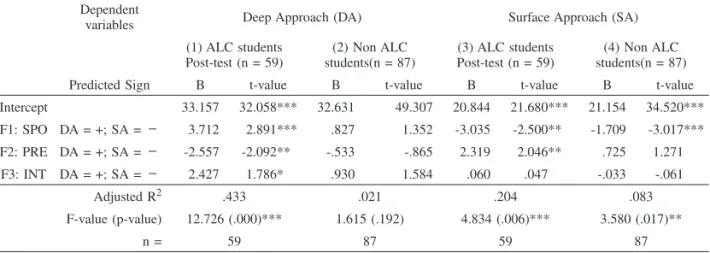
Table 5 demonstrates the results of multiple regression analyses using two scales of learning approaches (DA and SA) with the perceptions of accounting (SPO, PRE, and INT) in the post-test. The predicted signs are also shown in Table 5 with respect to H2-1. These predicted signs indicate that increasing the scores of perceptions at the post-test would indicate an improvement in accounting perceptions. Better perceptions would then be associated with the deep learning approach. In total, four regression analyses were performed to examine the statistical associations between the two types of learning approaches and perception profiles between two student groups (ALC and non-ALC student groups).
Between the four regressions, the results demonstrate that three models of DA with ALC students (F [3, n=58] =12.726, p <0.01) in Table 5 (1), SA with ALC students (F [3, n=58]
Table 5. Regression of Perception of Accounting on Learning Approach
B (t-value)
Dependent
variables Deep Approach (DA) Surface Approach (SA)
(1) ALC students Post-test (n = 59) (2) Non ALC students(n = 87) (3) ALC students Post-test (n = 59) (4) Non ALC students(n = 87)
Predicted Sign B t-value B t-value B t-value B t-value
Intercept 33.157 32.058*** 32.631 49.307 20.844 21.680*** 21.154 34.520*** F1: SPO DA = +; SA =− 3.712 2.891*** .827 1.352 -3.035 -2.500** -1.709 -3.017*** F2: PRE DA = +; SA =− -2.557 -2.092** -.533 -.865 2.319 2.046** .725 1.271 F3: INT DA = +; SA =− 2.427 1.786* .930 1.584 .060 .047 -.033 -.061 Adjusted R2 .433 .021 .204 .083 F-value (p-value) 12.726 (.000)*** 1.615 (.192) 4.834 (.006)*** 3.580 (.017)** n = 59 87 59 87
***, **, * indicate two-tailed statistical significance at the 1 percent, 5 percept and 10 percent levels, respectively. t-statistics are reported in parentheses below each coefficient.
=4.834, p <0.01) in Table 5 (3), and SA with non-ALC students (F [3, n=58] =3.580, p <0.05) in Table 5 (4) are statistically significant. In contrast, only one regression for DA with non-ALC students shows no significant result (F [3, n=58] =1.615, p =.192) in Table 5 (2).
As for the two significant regressions for ALC students (Table 5 [1] and [3]), the two compiled factors of SPO and PRE are statistically associated with each learning approach.
Between these two variables, SPO is consistent with the predicted sign, while PRE is not. Further, INT is significantly associated DA but not SA. Regarding the significant result for non-ALC students (Table 5 [4]), SA has a significant association with SPO. The other two factors of PRE and INT fail to show significant relationships with SA.
6. Discussion and Implications
6.1 Association between Perceptions of Accounting and Learning Approaches
Our findings show that the students’ profile of perceptions of accounting after the ALC is significantly correlated with the deep learning approach. In addition, our t-test results reported that ALC students’ perceptions at the post-test changed (more unstructured with people orientation, more discretional, and more interested), compared with the data at the pre-test and the data for the non-ALC students’ group. Given the combinations of these results, we interpret that the students’ perceptions of accounting alter on account of their participation in the ALC. Further, students are likely to apply a deep learning approach, but reluctant when their perceptions in the initial perception profile remain even after participating in the ALC. This finding empirically confirms that ALC is an effective tool to enhance students’ deep learning through altering their perception profiles.
However, prior studies report mixed results on the effectiveness of active learning materials as the pedagogy to acquire a deep learning approach (e.g., Wells 2019; Wynn-Williams et al. 2016; Phillips and Graeff 2014; Metrejean et al. 2002), but the present research successfully shows statistical evidence of a positive association between perceptions and learning approaches, although the course offers a short time activity. Additionally, most prior studies use active learning materials simply as proxies for effective interventions, while we ensure that deep learning is strongly adopted by students only when their participation in ALC changes their perceptions of accounting.
Similar to the regressions for the deep approach, our regression results for the surface approach also confirm that the participating students perceived accounting as less negative. Such perceived traits significantly discourage the adoption of a surface approach. This finding is widely supported by the literature (Wells 2019; Ma et al. 2016; Duffs and Mladenovic 2015; Ferreira and Santoso 2008; Jackling 2005). However, our t-test results reveal that the students who attend ALC do not change the adoption of the surface
approach. Thus, although the ALC influences students’ perceptions, such changes in perceptions do not assist significantly in altering their surface learning approach.
Consequently, we find that adopting a deep learning approach is subject to one’s perceptions toward accounting, but this does not occur for the surface approach. Altering the image of accounting does not influence the tendency to adopt a surface approach.
6.2 Image of Modern Professional
We find that the students’ profile of perceptions of accounting is not negative, even before they participate in the ALC. Our participants initially do not express skewed images of accounting as too structured, because most of the compiled variables from SPO are nearly neutral. For example, the subjects initially perceived accounting as a challenging and fascinating subject even before participating in the ALC. They also originally believed that accounting is an interesting and exciting subject. In contrast, we also confirm that they strongly perceive accounting to be a subject with strong compliance but less discretion, since the scores of the compiled variables from PRE are rated relatively lower both in the pre-test and control groups.
This finding is partly consistent with the image of the modern professional in Caglio et al. (2019), whose results show that accounting is considered honest and not boring. In their study, the factor of “Honest” is compiled by “Complies with law,” “Behaves ethically,” and “Trustworthy,” whereas the factor of “Boringness” is compiled by “Boring,” “Sad,” and “Shy” (Caglio et al. 2019). This commonality with our study arises because the current research subjects are similar. Our participants were undergraduate Italian students aspiring to become accountants in the near future. Similarly, Caglio et al. (2019) also contended that the image of modern professionals is thought to be portrayed by people who are close to becoming accountants. Thus, the findings of the present study support Caglio et al.’s evidence ― that is, the common image of accounting among Italian undergraduate students.
Further, our t-test results indicate that students’ perceptions of this modern professional has become more unstructured with people-orientation, more discretional, and more interesting owing to the ALC, compared with the data in the pre-test and the data for the non-ALC students group. The implications of this outcome will be explained as per each of the three compiled factors of perceptions.
6.3 Structured Image of Accounting
Regarding the structured image of accounting, Wells (2019) contends that there is general agreement that accounting is perceived as more structured among people regardless of their previous experience of accounting. However, our study confirms that ALC works effectively to persuade participants that accounting is a more unstructured type subject, whereby
perception surely enhances the deep learning approach. This might be due to the ALC, which provides students with opportunities to face more unstructured problems, and the experiences thereof might reflect students to change their view of accounting.
In the ALC, we prepared many tasks focusing on judgment and decision-making to ensure students confronted unstructured problems and did not resort to memorization and rote learning. This implies that the experience of a constructivist pedagogy that incorporates unstructured aspects is crucial to changing the students’ learning approaches (Bevinakoppa et al. 2016; Hodges 2011).
Moreover, our principal component analysis result indicates that this unstructured image, after the ALC, also incorporates higher involvement of people-related aspects. This aspect, in turn, accelerates the image of accounting to be more extroverted and people-oriented, and thus fostering people-related skills among students, such as communication and interpersonal skills. Such generic skills are thought to be highly relevant to deep learning approaches in accounting, especially owing to the effects of AI and robotics (ICAEW 2018; ACCA 2016), since generic skills are still difficult to automate.
Thus, we suggest stronger emphasis on using active learning methods, including GBL, in order to enhance students’ image of accounting to be more unstructured and people-oriented. This is an effective way to urge young candidates in accounting to redevelop their skills for future work.
6.4 Conformity Image of Accounting
Our regression result also reveals that the participant’s image of PRE is significantly correlated with both deep and surface approaches among ALC students. However, we find that the associations between the dependent and independent variables are negative for both regressions. That is, ALC students adopt a deep approach when they perceive accounting as a rule- or standard-oriented subject. In contrast, those holding perceptions of originality and spontaneity tend to adopt a surface approach.
Prior research contends that pervasive views of conformity among students about learning accounting are generally associated with rote learning strategies, including memorizing accounting standards, learning specific knowledge, and accurate mathematical calculating. This trait is more likely to employ learners’ surface approaches than deep learning (Flood and Wilson 2008; Lucas 2000). However, our finding reports that a negative association between PRE and the deep approach stands in contrast with the predicted signs of PRE. This finding was unanticipated.
In the ALC, participants can avoid technical tasks by using a computer and Excel worksheet that allows them to concentrate more on discretional decision-making and original judgment. However, if they recognize the basic importance of standards conformity
and accurate calculation in the ALC for deep learning, then perception-related responses would be negatively associated with the adoption of surface approach, as we see in our result. If we regard lower PRE as a high demand of basic knowledge and calculation skills for accounting (Conformity for P9; Standard Operating Procedures for P11; Mathematical for P36), our result remains consistent with Mala and Chand (2015). These authors find that numerous studies (e.g., Libbey and Luft 1993; Bedard and Graham 1994) empirically ensure that fundamental knowledge interacts with the ability to determine judgment. Other prior studies also affirm this interpretation because they contend that surface approaches and strategies are required to progress to higher levels of deep understanding in the accounting context (Hall et al. 2004; Birkett and Mladenovic 2002). These extant studies support our findings.
In addition, the perception of conformity that focuses on importance in rules compliance and accurate calculation does not necessarily stand for the adoption of a surface approach. For example, Sangster (2010) indicates that strong attention to technical knowledge of double-entry bookkeeping facilitates the development of higher order thinking skills when people start learning at an earlier stage of tertiary school. This study implies that an emphasis on the conformity aspect of accounting can draw a deep approach to learning. Given the implication of Sangster’s (2010) work, we interpret our findings as follows: A strong perception of conformity can be associated with a deep approach depending on whether its image is favorable. Prior studies define conformity image as an unfavorable one (Saemann and Crooker 1999; Byrne and Willis 2005; McDowall et al. 2012; Wells 2019), while our participants expressed a favorable image of conformity. This interpretation is also consistent with Caglio et al. (2019), who expressed strong pride in honesty (including conformity aspect) for the professions.
Moreover, this favorable status relies on how successfully educators facilitate pedagogies. Sangster (2010) eventually used Luca Pacioli’s Summa arithmetica in 1494 as his teaching material to conduct active learning, and achieved positive results to generate deep learning outcomes. As far as students hold strong but favorable perceptions of conformity, this image can foster their engagement with the process of deep understanding. The key to achieving an effective deep approach with a strong conforming image is through understanding how one can facilitate active learning materials to trigger appropriate learning.
6.5 Image of Interest
Regarding the image of interest in accounting, our research finds significant differences in its score between the pre-test and post-test. Moreover, participants of this action research were fully motivated even before participating in the ALC. Eventually, the scores of the items loaded for INT were improved dramatically in the post-test compared with those of
the pre-test among ALC students. Our regression results also confirm the positive effect of interest in accounting for empowering learners’ deep approach. The other three regressions report no significant associations between INT and learning approaches.
This finding is supported by the theory in the literature, where a deep approach to learning is characterized by a stronger interest in the subject (Biggs 1987). In addition, a previous study states that positive perceptions, including interests in accounting, can cause an increase in motivation and cognitive processing (Ferreira and Santoso 2008), which is the essence of the deep approach. Moreover, using GBL as a learning material is another important aspect to obtain our significant result because prior studies prove that it can produce affective learning outcomes that help improve learners motivation, engagement, and interests (Carenys and Moya 2016; Vlachopoulos and Makri 2017). In particular, our study admits that the ALC using LEGO game improves students’ level of interest when it has already been evaluated higher before the ALC owing to their stereotype of the modern profession (e.g., Caglio et al. 2019). This is important evidence ― that accounting curriculum coordinators should seek room in the curricula and programs to incorporate teaching materials that can elevate learners’ high enough interest in order to deploy their deep approach of learning.
7. Conclusion
The explicit contribution of the present study is that we successfully clarified the types of students’ perception profiles regarding accounting that is affected by a relatively short-term active learning course, which ultimately shifts learning approaches toward deep learning. This research provides practical guidelines on how educators and program coordinators can arrange active learning in the programs or curricula for the purpose of training students’ higher cognitive and generic skills. One primary limitation is that we address only one case of ALC at a certain point of the time, and the results may not be generalizable. In addition, a longitudinal study is relevant to investigate the impact of ALC on changes in students’ intrinsic interest to compare with findings of the present study that deal with a short-time active learning activity. These flaws should be addressed in future studies.
Acknowledgement: The author is grateful for research fund provided by JSPS KAKEN, Fund for the Promotion of Joint International Research (Fostering Joint International Research (A) 18KK0372.
References
Abeysekera, I. 2006. Issues relating to designing a work-integrated learning program in an undergraduate accounting degree program and its implications for the curriculum. Asian-Pacific Journal of Cooperative Education 7 (1): 7-15.
Accounting Education Change Commission (AECC). 1990. Position and issues statements of the Accounting Education Change Commission. Position statement number one: Objectives of education for accountants. In American Accounting Association, Accounting Education Series (Vol. 13). http:// aaahq.org/AECC/PositionsandIssues/pos1.htm
Adobor, H., and A. Daneshfar. 2006. Management simulation: Determining their effectiveness. The Journal of Management Development 25(2): 151-168.
Albrecht, W. S., and R. J. Sack. 2000. Accounting Education: Charting the Course through a Perilous Future, Accounting Education Series, 16. Sarasota, FL: The American Accounting Association.
Ampountolas, A., G. Shaw, and S. James. 2019. Active learning to improve self-confidence and decision-making skills through the use of hotel simulation. Journal of Hospitality & Tourism Education 31(3): 125-138.
American Institute of Certified Public Accountants (AICPA). 1999. Core Competency Framework for Entry into the Accounting Profession. New York: AICPA.
Anderson, P. H., and L. Lawton. 2009. Business simulations and cognitive learning: Developments, desires and future directions. Simulation and Gaming 40(2): 193-216.
Bedard, J. C., and L. E. Graham. 1994. Auditors’ knowledge organization: Observations from audit practice and their implications. Auditing: A Journal of Practice & Theory 13 (1): 73-83.
Bevinakoppa, S., B. Ray, and F. Sabrina. 2016. Effectiveness of problem-based learning implementation. International Journal of Quality Assurance in Engineering and Technology Education 5(3): 1-13. Biggs, J. B., D. Kember, and D. Y. P. Leung. 2001. The revised two-factor Study Process Questionnaire:
R-SPQ-2F. British Journal of Educational Psychology 71 (1): 133-149.
Biggs, J. B. 1987. Student Approaches to Learning and Studying. Camberwell, Vic.: Australian Council for Educational Research.
Biggs, J. B. 1993a. What do inventories of students’ learning processes really measure? A theoretical review and clarification. British Journal of Educational Psychology 63, 1-17.
Biggs, J. 1993b. From theory to practice: A cognitive systems approach. Higher Education Research and Development 12, 73-86.
Bobe, B. J., and B. J. Cooper. 2020. Accounting students’ perceptions of effective teaching and approaches to learning: Impact on overall student satisfaction. Accounting and Finance, 60 (3), 2099-2143.
Bonner, S. E. 1999. Choosing teaching methods based on learning objective: An integrative framework. Issues in Accounting Education 14(1): 11-39.