平成 28 年度厚生労働行政推進調査事業費補助金
(厚生労働科学特別研究事業:H28‑特別‑指定‑016)
分担研究報告書
脳の機能的・解剖学的側面から見た大麻の有害性に関する調査研究
分担研究者:山本経之 (長崎国際大学大学院薬学研究科 薬理学研究室)
研究協力者:山口 拓、福森 良 長崎国際大学大学院薬学研究科 薬理学研究室)
【研究要旨】
本調査研究は、近年増加傾向にある大麻乱用を念頭に、大麻/THC/CBDの脳への機能的/解 剖学的側面から見た作用を最近の基礎・臨床の論文を基に調査することを目的としている。
大麻の薬理作用は、1)曝露期間 (短期間・長期間)、2)摂取量 (少量・多量)、3)摂取時・
退薬時、 4)摂取時期(青少年期・成年期) および 5)作用部位(末梢・中枢)によって変容して いる。また、大麻の常習により、脳の精神的機能に変容を起こすだけでなく、内側側頭皮質、側 頭極、海馬傍回、島、眼窩前頭皮質等での灰白質体積の減少と言う脳の形態学的変化も起こすこ とを指摘した報告が集積されつつある。さらに、これらの大麻の影響は、大麻使用の時期によっ て異なることが明らかにされている。即ち、青少年期の大麻乱用は成人期での大麻使用に比べて、
統合失調症を初めとする精神疾患の発症リスクが増加し、重篤かつ持続的な悪影響を及ぼすこと が基礎ならびに臨床実験から明らかにされている。更に、大麻乱用は脳のこの機能的障害のみな らず、青少年期に構
z 築される脳・神経系の正常な発達と成熟にも障害を起こす可能性が強く示唆されている。こ れらの知見は、青少年の脳が成人の脳に比べて大麻曝露の影響を受けやすいことを意味してい る。
近年のこれからの報告を基に、大麻の有害性を科学的に総括する意義は大きく、今後の大麻乱 用防止の為の教育的また行政的な方策の決定にも重要な指針を与えるものと考えられる。
A. 研究目的
大麻は、若者を中心に近年最も広く乱用され ている規制薬物である。大麻の有害性について は、1)曝露期間 (短期間・長期間)、2)摂取 量 (少量・多量)、 3)摂取時・退薬時、 4)
摂取時期(青少年期・成年期) および 5)作用部 位(末梢・中枢)の相違によって必ずしも一定の 結論が得られている訳ではない側面もある。大 麻の有害性に関する最近の報告に焦点を当て、
脳の高次機能を中心に調査研究を実施し、妥当 性のある科学的総括を加えることは重要な意 義があり、今回の目的とする所である。また、
臨床研究と基礎研究(動物実験)との 2 つを調
査研究対象として、動物実験での基礎的結果が 大麻の臨床知見と如何なる相関性・予測性を有 しているかを追究し、引いては THC 曝露時/退 薬時での臨床症状の発現機序を動物実験の研 究成果から推察する可能性も検討した。
B. 研究方法
「大麻、マリファナ、9-テトラヒドロカンナ ビノール(THC),カンナビジオール(CBD)」
のキーワードをリストアップの上、Pub.Med.等 のタイトルから動物での薬理研究論文ならび に臨床研究論文から適切と思われる論文294報 を選出した。更に下記のsubstanceおよびindex
を基に分類した。
Substance Index
A) Marijuana / Cannabinoid B) THC
C) CBD D) Stimulants E) Others
F) Endocannabinoid Subject Index
1) Toxicology 1-1) General
1-1-1) Central toxicology 1-2-2) Peripheral toxicology 1-2) Memory / Cognition 1-3) Abnormal behaviors 1-4) Others
2) Clinical benefit 2-1) Central 2-2) Peripheral
その上で、以下の5編の総説論文と臨床を中 心に20論文の要旨を精査した。
1)Long-term effects of cannabis on brain structure.
Neuropsychopharmacology, 2014, 39, 2041-2048 2) Cannabis and adolescent brain development.
Pharmacol Ther. 2015 Apr; 148:1-16. Review.
3) The Role of Cannabinoids in Neuroanatomic Alterations in Cannabis Users. Biol Psychiatry.
2016 Apr 1; 79(7): e17-31. Review.
4) What Can Rats Tell Us about Adolescent Cannabis Exposure? Insights from Preclinical Research.
Can J Psychiatry. 2016 Jun; 61(6): 328-34. Review.
5) Keep off the grass? Cannabis, cognition and addiction. Nat Rev Neurosci. 2016 May; 17(5):
293-306. Review.
C. 研究結果 1) 大麻による中枢薬理作用
1)−1 動物実験
カンナビノイドの短期間投与による脳に及
ぼす影響は様々な要因(年齢、曝露期間、用量、
細 胞 の 種 類 な ど ) に 依 存 し 異 な っ て い る
(Downer & Campbell, 2010)。カンナビノイドは、
投与した用量に依存して薬理作用が異なり、高 用量(1〜10 mg/kg)投与の場合では神経保護作 用を発現するのに対し、低用量投与の場合では 逆 に 軽 度 の 脳 障 害 を 誘 発 す る (Sarne &
Mechoulam, 2005)。しかしながら、カンナビノ
イドの短期間投与は、脳障害の保護(Lafuente et al., 2011)や神経炎症の抑制(Elliott et al., 2011)
が報告されている。培養皮質ニューロンに高用 量あるいは低用量の THC を添加すると、アポ トーシスが惹起され(Downer et al., 2001)、カン ナビノイド類の中でも THC は最も強い神経毒 性 を 持 つ こ と が 示 唆 さ れ て い る (Sarne &
Mechoulam, 2005)。
また、カンナビノイドの長期投与による神経 保護作用は、動物モデルを用いた広範な検討が なされている(Galve-Roperh et al., 2008;Sarne et
al., 2011)。THCを含むカンナビノイドの高用量
を短期間〜中程度期間投与すると(例:1〜30
mg/kg、3〜25日間投与)、脳損傷後の神経細胞
死(Femández-López et al., 2010、2012;Perez et al., 2013)および神経毒による細胞死(Shen et al., 2011)は抑制される。また、カンナビノイドの 長期投与により、免疫抑制作用と抗炎症作用が 発現する(Klein, 2005)。
1)−2 臨床研究
大麻の短期間摂取により、ヒトは知覚のゆが み、多幸症と安らぎ、知覚亢進、不快反応(不 安、浮動性めまい、空腹など)等々の中枢神経 作用を呈する(Zuurman et al., 2009)。脳機能に 関する急性大麻中毒の報告では、皮質(特に前 頭葉)、辺縁系、傍辺縁系、小脳の各領域を通じ て局所脳血流量(rCBF)の増大(Quickfall &
Crockford, 2006)が認められ、またこのrCBFの
増大と中毒の主観的感覚には正の相関が認め られている(Gonzalez, 2007)。大麻摂取による 快作用と不快作用の出現は、THC とCBDの異 なる作用に起因していると考えられる。
動物試験では神経保護作用が認められてい
るが、ヒトでのデータはない。ヒトでのミクロ グリア細胞(Klegeris et al., 2003)ならびにアス トロサイト細胞(Sheng et al., 2005)を用いたIn
vitro試験では、カンナビノイドはドーパミン作
動性ニューロン(Hu et al., 2013)を神経毒から 保護することが分かっている。これは、炎症関 連物質の産生阻害に起因するものと考えられ る。
重度の大麻常用者の退薬時には、前頭前皮質 と眼窩前頭皮質(Sevy et al., 2008)、線条体(Sevy et al., 2008)、小脳(Block et al., 2000)、側頭葉
(Amen & Waugh, 1998)、脳全体(Mathew et al.,
1989)の rCBF は減少している。しかし、これ
らの脳領域における変容は、必ずしもすべての 研究で一致している訳ではなく、亢進(Herning et al., 2005;Sneider et al., 2008)または無作用
(Mathew et al., 1986)という報告もある。一方、
短期間の大麻摂取後では対照的に rCBF の増大 が認められている。
2) 認知・記憶・学習に及ぼす大麻の作用 2)−1 動物実験
成熟期のげっ歯類および霊長類にカンナビ ノイドの短期間投与により、記憶/学習や注意 機能の障害が誘発される(Egerton et al., 2006)。 特に、カンナビノイドは作業記憶を障害する。
ラットの迷路課題(Ferrari et al., 1999)や遅延見 本合わせ課題(Miyamoto et al., 1995)での作業 記憶を障害する。この作業記憶障害はカンナビ ノイドの低用量でも認められている。THCの超 低用量(0.001〜0.002 mg/kg)の単回投与でも、
マウスの空間記憶や作業記憶が長期間にわた って障害されている(Amal et al., 2010)。運動機 能等に影響を及ぼさない極めて低用量である 点から考えると、カンナビノイドは記憶機能に 選 択 的 に 影 響 を 及 ぼ す こ と が 示 唆 さ れ る
(Ranganathan & D Souza, 2006)。
一方、成熟期および幼若期のラットにカンナ ビノイドを 14〜15 日間投与すると、短期記憶
/作業記憶障害および注意機能障害が認めら れる(Verrico et al., 2004)。その障害は、大麻退 薬後でも認められ、5〜10 日間で回復する
(Abush & Akirav, 2012)。THCの90日間投与さ れたラットは作業記憶の障害が認められるが、
その回復には大麻退薬後 30 日間を要した
(Nakamura et al., 1991)。
2)−2 臨床研究
カンナビノイドの短期間摂取により、様々な 認知過程(短期記憶、作業記憶、注意、学習、
遂行機能など)が障害される(Solowij & Pesa, 2012)。大麻およびその主要有効成分である THCを摂取すると、用量依存的に作業記憶とエ ピソード記憶が障害される(Crane et al., 2013)。 大麻中毒中の新たな記憶が損なわれ、その結果 として、これらの記憶の想起/再生が障害され る。一方、大麻摂取前に固定された古い記憶は、
大麻摂取による影響を受けない。大麻による作 業記憶障害は、 情報の保持よりも想起/再生 の障害と考えられる。
このように、大麻は動物モデルにおいて健忘 誘発作用を示すことが明らかとなっているが、
以下のような知見も報告されている。1)記憶に 関連している脳領域(海馬、扁桃体、前頭前皮 質など)には、カンナビノイド受容体が高密度 に存在している、2)THC は海馬において可塑 性障害(LTP、LTDを含む)を起こし、海馬と 前頭前皮質のアセチルコリン遊離を減少させ る。
また、大麻の記憶に対する障害は、特定のカ ンナビノイドの摂取に依存しているとの報告 もある。大麻の常習者の中で、CBDがより高濃 度に含まれている大麻を喫煙すると、THCの記 憶障害が軽減される(Morgan et al., 2010)。大麻 使用者を対象とした研究においても、THCによ る急性記憶障害に対する CBD の抑制効果が認 められている(Englund et al., 2013)。一方、CBD 単独では、恐怖記憶の消去が阻害される(Das et
al., 2013)。これらの事より、CBDとTHCは、
ヒトにおける記憶機構の中では、拮抗的作用を 持 つこと が示唆 される(Bhattacharyya et al., 2010)。
新たなエピソード記憶の障害は、断薬から数 日間の持続的障害が見いだされているが、使用
開始から 28 日後に持続的障害が認められるこ とはない(Crane et al., 2013)。
3)大麻による幼若期・青少年期の影響 3)−1 動物実験
げっ歯類における THC の反復投与による作 業記憶、物体認識記憶およびプレパルス・イン ヒビションに対する障害は、成熟期よりも幼若 期に投与されると、その障害の程度が大きいこ とが知られている(Lubman, et al., 2015)。例えば、
幼若期ラットへの CB1 受容体作動薬あるいは THC の長期投与により物体認識記憶は持続的 に障害されるが、成熟期ラットでは認められな い(Schneider, M. & Koch, M, 2007; Quinn et al.
2008)。さらに、水迷路試験におけるTHCの単
回投与による空間学習ならびに非空間学習の 障害も、幼若期ラットの方が、成熟期ラットよ りも強く発現する(Cha, et al., 2006)。幼若期のサ ルを用いた研究でも同様の結果が報告されて いる(Verrico, et al., 2014)。このように、神経回路 が活発に成熟する発達段階における THC 等の カンナビノイドの投与は、持続的な認知機能障 害を誘発することが実験動物を用いた研究か ら明らかとなっている。
3)−2 臨床研究
青少年期に大麻の使用を始めた場合、大麻に よる脳構造や認知機能に対する障害は、成年期 に始めた場合と比較して、より大きいとする報 告は多いが、成人と青少年とを直接的に比較検 討した研究は少ない。一方、青少年と若年成人 の大麻使用者を対象として、脳構造を画像検査 によって検討した研究では、皮質領域と皮質下 領域における容積量の減少が報告されている (Batalla, et al., 2013)。しかし、これらの研究結果 は、まだ統一された見解となってはいない (Jacobus & Tapert, 2014)。一方、拡散テンソル画 像 (Diffusion tensor imaging: DTI) 検査を用い た研究では、白質の統合性(異方性比率がより 低値であること、および平均拡散能がより高値 であることの双方の指標に基づいて評価)は、
大麻を頻繁に使用している青少年群の方が、大 麻を使用していない対照群よりも低下してい
たことが見いだされている(Jacobus & Tapert, 2014)。この白質の統合性の低下は、認知遂行能 力の評価尺度による障害と相関する (Jacobus &
Tapert, 2014)。
また、fMRIを用いた研究では、課題に関連し ている脳領域のBOLD (Blood oxygenation level-
dependent) シグナルは、大麻未使用者群と比べ
て大麻の青少年使用者群の方が、よりも強いこ とが示唆されている(Jacobus & Tapert, 2014)。こ の報告のように、青少年期の大麻使用者は、課 題関連処理を促進する脳領域の神経活動が増 大していることが(これは代償性活動を反映し ている可能性がある)、様々な機能画像検査の 結果から示唆されている。
認知機能の観点から見ると、視空間注意 (Ehrenreich, et al., 1999)、言語の流暢性(Gruber, et al., 2012)の各障害は、大麻の使用を青少年期 に開始した者の方が、成人期に開始した者よ りも大きいことが報告されている。
4)大麻による脳神経解剖学的影響 4)−1 動物実験
CB1受容体が多く発現している海馬(Heath et al., 1980; Scallet et al., 1987; Chan et al., 1998;
Landfield et al., 1988; Lawstone, et al., 2010)、扁桃 体(Heath et al., 1980)、線条体(Kolb et al., 2006)お よ び 前 頭 前 皮 質 (PFC)(Harper et al., 1977;
Downer, et al., 2001; Kolb et al., 2006)において、
THCの神経毒性が認められている。さらに、こ のCB1受容体が豊富な脳領域では、カンナビノ イドの投与量に相当する投与期間に依存して、
局所的容積が減少している(Lawston et al., 2000;
Downer et al., 2001;Burns et al., 2007)。
CB1 受容体が豊富な脳領域(海馬、扁桃体、
小脳、前側帯状皮質)におけるカンナビノイド による局所的容積の減少の機序(図 1)には、
1)THC 誘発性神経毒性[例えば、神経細胞核
および細胞体の萎縮(Heath et al., 1980; Scallet et al., 1987)、シナプス数の減少(Heath et al., 1980)、
錐体細胞密度の減少(Scallet, 1991; Lawstone, et
al., 2010)]に至るTHCおよびその代謝物の神経
細胞内での蓄積(Monnet-Tschudi et al., 2008)、2)
CB1 受容体下流のダウンレギュレーション、
CB1受容体の感作ならびに分子およびシグナル 伝 達 の 変 化(Breivogel et al., 1999; Sim-Selley, 2003; Rubino et al., 2008; Burston, et al., 2010)、3)
灰白質容積に関連する血管分布の変化、ならび にグリアおよびニューロンの樹状突起の減少 (Paus, 2005; Herning, et al., 2005; Hill, et al., 2007) が関与すると考えられている。
4)−2 臨床研究
ヒトの脳構造に及ぼす大麻の長期的使用の 影響に関する研究結果は、様々で一貫性があま りない。その中で、海馬・海馬傍回複合体およ び扁桃体の変容についての研究では、複数の報 告に一定の見解が認められている(Demirakc, et al., 2011; Matochik, et al., 2005; Yüce, et al., 2008;
Zalesky, et al., 2012)。即ち、大麻の長期使用が 記憶、実行機能や感情処理に関連する脳領域に おける高解像度脳構造MRI検査により、この領 域の形態学的変化と関連することが示唆され ている (Yüce, et al., 2008)。つまり、大麻の常 習的喫煙者の海馬体積の減少には、大麻の生涯 使用量と精神病症状の発症と関連している
(Yüce, et al., 2008 ;Ashtari, et al., 2011)。また、
Cousijn ら(2012)は 、Voxel based morphometry
(VBM) での解析による扁桃体と海馬での容積
量減少は、大麻常習者と非大麻使用者の間では 有意差が認められなかった。しかし、大麻の使 用量と大麻依存の重症度では、それぞれの脳部 位での容積減少と相関していることが報告さ れている。
図1. 青少年の脳の発達に対する大麻・カンナビノイドの薬理作用機序
内因性カンナビノイド系は、出生前および出生後早期段階の脳の発達中に神経細胞の産生と特殊化を調節すると共に(陰陽を表す太極図の灰色の 陽側)、成熟脳において神経細胞の維持と神経保護を調節する(陰陽を表す太極図の白色の陰側)。発達中の脳の場合、CB1受容体は、ニューロンの 移動、軸索経路の探索、およびグリア細胞(アストロサイト、オリゴデンドロサイトなど)の産生にも関与している。青少年期に大麻を長期的に使 用すると、内因性カンナビノイド系の機能が破綻して、脳の発達が変化するという大麻・カンナビノイドの作用機序を以下のように2つ提唱する:
1)シナプス刈り込み過程の阻害(赤色の経路)、2)白質の発達の異常(青色の経路)。
出典:Galve-Roperhら(2009)
5)大麻退薬後における持続的な影響
大麻使用で認められる認知障害は、退薬から 4〜6週間持続するが、それ以降の障害は認めら れないという結論になりつつある(Pope et al., 2001; Schreiner et al., 2012)。大麻の長期使用者で は、陽電子放射断層撮影(PET; Positron Emission
Tomography)の所見から皮質のCB1受容体のダ
ウンレギュレーションが認められている。この ダウンレギュレーションは、使用年数と相関す ることも分かっている。一方、この大麻の長期 使用者の CB1 受容体のダウンレギュレーショ ンは、大麻の退薬後 4 週間以内で回復する (Hirvonen et al., 2012)。大麻の長期投与後の脳 CB1受容体のダウンレギュレーションの回復は、
げっ歯類の研究でも示されている(Sim-Selley, 2012)。
大麻退薬後の持続的影響については、退薬期 間、多種多様な因子(アルコールの併用および 大麻使用前の機能レベルの群間差など)のため、
因果関係の結論を導き出すにはまだ困難な状 況にある。
6)大麻の嗜癖と離脱
嗜癖:大麻摂取後に生涯にわたる大麻嗜癖に 至る確率は8.9%と推定されており、この値はコ カイン(20.9%)、アルコール(22.7%)、タバコ
(67.5%)と比べるとかなり低い(Lopez-Quintero et al., 2011)。しかし、北米、欧州、オセアニアの 場合、大麻嗜癖に対する治療の必要性はかなり 増大している(UNODC, 2015)。現時点では、欧 州全土の薬物療法施設への新規登録者は、大麻 の 方 が 他 の 不 正 薬 剤 よ り も 多 い(EMCDDA, 2015)。
離脱・退薬:嗜癖のひとつの側面と考えられ ている退薬症状の発現は、大麻では十分認識さ れている。大麻の退薬症状には、渇望、睡眠の 問題、悪夢、怒り、易刺激性、不快気分、悪心 などが挙げられる(Allsop et al., 2011)。
大麻の常用者が使用を中止した場合、大麻退 薬症候群は約50%に発現する。一般に、この症 候群は中止してから1〜2日後に発現し始め、2
〜6日後にピークとなり、1〜2週間後に軽減す
る(Budney et al., 2004)。また大麻の離脱症状は、
退薬時の CB1 受容体の減少と相関している (D’Souza et al., 2016)。
一方、大麻とタバコの常用者の場合、大麻と タバコの個別の退薬の影響は同程度と考えら えるが、大麻とタバコが併用された時に生じる 退薬の影響は、大麻またはタバコのいずれかひ とつの断薬の影響よりも強い(Vandrey et al., 2008)。
7)大麻の精神疾患に与える影響 7)−1 動物実験
PPI 障害は精神障害の内在性表現型であり、
ヒトおよびげっ歯類間で相関性が高いと考え られている (Van Den Buuse, 2010)。幼若期中期
[PND(生後)35 から PND45] または幼若期後
期(PND40からPND65)におけるWINまたは THCの長期投与を行い、成熟期での投与を行わ なかった場合、成熟したラットでは永続的な PPI障害が誘発された(Renard et al., Wegener et al.,
2009)。げっ歯類のTHC投与により精神病様作
用が認められ (Malone & Taylor , 2006)、CBDの 投 与 に よ り 抗 精 神 病 様 作 用 が 認 め ら れ た (Zuardi et al., 1991; Moreira & Guimarães, 2005)。
この CBD の抗精神病様作用は、非定型抗精神 病薬に類似したプロファイルが認められてい る(Zuardi et al., 2006)。
一方、THC をげっ歯類に短期間投与すると、
不安が増大するが(Schramm-Sapyta et al., 2007)、
CBD は抗不安様作用を発揮することが数多く の研究 で明らかにさ れている(Moreira et al., 2006; Campos & Guimarães, 2008; Resstel et al., 2009)。幼若期早期から後期に様々なカンナビノ イド・アゴニスト(THC、CP またはWIN)の 長期投与によって、Social interaction試験では、
成熟期における社会的不安が増加している (Realini et al., 2011; Quinn et al., 2008; Schneider et
al., 2008)。さらに、PND30(生後 30 日)から
PND50 における WIN の、またはPND35 から
PND45におけるTHCの高用量の長期投与は、
novelty- suppressed feeding test (Bambico et al.,
2010) または明暗箱試験では、不安様行動を誘
発している(Renard et al., 2016)。しかし、オープ ン・フィールドおよび高架式十字迷路試験など、
他の不安評価試験を使用した場合、得られたデ ータには一貫性がなく、不安寛解(Wegener et al., 2009; Cadoni et al., 2015)、不安誘発(Llorente- Berzal et al., 2013; Stopponi et al., 2014)、または影 響がない等の三つの作用が示されている。これ らの相違は、実験動物種の遺伝的背景に原因が あ る 可 能 性 も 指 摘 さ れ て い る(Cadoni et al., 2015)。
一方、カンナビノイド投与によるうつ病様症 状の発現は、より妥当性が高い様に思われる。
一般的には、快楽反応は青少年期のカンナビノ イド投与後に影響されることが知られている。
無快感症はうつ病の基本的な特徴であり、通常 報酬刺激または活動全般的な興味の喪失とし て定義されている。非臨床の動物モデルにおい ては、 無快感症 は、sucrose preference testな どが利用され、普通の水と比較して、報酬とし ての飲み物(ショ糖液)を求める行動で動物の 嗜好性を評価している。幼若期におけるTHCま たは WIN の投与は、成熟期のオスおよびメス の両方において、無快感様症状(ショ糖の嗜好 の減少)を誘発する(Rubino et al., 2008; Realini et al., 2011; Bambico et al., 2010)。
強制水泳試験(FST)は、うつ病様表現型の試 験(非臨床モデル)として頻用され、エスケー プ行動の不動状態を指標としている(Porsolt, 1979)。この不動状態は、屈服/うつ病様行動を 反映したものであると考えられている。WIN
(PND30からPND50)またはTHC(PND35か
らPND45)への幼若期の投与は、成熟期ラット
において不動時間を増加させる(Realini et al., 2011; Zamberletti et al., 2012)。しかし、幼若期後
期(PND45からPND60)のラットにおけるWIN の長期投与は、FSTにおいて長期の障害を誘発 することはない(Abush et al., 2013)。カンナビノ イドの特定の投与時期(幼若期後期に対して幼 若期早期および中期)が、その後の精神病様症 状を引き起こす重要な役割を演じている可能 性が示唆されている。
7)−2 臨床研究
大麻使用関連の臨床上の問題は、大麻乱用ま たは大麻依存として、既に精神疾患の分類と診 断の手引き第4版新訂版(DSM-IV-TR)で分類 されている。これらのカテゴリーは、最新版
(DSM-5)では「大麻使用障害(CUD)」として、
まとめられている。
精神病:大麻の長期摂取は、統合失調症様後 遺症を起こす可能性が示唆されている(Solowij et al., 2012b)。大麻の使用と精神病との関連性を 明らかにする際、必ずしもすべての研究が既存 の危険因子を統一して適切に用いている訳で ない。この為、精神病への易罹患性が認められ ない大麻使用者が存在するので、大麻使用が統 合失調症を惹起するか否かを現時点では的確 な判断ができない(McLaren et al., 2010)。精神病 性障害の既往歴のないヒトの場合、精神病の症 状と大麻の累積摂取量との間に正の相関があ ることが指摘されている(Yücel et al., 2008)。
健康な被験者の大麻の使用とその後の精神 病との因果関係を明確に指摘した論文は現状 ではないが、これまでの研究結果からこの因果 関係の可能性を否定すべきではないと考えら れている。
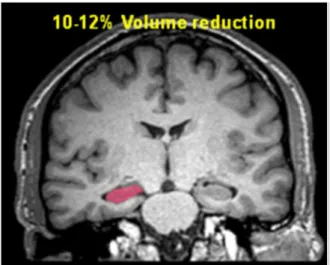
興味深いことに、成人の大麻使用者の海馬の 容積が減少しているというエビデンスが増え つつあり(図2)、大麻の生涯にわたる累積摂取 量と海馬の容積減少との間に相関関係がある ことが指摘されている(Yücel et al., 2006; Yücel et al., 2008)。今後、大麻と精神病との関連性に確 証が得られれば、特定脳部位としての海馬容積 の減少との因果関係に興味が持たれる。
図2. 大麻を長期間にわたって大量に使用している成人の海馬の容 量の平均減少量
10 年間の大麻の累積曝露量は、左海馬の容量と負に相関していた
(Yücelら、2008)。
うつ病、不安について、大麻の常用若年者(16
〜24歳)を対象とした研究では、THCの毛髪中 濃度が自己報告による抑うつと不安の双方の レベルと有意に相関していることが明らかに されている(Morgan et al., 2012)。疫学研究から、
成人期早期の大麻の常用使用群および大麻嗜 癖群は、29歳時点の不安障害の発現率は、対照 群(大麻を使用していない群)の2倍超である ことが示されている。一方、大麻使用と不安と の相関関係が存在するとの考えは、大麻を使用 しようとする素因が、不安を起こし易い素因で もあるためである。罹患しやすい個体の場合、
社会的不安に対する自己的な治療として、大麻 を「使用」するとの考え方も支持されている (Buckner et al., 2010; Van Dam et al., 2012)。
D. 考察
本研究から、大麻の大量使用は精神疾患およ び認知障害の発現リスクが高くなることが分 かる。特に、青少年期の常用的な大麻の大量摂 取は、成人期のそれと比べて、重度かつ持続的 な悪影響を及ぼすことが動物試験と臨床試験 から共に指摘されている。一方、脳の発達には 内因性カンナビノイド系が重要な役割を果た
していることから、青少年期における大麻の長 期的な使用は、青少年期の正常な神経成熟過程 に影響を及ぼし、内因性カンナビノイド系を介 した①シナプス刈り込み現象と②白質の発達 異常が生じていると考えられている。この神経 発達過程の破綻が、青少年期の大麻の常用的使 用と関連している認知障害および情動障害の 誘因と成っている可能性が考えられる。
一方、大麻使用に伴って、精神疾患への罹患 リスクが高くなることが示唆されるが、明確で ない点もある。大麻はこれまで脳の機能的変化 を起こすことが知られていたが、脳の形態学的 変化を誘発することが近年新たに指摘されて いる。即ち、大麻の常用的使用は、内側側頭皮 質、側頭極、海馬傍回、島、眼窩前頭皮質での 灰白質の体積減少と関連するという報告が数 多くなされている。これらの脳領域はCB1受容 体が豊富に発現しており、動機付け、情動行動、
情報の処理機能との関連性が示唆されている。
脆弱な青少年期の脳に大麻の重篤な障害とし て、上記脳組織の変容/CB1受容体の変容が起 こっている可能性が示唆されている。さらに、
これらの脳領域の灰白質容積の減少は、大麻の 使用頻度や大麻使用の開始年齢と相関するこ とが指摘されている。これらの知見は、大麻の 有害性を語る上に置いて、大麻の使用時期が重 要な意味を持つことを示唆している。
E. 結論
近年のこれらの報告を基に、大麻の有害性を 科学的に総括することは、今後の基礎研究・臨 床研究の新たな視点を与える点で意義がある だけでなく、今後の大麻乱用防止の為の教育的 また行政的な方策の決定にも重要な指針を与 えるものと考えられる。
F. 参考文献
Abush, H., & Akirav, I. (2012): Short- and long-term cognitive effects of chronic cannabinoids administration in late-adolescence rats. PLoS One 7(2), e31731.
Abush H, Akirav I. (2013): Cannabinoids ameliorate impairments induced by chronic stress to synaptic plasticity and shortterm memory.
Neuropsychopharmacology. 38(8): 1521-1534.
Allsop, D. J., Norberg, M. M., Copeland, J., Fu, S. &
Budney, A. J. (2011): The Cannabis Withdrawal Scale development: patterns and predictors of cannabis withdrawal and distress. Drug Alcohol Depend. 119, 123–129.
Amal, H., Fridman-Rozevich, L., Senn, R., Strelnikov, A., Gafni, M., Keren, O., et al. (2010):
Long-term consequences of a single treatment of mice with an ultra-low dose of Δ9- tetrahydrocannabinol (THC). Behav Brain Res 206(2), 245–253.
Amen, D. G., & Waugh, M. (1998): High resolution brain SPECT imaging of marijuana smokers with AD/HD. J Psychoactive Drugs 30(2), 209–214.
Ashtari M, Avants B, Cyckowski L, Cervellione KL, Roofeh D, Cook P et al. (2011): Medial temporal structures and memory functions in adolescents with heavy cannabis use. J Psychiatr Res 45:
1055–1066.
Bambico FR, Nguyen NT, Katz N, et al. (2010):
Chronic exposure to cannabinoids during adolescence but not during adulthood impairs emotional behaviour and monoaminergic neurotransmission. Neurobiol Dis.
2010;37(3):641-655.
Batalla, A. et al. (2013): Structural and functional imaging studies in chronic cannabis users: a systematic review of adolescent and adult findings.
PLoS ONE 8, e55821.
Bhattacharyya, S. et al. (2010): Opposite effects of Δ9-tetrahydrocannabinol and cannabidiol on human brain function and psychopathology.
Neuropsychopharmacology 35, 764–774.
Biscaia M, Marin S, Fernandez B, et al. (2003):
Chronic treatment with CP 55,940 during the peri- adolescent period differentially affects the behavioural responses of male and female rats in adulthood. Psychopharmacology. 170(3):301-308.
Block, R. I., O'Leary, D. S., Ehrhardt, J. C., Augustinack, J. C., Ghoneim, M.M., Arndt, S., et al. (2000): Effects of frequent marijuana use on brain tissue volume and composition. Neuroreport 11(3), 491–496.
Braff DL, Geyer MA, Light GA, et al. (2001): Impact of prepulse characteristics on the detection of sensorimotor gating deficits in schizophrenia.
Schizophr Res. 49(1-2):171-178.
Breivogel CS, Childers SR, Deadwyler SA, Hampson RE, Vogt LJ, Sim-Selley LJ. (1999):
Chronic Δ9-tetrahydrocannabinol treatment produces a time-dependent loss of cannabinoid receptors and cannabinoid receptor-activated G proteins in rat brain. J Neurochem 73:2447–2459.
Buckner, J. D. & Carroll, K. M. (2010): Effect of anxiety on treatment presentation and outcome:
results from the Marijuana Treatment Project.
Psychiatry Res. 178, 493–500.
Budney, A. J., Hughes, J. R., Moore, B. A. & Vandrey, R. (2004): Review of the validity and significance of cannabis withdrawal syndrome. Am. J.
Psychiatry 161, 1967–1977.
Burston JJ, Wiley JL, Craig AA, Selley DE, Sim- Selley LJ. (2010): Regional enhancement of cannabinoid CB1 receptor desensitization in female adolescent rats following repeated delta- tetrahydrocannabinol exposure. Br J Pharmacol 161:103–112.
Burns HD, Van Laere K, Sanabria-Boho´rquez S, Hamill TG, Bormans G, Eng W-s et al. (2007) [18F]MK-9470, a positron emission tomography (PET) tracer for in vivo human PET brain imaging of the cannabinoid-1 receptor. Proc Natl Acad Sci USA 104: 9800–9805.
Cadoni C, Simola N, Espa E, et al. (2015): Strain
dependence of adolescent cannabis influence on heroin reward and mesolimbic dopamine transmission in adult Lewis and Fischer 344 rats.
Addict Biol. 20(1):132-142.
Campbell, K., Foster, T., Hampson, R., & Deadwyler, S. (1986): Δ9-Tetrahydrocannabinol differentially affects sensory-evoked potentials in the rat dentate gyrus. J Pharmacol Exp Ther 239(3), 936–940.
Campos, A. C., & Guimarães, F. S. (2008):
Involvement of 5HT1A receptors in the anxiolytic- like effects of cannabidiol injected into the dorsolateral periaqueductal gray of rats.
Psychopharmacology (Berl) 199(2), 223–230.
Cha, Y. M., White, A. M., Kuhn, C. M., Wilson, W.
A. & Swartzwelder, H. (2006): Differential effects of Δ9-THC on learning in adolescent and adult rats.
Pharmacol. Biochem. Behav. 83, 448–455.
Chan GCK, Hinds TR, Impey S, Storm DR. (1998):
Hippocampal neurotoxicity of Δ9- tetrahydrocannabinol. J Neurosci 18:5322–5332.
Cousijn J, Wiers RW, Ridderinkhof KR, van den Brink W, Veltman DJ, Goudriaan AE. (2012):
Grey matter alterations associated with cannabis use: results of a VBM study in heavy cannabis users and healthy controls. Neuroimage 59: 3845–
3851.
Crane, N. A., Schuster, R. M., Fusar-Poli, P. &
Gonzalez, R. (2013): Effects of cannabis on neurocognitive functioning: recent advances, neurodevelopmental influences, and sex differences. Neuropsychol. Rev. 23, 117–137.
Das, R. K. et al. (2013): Cannabidiol enhances consolidation of explicit fear extinction in humans.
Psychopharmacology 226, 781–792.
Demirakca T, Sartorius A, Ende G, Meyer N, Welzel H, Skopp G et al. (2011): Diminished gray matter in the hippocampus of cannabis users: possible protective effects of cannabidiol. Drug Alcohol Depend 114: 242–245.
Downer, E. J., Boland, B., Fogarty, M., & Campbell, V. (2001): Δ9-Tetrahydrocannabinol induces the apoptotic pathway in cultured cortical neurones
via activation of the CB1 receptor. Neuroreport 12(18), 3973–3978.
Downer, E. J., & Campbell, V. A. (2010):
Phytocannabinoids, CNS cells and development: a dead issue? Drug Alcohol Rev 29(1), 91–98.
D’Souza, D. C. et al. (2016): Rapid changes in CB1 receptor availability in cannabis dependent males after abstinence from cannabis. Biol. Psychiatry Cogn. Neurosci. Neuroimaging 1, 60–67.
Egerton, A., Allison, C., Brett, R. R., & Pratt, J. A.
(2006): Cannabinoids and prefrontal cortical function: insights from preclinical studies.
Neurosci Biobehav Rev 30(5), 680–695.
Ehrenreich, H. et al. (1999): Specific attentional dysfunction in adults following early start of cannabis use. Psychopharmacology 142, 295–301.
Elliott, M. B., Tuma, R. F., Amenta, P. S., Barbe, M.
F., & Jallo, J. I. (2011): Acute effects of a selective cannabinoid-2 receptor agonist on neuroinflammation in a model of traumatic brain injury. J Neurotrauma 28(6), 973–981.
Englund, A. et al. (2013): Cannabidiol inhibits THC- elicited paranoid symptoms and hippocampal- dependent memory impairment. J.
Psychopharmacol. 27, 19–27.
European Monitoring Centre for Drugs and Drug Addiction. European drug report (EMCDDA, 2015).
Fernández-López, D., Pradillo, J. M., García- Yébenes, I., Martínez-Orgado, J. A., Moro, M. A.,
& Lizasoain, I. (2010): The cannabinoid WIN55212-2 promotes neural repair after neonatal hypoxia–ischemia. Stroke 41(12), 2956–
2964.
Ferrari, F., Ottani, A., Vivoli, R., & Giuliani, D.
(1999): Learning impairment produced in rats by the cannabinoid agonist HU 210 in a water-maze task. Pharmacol Biochem Behav 64(3), 555–561.
Freedland, C. S., Whitlow, C. T., Miller, M. D., &
Porrino, L. J. (2002): Dose-dependent effects of Δ9-tetrahydrocannabinol on rates of local cerebral glucose utilization in rat. Synapse 45(2), 134–142.
Galve-Roperh, I., Aguado, T., Palazuelos, J., &
Guzmán,M. (2008): Mechanisms of control of neuron survival by the endocannabinoid system.
Curr Pharm Des 14(23), 2279–2288.
Gonzalez, R. (2007): Acute and non-acute effects of cannabis on brain functioning and neuropsychological performance. Neuropsychol Rev 17(3), 347–361.
Gruber, S. A., Sagar, K. A., Dahlgren, M. K., Racine, M. & Lukas, S. E. (2012): Age of onset of marijuana use and executive function. Psychol.
Addict. Behav. 26, 496–506.
Harper JW, Heath RG, Myers WA. (1977): Effects of Cannabis sativa on ultrastructure of the synapse in monkey brain. J Neurosci Res 3:87–93.
Heath RG, Fitzjarrell AT, Fontana CJ, Garey RE.
(1980): Cannabis sativa: Effects on brain function and ultrastructure in rhesus monkeys. Biol Psychiatry 15:657–690.
Herning, R. I., Better,W. E., Tate, K., & Cadet, J. L.
(2005): Cerebrovascular perfusion in marijuana users during a month of monitored abstinence.
Neurology 64(3), 488–493.
Hill SY, Muddasani S, Prasad K, Nutche J, Steinhauer SR, Scanlon J, et al. (2007): Cerebellar volume in offspring from multiplex alcohol dependence families. Biol Psychiatry 61:41–47.
Hirvonen, J. et al. (2012): Reversible and regionally selective downregulation of brain cannabinoid CB1 receptors in chronic daily cannabis smokers.
Mol. Psychiatry 17, 642–649.
Jacobus, J. & Tapert, S. F. (2014): Effects of cannabis on the adolescent brain. Curr. Pharm. Des. 20, 2186–2193.
Klegeris, A., Bissonnette, C. J., & McGeer, P. L.
(2003): Reduction of human monocytic cell neurotoxicity and cytokine secretion by ligands of the cannabinoid-type CB2 receptor. Br J Pharmacol 139(4), 775–786.
Klein, T. W. (2005): Cannabinoid-based drugs as anti-inflammatory therapeutics. Nat Rev Immunol 5(5), 400–411.
Kolb B, Gorny G, Limebeer CL, Parker LA. (2006):
Chronic treatment with delta-9- tetrahydrocannabinol alters the structure of neurons in the nucleus accumbens shell and medial prefrontal cortex of rats. Synapse 60:429–436.
Lafuente, H., Alvarez, F. J., Pazos, M. R., et al.
(2011): Cannabidiol reduces brain damage and improves functional recovery after acute hypoxia–
ischemia in newborn pigs. Pediatr Res 70(3), 272–
277.
Landfield PW, Caldwallader LB, Vinsant S. (1988):
Quantitative changes in hippocampal structure following long-term exposure to Δ9- tetrahydrocannabinol: Possible mediation by glucocorticoid systems. Brain Res 443:47–62.
Lawstone J, Borella A, Robinson JK, Whitaker- Azmitia PM. (2000): Changes in hippocampal morphology following chronic treatment with the synthetic cannabinoid WIN 55,212-2. Brain Res 877:407–410.
Llorente-Berzal A, Puighermanal E, Burokas A, et al.
(2013): Sexdependent psychoneuroendocrine effects of THC and MDMA in an animal model of adolescent drug consumption. PLoS One. 8(11).
Lopez-Quintero, C. et al. (2011): Probability and predictors of transition from first use to dependence on nicotine, alcohol, cannabis, and cocaine: results of the National Epidemiologic Survey on Alcohol and Related Conditions (NESARC). Drug Alcohol Depend. 115, 120–130.
Lubman, D. I., Cheetham, A. & Yücel, M. (2015):
Cannabisand adolescent brain development.
Pharmacol. Ther. 148, 1–16.
Malone, D. T., & Taylor, D. A. (2006): The effect of Δ-9-tetrahydrocannabinol on sensorimotor gating in socially isolated rats. Behav Brain Res 166(1), 101–109.
Mathew, R. J., Tant, S., & Burger, C. (1986):
Regional cerebral blood flow in marijuana smokers. Br J Addict 81(4), 567–571.
Matochik JA, Eldreth DA, Cadet J-L, Bolla KI.
(2005): Altered brain tissue composition in heavy
marijuana users. Drug Alcohol Depend 77: 23–30.
McLaren, J. A., Silins, E., Hutchinson, D., Mattick, R. P., & Hall, W. (2010): Assessing evidence for a causal link between cannabis and psychosis: a review of cohort studies. Int J Drug Policy 21(1), 10–19.
Miyamoto, A., Yamamoto, T., & Watanabe, S.
(1995): Effect of repeated administration of Δ9- tetrahydrocannabinol on delayed matching-to- sample performance in rats. Neurosci Lett 201(2), 139–142.
Monnet-Tschudi F, Hazekamp A, Perret N, Zurich M-G, Mangin P, Giroud C, et al. (2008): Delta-9- tetrahydrocannabinol accumulation, metabolism and cell-type-specific adverse effects in aggregating brain cell cultures. Toxicol Appl Pharmacol 228:8–16.
Moreira, F. A., & Guimarães, F. S. (2005):
Cannabidiol inhibits the hyperlocomotion induced by psychotomimetic drugs in mice. Eur J Pharmacol 512(2), 199–205.
Moreira, F.A., Aguiar,D. C., & Guimarães, F. S.
(2006): Anxiolytic-like effect of cannabidiol in the rat Vogel conflict test. Prog Neuropsychopharmacol Biol Psychiatry 30(8), 1466-1471.
Morgan, C. J., Schafer, G., Freeman, T. P. & Curran, H. V. (2010): Impact of cannabidiol on the acute memory and psychotomimetic effects of smoked cannabis: naturalistic study. Br. J. Psychiatry 197, 285–290.
Morgan, C. et al. (2012): Sub-chronic impact of cannabinoids in street cannabis on cognition, psychotic-like symptoms and psychological well- being. Psychol. Med. 42, 391–400.
Nakamura, E.M., Da Silva, E. A., AdrianWilkinson, D., &Masur, J. (1991): Reversible effects of acute and long-term administration of Δ9- tetrahydrocannabinol (THC) on memory in the rat.
Drug Alcohol Depend 28(2), 167–175.
O’Shea M, McGregor IS, Mallet PE. (2006):
Repeated cannabinoid exposure during perinatal,
adolescent or early adult ages produces similar longlasting deficits in object recognition and reduced social interaction in rats. J Psychopharmacol. 20(5):611-621.
Paus T. (2005): Mapping brain maturation and cognitive development during adolescence.
Trends Cogn Sci 9:60–68.
Perez,M., Benitez, S. U., Cartarozzi, L. P., del Bel, E., Guimaraes, F. S., & Oliveira, A. L. (2013):
Neuroprotection and reduction of glial reaction by cannabidiol treatment after sciatic nerve transection in neonatal rats. Eur J Neurosci 38(10), 3424–3434.
Perry W, Minassian A, Feifel D, et al. (2001):
Sensorimotor gating deficits in bipolar disorder patients with acute psychotic mania. Biol Psychiatry. 50:418-424.
Pope, H. G., Gruber, A. J., Hudson, J. I., Huestis, M.
A. & Yurgelun-Todd, D. (2001):
Neuropsychological performance in long-term cannabis users. Arch. Gen. Psychiatry 58, 909–
915.
Porsolt RD. (1979): Animal model of depression.
Biomedicine. 30(3):139-140.
Quickfall, J., & Crockford, D. (2006): Brain neuroimaging in cannabis use: a review. J Neuropsychiatry Clin Neurosci 18(3), 318–332.
Quinn, H. R. et al. (2008): Adolescent rats find repeated Δ9-THC less aversive than adult rats but display greater residual cognitive deficits and changes in hippocampal protein expression following exposure. Neuropsychopharmacology 33, 1113–1126.
Ranganathan, M., & D'souza, D. C. (2006): The acute effects of cannabinoids onmemory in humans: a review. Psychopharmacology (Berl) 188(4), 425–444.
Realini N, Vigano` D, Guidali C, et al. (2011):
Chronic URB597 treatment at adulthood reverted most depressive-like symptoms induced by adolescent exposure to THC in female rats.
Neuropharmacology. 60(2-3):235-243.
Renard J, Rosen LG, Loureiro M, et al. (2016):
Adolescent cannabinoid exposure induces a persistent sub-cortical hyperdopaminergic state and associated molecular adaptations in the prefrontal cortex. Cereb Cortex. doi:
10.1093/cercor/bhv335.
Resstel, L., Tavares, R. F., Lisboa, S. F., Joca, S. R., Correa, F., & Guimaraes, F. S. (2009): 5-HT1A receptors are involved in the cannabidiol‐induced attenuation of behavioural and cardiovascular responses to acute restraint stress in rats. Br J Pharmacol 156(1), 181–188.
Rubino T, Vigano D, Realini N, Guidali C, Braida D, Capurro V, et al. (2008): Chronic delta 9- tetrahydrocannabinol during adolescence provokes sex-dependent changes in the emotional profile in adult rats: Behavioral and biochemical correlates. Neuropsychopharmacology 33:2760–
2771.
Sarne, Y., & Mechoulam, R. (2005): Cannabinoids:
between neuroprotection and neurotoxicity. Curr Drug Targets CNS Neurol Disord 4(6), 677–684.
Sarne, Y., Asaf, F., Fishbein, M., Gafni, M., & Keren, O. (2011): The dual neuroprotective–neurotoxic profile of cannabinoid drugs. Br J Pharmacol 163(7), 1391–1401.
Scallet AC, Uemura E, Andrews A, Ali SF, McMillan DE, Paule MG, et al. (1987):
Morphometric studies of the rat hippocampus following chronic delta-9-tetrahydrocannabinol (THC). Brain Res 436:193–198.
Scallet AC. (1991): Neurotoxicology of cannabis and THC: A review of chronic exposure studies in animals. Pharmacol Biochem Behav 40:671–676.
Scallet AC. (1991): Neurotoxicology of cannabis and THC: A review of chronic exposure studies in animals. Pharmacol Biochem Behav 40:671–676.
Schneider M, Koch M. (2003): Chronic pubertal, but not adult chronic cannabinoid treatment impairs sensorimotor gating, recognition memory, and the performance in a progressive ratio task in adult rats.
Neuropsychopharmacology. 28(10): 1760-1789.
Schneider, M. & Koch, M. (2007): The effect of chronic peripubertal cannabinoid treatment on deficient object recognition memory in rats after
neonatal mPFC lesion. Eur.
Neuropsychopharmacol. 17, 180–186.
Schneider M, Scho¨mig E, Leweke FM. (2008):
Acute and chronic cannabinoid treatment differentially affects recognition memory and social behavior in pubertal and adult rats. Addict Biol. 13(3-4):345-357.
Schramm-Sapyta, N. L., Cha, Y. M., Chaudhry, S., Wilson, W. A., Swartzwelder, H. S., & Kuhn, C.
M. (2007): Differential anxiogenic, aversive, and locomotor effects of THC in adolescent and adult rats. Psychopharmacology (Berl) 191(4), 867–877.
Schreiner, A. M. & Dunn, M. E. (2012): Residual effects of cannabis use on neurocognitive performance after prolonged abstinence: a meta- analysis. Exp. Clin. Psychopharmacol. 20, 420–
429.
Sevy, S., Smith, G. S., Ma, Y., Dhawan, V., Chaly, T., Kingsley, P. B., et al. (2008): Cerebral glucose metabolism and D2/D3 receptor availability in young adults with cannabis dependence measured with positron emission tomography.
Psychopharmacology (Berl) 197(4), 549–556.
Shen, E. Y., Ali, S. F., & Meyer, J. S. (2011): Chronic administration of THC prevents the behavioral effects of intermittent adolescent MDMA administration and attenuates MDMA-induced hyperthermia and neurotoxicity in rats.
Neuropharmacology 61(8), 1183–1192.
Sheng, W. S., Hu, S., Min, X., Cabral, G. A., Lokensgard, J. R., & Peterson, P. K. (2005):
Synthetic cannabinoid WIN55, 212-2 inhibits generation of inflammatory mediators by IL-1β- stimulated human astrocytes. Glia 49(2), 211–219.
Sheng, W. S., & Rock, R. B. (2013): CB2 Receptor agonists protect human dopaminergic neurons against damage from HIV-1 gp120. PLoS One 8(10), e77577.
Sim-Selley LJ. (2003): Regulation of cannabinoid
CB1 receptors in the central nervous system by chronic cannabinoids. Crit Rev Neurobiol 15:91–
119.
Sneider, J. T., Pope, H. G., Jr., Silveri, M. M., Simpson, N. S., Gruber, S. A., & Yurgelun-Todd, D. A. (2008): Differences in regional blood volume during a 28-day period of abstinence in chronic cannabis smokers. Eur Neuropsychopharmacol 18(8), 612–619.
Solowij, N., & Pesa, N. (2012): Cannabis and cognition: short and long-term effects. Marijuana and madness, 91–102.
Solowij, N., Yucel, M., Lorenzetti, V., & Lubman, D.
(2012b): Does Cannabis Cause Lasting Brain Damage? .
Stiglick, A., & Kalant, H. (1985): Residual effects of chronic cannabis treatment on behavior in mature rats. Psychopharmacology (Berl) 85(4), 436–439.
Stopponi S, Soverchia L, Ubaldi M, et al. (2014):
Chronic THC during adolescence increases the vulnerability to stress-induced relapse to heroin seeking in adult rats. Eur Neuropsychopharmacol.
24(7):1037-1045.
United Nations Office on Drugs and Crime. World drug report (UNODC, 2015).
Van Dam, N. T., Bedi, G. & Earleywine, M. (2012):
Characteristics of clinically anxious versus non- anxious regular, heavy marijuana users. Addict.
Behav. 37, 1217–1223.
Van Den Buuse M. (2010): Modeling the positive symptoms of schizophrenia in genetically modified mice: pharmacology and methodology aspects. Schizophr Bull. 36(2):246-270.
Vandrey, R., Budney, A., Hughes, J. & Liguori, A.
(2008): A within-subject comparison of withdrawal symptoms during abstinence from cannabis, tobacco, and both substances. Drug Alcohol Depend. 92, 48–54.
Verrico, C. D., Jentsch, J. D., Roth, R. H., & Taylor, J. R. (2004): Repeated, intermittent Δ9- tetrahydrocannabinol administration to rats impairs acquisition and performance of a test of
visuospatial divided attention.
Neuropsychopharmacology 29(3), 522.
Verrico, C. D., Gu, H., Peterson, M. L., Sampson, A.
R. & Lewis, D. A. (2014): Repeated Δ9‐tetrahydrocannabinol exposure in adolescent monkeys: persistent effects selective for spatial working memory. Am. J. Psychiatry 171, 416–
425.
Wegener N, Koch M. (2009): Behavioural disturbances and altered Fos protein expression in adult rats after chronic pubertal cannabinoid treatment. Brain Res. 1253:81-91.
Whitlow, C. T., Freedland, C. S., & Porrino, L. J.
(2002): Metabolic mapping of the time-dependent effects of Δ9-tetrahydrocannabinol administration in the rat. Psychopharmacology (Berl) 161(2), 129–136.
Yücel, M., Lubman, D. I., Velakoulis, D.,Wong, M.
T.,Wood, S. J., Condello, A., et al. (2006):
Structural brain correlates of alcohol and cannabis use in recreational users. Acta Neuropsychiatr 18(5), 226–229.
Yu¨cel M, Solowij N, Respondek C, Whittle S, Fornito A, Pantelis C et al. (2008): Regional brain abnormalities associated with longterm heavy cannabis use. Arch Gen Psychiatry 65: 694–701.
Zalesky A, Solowij N, Yucel M, Lubman DI, Takagi M, Harding IH et al. (2012): Effect of long-term cannabis use on axonal fibre connectivity. Brain 135(Pt 7): 2245–2255.
Zamberletti E, Prini P, Speziali S, et al. (2012):
Gender-dependent behavioral and biochemical effects of adolescent delta-9-tetrahydrocannabinol in adult maternally deprived rats. Neuroscience.
2012;204:245-257.
Zuardi, A., Rodrigues, J. A., & Cunha, J. (1991):
Effects of cannabidiol in animalmodels predictive of antipsychotic activity. Psychopharmacology (Berl) 104(2), 260–264.
Zuardi, A., Crippa, J., Hallak, J., Moreira, F., &
Guimaraes, F. (2006): Cannabidiol, a Cannabis sativa constituent, as an antipsychotic drug. Braz J
Med Biol Res 39(4), 421–429.
Zuurman, L., Ippel, A. E., Moin, E., & Van Gerven, J. (2009): Biomarkers for the effects of cannabis and THC in healthy volunteers. Br J Clin Pharmacol 67(1), 5–21.
G. 研究発表
1)論文発表 特になし
2)学会発表 特になし
H. 知的財産権の出願・登録状況
特になし