緒 言
頚 動 脈 ス テ ン ト 留 置 術(Carotid artery stenting;
CAS)後のステント内血栓症は比較的稀な合併症である が,ひとたび発症すると塞栓症や急性閉塞をきたし予後 不良となることがある10).今回,脳梗塞亜急性期に行 った CAS 後に症候性,進行性のステント内血栓症を合
併したため,緊急処置としてステント内に追加ステント 留置術(stent in stent 治療)を行った症例を経験したの で,文献的考察を加えて報告する.
症例呈示
症例:72歳,男性.
主訴:右上肢脱力発作.
頚動脈ステント内血栓症に対し 緊急ステント留置術を追加した 1 例
高杉祐二 杉生憲志 平松匡文 大熊 佑 伊丹尚多 菱川朋人 徳永浩司 伊達 勲
Stent-in-stent treatment for acute in-stent thrombosis after carotid artery stenting:
a case report
Yuji TAKASUGI Kenji SUGIU Masafumi HIRAMATSU Yu OHKUMA Hisakazu ITAMI Tomohito HISHIKAWA Koji TOKUNAGA Isao DATE
Department of Neurological Surgery, Okayama University Graduate School of Medicine, Dentistry and Pharmaceutical Sciences
●Abstract●
Objective: Symptomatic in-stent thrombosis with or without plaque protrusion is a relatively rare but devastating complication of carotid artery stenting (CAS).
Case presentation: A 72-year-old man presented with repeated transient ischemic attacks (TIAs). Digital subtraction angiography (DSA) showed severe stenosis in the left internal carotid artery at its origin.
Cervical MRI revealed carotid soft plaque. Balloon-protected CAS was planned. A self-expandable open- cell-type stent (PRECISETM) was successfully placed with a good angiographic result. However, he suffered a recurrent TIA several hours after the CAS procedure. Enhanced computed tomography (CT) scan revealed a contrast defect in the stent suggesting acute thrombus formation. Despite medical treatment including systemic heparinization and triple anti-platelet therapy, a follow-up ultra-sound examination showed enlargement of the thrombus in the stent. His neurological condition deteriorated and we decided to perform another stenting procedure. DSA demonstrated a significant contrast defect in the stent. A self-expandable closed-cell-type stent (Wallstent RPTM) was successfully deployed on the inside of a PRECISETM stent under distal balloon protection. A satisfactory angiographic result was achieved. After the second procedure, he showed good recovery from the neurological symptoms and no more TIAs.
Conclusion: This case demonstrated the usefulness of the stent-in-stent technique for medically refractory in-stent thrombosis with or without plaque protrusion. A closed-cell-type stent would be theoretically more effective in this situation.
●Key Words●
balloon protection, closed cell design stent, plaque MRI (MPRAGE), stent in stent, stent thrombosis
岡山大学大学院 脳神経外科
<連絡先:杉生憲志 〒700-8558 岡山市北区鹿田町2-5-1 E-mail: [email protected](Received February 21, -2012u.ac.jp >:Accepted September 17, 2012)
Takasugi Y, et al
既往歴:高血圧.
現病歴:約15分間の右上肢一過性脱力発作のため近医
を受診し,脳 MRI にて明らかな新鮮梗塞が認められな かったため一過性脳虚血発作と診断された.その原因と して頭頚部 MRA で左頚動脈狭窄を指摘され,発症から 33日目,精査・加療目的に当科紹介,検査入院となった.
初診時には神経学的異常所見を認めなかった.頚部 MRI(magnetization-prepared rapid acquisition gradient- echo;MPRAGE 法)では,プラークは高信号(プラー ク / 胸鎖乳突筋比2以上)に描出され(Fig. 1),出血 や壊死性成分を多く含む不安定プラークと判定され た4).Digital subtraction angiography(DSA)にて左頚 部内頚動脈に約80% の狭窄を認めたが,狭窄の遠位端 は第2頚椎レベルと比較的高位であった.99mTc-ECD Single Photon Emission Computed Tomography(SPECT)
では,安静時には左右差はないものの,acetazolamide 投与後に左大脳半球の予備能低下を認めた.以上より,
左頚部内頚動脈の不安定プラークによる症候性高度狭窄 と 診 断 し た. 頚 動 脈 血 栓 内 膜 剥 離 術(carotid endarterectomy;CEA)を行うには高位病変であったた
め,distal balloon protection 下での CAS を行う方針とし た.発症85日後に CAS を行う予定とし,抗血小板薬2 剤(aspirin 100 mg/ 日,clopidogrel 75 mg/ 日)を内服し,
自宅待機していた.
しかし,CAS 予定日の6日前に構音障害が出現し,
近医で施行した MRI にて左大脳深部白質に散在性の新 鮮脳梗塞を認めたため,直ちに当院へ転入院となった.
入院後,argatroban および edaravone の追加投与を開始 したところ,症状は徐々に改善した.
当初の予定通り,新規脳梗塞発症6日後に局所麻酔下,
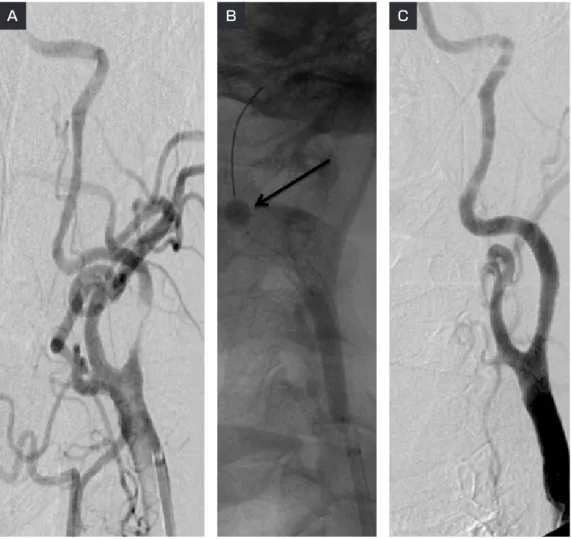
右大腿動脈アプローチで CAS を施行した.7Fr Shuttle sheath(COOK MEDICAL, Bloomington, IN, USA)を左 総頚動脈に留置し,全身ヘパリン化により活性化凝固時 間(activated clotting time;ACT)を術前の2〜2.5倍と した.DSA では,狭窄部の遠位部内頚動脈血管径は約 4.0 mm,狭窄部の近位部総頚動脈血管径は約7.8 mm で あり,最狭窄部では約0.8 mm 程度の内腔しかなく,狭
窄率は約80% で,左内頚動脈の狭窄は,初回検査時と
著 変 な か っ た(Fig. 2A).PercuSurge GuardWire
(Medtronic, Minneapolis, MN, USA. 以下 GuardWire)を,
狭窄部を通過させ内頚動脈遠位正常血管部に進め,1分 間の閉塞試験を行い,虚血耐性であることを確認した.
Distal balloon protection 下に,Sterling 3/40 mm バルー ン(Boston Scientific, Natick, MA, USA)により前拡張 を行い,PRECISE 9/40 mm(Cordis, Miami, FL, USA)
を病変部に留置した後,Sterling 4/30 mm で後拡張を行 った(Fig. 2B).その後,Eliminate 吸引用カテーテル(テ ルモ,東京)で血液を吸引し,balloon protection を解除 した.回収血液中には黄色の debris および血栓成分を 中等量認めた.DSA にて良好な拡張と血流の改善が得 られたことを確認し(Fig. 2C),手技を終了した.
術直後は新たな神経学的異常所見を認めなかったが,
術数時間後に構音障害の増悪と右上肢巧緻運動障害が出 現した.翌日の MRI 拡散強調画像では,左大脳半球に 散在する小梗塞巣を認めた.遊離したプラークおよび血 栓による遅発性塞栓症が考えられたため,これまでの抗 血小板薬に加えて cilostazol 200 mg/ 日を追加し,さら に ACT を2倍程度にするよう全身ヘパリン化を行い,
経過を観察した.術5日後の頚動脈超音波検査で,ステ ント内にプラークないしは血栓の突出による再狭窄を認 め(Fig. 3A),術7日後の CT-angiography(CTA)に おいてもステント内に血流欠損部が認められた.この間,
Fig. 1
Preoperative MR imaging using magnetization- prepared rapid acquisition gradient-echo (MPRAGE) demonstrates a high intensity area in the left carotid plaque (arrow).
患者の活動性は徐々に低下していき,脳血流量低下に伴 う症状と考えられた.術12日後の頚動脈超音波検査で 明らかなステント内血栓の増大および狭窄の進行を認め た(Fig. 3B).臨床症状が悪化し,内科的治療に抵抗性 で,画像上,ステント内血栓の進行性増大を認めたため,
外科的追加治療が必要と判断し,初回 CAS から12日後 に再度 CAS を施行することにした.
局所麻酔下,左大腿動脈アプローチで左総頚動脈撮影 を行うと,ステント内に血流欠損像が認められた(Fig.
4A). 通 常 の distal protection system で は, 最 初 の device の病変通過時に塞栓性合併症を生じる可能性が高 いと判断し,seat belt & air bag technique11)を用いるこ とにした.全身ヘパリン化の後,9Fr パトリーブバルー
ン付きカテーテル(テルモクリニカルサプライ,岐阜)
を左総頚動脈に留置した.PRECISE の網目を通して外 頚動脈に GuardWire を留置し外頚動脈を遮断した後,
パトリーブのバルーンを拡張し proximal protection とし た.パトリーブから血液を逆流させながらもう1本の GuardWire を前回同様に内頚動脈遠位部へと進めた.逆 流させた血液内には明らかな血栓は認めなかった.ここ からは総頚動脈と外頚動脈のバルーンは使用せず,内頚 動 脈 の distal balloon protection 下 に Wallstent RP 9/18 mm ス テ ン ト(Boston Scientific) を 初 回 留 置 し た PRECISE 内 の 血 栓 存 在 部 を 中 心 に 展 開 す る と,
Wallstent RP は PRECISE 内で全周性に全拡張した(Fig.
4B).その後7Fr Eliminate で,GuardWire のバルーン
A B C
Fig. 2 Angiograms performed during the first carotid artery stenting (CAS).
A: Left common angiogram demonstrates severe stenosis at the origin of the internal carotid artery.
B:Post-dilatation was performed under distal balloon protection (arrow).
C: Postoperative angiogram shows good dilatation of the internal carotid artery by the stent.
No filling defect is observed in the stent.
Takasugi Y, et al
直下およびステント内部の血液を吸引したが,この中に も明らかな血栓は認めなかった.DSA にて狭窄率は 70% から10% に改善したため後拡張は行わず,ステン ト内に明らかな欠損像を認めないことを確認して手技を 終了した(Fig. 4C).
術後は抗血小板薬3剤併用を続行し,3日間全身ヘパ リン化を継続した.術後経過は良好で,巧緻運動障害,
構音障害,活動性低下等の症状は徐々に改善した.術後 の頚動脈超音波検査にてステント内の血栓はほぼ消失し た(Fig. 3C)ため,2週間後にリハビリテーション目
的に他院転院となった.1ヵ月後に抗血小板薬を2剤に 減量し,3ヵ月後には,神経症状はほぼ完全回復し,
CTA でも良好な経過であったため,以後抗血小板剤を 1剤として経過を観察している.術後2年の時点で再狭 窄は認めておらず,臨床経過も良好である.
考 察
CAS 施行後,造影 CT で検出される早期のステント
内血栓は20%〜43.5% と報告されている.しかし,多く
の場合血栓による狭窄は軽度で無症候性であり,自然に A
B
C
Fig. 3
Serial carotid ultrasonograms carried out 5 days after the first CAS (A), 12 days after the first CAS (B), and 14 days after the second CAS (C) (left: longitudinal view, right: axial view).
A, B:The in-stent thrombus (arrows) is progressively enlarging between 5 and 12 days after the first CAS.
C:Only a small thrombus is observed in the stented internal carotid artery after the second CAS.
消失していく.そのため,ステント内血栓が症候性とな
るのは0.04〜2% と報告によりばらつきはあるものの,
比較的まれである6,17).
我々が渉猟し得た限りでは,過去10例の症候性ステ ント内血栓症が報告されている(Table).初期の3例 では,周術期に抗血小板薬を適切に用いていなかったこ とが原因と考えられた.そのうち1例は abciximab によ り良好な結果が得られたが,他の2例は転帰不良であっ
た3,15).2003年および2004年に1例ずつ報告された例で
は,abciximab と機械的破砕の併用によって,それぞれ 最終的には良好な結果が得られている2,13).2005年に Setacci らが報告した2例のうち1例は不安定プラーク が,もう1例は不安定プラークと高血小板血症がステン ト内血栓症の原因であり,ステントの摘出と CEA を行
うことで good recovery および moderate disability とい う転帰となっている12).その後,本邦から発表されて いる3例はいずれも不安定プラークが原因であった.そ の う ち1例 に 血 管 形 成 術(percutaneous transluminal angioplasty;PTA)のみが,残り2例には stent in stent 治療が行われており,1例では再開通は得られなかった ものの,すべて転帰良好であった7,9,14).以上の10例中,
良好な結果が得られたのは8例で,再開通の得られなか った残り2例は dead となっていることから,ステント 内血栓症に対して適切な対応ができなかった場合には予 後不良になり得ると言える.また,今回は CAS 後に神 経症状の悪化を認めたが,当初は遅発性の血栓・塞栓症 を疑い,ステント内血栓症の確定診断に至ったのは,術 5日後のエコー時であった.この5日間に臨床症状の悪 Fig. 4 Angiograms in the second CAS
A: Left common carotid angiogram before the second CAS demonstrates a filling defect (arrow), which we suspected was a plaque protrusion and thrombus in the stent.
B:The Wallstent RPTM stent is shown to have fully expanded in the PRECISETM stent just after its deployment.
C: Left common angiogram after CAS shows good patency of the internal carotid artery without any filling defects in the stent.
A B C
Takasugi Y, et al
化は認めなかったが,より早期の画像診断が必要であっ たことは明白で,反省すべき点であった.さらに,
NASCET, ECST の解析からは発症2週間以内の治療が より有効であると報告されており5),本例では発症後か ら治療までの時間がかかりすぎた点も反省点である.
ステント内血栓症の対処法としては,無症候性で緩徐 に血栓形成が進行する場合には,まず抗血小板・抗凝固 療法の強化などの内科的治療を行うのが適当と考えられ る8).内科的治療に抵抗して進行する場合や,急速に進 行して症候性となる場合などには,できるだけ早急に血 栓溶解療法,ステント摘出術,血管内治療などを考慮す る必要がある.血栓溶解に関しては,CAS 後のステン ト内血栓症で有効性が報告されているのは abciximab の みである15)が,本剤は本邦では認可されていない.ウ ロキナーゼや rt-PA などの血栓溶解薬は使用可能であ るが,遠位塞栓のリスクや効果の不確実性を考慮すると ステント内血栓に対しては使用しづらい.ステント摘出 術も報告されているが12),手技が困難であり,また抗 血栓療法中のため術中の止血困難が予想される.さらに,
本邦においては CAS の適応となった患者は,CEA ハイ リスクが前提であり,CEA の技術的困難がある上に厳 しい時間的制約の中で,手術を行わなくてはならないと
いう問題がある.
血管内治療としては,バルーンによる PTA と stent in stent 治療がある.CAS 後の内膜肥厚による慢性期の 再狭窄に対しては PTA が有効であるという報告もみら れる16).しかし,今回のような急性期の血栓やプラー ク突出が疑われる状況では追加ステントが血栓とプラー クを押しつぶしながら内腔を確保できるため,安全性と 有用性が高く,しかも低侵襲と考えられる.抗血栓療法 の影響や技術的難易度を考えると外科的摘出よりも先に 考慮すべき治療法と思われる.本症例では,術前画像診 断で多量の血栓の存在が確認されていたにもかかわら ず,Wallstent RP 展開後に回収した血液内には血栓も debris も認めなかった.状況からは,血栓は最初の PRECISE と後から留置した Wallstent の間に圧着・固定 されたと考えられる.バルーン PTA のみでは,このよ うな血栓・プラークの圧着は不可能であり,血栓付きの 病変に対してはステントで対処する方が望ましいと考え ている.一方で,最初のステントで抑え込むことができ なかったプラークや血栓を追加ステントで充分にコント ロールできるのかという疑問が残る.Bosiers らは open- cell ステントよりも網目の細かい closed-cell ステントの 方が,プラークや血栓を漏らすことなく抑え込み,血管 Table Reported cases of symptomatic in-stent thrombosis
Author
year Age/Sex Plaque Anti-platelet Stent/
Protection Treatment Recanali-
zation Outcome Tong
2000 44/M ND none Symphony/
ND Abciximab + GR
Chaturvedi 2001
63/F ND none ND/ND Urokinase − Dead
57/M ND none ND/ND None − Dead
Bush
2003 65/M ND ASA+CL Dynalink/
Balloon Abciximab + MD
Steiner
2004 64/M ND combined Wall/filter Abciximab + GR
Setacci 2005
82/M soft ASA+CL Wall/filter Stent removal + GR
78/M soft ASA+TI Wall/filter Stent removal + MD
Masuo
2006 71/M soft+
thrombus ASA+TI SMART/
Balloon PTA + GR
Kurisu
2007 72/M soft ASA+CI PRECISE/
Balloon PTA & stent + GR
Takemoto
2009 78/M soft ASA+CL PRECISE/
Balloon PTA & stent − GR
Abbreviations
ASA: acetylsalicylic acid, CL: clopidogrel, GR: good recovery, MD: moderate disability, ND: no data, PTA: percutaneous transluminal angioplasty, TI: ticlopidine
内腔を確保することが可能であると提唱している1).本 例では,初回術前から不安定プラークが強く示唆されて いた.Open-cell の PRECISE を留置後にプラーク突出を 来たして,血栓性合併症を生じたと考えられたため,対 処法として closed-cell の Wallstent RP を追加留置し,事 なきを得たと考えている.不安定なプラークに対するス テントの選択に関しては議論の分かれるところである が,網目が細かく,フリースペースの少ない closed-cell ステントの方が,理論上はプラーク突出等のトラブルは 少ないと考えられる.本例治療時には,本邦では保険診 療上 PRECISE のみが認可されていたが,現在では CarotidWall も認可されており,症例に応じた器材の選 択が可能である.
通常の CAS と比較して,ステント内血栓症に対する stent in stent 治療の場合には塞栓性合併症のリスクがよ り高いと考えられる.ステント内に新鮮血栓が存在する 場合には,distal protection device が血栓部を通過する 時に遠位塞栓を起こす危険性がある.また,病変部拡張 時に多量の血栓や debris が遊離し,その結果,フィル ターでのとりこぼしや閉塞(no flow)の可能性が危惧 される.そのため本例では,distal protection device と してフィルターではなくバルーンを使用し,さらに device が病変部を通過する際には seat belt & air bag technique11)を用いて,塞栓性合併症を予防した.本邦 ではフィルターによる脳保護が現時点で標準的となって いるが,最近は GuardWire も認可され,脳保護法に関 しても症例に応じたテクニックを選択できるようになっ た.
結 語
症候性ステント内血栓症に対して stent in stent 治療 を行い,進行性の血栓・塞栓性合併症から回復できた症 例を経験した.血栓を壁側に抑え込むことのできる stent-in-stent 治療は,内科的治療に抵抗性の,症候性ス テント内血栓症に対して有効な治療となり得る.
本論文に関して,開示すべき利益相反状態は存在しない.
文 献
1) Bosiers M, de Donato G, Deloose K, et al: Does free cell
area influence the outcome in carotid artery stenting?
. 33:135-143, 2007.
2) Bush RL, Bhama JK, Lin PH, et al: Transient ischemic attack due to early carotid stent thrombosis: successful rescue with rheolytic thrombectomy and systemic abciximab. 10:870-874, 2003.
3) Chaturvedi S, Sohrab S, Tselis A: Carotid stent thrombosis:
report of 2 fatal cases. 32:2700-2702, 2001.
4) Hishikawa T, Iihara K, Yamada N, et al: Assessment of necrotic core with intraplaque hemorrhage in atherosclerotic carotid artery plaque by MR imaging with 3D gradient-echo sequence in patients with high-grade stenosis. Clinical article. 113:890-896, 2010. 5) Imray C, Higman D, Tiivas C: Timing of surgery for
symptomatic carotid stenosis. 363:1553-1554, 2004. 6) Jongen LM, Hendrikse J, Waaijer A, et al: Frequency and
consequences of early in-stent lesions after carotid artery stent placement. 20:573-579, 2009. 7) Kurisu K, Manabe H, Ihara T: Case of symptomatic
subacute in-stent thrombosis after carotid angioplasty and stenting for severe carotid stenosis.
35:1001-5, 2007.
8) Lal BK: Recurrent carotid stenosis after CEA and CAS:
diagnosis and management. 20:259-266, 2007.
9) Masuo O, Terada T, Matsuda Y, et al: Successful recanalization by in-stent percutaneous transluminal angioplasty with distal protection for acute carotid stent thrombosis. ( ) 46:495-499, 2006. 10) Pandey AS, Koebbe CJ, Liebman K, et al: Low incidence of
symptomatic strokes after carotid stenting without embolization protection devices for extracranial carotid stenosis: a single-institution retrospective review.
63:867-873, 2008.
11) Parodi JC, Schönholz C, Ferreira LM, et al: Seat belt and air bag technique for cerebral protection during carotid stenting. 9:20-24, 2002.
12) Setacci C, de Donato G, Setacci F, et al: Surgical management of acute carotid thrombosis after carotid stenting: a report of three cases. 42:993-996, 2005.
13) Steiner-Böker S, Cejna M, Nasel C, et al: Successful revascularization of acute carotid stent thrombosis by facilitated thrombolysis. 25:1411-1413, 2004.
14) Takemoto K, Iwaasa M, Uda K, et al: A case of occlusion due to acute in-stent thrombosis after carotid artery stenting. ( )18:305-311, 2009. 15) Tong FC, Cloft HJ, Joseph GJ, et al: Abciximab rescue in
acute carotid stent thrombosis. 21:1750-1752, 2000. 16) van Haaften AC, Bots ML, Moll FL, et al: Therapeutic
options for carotid in-stent restenosis: review of the literature. 21:1471-1477, 2010.
17) Watarai H, Kaku Y, Yamada M, et al: Follow-up study on in-stent thrombosis after carotid stenting using multidetector CT angiography. 51:243-251, 2009.
Takasugi Y, et al
JNET 6:181-188, 2012
要 旨
【目的】頚動脈ステント留置術(CAS)後のステント内血栓症に対して stent-in-stent 留置術を行い良好な結果が得 られた1例を報告する.【症例】72歳男性.症候性左内頚動脈狭窄症に対し open-cell stent を使用して CAS を施行 した.術後急性期に症候性進行性ステント内血栓症をきたしたため,closed-cell stent で追加 CAS を行い良好な結 果を得た.【結論】CAS 後のステント内血栓症に対して,血栓を壁側に抑え込むことのできる stent-in-stent 留置術は,
有効な治療となり得る.