範囲基準下の最適停止について
長崎大学経済学部 津留崎和義(Kazuyoshi Tsurusaki)
FacultyofEconomics, Nagasaki Univ.
九州大学大学院経済学研究院 岩本誠一 (Seiichi Iwamoto)
Graduate School ofEconomics, Kyushu Univ.
1
Introduction
Inthispaper, weconsider the optimal stopping problem for compoudcriteria, whose counterpart
is simple criteria such
as
terminal, additive and minimum. We introducea new
notion of gainprocess, which is evaluated at stopped state. Some of gain processes
are
terminal, additive,minimum, range, ratio, sample variance. The former three are simple. The latter three are
compound. In this paper
we
discuss the compond criterion suchas
range, mid-range, ratio,average and sample variance.
2
General Process
We consider
a
class of finite-stage optimal stopping problems froma
view point of rewardaccumulation. An $N$-stageproblemhas to stop bytime$N$ at the latest. Each stage allowseiher
stop orcontinue. When adecision maker stops on astate at $n$-th stage, she gets arewardwhich
is closely related to all the states she has experienced.
Let $\{X_{n}\}_{0}^{N}$ be
a
Markov chain ona
finite state space $X$ witha
transition law $p=\{p(\cdot|\cdot)\}$.
Letting $X^{k}:=X\cross X\cross\cdots\cross X$($k$ times) be the direct product of $k$ state spaces $X$,
we
take$H_{n}:=X^{n+1}$; the set of all subpaths $h_{n}=x_{0}x_{1}\cdots x_{n}$ up to stage $n$ :
$H_{n}=\{h_{n}=x_{0}x_{1}\cdots x_{n}|x_{m}\in X, 0\leq m\leq n\}$ $0\leq n\leq N.$
In particular,
we
set$\Omega:=H_{N}$.
Its element $\omega$ $=h_{N}=x_{0}x_{1}\cdots x_{N}$ is called
a
path.Let$T_{m}^{\iota}$ be the set of all subsets in $\Omega$which
are
determinedbyrandom variables $\{X_{m},X_{m+1}$,,
.
.,$X\mathrm{J}$ where $X_{k}$ : $\mathit{1}arrow X$ is the projection, Xk(u) $=x_{k}$. Strictly, $\Psi_{m}^{\iota}$ is the $\mathrm{c}\mathrm{r}$-fieldon 0
generated by the set ofall subsets ofthe form
$\{X_{m}=x_{m}, X_{m+1}=x_{m+1}, \ldots, X_{n}=x_{n}\}(\subset\Omega)$
where $x_{m}$,$x_{m+1}$,. ..,$x_{n}$
are
all elements in state space $X$. Letus
take $\mathrm{N}=\{0, 1, \ldots, N\}$. Amapping$\tau$ : $El$ $arrow$ $\mathrm{N}$ is called
a
stopping timeif$\{\tau=n\}\in\Psi_{0}$ $in\in$ N.
where $\{\tau=n\}=$ $\{x_{0}x_{1} . . . x_{N}| \tau(\mathrm{t}_{0}x_{1} . . . x_{N})=n\}$. The stopping time $\mathrm{r}$ is called $\{f_{0}\}_{0}^{N_{-}}$
adapted. Let $\mathcal{T}_{0}^{N}$ bethe set of all such stopping times. Any stopping time $\mathrm{r}$ $\in \mathcal{T}_{0}^{N}$ generates a
stopped subhistory (random variable) (Xo,$X_{1}$,
$\ldots$ , $\mathrm{X}$ 1,
$X_{\tau}$) on $\Omega$ through
Let $\{g_{n}\}_{0}^{N}$ be a sequence ofgain
functions
$g_{n}$ : $H_{n}arrow R^{1}$ $0\leq n\leq N.$
Then a gain process $\{G_{n}\}_{0}^{N}$ is defined by
$G_{n}:=g_{n}(X_{0}, X_{1}, \ldots, X_{n})$
.
Then any stopping time $\tau$ yields
a
stoppedreward (random variable) $G_{\tau}:)arrow 7$? :$G_{\tau}(\omega)=G_{\tau(\omega)}(X_{0}(\omega), X_{1}(\omega),$ $\ldots,X_{\tau-1}(\omega)$,$X_{\tau}(\omega))$
.
Weremark that the expected value $E_{x_{0}}[G_{\tau}]$ is expressed by
sum
ofmultiplesums
:Then a gain process $\{G_{n}\}_{0}^{N}$ is defined by
$G_{n}:=g_{n}(X_{0}, X_{1}, \ldots, X_{n})$
.
Then any stopping time $\tau$ yields
a
stoppedreward (random variable) $G_{\tau}$ :$\Omegaarrow R^{1}$ :
$G_{\tau}(\omega)=G_{\tau(\omega)}(X_{0}(\omega), X_{1}(\omega),$$\ldots$,$X_{\tau-1}(\omega)$,$X_{\tau}(\omega))$
.
Weremark that the expected value $E_{x_{0}}[G_{\tau}]$ is expressed by
sum
ofmultiplesums
:$E_{x0}[G_{\tau}]$ $=$ $\sum_{n=0}^{N}\sum_{\{\tau=n\}}G_{n}(h_{n})P_{x_{0}}(X_{0}=x_{0}, \ldots,X_{n}=x_{n})$
$N$
$=$
5
$\sum G_{n}(h_{n})p(x_{1}|x_{0})p(x_{2}|x_{1})$.
.
.
$p(x_{n}|x_{n-1})$.
$n=0\{\tau=n\}$
Now
we
consider the optimal stopping problem for the gainprocess :Go(zo) ${\rm Max} E_{x_{0}}$$[G_{\tau}]$ $\mathrm{s}.\mathrm{t}$
.
$\tau\in$ $\mathcal{T}$$0N$(
. (1)Then
we
have the corresponding recursive equation and optimal stopping time ([4]) :Theorem 2.1
$v_{N}(h)=g_{N}(h)$ $h\in H_{N}$
$Vn(h)={\rm Max}[g_{n}(h), E_{x}[v_{n+1}(h, X_{n+1})]]$ (2)
$h=$ $(x_{0}, \ldots, x_{n-1}, x)\in H_{n}$, $0\leq n\leq N-1.$
Theorem 2.2 The stopping time $\tau^{*}$ :
Vn(h) $= \min\{n\geq 0 : v_{n}(h_{n})=G_{n}(h_{n})\}$ $\omega$ $=$ xoxi $\cdot$$\cdot$
.
$x_{N}$
is optimal :
$E_{x_{0}}[G_{\tau}*]\geq E_{x0}[G_{\tau}]$ $\forall\tau\in \mathcal{T}_{0}^{N}$
3
Expanded
Control
Chain
Now, inthis section, letusdiscussageneral result forrange
process.
Weconsideramaximizationproblem of expected value for stopped process under range criterion (As for nonstopping but
control problems,
see
[11-16, 21]$)$.
Let $\{X_{n}\}_{0}^{N}$ be the Markov chain
on
the finite state space $X$ with the transition law $p=$ $\{p(\cdot|\cdot)\}$ (Section 2). Let $g_{n}$ : $Xarrow$p$R^{1}$ b$\mathrm{e}$ a stop reward for $0\leq n\leq N$ and $r_{n}$ : $Xarrow R^{1}$ be
a
continue reward for $0\leq n\leq N-1.$ Then
an
accumulation process is constructedas
follows.When
a
decision-maker stops at stage $x_{n}$ onstage $n$ through asubhistory $(x_{0}, x_{1}, \ldots, x_{n-1})$, heor she will incur the range ofreward up to stage $n$ :
where
$h_{n}=(x_{0}, x_{1}, \ldots, x_{n})$, $r_{m}=r_{m}(x_{m})$, $g_{n}=g_{n}(x_{n})$.
The accumulationprocess $\{R_{an}\}_{0}^{N}$is called
a
rangeprocess. Thus astopped reward by adoptingstoppingtime $\mathrm{r}$ for range process is
$R_{a\tau}=r_{0}\vee r_{1}\vee\cdots\vee r_{\tau-1}\vee g_{\tau}-r_{0}\Lambda r_{1}\Lambda\cdots\vee r_{\tau-1}\Lambda g_{\tau}$.
Now
we
consider the optimal stopping problem for range process :Rao$(\mathrm{x}\mathrm{O})$ ${\rm Max} E_{x_{0}}$ $[$ ? $\tau$
$]$ $\mathrm{s}.\mathrm{t}$. $\tau\in J\mathit{0}N.$
The expected value of range is the sum ofmultiple
sums
:$N$
$E_{x_{0}}[h_{\tau}]=$ $\mathrm{p}$ $\sum\{R_{n}(h_{n})\mathrm{x}p(x_{1}|x_{0})p(x_{2}|x_{1}). . .p(x_{n}|x_{n-1})\}$ . $n=0\{\tau=n\}$
Let
us now
imbed $\mathrm{R}\mathrm{a}_{0}(x\mathrm{o})$ into anew
class of additional parametric subproblems $[2, 17]$.First
we
define the past-valued (cumulative) random variables $\{\tilde{\Lambda}_{n}\}_{0}^{N}$, $\{_{-n}^{-}-\}_{0}^{N}\sim$ up to $n$-th stageand the past-value sets $\{\Lambda_{n}\}_{0}^{N}$, $\{_{-n}^{-}-\}_{0}^{N}$ theytake :
$\mathrm{R}\mathrm{a}_{0}(x_{0})$ ${\rm Max} E_{x0}[R_{a\tau}]$ $\mathrm{s}.\mathrm{t}$. $\tau\in \mathcal{T}_{0}^{N}$.
The expected value of range is the sum ofmultiple
sums
:$E_{x_{0}}[h_{\tau}]$ $= \sum_{n=0}^{N}\sum_{\{\tau=n\}}\{R_{n}(h_{n})\mathrm{x}p(x_{1}|x_{0})p(x_{2}|x_{1})\cdots p(x_{n}|x_{n-1})\}$.
Let
us now
imbed $\mathrm{R}\mathrm{a}\mathrm{o}(x\mathrm{o})$ into anew
class of additional parametric subproblems $[2, 17]$.First
we
define the past-valued (cumulative) random variables $\{\tilde{\Lambda}_{n}\}_{0}^{N}$, $\{_{-n}^{-}-\}_{0}^{N}\sim$ up to $n$-th stageand the past-value sets $\{\Lambda_{n}\}_{0}^{N}$, $\{_{-n}^{-}-\}_{0}^{N}$ theytake :
$\overline{\Lambda}_{0}:=\overline{\lambda}_{0}$ where $\overline{\lambda}_{0}$ is smaller than or equal to $g_{n}(x)$,$r_{n}(x)$
$–0=:=\tilde{\xi}_{0}$ where $\tilde{\xi}_{0}$ is larger than or equalto$g_{n}(x),r_{n}(x)$ $\overline{\Lambda}_{n}:=r_{0}(X_{0})\vee\cdots\vee r_{n-1}(X_{n-1})$
$–n=:=r_{0}(X_{0})\Lambda\cdots\Lambda r_{n-1}(X_{n-1})$
$\Gamma_{0}:=\{(\lambda_{0}, \xi_{0})\}$
$\Gamma_{n}:=\{(\lambda_{n}, \xi_{n})|$ $\xi_{n}=r0(x\mathrm{o})\bigwedge_{-}\cdots\Lambda r_{n-1}(x_{n-1})\lambda_{n}=r0(x_{0})\mathrm{v}_{1}\cdots\vee r_{n-1}(x_{n-1})(x_{0}, \ldots,x_{n})\in X\mathrm{x}\cdots \mathrm{x}X$
” $\}$ .
We have
Lemma 3.1 (Forward recursive formulae)
$\Lambda_{0}=\lambda_{0}$
$\tilde{\Lambda}_{n+1}=\tilde{\Lambda}_{n}\vee r_{n}(X_{n})$ $0\leq n\leq N-1$,
$–0==\tilde{\xi}_{0}$
$–n+1-\sim=--\sim-_{n}\Lambda r_{n}(X_{n})$ $0\leq n\leq N-1$,
$\Gamma_{0}=\{(\tilde{\lambda}_{0},\tilde{\xi}_{0})\}$
$\Gamma_{n+1}=\{(\lambda\vee r_{n}(x), \xi\Lambda r_{n}(x))|(\lambda, \xi)\in\Gamma_{n}, x\in X\}$ $0\leq n\leq N-1$.
Let us now expand theoriginal state space $X$ to adirect product space :
$\mathrm{Y}_{n}:=X\mathrm{x}$ $\Gamma_{n}$ $0\leq n\leq N.$
We define a sequence of stop-reward
functions
$\{G_{n}\}_{0}^{N}$ by$G_{n}(x;\lambda,\xi):=\lambda\vee g_{n}(x)-4$$\Lambda g_{n}(x)$ $(x;\lambda, \xi)\in t_{n}$’
We define a sequence of stop-reward
functions
$\{G_{n}\}_{0}^{N}$ byand
a
nonstationary Markov transition laut$q=\{q_{n}\}_{0}^{N-1}$ by$q_{n}(y;\mu, \nu|x;)$ ,$\xi)$ $:=\{$
$p(y|x)$ if A $\vee gn(x)=\mu$, $\xi\Lambda vn\{v)=\nu$
0otherwise.
Let
us
define $\Gamma_{n}$ through$\tilde{\Gamma}_{n}:=(\overline{\Lambda}_{n},\underline{-_{n}=})$.
Then $\{(X_{n}, \Gamma_{n})\}_{0}^{N}$ is
a
Markov chainon
state spaces $\{\mathrm{Y}_{n}\}$ with transition law $q$.
We considerthe terminal criterion $\{G_{n}\}_{0}^{N}$ onthe expanded process :
$\overline{\mathrm{T}}$
o(yo) ${\rm Max} \mathrm{E}_{y0}[G_{\tau}]$ $\mathrm{s}.\mathrm{t}$. $\tau\in$ $\mathrm{r}\mathrm{o}$
where $\mathit{1}0=$ ($x0;\tilde{\lambda}0$,$\tilde{\mu}$o), and
$\tilde{\mathcal{T}}_{n}^{N}$ is the set of all stopping times which take values in $\{n$,$n\mathit{1}$
$1$,
. .
,$N$}
on thenew
Markov chain.Now
we
considea
subprocess whichstarts at state $y_{n}=(x_{n}; \lambda_{n}, \xi_{n})(\in \mathrm{Y}_{n})$on
$n$-th stage :$\overline{\mathrm{T}}_{n}(y_{n})$ ${\rm Max} \mathrm{E}_{y_{n}}[G_{\tau}]$ $\mathrm{s}.\mathrm{t}$.
$\tau\in\tilde{\mathcal{T}}$
:.
Let $vn(yn)$ be the maximum value of$\overline{\mathrm{T}}_{n}(y_{n})$, where
$v_{N}(y_{N})=G_{N}(y_{N})\triangle$ $y_{N}\in \mathrm{Y}_{N}$.
Then
we
have the the backward recursive equation :Corollary 3.1
$\{$
$v_{N}(y)=G_{N}(y)$ $y\in \mathrm{Y}_{N}$
$vn\{v)={\rm Max}[G_{n}(y), \mathrm{E}_{y}[v_{n+1}(\mathrm{Y}_{n+1})]]$ $y$ $\in \mathrm{Y}_{n}$, $0\leq n\leq N-1$
where $\mathrm{E}_{y}$ is the one-step expectation operator induced
from
the Markov transition probabilities$q_{n}(\cdot|\cdot)$ :
$\mathrm{E}_{y}[h(\mathrm{Y}_{n+1})]=\sum_{z\in Y_{n+1}}h(y)q_{n}(z|y)$.
Corollary 3.2 The stopping time $\tau^{*}$ :
$\mathrm{v}\mathrm{n}\{\mathrm{v}$) $= \min\{n\geq 0$ : $vn(yn)=Gn\{yn)\}$ $\omega$ $=y_{0}y_{1}\cdots$
.
$y_{N}$is optimal :
$\mathrm{E}_{y0}[G_{\tau^{\mathrm{r}}}]$ $\geq \mathrm{E}_{y0}[G_{\tau}]$ $\forall\tau\in$ $\mathrm{j}\mathrm{g}$ .
Then
we
have the corresponding recursive equation for the original process with maximumreward :
where $y0=$ (#o;$\tilde{\lambda}_{0},\tilde{\mu}0$), and $\mathcal{T}\sim_{N,n}$ is the set of all stopping times which take values in $\{n,n+$
$1_{;}\ldots$,$N$
}
on thenew
Markov chain.Now
we
considea
subprocess whichstarts at state $y_{n}=(x_{n};\lambda_{n}, \xi_{n})(\in \mathrm{Y}_{n})$on
$n$-th stage :$\overline{\mathrm{T}}_{n}(y_{n})$ ${\rm Max} \mathrm{E}_{y_{n}}[G_{\tau}]$ $\mathrm{s}.\mathrm{t}$. $\tau\in\tilde{\mathcal{T}}_{n}^{N}$.
Let $v_{n}(y_{n})$ be the maximum value of$\overline{\mathrm{T}}_{n}(y_{n})$, where
$v_{N}(y_{N})-=G_{N}(y_{N})$ $y_{N}\in \mathrm{Y}_{N}$.
Then
we
have the the backward recursive equation :Corollary 3.1
$)$ $y\in \mathrm{Y}_{N}$
$G_{n}(y)$, $\mathrm{E}_{y}[v_{n+1}(\mathrm{Y}_{n+1})]]$ $y\in \mathrm{Y}_{n}$,
where $\mathrm{E}_{y}$ is the one-step expectation opemtor induced
from
the Markov transition probabilities$q_{n}(\cdot|\cdot)$ :
$\mathrm{E}_{y}[h(\mathrm{Y}_{n+1})]=\sum_{z\in Y_{n+1}}h(y)q_{n}(z|y)$.
Corollary 3.2 The stopping time $\tau^{*}$ :
$\tau^{*}(\omega)=\min\{n\geq 0 : v_{n}(y_{n})=G_{n}(y_{n})\}$ $\omega$ $=y_{0}y_{1}\cdots\cdot y_{N}$
is optimal :
$\mathrm{E}_{y0}[G_{\tau^{\mathrm{r}}}]\geq \mathrm{E}_{y0}[G_{\tau}]$ $\forall\tau\in\tilde{\mathcal{T}}_{0}^{N}$
Then
we
have the corresponding recursive equation for the original process with maximumreward :
Theorem 3.1
$\{$
$v_{N}(x;\lambda, \xi)=\lambda\vee g_{N}(x)-\xi\Lambda g_{N}(x)$ $x\in X,$ $(\lambda, \xi)\in\Gamma_{N}$
$v_{n}(x;\lambda,\xi)={\rm Max}$
[
$\lambda\vee g_{n}(x)-\xi\Lambda g_{n}(x),$$E_{x}[v_{n+1}(X_{n+1;}$A$\vee r_{n}(x),$ $\xi\Lambda r_{n}(x))]$]
(3)Here
we
considerafamilyof subprocesses which start at $x_{n}(\in X)$ witha
pairofaccumulatedmaximum and maximum up to there $(\lambda_{n}, \xi_{n})$ :
${\rm Max} E_{x_{n}}$$[\lambda n\Lambda r_{n}\vee\cdots\vee r_{\tau-1}\vee g_{\mathcal{T}}-\xi_{n}\Lambda r_{n}\Lambda. ..\Lambda r_{\tau-1} \Lambda g_{\tau}]$
$\mathrm{R}\mathrm{a}_{n}(x_{n};\lambda_{n}, \xi_{n})$
$\mathrm{s}.\mathrm{t}$
.
$\tau\in \mathrm{U}_{n}^{\prime N}$$x_{n}\in X$, $(\lambda_{n}, \xi_{n})\in\Gamma_{n}$, $0\leq n\leq N-1$
where
$E_{x_{n}}[\lambda_{n}\vee r_{n}\vee\cdots\vee r_{\tau-1}\vee g_{\tau}-\xi_{n}\Lambda r_{n}\Lambda\cdot. .\Lambda r_{\tau-1}\Lambda g_{\tau}]$
$=$ $\sum_{m=n}^{N}\sum_{\{\tau=m\}}\{[\lambda_{n}\vee r_{n}(x_{n})\vee\cdots\vee r_{m-1}(x_{m-1})\vee g_{m}(x_{m})$
$-\xi_{n}\Lambda r_{n}(x_{n})\Lambda\cdots\Lambda r_{m-1}(x_{m-1})\Lambda g_{m}(x_{m})]\cross p(x_{n+1}|x_{n})p(x_{n+2}|xn+1)$
. .
.
$p(x_{m}|x_{m-1})\}$.Let $v_{n}(x_{n}; \lambda_{n}, \xi_{n})$ be the maximum value for$\mathrm{R}a_{n}(x_{n}; \lambda_{n}, \xi_{n})$, where
$J_{N}(x_{N};\lambda_{N},\xi_{N})=\lambda_{N}\vee g_{N}(x_{N})-\xi_{N}\Lambda g_{N}(x_{N})$.
Then the maximum value functions satisfy the recursive equation (3).
Theorem 3.2 The stopping time $\tau^{*}$ :
$\tau^{*}(\omega)=\min$
{
$n\geq 0$ :$v_{n}(x_{n};\lambda_{n},\xi_{n})=\lambda_{n}\vee$gn(xn) $-\xi_{n}\Lambda g_{n}(x_{n})$}
$\omega$ $=(x_{0}; \tilde{\lambda}_{0},:0)(x_{1}; \lambda_{1},\xi_{1})$
. . .
$(x_{N};\lambda_{N},\xi_{N})$is optimal :
$E_{x_{0}}[R_{a\tau}*]\geq E_{x_{0}}[R_{\tau}]$ $\forall\tau\in \mathcal{T}_{0}^{N}$.
$v_{N}(x_{N};\lambda_{N},\xi_{N})=\lambda_{N}\vee g_{N}(x_{N})-\xi_{N}\Lambda g_{N}(x_{N})$
Then the maximum value functions satisfy the recursive equation (3).
Theorem 3.2 The stopping time $\tau^{*}$ :
$\tau^{*}(\omega)=\min\{n\geq 0 : v_{n}(x_{n};\lambda_{n}, \xi_{n})=\lambda_{n}\vee g_{n}(x_{n})-\xi_{n}\Lambda g_{n}(x_{n})\}$
$\omega$ $=(x_{0}; \tilde{\lambda}_{0},\tilde{\xi}_{0})(x_{1}; \lambda_{1}, \xi_{1})\cdots(x_{N};\lambda_{N},\xi_{N})$
is optimal :
$E_{x_{0}}[R_{a\tau}*]\geq E_{x_{0}}[R_{\tau}]$ $\forall\tau\in \mathcal{T}_{0}^{N}$
3.1
DP solution
Letusillustrate
a
twO-state fo$\mathrm{u}\mathrm{r}$-stage model, which is specifiedby anoptimal stoppingproblem:${\rm Max} E_{x_{0}}$[$r_{0}(X_{0})\vee\cdots\vee r_{\tau-1}(X_{\tau-1})\vee$ gn$(X_{\tau})-r_{0}(X_{0})\Lambda\cdots\Lambda$$r_{\tau-1}(X_{\tau-1})\Lambda g_{\tau}(X_{\tau})$]
$\mathrm{s}.\mathrm{t}$
.
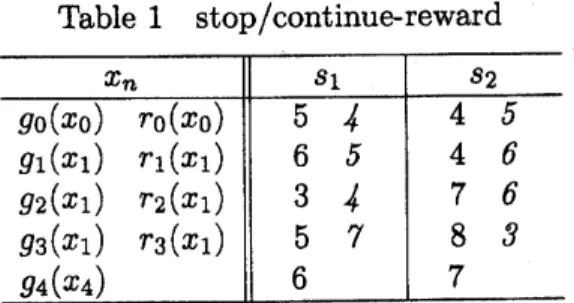
(i) $\tau\in \mathcal{T}_{0}^{4}$ (4)where the $\mathrm{s}\mathrm{t}\mathrm{o}\mathrm{p}/\mathrm{c}\mathrm{o}\mathrm{n}\mathrm{t}\mathrm{i}\mathrm{n}\mathrm{u}\mathrm{e}$-reward $\{g_{0},g_{1},g_{2}, g_{3}, g_{4};r_{0}, r_{1},r_{2}, r_{3}\}$is given in Table 1, and the
tran-sition matrix is symmetric $(p=q=1/2)$. Let
us
findan
optimal stopping time by solvingrecursive equation.
Table 1 $\mathrm{s}\mathrm{t}\mathrm{o}\mathrm{p}/\mathrm{c}\mathrm{o}\mathrm{n}\mathrm{t}\mathrm{i}\mathrm{n}\mathrm{u}\mathrm{e}$-reward
$x_{n}$ $s_{1}$ $s_{2}$ $x_{n}$ $s_{1}$ $s_{2}$ $g\mathrm{o}(x_{0})$ $r_{0}(x_{0})$ $g_{1}(x_{1})$ $r_{1}(x_{1})$ $g_{2}(x_{1})$ $r_{2}(x_{1})$ $g_{3}(x_{1})$ $r_{3}(x_{1})$ $g_{4}(x_{4})$ 5
4
6 5 34
5 7 6 4 5 4 6 7 6 8 3 7It is shown that the total number of stopping times $\{f_{m}(n)\}$ for $m$-state $n$-stage model
satisfies the recursive relation ([6])
$f_{m}(n+1)$ $=$ $1+(f_{m}(n))^{m}$
$f_{2}(m)$ $=$ $1+2^{m}$.
There exist $f_{2}(4)=677$stopping times for twO-state $(m=2)$ fo$\mathrm{u}\mathrm{r}$-stage $(n=4)$ model. Among
them, let
us
findan
optimal stopping time by solving dynamic programming recursive equation(3).
First, the forward recursion in Lemma 3.1 generates the following past-value sets :
$\Gamma_{0}=\{(-\infty, \infty)\}$, $\Gamma_{1}=\{(4,4)\}$, $\Gamma_{2}=\{(5,4), (6,4)\}$
$\Gamma_{3}=\{(5,4), (6,4)\}$, $\Gamma_{4}=\{(7,4), (5,3), (6,3)\}$
.
Second, the backward recursion (3) yields an optimal solution in expanded Markov class $\Pi$;
optimal value functions
$v_{0}$, $v_{1}$, $v_{2}$, $v_{3}$, $v_{4}$; $v_{n}=v_{n}(x_{n};\lambda_{n},$$\xi_{n}$
and an optimal policy
$\pi^{*}=\{\pi_{0}^{*}, \pi_{1}^{*}, \pi_{2}^{*}, \pi_{3}^{*}\})$
.
$\pi_{n}^{*}=\pi_{n}^{*}(x_{n};\lambda_{n}, \xi_{n})$.In fact the optimal solution is calculated
as
follows:$v_{4}(s_{1}; 7, 4)=7\vee g_{4}(s_{1})-4\Lambda g_{4}(s_{1})=7\vee 6-4\Lambda 6=7-4=3$
$v_{4}(s_{1}; 5, 3)=5\vee g_{4}(s_{1})-3\Lambda g_{4}$(si) $=5\vee 6-3\Lambda 6=6-3=3$
$v_{4}(s_{1}$; 6,3$)$ $=6\vee g_{4}(s_{1})-3\Lambda g_{4}(s_{1})=6\vee 6-3\Lambda 6=6-3=3$ $v_{4}(s_{2}; 7, 4)=7\vee g_{4}(s_{2})-4\Lambda g_{4}(s_{2})=7\vee 7-4\Lambda 7=7-4=3$
$04(\mathrm{s}2)5,3)=5\vee$gA$\{\mathrm{s}2)-$$3\Lambda \mathrm{g}\mathrm{A}\{\mathrm{s}2)=5\vee 7-$$3\Lambda 7=7-$$3$$=4$
$04(\mathrm{s}2)6,3)=6\vee$gA{$\mathrm{s}2)-$ $3$$\Lambda$gA$\{\mathrm{s}2)=6\vee 7-$$3$$\Lambda 7=7-$$3$$=4$
$v_{3}(s_{1}$;5,4$)$ $=$ ${\rm Max}\{$
$5\vee$$g_{3}(s_{1})-4$$\Lambda g_{3}(s_{1})$
$v_{4}(s_{1}; 5 \vee r_{3}(s_{1}), 4\Lambda r_{3}(s_{1}))\cdot\frac{1}{2}+v_{4}(s_{1} ; 5\vee r_{3}(s_{1}), 4\Lambda r_{3}(s_{1}))\cdot\frac{1}{2}$
$=$ ${\rm Max}\{$
$5\vee g_{3}(s_{1})-4\Lambda g_{3}(s_{1})$
$v_{4}(s_{1}; 5 \vee 7,4\Lambda 7)\cdot\frac{1}{2}+v_{4}(s_{1}; 5\vee 7, 4 \Lambda 7)\cdot\frac{1}{2}$
$=$ ${\rm Max}\{$
$5\vee 5-4\Lambda 5$
$v_{4}(s_{1}$; 7,4$)$$\cdot\frac{1}{2}+v_{4}(s_{1} ; 7, \cdot 4)$
.
$\frac{1}{2}$ $=$ ${\rm Max}\{$5-4 3$\cdot\frac{1}{2}+3$
.
$\frac{1}{2}$$=$ ${\rm Max}\{$ 1
$v_{3}(s_{1}$;6, 4$)$ $=$ ${\rm Max}\{$
$v_{4}(s_{1)}.6 \vee r_{3}(s_{1}), 4\Lambda r_{3}(s_{1}))\cdot\frac{1}{2}+v_{4}(s_{1} ; 6\vee r_{3}(s_{1}), 4\Lambda r_{3}(s_{1}))\cdot\frac{1}{2}$
$=$ ${\rm Max}\{$ $6\vee 5-4\Lambda 5$ $v_{4}(s_{1}$;7, 4$)$$\cdot\frac{1}{2}+v_{4}(s_{1}$; 7,4$)$$\cdot\frac{1}{2}$ ${\rm Max}\{$ 6-4 3
.
$\frac{1}{2}+3$.
$\frac{1}{2}$ $=$ ${\rm Max}\{$ 2 3 $=3$ $\pi_{3}^{*}(s_{1}; 6, 4)=\mathrm{c}o\mathrm{n}\mathrm{t}\mathrm{i}\mathrm{n}\mathrm{u}\mathrm{e}$ $v_{3}(s_{2;}5,4)={\rm Max}\{$ 8-4 3$\cdot\frac{1}{2}+4\cdot\frac{1}{2}$ $=4$ $\pi_{3}^{*}(s_{2};5,4)=\mathrm{s}$ $v_{3}(s_{2}; 6, 4)={\rm Max}\{$ 8-4 3$\cdot\frac{1}{2}+3\cdot\frac{1}{2}$ $=4$ $\pi_{3}^{*}(s_{2}; 6, 4)=\mathrm{s}$ $v_{2}(s_{1} ; 5, 4)={\rm Max}\{$ 5-3 3$\cdot\frac{1}{2}+4$.
$\frac{1}{2}$ $=3.5$ $\pi_{2}^{*}(s_{1} ; 5, 4)=\mathrm{c}$ $v_{2}(s_{1} ; 6, 4)={\rm Max}\{$ 6-3 3$\cdot\frac{1}{2}+4\cdot\frac{1}{2}$ $=3.5$ $\pi_{2}^{*}(s_{1}; 6, 4)=\mathrm{c}$ $v_{2}(s_{2}; 5, 4)={\rm Max}\{$ 7-4 3$\cdot\frac{1}{2}+4\cdot\frac{1}{2}$ $=3.5$ $\pi_{2}^{*}(s_{2}; 5, 4)=\mathrm{c}$ $v_{2}(s_{2}; 6, 4)={\rm Max}\{$ 7-4 3$\cdot\frac{1}{2}+4$.
$\frac{1}{2}$ $=3.5$ $\pi_{2}^{*}(s_{2}; 6, 4)=\mathrm{c}$ $v_{1}(s_{1}; 4, 4)={\rm Max}\{$ 6-4 3.5.
$\frac{1}{2}+3.5$.
$\frac{1}{2}$ $=3.5$ $\pi_{1}^{*}(s_{1} ; 4, 4)=\mathrm{c}$ $v_{1}(s_{2}; 4, 4)={\rm Max}\{$ 4-4 3.5$\cdot\frac{1}{2}+3.5$.
$\frac{1}{2}$ $=3.5$ $\pi_{1}^{*}(s_{2}; 4, 4)=\mathrm{c}$ $v_{2}(s_{1} ; 5, 4)={\rm Max}\{$ 5-3 3$\cdot\frac{1}{2}+4\cdot\frac{1}{2}$ $=3.5$ $\pi_{2}^{*}(s_{1}; 5, 4)=\mathrm{c}$ $v_{2}(s_{1} ; 6, 4)={\rm Max}\{$ 6-3 3$\cdot\frac{1}{2}+4\cdot\frac{1}{2}$ $=3.5$ $\pi_{2}^{*}(s_{1}; 6, 4)=\mathrm{c}$ $v_{2}(s_{2}; 5, 4)={\rm Max}\{$ 7-4 3$\cdot\frac{1}{2}+4\cdot\frac{1}{2}$ $=3.5$ $\pi_{2}^{*}(s_{2}; 5, 4)=\mathrm{c}$ $v_{2}(s_{2}; 6, 4)={\rm Max}\{$ 7-4 3$\cdot\frac{1}{2}+4\cdot\frac{1}{2}$ $=3.5$ $\pi_{2}^{*}(s_{2}; 6, 4)=\mathrm{c}$ $v_{1}(s_{1}; 4, 4)={\rm Max}\{$ 6-4 3.5$\cdot\frac{1}{2}+3.5\cdot\frac{1}{2}$ $=3.5$ $\pi_{1}^{*}(s_{1}; 4, 4)=\mathrm{c}$ $v_{1}(s_{2;}4,4)={\rm Max}\{$ 4-4 3.5$\cdot\frac{1}{2}+3.5\cdot\frac{1}{2}$ $=3.5$ $\pi_{1}^{*}(s_{2}; 4, 4)=\mathrm{c}$$v0(s_{1};-\infty, \infty)={\rm Max}\{$
5-5
3.5
.
$\frac{1}{2}+3.5\cdot\frac{1}{2}$$=3.5$ $\pi_{0}^{*}(s_{1};-\infty, \infty)=\mathrm{c}$
The optimal solution is tabulated in Table 2:
Table 2 optimal solution
$x_{4}\backslash (\lambda_{4}, \xi 4)$
$v_{4}(x_{4;} \lambda 4, \xi 4)$ $(7,4)$ $(5,3)$ $(6,3)$ $s_{1}$ $s_{2}$
3
3 3 3 4 4$x_{n}\backslash (\lambda_{n}, \xi_{n})$
$v_{1}$$(x_{1} ; \lambda 1, \xi 1)$ $\pi_{1}^{*}(x1; \lambda 1, \xi 1$) $v_{0}(x0; 1)$ $\pi_{0}^{*}(x0; \lambda 0, \xi 0$)
$(4,4)$ $(-\infty, \infty)$ $s_{1}-$ $s_{2}$ $3.\overline{5}\mathrm{c}---$ 3.5 $\underline{c}$ $3.5-$ $-c$
Third,
we see
that an optimal stpping rule $\tau^{*}$ is to stop at state$s_{2}$
on
stage 3. The ruleimplies that
an
optimal decison-maker should continue at any stateon
stages 0, 1, 2 and atstate $s_{1}$ on stage
3
(Figure 1). The maximumexpected value ofrange is $v_{0}(s_{0};-\mathrm{o}\mathrm{o}, \infty)$ $=3.5.$As is directly verified at thebottom line, the optimal expected value is equal to $E_{s_{1}}[R_{\tau}*]$
.
Thestopping $\mathrm{t}$ime $\tau^{*}$ has
$E_{s_{1}}[R_{\tau}*]=3 \cdot\frac{1}{16}+3\cdot\frac{1}{16}+\cdots+4\cdot\frac{1}{8}=\frac{7}{2}=3.5.$
$\star$ : stop
2
: continue$\mathrm{o}$ : not reached
67 6 7 6 7 6 7
$R_{n}$ 3 3 4 3 3 4 3 3 4 3 3 4
$\mathrm{p}\mathrm{r}$
.
$\mathit{1}$/16 1/16 1/8 1/16 1/16 1/8 1/16 1/16 1/8 1/16 1/16 1/8Figure 1 It is optimal to stop at state $s_{2}$
on
stage 3 :$\tau^{*}$
References
[2] . Bellman and . Denman, Invariant Imbedding, Lect. Notes in Operation Research
and Mathematical Systems, Vol. 52, Springer-Verlag, Berlin, 1971.
[3] $\mathrm{R}.\mathrm{E}$. Bellman and $\mathrm{L}.\mathrm{A}$. Zadeh, Decision-making in a fuzzy environment, Management Sci.
17(1970), B141-B164.
[4] $\mathrm{Y}.\mathrm{S}$
.
Chow, H. Robbins and D. Siegmund, Great Expectations: The Theoryof
OptimalStopping, Houghton Mifflin Company, Boston, 1971.
[5] N. Furukawa and S. Iwamoto, Stopped decision processes on complete separable metric
spaces, J. Math. Anal. Appl. 31(1970), 615-658.
[6] H. Hisano, Optimal stopping problemon finiteMarkov chain, Bull. Informatics and
Cyber-netics, 34, No. 2 (2003), 97-104.
[7] S. Iwamoto, Theory
of
Dynamic Program: Japanese, Kyushu Univ. Press, Fukuoka, 1987.[8] S. Iwamoto, From dynamic programming to bynamic programming, J. Math. Anal. Appl.
177(1993), 56-74.
[9] S. Iwamoto, On bidecision processes, J. Math. Anal. Appl. 187(1994), 676-699.
[10] S. Iwamoto, Associative dynamic programs, J. Math. Anal. Appl., 201(1996), 195-211.
[11] S.Iwamoto, Maximizing threshold probabilitythroughinvariant imbedding, Ed. $\mathrm{H}.\mathrm{F}$. Wang
and $\mathrm{U}.\mathrm{P}$. Wen, Proceedings of the 8th Bellman Continuum, National Tsing Hua University,
Hsinchu, ROC, Dec, 2000, 17-22.
[12] S. Iwamoto, Fuzzy decision-making through three dynamic programming approaches, $\mathrm{d}$
.
$\mathrm{H}.\mathrm{F}$. Wang and$\mathrm{U}.\mathrm{P}$
.
Wen, Proceedings ofthe 8th Bellman Continuum, National TsingHuaUniversity, Hsinchu, ROC, Dec, 2000, 23-27.
[13] S. Iwamoto, Recursive method in stochastic optimization under compound criteria,
Ad-vances in Mathematical Economics $3(2001)$, 63-82.
[14] S. Iwamoto, K. Tsurusaki and T. Fujita, “On Markov policies for minimax decision
prO-cesses,” J. Math. Anal. Appl., v01.253, nO.1, pp.58-78, 2001.
[15] S. Iwamoto, T. Ueno and T. Fujita, “Controlled Markov chains with utility functions,”
Proc.
of
Intl Workshopon
Markov Processes and Controlled Markov Chains, Changsha,China, August 22-28, 1999, Kuluwer, 2002, pp.135-148. to
appear.
[16] S. Iwamoto and T. Fujita, Stochasticdecision-makingin
a
fuzzyenvironment, J. Operations${\rm Res}$
.
Soc Japan 38(1995), 467-482.[17] $\mathrm{E}.\mathrm{S}$. Lee, Quasilinearization an$d$ Invariant Imbedding, Academic Press, New York, 1968.
[18] $\mathrm{A}.\mathrm{N}$
.
Shiryaev, Optimal Stopping Rules, Springer-Verlag, New York, 1978.[19] M. Sniedovich, Dynamic Programming, MarcelDekker, Inc. NY 1992.
[20] K. Tsurusaki, Extrema-trimmed sum in decision problem, Ed. $\mathrm{H}.\mathrm{F}$
.
Wang and $\mathrm{U}.\mathrm{P}$.
Wen,Proceedingsofthe8th Bellman Continuum,National TsingHuaUniversity, Hsinchu,ROC,
Dec, 2000, 2-6.
[7] $\mathrm{S}$
, Iwamoto, Theory
of
Dynamic Program: Japanese, Kyushu Univ. Press, Fukuoka, 1987.[8] S. Iwamoto, From dynamic programming to bynamic programming, J. Math. Anal. Appl.
177(1993), 56-74.
[9] S. Iwamoto, On bidecision processes, J. Math. Anal. Appl. 187(1994), 676-699.
[10] S. Iwamoto, Associative dynamic programs, J. Math. Anal. Appl., 201(1996), 195-211.
[11] S.Iwamoto, Maximizing threshold probabilitythroughinvariant imbedding, Ed. $\mathrm{H}.\mathrm{F}$. Wang
and $\mathrm{U}.\mathrm{P}$. Wen, Proceedings of the 8th Bellman Continuum, National Tsing Hua University,
Hsinchu, ROC, Dec, 2000, 17-22.
[12] S. Iwamoto, Fuzzy decision-making through three dynamic programming approaches, $\mathrm{d}$
.
$\mathrm{H}.\mathrm{F}$. Wang and$\mathrm{U}.\mathrm{P}$
.
Wen, Proceedings ofthe 8th Bellman Continuum, National TsingHuaUniversity, Hsinchu, ROC, Dec, 2000, 23-27.
[13] S. Iwamoto, Recursive method in stochastic optimization under compound criteria,
Ad-vances in Mathematical Economics $3(2001)$, 63-82.
14] S. Iwamoto, K. Tsurusaki and T. Fhjita, “On Markov policies for minimax decision
prO-cesses,” J. Math. Anal. Appl., v01.253, nO.1, pp.58-78, 2001.
[15] S. Iwamoto, T. Ueno and T. Fujita, “Controlled Markov chains with utility functions,”
Proc.
of
Intl Workshopon
Markov Processes and Controlled Markov Chains, Changsha,China, August 22-28, 1999, Kuluwer, 2002, pp.135-148. to
appear.
[16] S. Iwamoto and T. Fujita, Stochasticdecision-makingin
a
fuzzyenvironment, J. Operations${\rm Res}$
.
Soc Japan 38(1995), 467-482.[17] $\mathrm{E}.\mathrm{S}$. Lee, Quasilinearization and Invariant Imbedding, Academic Press, New York, 1968.
[18] $\mathrm{A}.\mathrm{N}$
.
Shiryaev, Optimal Stopping Rules, Springer-Verlag, New York, 1978.[19] M. Sniedovich, Dynamic Programming, MarcelDekker, Inc. $\mathrm{N}\mathrm{Y}$, 1992.
[20] K. Tsurusaki, Extrema-trimmed sum in decision problem, Ed. $\mathrm{H}.\mathrm{F}$
.
Wang and $\mathrm{U}.\mathrm{P}$.
Wen,
Proceedingsofthe8th Bellman Continuum,National TsingHuaUniversity, Hsinchu,ROC,