In this context, the analysis of the emergence and response to the risk of COVID-19 in the early stages of the spread of infection will serve as an important collection of empirical knowledge for future reference. First, it is worth mentioning the existence of a cognitive bias in the subjective assessment of the probability of the risk of COVID-19. Second, in the UK, those with a pessimistic bias rated the necessity and effectiveness of the lockdown lower than those with an optimistic bias.
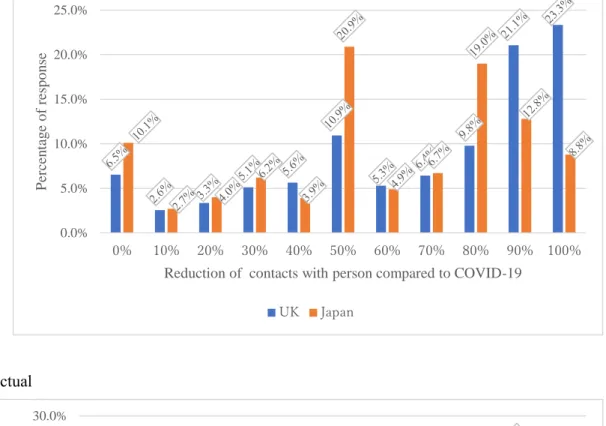
These results suggest that the paternalistic policy can be effective in preventing the spread of the Covid-19 infection. However, the effectiveness of the measures is around 70% in both countries, with more than 10% of respondents in Great Britain. This difference may be due to the difference in the restrictive power of the emergency declaration in Japan compared to that in Britain.
In the UK, the lockdown resulted in more severe reductions in the number of contacts than in the number of outings.
Subjective probability of infection risk
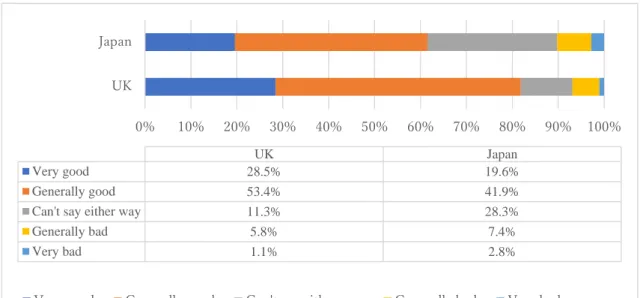
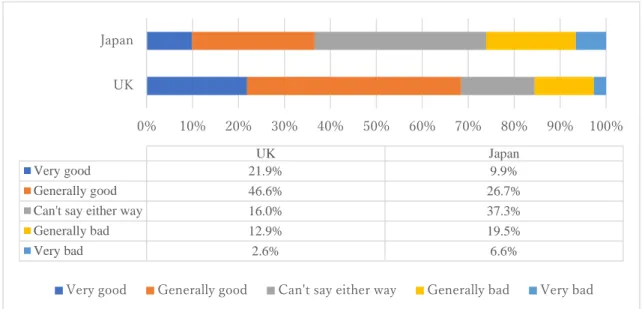
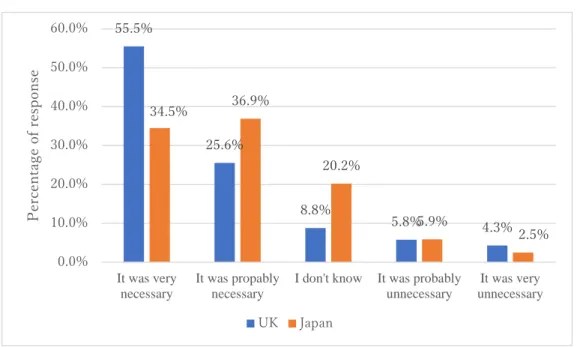
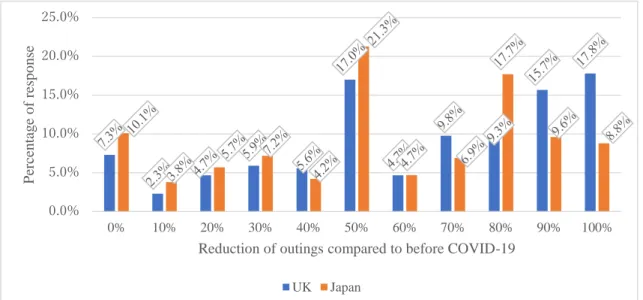
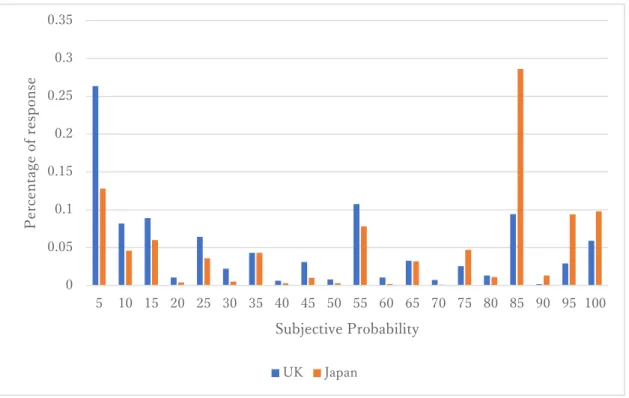
In the following sections, we will analyze how people's subjective risk assessment influences their evaluation and behavior change regarding lockdown and emergency declaration, as observed in Figures 6, 7 and 8, paying attention to the differences between Japan and the UK. The skewness, indicating the distribution asymmetry, is 0.73 in the UK, skewed to the left, while it is -0.49 in Japan, skewed to the right. These differences in the distribution of responses indicate an optimistic tendency to underestimate the risk of COVID-19 in the UK, while there is a pessimistic tendency to overestimate the risk in Japan.
It is worth noting that there were differences in the public's assessment of the risk of infection between these two countries. In the next section, we quantitatively analyze how each nation's citizens' subjective likelihood and socioeconomic characteristics influence their assessment of countermeasures and behavior change.
Estimation model
In Japan, the government did not implement as severe a lockdown as the one in Britain in the form of a declaration of emergency, but most of the population voluntarily limited outdoor activities. They also actively wore masks and washed their hands, and both the number of infected and the rate of infection were among the lowest in the world during the first wave in spring 2020. In contrast, the UK was one of the countries that suffered a major blow in the early stages of COVID -19 outbreak.
Furthermore, to analyze the effect of pessimistic/optimistic bias, a pessimistic bias, Pess, is introduced into the econometric model, and a cross term is taken with SP as a variable that takes 1 only when the subjective probability is estimated to be higher. than 44.5%. For evaluation items considered closely related, such as the need for and effectiveness of lockdowns and emergency statements, as well as the desired and actual reduction in the number of exits and contacts, an apparently unrelated regression (SUR) was applied to account for . for their associations.
Estimation results
Economy vs infection control
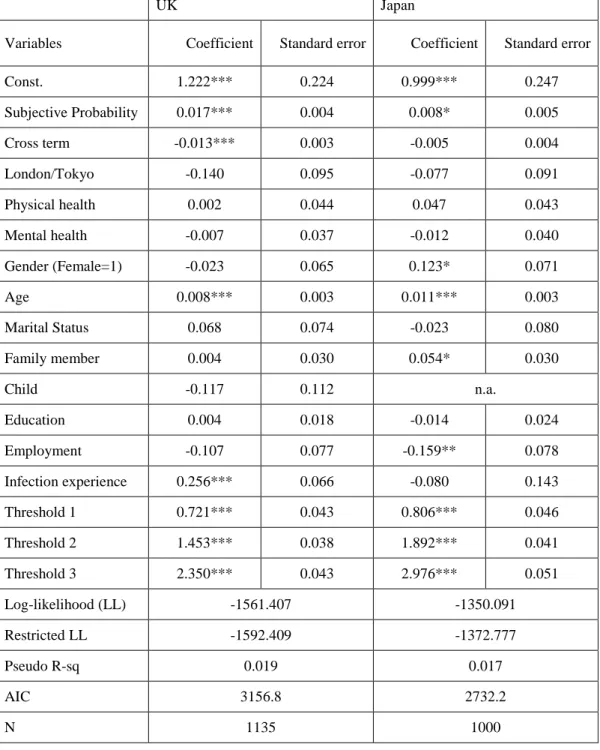
Comparing the correlation between the subjective probability of infection and the importance of measures for COVID-19 in Japan and the UK, both countries share the same tendency to place more emphasis on the economy when the tendency towards an optimistic bias increases, and a greater emphasis on COVID-19. when the tendency toward pessimistic bias increases. In the UK, where the contagion has been hardest hit, there may be evidence of a wide divergence of opinion between economic and COVID-19 countermeasures, between an optimistic bias that represents the majority and a pessimistic bias that represents only a small minority. Regarding the influence of other variables, it was statistically significantly found that in the UK, the elderly and those who had been infected placed more importance on COVID-19, while in Japan women, the elderly and those with larger families placed more importance on managing COVID -19, while those who were employed gave greater importance to the economy (Table 1).
Evaluation of lockdown/state of emergency
In Japan, the coefficient for optimism bias is -0.002, while the coefficient for pessimism bias is 0.003. A greater optimistic bias does not statistically or significantly reduce the need to declare an emergency (𝜒2= 0.22, non-significant). Nevertheless, a greater pessimistic bias statistically and significantly increases the need to declare a state of emergency (𝜒 significant).
However, in Japan, those who had experienced an infection also rated the need for declaring a state of emergency more highly. When the optimistic bias increases, the effectiveness of the lockdown is statistically significantly higher (𝜒 significant). In Japan, the coefficient for optimistic bias is -0.001, while the coefficient for pessimistic bias is 0.003.
A greater optimistic bias does not statistically or significantly reduce the effectiveness of emergency statements (𝜒2 =0.11, not significant). As with necessity, a comparison of the correlation between subjective probability of infection and lockdown/emergency declaration effectiveness in Japan and the UK. Regarding the influence of other variables, in both countries, the elderly tend to rate the effectiveness of the blockade higher.
Furthermore, in the UK, those who felt unwell rated the lockdown's effectiveness higher, while the elderly and those with large families did not rate it as effective. In Japan, however, those who were physically unwell rated the lockdown's effectiveness the least, while the elderly, women, and those who experienced infection rated the effectiveness the most. In Japan, more educated and employed people were less likely to rate the effectiveness of the lockdown, which is similar to the result of the necessity analysis.
Behavioral changes
- Desired and actual reduction of outings during lockdown/state of emergency
- Desired and actual reduction of the number of contracts
A larger optimistic bias does not lead to a statistically significant decrease in the actual level of leave reduction (𝜒2= 0.00, non-significant). Moreover, a greater pessimistic bias does not lead to a statistically significant increase in the actual level of leave reduction (𝜒2=0.54, non-significant). In this subsection we analyzed the subjective probability of infection and reduction in the number of contacts.
The lower part of Table 4 shows how the subjective probability of infection affected the actual reduction in the number of contacts. A larger optimistic bias does not lead to a statistically significant decrease in the number of desired contacts (𝜒2=0.02, non-significant). A larger optimistic bias does not lead to a statistically significant increase in the number of desired contacts (𝜒2= 0.05, non-significant).
However, those with a pessimistic bias are more committed to reducing the number of contacts, as in the case of the reduction in outings. A larger optimistic bias does not lead to a statistically significant decrease in the actual number of contacts (𝜒2= 0.02, non-significant). A larger optimistic bias does not lead to a statistically significant increase in the actual number of contacts (𝜒2= 0.22, non-significant).
Even greater pessimistic bias does not lead to a statistically significant increase in the actual number of contacts (𝜒2= 2.70, not significant). However, those with a pessimistic attitude were able to reduce contact in the UK, but not in Japan, as in the case of holiday reduction. For other variables, the results are similar to the desired reduction in the number of contacts (Table 4).
Political implications and conclusions
Nevertheless, a larger pessimistic bias statistically and significantly increases the actual number of contacts (𝜒 significant). In Japan, the coefficient for optimistic bias is -0.002, while the coefficient for pessimistic bias is 0.002. Comparing the correlation between subjective likelihood of infection and desired number of contacts in Japan and the UK, those with an optimistic bias were unable to achieve contact reduction in both Japan and the UK, as was the case for output reduction.
For the other variables, the results are similar to the desired reduction in the number of contacts (Table 4). Perceived probability of dying from SARS was higher in Europe than in Asia. Using COVID-19 as a case study, Dryhurst et al. 2020) compared risk perceptions, including severity, internationally and noted that the risk of COVID-19 was rated higher in the United Kingdom in March–April 2020. Therefore, in this paper we analyzed the subjective probability of COVID-19 infection using Bayes' theorem and showed that the risk of infection is perceived to be higher in Japan than in the UK.
In addition, we analyzed the correlation between subjective likelihood of infection and policy evaluation and preventive behavior in the UK. The results of this study also showed that the correlation between subjective likelihood of infection and change in infection prevention behavior differed between those with a pessimistic bias and those with an optimistic bias. Second, in the UK, those with pessimistic attitudes rated the necessity and effectiveness of quarantine lower than those with optimistic attitudes.
However, in the first wave, those with a pessimistic attitude rated the necessity and effectiveness of prisons higher than those with an optimistic attitude in Japan because the damage caused by the contagion was less than in other countries. Third, perceived risk of contagion, such as pessimistic and optimistic biases, was associated with behavioral changes, such as reductions in the frequency of going out and the number of contacts. Still, those with an optimistic attitude were clearly unwilling to go out and cut back on contacts in both Japan and the UK.
This study revealed that a large number of people in the UK have an optimistic bias. FeldmanHall (2021), “Emotional responses to prosocial messages increase willingness to self-isolate during the COVID-19 pandemic”, Personality and Individual Differences, 170. Hoshino (2020) “Nudging Preventive Behaviors in COVID-19 Crisis: A Large Scale RCT uses smartphone advertising”, Keio-IES DP2020-021,.
Abu Bakar (2020) "Using the Health Belief Model to Assess Predictors of Intention to Receive a COVID-19 Vaccine and Willingness to Pay", Human Vaccines and Immunotherapeutics before and after the initial lockdown).