A Note on a Real Option and Game‑theoretic Approach toward a Valuation of GHG Emission Rights in Climate Change
著者(英) Satoshi Taguchi
journal or
publication title
Doshisha Shogaku (The Doshisha Business Review)
volume 61
number 1‑2
page range 69‑77
year 2009‑07‑30
URL http://doi.org/10.14988/pa.2017.0000007413
《研究ノート》
A Note on a Real Option and Game-theoretic Approach toward a Valuation of GHG
Emission Rights in Climate Change
Satoshi Taguchi
1. Introduction
This paper focuses on a valuation of GHG (Greenhouse Gas) emission
1
rights with a real op- tion and game-theoretic
2
approach.
Environmental destruction of the earth, such as global warming, is our important problem (Gore 2006). Toward this problem, it is said that GHG emission rights trading would be one of the most useful methods that might solve it, because emission rights trading would strike a balance between economical activity and ecology movement.
Indeed emission rights trading have much possibility to solve the problem, and there are some arguments how we apply it relevantly in reality and how we think of the nature of emis- sion
3
rights. But these arguments seem to be not matured ; in particular, we have no consensus on a price theory of emission rights created in negotiated transactions such as CDM (Clean Development Mechanism) projects. This is the reason why we think of a price theory of emis- sion rights.
We think of this problem with a real option and game-theoretic approach and we focus on CERs in negotiated transactions. This paper has two unique points. First, this paper has con- sidered interactions of participants in emission rights trading and situations in negotiated trans- actions with a game-theoretic approach. Conrad (1997), Lambie (2009) and Pindyck (2000, 2002) have arguments of emission rights with real option approach, but they have not consid- ered interactions of participants in emission rights trading and situations in negotiated transac- tions. On contrast, this paper has considered them.
Second, this paper focuses on CERs and processes in which CERs are created. CERs are
────────────
1 There are three types of GHG emission rights ; AAU (Assigned Amount Unit), ERU (Emission Reduction Unit) and CER (Certified Emission Reduction). This paper especially focuses on CER.
2 See Gibbons (1992) for game theory, Dixit and Pindyck (1994) for real option approach, and Dixit and Pindyck (1994, chapter. 9) for real option and game-theoretic approach.
3 For example, you can see this type of research in environmental economics and experimental economics.
(69)69
created by CDM projects, and what important point in CDM projects is that they are made by negotiated transactions between a firm in a developed country and an underdeveloped country.
Sakagami (2007) have arguments of emission rights with a real option and game-theoretic ap- proach, but it has not considered this point. On Contrast, this paper focuses on this point.
In section 2, a two-players-model is presented. In section 3, we consider the equilibria in this model. In section 4, we sum up this model.
2. the model
2−1. Setup
This paper focuses on a valuation of emission rights ; in particular, CERs. We have consid- ered interactions of participants in emission rights trading and situations in negotiated transac- tions with game-theoretic approach.
We assume two players in a CDM project ; a firm in a developed country (called ‘country A’ or ‘A’ in our model) and an underdeveloped country (called ‘country B’ or ‘B’ in our model). Country A is a Annex I in the Kyoto Protocol, and country B is a Annex II in the Kyoto Protocol. So country A has responsibility for the observance of the Kyoto Protocol. On the other hand, country B doesn’t have responsibility for the observance of the Kyoto Protocol.
Country A faces a decision-problem whether country A would participate in a CDM project with country B. On the other hand, country B also faces a decision-problem whether country B would participate in a CDM project with country A. Country A is the reader and country B is the follower in our model.
Timeline of this model is following table 1.
Table 1 Timeline
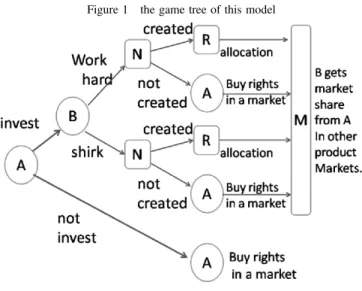
1. Country A decides whether A would invest in a CDM project with B. To participate in the project, country A must payIfor it.I is defined as initial costs for the project.
2. When A invests, country B decides whether B would work hard or shirk in the CDM project. Country B must due the disutility of his work which is defined as ‘DU’. When B works hard, DU=D (D is some fixed number), otherwise, DU=0.
When A doesn’t invest, A must buy emission rights in the markets in the 4 th period because of the limitation in the Kyoto Protocol. Unit price of emission rights in the 4 th period is P.
3. (When A invests,) ‘nature’ decides whether the CDM project with A and B would produce GHG emis- sion rights. Probability that A and B get emission rights when B works hard is defined as P(CER/hard).
Now we define P(CER/hard) as α. Probability that A and B wouldn’t get emission rights when B works hard is defined as P(not/hard), and we define P(not/hard) as (1−α). Probability that A and B would get emission rights when B shirks is P(CER/shirk). We define P(CER/ shirk) asβ. Probability that A and B wouldn’t get emission rights when B shirks is defined as P(not/shirk), and we define P(not /shirk) as (1−β). We define 0<β<0.5<α<1.
同志社商学 第61巻 第1・2号(2009年7月)
70(70)
The game tree of this model is presented by figure 1.
2−2. Expected utilities
The expected utility of A is defined asEUA. This consists of four factors ; allocation of CER, market share that B gets, initial investment, and P when A buy emission rights in a market.
EUA=rCER−m−I−P ………(1)
In reality, country A may compare the value of a CDM project (EUA) with market prices that A can buy CER in a market before A makes a decision whether A invests in the first pe- riod. Now we define ρas 1/(1+discounted rate). Now we defined that ρ=1. For country A, the option value of postponement is just the value of the choice that A will buy emission rights in the market. Country A would compare a value of the project with the option value of postponement.
────────────
4 We assume that this market is monopoly for A.
4. When the CDM project produces emission rights, A and B will share them with an allocation rule ‘R’.
R is defined as ‘A:B=r:1−r.’ Now we defineras the ratio of this allocation, 0!r!1. When the project doesn’t produce them, A must buy emission rights in the market because of the limitation in the Kyoto Protocol. A price of emission rights in the market is P.
5. Country B gets some know-how of business from the project when A invests. This is because the know- how which A has in other business would be shared by A and B. In our model, the fact that B gets the know-how means that B would get market share in other productsmarkets from A. This rate that B gets4 market share from A is ‘M,’ M is defined as ‘A:B=1−m:m.’ Now we definedmas the ratio of the market share which B gets, 0!m!1. Unit price of other product is defined as 1.
Figure 1 the game tree of this model
A Note on a Real Option and Game-theoretic Approach in Climate Change(Taguchi) (71)71
【Observation 1】: the condition that A participates in a CDM project
If EUA>P, A would participate in a CDM project. If not, A would not partici- pate.
Expected Utility of B is defined as EUB. This consists of allocation of CER, market share that B gets, and DU.
EUB=rCER+m−DU ………(2)
In reality, country B may compare the value when B works hard (this is defined as EUB
(hard)) with the value when B shirks (this is defined asEUB (shirk)).
【Observation 2】: the condition that B works hard in a CDM project
IfEUB(hard)>EUB(shirk), B would work hard in a CDM project. If not, B would shirk in a project.
3. equilibria
3−1. three conditions
In this section, we consider three conditions to solve this problem backward.
First, we consider the condition of the maximization ofEUA when A invests in a CDM pro- ject. If we compare the EUA when B works hard with theEUA when B shirks, we will derive following condition.
【Corollary 1】the condition of the maximization ofEUA when A invests in a project.
If CER!m+I
r , country A will maximize EUA when B works hard. If CER
<m+I
r , country A will maximizeEUA when B shirks.
【Proof】
See appendix 1.
Second, we consider the condition that B works hard or B shirks. From Observation 2, we will derive following corollary.
同志社商学 第61巻 第1・2号(2009年7月)
72(72)
【Corollary 2】the condition that B works hard or B shirks in a CDM project.
If r≠1 (that is, 0!r<1), B would work hard in a CDM project. If r=1, B would shirks in a project.
【Proof】
See appendix 2.
Corollary 2 shows that B shirks in a project when country A gets all emission rights.
Third, we consider the condition that A participates in a CDM project. From Observation 1, we will derive following corollary.
【Corollary 3】the condition that A participates in a CDM project.
【Case 1】When B works hard.
If CER"2−α
αr P+m+I
αr , A would participate in a CDM project. If CER
<2−α
αr P+m+I
αr , A would buy emission rights in a market.
【Case 2】When B shirks.
If, CER"2−β
βr P+m+I
βr A would participate in a CDM project. If CER
<2−β
βr P+m+I
βr , A would buy emission rights in a market.
【Proof】
See appendix 3.
3−2. equilibria
From three conditions, we derive following conditions (we write the decisions of country A and B as (A,B)).
【Lemma 1】 the condition of Nash equilibria in this model.
The condition that (A,B)=(invest in a CDM project, work hard) is Nash equilibria in this model is described as ;
CER"2−α
αr P+m+I
αr , and r≠1.
The condition that (A,B)=(invest in a CDM project,shirk) is Nash equilibria in this model is empty set.
A Note on a Real Option and Game-theoretic Approach in Climate Change(Taguchi) (73)73
The condition that country A would buy emission rights is Nash equilibria in this model is described as ;
CER<2−α
αr P+m+I αr
【proof】
See appendix 4.
We can describe Lemma 1 as following figure 2.
3−3. valuation
From Lemma 1, we can describe following theorem.
【Theorem】the valuation of CERs from a CDM project.
If there is no arbitrage trade, the value of CERs from a CDM project would be described as following ;
CER=2−α
αr P+m+I
αr (s.t.r≠1)
漓IfP increases, the value of CER will increase.
滷Ifm increases, the value of CER will increase.
澆Ifr increases, the value of CER will decrease.
潺Ifα increases, the value of CER will decrease.
【proof】
See appendix 5.
Figure 2 the image of Lemma 1 同志社商学 第61巻 第1・2号(2009年7月)
74(74)
澆and潺are paradoxical conclusions.
4. Conclusion
The purpose of this paper is to consider a valuation of GHG emission rights, especially CERs from CDM projects with a real option and game-theoretic approach. There has been no study that tried to prove a valuation of them with a real option and game-theoretic approach.
We discovered Nash equilibria in a CDM project game, and we got a theorem of a valu- ation of CERs. The following results were obtained :
(1) In a CDM project, an underdeveloped country shirks in a project when a firm in a devel- oped country will get all emission rights in the contract (r=1).
(2) a value of CERs from CDM projects is affected by following factors : (a) a market price of emission rights (P),
(b) the ratio of allocation of CERs between an underdeveloped country and a firm in a de- veloped country in CDM contracts (r),
(c) the ratio of the market share which an underdeveloped country gets from a firm in a developed country in other products markets because of know-how which an underde- veloped country gets in CDM projects (m),
(d) initial costs of CDM projects which a firm in a developed country must pay (I), and (e) the probability that an underdeveloped country and a firm in a developed country get
CERs when an underdeveloped country works hard in CDM projects (α).
(3) the value of CERs from CDM projects will decrease when (b) or (e) increases.
※This work was supported by Grant-in-Aid for Young Scientists (B) of the Ministry of Education, Culture, Sports, Science and Technology.
【References】
Bqudry, M. (2000) “Joint Management of Emission Abatement and Technological Innovation for Stock Exter- nalities,”Environmental and Resource Economics, Vol. 16, pp. 161−183.
Baker, E. (2005) “Uncertainty and learning in a strategic environment : global climate change,”Resource and Energy Economics,Vol. 27, pp. 19−40.
Bernard, A., A. Haurie, M. Vielle and L. Viguier (2008) “A two-level dynamic game of carbon emission trading between Russia, China, and Annex B countries,”Journal of Economic Dynamics & Control, Vol. 32, pp.
1830−1856.
Conrad, A. K. (1997) “Global Warming : When to bite the bullet,”Land Economics,Vol. 73, pp. 164−173.
Dixit, A. K. and R. S. Pindyck. (1994) Investment Under Uncertainty, Princeton University Press, Princeton, Flam, S. D. and Y. M. Ermoliev (2008) “Investment, uncertainty, and production games,”Environment and De-
velopment Economics,Vol. 14, pp. 51−66.
A Note on a Real Option and Game-theoretic Approach in Climate Change(Taguchi) (75)75
Gore, A. (2006)An Inconvenient Truth, Bloomsbury Publishing PLC.
Gibbons R. (1992)Game Theory for Applied Economists, Princeton University Press.
Grenadier, S. R. (1996) “The Strategic Exercise of Options : Development Cascades and Overbuilding in Real Estate Markets,”Journal of Finance,Vol. 51, No. 5, pp. 1653−1679.
Lambie, N. R. (2009) “The role of real options analysis in the design of a greenhouse gas emissions trading scheme,” Paper presented at the 53rd Annual Conference of the Australian Agricultural and Resource Eco- nomics Society, 10−13 February 2009, Cairns, North Queensland.
Pindyck, R. S. (2000) “Irreversibilities and the timing of environmental policy,”Resource and Energy Econom- ics,Vol. 22, pp. 233−259.
───(2002) “Optimal timing problems in environmental economics,”Journal of Economic Dynamics & Con- trol Vol. 26, pp. 1677−1697.
Sakagami, S. (2007) “Environmental Policy and Real Option,”Mita Gakkai Zasshi, Vol. 100, No. 3, pp. 129−
150 (in Japanese).
Wirl, F. (2005) “Consequences of irreversibilities on optimal intertemporal CO 2 emission policies under uncer- tainty,”Resource and Energy Economics,Vol. 28, pp. 105−123.
───(2004) “International greenhouse gas emissions when global warming is a stochastic process,”Applied Stochastic Models in Business and Industry,Vol. 20, pp. 95−114.
Zhao, J. (2003) “Irreversible abatement investment under cost uncertainties : tradable emission permits and emis- sions charges,”Journal of Public Economics,Vol. 87, pp. 2765−2789.
Appendix
Appendix 1 the proof of Corollary 1.
We think ofEUAif A invests.
【Case 1】When B works hard.
EUA=α(rCER−m−I)+(1−α)(−m−I−P)
【Case 2】 When B shirks.
EUA=β(rCER−m−I)+(1−β)(−m−I−P) When we compare both of them, we can get Corollary 1.
Appendix 2 the proof of Corollary 2.
We think ofEUBif A invests.
【Case 1】When B works hard.
EUB(hard)=α((1−r)CER+m−D)+(1−α)(m−D)
【Case 2】 When B shirks.
EUB(shirk)=β((1−r)CER+m−D)+(1−β)(m−D)
From observation 2, the condition that B Works hard isEUB(hard)−EUB(shirk)>0. We solve this.
α((1−r)CER+m−D)+(1−α)(m−D)−β((1−r)CER+m−D)−(1−β)(m−D)>0
⇔(α−β)(1−r)CER>0
Nowα>β and CER>0, so we need the condition ‘1−r>0’ when B works hard.
Appendix 3 the proof of Corollary 3.
From Observation 1, we will deriveEUA>P. We solve this.
【Case 1】When B works hard.
EUA=α(rCER−m−I)+(1−α)(−m−I−P)>P
同志社商学 第61巻 第1・2号(2009年7月)
76(76)
⇔CER"2−α
αr P+m+I αr
【Case 2】When B shirks.
EUA=β(rCER−m−I)+(1−β)(−m−I−P)>P
⇔CER"2−β
βr P+m+I βr
Appendix 4 the proof of Lemma 1.
From Corollary 1−3, we will describe the condition of Nash equilibria in this model as following figure.
First, we think of (A, B)=(invest, work hard). Because ofα<1, we will get the condition‘m+I r <m+I
αr .’ So we can rewrite the condition that (A, B)=(invest, work hard) is Nash equilibria in this model as following.
CER"2−α αr P+m+I
αr , andr≠1. ………(3)
Second, we think of (A, B)=(invest, shirk). From the condition of ‘r=1’, we can rewrite the condition as following.
CER<m+I, CER"2−β β P+m+I
β ………(4)
Because ofβ<1, we will get the condition‘m+I r <m+I
βr .’
So the condition of (4) is empty set.
Appendix 5 the proof of Theorem.
If there is no arbitrage trade, we can define ‘EUA=P.’ From Lemma 1 and this condition, we can get Theorem.
B
Work hard shirk
A
Invest in a CDM project
CER"m+I r r≠1(0!r<1) CER"2−α
αr P+m+I αr
CER<m+I r r=1 CER"2−β
βr P+m+I βr Buy emission
Rights in a market CER<2−α αr P+m+I
αr orCER<2−β
βr P+m+I βr
A Note on a Real Option and Game-theoretic Approach in Climate Change(Taguchi) (77)77