
Justice and Security through the Looking Glass of Catastrophe ―Borders, Overlaps, Challenges―
16
0
0
全文
(2) 立命館言語文化研究 24 巻 4 号. involving multiple variables that become even more intricate as human societies move forward into modernity and, thus, require efforts up to the task of deciphering them. The study of disaster is a rather new trans-disciplinary enterprise, which only in the late part of the twentieth centur y started to coalesce outside traditional academic ivor y towers. If we follow Manfred Max-Neef view on trans-disciplinarity, there are four levels at which knowledge is articulated: empirical, pragmatic, normative and the value level.3) These levels appear nested, moving from epistemic communities searching what exists, such as geology or sociology, to what we are capable of doing, like in engineering, later to what we want to do, as in politics and law, and finally to what should we do, or the ethical dimension. The nested nature of the arrangement implies a hierarchical relation, although not one that results in the final level receiving most of the attention; on the contrary, from Max-Neef presentation it becomes evident that the structure makes it easier to ignore the deepest levels of trans-disciplinary interrogation. The scientific approach of basic research, especially in social sciences, upholds a value-free pose that forbids intromissions of value discussions̶a problem that Max-Neef identifies in poverty eradication policies. Since an ultimately successful comprehensive approach to catastrophe would depend on addressing all the levels of knowledge articulation, this paper offer some thoughts on what in principle should be the most important joint for disciplines, i.e., ethical reflection. The particular approach adopted in the following pages consists in preliminarily examining two fundamental ideals usually influencing the way catastrophe is rationalized: justice and security. This framing of the vast question on the ethical underpinnings of catastrophe is inspired and informed by the personal experience of the author during the events of March 11, 2011 in Tohoku region, at ver y different levels: as a citizen of Sendai, as a PhD graduate specialized on human security studies, as a family person and as a foreigner in Japan. From the outset of the emergency, there seemed to be an asymmetry on the emphasis behind reports about the disaster, on the issues that were given more attention by the general public and what seemed to be the needs on the ground. I associated this asymmetry with an unbalance between considerations based on ideals of justice and security during the emergency. This perceived difference was less accentuated in the local media than in the international one, but it was still present. The early stages on the crisis in the nuclear plant in Fukushima seemed to be especially prone to this unbalance, so episodes of it will be recurrent in this presentation. The review is presented in terms of borders, overlaps and challenges, reflecting the variable interface between justice-oriented and security-oriented views: sometimes aligned, sometimes in clear tension, still both highly relevant as a catastrophe evolves and, hopefully, is overcome. As the title suggests, the paper has also the goal of shedding light on the relation between security and justice itself, both equally conspicuous social concerns. This goal is particularly important − 88 −.
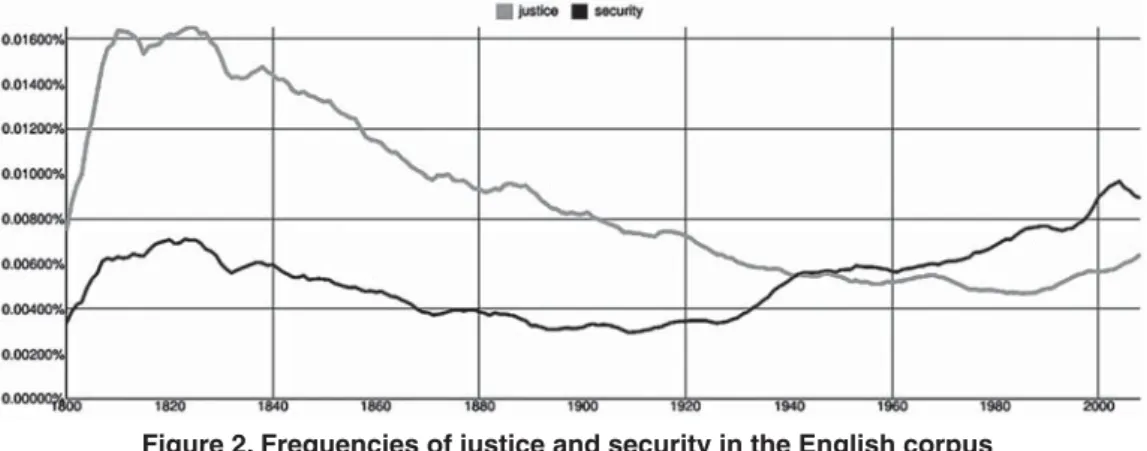
(3) Justice and Security through the Looking Glass of Catastrophe(GÓMEZ S.). when dealing with the idea of security, because it is surprisingly a concept about which there is much less understanding as well as lack of conceptual literature; it has even been called a neglected concept.4) However, when the statistics on publications making use of the two concepts are examined, at least in a compelling sample of the English corpus, the growing relevance of security compared to justice becomes evident.5) Figure 1 shows how capitalized Justice and Security have occurred in the corpus. It seems sensible to assume correlation between capitalization and conceptual interest on the concept, since capitalization happens mainly in titles or opening sentences, where the word is supposed to play a major role. The figure reveals a drastic increase in the use of Security in the inter war period, probably linked to the social ef fects of the great depression, and thereon the rhetoric of Security has caught up with that of Justice. Interestingly, the non-capitalized frequency of security and justice, as shown in Figure 2, suggests that the former has been more common than the latter from the Second World War onwards. The evidence is of course culturally biased, imperfect in many ways, but it still warrants more attention on the neglected concept of security.. Figure 1. Frequencies of capitalized Justice and Security in the English corpus Source: Google books Ngram Viewer (http://books.google.com/ngrams). Figure 2. Frequencies of justice and security in the English corpus Source: Google books Ngram Viewer (http://books.google.com/ngrams). − 89 −.
(4) 立命館言語文化研究 24 巻 4 号. Therefore, I start by advancing a very rough description of the justice and security interface, to be used heuristically to analyze some events after March 11 2011 earthquake. The analysis results in mainly three situations in which borders and overlaps are the more evident, namely: demands for information, assessing reaction and resetting standards. The final section of the paper reflects on the findings, critically reviewing the ties between catastrophe and justice and security.. Justice and Security interface: a rough start for the analysis It is difficult to exaggerate how difficult is the task of delineating the interface between general ideas of security and justice, foundational ideals of society. Figures 1 and 2 are but a warning of the present unbalance on the corresponding debates. Justice is an idea or a virtue that has been object of study and reflection for as long as there are records. The study of justice belongs to the highest echelons of the intellectual world, through which works penned more than two thousand years ago are still discussed today. On the other hand, Rothschild locates the origin of security somewhere in the seventeenth century, at the heart of European political thought after the crises behind the emergence of the Westphalia system of states.6) It has been suggested that this proximity to the state explains why then security did not become a major concept to study7): works on theory of the state, sovereignty, power, among others, may have diverted the attention. While there are other possible explanations, the tr uth is that conceptual literature is still on the first stages of consolidation, if consolidation is ever possible.8) The background thus indicates that the best place to start looking for an interface between the two ideas, one that is not exclusively intuitive, is the justice side of the couple. An appealing option is an element on theories of justice that is common to Hobbes, Hume and Rawls, which the latter introduces as the Circumstances of Justice.. 9). The basic idea is that there are some normal. conditions under which the human cooperation underlying justice is both possible and necessary. Hume s description of these circumstances includes descriptions of extreme scenarios, either utopian or dystopian, where the idea of justice loses sense.10)The negative examples deserve to be quoted in full: Suppose a society to fall into such want of all common necessaries, that the utmost frugality and industry cannot preserve the greater number from perishing, and the whole from extreme misery; it will readily, I believe, be admitted, that the strict laws of justice are suspended, in such a pressing emergence, and give place to the stronger motives of necessity and selfpreservation. Is it any crime, after a shipwreck, to seize whatever means or instrument of safety one can lay hold of, without regard to former limitations of proper ty? Or if a city besieged were perishing with hunger; can we imagine, that men will see any means of preservation before them, and lose their lives, from a scrupulous regard to what, in other − 90 −.
(5) Justice and Security through the Looking Glass of Catastrophe(GÓMEZ S.). situations, would be the rules of equity and justice? The use and tendency of that virtue is to procure happiness and security, by preserving order in society: but where the society is ready to perish from extreme necessity, no greater evil can be dreaded from violence and injustice; and every man may now provide for himself by all the means, which prudence can dictate, or humanity permit. The public, even in less urgent necessities, opens granaries, without the consent of proprietors; as justly supposing, that the authority of magistracy may, consistent with equity, extend so far: but were any number of men to assemble, without the tie of laws or civil jurisdiction; would an equal partition of bread in a famine, though effected by power and even violence, be regarded as criminal or injurious? Suppose likewise, that it should be a virtuous man s fate to fall into the society of ruffians, remote from the protection of laws and government; what conduct must he embrace in that melancholy situation? He sees such a desperate rapaciousness prevail; such a disregard to equity, such contempt of order, such stupid blindness to future consequences, as must immediately have the most tragical conclusion, and must terminate in destruction to the greater number, and in a total dissolution of society to the rest. He, meanwhile, can have no other expedient than to arm himself, to whomever the sword he seizes, or the buckler, may belong: To make provision of all means of defense and security: And his particular regard to justice being no longer of use to his own safety or that of others, he must consult the dictates of self-preser vation alone, without concern for those who no longer merit his care and attention. Hume introduces through the dystopian examples two views on security and justice interface that are in tension. On the first objective scenario, in which catastrophe strikes humanity, the suspension of justice results in additional insecurity because in such a world self-preser vation becomes the sole motive for action. Preserving and refining our understanding of justice is a way to provide security in the shape of social order, a tempting explanation of those days neglect of security as a separate idea deserving study. However, in the subjective scenario, where the virtuous man is surrounded by catastrophe, security means are recognized as the essence of self-preservation. The use of the sword is presented as killing and not being killed, anticipating the meaning the concept would acquire centuries later. Yet, it can easily be argued that the extreme actions during shipwreck or famine described in the objective dystopia are also means of security. Hume uses later the example of war between civilized societies and barbarians, showing that the self in self-preservation includes groups beyond the virtuous man. By recalling Hobbes state of nature in a footnote to this excerpt̶mentioning, by the way, that − 91 −.
(6) 立命館言語文化研究 24 巻 4 号. Plato and Cicero had also considered such dystopian scenario before̶Hume plays with the fiction that justice is only possible after security brought by the State has been achieved. He doubts whether that fiction justifies the State, but he does recognize that catastrophe forecloses justice. The missing piece in this line of reasoning is that, whether or not the State is summoned, after catastrophe, security allows justice to be possible again. The two views on security and justice present in Hume are of precondition or consequence, but the chicken and egg debate is not his (nor our) interest. When the discussion is brought back from the hypothetical to the real world, security and justice can be seen as mutually dependent social tasks. Security concerned with the pursuit of survival and Justice with the pursuit of fairness, the right thing to do. underlying social order.. 11). This is not a totally undisputed starting point, since both the Circumstances of Justice and the effects of catastrophe on the application of Justice are criticized in the literature. For example, Martha Nussbaum aimed at this underpinning of Rawls theory of justice to partly explain why it fails to cover vulnerable populations.12)Social cooperation is still possible during adversity and even when relation between members of society is asymmetric. She still concedes that It may be true that in desperate conditions justice cannot be achieved; that does not mean , however, that it cannot be contemplated, and questions asked about how conditions arose that prevent justice from being realized.. 13). In fact, Michael J. Sandel points out that in time of hardship moral dilemmas underpin different visions of justice. He does so by referring to a famous case of cannibalism after a shipwreck that is said to have changed the British common law in the end of the nineteenth centur y.14) In circumstances similar to those depicted by Hume, after twenty days adrift, sailors killed and ate one of their comrades. They were rescued four days later, tried and sentenced to death for murder̶a sentence that was later commuted. Siding with the surviving sailors, that is justifying cannibalism, is thus associated with a utilitarian view of justice because it gives more salience to consequences when assessing the situation; on the other hand, supporting the ruling is closer to deontological principles of respecting human dignity whatever the circumstances. This case and the ensuing changes on legislation and on society s view of catastrophe can be interpreted in at least two ways. On the one hand, Sandel presents the issue as if security and justice were not two different conflicting aims, but the two sides of the same coin, the matter of a single moral or ethical inquiry on the deeds of humans. Therefore, the dystopian scenarios of Hume lose power since they would not foreclose the possibility of justice but, as Nussbaum suggests, in all the cases we can think of what is the right thing to do and assimilate it to justice.. − 92 −.
(7) Justice and Security through the Looking Glass of Catastrophe(GÓMEZ S.). However, on the other hand, this approach could be seen historically as one way or practice through which the idea of security was denied space as a legitimate social concern in those days, as seen in the figures 1 and 2. Long-standing institutions of justice monopolize ethical investigation to the point that both seem exchangeable. The dystopian situation is not considered bad enough to overrule justice, but that does not foreclose the possibility of dystopia. So, while the overlap between security and justice does exist, it does not necessarily mean that one of the concepts becomes irrelevant. The tension between these two interpretations of Sandel s example is in fact another component of the interface between security-justice that is in need of investigation. That is to say, it is not only important to observe how justice and security converge in the understanding of catastrophe, but also how catastrophe affects the ideals society holds dear. Unfortunately, the latter inquiry requires a larger scope than what is allowed by the still ongoing events after 2011 earthquake in Japan, but some comments are offered in the conclusion.. Borders and Overlaps after March 11 A power ful 9.0 magnitude ear thquake shook the eastern coast of Japan in March 11, 2011, triggering a gigantic waves that washed out over 650 Km of the coastline. Around 20,000 lives were lost and the direct economic costs are about 16.9 trillion yen.15)At the peak of the emergency, more than 300,000 people stayed in designated or provisional shelters, dearth of main utilities, food and fuels. The impact on the transportation system in Tokyo forced 14 million people to find alternative ways to return home, a distress that may have ensued panic buying and hoarding of food and fuels.16) On top of this, two nuclear plants in Fukushima prefecture were heavily affected by the disaster, one of them resulting in a major crisis due to radiation leakage requiring massive evacuation while exacerbating fears of the general population, even at the global level. From the many issues taking place during the hectic days following March 11, there are at least three of them in which differences between the pursuit of justice and security are more evident. They are: (1) demanding information, (2) assessing reaction and (3) resetting standards. I will examine each of them through some examples.. Demands for information The triple disaster disrupted normalcy and introduced uncertainty into the most basic human activities for those af fected. Getting food or moving around became excruciating and even dangerous under takings. The exper t systems on which modern life relies were thrown into disarray and, thus, dependent populations even beyond the most physically affected areas were in direly need of knowing what the situation was in order to think of contingency strategies, not to − 93 −.
(8) 立命館言語文化研究 24 巻 4 号. mention regaining a minimum sense of normalcy. This is equally true for each of the three disasters so, for instance, communities isolated by the tsunami were anxious about humanitarian operations and how to satisfy evolving needs, while large shares of urban populations only affected by the earthquake had to explore the city in order to find minimum provisions. Demands for information were arguably the most critical during the whole radiation crisis. On the one hand, radiation is invisible, thus the danger it entails tests the limit of people s trust in society and its expert systems. Lack of visible evidence is fertile ground for rumors. There was little option but to believe the information provided by experts. Yet, even experts could not but speculate without access to details about the actual situation of the reactors. In consequence, there was constant pressure on the plant officials and the government to inform about the situation. Any strange gesture, obscure technicality or ambiguous declaration was considered evidence of deception. To make matters worst, suspicions about the incentives officials and the company could have for secrecy or for distorting information killed the possibility of trust, which at the time redoubled the perceived necessity of reassurance and thus more information. On the other hand, emergencies are ver y fluid situations, in which conditions change by the second, and the information available only allows to provide partial, provisional assessments. Perhaps more importantly, during emergency times the span of assessment implies a pressing trade-off against reaction and thus saving lives or putting corrective actions in place, through which better assessment is possible. Bits and pieces of data, sometimes contradictory, cannot be helped. Therefore, there were times when officials basically did not know what was going on, but saying so was a political taboo. I would like to argue that this taboo about silence and perplexity is the first overlap between security and justice requiring examination. The pursuit of self-preservation and determining the right thing to do seem to converge in demanding information, but could the demand for one of them turn to be self-defeating? Once the rumor of deception by officials spread, the daily briefings about the plant were perceived by some as a bait to confuse the public about safety. So from April 25th short reports on the situation became press conferences of more than four hours, full of all the technical details and measures considered by the staff trying to stabilize the reactors compromised by the disaster. Of course, these lengthy, dull meetings did not last long, but they allow elaborating more on the information boundary between the justice and security frames of mind. I suggest that determining the right thing to do mentality was behind the demands for more details and clarity, while the pursuit of self-preservation works towards heavy constraints on time and resources. Conciliating these two without compromising the emergency operations is a foreseeable challenge. − 94 −.
(9) Justice and Security through the Looking Glass of Catastrophe(GÓMEZ S.). It has to be admitted that doubts about the messenger are not an invention. History is full of events in which harm is concealed to avoid responsibility or economic shocks, even to the point of allowing the harm to keep claiming lives. There are some notorious cases of this in Japan, related to environmental pollution and other public health crisis.17) One of the most well known is Minamata disease, a neurological syndrome caused by metil-mercury poisoning mainly through consumption of contaminated fish, which still affects a region of western Kyushu, south of Japan.18) There, the company behind the harm shortly after the outbreak of the disease discovered it was actually the cause but, in complicity with the government, concealed this fact and went on business as usual for ten years. The gover nment never allowed under taking a comprehensive epidemiological study on the impact of pollution in the area surrounding Minamata city, where the company was located, and legal actions still continue. However, secrecy and partiality on harm done is different from secrecy and partiality concerning potential harm. This is arguably part of the border between security and justice. Security providers tolerate secrecy because it is a fact that harm follows not only from threats but also from fear itself. Little by little, it was known later last year that the government had early commissioned a worstcase scenario report in order to consider extreme contingencies.19) The researchers in charge concluded that if the worst happened, Tokyo would have had to be evacuated. Those researchers made clear that the conditions considered were very improbable, and the calculations inaccurate; but would have the public opinion cared about such considerations during the peak of the emergency? An informed commentator denounced that the government treated the public as children. However, that person seemed to ignore that population had already panicked just after the tremor and the power outage. While demands for information overlap, there seems to be a border relative to the timing or temporality of the questions from the security and justice frames of mind. Security needs these silences and perplexity before taking drastic decisions. Yet, while the odds of overcoming the crisis with the least possible harm may increase with secrecy, security will not be perfect, nor can be taken for granted. Still, justice-oriented demand for transparency can become a self-fulfilling prophecy in respect to its doubts over security providers sincerity. The noteworthy fact is that we know that after March 11 a worst-case scenario was actually considered, preparations were undertaken to some extent, and things went reasonably well. The challenge for society is to recognize the existence of a diachronic border between the overlapping demands for information̶ a period of perplexity and secrecy to be followed by one of transparency̶and realizing this border during a catastrophe without overburdening the system (during security time) or concealing facts necessary to learn from the experience (when justice is back online).. − 95 −.
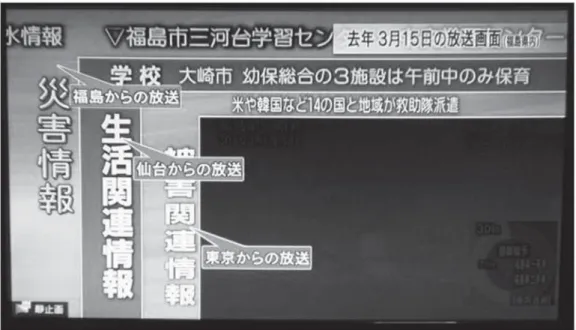
(10) 立命館言語文化研究 24 巻 4 号. Assessing reaction There is one question that almost instantly emerges in the mind of observers after a catastrophe: who is in charge? This question is tightly related, if not practically identical, to that of: who is responsible? Of course, observers are not the only ones to raise the question; the overwhelmed population also shares this preoccupation, but the nuance is different. Affected populations look for providers of needs that go beyond their capabilities. From the very first day after the earthquake, the local newspaper in Sendai, the Kahoku Shinpo, dedicated two full pages to offer details about where to get goods to satisfy both basic and special needs, as well as information on the pace of the recover y and volunteer activities. Local television stations adopted even three layers of news tickers̶see Figure 3̶where information on hospitals and many other issues were constantly updated. Local radio stations played a similar role. This kind of micro data about who can provide security close to those in need gradually fades away from media oriented to observers located outside the affected area, and finally are totally absent from international sources. This change is commercially understandable̶as two interviews with journalists from the Kahoku Shinpo and one conversation with one from the New York Times made clear̶but what kind of assessment replaces that of the detailed needs of population affected? I will suggest that distance allows questions of responsibility to take the place of needs assessments, the former closer to justice and the latter closer to security, and that such change can have deleterious effects on the evolution of the emergency.. Figure 3. Example of news tickers during the March 2011 emergency Source: NHK, from http://blog.goo.ne.jp/tvdx5/e/bc8e72c01c4e6a9baaa4175614bba383. − 96 −.
(11) Justice and Security through the Looking Glass of Catastrophe(GÓMEZ S.). Very early during the emergency, there was a rush to distinguish natural disasters from humanmade ones. But for experts on disaster management it is quite clear that this is a superfluous division: no matter from whom or from where the harm comes, the top priority is the lives of those affected. What this distinction introduces to the understanding of the situation are the questions of responsibility, negligence and blame. Negligence is closely related to justice-oriented demands for information, in as much as it tries to make clear failures to act upon knowledge of the causes of harm. In fact, that was one of the main lessons regarding prosecution after the Minamata disease, presented above, which resulted in an expansion of what was considered negligence.20) But once more, the conditions when harm has not taken place are rather different. Assessing reaction by focusing on responsibility and those responsible is counterproductive in at least three ways. First, it cements the view that officials are hiding information, affecting both the public and officials themselves. Distrustful public tend to pressure the system to implement unnecessarily strict measures̶the so-called Security Theater21)̶or even take it upon themselves to provide full security, which can result in panic or vigilantism. Self-protection is not a bad practice in itself but the higher the complexity of the threat at hand, the more prone are emerging provisions of security to result in harm. Observe that this can also be a self-fulfilling prophecy, since the emphasis on blame may also dissuade persons with relevant information from sharing it in reason of fears of later being held accountable, thus foreclosing the possibility of justice. Second, looking for the person in charge plays down the irrationality of the whole emergency situation. Catastrophes are hectic times during which decisions are taken under extreme pressures not only in terms of time and information constraints, but also they are emotionally overwhelming. So, for instance, taking inaction or silence for irresponsibility actually forces actors to undertake a micro-management of situations that normally is out of their range. It was criticized for some time in the first months after the beginning of the crisis how an order by Prime Minister Kan had gone unheard. The order in question was to stop pumping seawater into the nuclear reactors because corrosion could further compromise the stabilization. The boss of the plant did not consider that reasonable given the situation and did not follow the order, but neither let the Prime Minister know he was not going to do it. It was later understood that to keep the water flowing was the appropriate decision, still the focus of the public was on the failure of risk management, rather than the effects of pressuring the person in charge to take action. This example also highlights the third problem with the responsibility question: it entrenches the myth of a centralized response. Our cities and most of the systems that support modern life do not respond to one control center. In fact, disaster researchers use the categor y of catastrophe to describe those events in which numerous organizations play a role that nobody coordinates.22) At the peak of the emergency, neighbors helped neighbors, companies struggled to supply food to − 97 −.
(12) 立命館言語文化研究 24 巻 4 号. their own employees, and organizations used their network of contacts to protect their members as well as the people around them. Even if we concentrate only on the government, the Self Defense Forces, police and firefighters deployed an enormous number of operatives, local governments worked without rest, roads were quickly reopened, and so on. During a catastrophe nobody and everybody is in charge. Fears over radiation also signal in this direction. As soon as the first week after March 11 Tohoku University was already measuring radiation in Sendai and some parts in the south of Miyagi.23) Universities and other organizations have the means and skills to help regain the trust necessary to concentrate efforts on the people who actually are in the greatest danger. Asking who is in charge? can prevent them from doing so.. Resetting standards As soon as the circumstances allow it, the long quest for restoration and revival starts. Catastrophe severs so many bonds, destroys so much that the list of tasks seems to never end. And, unfortunately, no matter how much effort is put on it, society as a whole can only attend a limited number of issues at the same time. Thus, the most attractive issues would remain for long in the eye of the beholder; committed actors would under take other issues silently, while an indeterminate number of issues might remain unaddressed. The balance between justice and security visions of this revival process plays a fundamental role defining the upcoming priorities. No matter how catastrophic Fukushima s nuclear accident actually is, for moments it seemed as if radiation were the only disaster. Very early, people displaced by the tsunami already suspected that their concerns were going to be left to the background while the public worried about the nuclear plants. There are many, many issues pending, such as the relocation of communities, dealing with rubble, deciding how much should be invested on tsunami protection infrastructure, the best way to disseminate information, how to avoid panic over food and fuel supply, the resource allocation process, to mention but a few. A single sighted perspective would bias the prioritization of these issues. Indeed, it is not only about setting priorities. The dynamic interaction of the justice and security visions dealing with each of the emerging tasks is necessary for at least another two reasons. One is that the pursuit of justice is a necessary input to the redefinition of what prudence mean for society,24) and therefore makes explicit the limits of the security approach. By highlighting the needs and sufferings of the most vulnerable, the quest for the truth behind the justice approach can correct the tendency of security-oriented assessments that aim at strict maximization. For instance, it has been remarked that the best strategy for people to survive a tsunami is to try to protect themselves first̶in Japanese tsunami tendenko. The logic behind this rule of thumb is that during − 98 −.
(13) Justice and Security through the Looking Glass of Catastrophe(GÓMEZ S.). a tsunami emergency, helping others may result in more lives lost than necessary. However, in the case of March 11 around 60% of the fatalities were over 60 years old, an important share of which might have needed support to escape. A solution that balances justice and security is urgently needed. The other reason is that the balance between justice and security helps promoting the plurality of values required when envisioning the future post-reconstruction. A security outlook of the future can be dark and obsessed with threats, which is not by any means the full picture of human nature. Justice is a necessary process to overcome bereavement and move from a backward-looking view to one in which a future of reconciliation with life is possible. Other values and virtues may become relevant as well.25)The priority while resetting standards should always be based on agency, that is, should be people-centered.. Closing remarks: Security and Justice in need to contain modern catastrophe Through this paper I advanced in an exploration of the interface between pursuits of security and justice using for contrast some of the situations triggered by the March 11, 2011 Great East Japan Earthquake. Based on the Circumstances of Justice embraced by Rawls in his Theory of Justice, I suggested a heuristic to explore the borders and overlaps of this interface, namely in terms of a tension between the pursuit for survival and the pursuit for the right thing to do. Such a tension was evident on at least three situations: demanding information, assessing reaction and resetting standards. One interesting element common to the situations is the role of temporality. When harm has not yet happened, it seems more pressing to know, so we can avoid harm, but emergency respondents need time to come with better answers. Contrastingly, resetting standards can be gloomy if they are restricted to thinking in terms of emergency, and thus justice emerges as a way to move from fear to a broader horizon of values. Therefore, it may be worth exploring in the future how the border between security and justice varies with the time perspective of the observer, instead of considering it a static division. The concept of responsibility also emerged as problematic, mainly when seen from the temporality of the rationalization of catastrophe. While negligence is a serious concern regarding the way emergencies are dealt with, they can affect the willingness of possible security providers to attempt protecting people. In other words, the pursuit for justice can result in more harm than necessary. For instance, the tsunami alert system during 3.11 told the people the height in meters of the expected wave. Unfortunately this information was inaccurate, but it has been disputed whether accuracy would have been better. Informing the exact height of the wave transfers completely the − 99 −.
(14) 立命館言語文化研究 24 巻 4 号. decision about how to react to people, who might not be in the best position to do so during the emergency. The strategy of informing the expected height of the wave can be motivated by uncer tainty, but through it exper ts and security providers also avoid responsibility for the consequences of reaction̶which even when the threat does not materialize also harms people. High demands for responsibility, associated with justice, can thus result in less protection. In sum, there is a necessity to recover a security space , the dystopian scenario proposed by Hume, in which that dreadful world can be studied in order to decide plans against contingency. Space is a useful wording, likening it to the so-called humanitarian space , or the conditions in which humanitarian relief is possible.26) The humanitarian space implies, for example, that in the middle of conflict the possibility of neutrality has to exist, so providers can enter the area without being attacked. Thus, it brings along the idea of exceptionality, which allows action under harsh situations. Similarly, the security space is needed to think of evolving catastrophes without responsibility forbidding action̶although probably security time would be a more accurate description. The opening of this security space or time for trans-disciplinary study should not be mistaken for a step backwards on the precious pursuit for justice. As it was mentioned in the opening, modernity seems to bring along catastrophe with a degree of complexity that defies the monopoly of the justice mind-frame. The study of security can help deal better with emerging crises so harm, and thus the time outside the circumstances of justice, is minimized. Perhaps as important, the understanding security should also ser ve to counter a tendency to instrumentalize the possibility of crisis as a shortcut to advance particular agendas.27)Experts refer to catastrophe in order draw attention and persuade the reader of the urgency of whatever they are claiming. Indeed, enlarging the conception of catastrophe can later betray our good intentions because catastrophe is actually used to avoid what justice holds most dear. In late April 2011 it was known that the law governing compensation for nuclear accidents contains a provision exempting plant operators from liability for damages of accidents caused by an extremely large-scale act of god.. 28). In other contexts, catastrophe is being used to restrict the access to important information. or to initiate preventive wars. Tackling catastrophe from inside and outside, security and justice are complementary visions that humans would need to live and prosper in the centuries to come.. Notes 1)Postdoctoral fellow, Japan Society for the Promotion of Science, and Visiting Scholar at the Graduate School of Global Studies, Doshisha University. This work was supported by JSPS KAKENHI Grant Number 34310. A short version of this paper was presented at the 8th International Conference Catastrophe and Justice , Graduate School of Core Ethics and Frontier Sciences, Ritsumeikan University, Kyoto, Japan, March 21-22, 2012. I learned much from all the presenters and discussants during those two days, to all of − 100 −.
(15) Justice and Security through the Looking Glass of Catastrophe(GÓMEZ S.) whom I am very thankful. The final drafts were greatly improved thanks to the comments from Professor Paul Dumouchel, one of the organizers of the conference. The usual disclaimer applies. 2)World Bank and United Nations, Natural Hazards, Unnatural Disasters: The Economics of Ef fective Prevention (Washington: World Bank, 2010), p. 2. 3)M.A. Max-Neef, Foundations of transdisciplinarity , Ecological Economics 53 (2005), pp. 5–16. 4)D.A. Baldwin, The Concept of Security , Review of International Studies 23 (1997), pp. 5–26. 5)J.B. Michel, Y.K. Shen, A.P. Aiden, A. Veres, M.K. Gray, W. Brockman, The Google Books Team, J.P. Pickett, D. Hoiberg, D. Clancy, P. Norvig, J. Orwant, S. Pinker, M.A. Nowak, and E.L. Aiden, Quantitative Analysis of Culture Using Millions of Digitized Books , Science, 331: 6014 (2011), pp. 176–182. 6)E. Rothschild, What is security? , Deadalus 124:3 (Summer, 1995), pp. 53–98. 7)B. Buzan, People, States & Fear: The National Security Problem in International Relations (Revised Second Edition, Boulder: Lynne Reinner Publishers, 1991) 8)From the viewpoint of criminology, L. Zedner, Security (Oxon: Routledge, 2009) has suggested that security is a relational concept, umbrella to many actors and practices that may not be possible to hold a single identity or be studied by a single discipline. 9)J. Rawls, A Theory of Justice (Revised Edition, Cambridge: Belknap Harvard, 1971, 1999), pp. 109–112. 10)D. Hume, An Enquiry Concerning the Principles of Morals (EBook #4230: Gutenberg Project, 1777, 1912, 2010). 11)M.J. Sandel, Justice: What s the right thing to do (New York: Farrar, Straus and Giroux). 12)M. Nussbaum, Frontiers of Justice: Disability, Nationality, Species Membership (Cambridge: Belknap Harvard). 13)Ibidem, p. 86. 14)Sandel, Justice, pp. 31–33. 15)The World Bank, The Sendai Report: Managing Disaster Risks for a Resilient Future (Washington: World Bank, 2012). 16)O.A. Gómez S., Panic over food supply after an urban ear thquake: March 11 s experience Joint Symposium on Human Security in Disasters: Tohoku University & United Nations University (UNU-EHS), Tohoku University, February 1st 2011. 17)T. Imamura, H. Ide and Yasunaga, H., History of Public Health Crises in Japan , Journal of Public Health Policy 2:8 (2007), pp. 221–237. 18)The most complete account of this tragedy is T. George, Minamata: Pollution and the Struggle for Democracy in Postwar Japan (Cambridge: Harvard University Press, 2001). 19)Independent Investigation Commission on the Fukushima Daiichi Nuclear Accident, Report of survey and inspection (Tokyo: Discover, 2012). 20)M.A. McKean, Environmental protest and citizen politics in Japan (Berkeley: University of California Press, 1981). 21)B. Schneier, Beyond fear: Thinking sensibly about security in an uncertain world (New York: Springer, 2006). 22)E. L. Quarantelli, Organizational response to the Mexico City earthquake of 1985: Characteristics and implications , Natural Hazards 8:1 (1993), pp. 19–38. 23)Measurements have been reported daily and are all available from March 18, 2011 at http://www.bureau. tohoku.ac.jp/anzen/monitoring/ (accessed November 15, 2012). 24)A philosophical discussion on the interface between prudence, justice and other virtues can be found in D. N. McCloskey, The Bourgeois Virtues: Ethics for an age of commerce (Chicago: The University of Chicago − 101 −.
(16) 立命館言語文化研究 24 巻 4 号 Press, 2006). 25)In team with a colleague, we have written in this respect in: P.V.Q. Sousa and O.A. Gómez, Human security in the aftermath of March 11th tsunami: different levels of empowerment in provisional shelters in coastal Miyagi , Journal of Human Security Studies 1:2 (2012), pp. 109-123.. 26)J. Lonergan, Shrinking Humanitarian Space? Trends and Prospects on Security and Access , The Journal of Humanitarian Assistance (2010, available at: http://sites.tufts.edu/jha/archives/863, accessed November 20, 2012). 27)D. Gardner, Risk: The Science and Politics of Fear (London: Virgin Books, 2008). 28)Asahi Shinbun, Kan: TEPCO must pay compensation , Asahi Shinbun, (April 30th, 2011, http://ajw.asahi. com/article/0311disaster/fukushima/AJ201104304520, accessed November 20, 2012).. − 102 −.
(17)
図
関連したドキュメント
An easy-to-use procedure is presented for improving the ε-constraint method for computing the efficient frontier of the portfolio selection problem endowed with additional cardinality
Keywords: Convex order ; Fréchet distribution ; Median ; Mittag-Leffler distribution ; Mittag- Leffler function ; Stable distribution ; Stochastic order.. AMS MSC 2010: Primary 60E05
It is suggested by our method that most of the quadratic algebras for all St¨ ackel equivalence classes of 3D second order quantum superintegrable systems on conformally flat
Keywords: continuous time random walk, Brownian motion, collision time, skew Young tableaux, tandem queue.. AMS 2000 Subject Classification: Primary:
Inside this class, we identify a new subclass of Liouvillian integrable systems, under suitable conditions such Liouvillian integrable systems can have at most one limit cycle, and
Applications of msets in Logic Programming languages is found to over- come “computational inefficiency” inherent in otherwise situation, especially in solving a sweep of
Our method of proof can also be used to recover the rational homotopy of L K(2) S 0 as well as the chromatic splitting conjecture at primes p > 3 [16]; we only need to use the
Shi, “The essential norm of a composition operator on the Bloch space in polydiscs,” Chinese Journal of Contemporary Mathematics, vol. Chen, “Weighted composition operators from Fp,
